
Somebody picks up a prescription for Flagyl on a Tuesday, reads the leaflet in the parking lot, sees “peripheral neuropathy” in the side effect list, and by midnight they are on this site wondering whether they have just been handed nerve damage in a paper bag.
If that is roughly where you are, here is the answer before anything else, because you should not have to read fifteen paragraphs to get it.
For a standard short course of metronidazole, the risk of peripheral neuropathy is very low. The risk lives almost entirely in long courses, and “long” here means beyond about four weeks or beyond a total of roughly 42 grams. A typical week to ten days of treatment lands nowhere near that. And even when neuropathy does occur, it is usually reversible when the drug is stopped early.
Now, if you are the other reader — the one who has been on metronidazole for months for Crohn's disease or a bone infection or chronic pouchitis, and whose feet have started tingling — this article is really for you, and the rest of it is written with you in mind. There is a real thing to pay attention to here, and paying attention early is what determines how this goes.
I am a patient advocate rather than a doctor, and I want to be clear about one thing from the start: nothing here is a reason to stop a prescribed antibiotic on your own. Untreated infection is a much bigger problem than a reversible neuropathy. What I am arguing for is prompt reporting, not unilateral quitting.
The Short Answer for Most People Taking Flagyl
Metronidazole is one of the most widely prescribed antibiotics in the world. It handles anaerobic bacteria and certain parasites, making it the go-to for bacterial vaginosis, trichomoniasis, dental infections, diverticulitis, some intra-abdominal infections, and certain C. difficile situations. The vast majority of those prescriptions are short: seven days, ten days, sometimes a single large dose.
Take it as prescribed, finish it, and do not spend the week monitoring your toes.
Peripheral neuropathy from metronidazole is described as extremely uncommon with short-term use. The side effect appears on the leaflet because leaflets list what has ever been reported, not what is likely to happen to you. In your situation, the infection is the actual risk.
Peripheral neuropathy from metronidazole is described in the literature as extremely uncommon with short-term use, meaning four weeks or less. The side effect appears on the leaflet because leaflets list what has ever been reported, not what is likely to happen to you. It sits on the same page as effects occurring in a fraction of a percent of people.
So if you are holding a ten-day script, the honest reading is: take it as prescribed, finish it, and do not spend the week monitoring your toes. The infection you are treating is the actual risk in that scenario.
What follows is for the other situation.
How Much Metronidazole Is Too Much
This is the part that makes the whole picture click, and it is the reason I think this article can be genuinely useful rather than just anxiety-generating.
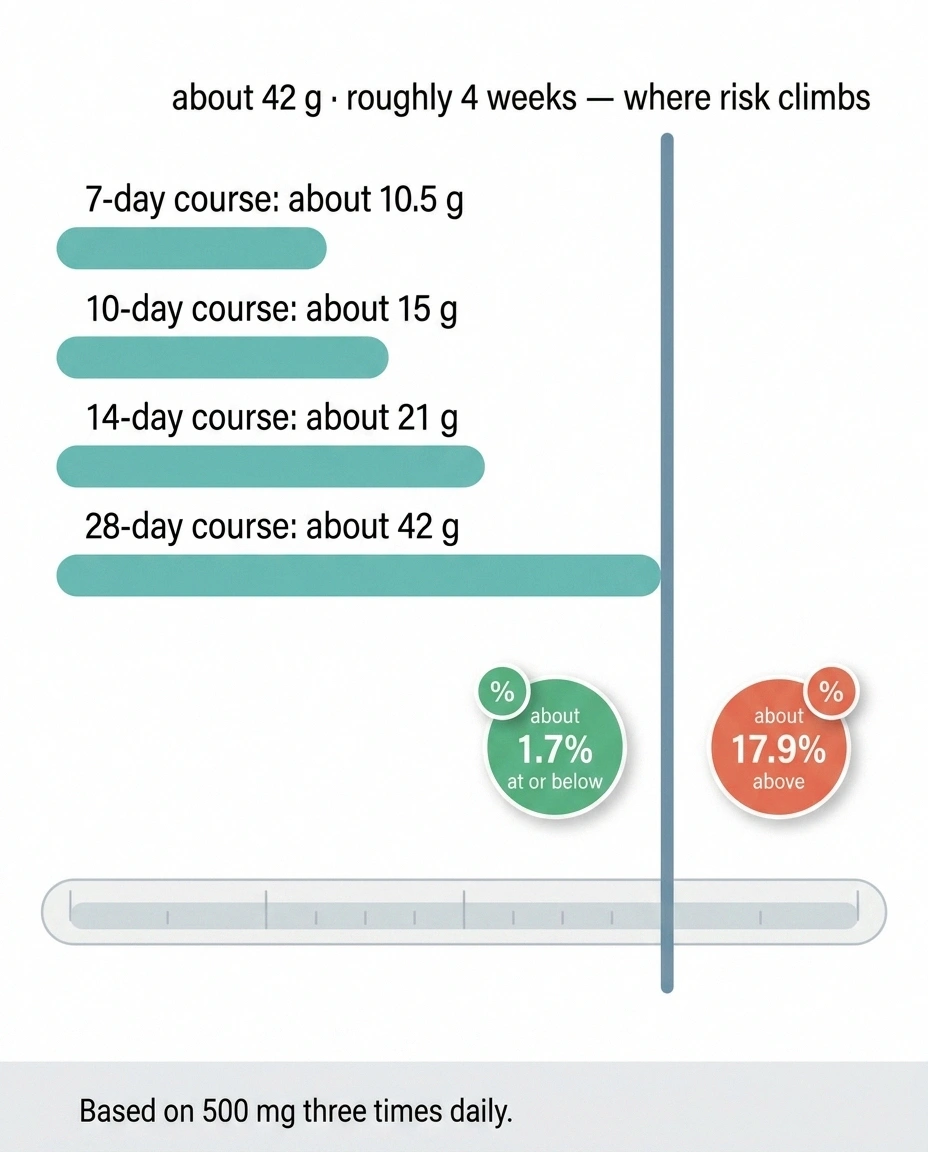
1.7%
Incidence at 42 g or less, or four weeks or less
17.9%
Incidence above 42 g, or beyond four weeks
The arithmetic, at 500 mg three times daily — 1.5 g per day
- 7 days → about 10.5 g
- 10 days → about 15 g
- 14 days → about 21 g
- 28 days → about 42 g — the threshold
Population-level figures, not a personal limit to police. If you are on a long course, ask what your expected total will be rather than counting grams yourself.
The duration and the total cumulative dose are the primary determinants of whether someone develops metronidazole neuropathy. The literature has a reasonably clear inflection point around 42 grams total, or about four weeks of therapy.
The numbers on either side of that line are strikingly different. In the systematic review data, people receiving more than 42 grams total or more than four weeks of therapy had an incidence of peripheral neuropathy around 17.9 percent. People receiving 42 grams or less had an incidence around 1.7 percent.
That is roughly a tenfold difference, and it is why the same drug can be genuinely low-risk for one person and genuinely worth watching for another.
Now here is the arithmetic that turns those figures into something you can actually use. A very common metronidazole regimen is 500 mg three times a day, which is 1.5 grams per day. At that dose:
A 7-day course is about 10.5 grams. A 10-day course is about 15 grams. A 14-day course is about 21 grams. Reaching 42 grams takes roughly 28 days at that dose.
So the standard courses that most people are prescribed land at a quarter to half of the threshold where risk begins to climb. That is the arithmetic behind the reassurance at the top of this page, and I would rather show you the math than ask you to trust me.
One caution about using these numbers. They are population-level signals meant to inform a conversation, not a personal limit for you to police. Doses vary, regimens vary, and your prescriber is weighing an infection against a side effect profile with information you do not have. If you are on a long course, the useful move is to ask what your expected total will be, not to start counting grams and negotiating.
Who Actually Ends Up on Long Courses
Almost nobody takes metronidazole for months by accident. The long courses cluster in a handful of situations, and if none of these describe you, the risk conversation is largely academic.
Four separate two-week courses over a year is still 42 grams.
Repeated short courses are how people reach a high cumulative total without ever feeling like they were on a long course — and it will not be obvious from a quick glance at your chart. If you have had several rounds, say so explicitly. It is the kind of detail that only you are positioned to supply.
Crohn's disease, particularly perianal fistulizing disease. Chronic or recurrent pouchitis after ileal pouch surgery, where repeated antibiotic cycling is common. Bone and joint infections requiring prolonged anaerobic coverage. Brain abscess and other deep-seated infections. Certain recurrent intra-abdominal or pelvic infections. And repeated courses for recurrent C. difficile, where the total across several rounds can quietly add up even though no single course is long.
That last one deserves emphasis, because it is how people reach a high cumulative dose without ever feeling like they were on a long course. If you have had repeated rounds, mention it explicitly — it may not be obvious from a quick glance at your chart.
What Metronidazole Neuropathy Feels Like

The presentation is predominantly sensory, and it follows the pattern our readers will recognize from other causes.
It starts in the feet, usually both at once, and it is symmetric. Numbness, tingling, pins and needles. Some people describe burning, in the same family as the sensations we cover in our article on burning feet syndrome. Hands may follow later. Some people notice a reduction in the ability to feel textures clearly, or a sense that their feet are wrapped in something.
Motor involvement — actual weakness — is less common, and when it appears it tends to be in more advanced cases.
Nerve conduction studies, when they are done, typically show an axonal pattern, meaning the nerve fibers themselves are affected rather than their insulation.
The tricky part is that none of this is distinctive. Numb, tingling feet is one of the most common symptom presentations in medicine, and it has a long list of causes. Diabetes, B12 deficiency, thyroid problems, alcohol, and a great many other medications all produce a similar picture, which is why our page on medications that can cause neuropathy is as long as it is.
What makes metronidazole a plausible suspect is not the symptom. It is the timing and the cumulative dose. New symmetric sensory symptoms appearing during an extended course, in someone who did not have them before it started, is a pattern worth flagging.
How Fast It Comes On
The onset is usually gradual and it typically appears well into therapy rather than in the first days.
In the case literature, symptoms commonly emerge somewhere in the range of weeks to a few months into treatment, tracking with accumulating dose. That is consistent with the mechanism, which appears to be a cumulative toxic effect rather than an allergic-type reaction.
This has one useful practical implication. If you started metronidazole two days ago and your feet feel strange today, metronidazole is an unlikely explanation, and something else deserves the attention — including, quite often, anxiety, which produces genuine physical sensations and is extremely common in someone who has just read a medication leaflet. That is not a dismissal. Anxiety-driven paresthesia is real, physically felt, and worth naming rather than pretending away.
Conversely, if you are six weeks into a course and something has been slowly building, the timing fits and the report is worth making today.
The Brain Side: Metronidazole Encephalopathy
There is a second, separate neurological effect of metronidazole that deserves its own section, because the symptoms are different and the urgency is different.
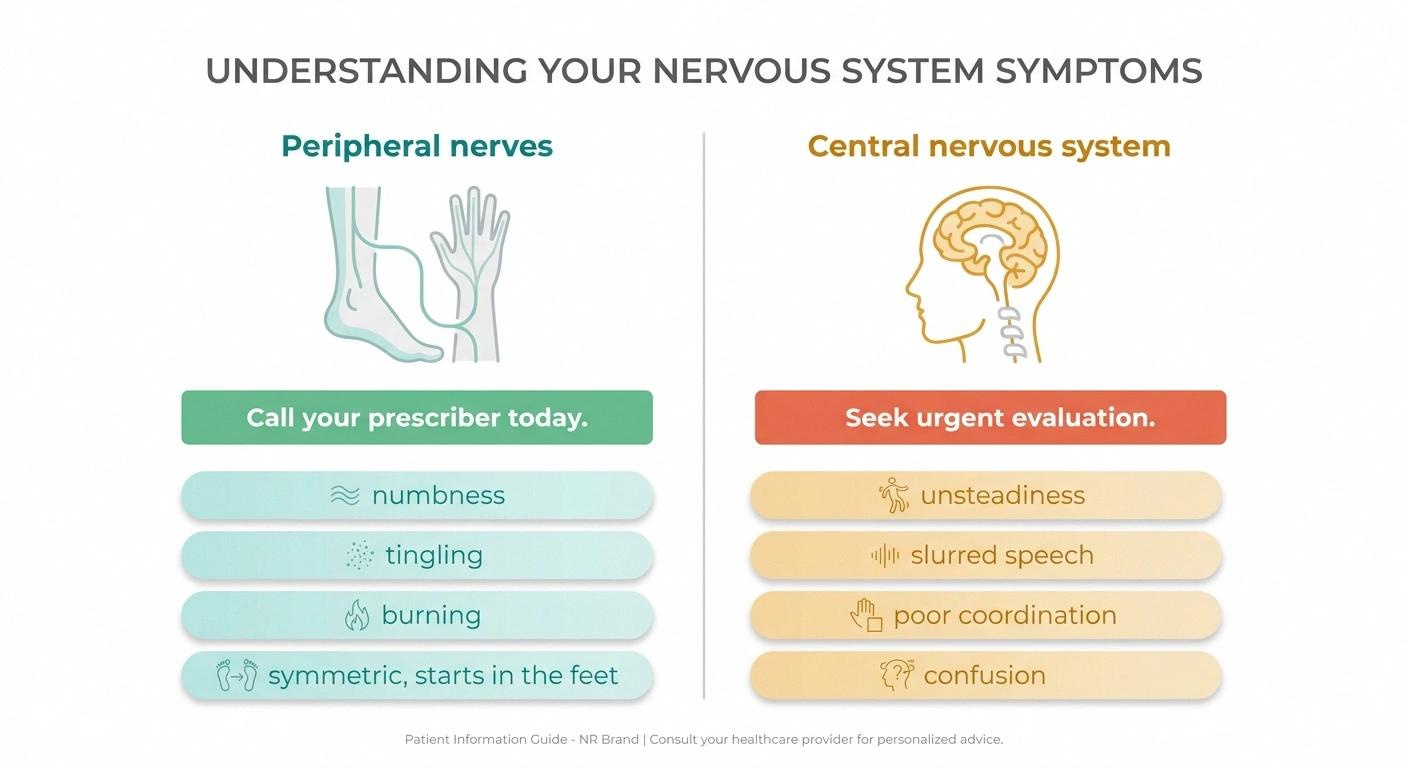
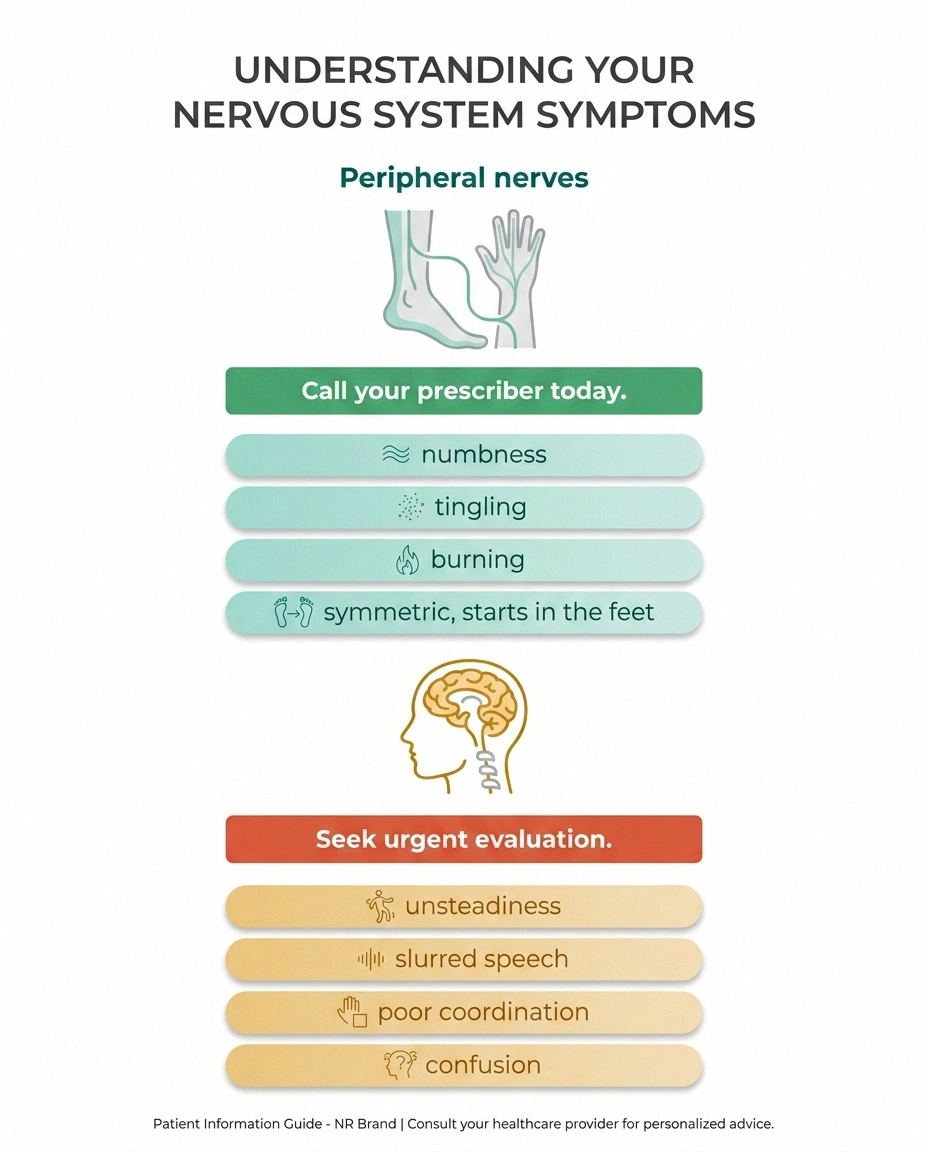
Peripheral nerves
Numbness, tingling, or burning — symmetric, starting in the feet.
Call your prescriber today.
Central nervous system
New unsteadiness, slurred speech, clumsy coordination, or confusion.
Seek urgent evaluation, not a message with the office.
If you cannot tell which one you are experiencing, that is itself a reason to be evaluated rather than to wait and see.
Metronidazole-induced encephalopathy is a central nervous system effect rather than a peripheral nerve effect. It classically produces cerebellar signs: unsteadiness and incoordination that is different in character from sensory imbalance, slurred or scanning speech, and clumsy limb movements. Confusion and altered mental state can occur. On MRI it produces a fairly characteristic pattern of changes, often involving the dentate nuclei of the cerebellum, and in some reported cases changes confined to the corpus callosum.
Like the peripheral neuropathy, it is usually reversible when the drug is withdrawn, and the two can occur together in the same person.
The reason it belongs in this article is that the two conditions need very different responses. Sensory changes in the feet warrant a prompt call to the prescriber. New unsteadiness, slurred speech, or confusion warrants urgent medical evaluation, not a message left with the office.
If you cannot tell which one you are experiencing, that itself is a reason to be evaluated rather than to wait and see. Balance trouble caused by numb feet and balance trouble caused by the cerebellum feel different to a neurologist, but they can be genuinely hard to distinguish from the inside.
Why the Nerve Damage Happens
The mechanism is not fully settled, and I would rather say that plainly than dress up a hypothesis as established fact.
Leading explanations involve metronidazole's metabolites binding to components of nerve cells and interfering with their function, along with oxidative stress damaging the axon. There is also longstanding interest in a thiamine-related pathway, given some resemblance to the picture in thiamine deficiency, though that remains discussion rather than conclusion.
What is well established is the shape of the relationship rather than the machinery: risk rises with cumulative exposure, and removing the drug usually allows recovery. Those two facts drive management, and they hold regardless of which mechanistic account eventually wins.
I mention it because you may encounter confident claims that a particular supplement addresses the underlying mechanism. The mechanism is not settled enough for anyone to make that claim honestly.
Risk Factors That Raise Your Odds

Several factors show up repeatedly in the case series and reviews as raising risk beyond the dose and duration:
Liver dysfunction. Metronidazole is metabolized by the liver, so impaired liver function means the drug and its metabolites clear more slowly and accumulate more.
Kidney dysfunction. Similarly affects clearance of metabolites.
Alcohol use. Relevant twice over — as a factor in this context and as an independent cause of nerve damage in its own right, which we cover in alcoholic neuropathy.
Malnutrition and metabolic derangement. Including the nutritional deficiencies that often accompany the very conditions requiring long antibiotic courses.
Prior adverse neurological reaction to metronidazole. This one matters enough that it gets its own section further down.
There is a compounding problem hiding in this list. The people most likely to need long metronidazole courses — those with Crohn's disease, pouchitis, or chronic intra-abdominal infection — are also people at elevated risk for nutritional deficiency, particularly B12. So a person on long-term metronidazole with new numb feet may have a drug effect, a vitamin deficiency, or both at once. This is exactly why the workup should include checking the correctable causes rather than stopping at the obvious suspect.
What to Watch For While You're On It
If you are on an extended course, low-effort monitoring beats anxious hypervigilance. A few specific things, checked occasionally rather than constantly:
New tingling, numbness, or pins and needles in the toes or fingers that was not there before treatment started. Any change in how the floor feels underfoot. New unsteadiness, especially in the dark or the shower. A change in your ability to feel textures or manage small objects. And separately, any slurred speech, coordination difficulty, or confusion.
One suggestion that costs nothing: note the date you started, and if anything sensory begins, note that date too. “It started around week five” is far more useful than “it's been going on a while,” and the difference between those two sentences can determine whether the drug gets suspected at all.
What I would not suggest is daily foot testing or a symptom app. Extended antibiotic courses happen because something serious is being treated, and that is already enough to carry.
What to Do If Symptoms Start
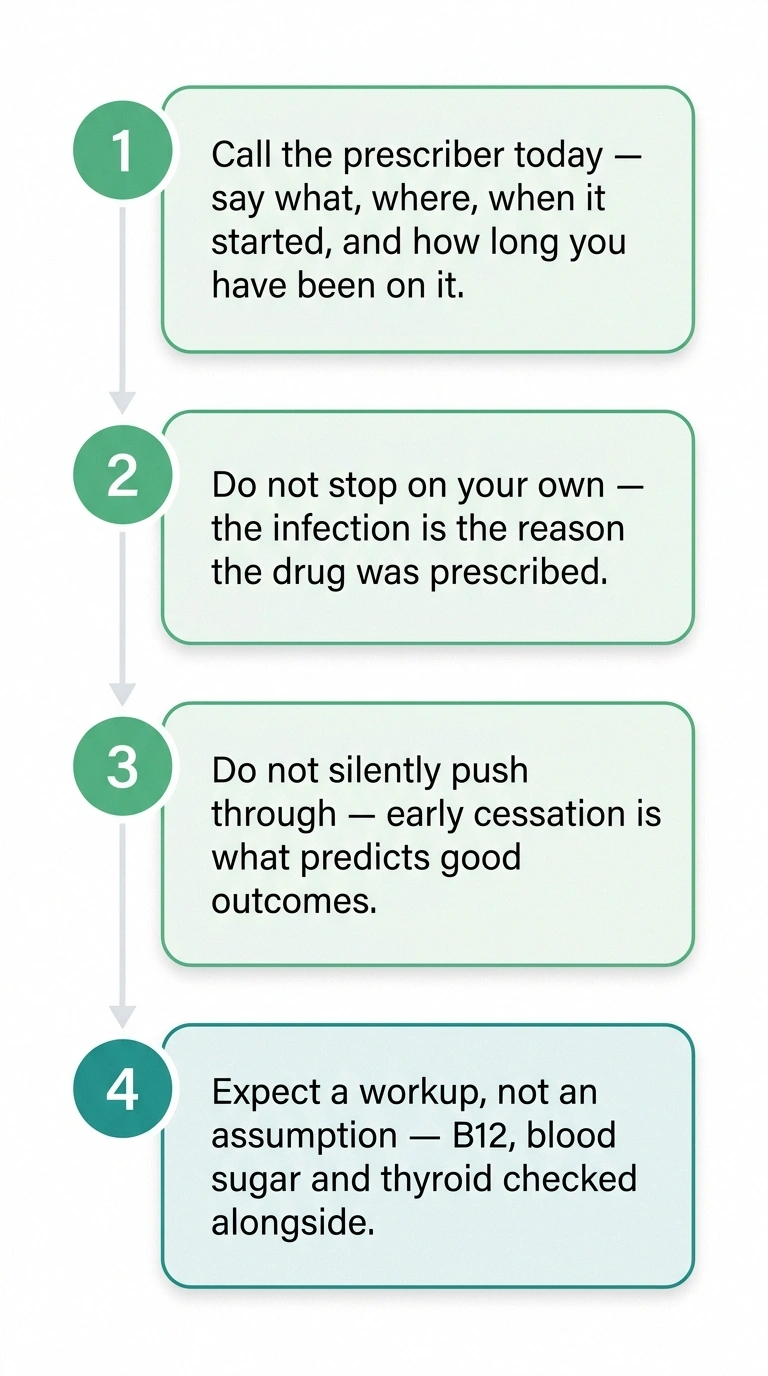
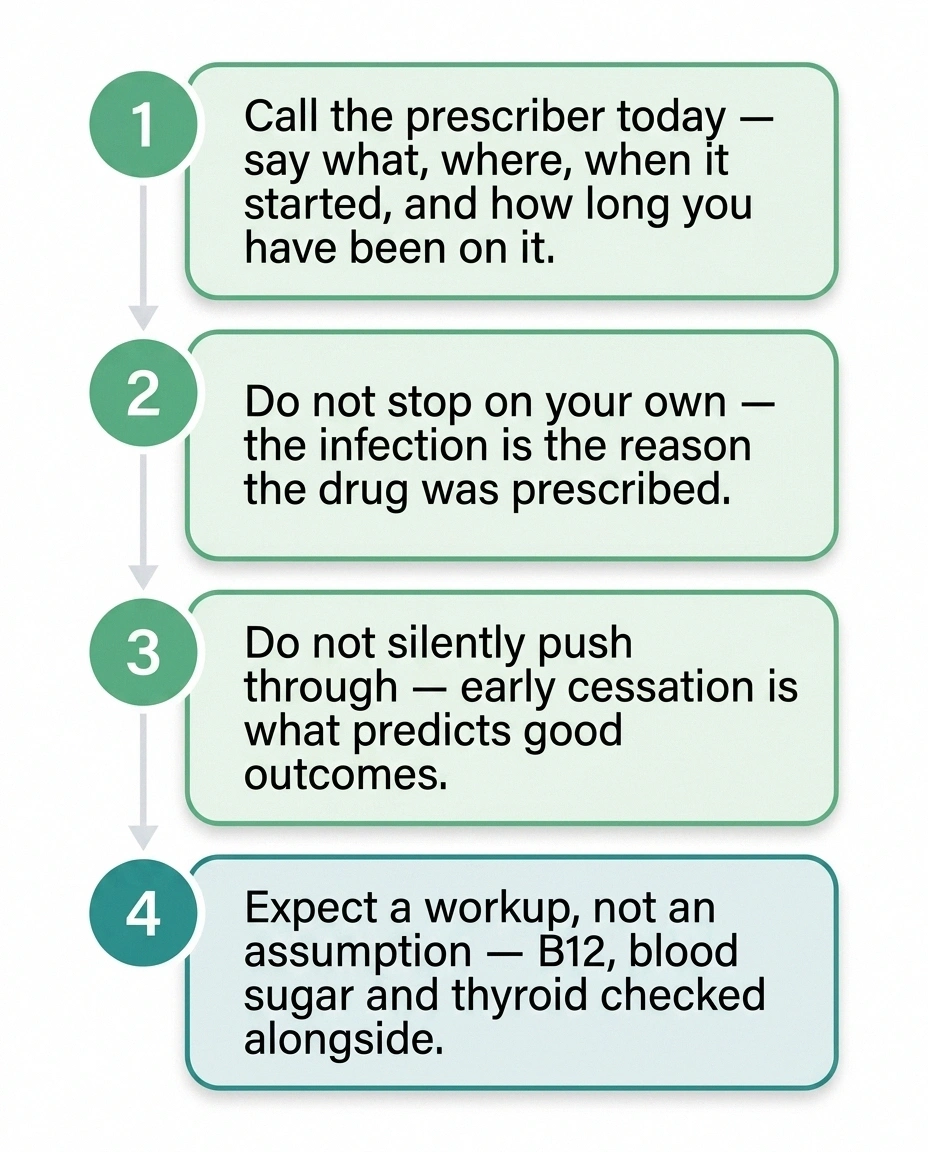
Here is the whole of it, in order.
Call the prescriber today. Say what the symptom is, where it is, when it started, and how long you have been on metronidazole. That last piece is the one people leave out, and it is the one that triggers recognition.
Do not stop on your own. Some conditions requiring long metronidazole courses are genuinely dangerous if undertreated. Stopping, switching, or continuing is the prescriber's call — your job is to make sure they have the information.
Equally, do not silently push through. The people who do worst in this literature are the ones who continued for months with symptoms they never mentioned. Politeness is genuinely costly here.
Expect a workup, not an assumption. A good response checks the other correctable causes at the same time — B12, blood sugar, thyroid. Finding a coexisting deficiency is common in this population and treating it is straightforward.
Call your prescriber. Today, not at the next scheduled visit. Say specifically: what the symptom is, where it is, when it started, and how long you have been on metronidazole. That last piece is the one people leave out and it is the one that triggers recognition.
Do not stop the medication on your own. This is the part I want to be most emphatic about. The infection being treated is the reason the drug was prescribed, and some of the conditions requiring long metronidazole courses are genuinely dangerous if undertreated. The decision to stop, switch, or continue belongs to the prescriber, who can weigh both risks together. Your job is to make sure they have the information.
Equally, do not silently push through. The single most consistent finding in this literature is that early identification and prompt cessation lead to good outcomes. The people who do worst are the ones who kept going for months with symptoms they never mentioned. Politeness is genuinely costly here.
Expect a workup rather than an assumption. A good response is not simply to blame the drug. It is to check the other correctable causes at the same time — blood sugar, B12, thyroid, and anything else your history suggests. Our guide to neuropathy diagnosis covers what those tests look for. Finding a coexisting B12 deficiency is common in this population and treating it is straightforward.
How Reversible Is It, Really?
Good, but not universal, and I want to give you the honest version of both halves.
The favorable half: early identification followed by cessation commonly leads to full reversibility with no long-term complications, and in followed-up patients the large majority showed resolution or improvement.
The honest half: roughly one in ten had symptoms that continued beyond stopping or reducing the drug. That is not a trivial fraction.
Reversibility appears better the earlier the drug is stopped and the lower the cumulative exposure. That relationship — earlier off, better outcome — is the entire practical reason to report symptoms today rather than wait to see whether they settle.
The favorable side: early identification followed by cessation of therapy commonly leads to full reversibility with no long-term complications. In followed-up patients, resolution or improvement was evident in the large majority.
The honest side: roughly 10 percent of patients in that follow-up data had symptoms that continued beyond stopping or reducing the drug. That is not a trivial fraction, and it is the number that argues for reporting early rather than waiting to see whether it settles.
Reversibility is not guaranteed, and it appears to be better the earlier the drug is stopped and the less cumulative exposure occurred. That relationship — earlier off, better outcome — is the practical reason this article exists.
The Recovery Timeline

Nerve recovery is slow, and expectations set correctly prevent a lot of unnecessary despair.
After the drug is stopped, improvement typically unfolds over weeks to months rather than days. Some people notice a plateau or even slight worsening in the first stretch before improvement begins, which is unsettling but not necessarily a bad sign given how slowly nerve tissue responds to anything.
Sensory symptoms often improve before any objective testing catches up, and some people are left with mild residual numbness in the toes even after a good overall recovery.
Things that support recovery in the meantime are unglamorous and worth doing anyway: correcting any nutritional deficiency that testing turned up, addressing alcohol intake, managing blood sugar if that is part of your picture, and protecting feet that are not reporting sensation reliably. Our foot care guide covers the daily routine, which matters more than usual while sensation is impaired.
If you want a broader frame for where you are in the arc, our overview of the stages of neuropathy is a reasonable orientation, with the caveat that a drug-induced neuropathy that is caught and stopped follows a much more favorable course than a progressive one.
Alternatives Your Doctor May Consider
I am not going to recommend a different antibiotic, because that is genuinely not something an article can do responsibly. Antibiotic choice depends on the organism, the site, local resistance patterns, allergies, other medications, and a dozen things that live in your chart.
What I can tell you is that for most indications where long metronidazole courses are used, alternatives exist, and prescribers are generally aware of the neuropathy risk with extended therapy. Depending on the situation, that might mean a different agent with anaerobic coverage, a shorter course paired with a different strategy, cycling between agents, or a change in overall approach that reduces the need for prolonged antibiotics at all.
The useful question is not “can I take something else?” but “given how long I have been on this and these symptoms, is there an alternative that would work for my situation?” That version invites the actual clinical reasoning rather than a yes or no.
Metronidazole and Alcohol

This is the other thing everyone wants to know about metronidazole, and it is related enough to belong here.
Everyone knows about the flushing-and-nausea reaction between metronidazole and alcohol. Fewer people know the second reason it matters on a long course: alcohol is itself a well-established cause of peripheral neuropathy, and it appears as a risk factor for metronidazole neuropathy specifically.
On extended therapy you would be stacking two nerve-damaging exposures on top of one another. If cutting back is genuinely difficult, raise it with your prescriber directly rather than working around it — it is a common conversation and it changes the risk calculation.
Metronidazole can cause a disulfiram-like reaction with alcohol, producing flushing, nausea, vomiting, headache, and palpitations. The strength of the evidence has been debated in recent years, but the standard advice remains to avoid alcohol during treatment and for a period afterward, and there is no good reason to test it personally.
For this article, though, there is a second and more relevant reason to avoid it on a long course: alcohol is itself a well-established cause of peripheral neuropathy, and it appears as a risk factor for metronidazole neuropathy specifically. On extended therapy you are stacking two nerve-damaging exposures, and one of them is optional.
If cutting back is difficult, raise it with your prescriber directly rather than working around it. It is a common conversation and it genuinely affects the risk calculation.
If You've Had It Before: The Re-Exposure Question

Prior adverse neurological reaction to metronidazole shows up in the literature as a risk factor for recurrence, and it is the single most important thing in this article to actually act on.
Gets recorded as nothing
“I had a reaction to an antibiotic once.”
Gets recorded properly
“I developed peripheral neuropathy on long-term metronidazole in 2023.”
Metronidazole gets prescribed by dentists, urgent care clinicians, gynecologists, surgeons, and emergency physicians — most of whom have never met you, and none of whom will discover this from a five-minute chart review. Re-exposure is not automatically forbidden. It is a judgment your prescriber can only make correctly if they know.
If you have previously developed neuropathy, unsteadiness, or any other neurological problem on metronidazole, that fact needs to be in your chart, on your allergy and adverse reaction list, and out of your mouth every time a new prescriber considers an antibiotic. Metronidazole is prescribed by dentists, urgent care clinicians, gynecologists, surgeons, and emergency physicians, most of whom have never met you and none of whom will discover this from a five-minute chart review.
Say the whole thing: “I developed peripheral neuropathy on long-term metronidazole in 2023.” Not “I had a reaction to an antibiotic once,” which reliably gets recorded as nothing useful.
Re-exposure is not automatically forbidden, and there are situations where metronidazole is genuinely the right drug and a short course is an acceptable risk. That is a judgment your prescriber makes — but only if they know.
And if you are the reader who came here from a parking lot with a ten-day prescription: go take it. The math is on your side, the infection is the real problem, and you can close this tab.
Frequently Asked Questions
Can a short course of metronidazole cause nerve damage?
It is very unlikely. Peripheral neuropathy from metronidazole is described as extremely uncommon with short-term use of four weeks or less, and risk is strongly tied to cumulative dose. At a common regimen of 500 mg three times daily, a seven-day course totals roughly 10.5 grams and a ten-day course roughly 15 grams, well below the approximately 42 gram threshold where incidence rises sharply. In the systematic review data, incidence was around 1.7 percent at 42 grams or less compared with around 17.9 percent above that. Standard short courses carry low risk, and the infection being treated is generally the more significant concern.
How much metronidazole causes peripheral neuropathy?
The literature identifies an inflection point at roughly 42 grams cumulative dose or about four weeks of therapy. Below that threshold the reported incidence of peripheral neuropathy was approximately 1.7 percent; above it, approximately 17.9 percent. At a typical dose of 500 mg three times daily, which is 1.5 grams per day, reaching 42 grams takes roughly 28 days. These figures describe populations rather than individuals and are intended to inform a conversation with a prescriber, not to serve as a limit a patient enforces independently, since dosing and duration decisions depend on the infection being treated.
Is metronidazole-induced neuropathy reversible?
Usually, though not always. Early identification followed by discontinuation commonly leads to full reversibility with no long-term complications, and in followed-up patients the large majority showed resolution or improvement. However, approximately 10 percent had symptoms that persisted beyond stopping or reducing the drug. Reversibility appears better the earlier the drug is stopped and the lower the cumulative exposure, which is the practical argument for reporting symptoms promptly rather than waiting to see whether they settle on their own.
Should I stop taking metronidazole if my feet start tingling?
Not on your own. Contact the prescriber promptly, the same day rather than at the next scheduled visit, and describe the symptom, its location, when it started, and how long the course has been running. The decision to stop, switch, or continue belongs to the prescriber, who can weigh the neuropathy risk against the infection being treated, which in some cases is serious enough that stopping treatment carries the greater danger. What matters is that the information reaches them quickly. Continuing silently with symptoms is the pattern associated with the worst outcomes.
How long does it take for metronidazole neuropathy to develop?
Onset is typically gradual and appears well into therapy rather than in the first days, generally emerging over weeks to a few months and tracking with accumulating dose. This pattern is consistent with a cumulative toxic effect rather than an allergic-type reaction. Symptoms beginning within the first few days of treatment are unlikely to be caused by metronidazole and deserve consideration of other explanations. Noting the start date of the medication and the start date of any symptoms makes the timing relationship much easier for a clinician to assess.
What is metronidazole-induced encephalopathy?
It is a separate central nervous system effect of metronidazole, distinct from peripheral neuropathy though the two can occur together. It classically produces cerebellar signs including unsteadiness, incoordination, and slurred or scanning speech, and confusion or altered mental state can occur. MRI often shows a characteristic pattern of changes involving the dentate nuclei of the cerebellum, and some reported cases show changes confined to the corpus callosum. It is usually reversible on withdrawal of the drug. Unlike sensory symptoms in the feet, new unsteadiness, slurred speech, or confusion warrants urgent medical evaluation rather than a routine call.
Who is most at risk of metronidazole neuropathy?
Risk concentrates in people on prolonged or repeated courses, which typically means Crohn's disease with perianal fistulizing disease, chronic or recurrent pouchitis, bone and joint infections, brain abscess, and recurrent intra-abdominal or pelvic infections. Repeated shorter courses can accumulate to a high total without ever feeling like a long course. Additional risk factors documented in case series include hepatic or renal dysfunction, which slow clearance, alcohol use, malnutrition and metabolic derangement, and a previous adverse neurological reaction to the drug. Many of these patient groups are also at elevated risk of vitamin B12 deficiency, which can contribute independently.
Can you take metronidazole again after having neuropathy from it?
A previous adverse neurological reaction is documented as a risk factor for recurrence, so it must be recorded in the medical record and stated to every new prescriber considering an antibiotic. Metronidazole is prescribed across many specialties including dentistry, urgent care, gynecology, surgery, and emergency medicine, and prescribers will not reliably discover the history without being told. The reaction should be described specifically, for example that peripheral neuropathy developed on long-term metronidazole in a stated year, rather than vaguely as an antibiotic reaction. Re-exposure is not automatically prohibited, but it is a decision the prescriber can only make correctly with the full history.
About the Author