
You get about eleven seconds.
That is roughly how long a patient speaks before the clinician redirects the conversation. Not out of malice. The visit is short, the chart is long, and the person across from you is trying to find the thread fast. But it means the order of your sentences matters more than the number of them, and most of us spend those eleven seconds on the least useful information we have.
I have sat in a lot of those chairs. For the first two years I opened with some version of “my feet have been bothering me,” which is true and tells a clinician almost nothing. It took me longer than it should have to work out that describing nerve pain is a skill, separate from having it, and that nobody teaches it.
What follows is that skill, broken into parts. The vocabulary that points at nerve damage and the vocabulary that points somewhere else. The three sentences worth opening with. How to answer the zero-to-ten question so the number means something. And what to do on the day you are not believed, because that day comes for most of us eventually.
Why “It Hurts” Gets You Nowhere
Pain is invisible. There is no scan that lights up and no blood test that reads it back. Everything a clinician knows about your pain arrives through your description, which makes your description a piece of diagnostic data rather than a preamble to the real appointment.
The trouble is that ordinary pain language evolved for ordinary pain. When you stub a toe or pull a muscle, “it hurts” is complete information, because the cause is standing right there. Nerve pain has no visible cause, so the same phrase arrives empty. It gets filed next to a hundred other people's empty phrases, and the visit moves on.
Precise description does something specific: it narrows the list. A clinician hearing “burning across the balls of both feet, worse when I lie down, no relief from elevation” has already crossed several possibilities off and moved several others up. That is work you did with a sentence.
The Vocabulary That Points at Nerves
Certain words carry weight because damaged nerves produce a characteristic set of sensations that damaged joints and starved muscles do not. Using them is not gaming the system. It is reporting accurately, in the register the listener is trained to hear.
Burning. The single most common neuropathic descriptor. Not warmth, not soreness. The sensation of skin held too close to something hot, present without any heat source. If this is your main experience, say the word first.
Electric, shooting, shock-like. Sudden, brief, travels along a line. Lightning down the calf. A jolt through the arch. These describe a nerve firing all at once and they are among the most specific words available to you.
Pins and needles, tingling, fizzing. The sensation of a limb waking up, except it never finishes waking up. Familiar enough that people undersell it.
Numbness that is not absence. Worth separating carefully. Some numbness is genuine loss of feeling. Some is a thick, padded, wrapped sensation, as though the foot were wearing a sock that is not there. Both matter and they are different findings.
Walking on gravel, marbles, or a wrinkled sock. Deeply characteristic. Say it exactly this way if it fits.
A band or a squeeze. A tight ring around the ankle, the calf, the forefoot. Constricting without anything constricting it.
Pain from things that should not hurt. Bedsheets. A sock seam. A light touch from a grandchild. This one has a clinical name and it is one of the strongest signals in the whole vocabulary, so do not soften it into “sensitive.”
If your feet burn as the dominant sensation, the pattern deserves its own conversation about burning feet, which has a shorter differential than generalized foot pain does.
The Vocabulary That Points Somewhere Else
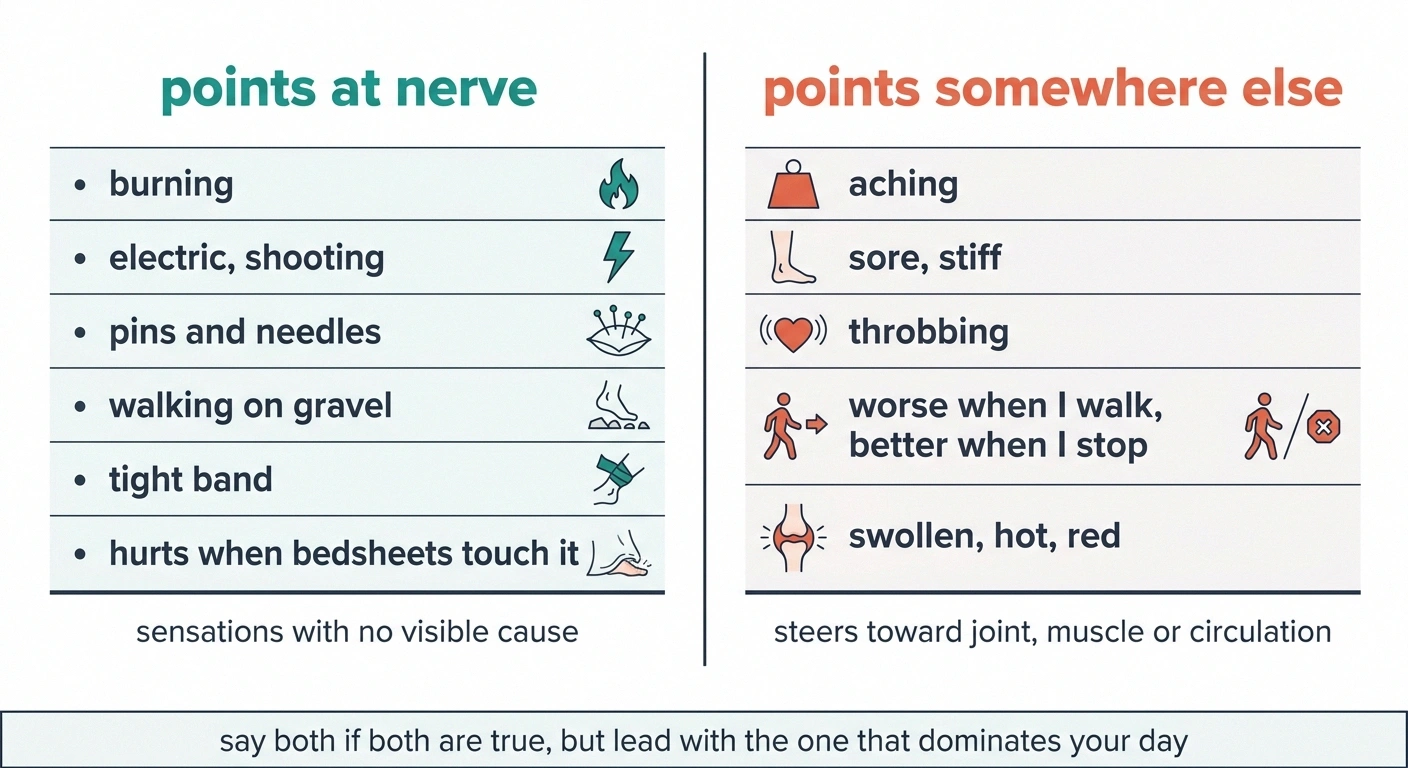
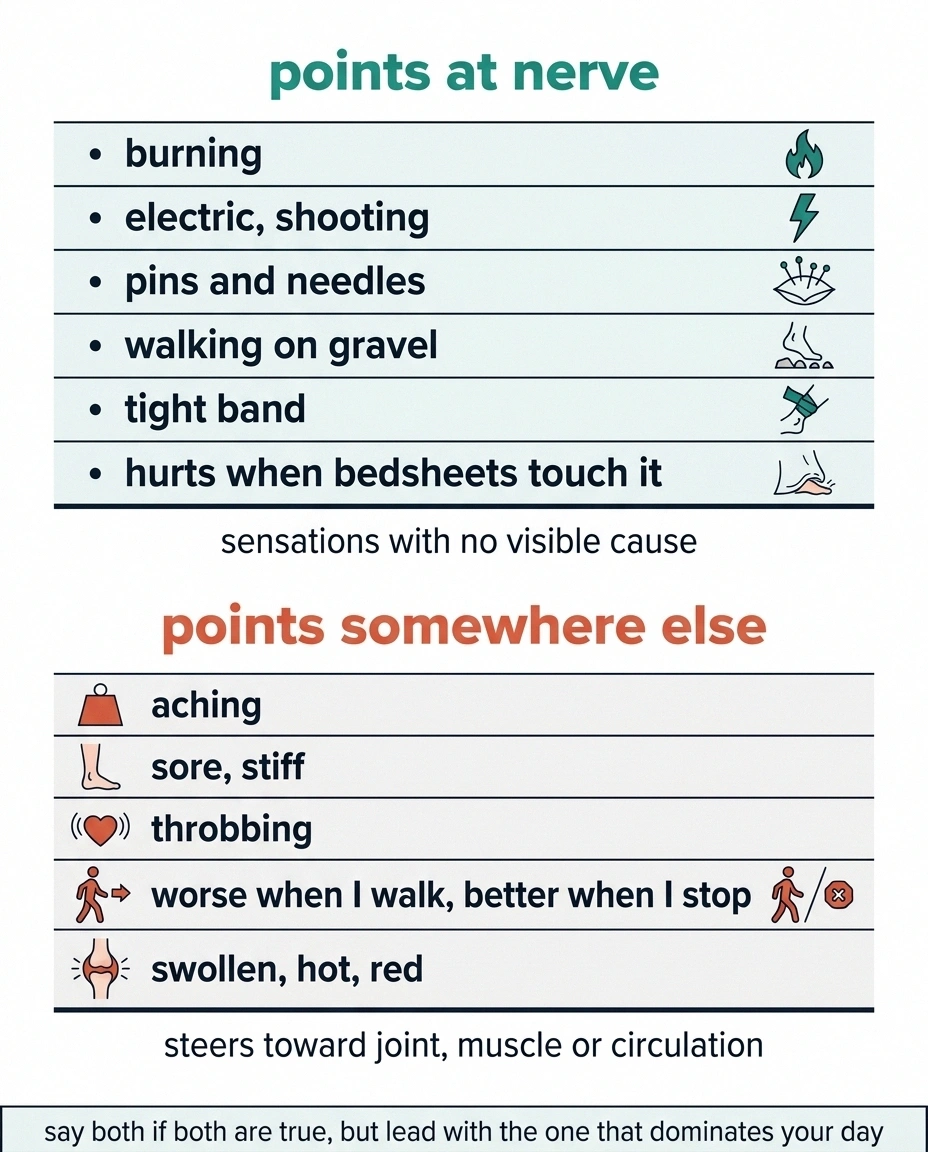
The other half of the skill is knowing which of your words send the visit down a different road. None of these are wrong to say. They just carry the conversation toward joints, muscle, or circulation, so say them deliberately rather than by habit.
What your word actually starts the clinician thinking about
| If you say | They start considering | Likely next move |
|---|---|---|
| Burning, both feet, toes upward | Length-dependent peripheral neuropathy | Blood panel, foot exam, possible nerve study |
| Electric jolt down one leg | Nerve root compression in the spine | Straight-leg testing, spine imaging |
| Cramping calf at a set walking distance | Arterial circulation | Pulse check, ankle-brachial index |
| Bedsheets hurt my feet | Small fiber involvement, sensitised pain pathways | Small fiber workup, medication aimed at nerve pain |
| Aching and stiff, worse in the morning | Joint disease | Joint exam, foot X-ray, anti-inflammatory trial |
Two of these can be true at once. Naming both, in order of which bothers you more, is better than picking one.
Aching, sore, stiff, throbbing. These lean musculoskeletal. If you have arthritis and neuropathy in the same foot, and most people over sixty who have one have some of the other, leading with “aching” will get you the arthritis conversation.
Worse when I walk, better when I stop. Careful here. Cramping calf pain that comes on at a predictable walking distance and eases within minutes of standing still is a circulation pattern, not a nerve pattern, and it is one of the differences worth understanding between nerve pain and vascular pain. Nerve pain more often does the opposite. It gets loud when you are still.
Swollen, hot, red. These push toward inflammation or infection and will reasonably change the exam.
Say all of it if all of it is true. Just lead with the sensation that dominates your day, and let the rest follow.
Six Things Worth Naming

A complete description has six parts. Most people offer two. Cover all six and you have given the clinician more than most patients manage in a full visit.
The six parts, each in one worked sentence
- Character
- “A constant burn, with electric jolts on top of it two or three times an hour.”
- Location
- “Both feet, toes to just above the ankle. The edge fades out rather than stopping sharply. Hands started about six months ago.”
- Timing
- “Present every hour I am awake. Worst between nine at night and two in the morning.”
- Triggers
- “Cold tile floors set off the jolts. Twenty minutes standing makes the burn climb.”
- What helps and what does not
- “Walking helps for about ten minutes. Ibuprofen does nothing at all, and I have tried it properly.”
- Trajectory
- “Toes only, two years ago. Mid-foot last winter. Above the ankle now. Both sides the whole way.”
Read aloud, all six take about forty seconds. That is the entire preparation this appointment needs.
Character. What it feels like, in the vocabulary above.
Location, precisely. Not “my leg.” Put a finger on it. Both feet or one. Toes only, or up to the ankle, or past the ankle. Whether the border is sharp or fades out. Whether hands are involved too, and if so whether they started later.
Timing. Constant or intermittent. If intermittent, how long an episode lasts and how many a day. Whether there is a clock to it. A great many people find it peaks in the evening, and if yours gets worse at night, that is a pattern worth stating outright rather than mentioning at the end.
Triggers. Cold floors. Heat. Standing for twenty minutes. Bedsheets. Nothing at all.
What helps. Including what does not. “Ibuprofen does nothing” is genuinely useful information, because nerve pain characteristically shrugs off ordinary anti-inflammatories, and saying so quietly supports the neuropathic reading.
Trajectory. Where it started, where it is now, over what span of time. Toes eighteen months ago, mid-foot now, both sides, gradual. That single sentence describes a classic distal pattern and it is often the most diagnostically loaded thing you will say all visit. It also tells the clinician roughly where you sit among the stages of neuropathy, which shapes how urgently the workup moves.
The Zero-to-Ten Question You Probably Answer Wrong
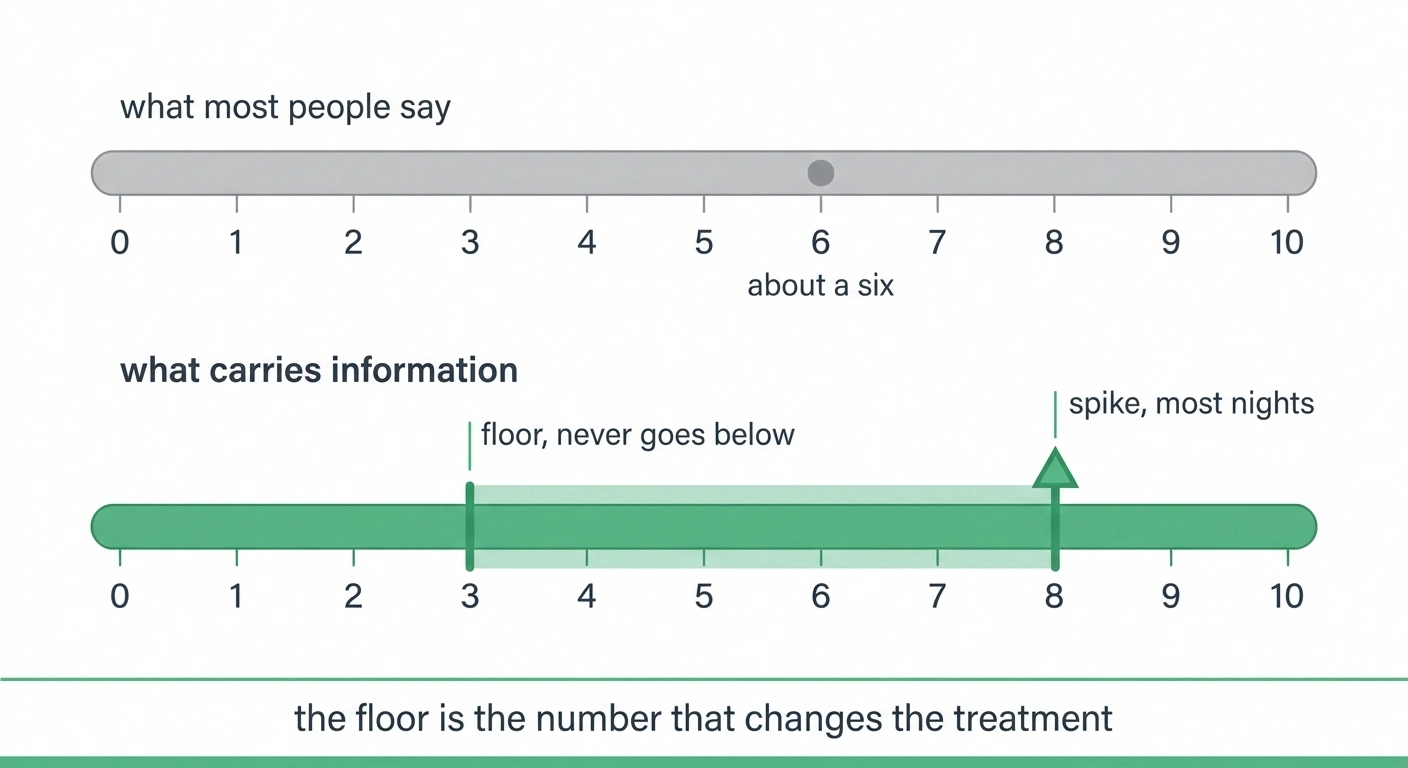
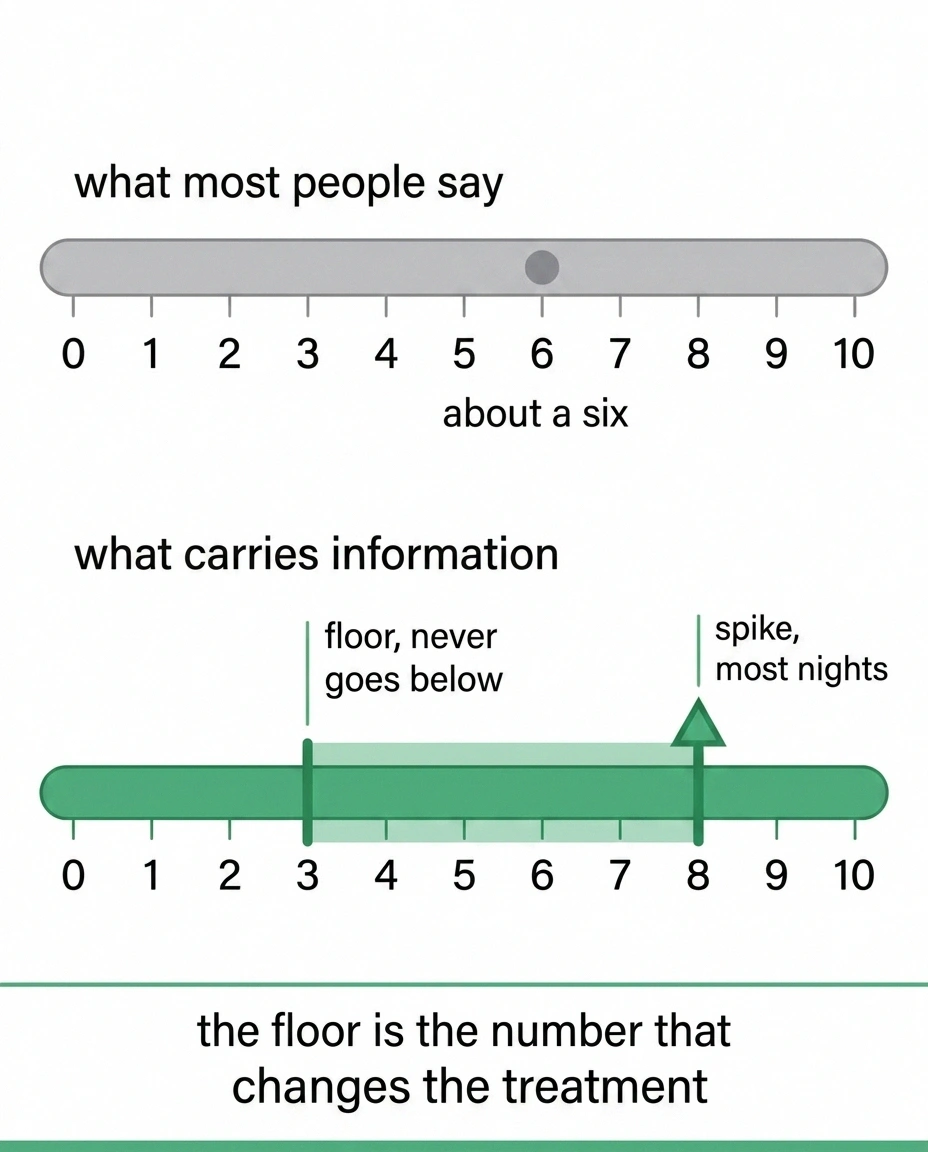
Everyone is asked for a number. Most people give an average, which is the least informative answer available, because an average of six can describe a steady dull six or a day that swings between two and ten. Those are different problems with different treatments.
Give a range and a floor instead.
“Best it gets is a three. Worst is an eight, usually around ten at night. It never goes below three, not once in six months.”
That answer contains four facts. There is a baseline that never clears, which tells the clinician this is constant rather than episodic. There is a spike, and it has a schedule. And the floor of three is arguably the most important number in the sentence, because unremitting background pain and intermittent flares respond to different approaches.
If numbers genuinely do not work for you, say so and substitute function, which is the subject of the next section and is better data anyway.
Trade Adjectives for Verbs
This is the change that altered my own appointments more than any vocabulary list.
Reported in adjectives
“It has been pretty bad. Maybe a seven. The burning is constant and it is exhausting.”
Nothing here can be measured against the last visit, and nothing suggests a specific test.
Reported in verbs
“I stopped using the stairs in March. I carry laundry in two trips so a hand stays on the rail. I have not driven after dark since I lost pedal feel. Two near-falls this month, both on the same step.”
Four datable facts, one safety issue, and a balance finding worth examining today.
Adjectives describe the pain. Verbs describe what the pain has taken. Clinicians make decisions on the second one, because function is measurable, comparable across visits, and impossible to dismiss as subjective in the way a number is.
Compare these.
“The pain is about a seven most days.”
“I have stopped using the stairs in my own house. I do the laundry in two trips instead of one because I need a hand free for the rail. I have not driven after dark since March because I cannot feel the pedals well enough to trust myself.”
The second version is the same pain, reported in a currency that gets acted on. It also surfaces problems that a pain score buries entirely. Losing pedal feel is a safety issue. Needing the rail is an early balance signal, and balance loss and fall risk often show up in these details well before anyone thinks to test for them.
Bring three function statements to every appointment. Something you have stopped doing, something you have modified, and something you are worried about losing next.
The One-Page Log

Pain diaries fail for a predictable reason. People produce fourteen pages and hand them across the desk, and there is no world in which anyone reads fourteen pages during a twelve-minute visit. The log gets set aside, and the patient concludes that logging is pointless.
Four columns, two lines a day, thirty seconds
Sample rows shown filled in, so the shape is obvious before you start.
| Date | Worst | Could not do | Anything unusual |
|---|---|---|---|
| Tue 4th | 7 | Grocery run, sent my son instead | Jolts started in the left hand |
| Wed 5th | 4 | Nothing, good day | Slept six hours straight |
| Thu 6th | 9 | Stood for the whole service, then could not | Near-fall on the porch step |
At day fourteen, count the rows at seven or above, count the ones after four in the afternoon, and write those two numbers at the top of the page. Those are the sentences that get read.
Log for two weeks. Summarize onto one page. Hand over the page.
Four columns are enough: date, worst score, what you could not do, anything unusual. Two lines a day, thirty seconds each. At the end of two weeks you write four or five sentences at the top of a single sheet, and those sentences are what you actually hand over.
The summary might read: fourteen days logged, worst score seven or above on nine of them, all nine after four in the afternoon, three nights of no sleep, two near-falls both on the same stair, no day below a three. Keep the raw pages in your bag. Offer them only if asked.
The log has a second use that nobody mentions. It protects you from your own recall. On the day of an appointment you tend to report how you feel that morning, and if the morning happens to be good you will underreport six weeks of misery without meaning to.
Your Opening Three Sentences
Write these down and read them if you need to. Nobody minds. Given eleven seconds, these three cover character, distribution, trajectory, and impact before anyone interrupts.
One, the sensation and where. “I have constant burning in both feet, from the toes to just above the ankle.”
Two, the trajectory. “It started in my toes about two years ago and has moved up since. It is the same on both sides.”
Three, the cost. “It wakes me most nights and I have stopped walking the dog because I do not trust my footing on the sidewalk.”
Then stop and let them ask. The remaining details are answers to questions you have now made obvious.
If you leave with a plan for testing, it helps to know roughly what the neuropathy workup involves, because the sequence is fairly standard and knowing it makes the next visit shorter too.
When You Are Not Believed
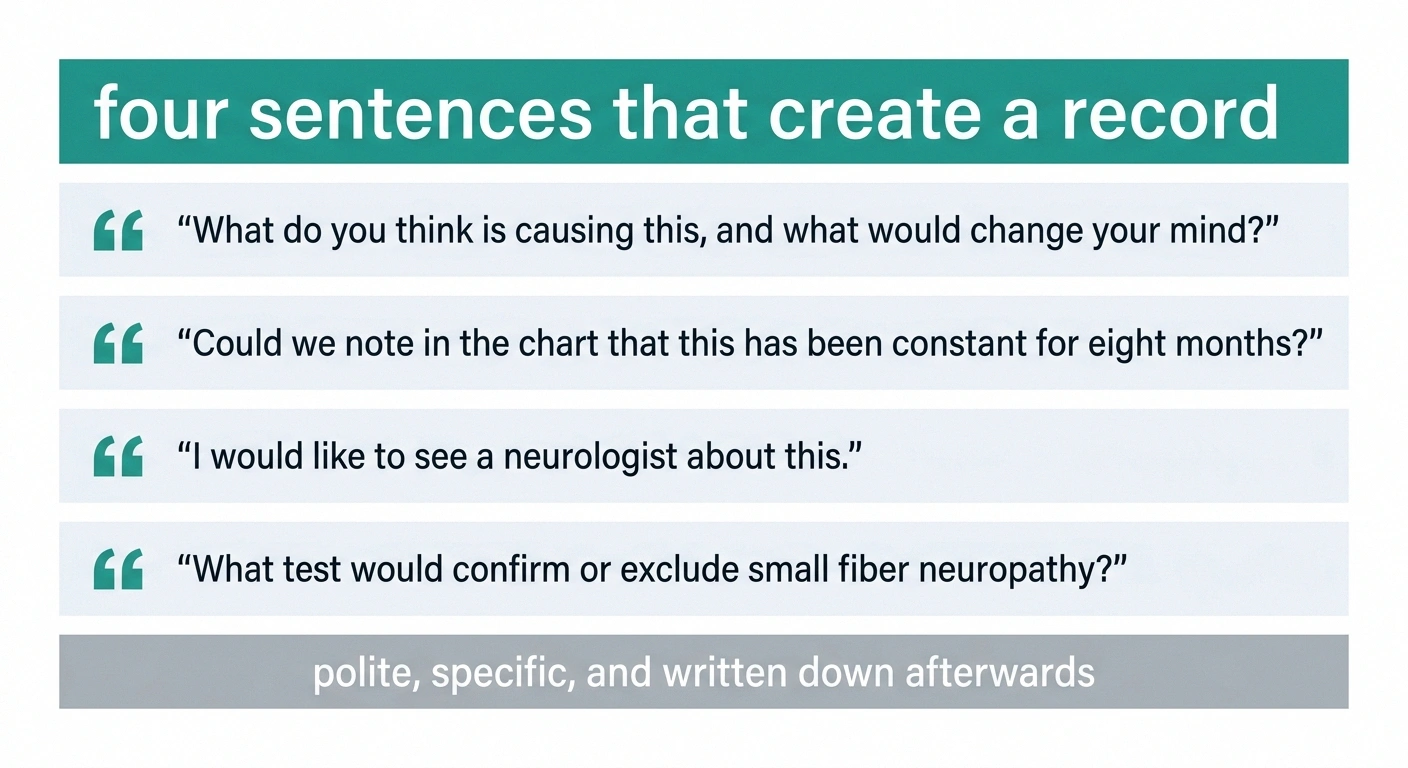
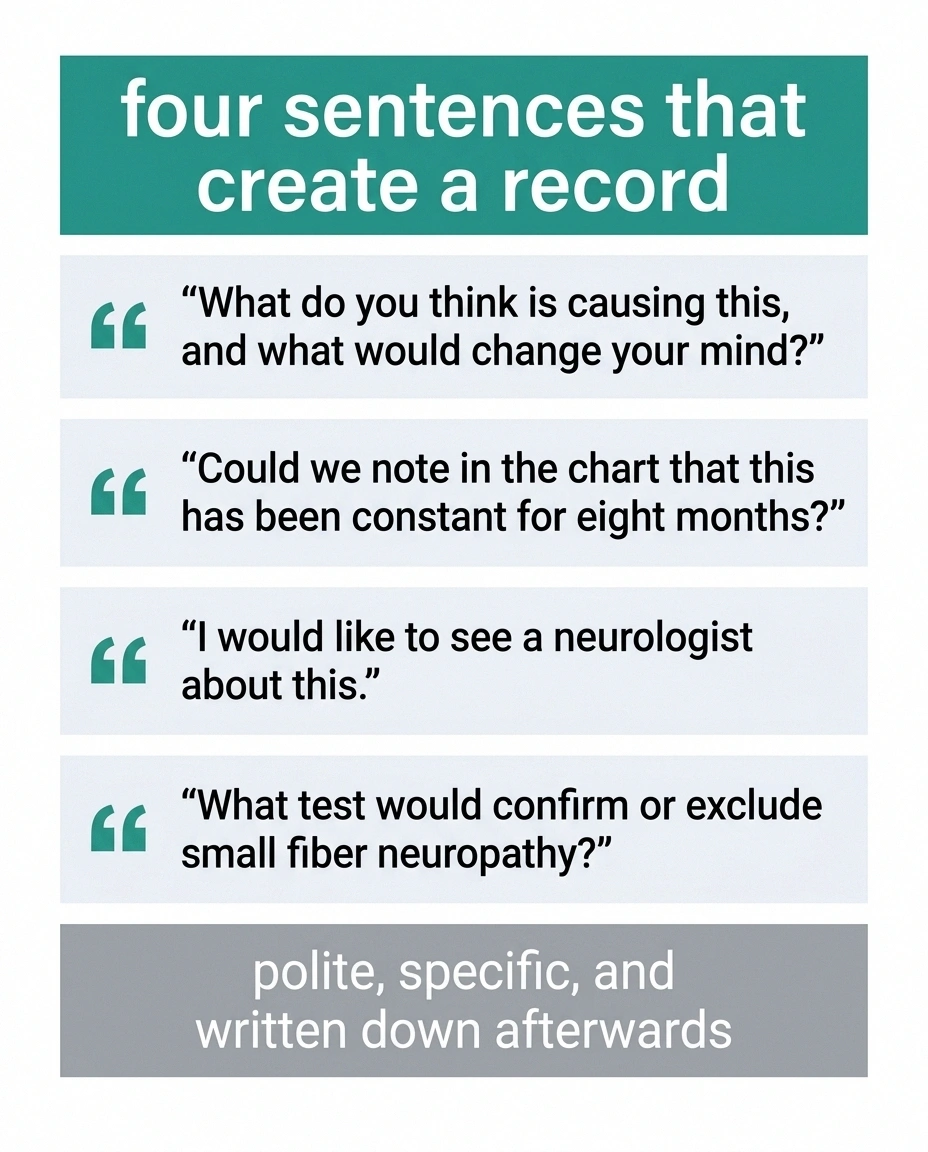
Sometimes the description is excellent and it still does not land. This happens to people whose exam looks normal, to people whose nerve conduction study comes back clean, and disproportionately to women, whose pain reports are documented as being taken less seriously across a wide range of settings.
Escalate in this order, one step per visit
- Ask what would change their mind. Converts an impression into stated reasoning that can be examined.
- Ask for the duration to be charted. “Constant for eight months” in the record outlives the visit and reaches the next clinician.
- Bring the function list, not the score. Stairs, driving, and near-falls are findings. A number is an opinion.
- Name the specific thing being missed. A clean nerve conduction study does not exclude small fiber damage. Ask what test would.
- Request the referral in one plain sentence. “I would like to see a neurologist about this.”
- Change clinicians after two clear attempts. Not a failure of description. A mismatch, and a fixable one.
Ask for a copy of the visit summary each time. Three summaries showing the same unresolved symptom is itself an argument.
A few things help.
Know that a normal test does not mean a normal nerve. Standard nerve conduction studies measure large fibers. They are largely blind to the small fibers that carry burning and temperature, which is why a person can have severe symptoms and a clean study. If that is your situation, small fiber neuropathy is a specific thing to raise by name, along with asking what would confirm or exclude it.
Ask the question that creates a record. “What do you think is causing this, and what would change your mind?” It is polite, it is not confrontational, and it moves a vague impression into a documented reasoning.
Request that the symptom be documented. “Could we note in the chart that this has been constant for eight months?” Charts carry forward. The next clinician reads them.
Bring the function list, not the feelings. Hard to argue with stairs.
Ask directly for the referral. “I would like to see a neurologist about this.” You are allowed to say that sentence.
And if the appointments themselves have started to feel corrosive, that is worth naming too. The grind of not being believed does real damage, and the overlap between chronic nerve pain and mental health is not a side issue. It belongs in the visit.
Bringing Someone With You

A second person in the room changes the acoustics of an appointment, and not only because they remember what was said.
Ask them to do three specific jobs. Write down what is said, including the names of anything ordered. Speak up once, with one observation you did not think to mention. And notice what you minimize, because almost everyone minimizes in front of a clinician, and a spouse saying “he was up four times last night” carries a weight that your own report of the same fact does not.
Brief them beforehand on that last one. Most people default to silent support, which is kind and less useful than one well-timed correction.
When the Problem Is Not Your Description
One honest caveat, because this article could otherwise leave you carrying something that is not yours.
Sometimes you describe it perfectly and nothing happens, and the reason has nothing to do with your words. Some clinics run seven-minute visits. Some clinicians are not comfortable with chronic pain and will route around it. Some workups genuinely stall because idiopathic cases are common and the honest answer at that moment is that nobody knows yet.
You can tell the difference by the quality of the questions coming back. A clinician who is engaged asks about distribution, timing, alcohol, blood sugar, thyroid, family history, medications. One who is not asks nothing and reaches for a prescription pad.
If you have given a clear, specific, function-anchored description across two visits and nothing has moved, the problem is upstream of you. Change clinicians. That is not being difficult. That is the correct response to a mismatch, and you will describe it better the second time anyway.
Frequently Asked Questions
What words best describe nerve pain to a doctor?
Burning, electric, shooting, shock-like, pins and needles, tingling, and numbness are the core set. Sensations described as walking on gravel or marbles, a tight band around the limb, or pain triggered by bedsheets and light touch are also strongly characteristic of nerve involvement. Lead with whichever one dominates your day rather than listing all of them.
How do I explain nerve pain if my doctor keeps interrupting?
Front-load. Prepare three sentences covering the sensation and its location, how it has spread over time, and what it has stopped you doing, then deliver those first. Interruptions are usually attempts to find the thread quickly, and if you hand over the thread in the first fifteen seconds the rest of the visit tends to open up.
Should I use the pain scale or describe what I cannot do?
Both, but function carries further. Give a range and a floor rather than an average, such as best three, worst eight, never below three. Then add two or three concrete things you have stopped or modified. Function is comparable between visits and much harder to dismiss than a single number.
Is it worth keeping a pain diary for neuropathy?
Yes, provided you summarize it. Log briefly for two weeks, then condense it to one page of four or five sentences and hand over the summary rather than the raw pages. Nobody reads fourteen pages during a short visit. A diary also protects you from reporting only how you happen to feel on the morning of the appointment.
What if my nerve tests are normal but I still have symptoms?
Standard nerve conduction studies mainly assess large nerve fibers and can miss small fiber damage entirely, which is why burning and temperature symptoms can coexist with a clean study. Raise small fiber neuropathy by name and ask what test would confirm or exclude it. A skin biopsy measuring nerve fiber density is the usual next step.
How do I get my doctor to take my nerve pain seriously?
Be specific about character, location, timing, and trajectory, anchor the impact in lost function rather than adjectives, and ask two questions that create a record: what do you think is causing this, and what would change your mind. Requesting that the duration be documented in the chart also helps, because the chart carries forward to whoever sees you next.
Should I bring someone to my neurology appointment?
It usually helps. Give them three jobs: write down what is said and the names of anything ordered, contribute one observation you might not mention, and correct you when you minimize. Almost everyone underreports in front of a clinician, and an outside voice noting how many times you were awake last night carries weight your own account may not.
What should I do if nothing changes after I describe it clearly?
Judge the response by the questions coming back. Engaged clinicians ask about distribution, timing, blood sugar, thyroid, alcohol, medications, and family history. If you have given a clear, function-anchored description across two visits and no workup has followed, the obstacle is not your description, and finding a different clinician is a reasonable next move.
About the Author