
The drug in your cabinet is named after a molecule it does not touch.
Gabapentin was built in the 1970s to imitate GABA, the brain's main calming neurotransmitter. The molecule was designed to slip across the blood-brain barrier and behave like GABA once it arrived. It does cross. It does not behave like GABA. It does not bind GABA receptors, it is not converted into GABA, and it does not meaningfully affect how GABA is taken back up or broken down. Pregabalin, its younger relative, has the same misleading pedigree and the same non-relationship with the neurotransmitter in its name.
For about twenty years nobody could say what these drugs actually did. They worked, unevenly, for nerve pain, and the mechanism was a blank. The answer, when it arrived, turned out to be a small accessory protein bolted onto the side of a calcium channel, with a name that sounds like a fraternity: alpha-2-delta.
That protein explains three things people taking these drugs constantly ask about. Why the first dose does almost nothing. Why the drug seems to hit a ceiling where more stops meaning more. And why it fails outright for a substantial share of the people who try it. I am not a pharmacologist, I am someone who has taken one of these and wanted to know what it was doing in there. The mechanism is genuinely interesting once it is laid out in order.
What a Calcium Channel Does at a Nerve Ending
Start at the place where one nerve hands a message to the next.
Commonly repeated
“It works by boosting GABA, the calming neurotransmitter.”
“It's a calcium channel blocker.”
“If it hasn't helped in a few days, it isn't going to.”
What the research shows
No binding to GABA receptors, no conversion to GABA, no meaningful effect on GABA handling. The name records an intention from the 1970s, not a mechanism.
Applied acutely to a nerve, it barely changes calcium currents. It binds an accessory subunit and reduces how many channels get installed.
The benefit accrues as over-supplied machinery ages out unreplaced. Days is too short a trial. Weeks at a steady dose is the fair test.
A pain signal travels along a sensory nerve as an electrical wave. At the end of that nerve, in the spinal cord, the electrical wave has to become a chemical one, because the next cell is not physically connected. The nerve ending releases packets of neurotransmitter across the gap, and the receiving cell picks them up and starts a new electrical wave of its own.
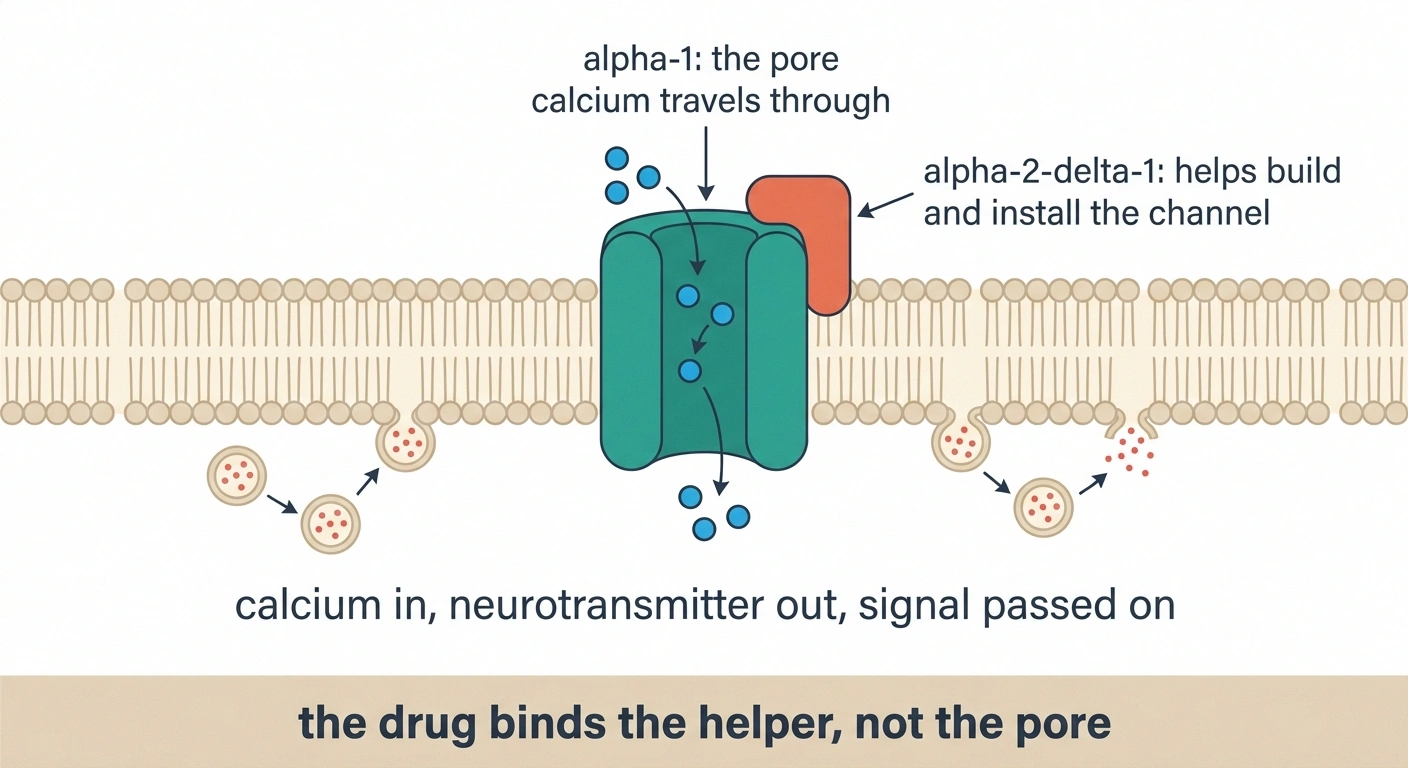
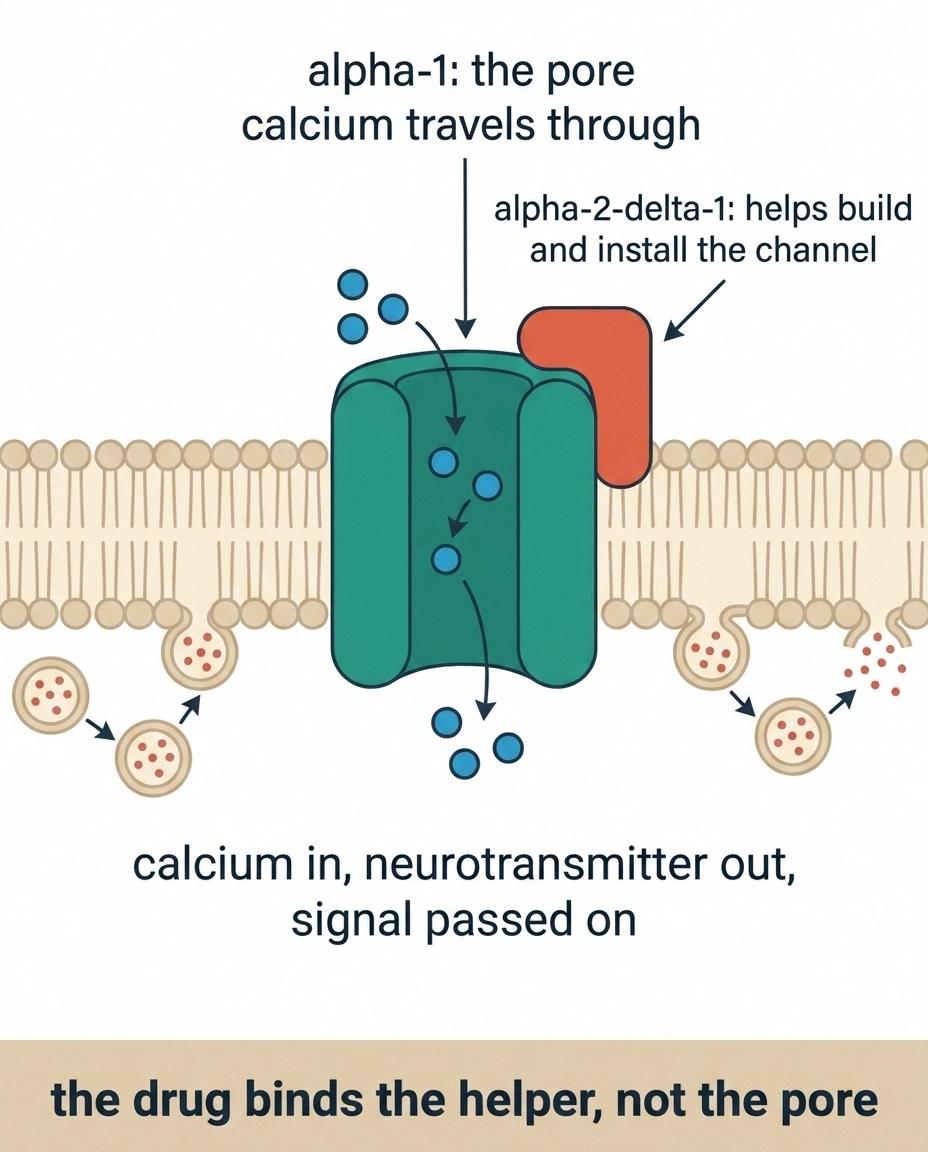
Calcium is the trigger for that release. Sitting in the membrane of the nerve ending are voltage-gated calcium channels: pores that stay shut at rest and swing open when the electrical wave arrives. Calcium floods in. The rise in calcium is what tells the packets of neurotransmitter to fuse with the membrane and dump their contents into the gap.
More calcium entering means more neurotransmitter released, which means a louder signal handed up toward the brain. That relationship is the lever the whole drug class pulls on.
The Part That Is Not the Channel
A voltage-gated calcium channel is not a single protein. It is an assembly.
The central piece, called alpha-1, is the pore itself: the tube calcium travels through, with the voltage-sensing machinery that opens and closes it. Clustered around it are auxiliary subunits that are not part of the pore at all. They are the support staff. They help the channel fold correctly, escort it out to the membrane, position it, and tune how readily it opens.
Alpha-2-delta is one of those auxiliary subunits. Written properly it appears as α2δ, and it comes in four versions numbered one through four. The one that matters here is α2δ-1.
Its job in a healthy nerve is unglamorous and important: it helps get calcium channels delivered to the nerve terminal and installed in the membrane where they can do their work. Think of it less as the door and more as the crew that builds doors and decides how many the building gets.
That distinction is the crux of everything that follows. The drug does not plug the pore. It interferes with the crew.
What Nerve Injury Does to Alpha-2-Delta-1
Here is where a damaged nerve starts behaving differently from a healthy one.
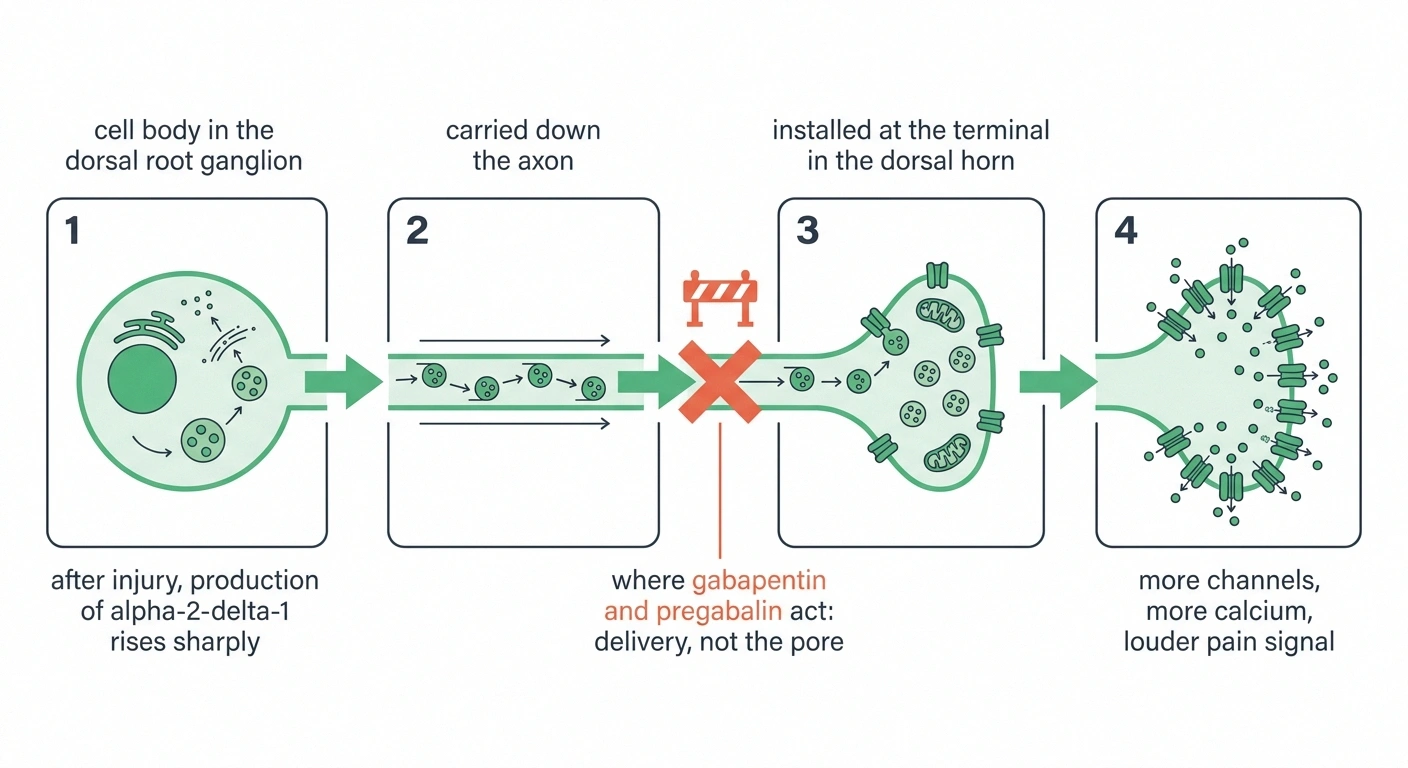
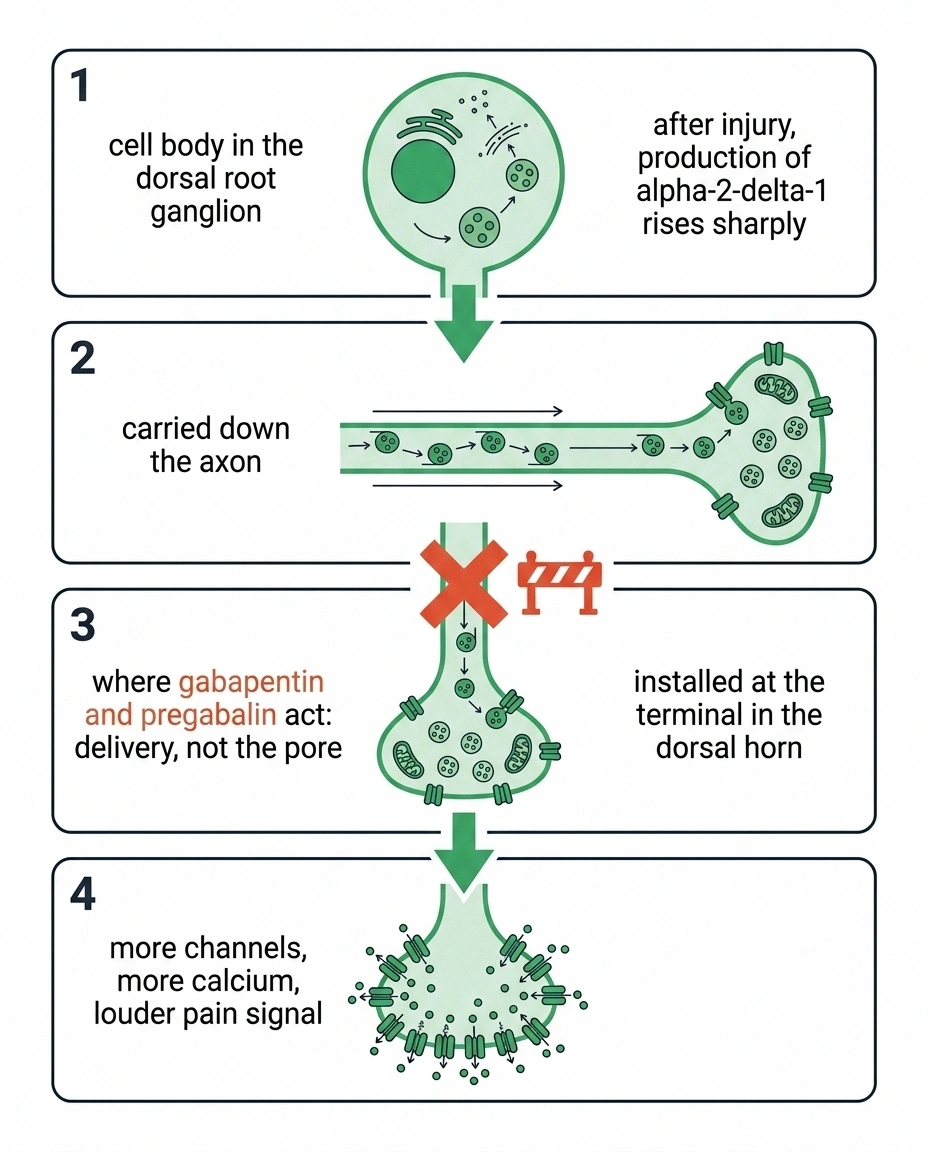
When a peripheral nerve is injured, whether by diabetes, chemotherapy, compression, or the virus behind post-herpetic neuralgia, the cell bodies of those sensory neurons respond by changing what they manufacture. They sit in clusters just outside the spinal cord called the dorsal root ganglia. After injury, those cells sharply increase their production of α2δ-1.
This is not incidental. In animal models of nerve injury, the rise in α2δ-1 tracks the onset of allodynia, the state in which a light, harmless touch registers as pain. Block the increase and the pain behaviour is reduced. The relationship looks causal rather than coincidental, which is a strong claim in pain research and one that has held up across many labs.
Researchers have traced where the extra protein goes. After injury, α2δ-1 accumulates in the manufacturing compartment of the cell body, then appears inside transport vesicles moving down the axon, then arrives in the membrane of the nerve terminals in the superficial layers of the spinal cord's dorsal horn. It is a supply chain, running from the cell body to the terminal, and injury turns up the volume on the whole line.
The consequence at the far end is more calcium channels installed at the terminal. More channels means more calcium per electrical wave. More calcium means more neurotransmitter released. The pain pathway has been physically re-engineered to be louder, which is a large part of why nerve pain persists long after the original injury and why it responds so poorly to ordinary painkillers. This is the amplification that sits underneath much of what happens in the later stages of neuropathy.
Where the Drug Binds
Gabapentin and pregabalin bind to α2δ. That is their target, and the binding is tight and specific.
The drug binds two subunits. Only one of them is the point.
- Alpha-2-delta-1
- Concentrated in sensory neurons. Sharply over-produced after nerve injury, and the rise tracks the onset of pain from harmless touch. This is the therapeutic target.
- Alpha-2-delta-2
- Abundant in the brain and cerebellum, with no established role in neuropathic pain. Binding here is thought to contribute to the drowsiness, unsteadiness and word-finding difficulty that arrive on day one.
- Why that gap matters
- Side effects and benefit come from two different proteins. Separating them more cleanly is the stated design goal of every newer drug in this class, and it is the reason a next-generation option may suit someone who could not tolerate the first two.
They bind both α2δ-1 and α2δ-2. Only α2δ-1 has been convincingly tied to neuropathic pain in animal work, which is one theory for why these drugs produce side effects that feel unrelated to pain: they are attaching to a subunit that has other jobs elsewhere, including in the brain, where α2δ-2 is abundant.
The binding site sits on a region of the protein that ordinarily recognises certain amino acids, which is why the drugs are structurally amino-acid-like and why, as you will see below, they ride into the body on an amino acid transporter. That structural quirk turns out to matter enormously for how the two drugs behave in practice.
Blocking Delivery, Not Blocking the Pore
This is the part most explanations get wrong, including a good many written for patients.
These drugs are frequently described as calcium channel blockers. They are not. A calcium channel blocker, in the sense used for blood pressure medication, sits in the pore and physically obstructs the flow of calcium. Gabapentinoids do nothing of the kind. Applied to a nerve acutely, they barely change calcium currents at all, which puzzled researchers for years because the drugs clearly did something.
What they do is interrupt the supply chain.
Pregabalin has been shown to inhibit the increased trafficking of α2δ-1 to presynaptic terminals after nerve injury. The protein is still being over-produced in the cell body. What the drug prevents is its delivery to the terminal, where it would otherwise recruit and install more calcium channels. Fewer new channels arrive. The terminal stops getting louder, and over time it gets quieter as existing channels turn over and are not fully replaced.
The distinction is not academic. A blocker acts on channels that are already there, which is fast. Interfering with delivery acts on channels that have not arrived yet, which is slow, and that single fact explains the most common complaint about these medications.
Why It Takes Weeks and Not Hours
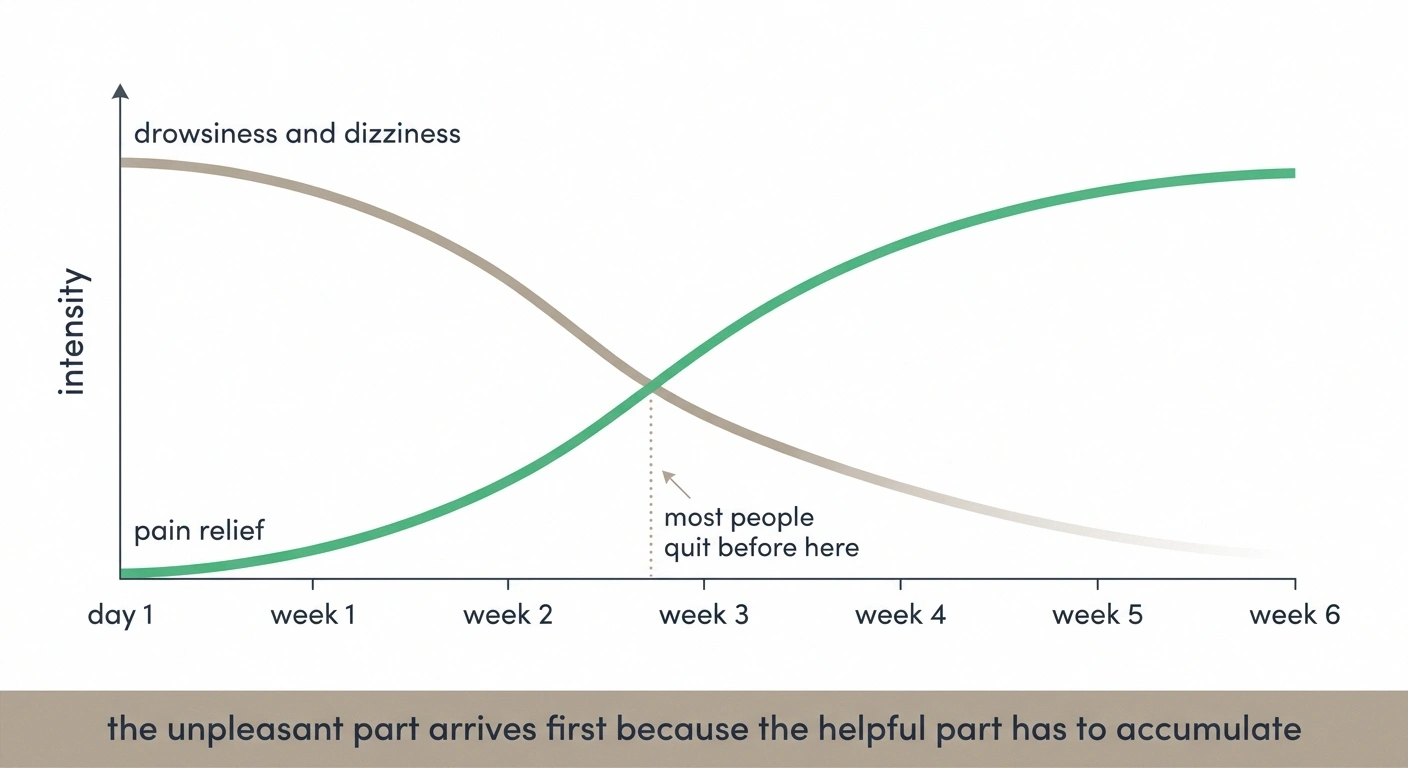
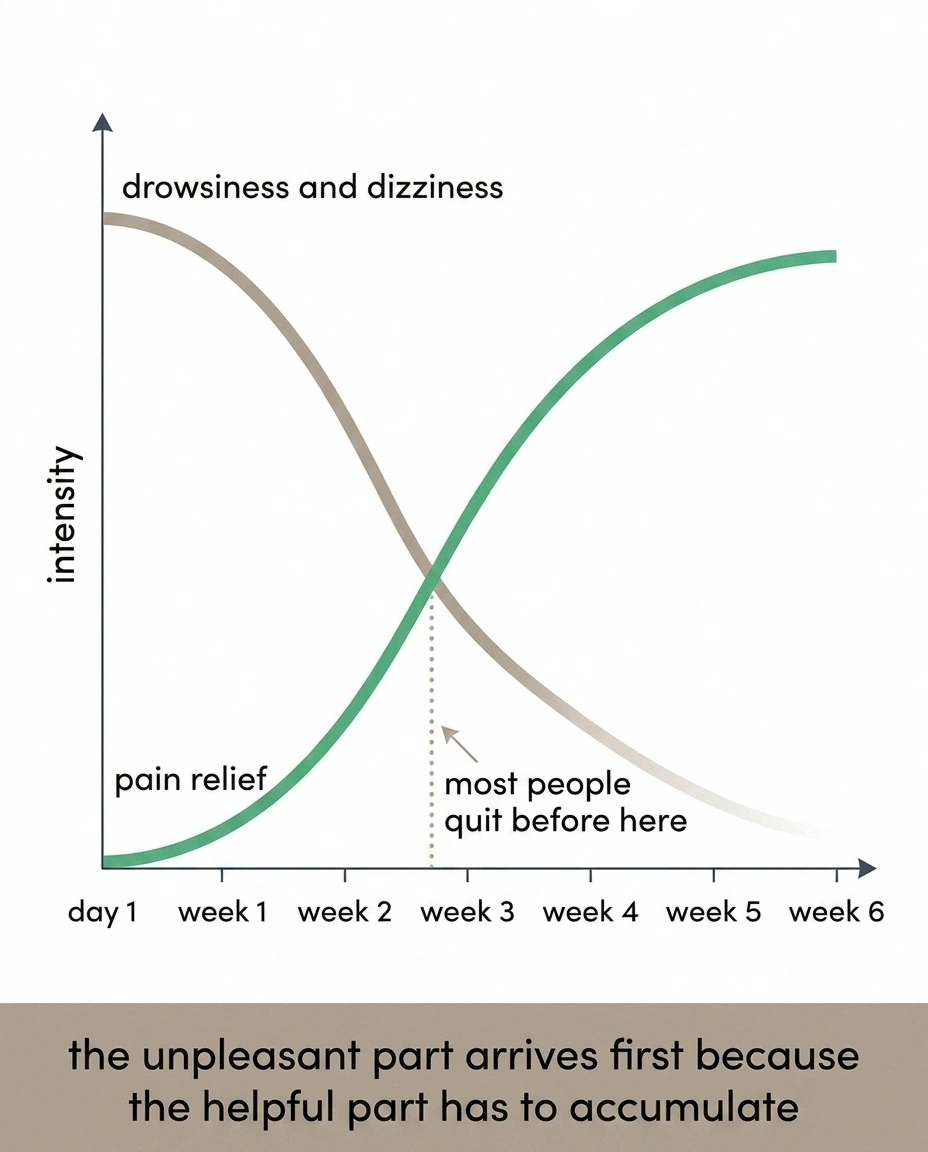
People start gabapentin, take it for three days, feel nothing except drowsy, and conclude it does not work for them. Sometimes that conclusion is right. Often it is premature, and the reason sits directly in the mechanism.
A fair trial, week by week
Typical shape at a steady dose. Individual timing varies, and any dose increase restarts a smaller version of the same climb.
- Days 1 to 4. Sedation, unsteadiness, sometimes swollen ankles. Little or no pain change. This stretch tells you nothing about whether the drug will work.
- Week 1 to 2. Side effects usually begin easing. The first sign of benefit is often not less pain but slightly better sleep.
- Week 2 to 4. Where the two curves cross for most responders. Pain relief becomes noticeable, typically as fewer spikes rather than a lower baseline.
- Week 4 to 6. The plateau. What you have at six weeks on an adequate dose is broadly what this drug offers you, and it is the point at which continuing, increasing, or switching becomes a real decision rather than a guess.
A drug that plugged a pore would work on the first dose, the way a numbing injection does. A drug that stops new protein being delivered has to wait for the existing over-supply to age out. Proteins in a nerve terminal have a turnover time. The therapeutic effect accumulates as the terminal's excess machinery is gradually retired without replacement.
In practice that means the pain benefit builds over one to several weeks at a stable dose, while the sedation and dizziness show up on day one and then partially fade. The two curves run in opposite directions, which is a cruel design: you get the side effects before you get the relief. A great many people quit inside that window, in the gap where the drug has given them everything unpleasant it has to offer and none of the benefit.
Knowing the mechanism does not make the first fortnight pleasant. It does reframe it as a waiting period with a reason rather than as evidence of failure, which is worth something when deciding whether to persist. Dose changes need the same patience, since each increase restarts a smaller version of the same accumulation.
The Second Job Nobody Mentions
Alpha-2-delta-1 turns out to moonlight, and this is where the story stops being tidy.
The subunit interacts with thrombospondin-4, a protein released by support cells in the nervous system that rises after nerve injury and is involved in forming new synaptic connections. Some of that interaction is not blocked by gabapentin at all. A soluble form of α2δ-1 binds thrombospondin in a way that these drugs leave untouched.
Separately, α2δ-1 has been implicated in coupling with NMDA receptors, a completely different signalling system central to how the spinal cord amplifies and remembers pain. In that role it is doing something quite apart from assembling calcium channels.
The practical implication is uncomfortable and honest: α2δ-1 does more than one thing in an injured nerve, gabapentinoids interrupt one of those things well, and the others carry on. That is a plausible partial explanation for why a drug aimed squarely at the right molecule still leaves many people with meaningful pain. It also marks out where the next generation of drugs is likely to aim.
Why the Two Drugs Behave So Differently in the Gut

Gabapentin and pregabalin hit the same target. Their reputations differ anyway, and the reason has nothing to do with the nerve. It happens in the small intestine.
Same target, different journey to it
| Gabapentin | Pregabalin | |
|---|---|---|
| Absorption route | LAT1 transporter only, and it saturates | An additional route, so it does not saturate |
| Dose to blood level | Falls away as dose rises, roughly 60% absorbed at 900 mg daily and 33% at 3600 mg | Close to proportional; doubling the dose doubles exposure |
| Time to peak level | Slower and more variable | Around one hour |
| Usual daily schedule | Three times, to avoid swamping the transporter | Twice |
| Practical consequence | Splitting the same daily total into smaller, more frequent doses gets more drug absorbed at no extra cost | Dose changes translate more predictably into effect, useful when titrating carefully |
None of these differences are about which drug is stronger. They describe how reliably a given dose reaches the target.
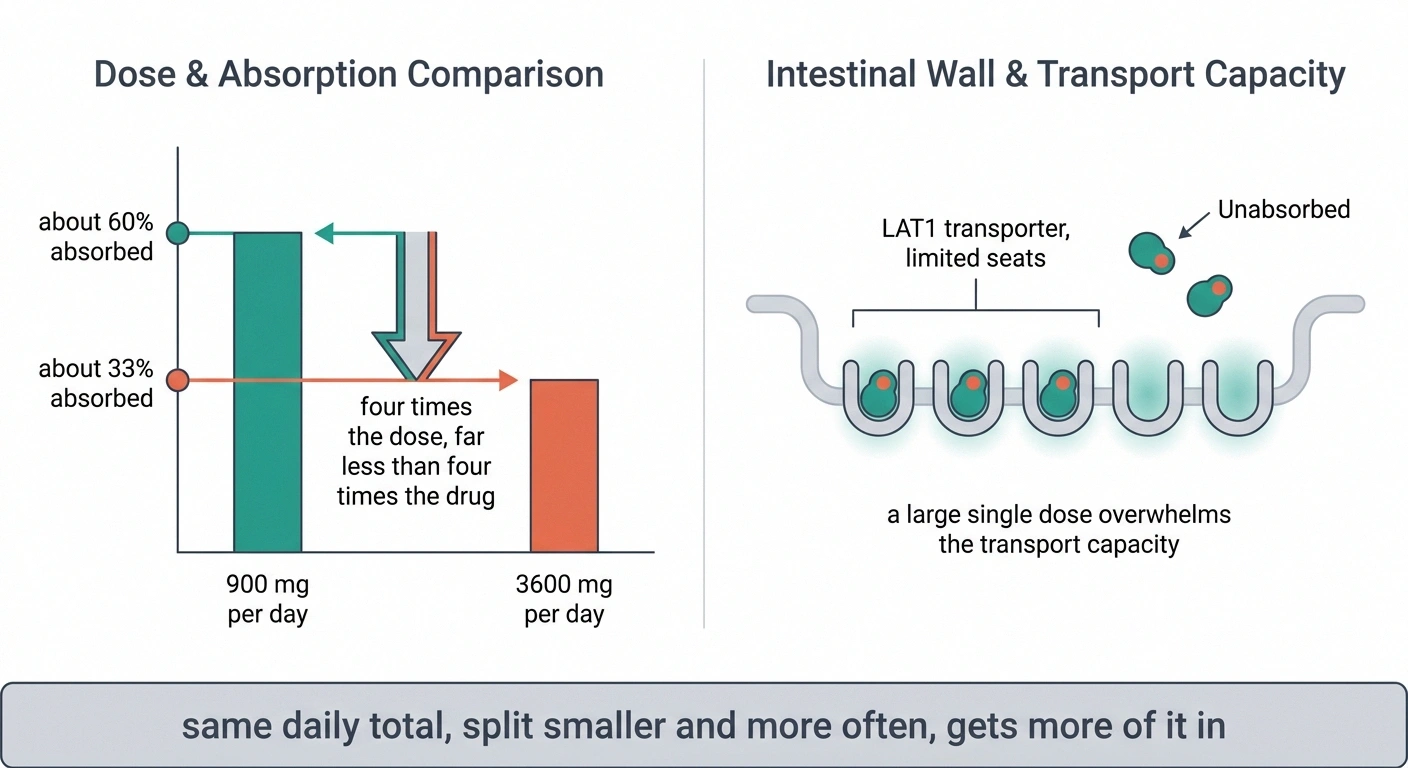
Because these molecules resemble amino acids, they are absorbed by an amino acid transporter called LAT1 rather than by simple diffusion. Transporters have a finite number of seats.
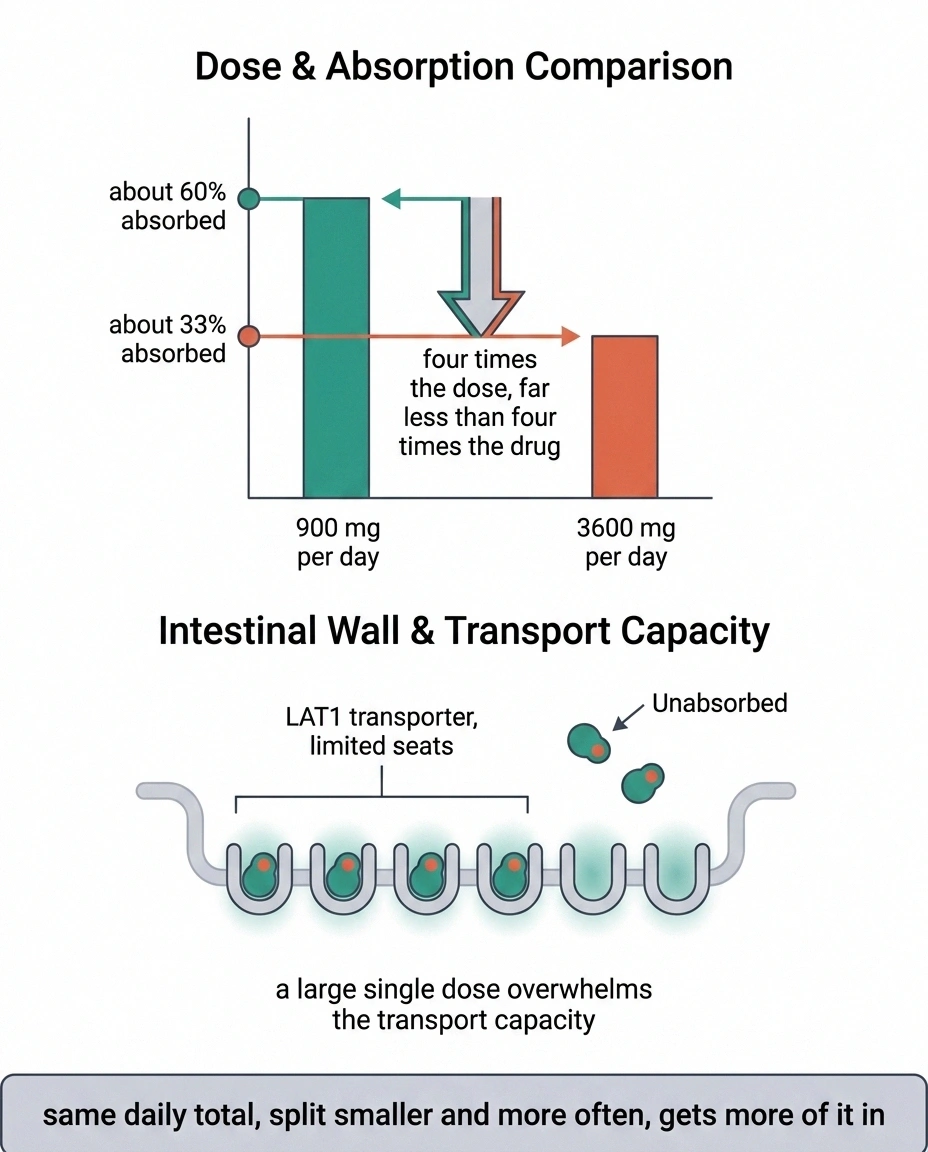
Gabapentin depends on LAT1 alone. The transporter saturates. Once every seat is taken, extra drug sitting in the intestine simply cannot get in and passes on through. The numbers are striking: absolute bioavailability falls from roughly 60 percent at 900 mg a day to roughly 33 percent at 3600 mg a day. Quadruple the dose and you do not get four times the drug in the blood. You get considerably less than that, and the shortfall widens as the dose climbs.
Pregabalin uses an additional absorption route, so it is not limited the same way. Absorption is close to complete and stays proportional to dose. Peak blood levels arrive within about an hour, and doubling the dose genuinely doubles the exposure.
Three familiar things fall out of that difference. Gabapentin is usually taken three times daily and pregabalin twice, because spreading gabapentin out avoids swamping the transporter with each dose. Gabapentin's dose ceiling is partly an absorption ceiling rather than a biological one. And pregabalin's more predictable behaviour is why it is often preferred when dosing needs to be precise, a distinction covered in more depth in the comparisons of gabapentin and pregabalin individually.
One practical point that follows directly: taking a large gabapentin dose all at once wastes a meaningful fraction of it. Splitting the same daily total into more, smaller doses gets more of it into your blood, for free.
Why It Works Well for Some People and Not at All for Others
The response to these drugs is famously all-or-nothing. Some people describe the difference as their life returning. Others feel nothing but fog. Trials reflect that split rather than showing a gentle average benefit: across the neuropathic pain literature, for roughly every six to eight people treated, one gets at least half their pain removed who would not have got that from a placebo. The rest get little, or get side effects instead.
The mechanism suggests several reasons for the divide.
Not everyone's pain runs through this pathway. The α2δ-1 story is a story about a specific kind of amplification at the spinal cord. Pain driven mainly by ongoing inflammation, by a compressed nerve that is still being compressed, or by damage in the brain and spinal cord rather than the peripheral nerves may simply not depend on the machinery this drug interferes with. The response in small fiber neuropathy is likewise inconsistent, which fits a picture where the fiber population involved shapes how much of the pain runs through this particular route.
Timing may matter. The upregulation follows injury. Where the pathway has been remodelled for years, there may be more going on than the piece these drugs address.
Absorption varies between people. Transporter capacity is not identical in everyone, which means two people on the same gabapentin dose can end up with genuinely different amounts of drug in the blood.
The other jobs carry on. The thrombospondin and NMDA-related roles are unaddressed, and in some people those may be doing more of the work.
This is also why a failure of one gabapentinoid is not automatically a failure of the other, though the expected benefit from switching is modest, and why a drug from an entirely different class such as duloxetine, which works on descending pain control rather than on calcium channel assembly, is a genuinely different attempt rather than a lateral move.
What This Mechanism Cannot Do

Worth stating plainly, because hope attaches easily to a good mechanistic story.
Four things to track before the six-week decision
Because these drugs reduce spikes more than baselines, an average pain score is the measure least likely to detect a real effect.
- Nights woken. Count them per week. Sleep frequently improves before daytime pain does, and it is the earliest honest signal.
- Spikes per day. How many times the pain forces you to stop what you are doing. This is the number the mechanism predicts should move first.
- The floor. The level it never drops below. If the floor is unchanged at six weeks but the spikes have halved, the drug is working and the dose is probably right.
- Words and balance. Track word-finding trouble and unsteadiness separately from pain. These come from a different subunit, and if they have not settled by week four they are a dose problem rather than a price of admission.
Nothing in this pathway repairs a nerve. Gabapentinoids do not regrow axons, restore myelin, improve nerve conduction, or slow the underlying process damaging the fibers. They reduce the gain on a signal after the damage has happened. If the cause is ongoing, and high blood sugar is the obvious example, the damage continues underneath the drug while the volume is turned down on the alarm.
That is not a small thing. Sleeping through the night matters. Being able to wear shoes matters. But it explains why controlling the cause and treating the pain are separate projects that both have to happen, and it belongs in any honest discussion of whether neuropathy can be reversed.
Nor does the mechanism suggest the drug should keep working better at higher doses indefinitely. Between transporter saturation and the fact that only part of the injured-nerve biology is being addressed, there is a point past which more milligrams buy more sedation and not more relief.
What Is Being Built Next
Understanding the target has redirected drug development in a few visible ways.
Newer α2δ ligands aim for cleaner separation between the α2δ-1 subunit tied to pain and the α2δ-2 subunit associated with central side effects. Binding more selectively, and staying bound longer at the subunit that matters, is the explicit design goal of the most recent entrants in this class.
Elsewhere, the interest has moved upstream of the calcium channel entirely, toward the sodium channels that decide whether a pain signal fires in the first place. That is a different lever on the same problem and the reason for much of the current excitement around non-opioid pain drugs.
Alpha-2-delta will keep its place regardless. It is one of the few targets in chronic pain where the chain from injury to protein to symptom has been traced end to end, and where an existing drug demonstrably interrupts it. Partial answers that are genuinely understood tend to be more useful than complete answers that are not.
Frequently Asked Questions
Does gabapentin work on GABA?
No. Gabapentin was designed as a GABA imitator and named for it, but it does not bind GABA receptors, is not converted into GABA, and does not meaningfully change GABA uptake or breakdown. Its analgesic target is the alpha-2-delta-1 auxiliary subunit of voltage-gated calcium channels, which is unrelated to the GABA system.
What is the alpha-2-delta subunit?
It is a helper protein attached to voltage-gated calcium channels. It is not the pore that calcium passes through. Its role is to help the channel fold, escort it to the nerve terminal, and install it in the membrane. Four versions exist, and the one relevant to nerve pain is alpha-2-delta-1.
Why does gabapentin take weeks to work?
Because it interferes with the delivery of new alpha-2-delta-1 to nerve terminals rather than blocking calcium channels already in place. The benefit accumulates only as existing excess machinery ages out without being replaced, which takes days to weeks. Sedation and dizziness begin on the first dose, so the side effects reliably arrive before the relief does.
Is gabapentin a calcium channel blocker?
Not in the usual sense. Calcium channel blockers used for blood pressure obstruct the pore and reduce calcium flow immediately. Gabapentin binds an accessory subunit and interferes with how many channels get installed at the nerve terminal after injury. Applied acutely to a nerve, it barely changes calcium currents at all.
Why do I have to take gabapentin three times a day?
Gabapentin is absorbed by a single saturable transporter in the small intestine. Large single doses overwhelm the available transport capacity and a substantial fraction passes through unabsorbed. Splitting the daily total into smaller, more frequent doses gets more of the same amount of drug into the bloodstream.
Is pregabalin stronger than gabapentin?
They act on the same target, so the difference is not really potency. Pregabalin is absorbed more completely and more predictably, reaches peak levels within about an hour, and its blood levels rise in proportion to the dose. Gabapentin's absorption falls off as the dose increases, from roughly 60 percent bioavailability at 900 mg daily to roughly 33 percent at 3600 mg daily, which makes its effect at high doses less predictable.
Does gabapentin heal nerve damage?
No. It reduces the amplification of pain signals at the spinal cord. It does not regrow nerve fibers, restore myelin, improve nerve conduction, or slow whatever process is damaging the nerves. Treating the underlying cause and treating the pain are separate tasks that both need attention.
Why does gabapentin work for some people and not others?
Trials show a split rather than a modest average benefit: for roughly every six to eight people treated, one gets at least half their pain removed beyond what a placebo delivers. Likely reasons include pain that is not driven by this particular spinal amplification pathway, individual differences in intestinal absorption, and the fact that alpha-2-delta-1 has additional roles involving thrombospondin and NMDA receptor signalling that these drugs do not address.
About the Author