
Every medication conversation eventually reaches a fork where you weigh a benefit against a cost. With most drugs, if the cost gets too high you stop taking it and try something else. That escape route is what makes side effects tolerable.
Thalidomide takes the escape route away. When a drug is holding a myeloma in check, “I'll stop it” is not a decision you get to make casually, and neither does your hematologist. So the conversation changes shape. It stops being about whether to accept the risk and becomes about how to spend it carefully.
That is a harder conversation, and it goes considerably better when you know what the numbers are, what the early warning looks like, and what levers actually exist. Most people are handed the prescription without any of that.
A Side Effect You Cannot Simply Refuse
Thalidomide has an unusual history. It was withdrawn worldwide in the early 1960s after causing catastrophic birth defects, then returned decades later when researchers discovered it did something valuable against plasma cell cancers. Today it is used mainly in multiple myeloma, often alongside dexamethasone, and also in erythema nodosum leprosum, a painful complication of leprosy.
It works. That is the reason anyone tolerates the rest of it.
Peripheral neuropathy is the side effect that most often forces a change in plan. Not because it is the most dangerous, but because it is the most common, the most cumulative, and the one most likely to become permanent. Blood counts recover. Fatigue lifts. Nerve damage sometimes does neither.
Understanding that early is worth more than almost anything else in this article, because the decisions that protect nerve function all happen in the first few months, and most of them are yours to initiate.
How Common Is It, Honestly
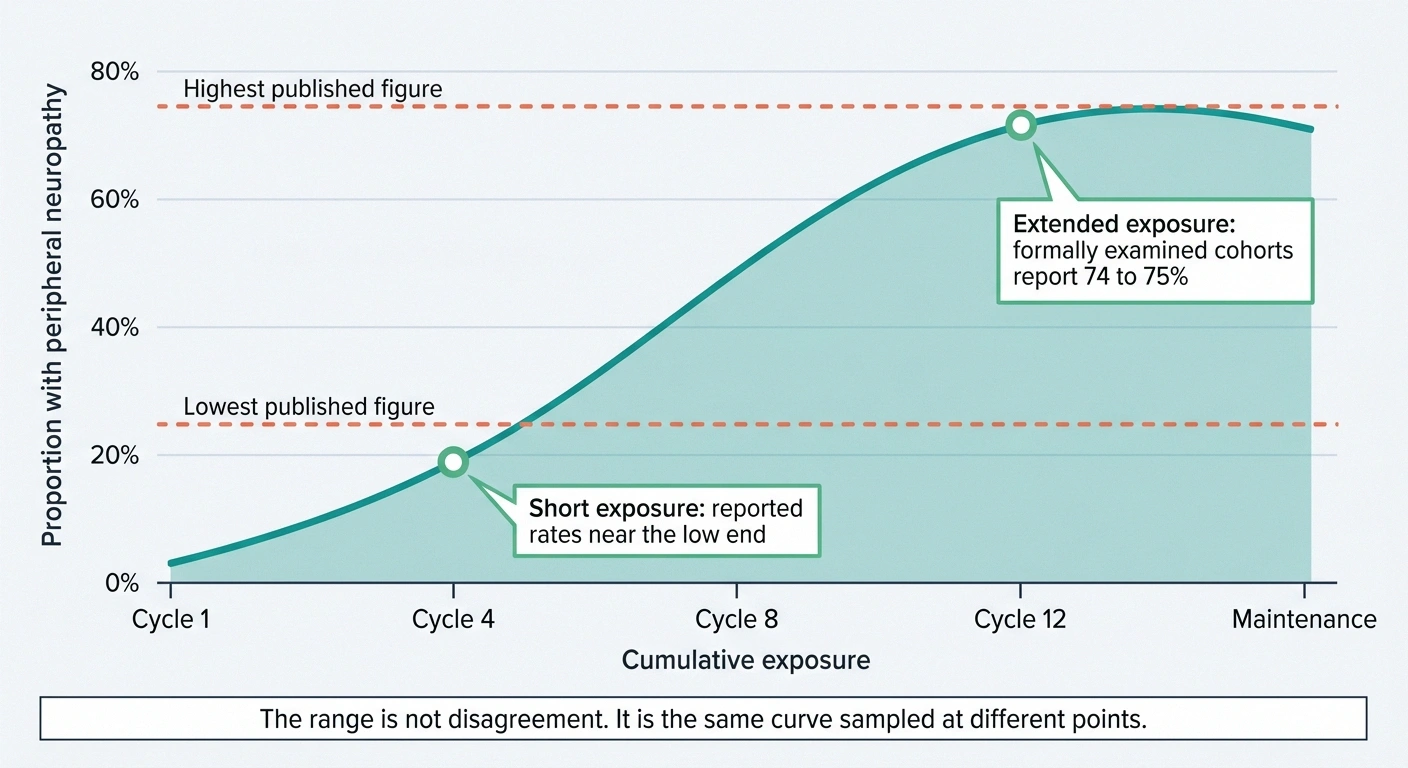
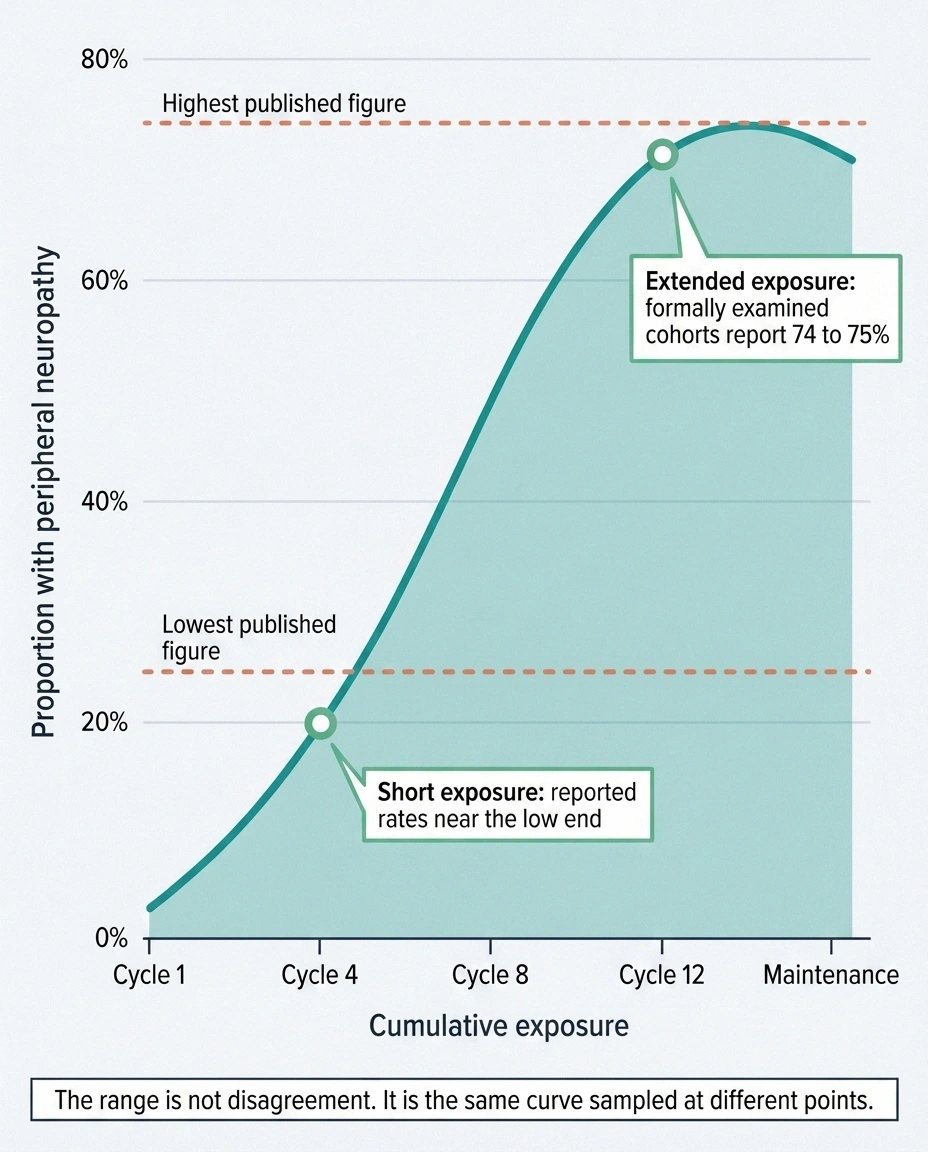
Published rates for thalidomide-induced peripheral neuropathy range from 25% to 75%, which sounds like the literature cannot make up its mind. It can. The spread reflects how long people stayed on the drug and how carefully anyone looked.
Studies that examined patients formally and followed them for extended treatment periods report the high end. One found 56% developing symptoms. Another reported averages near 74% in newly diagnosed patients and 75% in those previously treated. Studies capturing only symptoms severe enough to be reported spontaneously land much lower.
The number that matters for planning is not the average. It is the shape: risk climbs with cumulative dose and total time on the drug. Someone completing four cycles sits in a different place than someone entering their second year of maintenance.
This does not mean the neuropathy is inevitable, and it does not mean it will be severe. Most cases are sensory and mild to moderate. But at rates like these, the sensible assumption is that some degree of nerve change is likely rather than unlikely, and planning around it beats being surprised by it.
The Shape of the Damage
Thalidomide neuropathy is a sensory neuropathy, and it follows the classic length-dependent pattern: the longest nerves in the body fail first, so the toes go before the arches, and the arches before the ankles.
Why a normal test result can sit beside real symptoms
Large fibers
Carry vibration, position sense and muscle signals. Thickly insulated and fast.
Measured by: standard nerve conduction studies and EMG.
Small fibers
Carry pain, burning and temperature. Thinly insulated or bare, and damaged first here.
Measured by: skin punch biopsy or quantitative sensory testing. Not by a routine conduction study.
If your study came back clean and your feet did not, ask which fibers were actually tested.
Fingertips typically follow the feet by some months, and the hands often bother people more, because hands do precision work that feet do not. Our guide to neuropathy in the hands covers the specific losses that show up there.
What people report, in rough order of frequency:
- Tingling and numbness in the toes, symmetric on both sides
- A burning or aching quality, more noticeable at night
- Painful cramping in the feet and calves
- Reduced sensitivity to temperature, which is often noticed first in a shower
- Fingertips losing fine discrimination, so buttons, coins and jar lids get harder
- Balance drifting, particularly in the dark or on uneven ground
Weakness is less common and appears later. It is worth reporting immediately, because a sensory neuropathy that starts adding motor involvement is a different situation.
Much of the early damage is to small nerve fibers, which are the ones carrying pain and temperature. That has a frustrating consequence: standard nerve conduction studies test large fibers and can look entirely normal while a person is genuinely symptomatic. Our article on small fiber neuropathy explains why a normal test result is not the reassurance it appears to be, and what tests do capture it.
Symptoms That Arrive After the Last Dose

This is the part that catches almost everyone, and it deserves a name because it has one. It is called coasting.
Thalidomide neuropathy can begin, or get noticeably worse, after the drug has already been stopped. Weeks after. Sometimes months. The damage was set in motion during treatment and continues to declare itself afterward, the way a wave keeps moving after the wind drops.
Two things follow from that.
The first is emotional. People who develop symptoms after finishing treatment often assume the drug is off the hook and something new is wrong, or worse, that they are imagining it. They are not. Late onset is a recognized behavior of this particular toxicity, and it should be reported exactly as promptly as early onset would be.
That said, coasting being real does not make it the explanation for every late symptom. Some patterns argue for something other than the drug and need urgent assessment rather than patience: weakness rather than numbness, symptoms on one side only, a band of numbness or tightness around the trunk, new or worsening back pain, or any change in bladder or bowel control. In myeloma those point toward spinal cord compression, amyloid involvement or active disease, and none of them should be filed under expected.
The second is practical. Recovery timelines get measured from the point symptoms peak, not from the last dose. If your symptoms crested two months after treatment ended, your clock starts there. This is also why “it stopped getting worse” is genuine progress and worth noting, even though it does not feel like much at the time.
Coasting is well described with several nerve-toxic cancer drugs, and the pattern is similar across them. Our overview of chemotherapy-induced peripheral neuropathy covers how the same phenomenon behaves with platinum agents and taxanes.
Why Week Six Matters More Than Month Six
Here is the single most useful idea in this article.
Three numbers that turn “my feet feel odd” into a dosing decision
The date you first noticed. Not the date you decided it counted. Cycle number at onset is what tells your team whether this tracks cumulative dose.
How far up it now reaches. Toes, ball of the foot, whole foot, above the ankle. Point to the line on your own leg. Movement of that line between visits is the clearest evidence of progression there is.
One specific task that changed. Grading scales are built around interference with activity, so a concrete example does more than any adjective. “I stopped taking the stairs without the rail” moves a grade. “It's worse” does not.
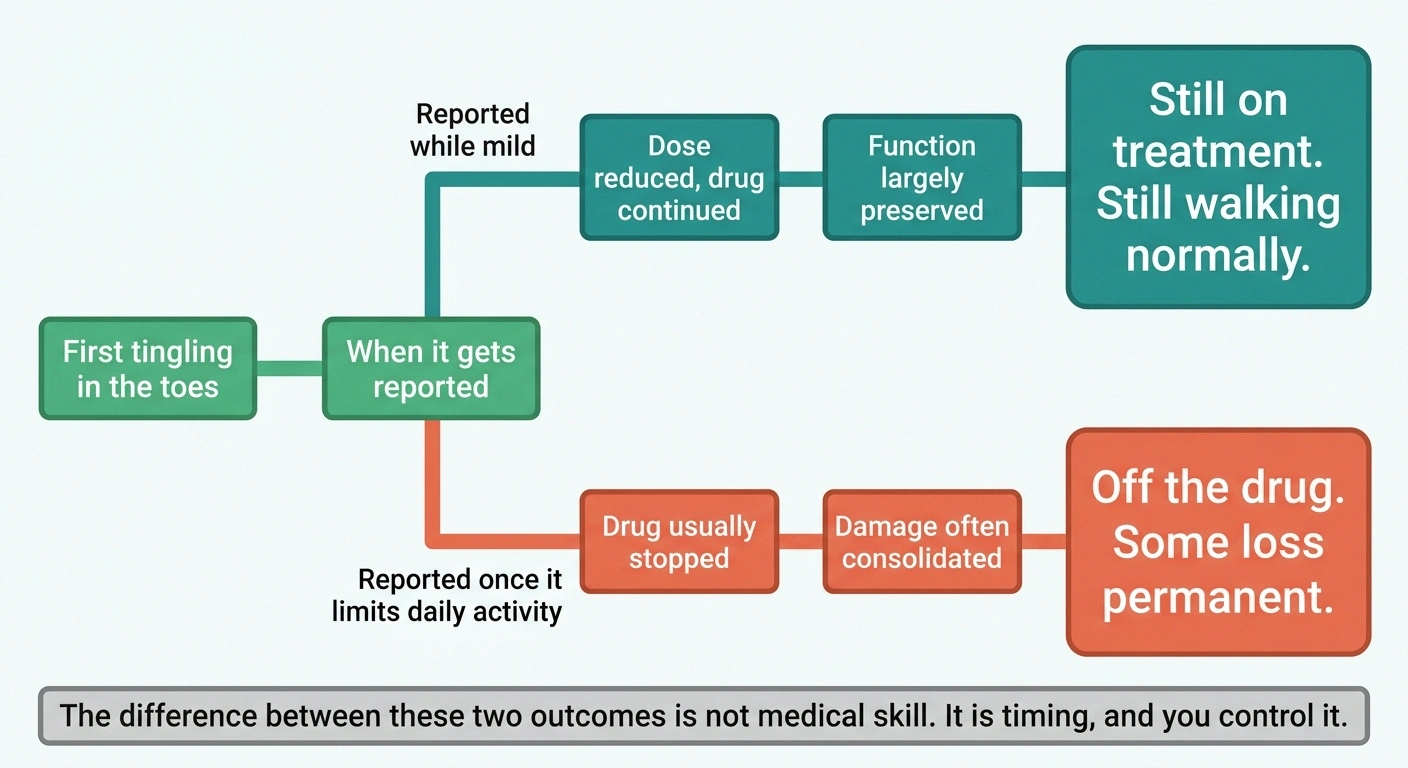
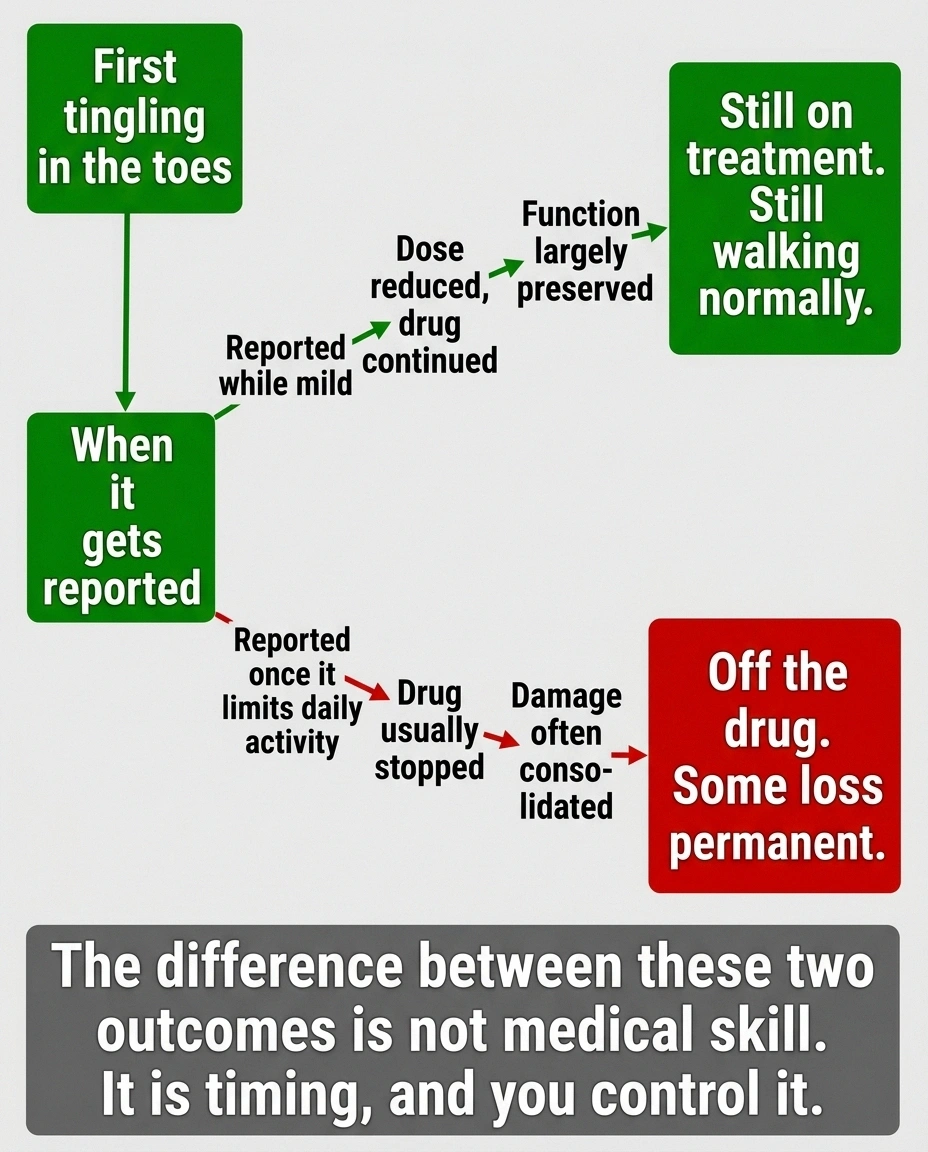
There is a management ladder for thalidomide neuropathy. It exists, it is standardized, and it works reasonably well. But it only works while the damage is still mild, because the whole strategy is to reduce exposure before the nerve loses more than it can rebuild.
Mild symptoms reported early usually mean a dose adjustment, and function is largely preserved. The same symptoms reported six months later, after they have progressed to interfering with walking or self-care, usually mean stopping the drug entirely, and by then a meaningful share of the loss is permanent.
The gap between those two outcomes is not medical skill. It is timing, and the timing is controlled almost entirely by when the patient speaks up.
Two reasons people wait, both understandable and both worth arguing with:
Not wanting to seem like a complainer. When your treatment team is managing a cancer, tingling toes feel trivial by comparison. They are not trivial to the team. Neurotoxicity is one of the specific things they are monitoring for, and reporting it is you doing your part of the job rather than adding to theirs.
Fear the drug will be taken away. This is the bigger one, and it is worth saying plainly: reporting early makes it far more likely you can stay on the drug at a reduced dose. Silence is what leads to full discontinuation, because by the time the damage announces itself loudly enough to be undeniable, the gentle options have expired.
Keep a written record between visits. Not a diary of feelings, just dates and changes: when a sensation started, where it reached, what it stopped you doing. Three lines a week is plenty, and a simple symptom log turns a vague impression into something a clinician can act on.
What a Dose Reduction Actually Looks Like

The standard approach is graded, and knowing it in advance removes a lot of the fear from the conversation.
Neuropathy that you notice but that does not change what you can do is typically watched closely with the dose unchanged. Once symptoms begin interfering with daily activities, thalidomide is generally held until they settle back toward baseline, then restarted at roughly half the previous dose. If symptoms return, another halving follows, and doses as low as 50 mg daily or every other day are used deliberately rather than as a last resort.
If neuropathy becomes severe or disabling, the drug is usually stopped for good and the regimen rebuilt around other agents.
What surprises people is how much room there is in the middle. This is not a binary between full dose and nothing. There is a wide band of reduced dosing where disease control is often maintained while the nerve stress comes down, and that band is the entire reason for reporting symptoms while they are small enough to be manageable.
Is It the Drug or Is It the Myeloma
Worth asking, because the answer changes what happens next, and because it is not automatic.
Four ways the disease itself reaches the nerves
- AL amyloid deposition. Misfolded light chains build up in nerve tissue. Often painful, often involves autonomic function too, so look for lightheadedness on standing, altered sweating, or new digestive trouble alongside the feet.
- Light chain effects without amyloid. Circulating proteins can disrupt nerve function directly. Tends to be slower and more purely sensory.
- Vertebral compression. A collapsed vertebra can compress a nerve root and produce symptoms in a band or stripe rather than a stocking pattern. Usually one-sided, and back pain is often present.
- POEMS syndrome. A rare plasma cell disorder in which neuropathy is the leading feature, typically with prominent weakness, skin changes and organ enlargement. Uncommon, but it explains cases where the neuropathy seems out of proportion to everything else.
Asymmetry, early weakness, or autonomic symptoms all argue for looking past the medication.
Multiple myeloma causes neuropathy on its own. Light chains produced by the disease can deposit in nerves. Amyloid deposition damages nerves directly. Vertebral collapse compresses nerve roots and produces symptoms that can be mistaken for a stocking-pattern neuropathy. And a fair number of people arriving at a myeloma diagnosis had a neuropathy beforehand, from diabetes or B12 deficiency or no identifiable cause at all.
Several clues point toward the drug rather than the disease. Timing that tracks with cycles. Strict symmetry. A pattern that starts at the toes and climbs. Progression that mirrors cumulative dose.
Clues that point elsewhere include asymmetry, a symptom that follows one nerve or one nerve root, prominent weakness early, or a neuropathy that was already there before treatment started.
This distinction is not academic. If the myeloma is driving the neuropathy, better disease control may improve it, which points toward treating harder rather than backing off.
Same Family, Different Nerve Risk
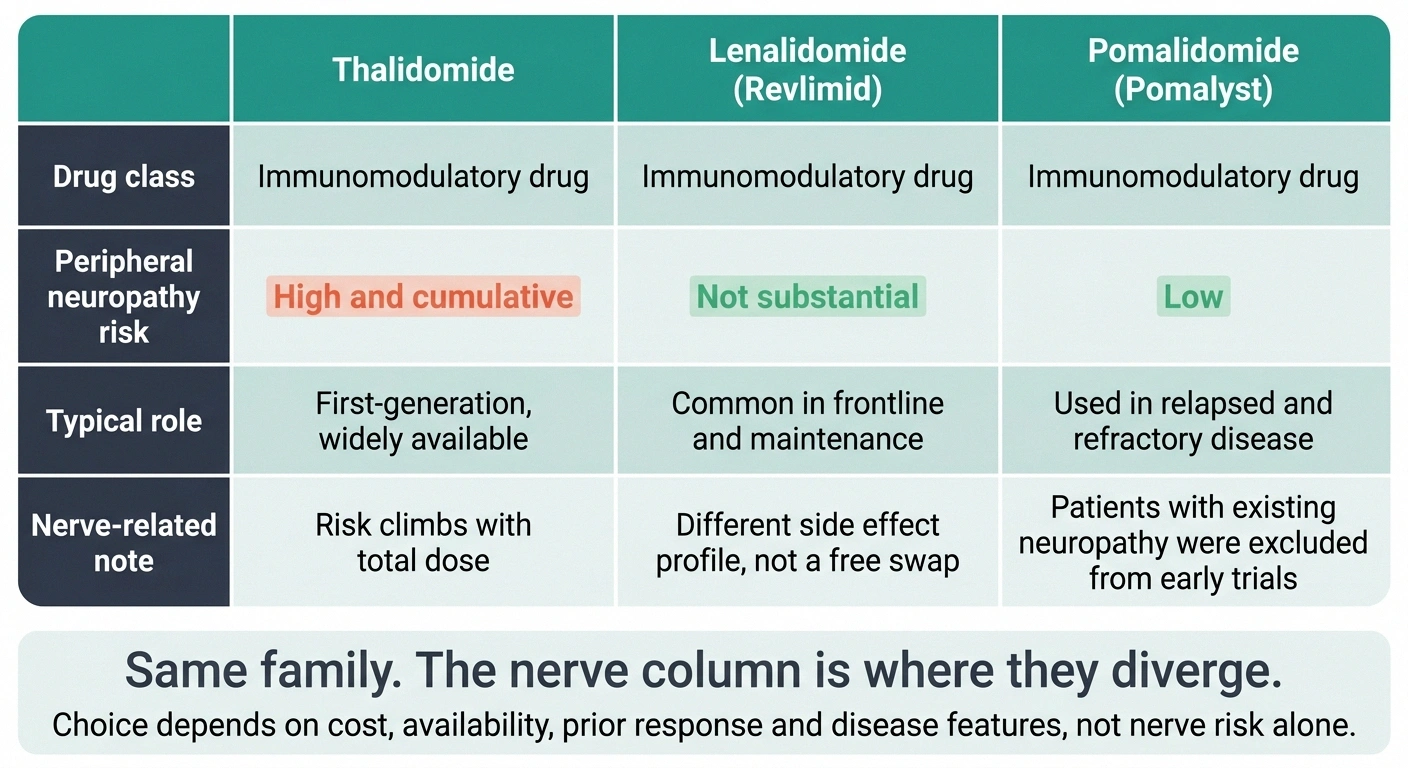
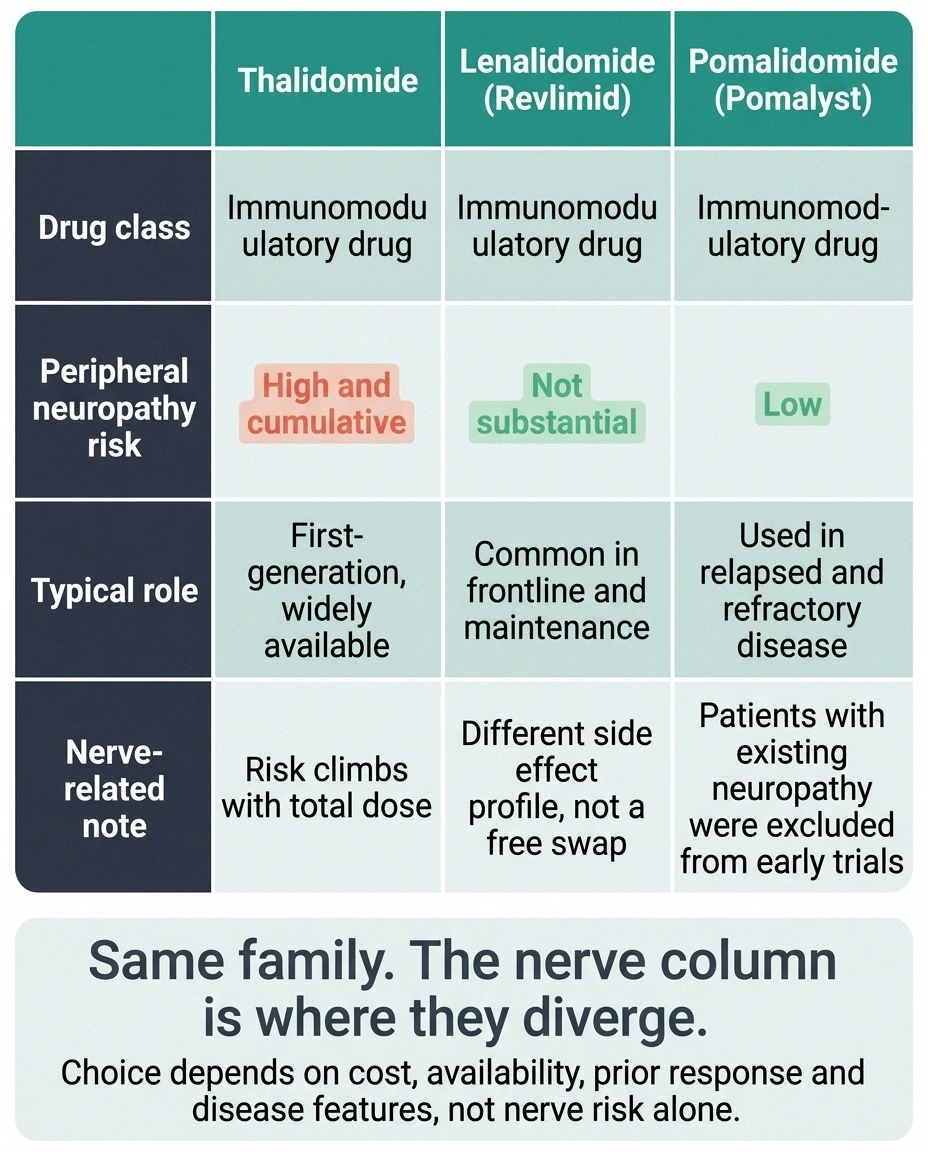
Thalidomide belongs to a class called immunomodulatory drugs, and it has two younger relatives: lenalidomide, sold as Revlimid, and pomalidomide, sold as Pomalyst.
Both were developed after thalidomide, and both are notably kinder to nerves. Lenalidomide does not appear to cause substantial neurotoxicity. Pomalidomide has shown low rates of new or worsening peripheral neuropathy in trials. Same drug family, materially different nerve profile.
That fact makes one question reasonable to ask, in a non-confrontational way: given my neuropathy, is there a role for a different agent in this class in my regimen?
There may not be. Thalidomide gets chosen for reasons that have nothing to do with preference, including cost, availability, insurance coverage, prior response, and specific disease features. In much of the world it is the immunomodulatory drug that is actually obtainable. But the question is fair, it is informed, and it occasionally changes a plan.
Worth knowing that bortezomib, a proteasome inhibitor often combined with thalidomide, also causes neuropathy through a different mechanism. Combination regimens compound the risk, which is one reason neuropathy rates in combination arms run higher than either drug alone would predict. A broader look at which drugs carry this risk is in our guide to medications that can cause neuropathy.
What to Do About What Stays

Some of it resolves. One analysis of a thalidomide and dexamethasone regimen reported peripheral neuropathy resolving in 95% of affected patients, and across the wider literature improvement after dose reduction or discontinuation is more common than not. Recovery gets measured in months rather than weeks.
The fall you want to prevent is the one at 3 a.m.
Numb feet remove the floor feedback you normally balance with, and myeloma-weakened bone raises what a fall costs. Five changes, in order of how much they buy:
- A lit path from bed to bathroom. Motion-activated plug-in lights at ankle height, not an overhead you have to cross the room to reach.
- Shoes indoors, including at night. Slippers with a back and a real sole, never loose scuffs.
- Loose rugs and trailing cords gone entirely. A rug edge you cannot feel is a trip you cannot correct for.
- A grab bar beside the toilet and inside the shower, mounted into studs. Towel rails fail under real load.
- Balance practice while holding a counter, two minutes daily. Standing balance responds to training even when sensation does not return.
And some of it does not. The prescribing information is explicit that the damage may be irreversible, and a real fraction of people are left with permanent change. Both facts are true at once, and holding both is more useful than choosing one.
One correction worth carrying, because you will run into it. A figure of 60% resolution within roughly six months circulates widely in discussions of myeloma treatment neuropathy. That number comes from the VISTA trial and describes bortezomib-associated neuropathy, not thalidomide. The two drugs are frequently given in the same regimen, which is how the figures get blended together. Applying the bortezomib number to thalidomide makes the outlook look better than the thalidomide evidence supports.
For symptoms that persist, the toolkit is the same one used for other nerve pain. Pregabalin and duloxetine are common starting points, with the choice usually shaped by what else you are taking and what other symptoms need covering.
Two practical matters deserve more attention than they usually get.
Falls. Reduced sensation in the feet degrades balance, and myeloma frequently weakens bone. That combination turns an ordinary stumble into a fracture. Home lighting, removing loose rugs, a rail on the stairs, and deliberate balance work are not fussy precautions in this context. Our guide to balance and fall prevention covers what actually reduces risk.
The weight of it. Persistent nerve pain during or after cancer treatment sits on top of everything else you are carrying, and it wears people down in a way that rarely gets named in an appointment. That is worth raising too. Our article on neuropathy and mental health covers the connection and what helps.
If you are early in treatment and reading this because you noticed something in your toes last week, you are exactly the person this article was written for. Say it out loud at the next appointment, even if it feels too small to mention. Small is precisely when it is worth mentioning.
Frequently Asked Questions
Does thalidomide neuropathy go away?
Sometimes. One analysis of a thalidomide and dexamethasone regimen reported resolution in 95% of affected patients, and improvement after dose reduction or stopping is more common than not, though it is measured in months rather than weeks. The prescribing information is also clear that the damage can be irreversible, and a meaningful fraction of people are left with permanent symptoms. Treat the widely quoted figure of 60% resolution in about six months with caution: it comes from the VISTA trial and describes bortezomib neuropathy rather than thalidomide. Reporting symptoms early and reducing the dose promptly improves the chance of recovery.
How long does it take for thalidomide neuropathy to start?
There is no fixed point. Risk accumulates with total dose and total time on the drug, so symptoms can appear within the first few cycles or emerge after a year of maintenance therapy. They can also begin or worsen after treatment has stopped, a recognized pattern called coasting. Because risk is cumulative rather than tied to any single week, monitoring needs to continue for the whole course.
What are the first signs of thalidomide neuropathy?
Usually symmetric tingling or numbness in the toes of both feet, sometimes with burning that becomes more noticeable at night. Reduced sensitivity to temperature is a common early sign that people first notice in the shower. Fingertips typically follow the feet by some months, showing up as difficulty with buttons, coins or small fastenings. Any of these should be reported at the next appointment rather than waited on.
Can you keep taking thalidomide if you develop neuropathy?
Often, yes, at a reduced dose. The standard approach holds the drug until symptoms improve toward baseline, then restarts at about half the previous dose, with a further halving if symptoms return. Doses as low as 50 mg daily or every other day are used deliberately. Continuing at a reduced dose is far more achievable when symptoms are reported while still mild, which is why early reporting tends to protect access to the drug rather than threaten it.
Is lenalidomide safer than thalidomide for nerves?
Regarding neuropathy specifically, yes. Lenalidomide, sold as Revlimid, does not appear to cause substantial neurotoxicity, and pomalidomide, sold as Pomalyst, has shown low rates of new or worsening peripheral neuropathy. All three belong to the same immunomodulatory drug class. Each has its own distinct side effect profile beyond nerves, and thalidomide is often chosen for reasons of cost, availability or specific disease features, so this is a question to raise rather than a substitution to assume.
Is my neuropathy from the myeloma or from the treatment?
Both are possible, and telling them apart matters. Drug-related neuropathy is typically symmetric, starts in the toes and climbs, and tracks with cumulative dose. Myeloma itself can damage nerves through amyloid deposition, light chain effects, or vertebral compression, and those patterns are more often asymmetric or follow a single nerve. Weakness appearing early, or symptoms that were present before treatment began, both point away from the drug.
Why did my symptoms start after I stopped thalidomide?
This is called coasting and it is a known behavior of this toxicity. Damage set in motion during treatment can continue to declare itself for weeks or months after the final dose, so a late start does not mean the medication was unrelated. It does not rule out other causes either. Weakness rather than numbness, symptoms on one side only, a band of numbness around the trunk, new back pain, or any change in bladder or bowel control all point away from coasting and toward spinal cord compression, amyloid involvement or active disease, and need urgent assessment. Report late-onset symptoms with the same promptness you would give early ones.
Will a nerve conduction study show thalidomide neuropathy?
Not always. Much of the early damage affects small nerve fibers that carry pain and temperature, while standard nerve conduction studies measure large fibers. That mismatch means the test can return normal results in someone with genuine symptoms. A normal study does not mean nothing is happening, and testing that specifically assesses small fibers, such as skin biopsy or quantitative sensory testing, may be more informative.
About the Author