
Most antibiotic labels do not come with an expiration date attached to the person taking them. Linezolid does. The prescribing information sets a maximum treatment duration of 28 days, and that number is not about the bacteria running out of patience. It is about what happens to the person after week four.
Plenty of people cross that line anyway, and for good reason. Drug-resistant tuberculosis, an infected prosthetic joint, stubborn osteomyelitis, endocarditis that will not clear. These are infections that take months to treat, and linezolid is sometimes the only oral drug left that works against them. So the 28-day line gets crossed deliberately, with a specialist watching, because the alternative is worse.
What often does not get explained is what is being watched for, or why the answer changes depending on which nerves are involved.
The 28-Day Line on the Label
Linezolid, sold as Zyvox and now widely available as a generic, belongs to a drug class called oxazolidinones. It works by shutting down bacterial protein production. That is a genuinely useful trick against organisms that have learned to shrug off everything else, including MRSA and vancomycin-resistant enterococcus.
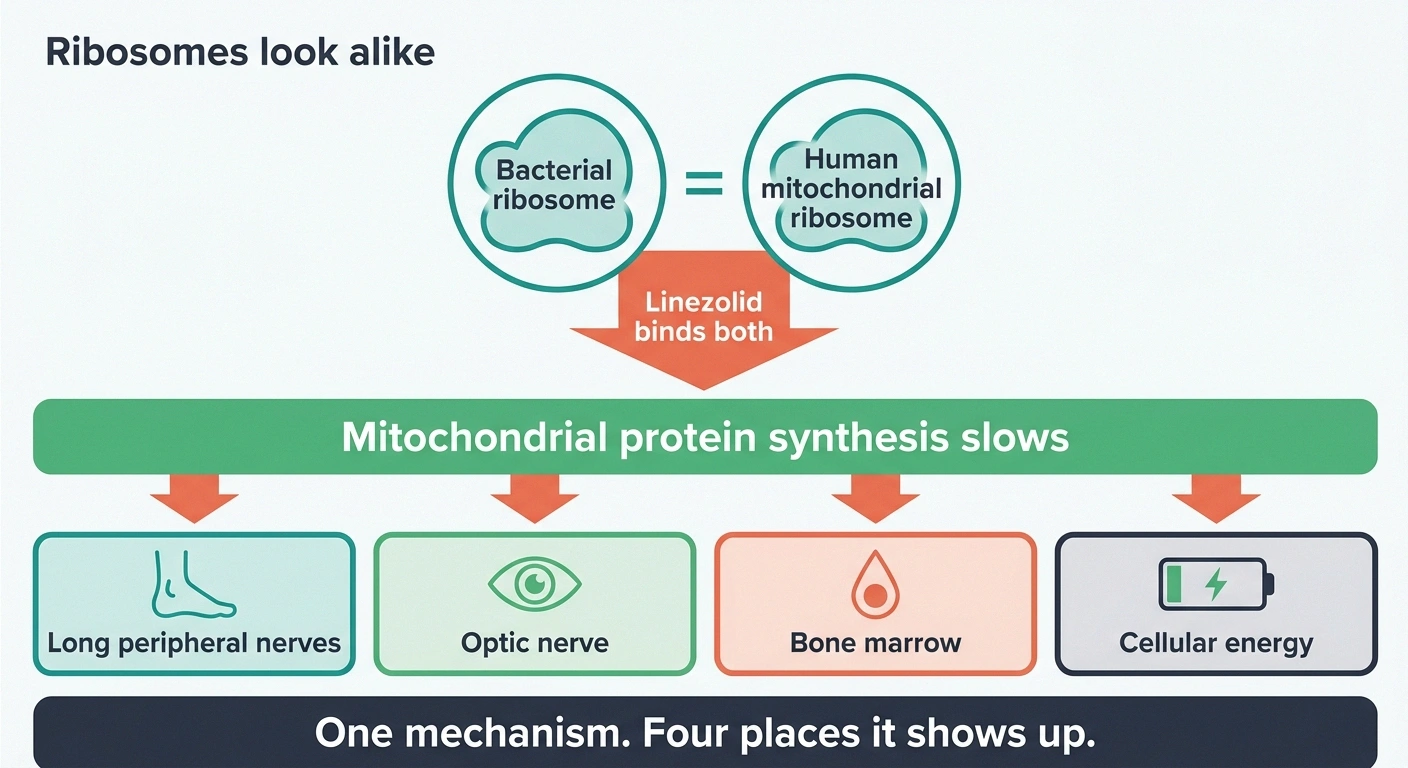
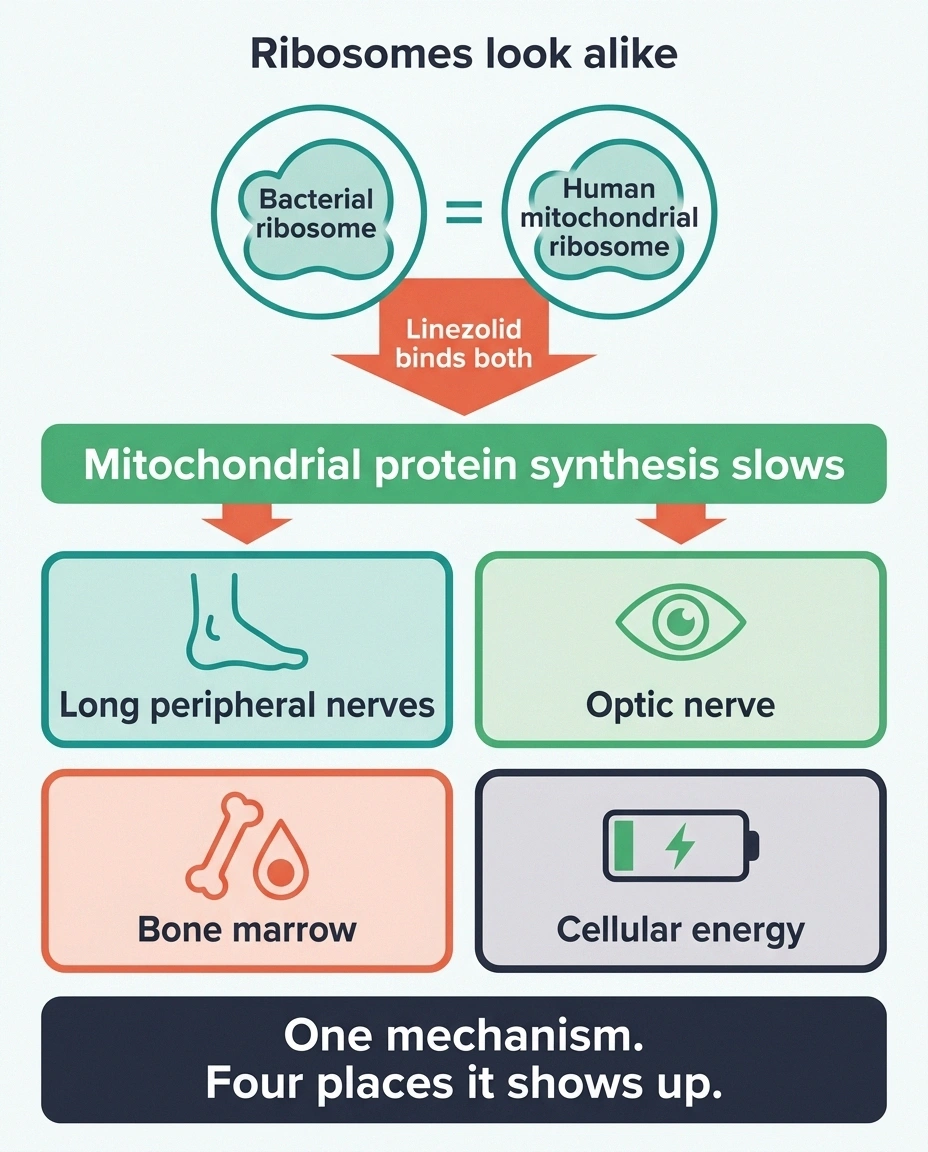
The problem is a resemblance. Bacterial ribosomes, the cellular machinery that builds proteins, look a great deal like the ribosomes inside human mitochondria. Mitochondria are the small power plants inside your cells, and they descend from ancient bacteria, which is why they kept the family resemblance. Linezolid cannot fully tell the difference. While it is dismantling bacterial protein synthesis, it is quietly interfering with mitochondrial protein synthesis too.
For two weeks, this barely matters. Mitochondria have reserves. For six months, it matters a great deal, and it matters most in the tissues that burn the most energy and sit the farthest from a fresh blood supply. Long nerves. Optic nerves. Bone marrow.
That single mechanism explains why the same drug causes anemia, low platelets, occasional lactic acidosis, and nerve damage. They are not four separate side effects. They are one problem showing up in four places.
Why the Clock Matters More Than the Dose
With many medications that damage nerves, the question is how much. With linezolid, the more useful question is how long.
Mitochondrial injury accumulates. A nerve cell can absorb a fair amount of it before function slips, which is why nothing happens in month one, and why so many people sail through a standard course with no trouble at all. Somewhere past the three-month mark the reserve runs low, and that is when symptoms tend to appear.
One series that tracked 21 patients with clinically significant peripheral neuropathy found the cases spread across the full year of treatment. Five showed up in the first four months. Ten arrived between months four and eight. Another five appeared between months eight and twelve. There is no single dangerous week. The risk simply keeps compounding for as long as the drug keeps going.
This is worth understanding for a practical reason. If you made it through month five with no symptoms, that is not a clean bill of health for month nine. The exposure is cumulative, and so is the surveillance you need.
What It Feels Like When It Starts

Linezolid peripheral neuropathy behaves like most toxic neuropathies. It is symmetric, it is sensory first, and it starts at the far ends. Both feet, not one. Toes before arches, arches before ankles.
Four words that move the conversation faster
Describing the sensation precisely saves a visit. These are the terms clinicians file symptoms under.
- Glove-and-stocking
- Numbness covering both feet and both hands in the pattern the clothing would. Confirms a length-dependent process rather than a single trapped nerve.
- Allodynia
- Pain from something that should not hurt, such as a bedsheet or a sock seam.
- Hyperesthesia
- Ordinary touch registering far louder than it should. Different from allodynia, which crosses into pain.
- Coasting
- Symptoms that start or worsen after the drug is stopped. Naming it prevents the assumption that a late onset rules the medication out.
People describe it in the usual ways: pins and needles that do not resolve, a sock-like band of numbness, feet that feel padded or distant from the floor, or a slow burn that shows up in the evening. If you want the fuller catalog of how nerve pain announces itself, our piece on burning feet syndrome walks through the sensations in detail.
Fingertips can join later. Weakness is uncommon early and would be a reason to raise the volume of the conversation considerably.
The change most people notice first is not pain at all. It is a small loss of precision. Buttons take an extra second. You start looking at your feet on stairs. Someone mentions you are walking differently before you have consciously registered anything.
Write it down when it starts. Not the day you finally mention it, the day you first noticed. On a long antibiotic course that date becomes a real piece of clinical information, and nobody remembers it accurately three months later. Three lines in a notebook is enough.
Your Eyes Run on a Different Clock
Here is the part that almost never makes it into a patient conversation, and it is the part most worth carrying out of this article.
Call the same week. Do not wait for the next appointment.
Any of these on a linezolid course running past two months:
- Reading has become harder than it was a month ago
- Reds and greens look washed out or hard to separate
- A dim, grey or blurred patch sits near the center of your sight
- One eye now sees noticeably differently than the other
Say it like this: “I have been on linezolid for [number] months and my vision has changed in the last few weeks. I understand this can be reversible if it is caught early. Can I be seen before my next scheduled visit?”
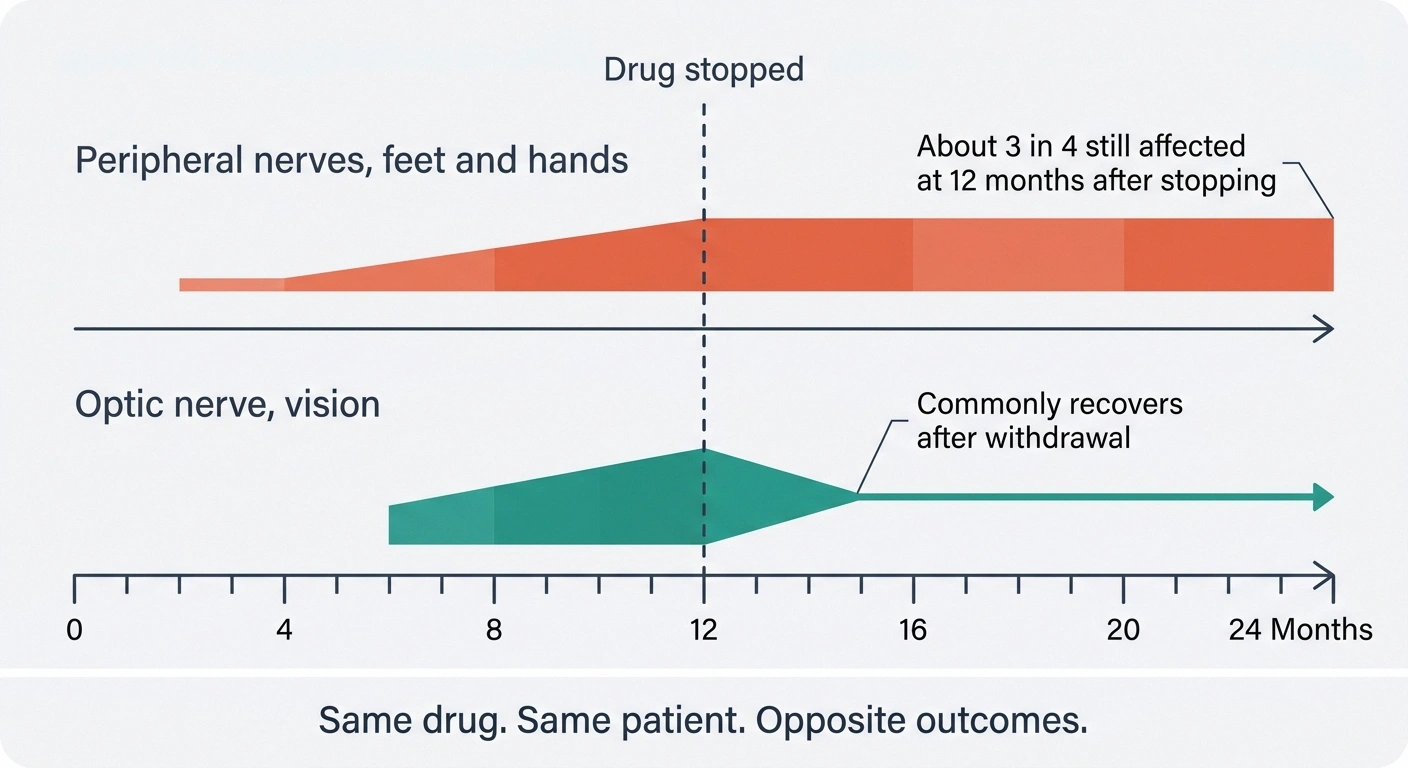
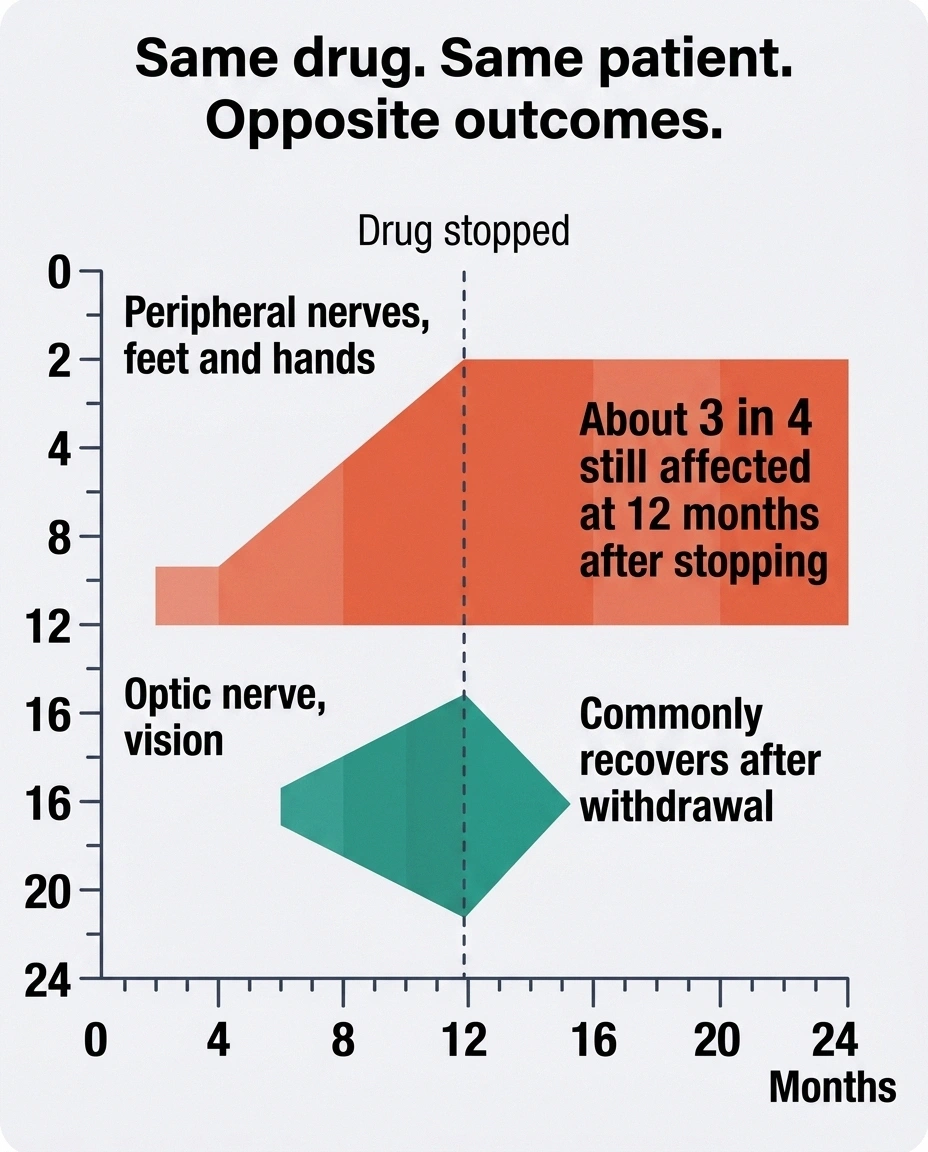
Linezolid also damages the optic nerve. That damage tends to appear later than the peripheral kind, usually somewhere between five and ten months of continuous treatment, and in long-course populations it has been reported in roughly 30% of patients who were formally examined.
But optic neuropathy from linezolid is substantially reversible. Stop the drug, and vision often comes back.
Peripheral neuropathy from linezolid frequently is not. In one carefully followed cohort of patients treated for multidrug-resistant tuberculosis, peripheral neuropathy was confirmed in about a third of the group, and 78% of those cases were still unresolved a full year after linezolid had been withdrawn.
Two nerve problems, same drug, opposite prognoses. The feet keep what they were given. The eyes usually give it back.
The consequence is direct. Blurred vision, colors that look washed out, a dim or grey patch near the center of your sight, or trouble reading something you could read last month are not things to raise at the next scheduled visit. On long-course linezolid, they are a this-week phone call, because there is a recovery window and it is spendable. Waiting does not preserve it.
Red and green are usually the first colors to fade. It is a subtle enough change that people talk themselves out of it, which is exactly the problem.
What the Numbers Actually Say
The published incidence figures for linezolid neuropathy look wildly inconsistent until you sort them by treatment length, at which point they line up neatly.
In the original registration data, peripheral neuropathy showed up in fewer than 1% of patients. Three cases out of 796. All three had received prolonged courses. That figure gets quoted a lot, and it is accurate for the population it describes, which is people taking linezolid for a couple of weeks for pneumonia or a skin infection.
It is close to meaningless for someone eight months into tuberculosis treatment. In that population, the honest number is around 32%.
Both figures are real. They describe different situations. If you are on a two-week course, the sub-1% number is yours, and there is very little here to worry about. If you are on a six-to-twelve-month regimen, plan around the higher one.
This pattern is not unique to linezolid. Plenty of medications carry a nerve risk that is nearly theoretical at normal exposure and substantial at extended exposure, which our overview of medications that can cause neuropathy covers across drug classes.
The Dose Conversation Worth Having

For years the standard linezolid dose was 600 mg twice daily. In long treatment courses that turned out to be more than necessary, and considerably more than the nerves could tolerate.
How severity maps to the usual response
| What you are experiencing | Typical response |
|---|---|
| Tingling or numbness you notice but that changes nothing about your day | Document it, continue, monitor more closely |
| Symptoms that interfere with tasks like buttons, stairs or handwriting | Reduce to 300 mg daily, sometimes after a one to two week pause |
| Symptoms limiting self-care, or any weakness | Usually stop linezolid and rebuild the regimen around it |
The top row is the one worth acting on. It is the only rung where a dose change still buys back function.
The evidence now supports lower exposure. In drug-resistant tuberculosis regimens combining bedaquiline, pretomanid and linezolid, a 600 mg daily dose given for 26 weeks produced favorable outcomes in 89% of patients, with peripheral neuropathy in 24% and notably fewer forced dose interruptions than higher-dose arms. Structured reduction strategies stepping down from 600 mg to 300 mg have held treatment success in the 88% to 94% range while cutting nerve injury further.
The cure rate barely moved. The nerve damage did.
There is also a defined response when symptoms appear. Moderate peripheral neuropathy generally prompts a reduction to 300 mg daily, sometimes preceded by a drug holiday of one to two weeks. More severe neuropathy usually means stopping linezolid permanently and rebuilding the regimen around it.
To be clear about what those numbers are: they describe what published regimens and treatment guidance actually do, not instructions for you to follow. Nobody should change or stop an antibiotic treating a serious infection on their own. The reason to know them is so you recognize the options when they are offered, and can ask about them when they are not.
None of that happens if nobody knows your feet have changed. The reduction ladder exists, it works, and it is only available to people who report early. Symptoms mentioned at the six-week mark can often be managed with a dose adjustment. The same symptoms mentioned six months later have usually already become the permanent kind.
What Should Be Checked, and How Often
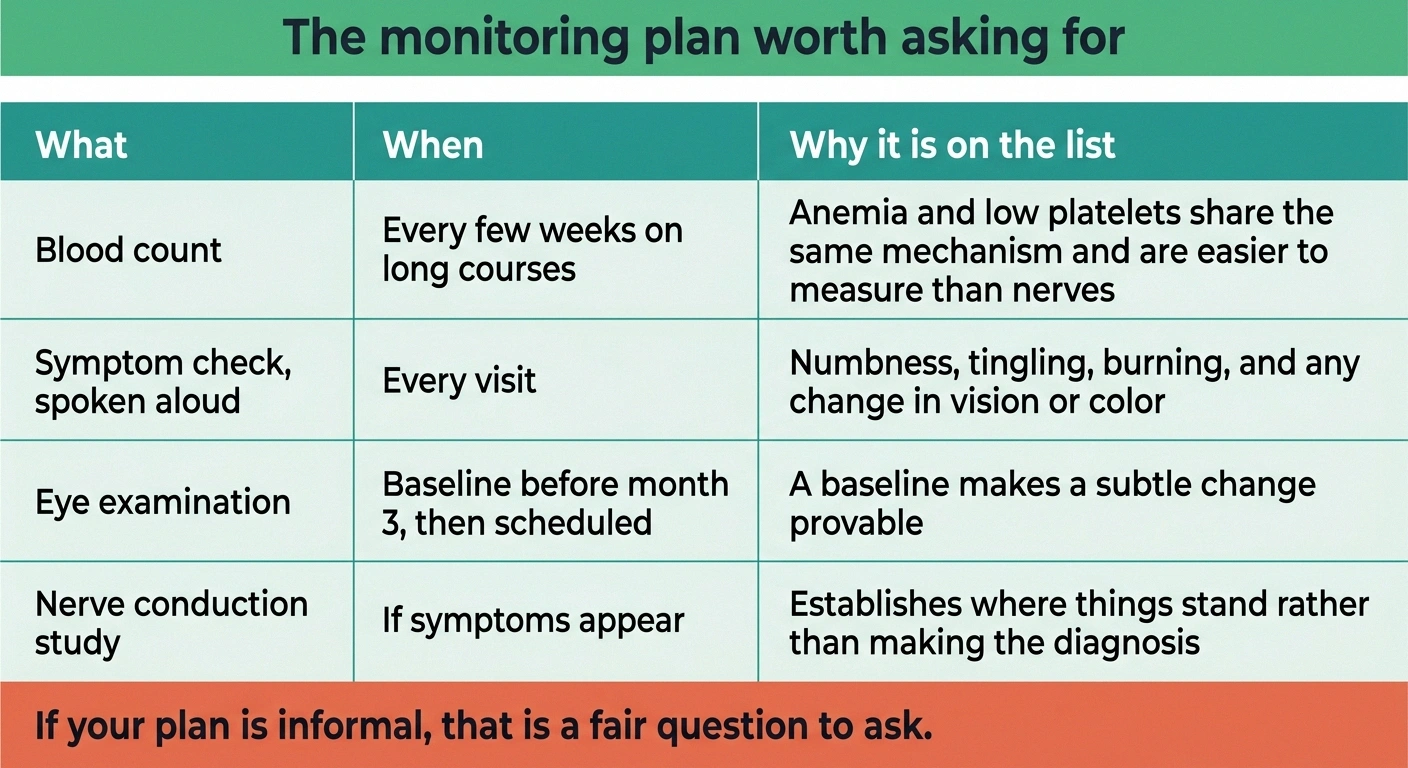
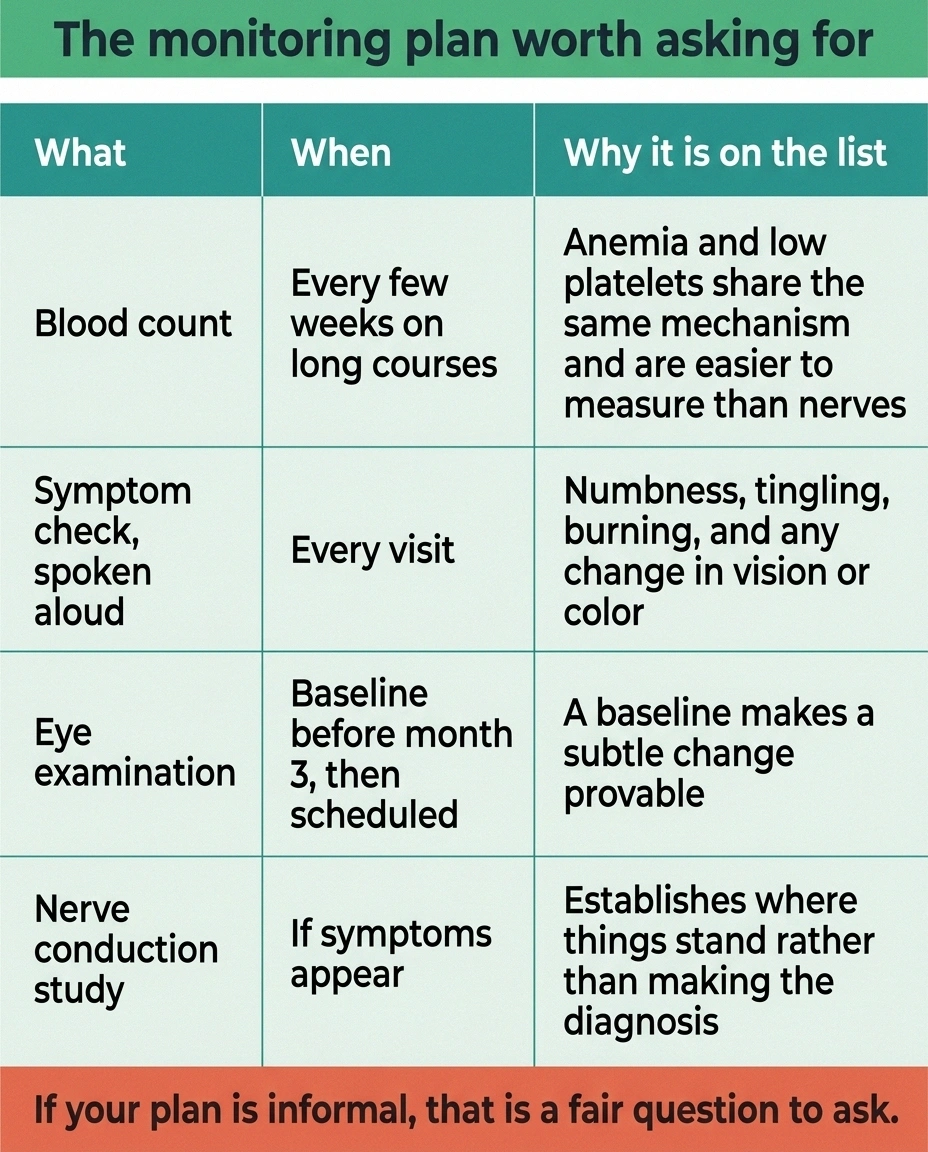
Anyone on linezolid past the one-month mark should have a monitoring plan in place. If yours is informal, it is reasonable to ask what it consists of.
- Blood counts. Anemia and low platelets share the mitochondrial mechanism with the nerve damage and are far easier to measure. A falling hemoglobin is sometimes the first objective sign that the mitochondrial toll is mounting.
- A symptom check at every visit. Specifically about numbness, tingling, burning, and any change in vision or color perception. Vague questions get vague answers.
- Baseline eye examination for courses expected to exceed a few months, with repeat examinations scheduled rather than left to chance. A baseline you can compare against is worth a great deal when the change is subtle.
- Nerve conduction testing if symptoms appear. It is not required to make the diagnosis, but it establishes where things stand. Our guide to neuropathy diagnosis and the tests involved explains what these studies do and do not capture.
You will also see B vitamins used alongside linezolid in practice, including pyridoxine, benfotiamine and methylcobalamin, frequently given even when blood levels of B12 come back normal. The reasoning is that mitochondrial stress raises demand for these cofactors regardless of what a serum level shows. The evidence that this prevents linezolid neuropathy is thin. It is inexpensive and low-risk, which is why it is common, but treat it as support rather than protection. Our comparison of B12 injections and oral supplements covers when the delivery route genuinely matters.
Worth knowing separately: linezolid has mild MAO-inhibiting activity, so combining it with SSRIs, SNRIs, tramadol or triptans carries a serotonin syndrome risk. That is unrelated to nerve toxicity, but it becomes relevant the moment someone suggests duloxetine for the neuropathy the linezolid caused. Your prescriber will already be thinking about this. It is still worth naming, because the two conversations happen with different specialists.
If You Have Already Finished the Course

Some readers arrive here after treatment ended, which changes the useful questions.
A realistic recovery calendar
Nerves regrow at roughly 1 mm per day. From the lower spine to the toes is about 1,000 mm, which sets the pace of everything below.
- Months 0 to 3 after stopping: often no change at all, and symptoms may briefly worsen. This is expected and is not a sign the drug is still doing damage.
- Months 3 to 9: the window where most measurable improvement begins, usually as shrinking numb territory rather than reduced pain.
- Months 9 to 18: slow continued gains. Vision, if it was affected, will typically have resolved long before this point.
- Beyond 18 months: whatever remains is likely to be the long-term picture. Roughly three in four long-course cases still have symptoms at the one-year mark.
Recovery from linezolid peripheral neuropathy, when it comes, is slow. Peripheral nerves regenerate at roughly a millimeter a day under good conditions, and the distance from the lower spine to the toes is not short. Meaningful change is measured in months, and improvement that arrives at month eighteen is still improvement. Our article on whether neuropathy can be reversed lays out what nerve repair realistically looks like.
The honest framing is this: a substantial share of long-course cases do not fully resolve. That is not a reason to stop working on it, but it is a reason to spend energy on function rather than exclusively on cure. Symptom management, foot protection, and balance work all pay off regardless of what the nerve does.
Symptomatic treatment for what remains is the same toolkit used for other nerve pain. Gabapentin and duloxetine are the usual starting points, with the serotonin caution above applying only while linezolid is still on board.
And if sensation in your feet is reduced, the protective habits matter more than they did before. Numb feet do not report injuries. Daily visual inspection, properly fitted shoes, and never walking barefoot on unfamiliar ground are small routines that prevent large problems, and our foot care guide covers the full routine.
One last thought for anyone in the middle of a long course right now. This drug is being used because something serious required it. The goal is not to be afraid of it. The goal is to be the patient who notices early, says so plainly, and gives the team the chance to adjust while adjusting still helps.
Frequently Asked Questions
How long can you safely take linezolid?
The label sets a maximum of 28 days, and courses within that window carry very little nerve risk. Longer courses are used deliberately for infections like drug-resistant tuberculosis, prosthetic joint infection and osteomyelitis, where no better oral option exists. Beyond about three months the risk of nerve damage climbs steadily, which is why extended courses should come with a defined monitoring plan rather than being left to run unwatched.
Does linezolid nerve damage go away after stopping?
It depends entirely on which nerves are affected. Optic neuropathy from linezolid is largely reversible and vision commonly recovers after the drug is withdrawn. Peripheral neuropathy in the hands and feet often does not fully resolve. In one long-course cohort, 78% of confirmed peripheral neuropathy cases remained unresolved twelve months after linezolid was stopped.
What are the first signs of linezolid neuropathy?
Usually symmetric numbness or tingling in both feet, beginning at the toes and moving upward. Some people notice burning in the evening, a padded or distant feeling underfoot, or reduced fine control in the fingers. Loss of precision with small tasks often appears before any pain does. Any of these on a course lasting more than a month is worth reporting promptly.
Can linezolid affect your eyesight?
Yes. Linezolid can cause optic neuropathy, typically after five to ten months of continuous treatment, and roughly 30% of formally examined patients in long-course populations have shown it. Blurred vision, faded color perception, or a dim patch near the center of vision should be reported within days rather than waiting for a scheduled appointment, because this form of damage has a genuine recovery window.
Why does linezolid cause nerve damage at all?
Human mitochondria carry ribosomes that closely resemble bacterial ribosomes, and linezolid targets bacterial ribosomes. It therefore partially inhibits mitochondrial protein production in human cells. Long nerves and optic nerves have high energy demands and limited reserve, so they show the damage first. The same mechanism explains the anemia and low platelet counts that can accompany extended treatment.
Will lowering the dose help?
Frequently, yes. Reducing linezolid from 600 mg to 300 mg daily has preserved treatment success rates between 88% and 94% in drug-resistant tuberculosis regimens while lowering the rate of peripheral neuropathy. Moderate neuropathy is commonly managed with a dose reduction, sometimes after a one to two week pause. Severe neuropathy usually calls for stopping the drug and rebuilding the regimen around it.
Should I take B6 or B12 while on linezolid?
Pyridoxine, benfotiamine and methylcobalamin are often given alongside long linezolid courses, sometimes even when B12 blood levels are normal, on the reasoning that mitochondrial stress raises demand for these cofactors. The evidence that this prevents nerve damage is limited. It is low-cost and low-risk, so it is widely used, but it should not be treated as protection that makes monitoring unnecessary.
Is linezolid neuropathy the same as chemotherapy neuropathy?
They look similar from the outside, since both are symmetric, sensory-predominant and start in the feet. The mechanisms differ. Linezolid damages mitochondrial protein synthesis, while chemotherapy agents typically disrupt the nerve's internal transport structures or damage the nerve cell bodies directly. The practical overlap is real, which is why the symptom management strategies are largely shared.
About the Author