
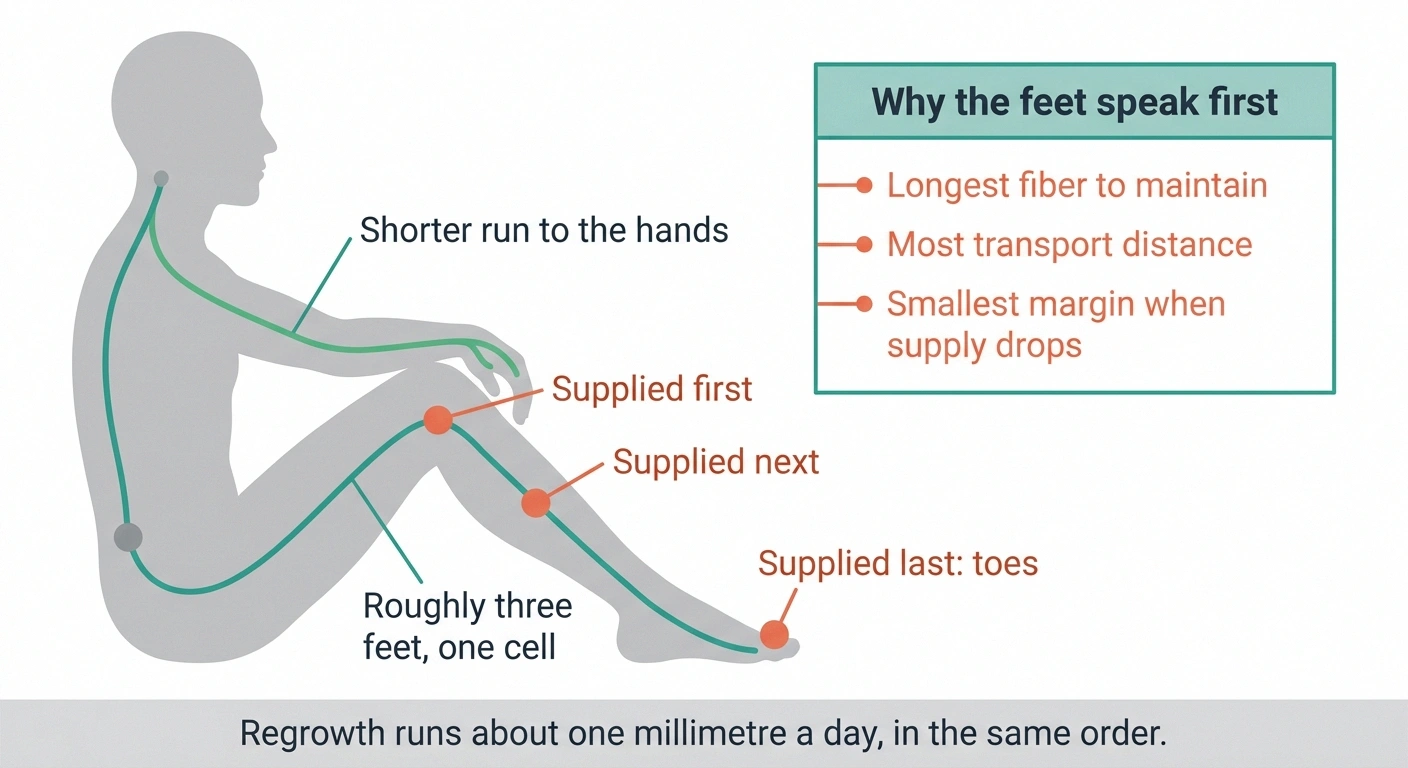
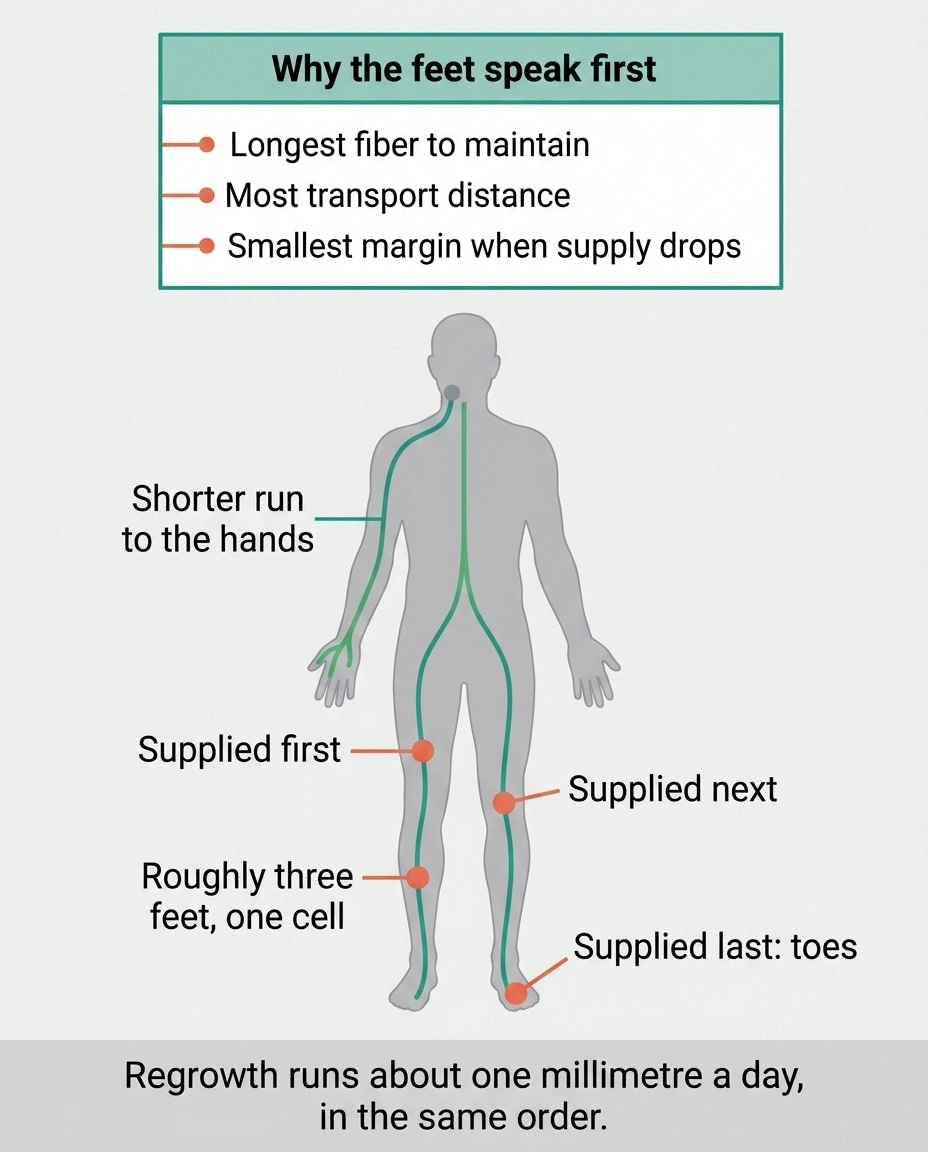
Nerves are among the most metabolically demanding tissue you own. A single nerve cell running from the base of your spine to your big toe has to manufacture, transport and maintain a fiber roughly three feet long, keep an electrical gradient charged along its entire surface, and do it continuously, without a night off, for your whole life.
That work runs on a specific set of nutrients. When those nutrients stop arriving, nerves are not spared. And because the longest fibers have the most to maintain and the least margin, they fail first, which is why the feet almost always speak before anything else does.
This is one of the least discussed consequences of restricted eating, and one of the most frightening when it appears, because burning feet and numb hands feel permanent in a way that most other symptoms do not. The honest picture is more hopeful than that, and also more complicated. Here is what actually happens to nerves during malnutrition, what tends to recover, and what the treatment should include.
Why Nerves Fail Early When Food Is Scarce
Three properties of peripheral nerves make them vulnerable.
They cannot store much. Unlike fat or muscle, a nerve carries almost no reserve of the vitamins it needs. Thiamine, the most critical one, is held in the body in quantities measured in weeks rather than months.
They are long, and length costs. Everything a nerve needs has to be manufactured in the cell body and shipped down the fiber. The further the destination, the more the transport system has to deliver, and the sooner shortfalls show. This is why nutritional neuropathies produce the classic pattern of toes first, then feet, then hands, working inward.
They are electrically expensive. Maintaining the charge across a nerve membrane consumes a large share of the body's energy budget even at rest. When energy intake drops far enough for long enough, that budget gets cut like any other.
What the person actually notices is usually mild at first and easy to attribute to something else. Feet that feel cold when the room is not. Pins and needles in the toes at night. A patch of numbness on the outside of a foot. Legs that feel heavy on stairs. Because so many other things are happening at the same time, nerve symptoms are often the last thing anyone mentions and the last thing anyone asks about.
Thiamine: The One That Runs Out First
Vitamin B1, thiamine, is the headline deficiency in restricted eating, and it is worth understanding on its own.
Thiamine is required to turn carbohydrate into usable energy. Without it, cells that depend heavily on that pathway fail, and the two most dependent systems are the nervous system and the heart. The resulting condition is called beriberi, which comes in two forms. Wet beriberi involves the heart. Dry beriberi is the nerve version.
Dry beriberi produces a sensorimotor polyneuropathy that is bilateral and roughly symmetrical, in the familiar stocking and glove distribution, with the legs affected before the arms. The specific complaints described in the clinical literature are paresthesias in the toes, burning in the feet, cramping in the calves, and painful sensations in the soles. Weakness follows, usually starting with the muscles that lift the foot and rise from a chair. Reflexes fade.
Thiamine deficiency has been documented repeatedly in adolescents and adults with anorexia nervosa, and in at least one published case it produced a picture so rapidly progressive that it was initially mistaken for Guillain-Barré syndrome. It also underlies Wernicke encephalopathy, the brain form, which brings confusion, eye movement abnormalities and unsteadiness, and which is a medical emergency.
One detail matters more than any other here, and it is routinely missed. Neurologic damage from thiamine deficiency can occur in this setting despite a normal serum thiamine level. The blood test is unreliable. Clinicians who understand this treat empirically when the clinical picture fits rather than waiting for a number to authorize them. If a normal thiamine level has been used to close the question in your case, that reasoning is worth challenging.
The Deficiencies That Rarely Travel Alone

Thiamine gets top billing, but nutritional neuropathy is almost never a single-vitamin story. The literature on nerve damage after bariatric surgery, which produces the same deficiencies by a different route and has been studied far more thoroughly, describes the cause as polynutritional. Thiamine dominant, with several others contributing.
Five deficiencies, five different signatures
They overlap and they cluster, but each leaves a slightly different fingerprint. Knowing which one you are describing shortens the conversation.
- Thiamine (B1)
- Fastest to appear. Burning feet, calf cramps, tingling toes, then weakness lifting the foot. Blood level is unreliable, so treatment is often started without waiting for it.
- Vitamin B12
- Slow and insidious. Numbness plus unsteadiness that is noticeably worse in the dark, because position sense is failing. Reflexes may be brisk rather than absent.
- Copper
- Nearly identical to B12 and routinely mistaken for it. Test it separately. High zinc intake is a common hidden cause.
- Vitamin E
- Unsteady walking from lost position sense, alongside sensory symptoms. Tends to respond well to replacement.
- Vitamin B6
- Works in both directions. Too little causes neuropathy and too much causes neuropathy, which makes it the one supplement most likely to be self-prescribed into harm.
Vitamin B12. Causes a combination of peripheral neuropathy and damage to the spinal cord itself, which produces a distinctive mix of numbness, unsteadiness that is much worse in the dark, and sometimes brisk reflexes rather than absent ones. It develops slowly and insidiously. It is also the deficiency where early treatment matters most, because established spinal cord involvement often does not fully reverse. Our comparison of B12 injections and oral supplements covers how repletion is usually handled.
Copper. Produces a picture that looks almost exactly like B12 deficiency and gets misdiagnosed as one, or occasionally as a demyelinating disease. It is worth testing separately rather than assuming. One trap: high zinc intake causes copper deficiency by blocking its absorption, so supplements taken to help can quietly create the problem.
Vitamin E. Causes sensory ataxia, meaning a loss of position sense that makes walking unsteady, along with neuropathy. It tends to respond well to replacement.
Folate and vitamin B6. Both contribute. B6 deserves a specific warning because it works in both directions: too little causes neuropathy and too much also causes neuropathy. This is one of the few vitamins where enthusiastic self-supplementation causes the exact problem it is meant to solve.
Our broader guide to vitamin deficiencies that cause neuropathy covers each of these in more depth. The practical point for this situation is that testing should be broad rather than targeted, because finding one deficiency does not mean you have found the only one.
Nerve Damage That Has Nothing to Do With Vitamins
There is a second mechanism that almost nobody warns people about, and it is entirely mechanical.
Positions worth changing today
These cost nothing, work within days, and address a mechanism that no vitamin will fix.
- Stop crossing your legs at the knee. The peroneal nerve sits directly under the skin at the outer knee. Crossed legs press one bone into that nerve for however long you sit.
- Put something soft between you and every hard surface. Chair seats, chair edges, mattress on the side you sleep on. A folded towel is enough.
- Stop resting on your elbows. Table edges, desk edges, arm rests. The ulnar nerve runs through a shallow groove there with nothing to protect it.
- Sleep with arms straighter. A tightly bent elbow held for hours stretches and compresses the same nerve. A loose towel wrapped around the elbow is the standard trick.
- Change position every twenty minutes or so. Duration does the damage more than pressure does.
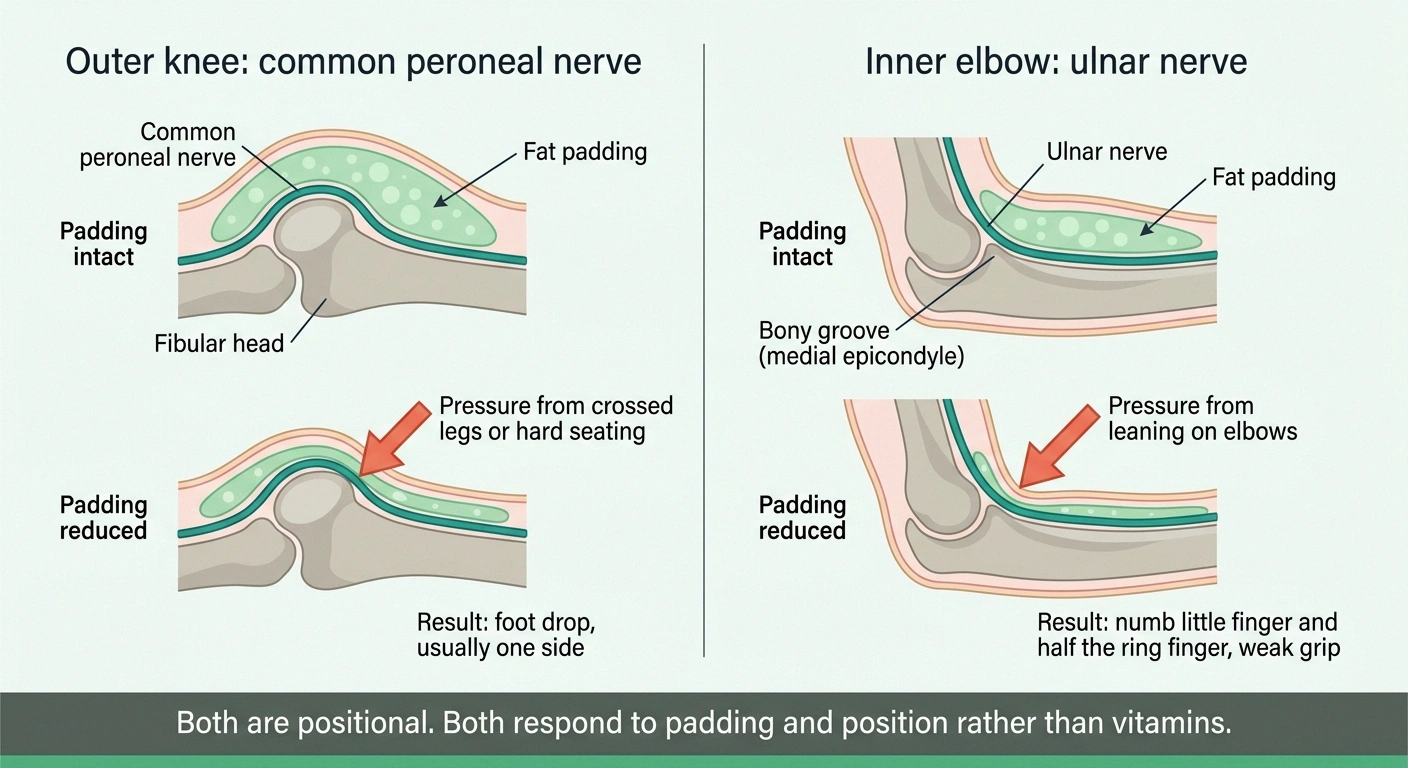
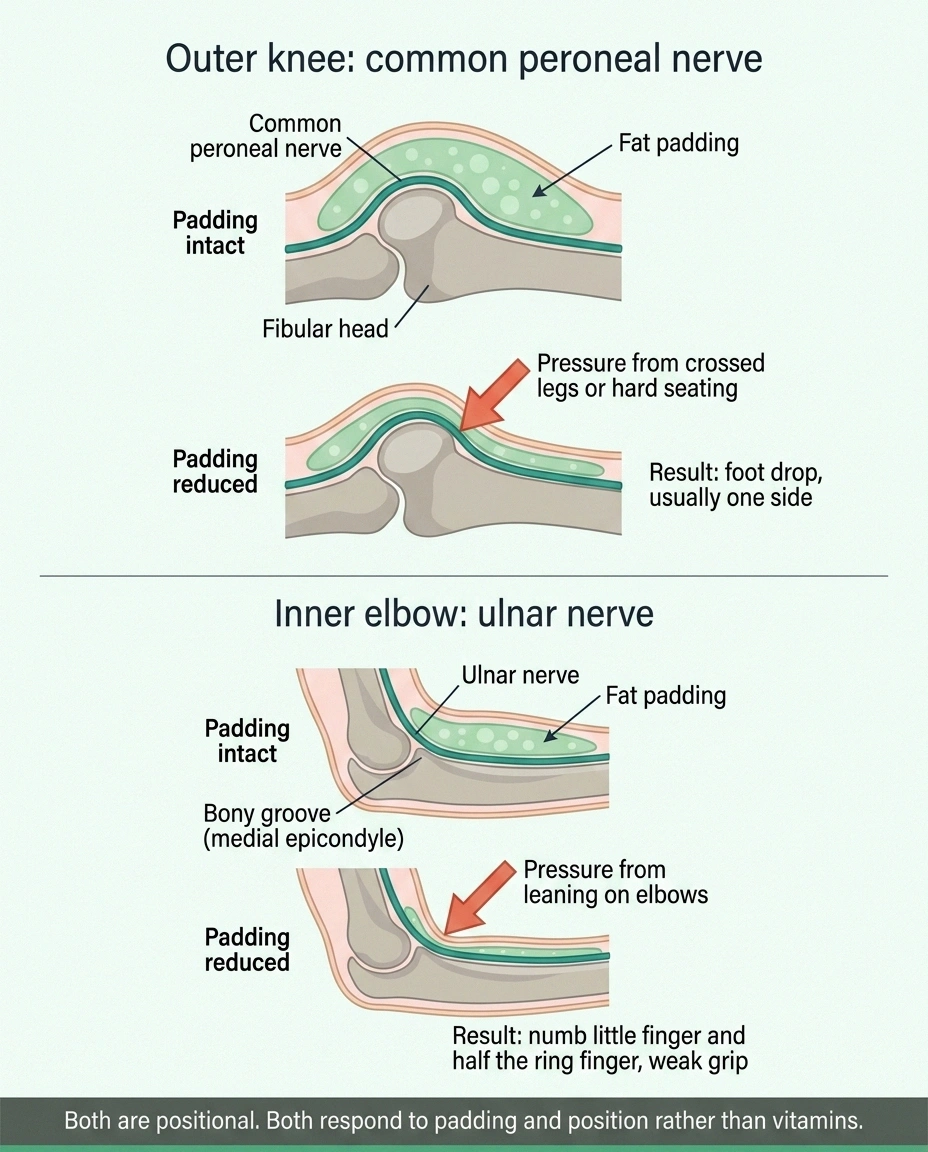
Several nerves in the body run just under the skin across a bony surface, cushioned only by a layer of fat. When that padding thins, the nerve loses its protection and becomes vulnerable to pressure from ordinary positions.
The common peroneal nerve wraps around the outside of the knee at the head of the fibula, where you can feel the bone just below the joint. Compress it, by crossing your legs, sitting on a hard chair edge, or lying on your side on a firm surface, and it stops working. The result is foot drop: the foot no longer lifts properly, the toes catch on the floor, and walking turns into a deliberate high step.
The ulnar nerve runs through a groove at the inside of the elbow. Leaning on your elbows at a table, or sleeping with arms tightly bent, compresses it and produces numbness in the little finger and half the ring finger, along with weakness of grip.
Both of these can appear within days rather than months, both are frequently mistaken for the vitamin-related neuropathy, and both respond to something much simpler: padding, position changes, and avoiding the specific postures that compress them. A physiotherapist or occupational therapist can identify the positions doing the damage faster than anyone else on the team.
Refeeding, and Why Symptoms Can Get Louder Before They Get Quieter

Restarting nutrition after a long period of restriction is not a neutral event. The body shifts abruptly out of a conservation state, and several things happen at once.
What is actually happening in that first week
Two separate processes, running at the same time, both capable of making nerve symptoms louder. Neither means eating is the wrong thing to be doing.
Thiamine gets consumed
Processing carbohydrate uses thiamine. A reserve that was already thin can drop into symptomatic territory within days, which is why thiamine is given before or alongside the first real carbohydrate load.
Phosphate leaves the bloodstream
Phosphate, potassium and magnesium shift into cells. More than a quarter of hospitalized adolescents develop low phosphate during this window, and low phosphate itself causes weakness and pins and needles.
The line that matters: new weakness, rapidly spreading numbness, or any change in breathing during refeeding is an urgent call, not a wait-and-see.
Carbohydrate metabolism restarts, and it consumes thiamine. If reserves are already low, that surge can tip a marginal deficiency into a symptomatic one. This is precisely why thiamine is given before or alongside the first significant carbohydrate load in properly supervised refeeding, and why doing this at home without oversight is genuinely risky.
At the same time, phosphate, potassium and magnesium move rapidly from the bloodstream into cells. Falling phosphate is the central feature of refeeding syndrome, and more than a quarter of adolescents hospitalized for malnutrition from anorexia nervosa develop at least mild hypophosphatemia during this period. Low phosphate can cause muscle weakness, paresthesias, and in severe cases an acute paralysis with absent reflexes.
So a person can begin eating again, which is unambiguously the right thing, and find that their hands tingle more, their legs feel weaker, and their feet burn harder for a stretch. That pattern is recognized. It is not evidence that eating is causing harm, and it is not a reason to stop. It is a reason for the process to be medically supervised with regular electrolyte monitoring, so that the drops are caught and corrected as they happen rather than discovered afterward.
Most of what this article describes belongs in a scheduled appointment. A few things do not. Seek same-day medical attention for any of the following, whether or not you are currently in treatment:
- Confusion, memory gaps, double vision, jerky eye movements, or new unsteadiness on your feet. That cluster points toward Wernicke encephalopathy, which is treated as an emergency with intravenous thiamine. Caught early it is largely reversible. Left alone it can cause permanent damage.
- Weakness that is new, or that is climbing upward from the feet toward the hips, or beginning to involve the arms.
- Any change in breathing or swallowing.
- A racing or irregular heartbeat, chest discomfort, or swelling in the legs and feet, which can reflect the cardiac form of thiamine deficiency.
- Fainting, palpitations or sudden muscle weakness during the first two weeks of refeeding, which can reflect the electrolyte shifts described above.
None of that is a reason to delay eating. It is a reason for the eating to happen somewhere the bloods are being watched.
What Recovery Actually Looks Like
The honest answer has a range in it, and the range depends on what was damaged.
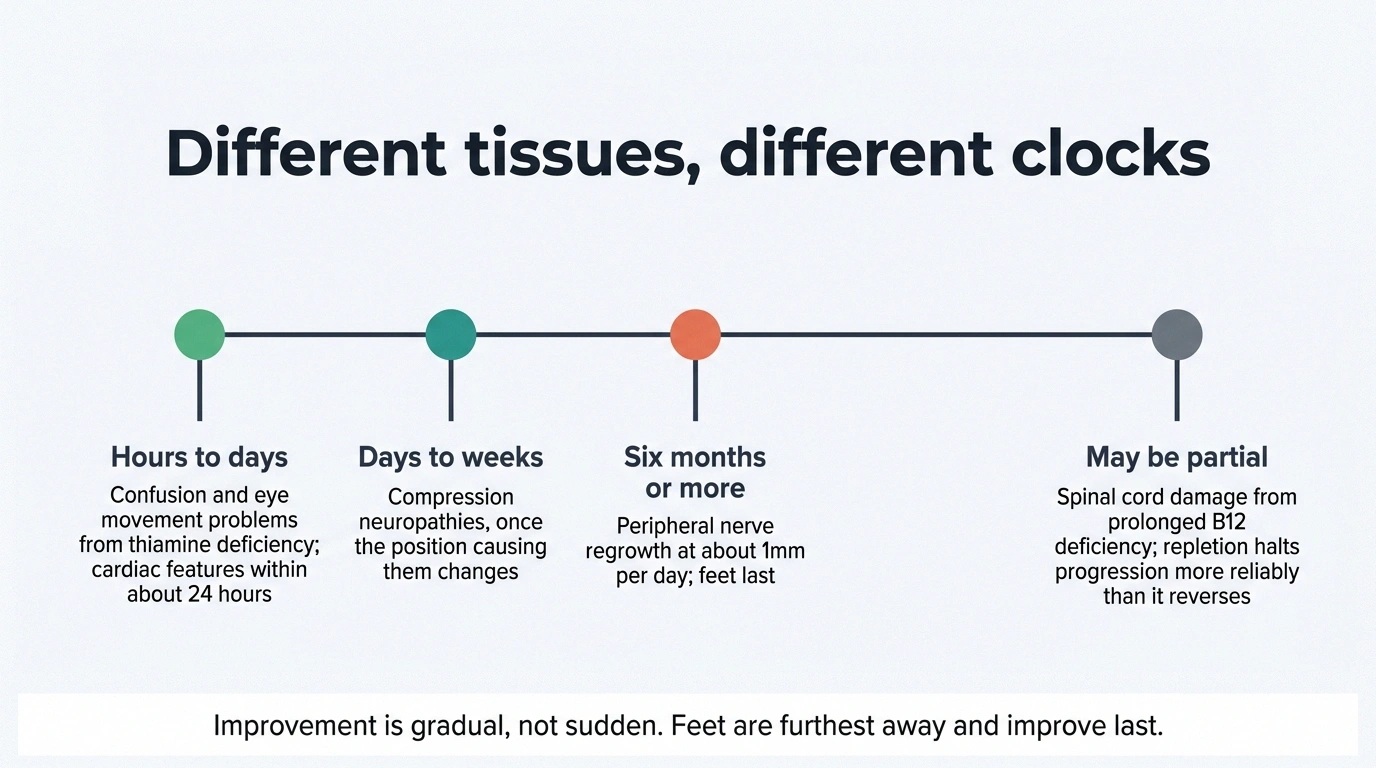
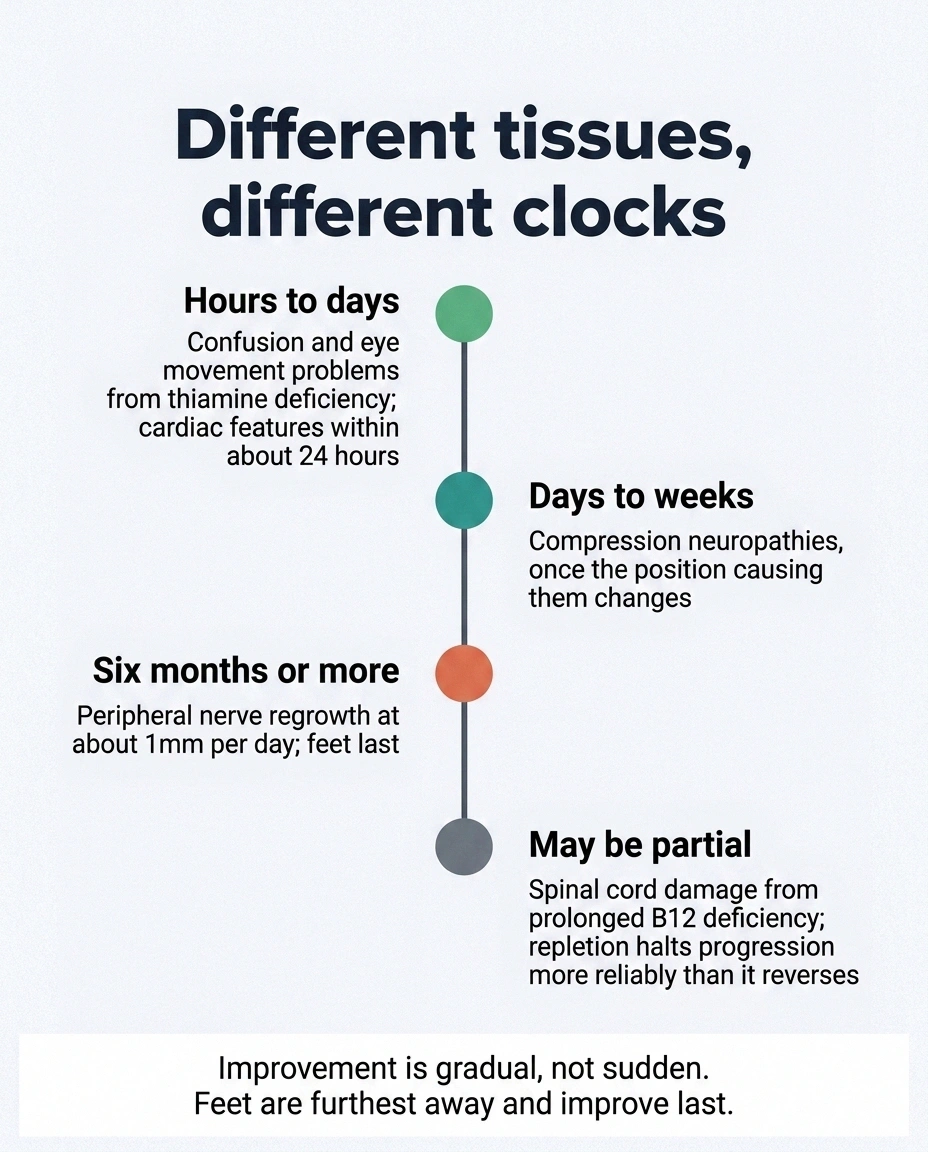
Different tissues, different clocks
Recovery is not one timeline. Knowing which clock you are on prevents a normal six-month course from feeling like failure at week three.
Hours to days
Eye movement problems and confusion from thiamine deficiency. Cardiac features of wet beriberi typically improve within about 24 hours of treatment.
Days to weeks
Compression neuropathies, once the position causing them changes. This is the fastest win available and the one most often missed.
Months, and mostly six or more
Peripheral nerve regrowth, at roughly a millimeter a day. From knee to toes is most of a year at that rate. Feet improve last because they are furthest away.
Partial, in some cases
Spinal cord damage from prolonged B12 deficiency. Repletion reliably halts progression and does not reliably undo what has already happened, which is the whole argument for treating early and broadly.
Fast, sometimes dramatic. The brain features of thiamine deficiency respond quickest. Eye movement abnormalities can resolve within a day of intravenous thiamine. Confusion often clears over days. Cardiac features of wet beriberi typically improve within about 24 hours of treatment starting.
Slow, and measured in months. Peripheral nerve symptoms take far longer, because this is physical regrowth rather than a metabolic switch flipping. A damaged axon regenerates at roughly a millimeter a day under good conditions. From the knee to the toes is most of a year at that rate, which is the arithmetic behind why feet are always last to improve. One documented case of dry beriberi showed slow, steady improvement across six months of replacement. That is a realistic shape to expect.
Partial, in some cases. Where nerve fibers have died rather than been starved, function does not fully return. Established spinal cord damage from prolonged B12 deficiency is the clearest example: repletion reliably stops progression, and it does not reliably undo what has already happened. This is the argument for treating early and treating broadly rather than waiting for certainty.
Two things genuinely help the odds. The first is time in a nourished state, sustained, because regrowth needs raw material every day and interruptions reset the clock. The second is protecting the nerves mechanically while they recover, which means padding, position changes, and careful foot care, since numb feet are injury-prone feet. Our guide to whether neuropathy can be reversed covers what determines recovery across causes.
What to Ask For in Treatment

Eating disorder treatment teams are focused, correctly, on nutrition, medical stability and psychological work. Nerve symptoms can slip between those responsibilities. A few specific requests help.
Say the nerve symptoms out loud, in detail. Where, how long, whether it is numbness or burning or weakness, whether it is both sides or one. One-sided symptoms in particular point toward the compression mechanism and get a different answer.
Ask about thiamine directly. Ask whether it has been given, at what dose, by what route, and whether it was started before refeeding. Ask specifically whether a normal blood level is being used to rule it out, because that is not a reliable basis for excluding it.
Ask for the wider panel. B12 with methylmalonic acid, folate, copper, ceruloplasmin, zinc, vitamin E, magnesium and phosphate. Broad rather than targeted, because these deficiencies cluster.
Ask for a neurology referral if symptoms persist or progress. Nutritional causes are the likely explanation, and they are not the only possible one. Our walkthrough of neuropathy diagnosis covers the standard workup.
Ask about footwear and skin checks. If sensation is reduced, blisters and pressure injuries stop announcing themselves. A daily look at the soles becomes worth doing, and our notes on neuropathy foot care cover the routine.
If You Are Reading This About Yourself
Nerve symptoms are not a verdict, and they are not something you have earned. They are a physiological consequence of a body that has not had enough of what it needs, and the treatment for them is the same treatment that helps everything else: sustained nourishment, medical supervision, and time. They also, in a significant number of cases, improve.
Reading a list of nerve complications can be frightening rather than motivating, and fear is not a useful fuel for recovery. If this article has landed hard, the most useful thing you can do with it is bring one question from it to someone on your treatment team rather than carrying it alone.
In the United States, the National Alliance for Eating Disorders operates a clinician-staffed helpline at 1-866-662-1235. If you are in crisis or thinking about harming yourself, call or text 988 to reach the Suicide and Crisis Lifeline, any time. Outside the US, your national eating disorder association or emergency services can direct you.
The distress that runs alongside chronic physical symptoms is real and treatable in its own right, and we have written about that separately in our piece on neuropathy and mental health.
Frequently Asked Questions
Can not eating enough cause nerve damage?
Yes. Peripheral nerves depend on a continuous supply of specific nutrients, particularly thiamine, and they store very little reserve. Sustained inadequate intake can produce a sensorimotor polyneuropathy with numbness, burning, cramping and weakness, typically starting in the feet and moving inward.
Is nerve damage from malnutrition reversible?
Often partly, and sometimes substantially, but recovery is slow. Brain and cardiac features of thiamine deficiency can improve within days of treatment. Peripheral nerve symptoms improve over months because nerve fibers regrow at roughly a millimeter per day. Damage to the spinal cord from prolonged B12 deficiency is the least reversible component, which is why early treatment matters.
What is dry beriberi?
Dry beriberi is the neurological form of thiamine deficiency, as distinct from wet beriberi which affects the heart. It produces a symmetrical peripheral neuropathy in a stocking and glove pattern, with burning feet, calf cramps, tingling in the toes, weakness and reduced reflexes, usually affecting the legs before the arms.
Can nerve symptoms get worse when you start eating again?
They can, temporarily. Restarting carbohydrate intake consumes thiamine and drives phosphate, potassium and magnesium into cells, and falling phosphate can itself cause weakness and paresthesias. This is a recognized part of refeeding syndrome and is a reason for medical supervision with electrolyte monitoring, not a reason to stop eating.
Why does a normal thiamine blood test not rule out deficiency?
Serum thiamine reflects recent intake more than tissue stores and correlates poorly with neurological status. Cases of significant thiamine-related nerve and brain damage have been documented in people whose blood levels appeared normal. Where the clinical picture fits, treatment is often given empirically rather than withheld pending a number.
Why do I have foot drop when my other symptoms are in both feet?
One-sided foot drop usually points to a different mechanism entirely. The common peroneal nerve runs just under the skin at the outer knee, and when the fat padding over it thins, ordinary positions such as crossing the legs or lying on one side can compress it. This is a positional problem with a positional fix, and it is worth raising separately from the nutritional picture.
Should I take supplements on my own to fix this?
Self-supplementing carries real risks in this situation. Vitamin B6 causes neuropathy in excess as well as in deficiency, high zinc intake causes copper deficiency, and taking thiamine informally without supervision during refeeding does not address the electrolyte shifts that are the dangerous part. Testing and supervised repletion produce better outcomes than guessing.
How long until my feet stop burning?
There is no single answer, and anyone offering one is guessing. The realistic frame is months rather than weeks once nutrition is stable, with gradual rather than sudden improvement, and with the feet improving last because they are furthest from the nerve cell body. Symptom treatment for the burning itself can run alongside recovery rather than waiting for it.
About the Author