
Phenytoin has been in continuous use since 1938. That is not a footnote. It means there are people alive right now who have taken the same medication every day for forty or fifty years, whose seizures have been controlled that entire time, and who have never had a serious reason to reconsider it.
Those are the people this article is written for. Not because the drug is dangerous, but because a medication you have taken for decades accumulates a set of quiet effects that a medication you took for a week never will, and nerves are on that list.
The useful news is that the most common nerve findings on long-term phenytoin are mild, and that some of what people assume is direct nerve toxicity turns out to be something else the drug caused, which is a different problem with a much better answer.
Forty Years on the Same Prescription
Phenytoin, still widely known by the brand name Dilantin, stabilizes overactive nerve signaling in the brain by acting on sodium channels. It was among the first antiseizure drugs that did not simply sedate people into stillness, and it remains effective.
What has changed since 1938 is everything around it. Blood levels are monitored routinely now. Interactions are catalogued. Newer alternatives exist. Someone starting antiseizure treatment today is unlikely to be started on phenytoin. Someone who has been stable on it since the Reagan administration is often, and reasonably, left exactly where they are.
Stable is worth a great deal in epilepsy. A regimen that has prevented seizures for thirty years is not something anyone changes casually, and no part of this article is an argument for changing it. It is an argument for knowing what to watch, because the watching is easy and the consequences of not watching are cumulative.
What the Nerve Studies Actually Find
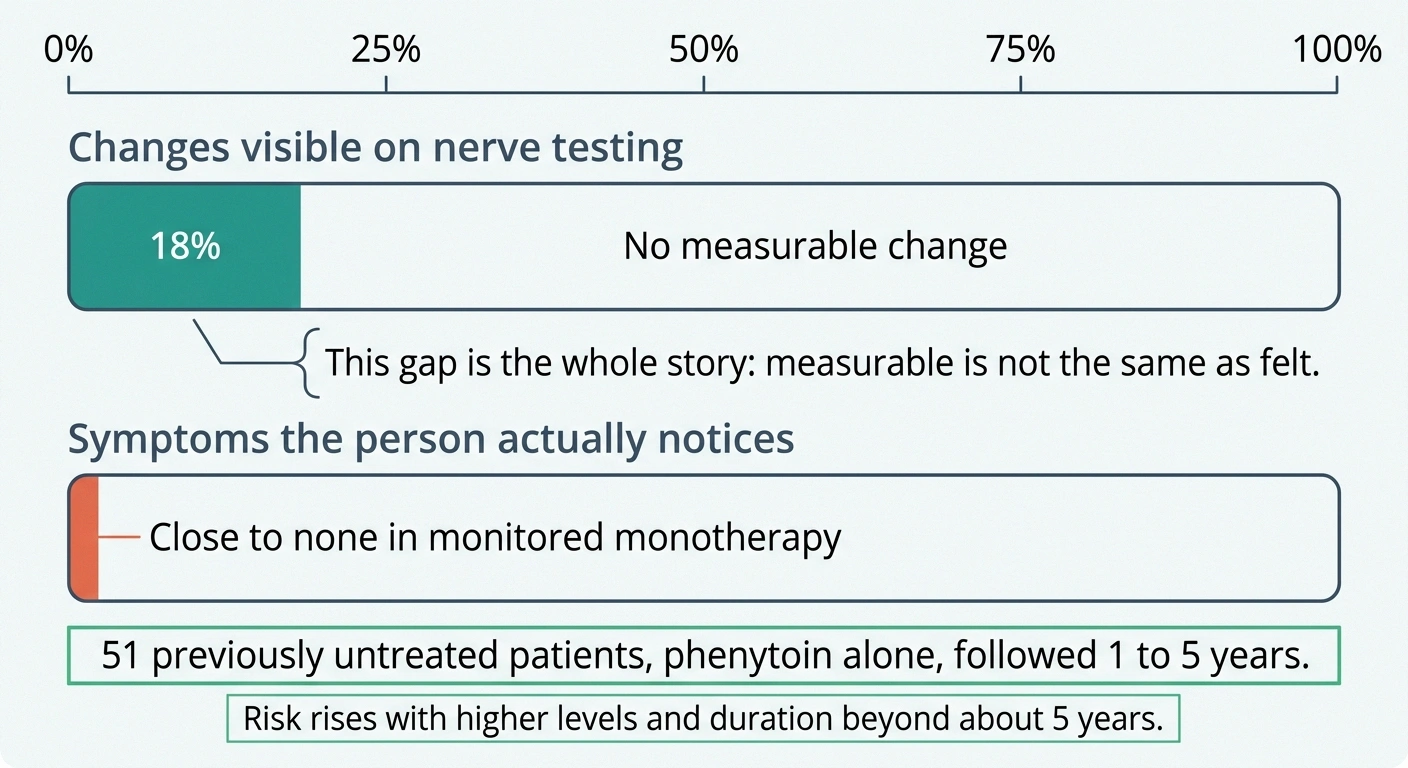
Long-term phenytoin is associated with a peripheral neuropathy. The important qualifier is that it is usually mild, and very often something a person cannot feel at all.
The classic findings are three: absent or reduced reflexes at the ankles, some loss of sensation in the feet, and slowed conduction velocity on nerve testing. Risk rises with higher blood levels and with longer duration, and the duration threshold that keeps appearing in the literature is around five years.
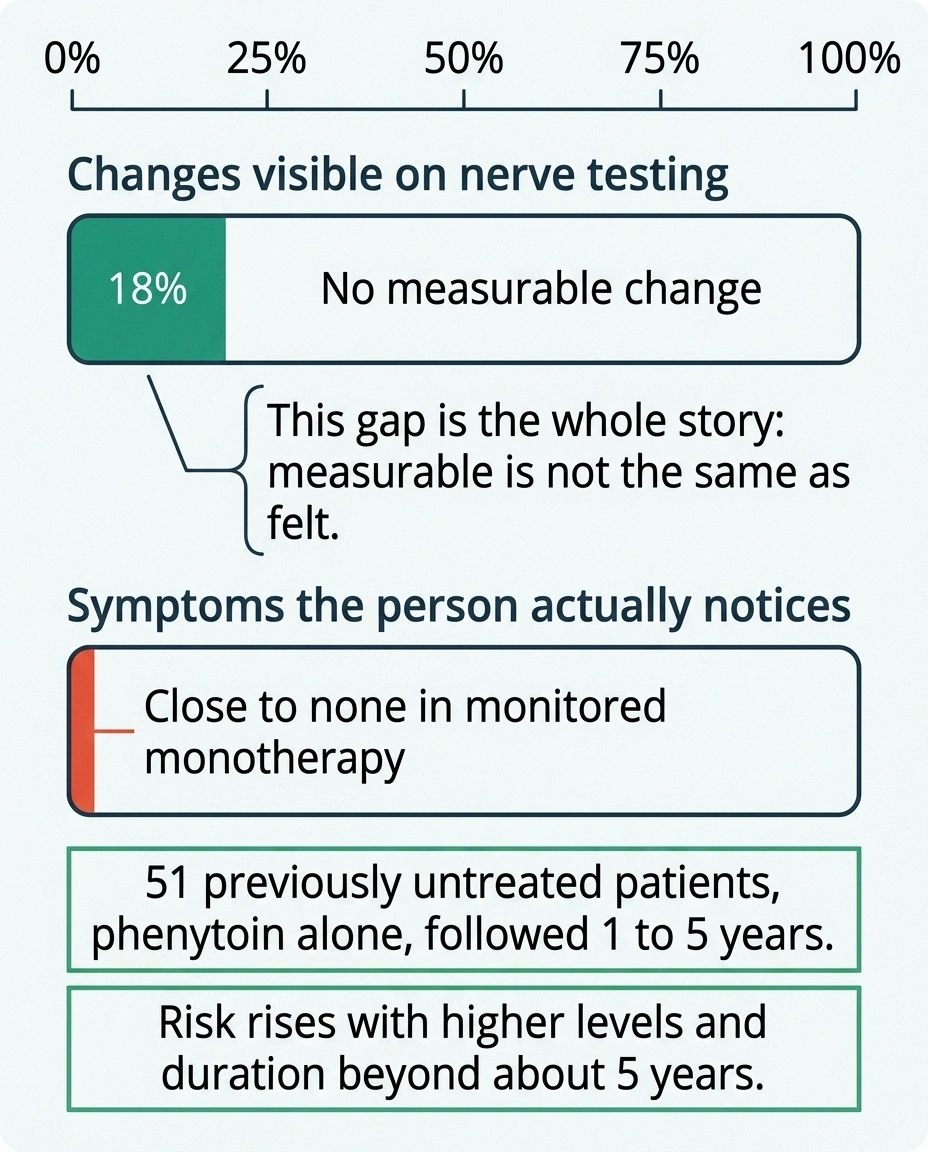
The scale is worth stating plainly. In one prospective study of 51 previously untreated patients on phenytoin alone, followed for one to five years, not a single person developed clinical neuropathy. About 18% showed mild changes on electrical testing, which is to say the nerves were measurably a little slower while the people attached to them noticed nothing.
That gap between what a test shows and what a person experiences runs through this entire topic. At the monitored doses used today, symptomatic phenytoin neuropathy is genuinely uncommon. Decades of exposure at higher levels is a different situation, and it is the situation many long-term patients are actually in.
If you do have symptoms, the reflex assumption should not be that phenytoin caused them. Diabetes, B12 deficiency, alcohol, thyroid disease and a dozen other causes are all more likely to produce noticeable numbness than a well-monitored phenytoin level is. Our guide to the tests used to work out what is causing a neuropathy covers what a proper investigation looks like.
The Sign You Will Never Feel
Absent ankle reflexes deserve their own section, because of everything on the phenytoin list this is the finding most likely to appear in your chart and least likely to appear in your life.
The ankle jerk is the reflex a clinician tests by tapping the Achilles tendon with a small hammer. It travels through the longest reflex arc in the body, which makes it the first one to fade when peripheral nerves are under strain. Losing it produces no symptom whatsoever. You cannot feel a reflex going.
What it does is mark a starting point. If your ankle reflexes were present five years ago and are absent now, something has changed, and that is worth knowing before it becomes something you can feel.
It is a reasonable thing to ask about directly at a routine visit. The examination takes fifteen seconds, requires no equipment beyond a reflex hammer, and gives you a fixed reference point for every future conversation. Most people have never thought to ask, and most clinicians will happily check.
Unsteadiness Is a Different Problem Entirely

This section is the one to read twice.
Sort the unsteadiness before you adapt to it
Coming from the feet
Built over years. Worse in the dark, because vision was compensating.
Coming from the cerebellum
Arrived over days or weeks. Lighting makes no difference.
Any chip in the right-hand column means a phenytoin level check now, not at the next appointment. The left column is slow and largely settled. The right column is often a number that can be brought back down.
If you take phenytoin and you have become unsteady on your feet, the most likely explanation is not your peripheral nerves. It is your cerebellum, the part of the brain that coordinates movement, and that is a considerably more urgent finding.
Phenytoin at elevated levels affects the cerebellum, and sustained elevated levels can damage it permanently. A systematic review of 81 documented cases found ataxia, meaning unsteady uncoordinated movement, in 96%. Nystagmus, an involuntary flicking of the eyes, appeared in 70%, and slurred or effortful speech in 63%. Seventy-two percent were left with lasting disability.
The reason this matters so much is that the two problems feel similar from the inside and are treated completely differently. Peripheral neuropathy makes you unsteady because your feet stopped reporting where the ground is. Cerebellar toxicity makes you unsteady because the coordination system itself is failing. The first is slow and mostly permanent by the time it appears. The second is often a blood level problem, and blood levels can be fixed.
Four signs that point toward the brain rather than the feet:
- The unsteadiness arrived over days or weeks rather than years
- Your speech has changed, even slightly, or people have asked if you are tired
- Your vision jumps or wobbles, or someone has noticed your eyes flicking
- Your hands have become clumsy as well as your feet, without any numbness in them
Any of those, on phenytoin, means a level check promptly rather than at the next scheduled appointment. New ataxia is one of the few genuinely time-sensitive situations in long-term phenytoin use, and it gets missed constantly because people file it under “my balance is going” and adapt around it.
The Blood Level That Jumps
To understand why phenytoin levels drift into trouble, you need one piece of pharmacology, and it is worth the two minutes.
Three numbers worth carrying
10–20
mcg/mL, the usual total phenytoin target range. Ask for your actual figure, not the word “fine”.
30 mg
The size of adjustment often used near the top of the range, precisely because 100 mg steps can overshoot badly.
5–14
Days before a level fully settles after any change. Testing sooner than this can give false reassurance.
Low albumin, kidney disease and pregnancy all shift how much of the measured drug is actually active, which is why a free phenytoin level is sometimes ordered instead.
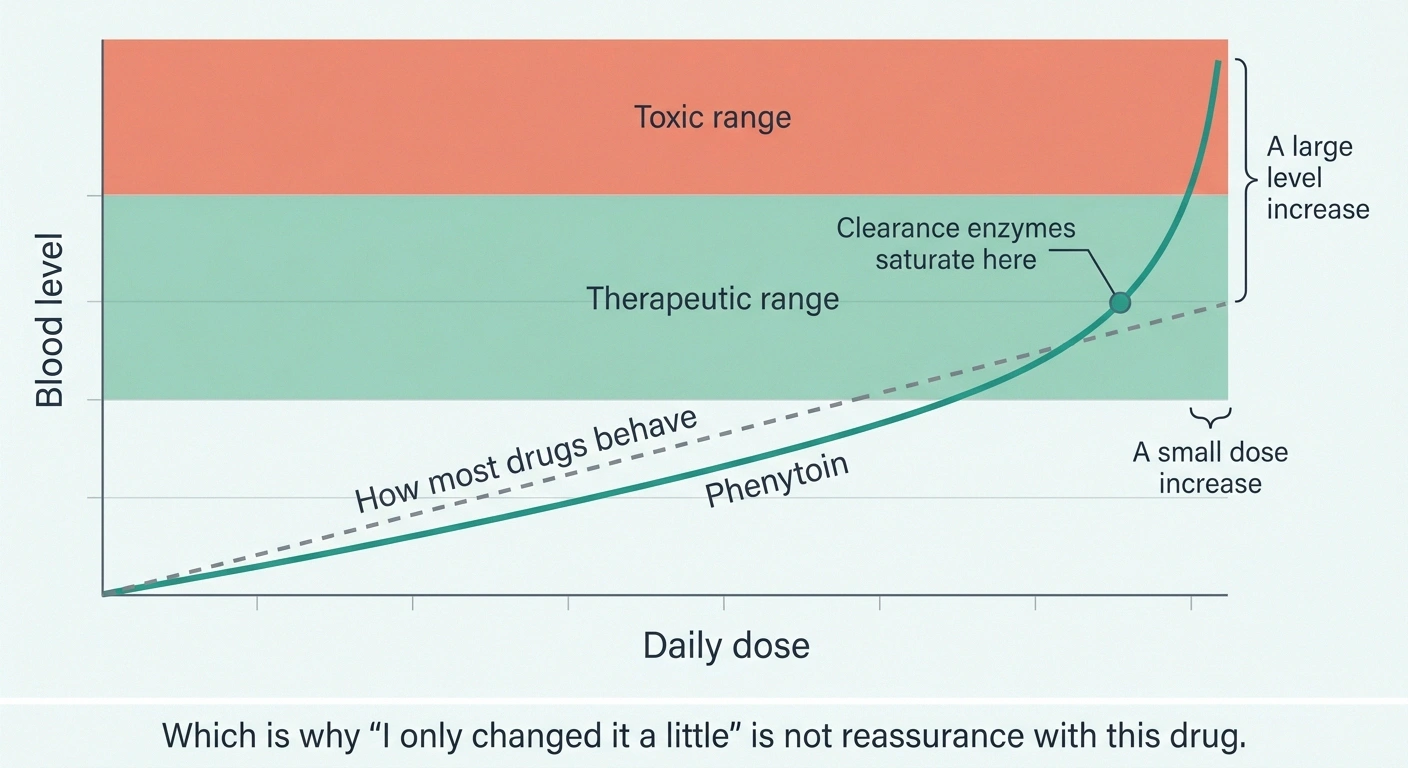
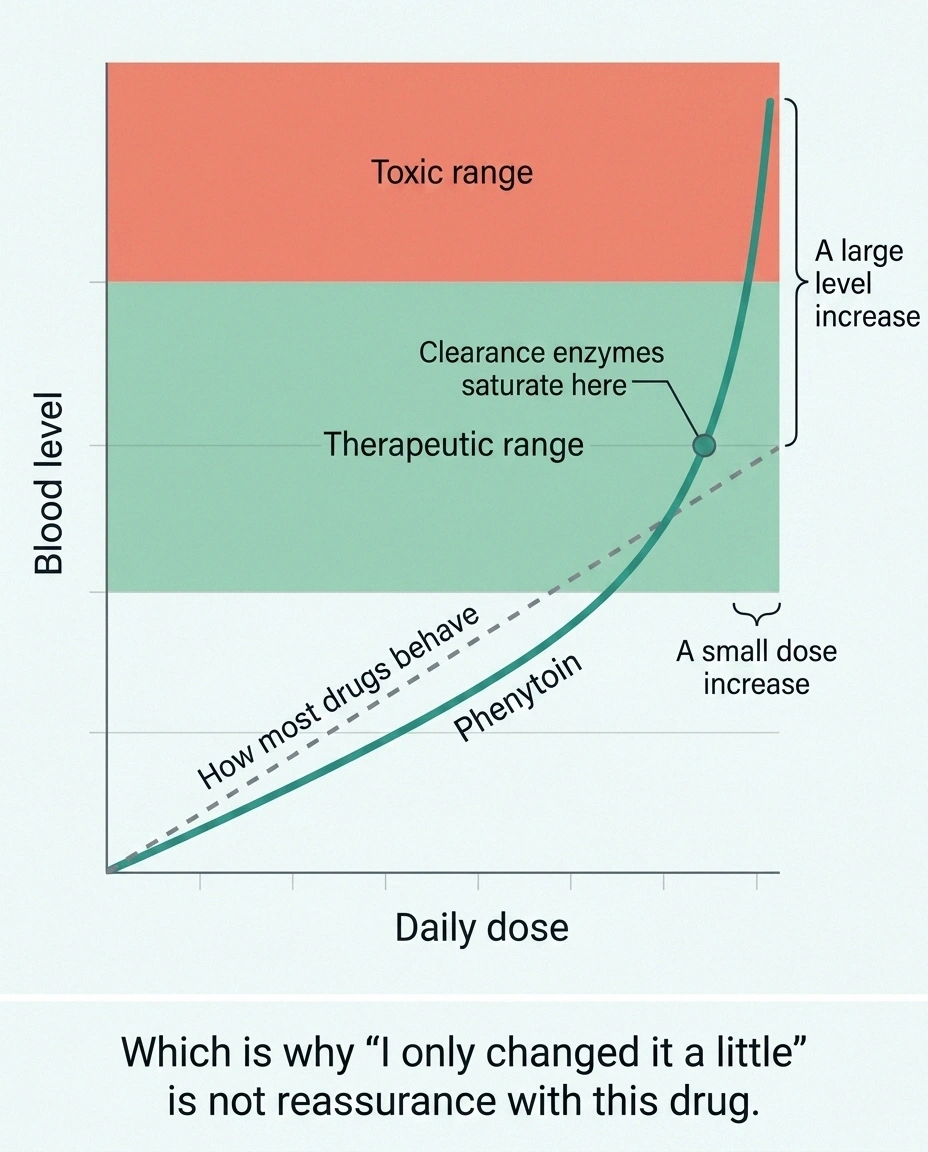
Most drugs clear from the body proportionally. Double the dose, roughly double the blood level. Phenytoin does not work that way. The enzyme system that clears it saturates, and once it does, the relationship between dose and level stops being proportional and becomes something much steeper.
The practical effect: near the top of the therapeutic range, a small dose increase can produce a disproportionately large jump in blood level. A 10% change in dose can produce far more than a 10% change in what is circulating. This is why someone can be stable for years and then become toxic after a modest adjustment, a switch between formulations, or the addition of a new medication that competes for the same clearance pathway.
It also means that “I only changed it a little” is not reassurance in this particular case.
Things that can push levels up without any change in your prescription include new medications, changes in liver function, illness, low albumin, and in some cases a change in manufacturer. Alcohol interacts in both directions depending on the pattern of drinking. None of this makes the drug unsafe. It makes level monitoring meaningful rather than a formality.
When the Nerve Problem Is a Nutrient Problem

Now the part with an actual answer attached, and the reason this article is worth reading even if your nerves feel fine.
Long-term phenytoin depletes folate. This has been documented since the 1960s and is one of the most consistent findings in the drug's entire literature. It also lowers vitamin B12 over time, with the effect showing up reliably in people treated beyond about two years.
Both deficiencies damage nerves independently of anything phenytoin does to them directly.
B12 deficiency in particular produces a neuropathy that looks very much like the drug-toxicity version: numbness and tingling in the feet, unsteadiness, sometimes cognitive fog and low mood alongside it. Our article on which vitamin deficiencies cause neuropathy covers the full picture of how these present.
One finding is worth carrying with you. A study of long-term anticonvulsant patients found markedly reduced B12 in the cerebrospinal fluid, the fluid surrounding the brain and spinal cord, in people whose blood work showed no anemia at all. In other words, the standard screening test can look acceptable while the tissue that matters is running short.
The reason this is genuinely good news: nutritional neuropathy is treatable in a way that direct drug toxicity is not. If part of what you are feeling comes from depletion rather than damage, correcting the depletion can improve it. Not always, and not completely, but the possibility exists and it is worth investigating rather than assuming.
Reasonable things to have checked if you have been on phenytoin for years: serum folate, vitamin B12, and where available methylmalonic acid, which detects functional B12 shortage that a standard B12 level can miss. Folate is commonly suggested for rechecking about every six months in this population. Our comparison of B12 injections and oral supplements covers when the delivery route makes a difference.
Do Not Start Folic Acid on Your Own
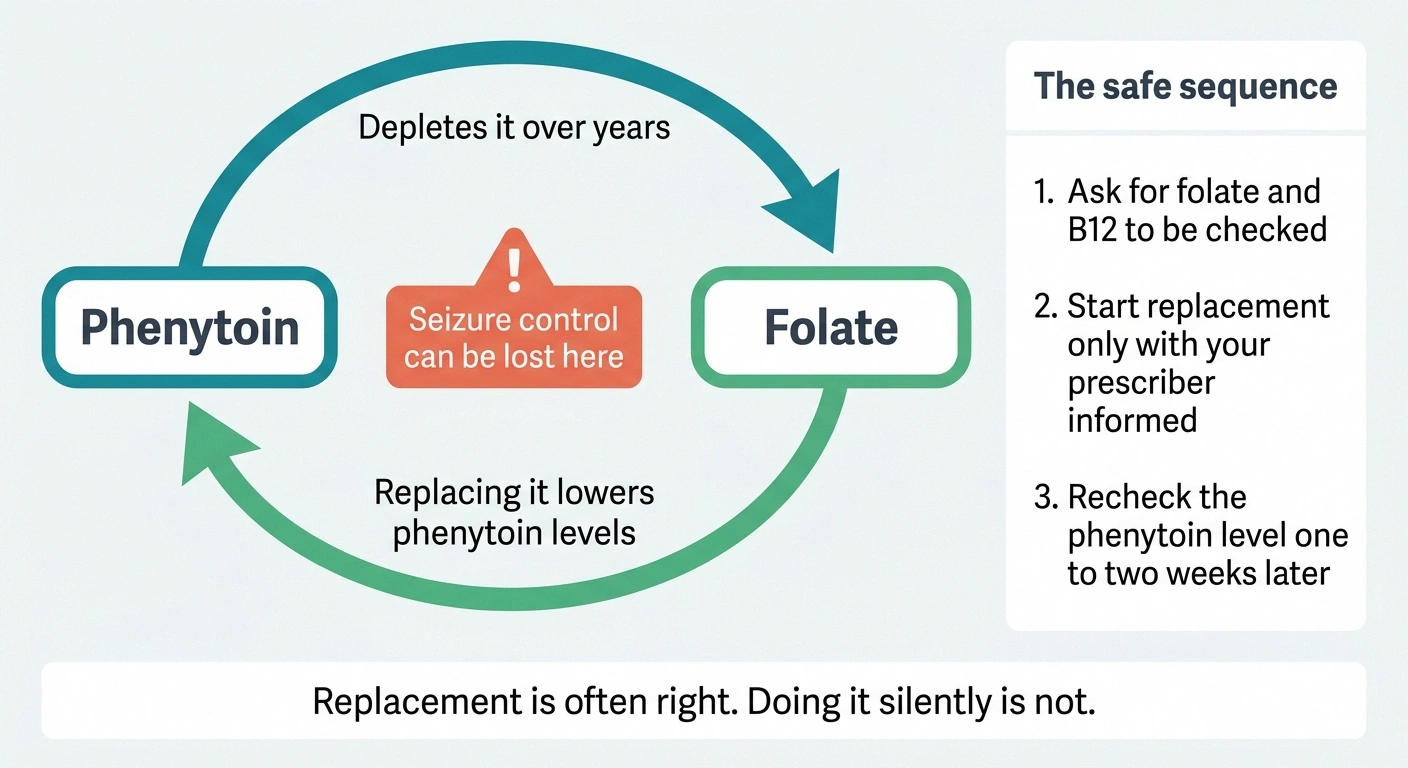
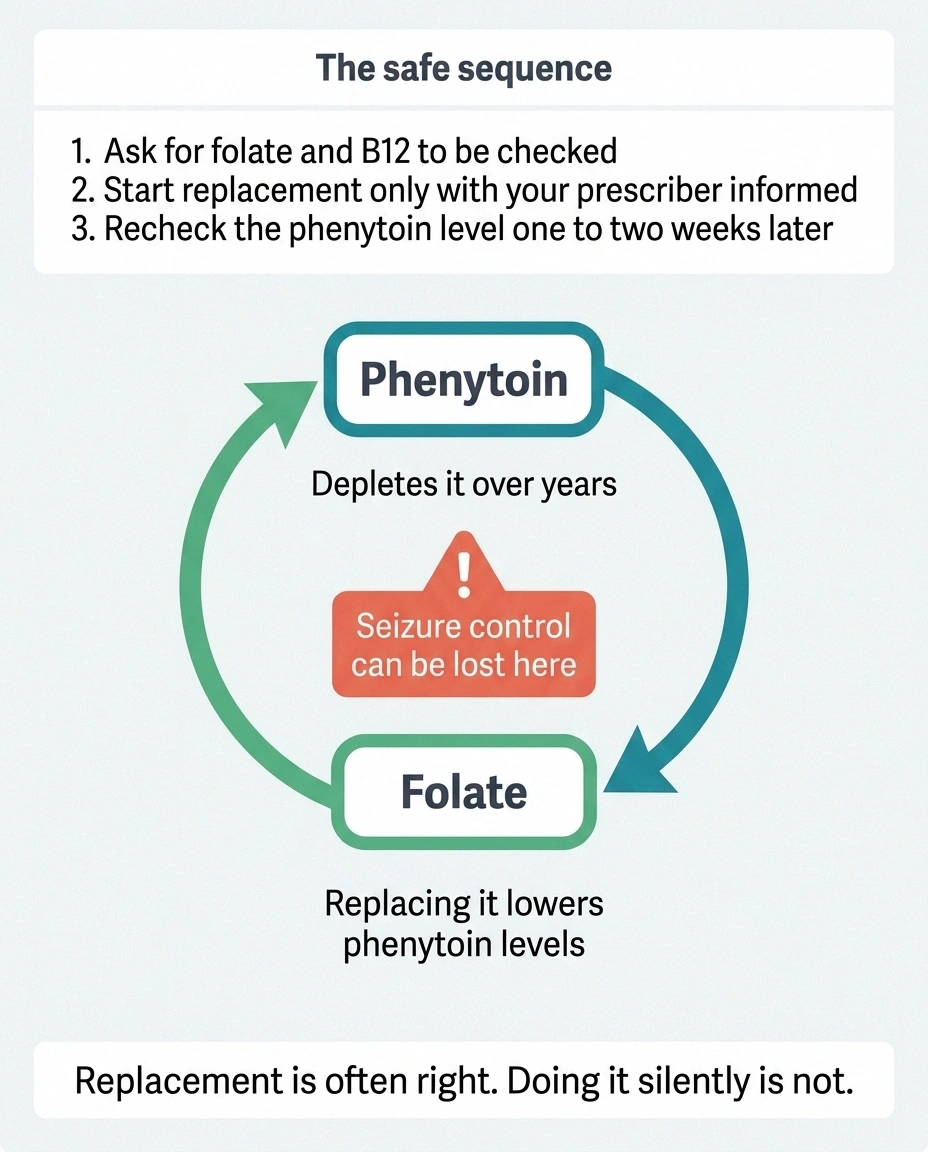
This is the single most important safety point in the article, and it runs directly against instinct.
Folic acid is in more things than you would guess
Nobody sets out to start a supplement. They start a general multivitamin. Check labels for folic acid, folate, or vitamin B9 before adding any of these:
Fortified food is not the concern. A supplement dose is. Tell your prescriber before you start one so a level can be rechecked a week or two later.
Folic acid supplementation in someone taking phenytoin lowers serum phenytoin levels. The interaction is well documented and it runs both ways: the drug depletes folate, and replacing the folate accelerates the drug's clearance. People have lost seizure control this way.
The supplement aisle looks harmless. Folic acid is in prenatal vitamins, in most B-complex products, in fortified cereals, and in a great many general multivitamins. Someone reading about phenytoin and folate depletion could very sensibly decide to start taking it, and could have a breakthrough seizure some weeks later without ever connecting the two.
Folate replacement in a phenytoin patient is often the right thing to do. It simply needs to happen with the prescriber knowing, so that levels can be rechecked afterward and the dose adjusted if it has fallen. That is a phone call, not an obstacle.
The same principle covers any new supplement while on this drug. Phenytoin has one of the longest interaction lists in the pharmacy, and its saturable clearance means interactions produce bigger swings than they would with almost any other medication.
Bones Belong in This Conversation
Phenytoin induces the liver enzymes that break down vitamin D, and it does so persistently. The downstream chain is well established: lower vitamin D, then lower calcium and phosphate, then reduced bone density, then measurably higher fracture risk over years of treatment.
On its own that would belong in a different article. It belongs in this one because of how it combines.
Reduced sensation in the feet degrades balance. Any cerebellar effect degrades it further. Thinner bone means a fall that would have been embarrassing at fifty becomes a hip fracture at seventy-five. The three risks do not add. They multiply, and they all trace back to the same prescription.
Vitamin D level, calcium, and a bone density scan are all reasonable to have on the record for anyone with long-term phenytoin exposure. Weight-bearing activity helps bone directly, and regular walking is about as accessible a version of that as exists. Balance work is the other half. Our guide to fall prevention with reduced sensation covers what actually shifts risk, and if sensation in your feet has dropped, the protective habits in our foot care routine matter more than they used to.
What to Raise at the Next Refill

None of this calls for a dramatic appointment. It calls for a slightly better version of a conversation you are already having a few times a year.
The long-term phenytoin check, on one screen
Screenshot this. None of it is urgent on its own. All of it is easy to leave undone for another decade.
- Ankle reflexes checked and the result written down. Fifteen seconds. Creates the baseline you do not have.
- Folate, B12, and methylmalonic acid if available. The one result here that may come with a fix attached.
- Vitamin D level and a bone density scan. Fracture risk compounds with everything else on this list.
- Your last phenytoin level, as a number and a date. If it was more than a year ago, say so out loud.
- Any new unsteadiness, speech change or visual wobble. Raise this first, not last. It is the only item on the list with a clock on it.
Worth asking about:
- Ankle reflexes. Fifteen seconds, and it gives you a baseline you do not currently have.
- Folate and B12, with methylmalonic acid if it can be arranged. Cheap, informative, and the one finding here that might come with a fix attached.
- Vitamin D and bone density, given the fracture risk and how it compounds with everything else.
- Where your phenytoin level actually sits and when it was last measured. Ask for the number rather than the reassurance.
- Any new unsteadiness, speech change or visual wobble, raised as its own item rather than mentioned in passing, since those point at the brain rather than the feet.
And one question that is fair to ask without it being a demand: is phenytoin still the best choice for me, or is it simply the one that has always worked? For many people the answer is that stability wins and the regimen stays. For some, especially those with accumulating findings, it opens a conversation about newer agents that a stable prescription had never prompted. Our broader guide to medications that can cause neuropathy covers how other drug classes compare.
What is worth avoiding is the version where nobody asks anything for another decade, because everything on this list is quiet, gradual, and easy to attribute to getting older. Some of it is getting older. Some of it is not, and the parts that are not are the parts you can do something about.
Frequently Asked Questions
Can Dilantin cause nerve damage?
Yes, though usually mild. Long-term phenytoin is associated with a peripheral neuropathy that most often shows up as reduced ankle reflexes, some sensory loss in the feet, and slowed nerve conduction on testing, frequently without symptoms the person notices. Risk increases with higher blood levels and with duration beyond about five years. In one prospective study of patients followed for one to five years, no one developed clinical neuropathy while 18% showed mild changes on electrical testing.
What are the long-term side effects of phenytoin?
The recognized long-term effects include peripheral neuropathy, folate and vitamin B12 depletion, vitamin D deficiency with reduced bone density and higher fracture risk, gum overgrowth, increased body hair, and coarsening of facial features. Cerebellar damage can occur with sustained elevated levels. Most of these develop gradually over years, which is why periodic monitoring matters more with this drug than with medications taken briefly.
Does phenytoin cause B12 deficiency?
It lowers both folate and vitamin B12, with the B12 effect appearing reliably in people treated beyond about two years. This matters because B12 deficiency causes its own neuropathy that closely resembles drug toxicity. One study found substantially reduced B12 in cerebrospinal fluid in long-term anticonvulsant patients who showed no anemia on standard blood work, meaning routine screening can look acceptable while tissue levels are low.
Why does phenytoin make some people unsteady?
Usually because of effects on the cerebellum rather than on peripheral nerves. Elevated phenytoin levels cause ataxia, nystagmus and slurred speech, and sustained elevation can cause permanent cerebellar damage. This is different from neuropathy-related unsteadiness and considerably more urgent, because it often reflects a blood level that can be corrected. New unsteadiness on phenytoin, particularly alongside speech or eye movement changes, warrants a prompt level check.
Should I take folic acid with phenytoin?
Not without telling your prescriber first. Folic acid lowers serum phenytoin levels, and people have lost seizure control after starting it independently. The interaction runs both directions: phenytoin depletes folate, and replacing folate speeds phenytoin clearance. Folate replacement is often appropriate, but it needs to happen with levels rechecked afterward and the dose adjusted if necessary. The same caution applies to multivitamins and B-complex products, which commonly contain folic acid.
Can phenytoin neuropathy be reversed?
Direct nerve damage from the drug improves slowly at best and may not fully resolve. However, part of what a long-term phenytoin patient experiences may come from folate or B12 depletion rather than direct toxicity, and that portion often does respond to correction. This is why checking nutrient levels is worthwhile before concluding that symptoms are permanent.
Why do small dose changes cause big level changes with phenytoin?
Phenytoin has saturable, nonlinear pharmacokinetics. The enzyme system that clears it can be overwhelmed, and once that happens the relationship between dose and blood level becomes disproportionate. Near the upper end of the therapeutic range, a small dose increase can produce a much larger rise in circulating drug. This explains why someone stable for years can become toxic after a modest adjustment, a formulation change, or the addition of an interacting medication.
Should I switch off phenytoin if I have neuropathy?
Not automatically, and not on your own. Effective seizure control is worth a great deal, and switching antiseizure medications carries its own real risk of breakthrough seizures. The more productive approach is to establish what is actually driving the symptoms, since deficiency, diabetes and other causes are common and treatable. If findings continue accumulating despite that, whether phenytoin remains the right choice becomes a reasonable conversation to open with your prescriber.
About the Author