
You have almost certainly already been told to eat more fiber, drink more water, and move around more.
You probably tried it. And there is a decent chance the fiber made things worse rather than better: more bloating, more gas, more of that tight, full, nothing-is-moving feeling, and no more results than before.
That outcome is not a personal failure or a sign you did it wrong. It is what happens when advice designed for one kind of constipation gets applied to a different kind. Ordinary constipation advice assumes a colon that pushes properly and simply needs better material to push. Autonomic neuropathy damages the pushing.
Once you understand that distinction, most of the confusing parts of this problem stop being confusing. Why fiber backfires. Why you swing between constipated and the exact opposite. Why the answer looks different from what everyone keeps suggesting.
Why the Usual Advice Backfires
Picture a conveyor belt with a bag of gravel on it. If the belt is running and the bag is too small, adding more gravel helps: there is now enough material to trigger the system properly.
Now picture the same belt running at a fraction of its normal speed. Adding more gravel does not help. It piles up. The belt is not the problem’s solution, it is the problem itself, and everything you load onto it just sits there taking up room.
That second picture is slow-transit constipation, and it is what autonomic nerve damage produces. Bulk-forming fiber supplements such as psyllium work by adding volume that stretches the bowel wall and prompts it to contract. When the contraction response is impaired, the volume arrives and the contraction does not. What you feel afterward is distension, trapped gas, and a heaviness that many people describe as worse than the original complaint.
This does not mean fiber is bad or that you should stop eating vegetables. Dietary fiber from food, particularly the soluble kind, is different from a heaped scoop of bulking powder, and general eating patterns still matter for nerve health and blood sugar in ways covered in more depth in guidance on what to eat with neuropathy. But the reflex of answering slow transit with more bulk is the single most common mistake in this specific situation, and it is worth naming clearly before anything else.
The Colon Runs on Signals, Not Muscle Power
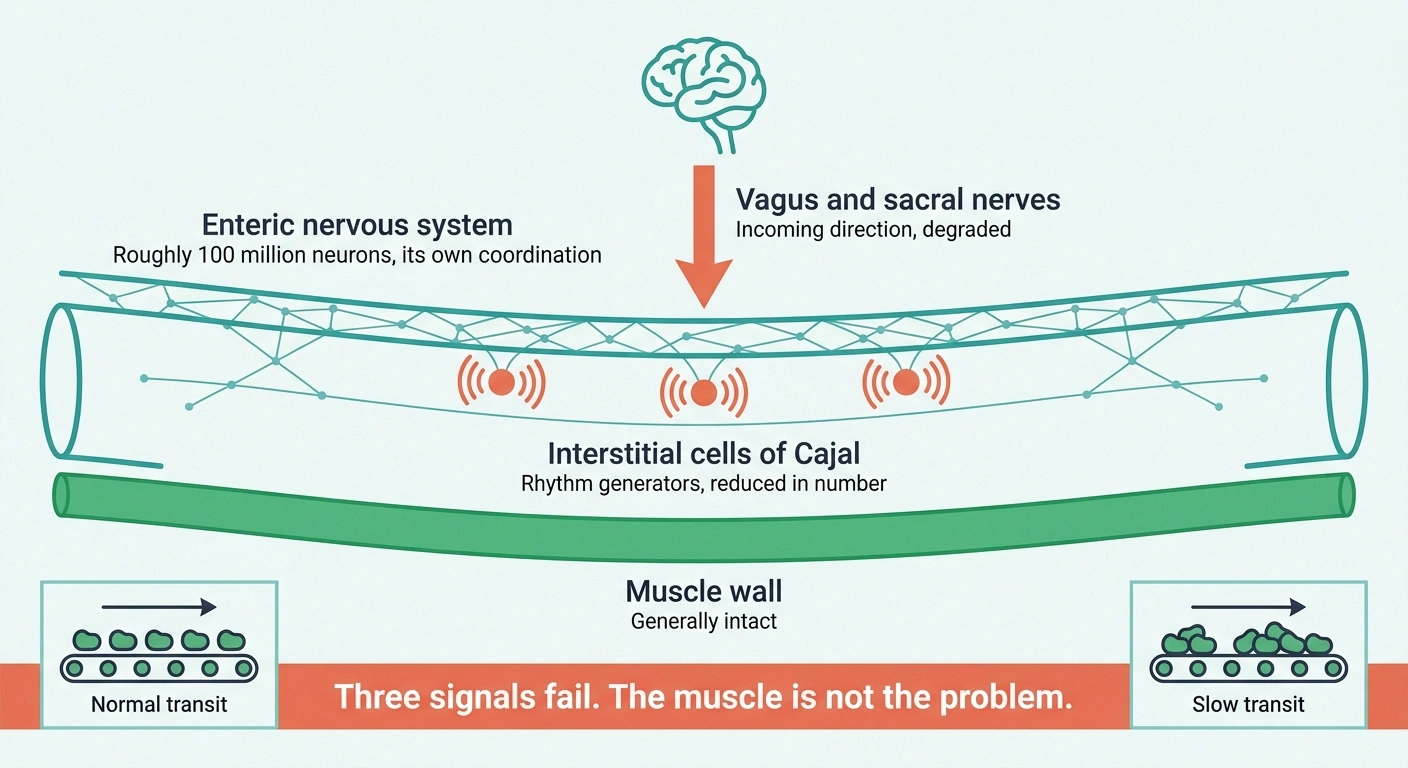
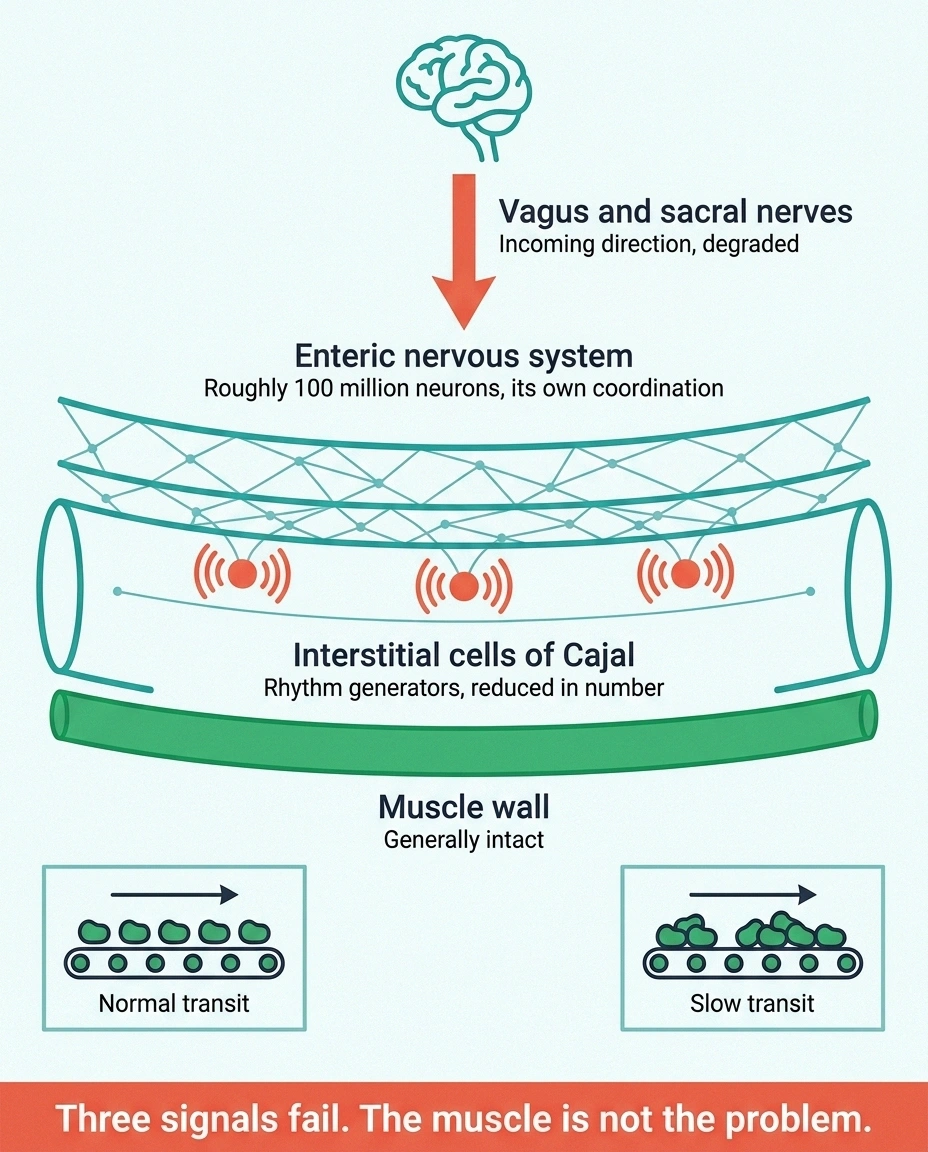
Your gut has its own nervous system. It contains something on the order of a hundred million neurons embedded in the wall of the digestive tract, enough that it gets called a second brain, and it can coordinate digestion largely on its own.
It does not work alone, though. It takes direction from the vagus nerve above and from sacral nerves below, and those connections are exactly what long-standing diabetes and other causes of autonomic nerve damage degrade.
There is a third component most people have never heard of, and it explains a great deal. Scattered through the bowel wall are specialized cells called the interstitial cells of Cajal. They function as pacemakers, generating the rhythmic electrical waves that set the timing of intestinal contractions, much as a pacemaker cell in the heart sets its rhythm. In long-standing diabetes, these cells are reduced in number and disrupted in function.
So the machinery breaks down at three levels at once. The incoming direction is degraded, the internal pacemaker is depleted, and the coordination between segments loses its timing. The muscle itself is generally fine. It simply is not receiving a properly organized instruction to squeeze in sequence.
That distinction has a practical consequence worth holding onto. This is not a strength problem you can exercise your way out of, and it is not a hydration problem you can drink your way out of. It is a signaling and timing problem, which is why the interventions that work either add water directly to the stool or act on the motor system itself.
Constipated, Except When You’re Not

One of the most disorienting features of this condition is that it does not behave like straightforward constipation. People describe going four or five days with nothing, then having a sudden urgent episode of diarrhea, then returning to nothing again.
Describe the cycle, not today
Whichever phase you happen to be in when you book the appointment tends to become the whole story. Saying it this way instead takes about fifteen seconds and points at the actual mechanism.
Gets you generic advice
“I’ve been really constipated lately.”
Gets you the right workup
“I go four or five days with nothing, then get a sudden loose episode, then it starts over. Fiber makes the bloating worse. I’ve had diabetes for eighteen years.”
Four details do the work: the interval between movements, the swing to loose stool, what fiber did, and how long you have had nerve damage. Mention any loss of control too, even though it is hard to say out loud. It points directly at the sphincter and it is treatable.
That pattern often gets reported to a clinician as two separate problems, or as an irritable bowel. It is usually one process.
When contents move too slowly through the small intestine, bacteria that normally stay in modest numbers there have time to multiply. The condition has a name, small intestinal bacterial overgrowth, and it produces gas, bloating and episodes of loose stool. The person is fundamentally constipated. The diarrhea is a downstream consequence of the slowness, not evidence against it.
Diabetic diarrhea has its own recognized signature as well: often at night, often painless, sometimes explosive, sometimes with loss of control. That last part is difficult to bring up and frequently goes unmentioned for years. The mechanism is not embarrassment-worthy at all. The internal anal sphincter is controlled by autonomic nerves, and when they are damaged, the seal weakens. It is nerve damage, in the same category as numb feet, and it is treatable.
If you have been experiencing this pattern, describing the whole cycle rather than whichever half is currently happening changes what a clinician can do with the information. Understanding how nerve damage progresses across different body systems also helps explain why the gut symptoms often show up years after the feet did.
The Medicines Making It Worse Are Often Yours
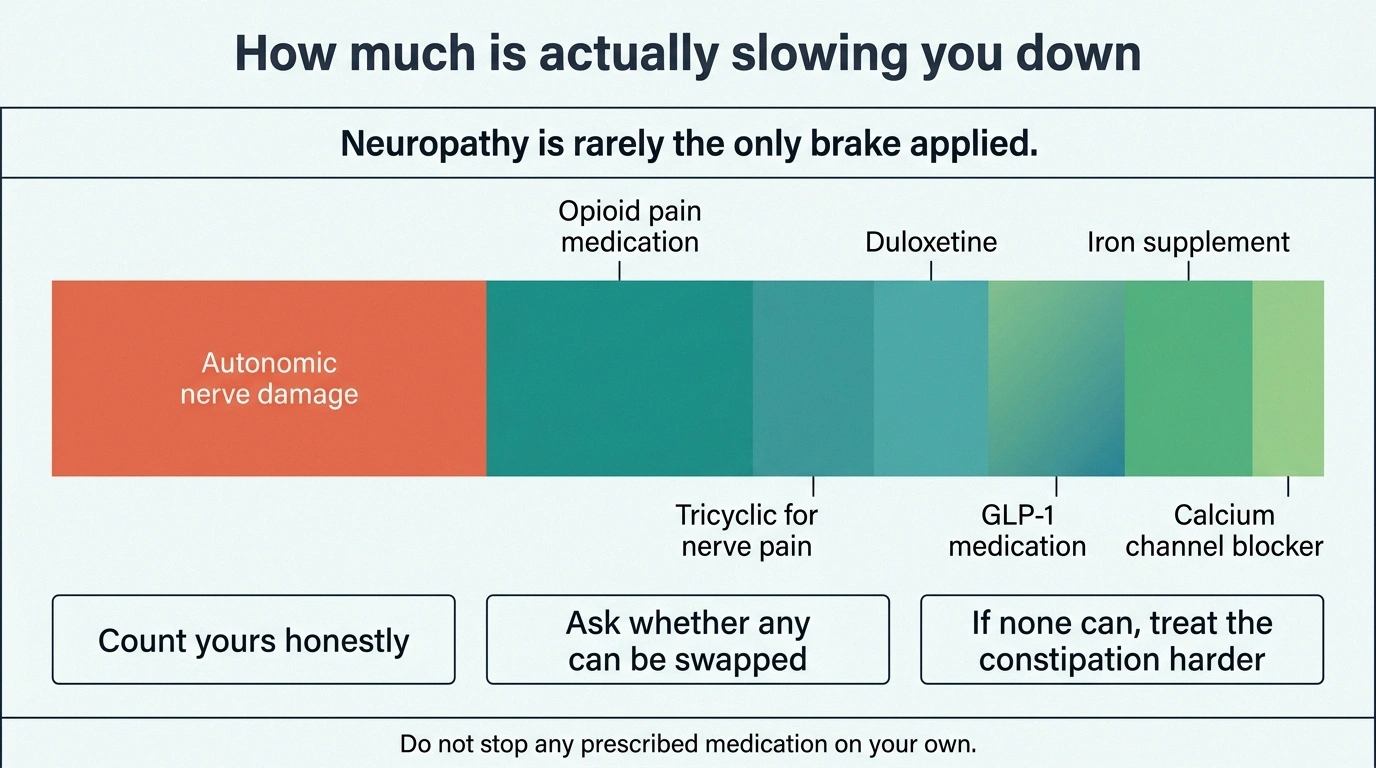
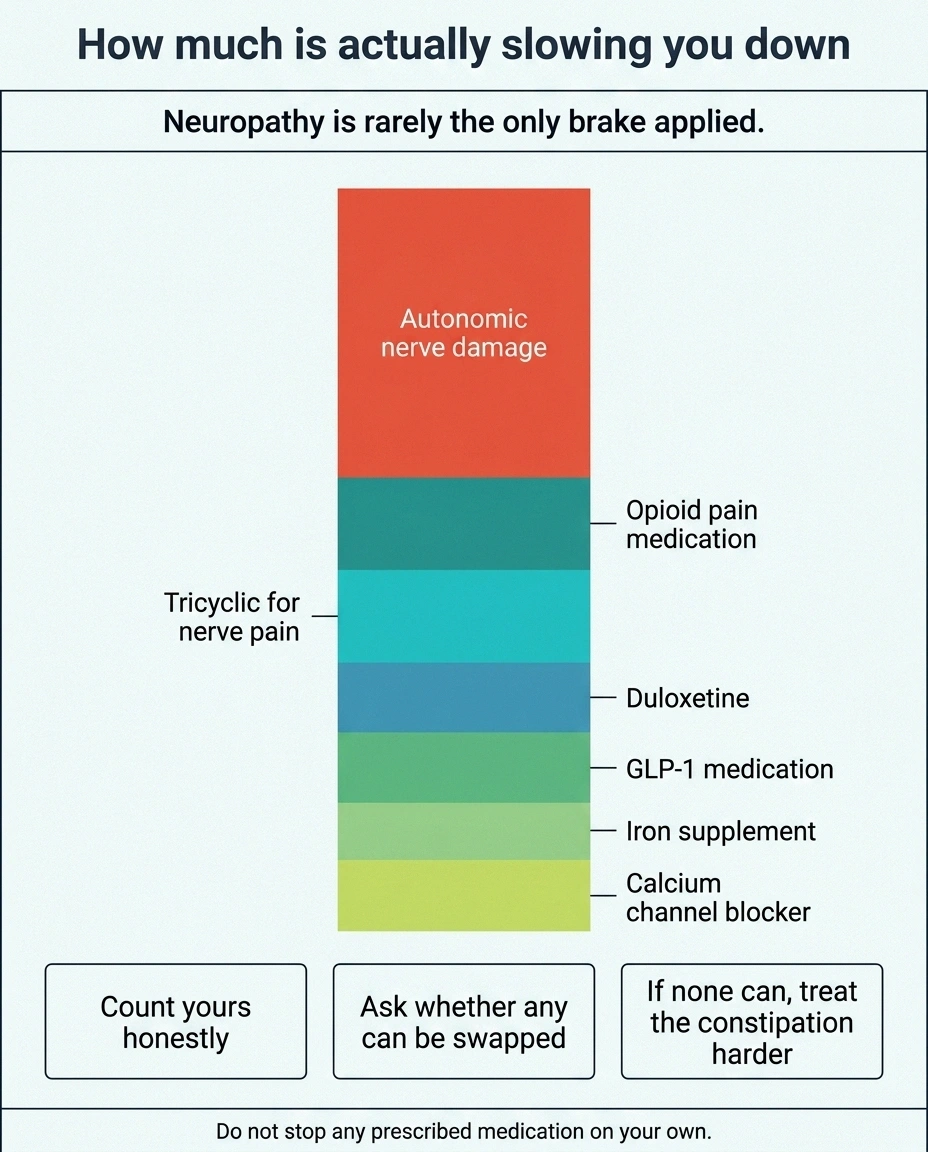
This part is uncomfortable, because for many readers the drugs treating their nerve pain are contributing to their bowel problem.
Opioids are the clearest example. They slow gut transit through direct action on receptors in the bowel wall, and unlike most opioid side effects, this one does not fade with time. Opioid-induced constipation persists for as long as the medication does. If you take opioids for neuropathic pain and are also constipated, that connection is real and worth raising explicitly rather than treating the two as unrelated.
Others that commonly appear on the same medication list:
- Tricyclic antidepressants such as amitriptyline and nortriptyline, widely used for nerve pain, which slow the gut through anticholinergic effects
- Duloxetine, where constipation is among the more frequently reported side effects, discussed further in the overview of duloxetine for neuropathy
- GLP-1 medications such as semaglutide and tirzepatide, which deliberately slow stomach emptying as part of how they work
- Calcium channel blockers for blood pressure, particularly verapamil
- Iron supplements, a very common and very underappreciated contributor
- Calcium-containing antacids and some bladder medications
- Ondansetron and similar anti-nausea drugs
None of this is an argument for stopping any of them. Several are doing important work, and pain control matters. What it argues for is an honest accounting: a person taking an opioid, a tricyclic and an iron tablet has three separate brakes applied on top of nerve damage, and the plan should reflect that rather than pretending the neuropathy is the only factor. Sometimes there is a substitution available. Sometimes there is not, and the answer is simply treating the constipation more aggressively than would otherwise be necessary.
Bulk Versus Water: The Distinction That Matters


Laxatives are not one category, and the differences between them are exactly what determines whether they help here.
Sequence beats shopping
Most people try five products in five weeks and conclude nothing works. Changing one thing at a time, in this order, with your clinician’s input, tells you what is actually contributing.
- Audit the medication list first. Removing or swapping one contributor beats adding a product to counteract it. This step costs nothing and is skipped almost universally.
- Build the morning routine before adding anything. Two full weeks. It is free, it works with a reflex you still have, and it changes what any later product is layered onto.
- Add one osmotic agent daily. Give it two weeks at a steady dose rather than judging it after three days.
- Keep a stimulant for rescue only. For breaking a backlog, not as the daily foundation.
- Then ask about prescription options. By this point you can say precisely what you tried, for how long, and what happened, which is what opens that conversation.
If you take opioids, ask at step one about the prescription drugs that block the gut effect specifically without reducing pain relief. That question skips several steps for the people it applies to.
Bulk-forming agents like psyllium and methylcellulose add volume. They work well for normal-transit constipation and poorly, sometimes counterproductively, when transit is slow.
Osmotic agents like polyethylene glycol, lactulose and magnesium-based products pull water into the bowel. Softer, wetter contents are easier for a weakened contraction to move, which is why this category generally suits slow transit better. Polyethylene glycol in particular is well tolerated for long-term daily use in many people.
Stool softeners such as docusate help the stool absorb water but do nothing about transit speed. Modest effect on their own.
Stimulant laxatives like senna and bisacodyl prompt the bowel wall to contract directly. They work, and they are useful for breaking a backlog. The traditional worry about permanent dependence is less supported than it once was, but they are still generally better positioned as rescue rather than as the daily foundation.
Prescription agents exist for cases that do not respond, including drugs that increase intestinal fluid secretion, drugs that act on serotonin receptors to improve motility, and drugs specifically designed to block opioid effects in the gut without reducing pain relief. That last group is directly relevant to anyone in the opioid situation described above and is worth asking about by name.
The general principle across all of it: in a colon that struggles to push, wetter is more useful than bigger. That sentence is the whole distinction, and it is what most general advice gets backward for this population.
When It Is Not the Nerves at All

Before settling on autonomic neuropathy as the explanation, a few other possibilities deserve checking, because two of them respond to completely different treatment.
Two questions you can answer at home
- Does stool arrive but refuse to pass?
- You feel it there, you strain hard, and nothing comes. That is an exit problem, most often pelvic floor dyssynergia. Laxatives will keep failing because the trouble is not upstream. The route forward is anorectal testing and biofeedback with a pelvic floor physical therapist.
- Or does nothing ever seem to arrive?
- Days pass with no urge at all, and when something does come it is hard and dry. That is a transit problem, which is the autonomic neuropathy picture this article describes. Osmotic agents and the morning routine are aimed here.
Both can be true at once, and often are. Answering which one dominates still changes the first move, and it is the single most useful sentence you can bring to the appointment.
The first is pelvic floor dyssynergia. In this condition the muscles of the pelvic floor tighten instead of relaxing during an attempt to pass stool, so the exit is effectively held shut. It produces the specific experience of straining hard, feeling stool present and ready, and being unable to pass it. No laxative fixes this, because the problem is not upstream. It responds well to biofeedback therapy with a trained pelvic floor physical therapist, often very well, and it is frequently missed for years.
The second is an underactive thyroid, which slows the gut along with everything else and is identified with an ordinary blood test.
Also worth excluding: low potassium or magnesium, high calcium, and celiac disease, all of which can present with constipation and all of which are found on standard testing. A clinician working through the full diagnostic workup for neuropathy is usually checking several of these already.
The distinguishing question that separates dyssynergia from slow transit is simple enough to answer at home. Does stool arrive at the exit and refuse to come out, or does it never seem to arrive at all? Those two experiences point in different directions and lead to different specialists.
The Day Structure That Beats Any Single Product

The most effective intervention for slow-transit constipation is not a product. It is timing, and it exploits a reflex you already have.
The forty minutes that do the most work
Same clock time every day, including weekends. Consistency is what trains the pattern; the specific hour matters far less than repeating it.
0:00
Something warm
Coffee, tea or hot water. Warmth in an empty stomach is the actual trigger behind the old advice.
0:05
Eat breakfast
Skipping it removes the strongest motility signal of your day. Size matters less than it happening at all.
0:25
Sit, urge or not
Ten minutes, unhurried, no phone clock-watching. Feet on a small stool so knees sit above hips.
0:40
Walk a little
Ten minutes helps transit modestly. A real contributor, never the main lever.
Do not strain. Straining raises pressure without improving transit and carries its own problems. If nothing happens, stand up at ten minutes and try again tomorrow. The routine works by repetition, not by effort on any single morning.
The gastrocolic reflex is the wave of colonic activity triggered by food entering an empty stomach. It is strongest in the morning and strongest after the largest meal following the longest fast, which for most people means breakfast. It is one of the few motility signals that remains at least partly functional even when autonomic damage is significant, because it is generated largely within the gut itself.
Using it deliberately means eating breakfast rather than skipping it, then sitting on the toilet twenty to thirty minutes afterward whether or not there is any urge, for ten minutes, unhurried, at the same time every day. Not straining. Just present and relaxed, giving the reflex somewhere to go.
This sounds too simple to matter. In slow-transit constipation it frequently outperforms adding another product, because it works with a signal that still functions rather than trying to substitute for one that does not.
Two mechanical details raise the odds. Position matters: knees higher than hips, achieved with a small footstool, straightens the angle the stool has to navigate and reduces the work required. And warmth in the stomach helps, which is the actual reason the traditional advice about morning coffee or hot water has persisted.
Movement helps too, though less than most people are told. Walking after meals supports transit modestly. It is a genuine contributor, not the main lever, and framing it as the main lever is part of why people conclude nothing works.
The Signs That Mean Stop and Get Seen
Most of this is a management problem handled over weeks. A few presentations are not, and knowing the difference prevents both unnecessary worry and dangerous waiting.
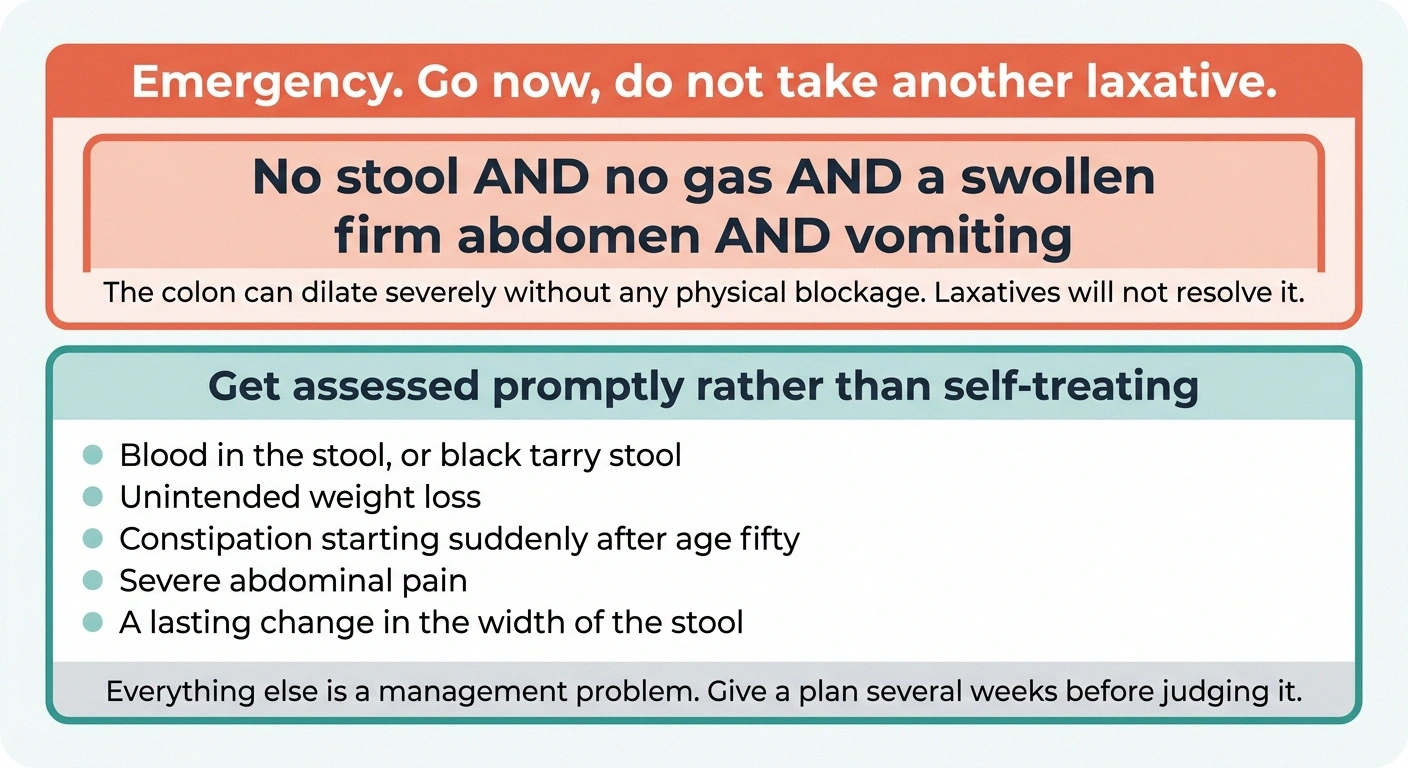
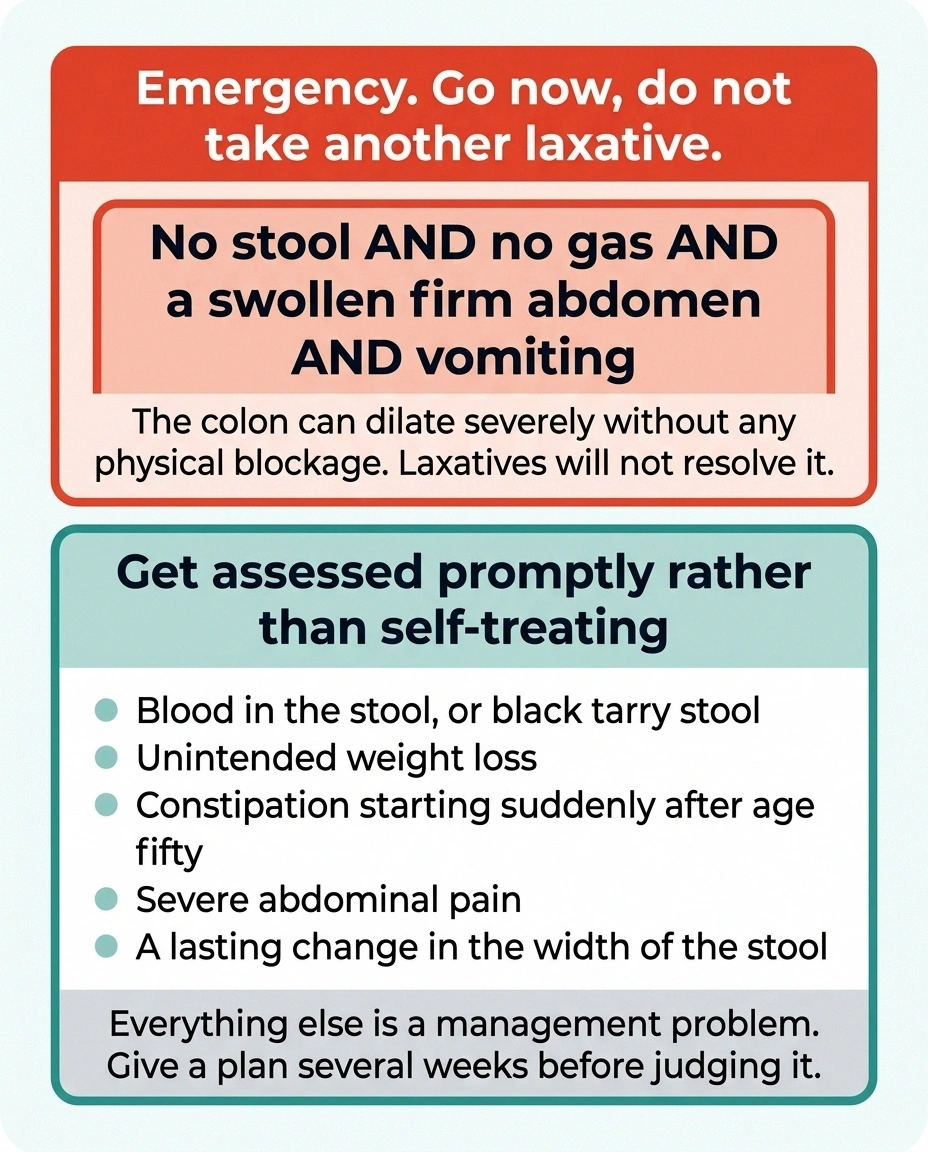
The one that matters most is obstruction. If you have passed no stool and no gas, your abdomen is distended and firm, and you are vomiting, that combination requires emergency evaluation rather than another laxative. Severe autonomic damage can produce a condition where the colon dilates dramatically without any physical blockage, and it is a genuine emergency that laxatives will not resolve.
Other findings that warrant prompt assessment rather than self-management include blood in the stool or black tarry stool, unintended weight loss, constipation that begins suddenly in someone over fifty with no prior history, severe abdominal pain, and a persistent change in the caliber of the stool. Each of these has causes unrelated to nerve damage that need identifying on their own terms.
Outside of those, the reasonable path is unglamorous and works: name every medication contributing to the problem, choose the laxative category that matches slow transit rather than the one that matches general constipation, build the morning routine, and give the combination several weeks before judging it. People with long-standing diabetic nerve damage often improve substantially with exactly that sequence, and many have never been offered it as a sequence, only as scattered individual suggestions that each failed alone.
Frequently Asked Questions
Can neuropathy really cause constipation?
Yes, and it is one of the most common digestive complaints in long-standing diabetes. The autonomic nerves that regulate the movement of the digestive tract can be damaged by the same processes that damage the nerves in the feet. When those signals degrade, contractions become slower and less coordinated, and stool moves through the colon far more slowly than it should. The muscle is generally healthy. It is the instruction to contract in an organized sequence that has broken down.
Why does fiber make my constipation worse?
Bulk-forming fiber supplements work by adding volume that stretches the bowel wall and triggers a contraction. That mechanism depends on the contraction response working. When nerve damage has slowed transit, the added bulk arrives in a colon that cannot move it efficiently, so it accumulates and produces bloating, gas and pressure instead of relief. Osmotic agents, which draw water in to soften and lubricate rather than adding mass, generally suit slow transit better. This is worth discussing with your clinician rather than switching products on your own.
Can I be constipated and have diarrhea at the same time?
It is a very common pattern in autonomic neuropathy and it is usually one problem rather than two. Slowed transit lets bacteria multiply in the small intestine, and that overgrowth produces gas, bloating and bouts of loose stool in someone who is fundamentally constipated. Diabetic diarrhea can also occur at night, painlessly and sometimes with loss of control, because the internal anal sphincter is autonomically controlled. Describing the full cycle rather than the current phase gives a clinician much more to work with.
How long does it take to see improvement?
Longer than most people expect, and that expectation gap causes many workable plans to be abandoned early. An osmotic laxative may soften stool within a few days, but retraining a routine around the morning reflex generally takes two to four weeks to show a consistent pattern, and clearing a significant backlog can take longer still. Judging any single change before a few weeks have passed tends to produce a series of abandoned attempts rather than a working system.
Should I stop taking my nerve pain medication if it causes constipation?
Not on your own. Opioids, tricyclic antidepressants and duloxetine all contribute to constipation, and they are also often providing meaningful pain relief. The productive conversation is whether an alternative exists, whether a dose adjustment is reasonable, or whether the constipation simply needs treating more assertively alongside the medication. For opioid-related constipation specifically, there are prescription drugs that block the gut effect without reducing pain control, and asking about them by name is a reasonable request.
When is constipation an emergency?
When no stool and no gas are passing, the abdomen is swollen and firm, and vomiting has started. That combination suggests obstruction and needs emergency evaluation immediately, not another laxative. Blood in the stool, black tarry stool, unintended weight loss, severe abdominal pain, or constipation starting abruptly after age fifty also warrant prompt assessment rather than self-treatment, because each has possible causes that have nothing to do with nerve damage.
What if I strain and nothing comes out even though I feel ready?
That specific experience points toward pelvic floor dyssynergia rather than slow transit. In that condition the pelvic floor muscles contract instead of relaxing during an attempt to pass stool, so the exit stays effectively closed regardless of what arrives. Laxatives do not address it, which is why people with dyssynergia often report that nothing works. It responds well to biofeedback therapy delivered by a pelvic floor physical therapist, and a gastroenterologist can test for it with anorectal manometry.
About the Author