
It wakes you.
That is the detail that matters most, and it is usually the one people leave out. You have been asleep. Nothing was eaten, nothing was drunk, nothing happened. And you are awake at two in the morning making a fast, undignified trip down the hall, and it happens again a few hours later, and by morning you are exhausted and slightly frightened and no closer to knowing why.
Most people who live with this never bring it up. They mention the burning feet. They mention the numbness. They do not mention this, partly because it feels like a separate and embarrassing problem, and partly because nobody ever told them that the nerve damage in their feet has relatives that run their intestines.
It has a name. Diabetic diarrhea, or more broadly diabetic enteropathy, and it belongs to the same family as the neuropathy you already know about. Nerves that go to the gut can be damaged the same way nerves that go to the toes can. The gut nerves just fail more quietly, and they fail in a way that is hard to talk about at a desk.
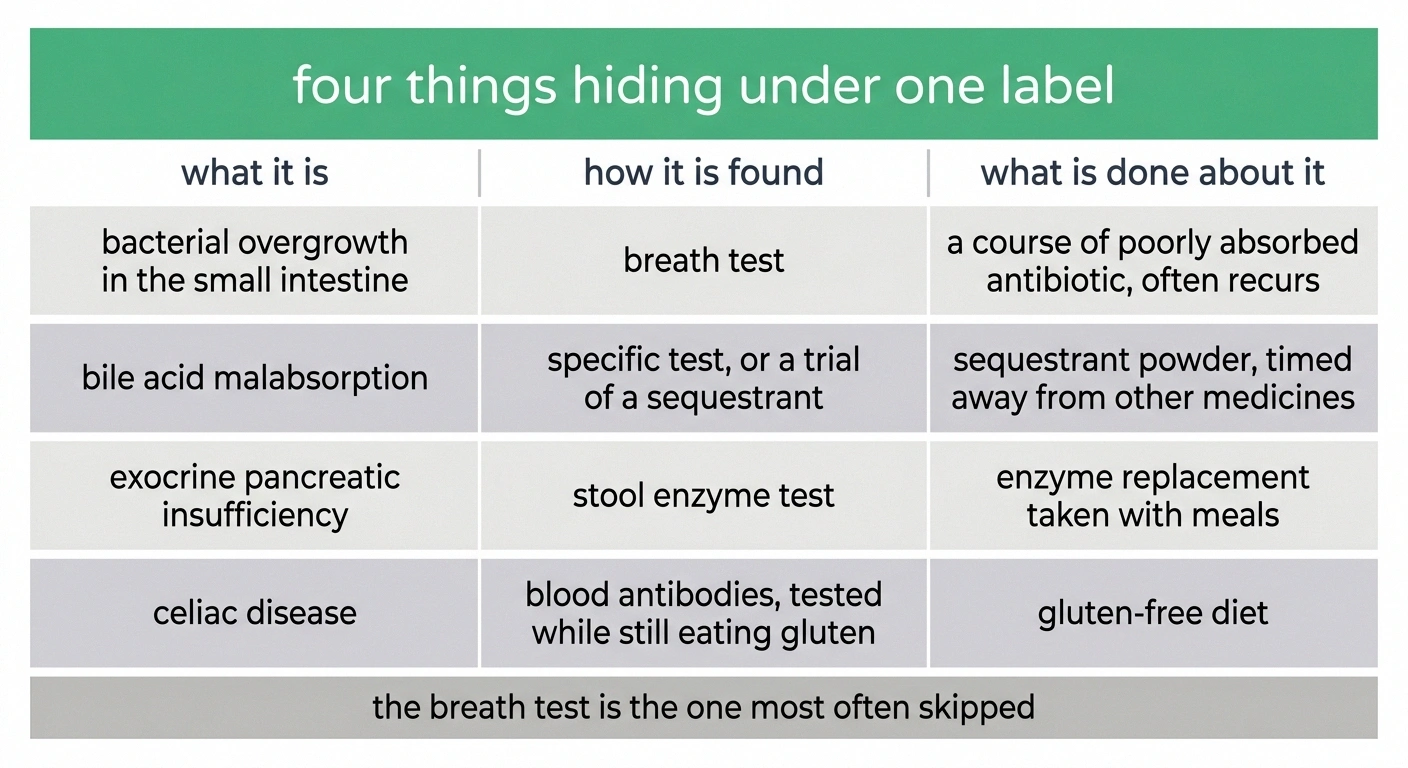
What follows is what is actually happening in there, the four treatable conditions that hide underneath the label and get missed with some regularity, and the symptom almost nobody reports even when directly asked.
What Separates This From an Upset Stomach
Several features distinguish this from ordinary bowel trouble, and knowing them changes how seriously it gets taken.
It wakes you from sleep. This is the single most useful clue. Irritable bowel syndrome, which is what this often gets labelled as, characteristically does not wake people. Nocturnal diarrhea points toward a physical cause, and diarrhea from small-intestinal nerve damage occurs most often at night.
It is painless or nearly so. Cramping may occur, but the crushing pain that dominates other bowel conditions is usually absent. Volume without pain is a different pattern.
It comes in episodes with normal stretches between. Days or weeks of watery stool, then a period of ordinary function, then a return. The intermittency convinces many people it must be something they ate.
It alternates with constipation. Frequently and confusingly.
It is unrelated to what you ate. People spend months on elimination diets looking for a trigger that is not food.
Other autonomic signs travel with it. Dizziness on standing, a resting heart rate that never varies, early fullness at meals, sweating that is excessive in some places and absent in others, bladder changes. These are all the same nerve population failing in different territories, which is the broader picture of autonomic neuropathy.
Who Tends to Get It
Length of diabetes matters. This generally shows up in people who have had diabetes for many years, usually alongside other complications, and it is more common in those who already have peripheral diabetic neuropathy. If your feet have been affected for a decade, the nerves elsewhere have been exposed to the same conditions for the same decade.
The Nerves That Run Your Gut
Your intestines have their own nervous system, and it is startlingly large.
Embedded in the wall of the gut, from the esophagus to the rectum, is a mesh of neurons called the enteric nervous system. It contains something on the order of a hundred million neurons, enough that it is sometimes called a second brain. It can run basic digestion without instruction from above, coordinating the rhythmic squeeze that moves contents along.
Above it sits the autonomic supply: the vagus nerve carrying parasympathetic signals that generally speed things up and increase secretion, and sympathetic fibers that generally slow things down and increase absorption. Between them they set the pace, control blood flow, tune how much fluid is secreted into the gut and how much is pulled back out, and keep the whole assembly working in sequence.
Sustained high blood sugar damages these nerves the same way it damages the nerves in your feet. Small vessels supplying the nerves narrow. Metabolic byproducts accumulate. Fibers are lost, and the ones that remain conduct poorly.
When that supply degrades, several things go wrong at once. Movement becomes uncoordinated rather than uniformly fast or slow. Secretion can be turned up while absorption is turned down, which tips the fluid balance straight toward watery stool. Segments of bowel stop clearing themselves properly. And the timing that normally keeps everything sequenced comes apart.
That last point explains the symptom that confuses people most.
Why It Swings to Constipation and Back
Nobody expects a nerve problem to produce opposite symptoms, and the alternation is the main reason this gets dismissed as irritable bowel.
The features that separate this from irritable bowel syndrome
Both labels get applied to the same person at different appointments. These are the points a clinician weighs.
| Feature | Irritable bowel syndrome | Diabetic enteropathy |
|---|---|---|
| Wakes you from sleep | Characteristically not | Often, and this is the strongest single clue |
| Pain | Central to the diagnosis | Usually mild or absent; volume without pain |
| Relation to food | Often identifiable triggers | Frequently none, which is why elimination diets fail |
| Other autonomic signs | Not expected | Dizziness standing, fixed heart rate, early fullness, sweating changes |
| Duration of diabetes | Unrelated | Typically many years, usually with neuropathy elsewhere |
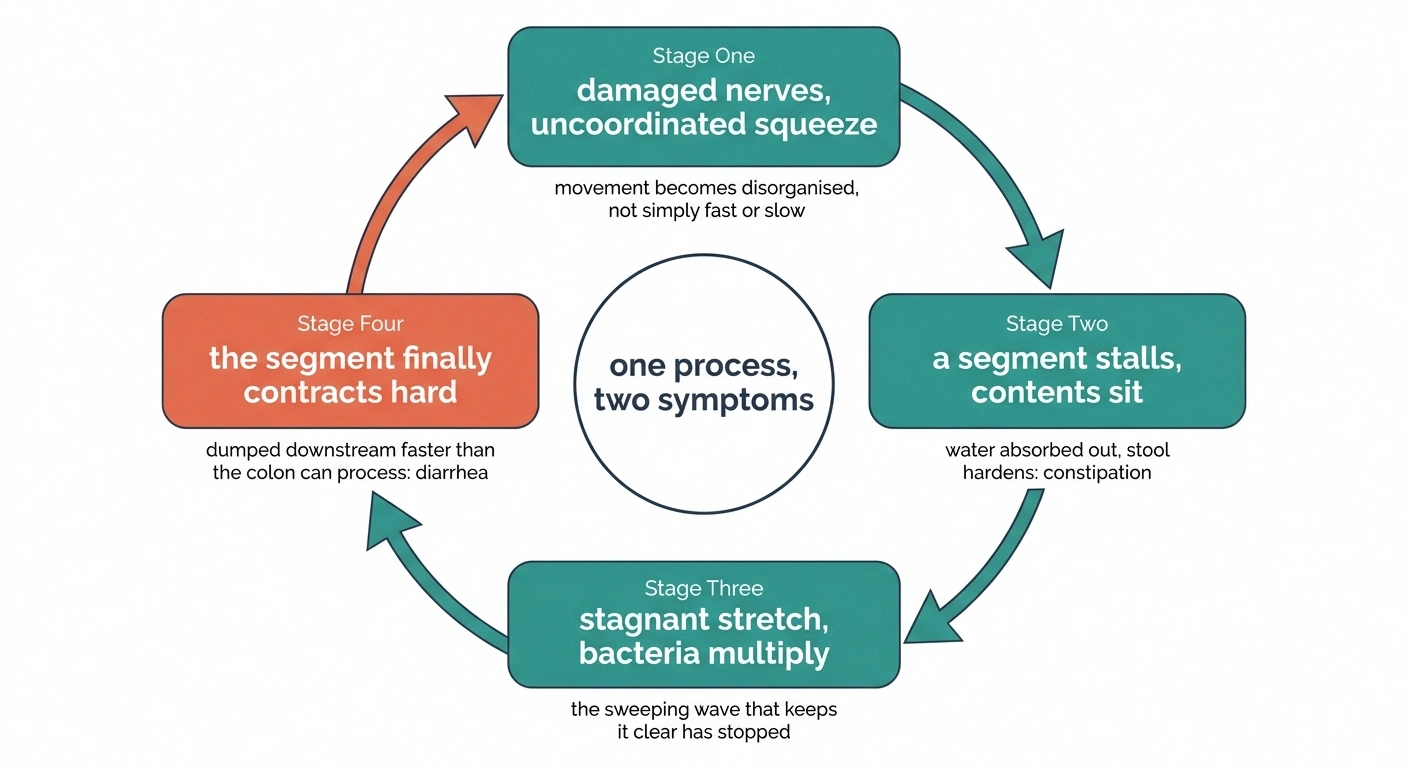
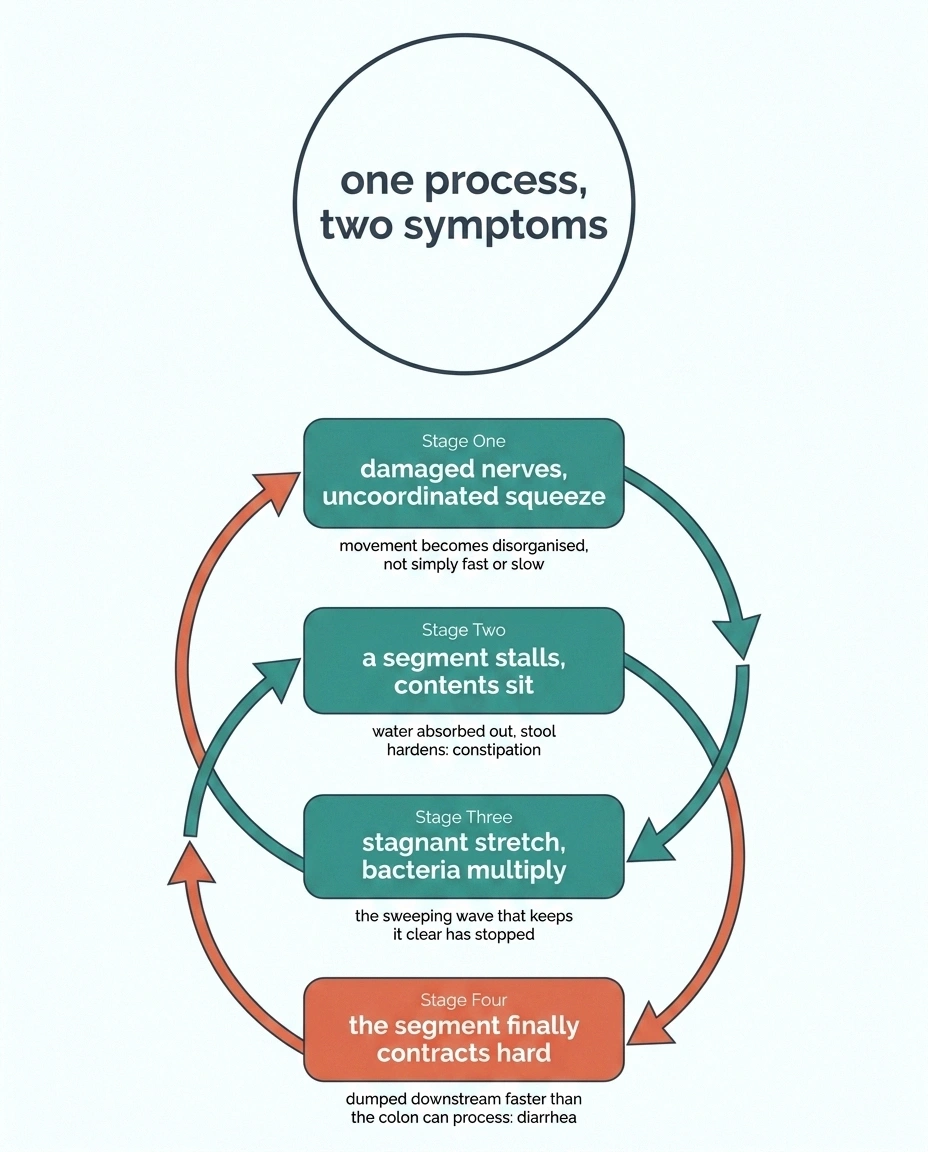
The explanation is that damaged gut nerves do not produce a consistent speed. They produce disorganization.
Segments of intestine slow down and contents sit there. Water is absorbed out of stationary contents, which hardens them, and constipation follows. Meanwhile the stagnant segment becomes an excellent place for bacteria to multiply, since the normal sweeping motion that keeps the small intestine relatively sparse has stopped. Eventually a stretch of bowel contracts hard and dumps its accumulated contents downstream faster than the colon can process, and you get the watery episode.
Constipation and diarrhea in this setting are not two problems. They are two visible stages of one problem, which is why treating them separately with a laxative and then an antidiarrheal tends to produce a person swinging harder between both extremes.
Bacterial Overgrowth Is the Overlap Nobody Tests For
This is the most important treatable thing on the page, and it is missed constantly.
Small intestinal bacterial overgrowth, measured
43%
of people with diabetes and diarrhea, in a study where they improved with antibiotic treatment
6%
of the general population, a figure that rises with age
Roughly a seven-fold difference, in a group whose symptoms had usually already been attributed to permanent nerve damage. The test is a breath test. It is the investigation most often left out.
Your small intestine is supposed to be relatively low in bacteria. It stays that way because of a housekeeping wave that sweeps through between meals, clearing contents downward. Autonomic damage weakens that wave. Contents linger. Bacteria that belong in the colon colonize the small intestine instead, and once established they ferment carbohydrate before you can absorb it, deconjugate bile acids, and produce gas, bloating, and watery stool.
The numbers are worth sitting with. In one study of people with diabetes and diarrhea, 43 percent had small intestinal bacterial overgrowth, against a general-population figure of around 6 percent. And they improved with antibiotic treatment.
Nearly half. Of a group whose diarrhea had already been attributed to nerve damage and effectively written off as permanent.
Overgrowth is diagnosed with a breath test, or sometimes treated empirically with a course of a poorly absorbed antibiotic to see whether symptoms respond. It is not a cure for the underlying motility problem, and it tends to recur, since the stalled housekeeping wave that permitted it in the first place has not been repaired. But recurring and treatable is a substantially better situation than permanent and untreatable, and the distinction is only available to people who get tested.
Bile Acids That Never Get Reabsorbed
The second treatable overlap, and even less known.
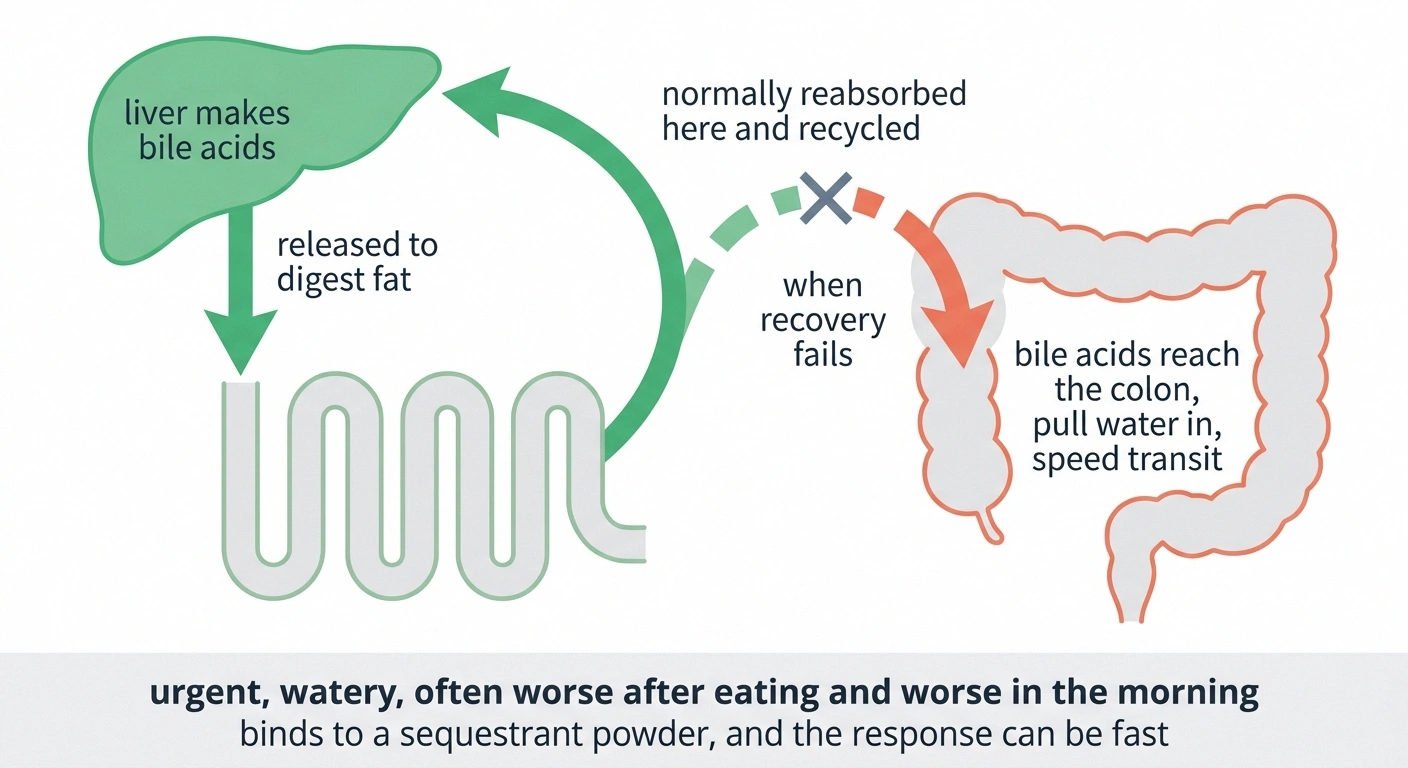
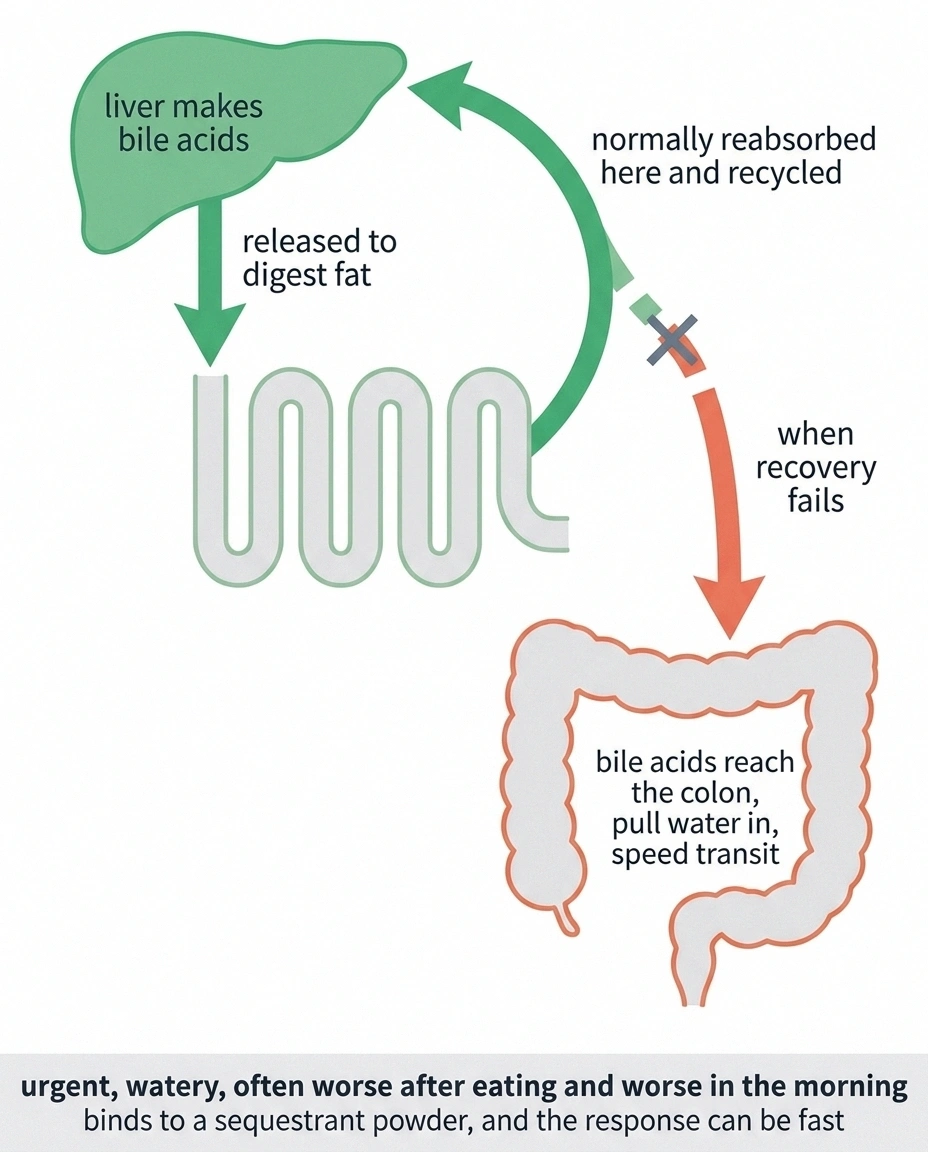
Your liver makes bile acids to digest fat. They are released into the small intestine, do their work, and then are reabsorbed near the end of the small intestine and recycled. That recovery step is efficient under normal conditions.
When it fails, bile acids spill into the colon. There they act as a direct stimulant, drawing water into the bowel and speeding transit. The result is urgent, watery, often yellowish diarrhea that is characteristically worse after eating and characteristically worse in the morning.
People with diabetes and diarrhea have been found to have measurably smaller bile-salt pools and increased fecal excretion of bile salts compared with those without diarrhea, which points at exactly this mechanism. Estimates put bile acid malabsorption in up to a third of people with chronic diarrhea of the type usually filed as functional, a figure high enough that it should be considered routinely and generally is not.
The treatment is a bile acid sequestrant, a powder that binds the acids in the gut so they cannot irritate the colon. When bile acid malabsorption is the driver, the response can be rapid and dramatic. It also has to be timed away from other medications, since it binds those too.
Check the Medication List First

Before attributing anything to nerve damage, the drug list deserves a careful look, because several standard diabetes medications cause diarrhea directly.
What to try before accepting a nerve explanation
- Metformin
- Ask about the extended-release form and a two-week trial. Can start years into treatment, which is why people wrongly rule it out. Have B12 checked at the same time.
- GLP-1 receptor agonists
- Altered gut motility is part of how they work. Effects often settle with slower dose escalation rather than needing the drug stopped.
- Acarbose
- Leaves carbohydrate undigested for bacteria to ferment. Gas and loose stool are the expected consequence of the mechanism, not an unusual reaction.
- Sugar alcohols
- Read for sorbitol, mannitol and maltitol. They draw water into the bowel and are concentrated in exactly the sugar-free products marketed to people with diabetes.
- Magnesium supplements
- Loosen stool reliably at meaningful doses. Worth pausing for a fortnight before anything more elaborate is arranged.
Change one thing at a time and leave two weeks between changes, or the result tells you nothing.
Metformin is the obvious one and causes diarrhea in a substantial minority of users. It is dose-related, often improves on the extended-release formulation, and can begin years into treatment rather than at the start, which is why people rule it out incorrectly. Metformin also depletes B12 over time, which matters here because B12 deficiency damages nerves in its own right and can quietly worsen the neuropathy underneath everything else. It is one of the better-known entries among medications that can affect nerves, and a reason to have levels checked rather than assumed.
GLP-1 receptor agonists alter gut motility as part of how they work, and gastrointestinal effects are common.
Acarbose works by leaving carbohydrate undigested for bacteria to ferment, so gas and loose stool are expected consequences rather than side effects.
Sugar alcohols in sugar-free products draw water into the bowel. Sorbitol, mannitol and maltitol appear throughout foods marketed to people with diabetes, which is an unkind arrangement.
Magnesium supplements at meaningful doses loosen stool reliably.
None of this rules out neuropathy, and medication effects and nerve damage frequently coexist. But a two-week trial of an alternative formulation is faster, cheaper and safer than a diagnostic workup, and it occasionally ends the whole investigation.
The Two Diagnoses That Get Missed
Two conditions produce nearly identical symptoms and are both more common in people with diabetes than in the general population.
Celiac disease occurs at notably higher rates in type 1 diabetes than in the general population, since both are autoimmune and cluster together. It produces diarrhea, weight loss, and nutrient deficiencies, and it also causes neuropathy independently. Testing is a blood test, and it needs to be done while gluten is still being eaten, which people frequently discover after they have already cut it out.
Exocrine pancreatic insufficiency is the other. The pancreas makes insulin, and it also makes the enzymes that digest fat. Long-standing diabetes can impair both functions. Without enough enzyme, fat passes through undigested, producing pale, greasy, foul-smelling stool that is difficult to flush, along with weight loss despite adequate eating. It is diagnosed with a stool test and treated with enzyme replacement taken at meals.
Both are worth excluding before accepting that nothing can be done, because both have specific treatments and neither responds to anything aimed at nerves.
The Symptom People Will Not Say Out Loud

This section exists because the thing it describes is common, treatable, and almost never volunteered.
Autonomic neuropathy can affect the internal anal sphincter, the muscle that maintains continence without conscious effort. It is not under voluntary control. When its nerve supply degrades, the seal weakens, and combined with loose stool arriving urgently, accidents happen.
Fecal incontinence is a recognized consequence of autonomic neuropathy. It commonly begins alongside low-volume diarrhea, which is why it is easy to attribute to the diarrhea alone rather than to a separate and specifically treatable problem.
Almost nobody reports it. People rearrange their entire lives around it first: they stop travelling, decline invitations, map every bathroom on any route they take, and stay home. The isolation compounds quickly, and the emotional weight of that is real enough to belong in the conversation about neuropathy and mental health rather than being carried privately.
Say it anyway. There are pelvic floor physical therapists who work on exactly this. There is biofeedback training with a decent evidence base. There are sacral nerve stimulation approaches for cases that do not respond. Firming the stool alone frequently improves continence substantially, because a formed stool is far easier for a weakened sphincter to hold than a liquid one.
The single sentence that opens all of that is hard to say and worth saying: “I am having accidents.”
What Testing Actually Involves
A reasonable workup is mostly straightforward, and knowing the sequence helps you ask for the parts that get skipped.
Tests to name individually, because a general referral does not order them
Take this list rather than a description. Naming a test is the difference between it being considered and it being ordered.
- 01Breath test for small intestinal bacterial overgrowth
- 02Stool pancreatic elastase, for exocrine pancreatic insufficiency
- 03Celiac antibodies, drawn while you are still eating gluten
- 04Bile acid malabsorption testing, or an agreed trial of a sequestrant
- 05B12, thyroid function and inflammatory markers
- 06Stool studies for infection and inflammation
Blood work comes first: celiac antibodies, thyroid function, B12, and inflammatory markers. A stool test looks for infection, inflammation, and pancreatic enzyme levels. A breath test checks for bacterial overgrowth. Bile acid malabsorption is assessed with a specific test where available, or by observing the response to a sequestrant trial, which is often how it is done in practice.
Beyond that, a colonoscopy may be arranged to exclude other causes, particularly if there is bleeding, weight loss, or a family history. Gastric emptying studies are sometimes added if symptoms suggest the stomach is involved as well.
The part most often skipped is the breath test, and given the overgrowth figures above, that omission is expensive. If your workup did not include one, that is a specific and reasonable thing to ask about by name.
What Helps

Treatment runs on several tracks at once, which is appropriate given that several mechanisms are usually running at once.
Blood sugar control comes first, and honestly. Better control will not reverse established nerve damage, but wide glucose swings worsen gut motility acutely, and stabilizing them frequently reduces the frequency of episodes. It is also the only intervention that affects the trajectory rather than the symptoms.
Treat what is treatable underneath. Antibiotics for overgrowth. Sequestrants for bile acid malabsorption. Enzymes for pancreatic insufficiency. A gluten-free diet for celiac. These are the interventions that produce the large changes, which is why the workup matters more than the symptom management.
Antidiarrheal medication is standard, taken on a schedule rather than in response to an episode, because reacting after the fact is always too late. Conventional antidiarrheals are sometimes ineffective in this setting, and where they fail, other drug classes have been used with success, including a case in which a serotonin 5-HT3 receptor antagonist eliminated severe watery diarrhea that had not responded to conventional treatment.
Soluble fiber absorbs water and firms loose stool. It is one of the few interventions that improves both directions of the swing. Start small, because starting at a full dose reliably produces gas and a fortnight of regret.
Diet adjustments aimed at reducing fermentable load, moderating fat if enzymes are limited, cutting sugar alcohols, and eating smaller and more frequent meals. These are supportive rather than curative and work better as adjustments to the broader neuropathy diet than as a separate regimen.
Correct the deficiencies. Chronic diarrhea depletes fat-soluble vitamins, magnesium, and B12, and the B12 question deserves attention here because deficiency worsens the underlying nerve damage. Where absorption is unreliable, B12 by injection bypasses the gut entirely, which is sometimes the reason a supplement appeared not to work. A wider look at nutritional deficiencies that damage nerves is worth doing once, properly, rather than piecemeal.
Protecting Sleep and Skin

Two practical matters that get no clinical airtime and cause a disproportionate share of the daily misery.
Sleep is the first casualty, and its loss makes everything else worse: pain perception rises, blood sugar control degrades, and mood follows. Keep a clear, lit, unobstructed path to the bathroom, since numb feet and a night-time hurry are a combination that produces falls. Some people find that shifting the largest meal earlier reduces the overnight episodes. Timing an antidiarrheal in the evening rather than the morning is worth discussing if the pattern is predominantly nocturnal, which for many people it is, and it sits alongside the general problem of neuropathy symptoms worsening at night.
Skin is the second. Repeated episodes plus repeated cleaning break the skin down fast, and in someone with diabetes, broken skin is not a minor matter. Use a barrier cream preventively rather than after soreness appears. Water and a soft cloth beat dry wiping. Avoid scented wipes, which sting damaged skin and worsen irritation.
Do not wait on any of these
Blood in the stool, black tarry stool, unintended weight loss, fever, severe abdominal pain, signs of dehydration such as dizziness on standing or passing very little urine, or a sudden change in a pattern that had been stable for years. None of these belong to diabetic enteropathy, and each has its own list of causes that need looking at now rather than at the next routine appointment.
When to Ask for a Gastroenterologist
Diabetes care and gut motility are different specialties, and this sits in the overlap where neither side automatically claims it.
A three-week record beats an impression
Six numbers, collected before the visit. They take about a minute a day and they change what gets ordered.
- Episodes per day, averaged across the three weeks.
- How many of those were between midnight and six. This is the number that most changes the differential.
- Days with no diarrhea at all, and whether constipation occurred on them.
- Whether stool is pale, greasy or hard to flush, which points at fat that is not being digested.
- Weight now against weight six months ago. An actual pair of numbers, not an impression.
- Accidents, counted. The hardest line to write and the one most likely to change the plan.
Ask for the referral if the diarrhea has lasted more than four weeks, if it wakes you at night, if you have had accidents, if you are losing weight, if antidiarrheals are not working, or if nobody has yet tested for overgrowth, bile acid malabsorption, celiac disease, or pancreatic insufficiency.
Bring specifics. How many episodes a day, how many of them at night, what the stool looks like, how long it has been going on, what you have tried and for how long. A three-week record beats an impression, and it makes the visit shorter for both of you.
The thing most worth carrying away is that “diabetic diarrhea” is a label describing a symptom, not a diagnosis explaining it. Underneath the label there are usually one or two specific, testable, treatable things. Accepting the label without looking underneath it is how people end up managing something for years that could have been substantially improved in a month.
Frequently Asked Questions
What is diabetic diarrhea?
It is chronic or episodic diarrhea caused by autonomic nerve damage affecting the intestines, part of a broader picture called diabetic enteropathy. The nerves controlling gut movement, secretion, and absorption stop working in a coordinated way, producing uncoordinated motility and a fluid balance tipped toward watery stool. It usually appears in people who have had diabetes for many years and who already have nerve damage elsewhere.
Why does diabetic diarrhea happen at night?
Diarrhea arising from small-intestinal nerve damage occurs most often at night, and this nocturnal pattern is one of the most useful clues available. Irritable bowel syndrome characteristically does not wake people from sleep, so diarrhea that does points toward a physical cause and deserves investigation rather than a functional label.
Can autonomic neuropathy cause loss of bowel control?
Yes. The internal anal sphincter is controlled by autonomic nerves rather than voluntarily, and when that supply is damaged the seal weakens. Fecal incontinence is a recognized consequence and often begins alongside low-volume diarrhea. It responds to pelvic floor physical therapy, biofeedback, and in some cases nerve stimulation, and simply firming the stool often improves control considerably.
Is it my metformin or my nerves?
It can be either and is frequently both. Metformin causes diarrhea in a substantial minority of users, is dose-related, often improves on the extended-release form, and can begin years after starting rather than immediately. Because a formulation trial is faster and cheaper than a diagnostic workup, it is usually worth ruling out first. Metformin also depletes B12 over time, which is worth checking separately since deficiency damages nerves independently.
What is SIBO and how is it related?
Small intestinal bacterial overgrowth occurs when the housekeeping wave that normally sweeps the small intestine downward weakens, allowing colonic bacteria to colonize it. In one study, 43 percent of people with diabetes and diarrhea had it, compared with roughly 6 percent of the general population, and they improved with antibiotics. It is diagnosed by breath test, treats well, and tends to recur because the motility problem permitting it remains.
Why do I swing between constipation and diarrhea?
Damaged gut nerves produce disorganized movement rather than uniformly fast or slow transit. Segments slow and contents sit, water is drawn out, and stool hardens. Eventually the accumulated contents are dumped downstream faster than the colon can handle them, producing a watery episode. The two symptoms are stages of one process, which is why treating them independently tends to widen the swings.
Does diabetic diarrhea ever go away?
The underlying nerve damage does not reverse, but the symptom often improves a great deal once the treatable overlaps are addressed. Bacterial overgrowth, bile acid malabsorption, pancreatic insufficiency, celiac disease, and medication effects account for a large share of cases and each has a specific treatment. Blood sugar stability reduces episode frequency without repairing the nerves.
What foods make diabetic diarrhea worse?
Sugar alcohols such as sorbitol, mannitol and maltitol draw water into the bowel and appear throughout products marketed as sugar-free. Large fatty meals are difficult if pancreatic enzyme output is reduced. Highly fermentable carbohydrates worsen symptoms when bacterial overgrowth is present. Caffeine and alcohol both accelerate transit. Smaller, more frequent meals are generally easier to handle than large ones.
About the Author