
The mug was three inches above the counter when it went.
Nothing dramatic happened. No pain, no spasm, no moment of weakness you could point to. The handle was in my fingers and then it was not, and I was standing in coffee wondering what exactly had just failed.
If that has happened to you more than once, you have probably already reached the obvious conclusion: my hands are getting weak. It is the natural explanation, and for a lot of people it is the wrong one.
Dropping things is usually a sensing problem rather than a strength problem. Understanding that distinction changes what you test, what you tell your doctor, and which fixes actually work in your kitchen. It also explains the presentation that confuses people most, which is being able to open a stubborn jar on the same afternoon you dropped a plastic cup.
Grip Is a Feedback Loop, Not a Clamp
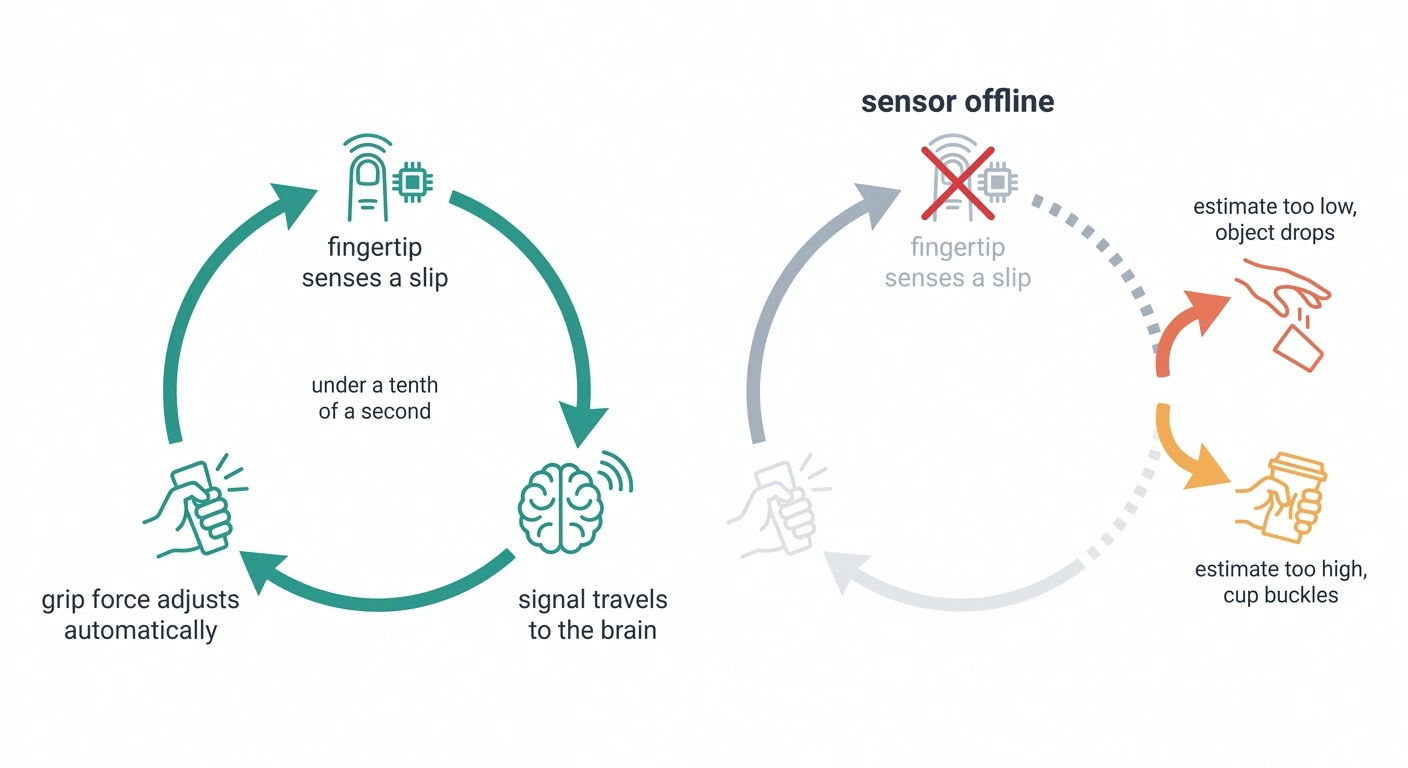
Pick up a glass of water and hold it. It feels like a single decision: close the fingers, apply force, done.
It is nothing of the sort. Holding an object is a control loop running continuously, and it is one of the fastest loops your nervous system operates.
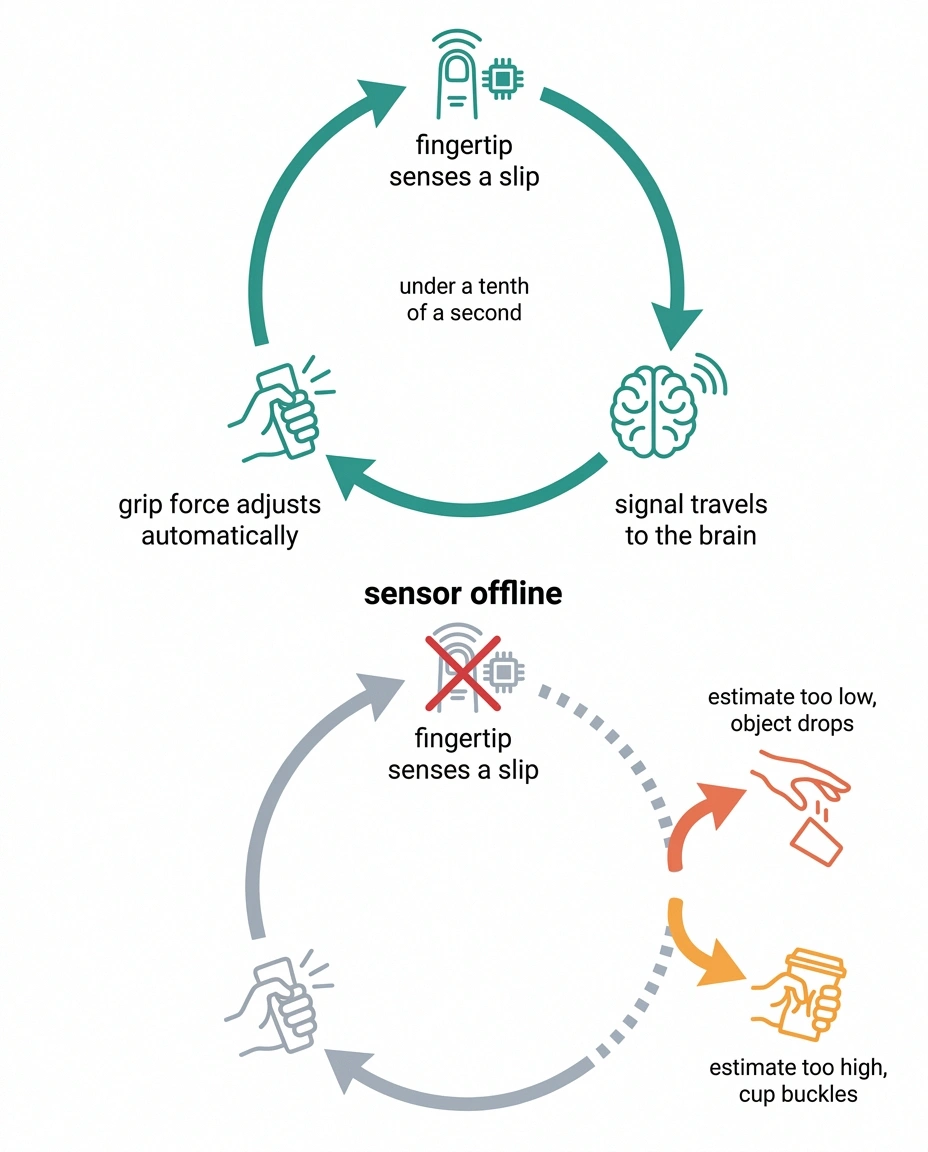
The skin of your fingertips is packed with receptors that detect tiny slips. Not visible slipping, but the object beginning to move against the skin by a fraction of a millimeter. That signal races up to the spinal cord and the brain, and the grip force is corrected before you have the faintest awareness anything happened. The whole cycle completes in a fraction of a second.
Because the loop is that fast and that reliable, healthy hands run on a thin margin. You do not squeeze a glass with all your might. You apply just slightly more force than the minimum required to hold it, because the loop is trusted to catch any slip that develops. Grip is efficient specifically because it is monitored.
Now take the sensors out of the equation. The loop opens. You are no longer measuring and correcting; you are estimating, once, at the moment of pickup, and then hoping. Sometimes the estimate is low and the object goes. Sometimes it is high and the paper cup buckles.
That is the whole mechanism. The hand is not weak. The hand is flying blind.
Why You Can Open a Jar and Still Drop the Cup
This is the observation that sends people away from an appointment feeling unheard, because it sounds contradictory and it is not.
Tick the ones that have failed in the last month
Which column fills up is the finding. Take the completed list with you rather than the conclusion you drew from it.
Fine control
Needs precision, not power
Gross force
Needs power, not precision
Reading it: ticks clustered on the left point toward sensory loss and fine motor control. Ticks spread across both columns, or concentrated on the right, point toward genuine weakness and deserve faster attention. Ticks only on the right with the left column completely clean is an unusual pattern worth naming out loud.
Opening a jar is a maximum-force task. You are applying everything you have, and precision is irrelevant. Nobody has ever opened a jar too hard. That task depends on muscle bulk and on the motor nerves that drive it, and if those are intact, you will pass.
Carrying a full mug across a room is a force-modulation task. The correct grip force is a narrow band. Too little and it slips, too much and it tips or your hand fatigues halfway. Getting into that band and staying in it requires continuous sensory feedback, and that is the system that has gone quiet.
So the pattern makes sense once you separate the two. Strength and control are different systems, supported by different nerve fibers, and they fail independently. A person can lose a great deal of fine control while their raw strength stays close to normal, and that person will drop cups, fumble buttons, and still be able to carry the groceries.
Worth saying out loud at the appointment, in exactly those words: my strength feels fine, my control does not. That sentence points a clinician toward sensory testing rather than toward a strength exam that will come back reassuringly normal and settle nothing.
The Other Half of the Symptom: Crushing
Almost nobody mentions this one, and it is the same failure viewed from the other direction.
When the feedback loop opens, over-gripping is just as likely as under-gripping. The results show up as a small daily litany: paper cups that buckle and spill, plastic forks that snap, eggs cracked while being picked up, a tomato squeezed into pulp, an ink pen held so hard the hand aches after a page, a phone gripped hard enough that the fingers cramp.
People experiencing this rarely connect it to the dropping. It gets filed as clumsiness, or as being distracted, or as a run of bad luck with cheap crockery.
Both errors are the same error. Without slip feedback there is no way to find the middle, so the hand alternates between too little and too much. If you recognize the crushing half, add it to the list you bring in. It supports the sensory explanation far more strongly than dropping alone does, because pure weakness does not crush anything.
Test One: Take Your Eyes Away
Vision substitutes for sensation. When your fingers stop reporting, your eyes take over the job, and most people begin doing this automatically long before they realize it.
That substitution gives you a clean test.
Think about when the drops actually happen. Reaching into a bag or a pocket for keys. Getting something out of a cupboard above eye level. Holding a cup while turning to talk to someone. Carrying a plate while watching where you are walking. Getting dressed in a dim bedroom. Washing dishes in water you cannot see through.
If your failures cluster in those moments, and you do noticeably better when you are looking directly at the object, that is sensory loss being compensated for by vision. It is one of the most characteristic signs there is.
True motor weakness behaves differently. A weak hand is weak whether you are watching it or not. Looking harder does not add force.
You can also test it deliberately, over a sink for safety. Hold a light unbreakable object, close your eyes, and hold it steady for thirty seconds. Nothing subtle is needed; either it stays put or you feel your grip drifting and have to keep resetting it. Do the same with the other hand and compare.
Test Two: Look for the Hollow
This one takes fifteen seconds and it is the check that most changes the urgency of the conversation.
Two spots, and what a hollow in each one means
- The web between thumb and index, back of the hand
- A muscle sits under that skin and normally keeps the area flat or gently rounded. A scooped valley there, on one hand and not the other, is the earliest visible sign of ulnar nerve involvement, usually from compression at the elbow rather than the wrist.
- The fleshy pad at the base of the thumb, palm side
- Flattening here points to the median nerve, most often compressed at the wrist. It is the finding that most raises the priority of getting seen, because thumb opposition is the movement almost every fine task depends on.
- What a hollow does and does not mean
- It means motor fibers have been lost, not only sensory ones. It does not mean anything catastrophic; ordinary nerve compression is the most common cause by a wide margin. It does mean the clock matters, because wasted muscle rebuilds slowly and incompletely, so the realistic goal is stopping the process rather than reversing it.
Photograph both hands today in the same light, palm-down and then palm-up. Three months from now that photo is evidence, and memory is not.
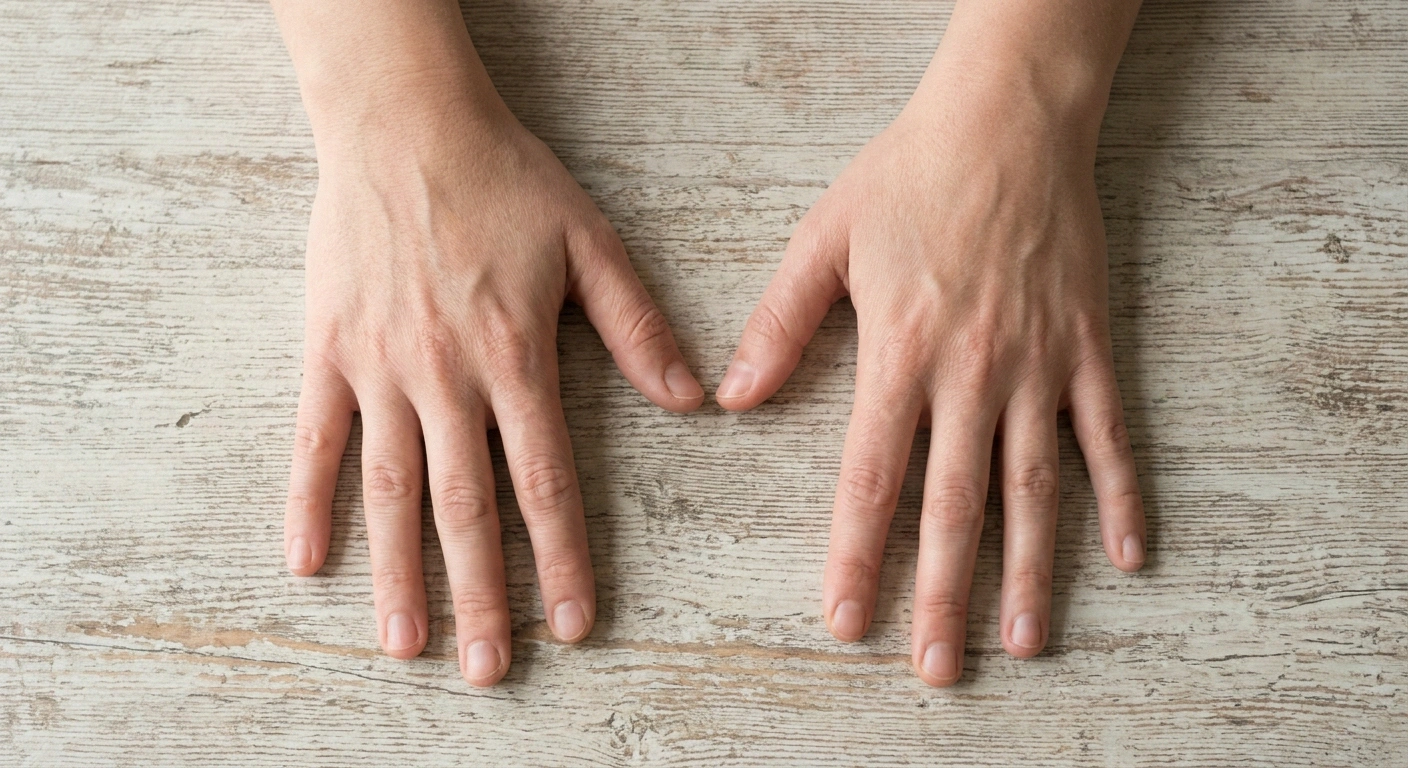
Put both hands palm-down on a table, side by side, in good light. Look at the web space between the thumb and the index finger on the back of the hand. In a healthy hand, that area is gently rounded or flat because a muscle sits underneath it. Then turn both hands over and look at the fleshy mound at the base of the thumb.
You are looking for a hollow. A scooped-out valley on one hand where the other is full. A thumb pad that has visibly flattened. A hand that has started to look bony compared to its partner.
Muscle wasting means motor nerve fibers have been lost, not just sensory ones, and that is a different situation from a purely sensory problem. It does not mean anything catastrophic, and one of the most common causes of exactly this finding is an ordinary compressed nerve at the wrist or elbow. But it does raise the priority of getting evaluated, because muscle that has wasted comes back slowly and incompletely, and the goal is to stop the process rather than to reverse it.
Photograph both hands in the same light today. Asymmetry is much easier to see in two pictures taken three months apart than it is by memory.
Test Three: Sort Your Failures
Take a week and pay attention to what you actually drop, then sort the list into two columns.
The first column is fine-control tasks: coins, keys, buttons, zippers, earrings, a single sheet of paper, eggs, a fork, contact lenses, pills out of a bottle, a cup by its handle. These need precision, not power.
The second column is gross-force tasks: jar lids, doorknobs, a heavy pan, a full grocery bag, a stuck window, wringing out a cloth. These need power, not precision.
Failures concentrated in the first column point toward sensory loss and fine motor control. Failures spread across both columns, or concentrated in the second, point toward genuine weakness and deserve faster attention. Failures in the second column only, with the first column entirely intact, is an unusual pattern and worth flagging specifically.
This sort is more useful than any adjective. “I drop things” tells a clinician almost nothing. “I can carry a full kettle but I cannot reliably hold a wine glass by the stem” tells them where to look.
When It's the Thumb Side
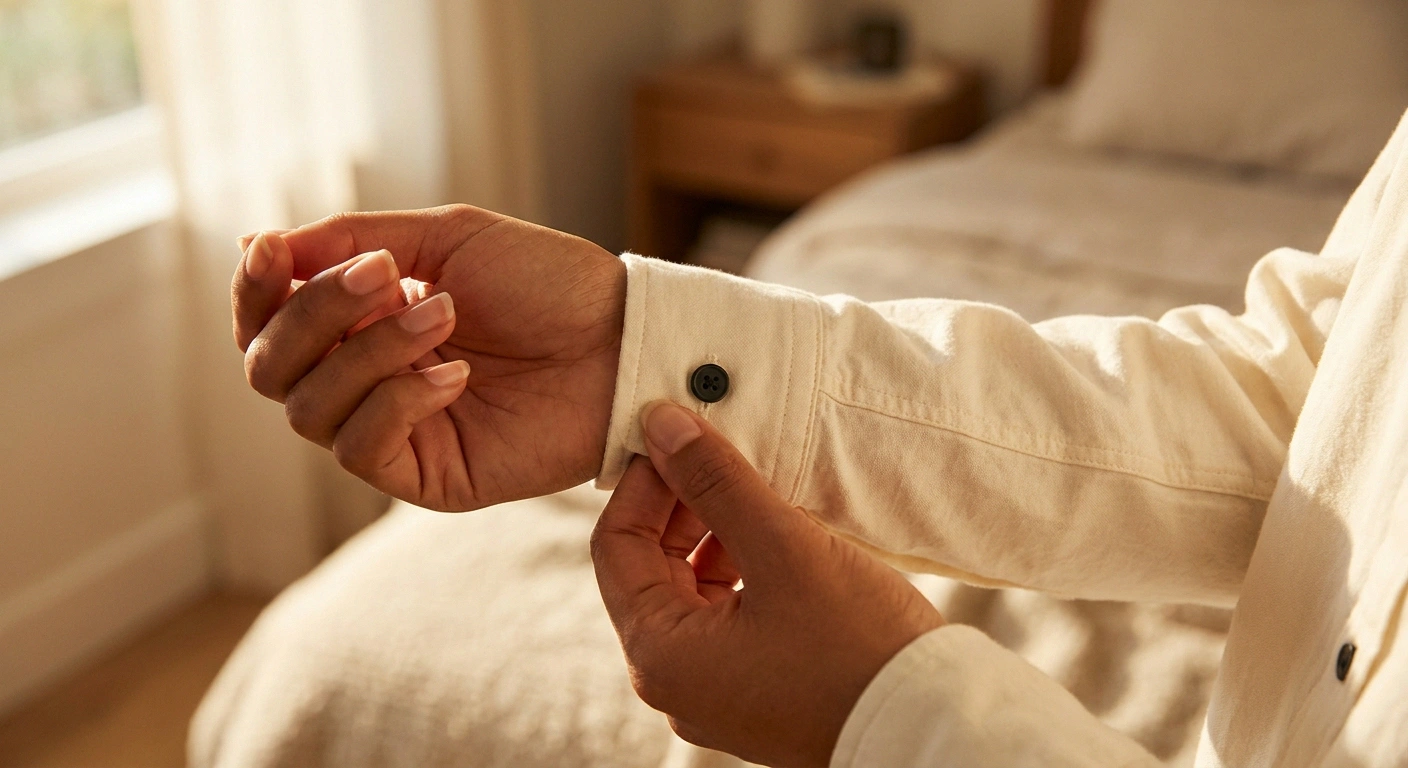
If the numbness and clumsiness sit in the thumb, index finger, middle finger, and half the ring finger, the median nerve is involved, and the usual reason is compression at the wrist.
The signature is distinctive. Symptoms wake you at three in the morning and you shake the hand out over the side of the bed until they settle. Holding a phone, a book, or a steering wheel with the wrist bent brings them on. The tasks that fail first are pinch tasks: picking a coin off a flat surface, fastening a small button, threading a needle, turning a key.
Wasting from this cause shows up as flattening of the thumb pad, and it is worth checking for specifically because it changes how quickly the problem should be addressed.
This is a mechanical problem with mechanical answers. A rigid night splint holding the wrist straight is the first thing most people try, and for a meaningful share of people it is also the last thing they need. It says nothing about your nerves in general.
When It's the Little Finger Side
Numbness and weakness on the little-finger side of the hand belongs to the ulnar nerve, most often compressed at the elbow rather than the wrist.
The ulnar nerve deserves particular attention in a conversation about dropping things, because it drives most of the small muscles inside the hand. Those muscles do the work of spreading the fingers, holding them together, and stabilizing them during a pinch. When they weaken, grip becomes unreliable in a way that is disproportionate to how the hand looks.
Two quick checks. Hold a sheet of paper between your straight index and middle fingers and have someone pull it out; a hand with ulnar weakness cannot hold it. And look at the web space on the back of the hand, which is the first place wasting from this nerve shows.
The triggers are elbow-related rather than wrist-related. Long phone calls with the elbow folded. Sleeping curled with hands near the face. An elbow resting on a car door or an armrest for hours. People often wake with the little finger dead and no idea why.
When Both Hands Went Together

If both hands are affected roughly equally, and especially if your feet started years earlier, this is a different animal.
Length-dependent polyneuropathy damages the longest nerve fibers first, which is why the feet go before the hands in almost every case. The hands typically join once symptoms in the legs have climbed to somewhere around mid-calf. Arriving hand symptoms in someone with a long history of foot symptoms is a progression marker worth dating, and it is a common reason for a first appointment about neuropathy in the hands.
This pattern ignores the borders between individual nerves. Rather than respecting the thumb side or the little-finger side, it fades in from the fingertips inward across the whole hand, roughly evenly on both sides. The dropping that comes with it is sensory in character, and it responds well to the compensations further down this page.
The causes worth checking are the same ones that drive foot symptoms: blood sugar, including in the prediabetic range, thyroid function, kidney function, sustained heavy alcohol use, and the vitamin deficiencies that damage nerves. B12 sits at the top of that list because it is both common and correctable, and because low-normal results still coincide with real symptoms.
Damage to the smallest fibers can also blunt fingertip sensation without producing weakness at all, which is the picture in small fiber neuropathy, and it explains people who drop things while every strength test they take comes back normal.
What Chemotherapy Does to Grip
Certain chemotherapy drugs are unusual in that they hit the hands and the feet at nearly the same time, rather than following the usual feet-first order.
People coming through treatment describe a specific version of this symptom. Buttons become impossible. Jewelry clasps are abandoned. Small items are dropped constantly, and the fingertips feel padded, as if wearing invisible gloves. Some describe holding an object and being unable to tell by feel whether they are actually holding it.
The trajectory varies substantially by drug and by dose. Some people improve over months after treatment ends, some plateau with permanent changes, and some experience a temporary worsening in the weeks immediately after the last cycle before improvement begins. Our fuller treatment of chemotherapy-induced neuropathy covers the timeline and the drugs involved.
The practical point during treatment: report grip changes to the oncology team promptly rather than at the next scheduled review. Dose adjustments are a genuine lever, and they work far better as prevention than as repair.
Getting It Measured
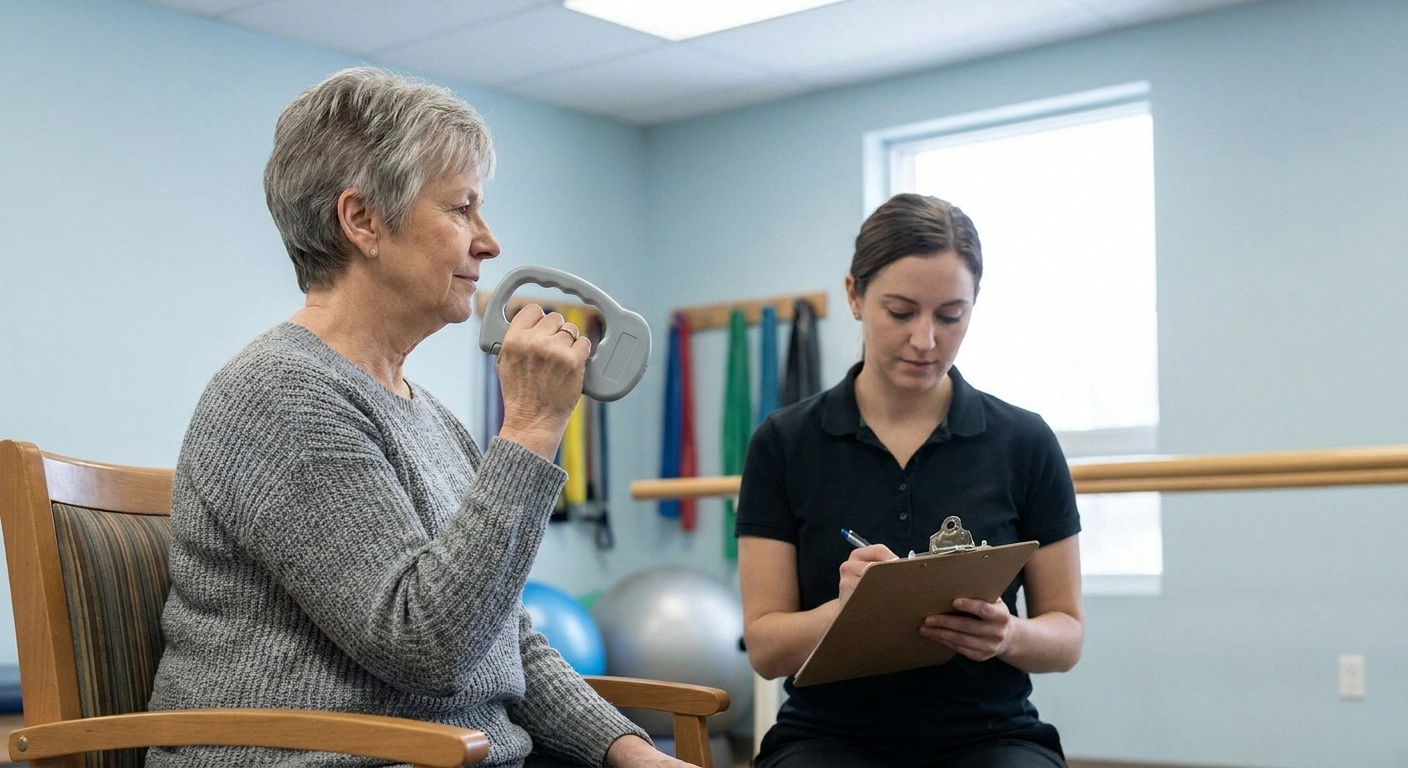
Grip strength can be measured properly, in kilograms, with a hand dynamometer. Most physical therapy departments and many primary care offices have one, and using it takes about two minutes.
Three numbers, two minutes, one device
| Measurement | The question it answers | How much weight it carries |
|---|---|---|
| Left against right, same day | Is one hand genuinely behind the other, or does it only feel that way? | The most informative single comparison. A slightly stronger dominant hand is normal. |
| You against yourself, six months apart | Is this stable, improving, or sliding? | One reading is a dot. Two are a direction, and a direction is what gets acted on. |
| Pinch, separately from grip | Is the problem showing up in precision before it shows up in power? | Often falls before overall grip does. Ask for it if fine-control failure is your complaint. |
| Published age norms | Where do I sit against everyone else my age? | The least useful of the four. The healthy range is wide and depends heavily on build and history. |
Published norms exist by age and sex, with strength peaking in the late twenties and declining gradually afterward. Those numbers are worth knowing about but they are the least useful part of the exercise, because the healthy range is wide and where you sit in it depends heavily on your build and your history.
Two comparisons carry almost all of the information.
The first is left against right, on the same device, on the same day. A meaningful gap between your two hands is far more informative than either number on its own, and your dominant hand being slightly stronger is normal.
The second is you against yourself, six months apart. A single reading is a dot. Two readings are a direction, and a direction is what actually gets acted on.
Pinch strength is worth measuring at the same time, since it is a separate measure and it often falls before overall grip does. If your complaint is fine-control failure, pinch is the number most likely to show it. Both of these fit naturally into the broader neuropathy workup alongside sensory testing and nerve conduction studies.
Changing the Objects Instead of the Hands
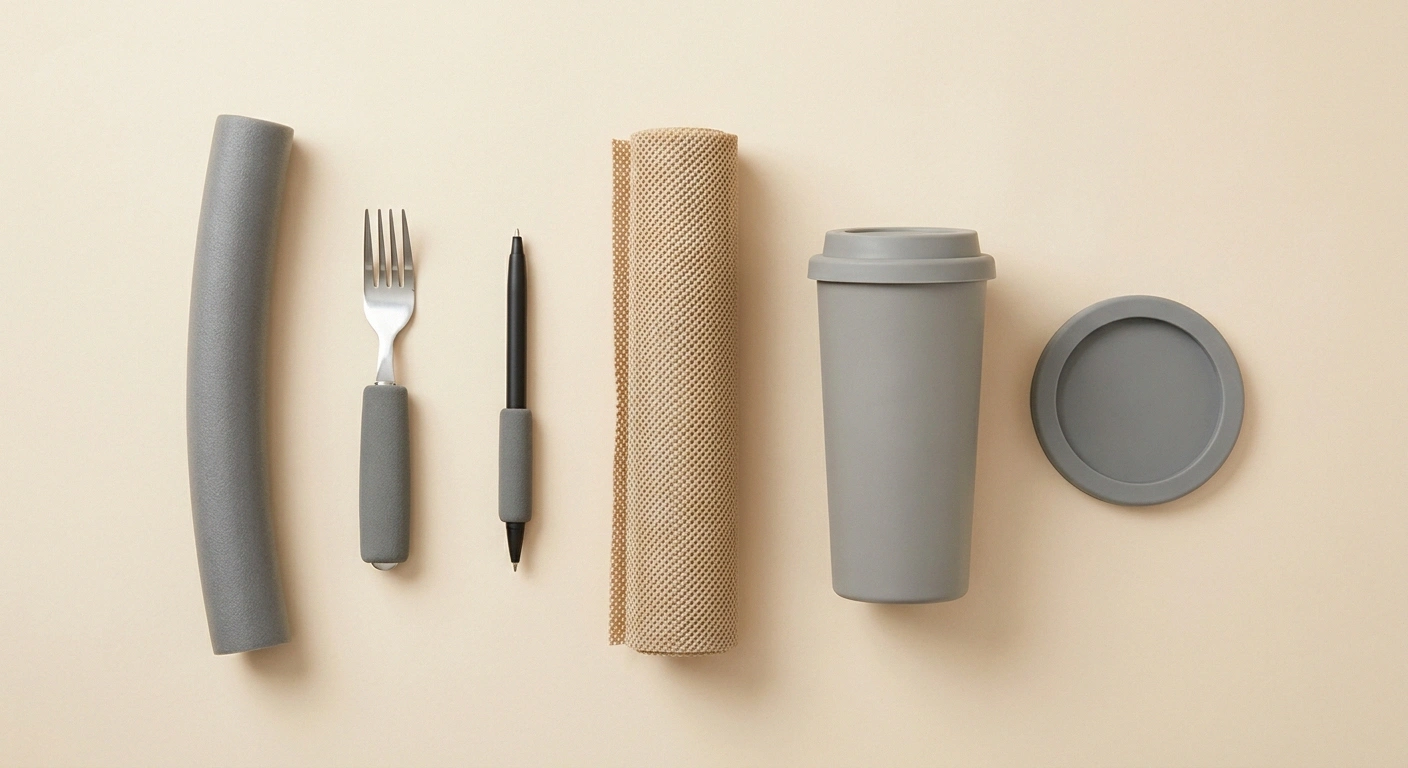
Here is the part you can act on today, and it works better than most people expect, because it attacks the problem from the object's side rather than the hand's.
A weekend's worth of changes, under thirty dollars
Ordered by how much difference each one makes per dollar. Start at the top and stop wherever the dropping stops.
Foam tubing, sold by the foot
Slides over pens, toothbrushes, cutlery and garden tools. A wider handle needs less force, which leaves more room for a bad estimate. Cheapest and highest-yield item on the list.
Non-slip shelf liner, one roll
Cut it for trays, under cutting boards, in drawers, and under anything that lives on a smooth counter. Friction added to the object is friction your fingertips no longer have to supply.
One lidded travel mug, kept on the counter
Turns a spill into a non-event, which removes the anxiety that makes over-gripping worse. The tension itself is part of the problem.
A rubber jar opener and a set of unbreakable everyday glasses
Retire the breakables from daily rotation only, not from the house. Keep the good ones for occasions when you are sitting down.
One counterintuitive note worth acting on: choose heavier over thinner. A substantial mug with a wide handle is held more securely than a delicate light one, because weight gives more sensory feedback and a thin handle concentrates the entire load onto a patch of skin that may not be reporting.
Widen every handle you use regularly. A wider grip needs less force to hold, which means less precision in the estimate and more room for error. Foam tubing sold by the foot slides over pens, toothbrushes, cutlery, and garden tools for very little money. Cutlery with fat handles works. So does wrapping a few turns of self-adhesive bandage around anything cylindrical.
Choose heavier rather than thinner. This surprises people, but a substantial mug with a wide handle is easier to hold securely than a delicate light one, because heavier objects give more sensory feedback and thin handles concentrate the whole load onto a tiny patch of skin that may not be reporting.
Prefer lids to open tops. A travel mug with a lid converts a spill into a non-event, and knowing that reduces the tension that makes over-gripping worse.
Retire the breakables from daily rotation. Not all of them and not forever. The everyday glasses and the everyday plates, swapped for something that bounces, removes the single largest consequence of a drop. Keep the good ones for occasions when you are sitting down.
Add friction wherever you can. Rubber jar openers, silicone mats under cutting boards, non-slip shelf liner in drawers and on trays, textured gloves for cold or wet tasks. Thin compression gloves help some people, partly through light steady pressure and partly through warmth, since cold hands are consistently worse hands.
Habits That Cost Nothing
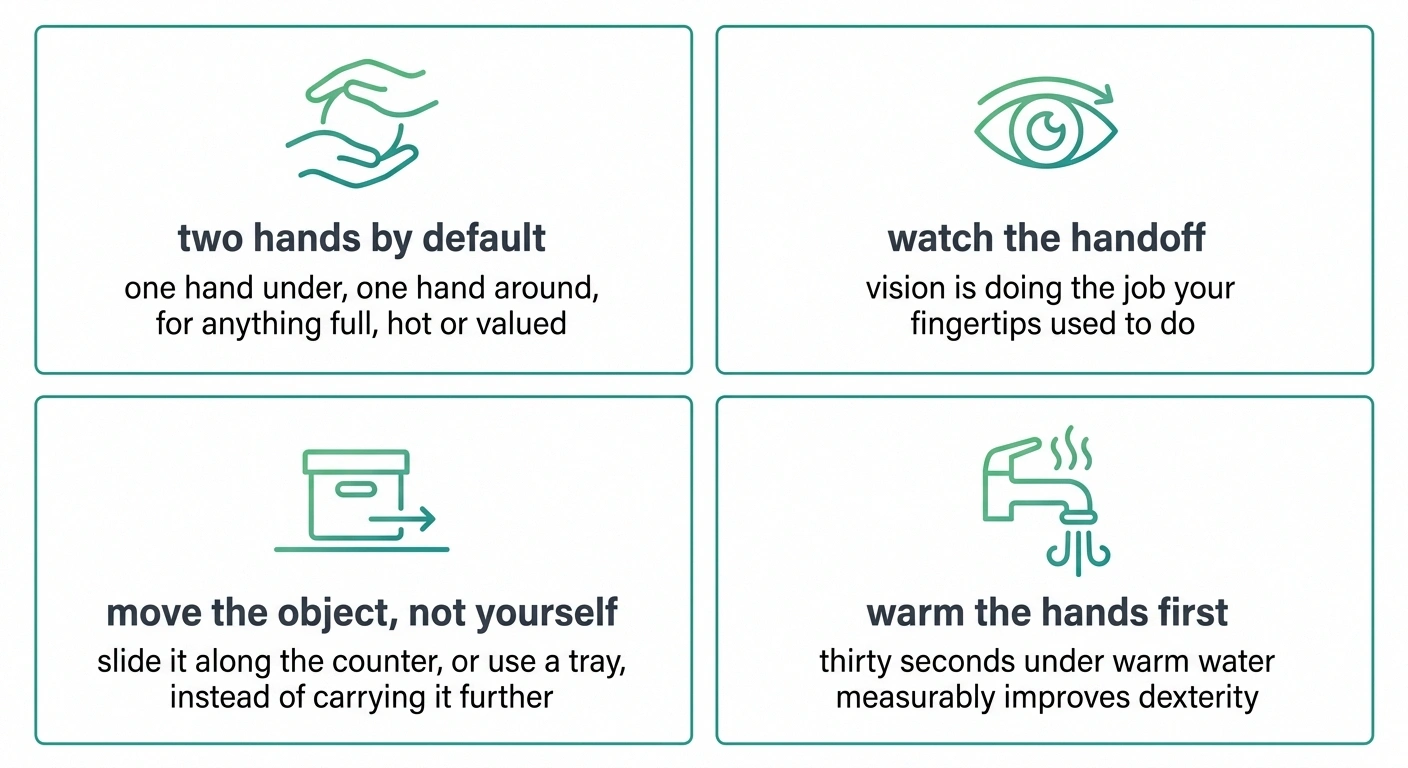
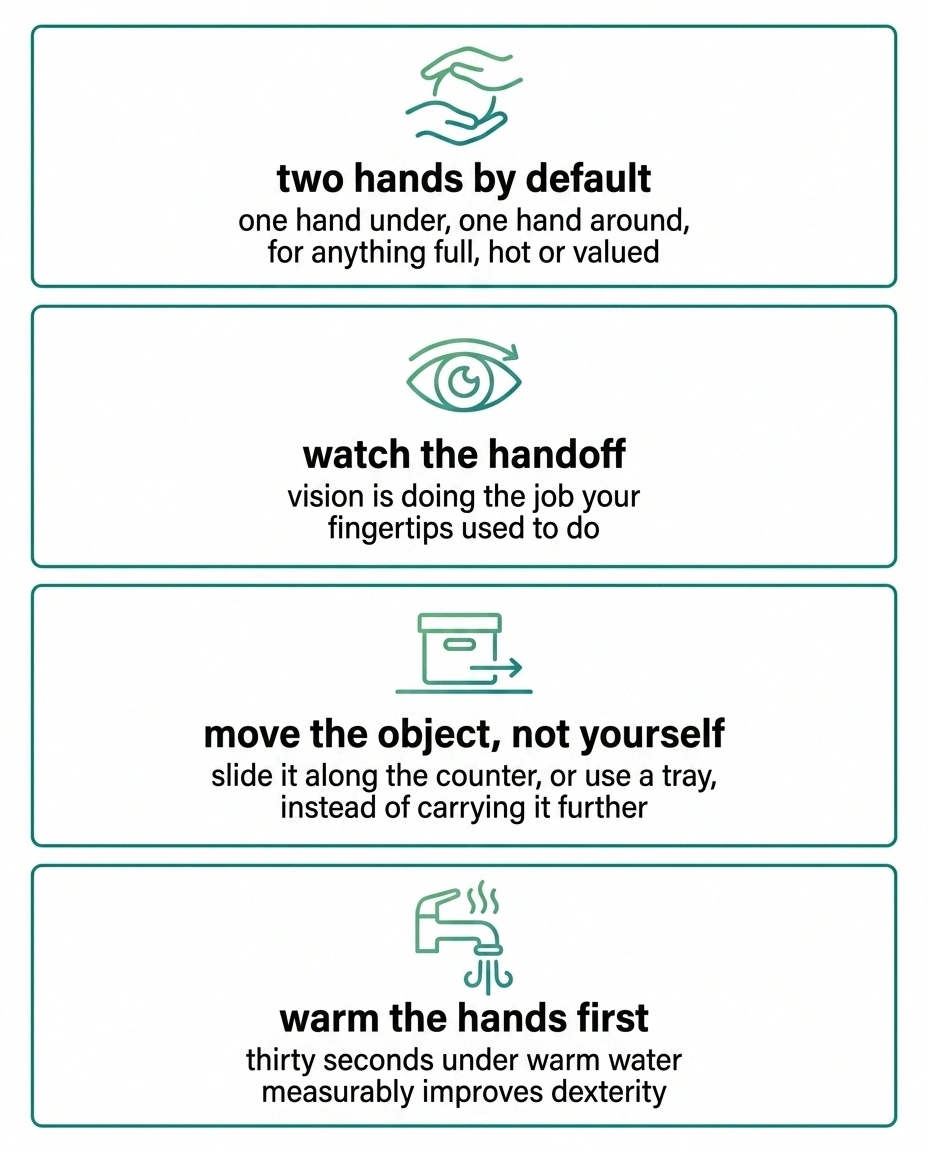
Four changes in how you move, none of which require buying anything.
Use two hands as the default rather than the fallback. One hand under, one hand around, for anything full, hot, or valued. This feels like a concession for about a week and then becomes invisible.
Look at the handoff. Whenever an object changes location, whether from cupboard to counter or from your hand to someone else's, watch it. Vision is doing the work your fingertips used to do, and giving it a clear line of sight during the risky second is free.
Move the object, not yourself. Slide a full pot along the counter rather than carrying it. Use a wheeled cart or a tray for the trip from kitchen to table. Reduce the distance you carry things rather than trying to improve how well you carry them.
Take the ring off before washing up, and get in the habit of setting things down before you turn around. Turning while holding is the single most common moment in which a drop happens, because it removes vision from the loop at the exact moment the hand also has to compensate for the movement.
One more, less obvious: warm the hands before precision work. Cold reduces both sensation and dexterity, and running your hands under warm water for thirty seconds before doing buttons or handling small items measurably improves both. The same principle explains why symptoms are consistently worse in winter and why hand symptoms often travel with the balance and coordination changes that show up elsewhere in the body.
What Would Make This Urgent
Most dropping develops gradually, has an ordinary explanation, and belongs in a regular appointment. A short list does not.
Weakness that arrives suddenly, over minutes to hours, particularly with facial droop, slurred speech, confusion, or vision change, is a stroke presentation and needs emergency services immediately. A hand that will not move at all, or grip that has collapsed over days rather than months, needs same-day attention. Weakness climbing upward from the legs toward the hands over hours to days needs same-day attention. And progressive weakness accompanied by visible muscle wasting and widespread twitching deserves a prompt neurological assessment rather than a wait-and-see approach.
Everything else on this page, including years of gradually worsening fumbling, has time. Getting it looked at is worthwhile precisely because several of the causes are fixable, and the fixable ones respond better earlier.
Frequently Asked Questions
Why do I keep dropping things if my hands do not feel weak?
Because grip depends on continuous sensory feedback rather than on raw strength. Receptors in your fingertips detect an object starting to slip and correct grip force automatically in a fraction of a second. When those receptors are damaged, that correction stops happening and you are estimating grip force instead of measuring it. Strength tests come back normal because strength is not the system that failed.
Is dropping things a sign of neuropathy or carpal tunnel?
Both produce it, and the pattern separates them. Carpal tunnel affects the thumb, index, middle and half the ring finger on one or both hands, wakes people at night, and improves when the hand is shaken out. Peripheral neuropathy fades in evenly from all the fingertips, ignores the borders between individual nerves, and in most cases followed months or years of foot symptoms.
Can neuropathy cause loss of grip strength as well as numbness?
Yes. Sensory fibers usually go first, which produces fumbling and dropping without measurable weakness. When motor fibers are affected too, genuine strength loss follows and often shows as visible thinning of the muscle between the thumb and index finger or of the pad at the base of the thumb. That finding raises the priority of being evaluated.
Why do I crush things instead of dropping them?
It is the same failure in the opposite direction. Without slip feedback there is no way to find the correct grip force, so the hand overshoots as readily as it undershoots. Buckled paper cups, snapped plastic forks, and cracked eggs are the usual evidence. Mentioning this alongside the dropping supports a sensory explanation more strongly than dropping alone, because weakness by itself does not crush anything.
What deficiency causes weak grip and dropping things?
B12 is the most common and the most correctable, and results in the low-normal range can still coincide with real symptoms, particularly in people over sixty, long-term metformin users, and people on reflux medication for years. Deficiencies in B1, folate and copper produce similar problems. B6 is unusual because both too little and too much damage nerves.
Does dropping things mean I have MS or ALS?
It very rarely does. The overwhelming majority of cases trace to a compressed nerve, a peripheral neuropathy, arthritis, or ordinary age-related change. The features that would point elsewhere are progressive weakness with visible muscle wasting and widespread twitching, weakness that spreads beyond the hands, or accompanying changes in speech or swallowing. Numbness and fumbling with normal strength do not fit either of those pictures.
Are there exercises that improve grip when the cause is neuropathy?
Strengthening helps when weakness is genuinely part of the problem, and a therapist-guided program aimed at the small muscles inside the hand is more useful than squeezing a ball. When the problem is sensory rather than motor, strengthening adds very little, and adapting the objects you handle produces far more improvement per hour spent. Sorting your failures into fine-control and gross-force groups tells you which of those two situations you are in.
Will my grip come back?
It depends on the cause. Grip lost to a compressed nerve usually recovers once the compression is relieved, though muscle that has visibly wasted recovers slowly and sometimes incompletely. Grip affected by a correctable deficiency often improves over months as fibers regrow. Grip affected by ongoing metabolic damage generally stabilizes rather than returns once the underlying driver is controlled, and adapting the objects around you becomes the higher-yield strategy.
About the Author