
Most descriptions of neuropathy assume both sides. Both feet. Both hands. Stocking and glove, creeping upward, roughly even on the left and the right.
So when only one foot burns, or one leg goes numb while the other feels fine, people reasonably conclude they have something unusual. What they actually have is something informative. Asymmetry is not a defect in the pattern. It is the pattern, and it narrows the possibilities faster than almost any other detail you can report.
The reason is mechanical, and once you see it you cannot unsee it. A cause that travels in the bloodstream cannot pick a side. A cause that lives in one location can pick nothing else.
What follows is what a one-sided pattern rules out, what it points toward, and the one presentation here that genuinely should not wait. I write as someone living with nerve damage who learned to read symptom patterns out of necessity, not as a clinician.
Why Symmetry Is the First Branch
Picture the two most common causes of nerve damage in this country. High blood sugar. Low B12.
Both circulate. Blood carrying too much glucose reaches your left foot and your right foot through the same system, at the same concentration, for the same number of years. A B12 shortage is a shortage everywhere at once. Neither can find one limb and skip the other, and neither has any way to prefer a side.
So the damage they cause is even. It starts in the longest nerves, which is why toes go before fingers, and it advances slowly and symmetrically. Someone with this pattern will usually tell you their symptoms are worse on one side, and on examination the difference turns out to be modest. A little louder on the left. Not a different situation on the left.
Now picture the alternative. A nerve squeezed where it crosses a bone. A disc pressing on one root. A small blood vessel that supplies one nerve trunk closing off. A virus that has been sleeping in one sensory ganglion for forty years and wakes up.
None of those have any reason to be symmetric. They are events with an address.
That is the whole branch. Even distribution points at something systemic in the blood. Uneven distribution points at something structural, vascular, or targeted. The workups that follow from those two readings barely overlap, which is why getting the branch right at the start saves months.
It is also why the first question worth answering is not what is wrong, but how evenly it is spread. Everything downstream of that answer changes: which tests get ordered, which specialist you end up in front of, and how quickly any of it needs to happen.
What Gets Delivered by Blood, What Gets Delivered by Geometry
It is worth naming which causes sit on which side of that line, because people frequently assume their known diagnosis explains everything they feel.
Arriving by blood, and therefore expected to be symmetric: diabetes and prediabetes, B12 and other vitamin deficiencies, thyroid disease, kidney failure, chronic heavy alcohol use, chemotherapy agents, and most of the medications known to damage nerves. If your only symptoms are on one side, none of these are a complete explanation on their own.
Arriving by geometry or by targeted attack, and therefore expected to be asymmetric: a nerve compressed at a specific point along its route, a nerve root squeezed at the spine, a plexus injured where nerves bundle and cross near the hip or the shoulder, inflammation of the small vessels that feed individual nerves, shingles reactivating in a single sensory root, physical trauma, and radiation to one region.
The trap sits in the middle. A person with diabetes has a systemic cause, and that cause also makes every individual nerve more fragile and less tolerant of local pressure. So they develop compression problems at higher rates than people without diabetes. The result is a genuinely mixed picture: a quiet symmetric background with one loud asymmetric problem sitting on top of it. That is not a contradiction and it is not rare. It is one of the most common presentations there is, and describing both layers separately at an appointment is far more useful than averaging them into one complaint.
Territory or Stripe: Reading Your Own Map
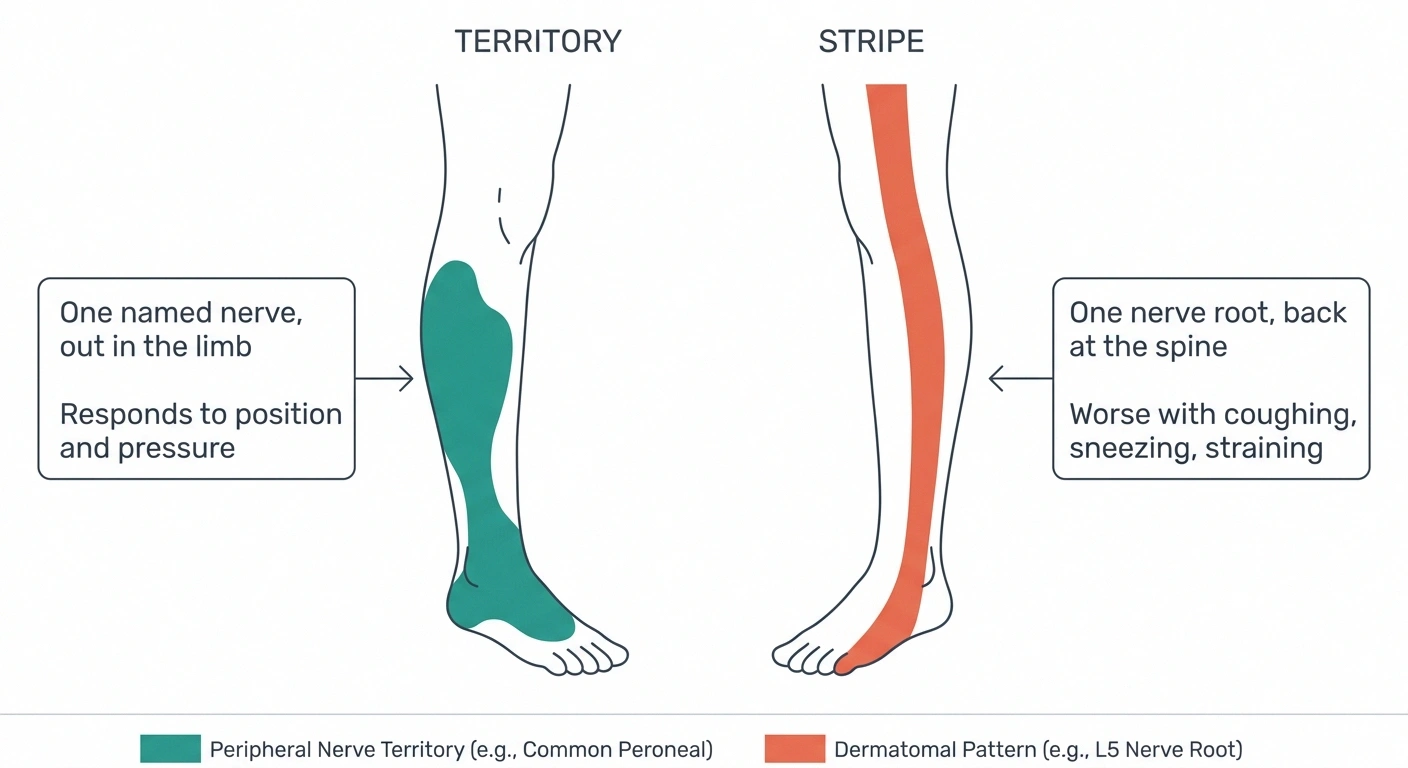
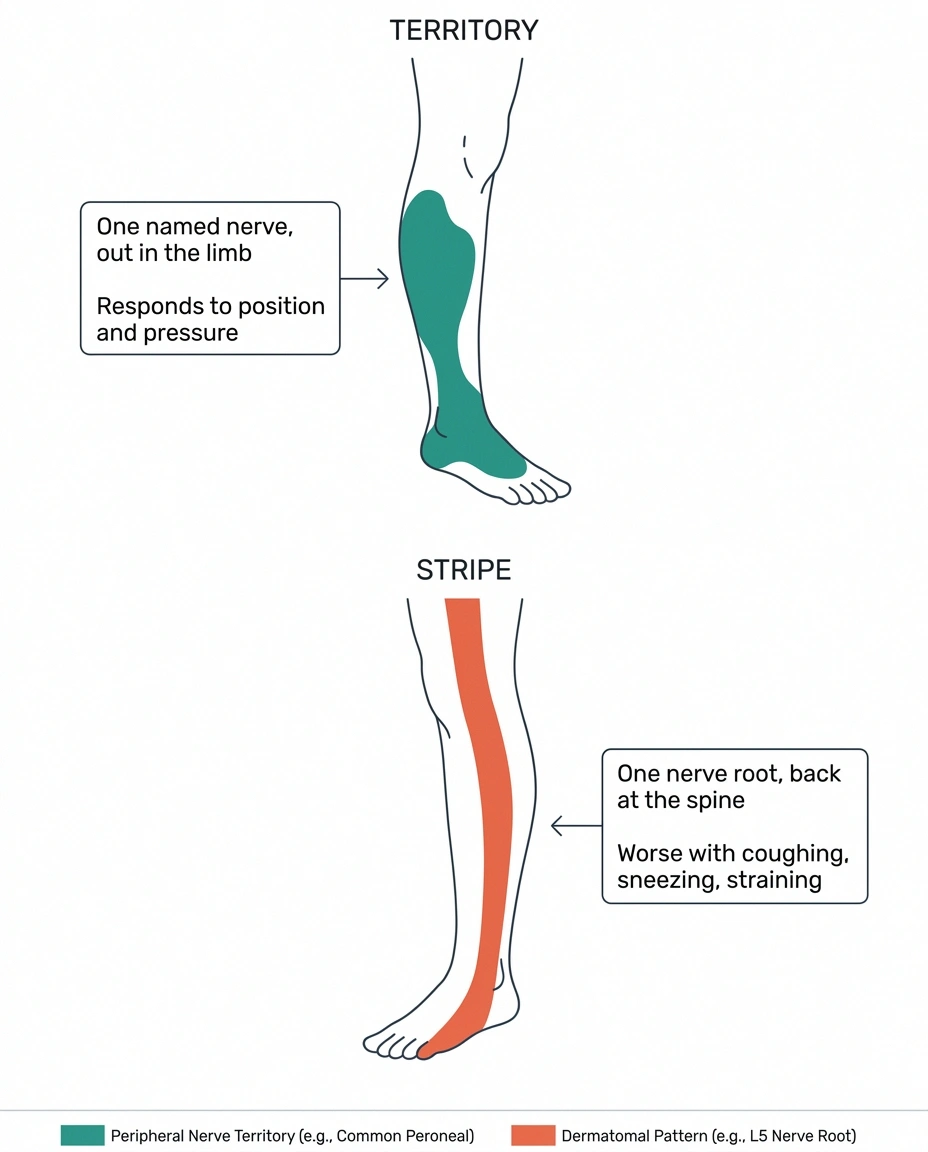
Here is the single most useful skill in this article, and it takes about two minutes to learn.
Two shapes, two addresses
Decide which of these your numb area looks like before your appointment. It is the fastest way to tell a limb problem from a spine problem without any equipment at all.
- Territory: one named nerve, out in the limb
- Odd, specific borders you would never draw yourself. The outer shin and the top of the foot. The sole but not the heel. The little finger and exactly half the ring finger.
- Behaves like this: responds to limb position, to pressure, and to how long you have held the limb one way. Ignores coughing and sneezing completely.
- Stripe: one nerve root, back at the spine
- Long and narrow, running lengthwise down the limb rather than wrapping around it. Down the outside of the calf to the big toe. Down the back of the calf to the heel. Around the ribs in a band.
- Behaves like this: worse with coughing, sneezing, straining, or bending, because all of those raise pressure inside the spinal canal. Often started as back or neck pain.
Nerve damage produces two different shapes on the skin, and which shape you have tells you roughly where the problem lives.
A territory is the patch of skin owned by one named peripheral nerve, downstream in the limb. Territories have odd, specific borders that do not look like anything you would draw yourself. The outer shin and the top of the foot. The sole but not the heel. The little finger and exactly half the ring finger. When your numbness matches a shape like that, the problem is usually in the limb, at whatever point that particular nerve gets squeezed.
A stripe is different. Stripes run long and narrow, following the band of skin served by a single nerve root as it exits the spine. They tend to run lengthwise down a limb rather than wrapping around it. Down the outside of the calf to the top of the foot and the big toe. Down the back of the calf to the heel and the little toe. Around the ribs on one side in a band. When your numbness looks like a stripe, the problem is usually at the spine rather than in the limb.
One practical tell separates them. Stripes from a spinal root get worse with coughing, sneezing, straining, or bending, because all of those raise pressure inside the spinal canal. Territories in the limb ignore that entirely; they respond to position and pressure.
You do not have to name the nerve. Draw the numb area on a printed outline of a leg or an arm and bring the drawing. It does more work in an appointment than any sentence you could build about it.
A Single Nerve, Pinched Somewhere
The most common explanation for a one-sided pattern is also the most ordinary one: a single peripheral nerve is being compressed at a single point, and that is a mechanical problem rather than a disease.
Nerves get pinched where they pass through narrow places. A tunnel of ligament at the wrist. A groove of bone at the elbow. A tight channel behind the inner ankle bone. A spot where a nerve wraps around the outside of the knee with almost nothing covering it.
The features that mark compression are consistent enough to be worth memorizing. Symptoms follow one nerve's territory rather than spreading everywhere. They come and go with position, and a specific position reliably brings them on. They often wake people at night. They frequently respond to something unglamorous, like a splint, a change in how you sit, or a different way of holding a tool. And crucially, the other side is genuinely normal rather than mildly affected.
Foot Drop and the Nerve at the Knee

One compression is worth its own section, because it produces the most alarming one-sided symptom and has one of the most reassuring explanations.
The peroneal nerve wraps around the outside of the knee just below the joint, where it sits close to the surface with little protection. Squeeze it there and two things happen together: numbness across the outer shin and the top of the foot, and weakness lifting the front of the foot. That second part is foot drop, and people notice it as a toe catching on carpet, a slap when the foot lands, or a suddenly clumsy step on stairs.
What compresses it is usually boring. Habitually crossing the legs at the knee. A long stretch of squatting or kneeling, in the garden or on a job. A cast or a brace pressing in the wrong place. Prolonged bed rest with the leg rolled outward. Substantial weight loss thinning the padding over that spot.
Two features separate this from something more serious. It is painless, or nearly so. And it is confined to one nerve's territory, which means the sole of your foot still feels normal and your hip and thigh strength are intact. When those things hold, the outlook is generally good, because the injury is compression rather than destruction and compression recovers once removed. Recovery is slow enough to be frustrating, measured in months, and a temporary brace during that time is standard rather than a defeat.
Any new foot drop deserves to be looked at rather than waited out, because the same picture can come from a nerve root in the lower back, and telling those apart is not something to do at home.
When the Problem Is at the Spine
Radiculopathy is the word for a nerve root being irritated where it leaves the spine, and it is a very common source of one-sided leg or arm symptoms in people who assumed they had neuropathy.
The presentation has its own signature. Pain frequently starts in the back or the neck rather than in the limb. It travels in a stripe rather than filling a glove. It changes with posture, gets worse with sitting or with certain movements, and flares when you cough or sneeze. Reflexes on that side may be reduced. Weakness, when present, hits specific muscle groups rather than everything below the knee.
The thing worth understanding is that this is not neuropathy in the usual sense at all, even though it produces numbness, tingling, burning, and shooting pain. The nerve is healthy; something is leaning on it upstream. That distinction matters because it points toward imaging of the spine rather than blood work, and toward treatments aimed at the mechanical problem.
Plenty of people carry both. Longstanding diabetic neuropathy in both feet plus a compressed root on one side gives one leg a character the other leg does not share, and it usually needs two treatments rather than one.
Thigh Pain That Turns Into Weakness

There is a specific and under-recognized condition that deserves naming, because it produces one of the most distinctive one-sided pictures in all of nerve medicine and it is routinely misfiled as a hip problem or a slipped disc.
It goes by several names: diabetic amyotrophy, diabetic lumbosacral radiculoplexus neuropathy, or Bruns-Garland syndrome. It typically affects people with long-standing type 2 diabetes, often people whose blood sugar is reasonably controlled, and it announces itself with severe pain in one hip, buttock, or thigh that arrives over days.
Then the pain is joined by weakness, and the weakness is proximal. The quadriceps. The muscles that lift the thigh. The knee gives way going down stairs. Getting out of a low chair without using the arms becomes difficult or impossible. The knee reflex on that side often disappears. Many people lose a noticeable amount of weight without trying, and the thigh visibly thins over weeks.
Two things make this stand out. First, it is proximal rather than distal, which is the exact opposite of the feet-first pattern everyone associates with diabetes, and that reversal is why it gets missed. Second, the mechanism is inflammation of the small vessels feeding the nerve bundle rather than a slow metabolic wearing-down, which is why it arrives fast rather than creeping.
The genuinely encouraging part: this condition is typically monophasic. It gets worse, it plateaus, and then it improves, and most people recover a meaningful amount of function even though the course can run a year or more. It may spread to the other side over weeks to months, which is unsettling to experience but does not change the overall picture.
New severe one-sided thigh pain with weakness and unexplained weight loss is worth pushing on if the first explanation you receive is arthritis or a disc.
Nerves Failing One After Another
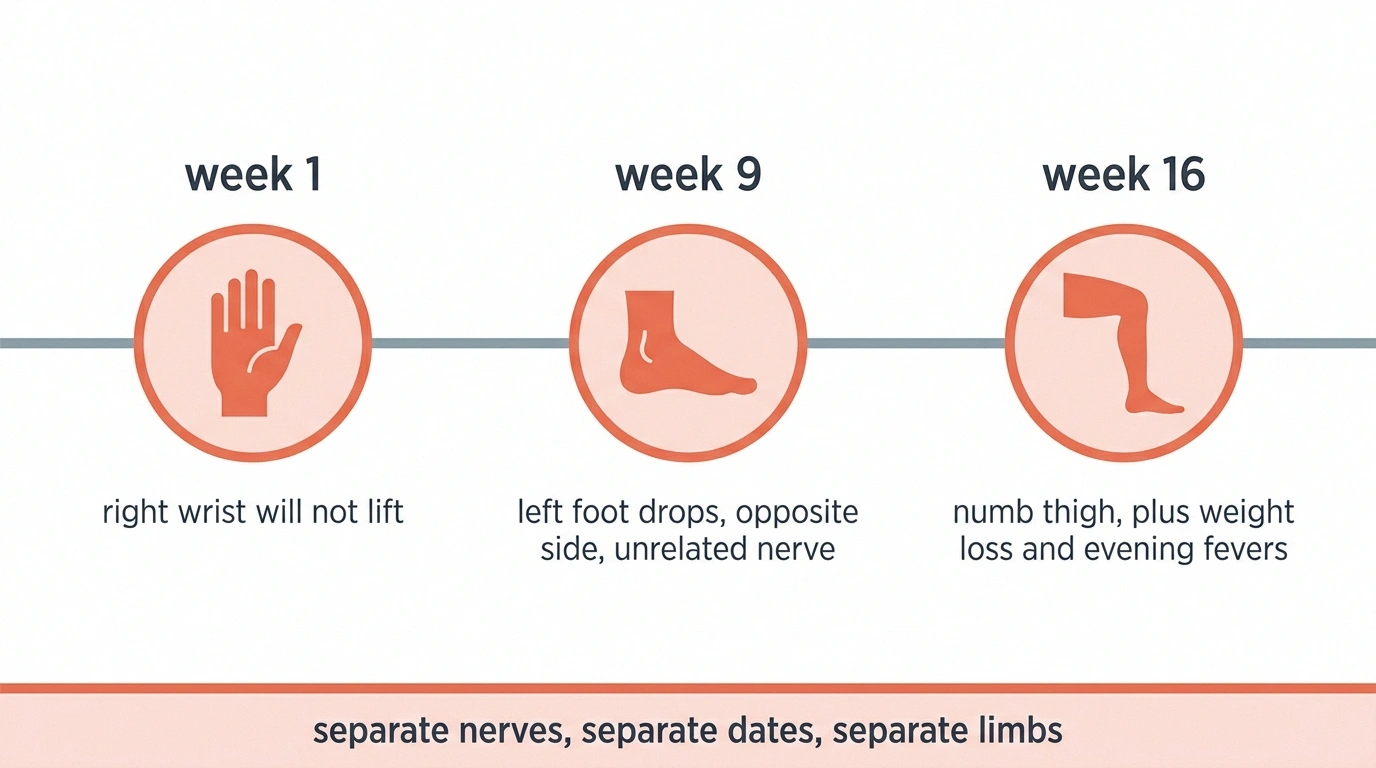
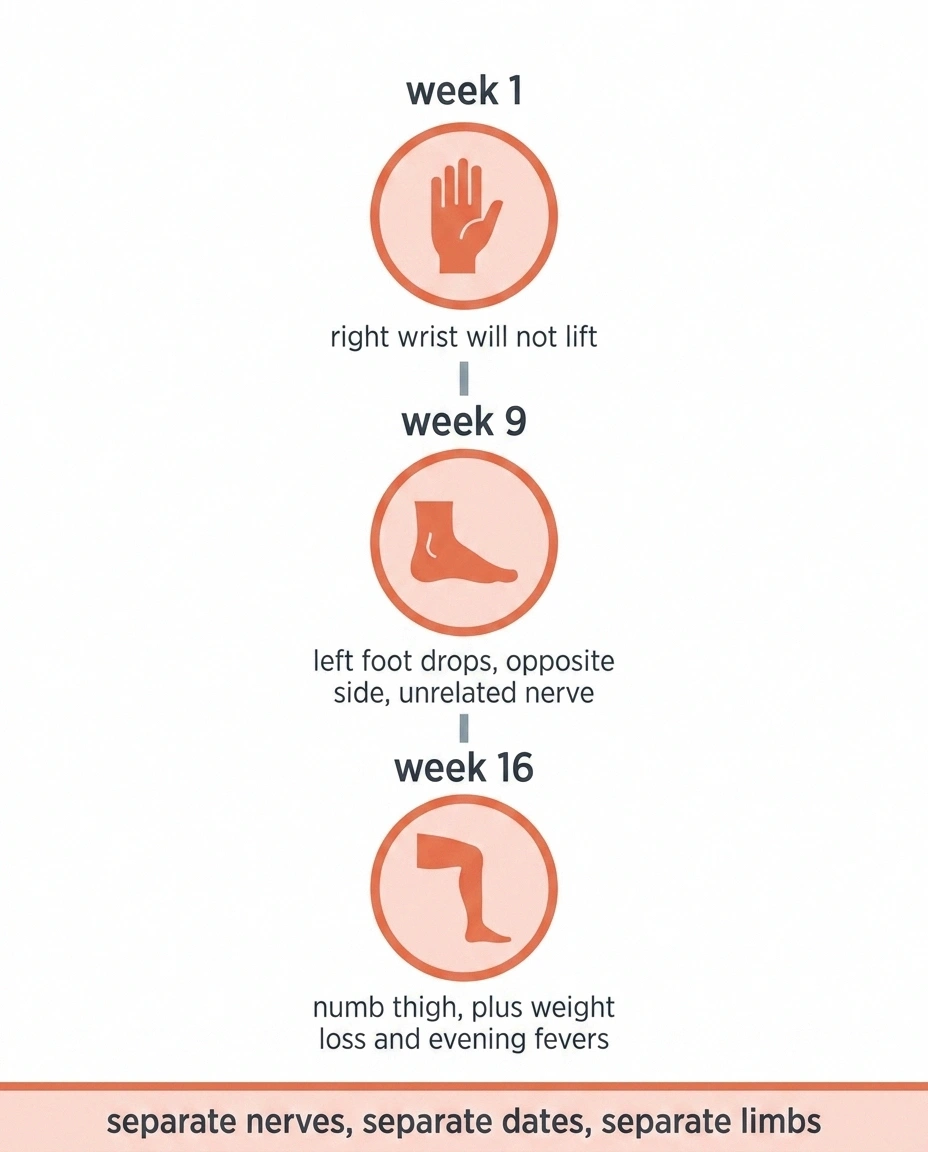
This section covers the pattern that matters most on this page. It is uncommon. It is also the one where recognizing it early changes the outcome, which is exactly the combination that makes something worth reading about before you need it.
What stepwise actually looks like on a calendar
Separate nerves, separate dates, separate limbs. This is the shape that separates an inflammatory process from an ordinary neuropathy, and it is the reason to write down dates rather than describe a general decline.
Week 1
A right wrist that will not lift. Diagnosed as a pinched nerve from sleeping awkwardly, which is a perfectly reasonable first read.
Week 9
A left foot that drops. Different limb, different side, different nerve, and no anatomical connection to the wrist whatsoever.
Week 16
Numbness across one thigh, plus eleven pounds lost without trying and three weeks of low-grade evening fevers nobody has connected to any of it.
Why the dates matter more than the symptoms: nerve fibers starved of blood supply do not come back, so the interval between the first event and the start of treatment is the interval in which permanent loss accumulates. Three dated events on an index card make the pattern visible in ten seconds. Three vague recollections do not.
Mononeuritis multiplex means damage to two or more separate named nerves, in different limbs or different regions, arriving at different times. The defining feature is not that things are asymmetric. It is that they accumulate stepwise.
The story sounds like this. In March, a wrist that will not lift. In May, a foot that drops on the opposite side. In July, numbness across one thigh. Each event is discrete, each has a date, and each involves a nerve with nothing anatomically to do with the last one.
The usual mechanism underneath is inflammation of the small blood vessels supplying individual nerve trunks. When a vessel closes, the nerve it feeds is starved, and that nerve fails on its own schedule. Vasculitis is the general heading. It also occurs with diabetes, with infections including Lyme disease and HIV, with sarcoidosis, and in an inflammatory nerve condition that presents this way instead of symmetrically.
The accompanying features are the ones people tend not to mention because they seem unrelated: fatigue that is out of proportion, unexplained weight loss, fevers or night sweats, a rash, joint pain, or new kidney or lung findings.
Why the urgency? Because vasculitis is treatable with immune-suppressing therapy, and because nerve fibers that die from lack of blood supply do not come back. Every week of untreated inflammation is potential permanent loss. This is not a wait-and-watch situation, and it is the one thing on this page that justifies pushing hard for a prompt neurology assessment rather than accepting a routine appointment in three months.
The Band That Respects the Midline

Shingles produces the most strictly one-sided pattern in medicine, and the timing of treatment matters enough to be worth recognizing early.
The virus that causes chickenpox never leaves. It settles into sensory nerve ganglia and stays dormant, sometimes for decades. When it reactivates it travels down the nerves from a single ganglion, which is why the result is a band on one side that stops abruptly at the midline. That abrupt stop is close to diagnostic on its own.
Burning, itching, or deep aching pain in the band often precedes the rash by two to five days, which sends a fair number of people for a chest or kidney workup on pain that turns out to be a rash three days early. Occasionally no rash appears at all.
When pain persists in that band for months after the skin has healed, it becomes post-herpetic neuralgia, which is one of the more stubborn forms of nerve pain and is much easier to prevent than to treat. Antiviral treatment started within roughly 72 hours of the rash appearing reduces that risk, which is why a new one-sided band of pain and blistering is worth a same-week call rather than a wait-and-see.
Asymmetry That Is Just Early
Not every uneven picture is a different category of problem. Some of it is an ordinary symmetric neuropathy caught before it evened out.
Two mechanisms produce it. The first is timing: length-dependent damage does not switch on everywhere at once, one foot commonly runs a few months ahead of the other, and people build a mental model of a one-sided condition before the second side catches up. The second is local wear. One leg carries more load, or has old hardware, or an old injury, or worse circulation, and nerves in a less hospitable limb fail sooner.
Three features suggest this is what is happening. The other side is not truly normal, just quieter, and careful attention finds something there. The affected side does not respect a single nerve's territory or a single stripe; it fills a stocking shape. And it arrived gradually, over many months, rather than on a date you could name.
That combination is common in idiopathic neuropathy and in early small fiber neuropathy, where the small nerve endings in the skin thin out on a schedule that is not perfectly synchronized between the two sides.
How It Arrived Matters as Much as Where
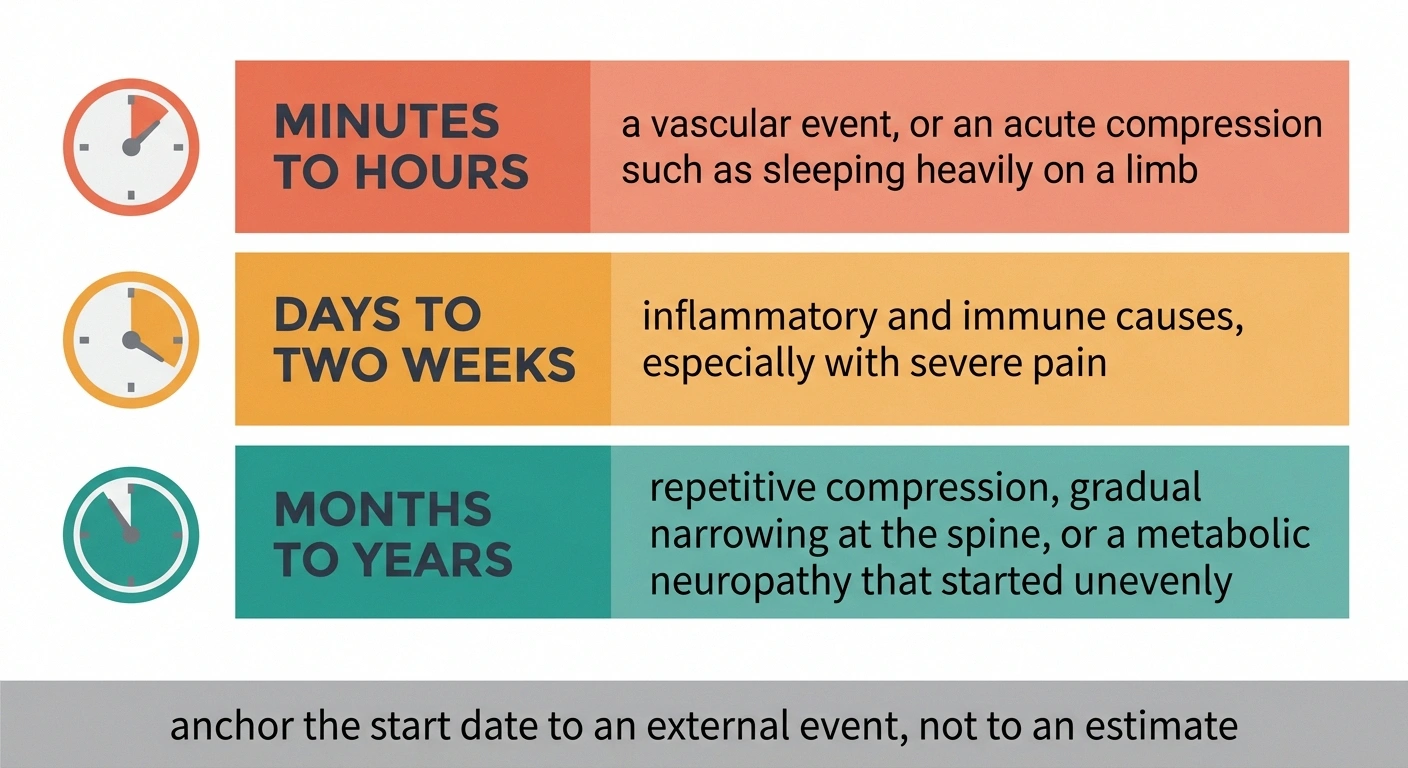
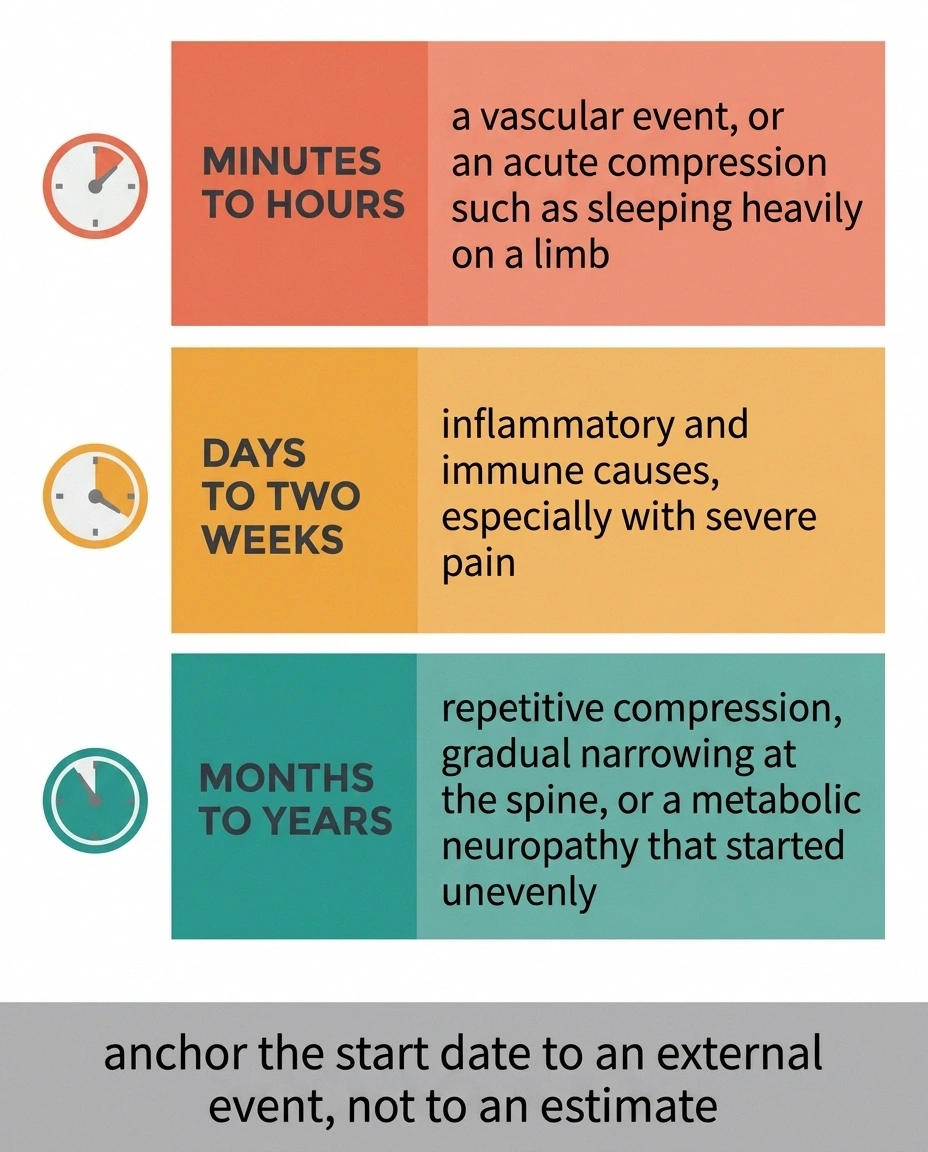
Location narrows the possibilities. Timing narrows them further, and it is the detail people most often fail to pin down.
Speed of onset, and what each speed puts on the table
| It came on over | Which causes fit | Reasonable pace |
|---|---|---|
| Minutes to hours | A vascular event, or acute compression such as sleeping heavily on a limb or a nerve pressed during a procedure | Same day if the face or arm is involved, otherwise same week |
| Days to two weeks | Inflammatory and immune-mediated causes, especially with severe pain: the thigh syndrome, the stepwise pattern | Days, not months. Push for it. |
| Months to years | Compression from repetitive use, gradual narrowing at the spine, or a metabolic neuropathy that simply started unevenly | Ordinary appointment time |
Anchor the start date to something external rather than estimating it. A holiday, a job change, a hospital stay, a new prescription. People asked cold routinely halve the true interval, and halving it moves the row you land in.
Minutes to hours points toward a vascular event or an acute compression, such as sleeping heavily on a limb. Days to a couple of weeks, especially with severe pain, fits the inflammatory and immune-mediated causes, including the thigh syndrome and the stepwise pattern above. Months to years fits compression from repetitive use, gradual narrowing at the spine, or an ordinary metabolic neuropathy that started unevenly.
Date it properly rather than saying “a while.” Anchor it to something external: a holiday, a job change, a hospital stay, a new prescription. People routinely underestimate the interval by half when asked cold. This is a separate question from whether the pain is coming from nerves or from blood vessels, which is worth settling on its own when leg pain is the main complaint.
What Changes in the Workup
A one-sided pattern changes what happens next, and knowing that in advance helps you tell whether your evaluation is going somewhere.
Blood work still happens, because a systemic background often coexists with a local problem and because it is cheap. But it is no longer the centerpiece. In a symmetric presentation, normal blood work plus a typical history is often enough to stop. In an asymmetric one, normal blood work explains nothing at all, and stopping there is a dead end.
Nerve conduction studies and electromyography carry much more weight here. They can localize a block to a specific segment of a specific nerve, distinguish a root problem from a limb problem, and identify the scattered multi-nerve pattern that signals the stepwise process. Ask whether both sides are being studied, because the comparison is where the information lives.
Imaging enters the picture when a stripe or a root pattern is present. And in a subacute, painful, stepwise presentation with systemic features, the evaluation should widen quickly toward inflammatory markers, autoimmune testing, and in some cases a nerve or muscle biopsy, which remains the definitive way to confirm vasculitis in a nerve. If you have a stepwise story and nobody has ordered inflammatory markers, that is a reasonable thing to ask about directly. The broader map of what a full neuropathy diagnostic workup involves is worth reading before the appointment rather than after it.
Writing Your Own Case Summary

Asymmetric presentations are where good history-taking pays off most, and where a rushed appointment does the most damage. Six lines on an index card fixes a surprising amount of that.
Six lines, one index card, written before you go
- Which side, and specifically what the other side does. “Normal” and “quieter” are different answers and they lead different places.
- The shape, drawn rather than described. A photo of a sketch on a printed limb outline works.
- The start date, anchored to an external event rather than estimated.
- Anything added since, each with its own date. A dated list is the single most valuable thing you can hand over.
- What changes it: position, coughing, walking distance, time of day.
- The things that feel unrelated: weight change, fevers, rashes, joint pain, fatigue.
Line six is the one people leave off, and in a stepwise presentation it is frequently the line that redirects the whole evaluation. Nobody will ask whether you had a rash three months ago unless something prompts them to.
Write which side, and be specific about what the other side does. Write the shape, or better, draw it. Write the date it started, anchored to an external event. Write whether new areas have been added since, with their own dates, because a list of dated events is the single most valuable thing you can hand over. Write what makes it better or worse, including coughing and position. And write the things that feel unrelated: weight change, fevers, rashes, joint pain, fatigue.
That last line is the one people leave out, and in the stepwise pattern it is often the line that redirects the entire evaluation. Nobody is going to ask you whether you had a rash three months ago unless something prompts them to. Prompt them.
Photograph any rash, visible muscle thinning, or swelling, with a date attached. Skin findings fade and asymmetry gets harder to see once you have adapted to it. A photo from week two is evidence in week ten.
The Two Situations That Are Emergencies
Almost nothing described on this page is an emergency. Two things are, and they are worth separating out clearly so the rest of it can be approached calmly.
Three tiers, and almost everything falls in the third
Emergency services now
- Sudden one-sided weakness or numbness involving the face or arm, with slurred speech, confusion, drooping, or vision change
- New saddle numbness across the inner thighs with any change in bladder or bowel control
Days, not months
- Separate nerve palsies accumulating over weeks, particularly alongside fatigue, weight loss, fever, or rash
- New severe one-sided thigh pain followed by weakness getting out of a chair
Ordinary appointment time
Foot drop, an uneven burning foot, a stripe of numbness down one leg, one hand worse than the other, symptoms that have been building for months. Every one of these deserves a proper look. None of them is improved by going tonight.
Sudden one-sided weakness or numbness involving the face or the arm, particularly with slurred speech, confusion, drooping, or vision change, is a stroke presentation. Call emergency services immediately. Do not drive, do not wait to see whether it settles, and do not spend the treatment window in a waiting room at an urgent care.
Numbness in the saddle area, meaning the inner thighs and the region you would contact sitting on a bicycle, combined with any new difficulty controlling the bladder or bowel, is a spinal cord emergency called cauda equina syndrome. It needs an emergency department the same hour, not the next available appointment.
Below those two, a third tier deserves urgency without panic: the stepwise accumulation of separate nerve palsies over weeks, particularly alongside fatigue, weight loss, fever, or rash. That is not an emergency room visit tonight. It is a reason to call and push for a neurology appointment in days rather than accept one in months.
Everything else on this page, including foot drop, thigh pain, an uneven burning foot, and a stripe of numbness down one leg, belongs in ordinary appointment time. Uneven is information. It is not, by itself, worse.
Frequently Asked Questions
Can peripheral neuropathy affect only one side of the body?
Yes, and when it does the likely causes shift substantially. Systemic causes carried in the bloodstream reach both sides equally and produce symmetric damage. One-sided symptoms point instead toward a compressed nerve, an irritated nerve root at the spine, inflammation of the small vessels feeding a nerve, shingles, or an injury.
Is one-sided neuropathy more serious than the symmetric kind?
Not automatically, and often the opposite. Most one-sided cases turn out to be a compressed nerve, which is mechanical and frequently reversible once the pressure is relieved. The exception is a stepwise pattern in which separate nerves fail one after another over weeks, which suggests inflammation of the blood vessels supplying those nerves and needs prompt evaluation.
Can diabetes cause neuropathy in just one leg?
Directly, no. Diabetic nerve damage from high blood sugar is symmetric because blood reaches both legs equally. Diabetes gets there by two indirect routes: it makes nerves more vulnerable to local compression, and it is the setting for diabetic amyotrophy, a distinct condition producing severe one-sided thigh pain followed by weakness around the hip and knee.
What is mononeuritis multiplex?
Damage to two or more separate named nerves, in different parts of the body, occurring at different times. The classic story is a wrist drop one month and a foot drop on the opposite side several weeks later. It usually results from inflammation of the small blood vessels that supply individual nerves, and because starved nerve fibers do not recover, it is treated as time-sensitive.
How do I know if my one-sided numbness is coming from my back?
Look at the shape and at what changes it. Numbness from a nerve root runs as a long narrow stripe down the limb, often with back or neck pain, and worsens with coughing, sneezing, straining, or certain postures. Numbness from a nerve compressed within the limb fills that nerve's own oddly shaped territory and responds to limb position instead.
Why did my foot suddenly start dropping on one side?
Most often the peroneal nerve is being compressed where it wraps around the outside of the knee, close to the surface with little padding. Habitual leg crossing, prolonged squatting, a cast, extended bed rest, or significant weight loss can all produce it. It is usually painless and usually recovers over months once the pressure is removed, but a nerve root in the lower back produces the same picture, so new foot drop should be evaluated rather than waited out.
Can shingles cause lasting one-sided nerve pain without a rash?
Yes. Pain typically precedes the rash by two to five days, and in a minority of cases no rash ever appears, which makes the cause hard to identify. The signature is a band of pain on one side that stops abruptly at the midline of the body. Persistent pain in that band after the skin heals is post-herpetic neuralgia.
Should I ask for nerve conduction studies if my symptoms are one-sided?
It is a reasonable request. These studies are considerably more informative in asymmetric presentations, because they can pinpoint where along a nerve a signal is blocked and separate a root problem from a limb problem. Ask whether both sides are being tested, since the side-to-side comparison carries most of the information.
About the Author