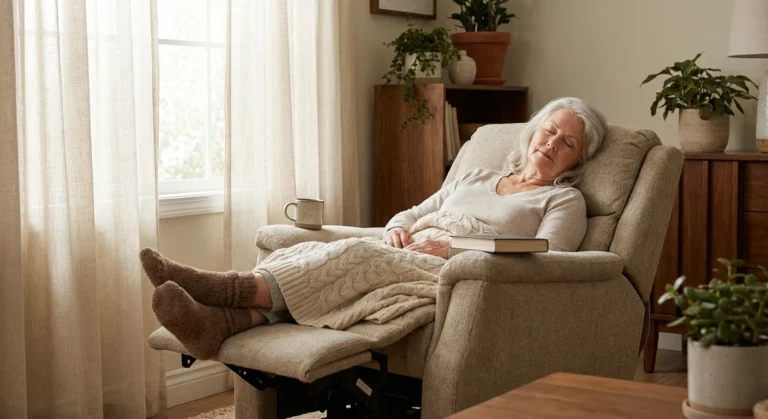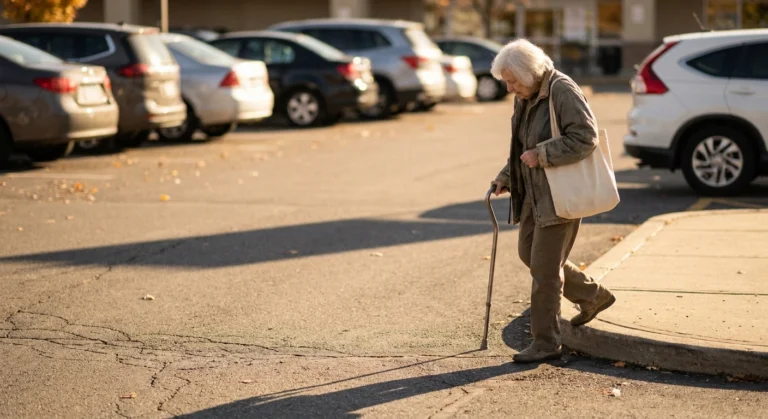
Picture the finish line first: you're sitting in a sturdy chair, a little out of breath, a block tower or a weeded flower bed down on the floor behind you, and you got there on your own. That's where physical therapists start when they teach this skill — they practice the last step first and work backward, which turns out to be the most useful thing I learned while researching this page.
A lot of us quietly stopped going down to the floor once neuropathy settled into our feet. The grandbaby's toys, the dog's water bowl, the bottom shelf, the garden bed — it all got moved up, or someone else got asked. That's a perfectly good choice, and our page on caring for grandchildren with neuropathy is full of ways to bring play up to the table. But if you'd like the floor back, there's a sensible, well-worn way to get down there and back up again.
Here's what this page covers: why the floor asks more of you now, how to set up a spot, the get-up method public-health sources teach, the strength that makes it easier, and — in its own section — what to do on a day you can't get up. I'm a patient advocate, not a physical therapist. If you've had a recent injury or surgery, a hip or knee replacement, bad knee pain, or dizziness when you stand, ask your doctor or a therapist before you practice any of it.
Why the Floor Asks More of You Now

NIDDK, the federal diabetes institute, says that with peripheral neuropathy your feet, legs, hands or arms may feel numb or weak. Its list of effects reads like a description of getting off the floor: poorer balance and more falls, weaker muscles in the hands and feet, and trouble sensing where your body is and how it's moving. That last one matters more than people expect. Getting up depends on knowing where your feet are without looking, and our page on losing your sense of position explains why that sense fades.
Ankles take a hit too. In one study of 36 people with type 2 diabetes, ankle muscles were 14 to 17% weaker than in people without diabetes, and the weakness tracked how severe their neuropathy was. Hands matter as well, since every common method has you push down on a chair seat. If your fingertips are numb, you may not feel exactly where your palm has landed; our page on neuropathy in your hands covers grip and pressure in more detail.
Then there's the head rush. If autonomic neuropathy is part of your picture, NIDDK notes that the nerves steering heart rate and blood pressure may respond slowly when you change position, which can leave you woozy or faint as you rise. Going from the floor to standing is the biggest position change most of us make all day. Some medicines add to it, too; a CDC checklist warns that “some medicines can make you sleepy or dizzy.”
None of this means the floor is off-limits. It means the risk is real: in a small study of 20 older people with neuropathy, 13 fell during a year of observation, and in another study, 48.8% of 82 people with polyneuropathy reported at least one fall over two years. A plan makes sense.
Choosing Your Spot Before You Sit Down
Where you sit down decides how easily you get up. Trainers in a 2026 floor-rising study practiced right next to a sturdy chair, partly because long stretches stuck on the floor mostly happen indoors, where furniture is close. In an older study of frail adults in congregate housing, people were most likely to succeed when they rose from lying on their side while using furniture for support. So pick a spot within arm's reach of a heavy chair or a solid couch, not a folding chair or a rolling stool.
- Keep phones on low shelves or tables in the rooms you use, so one is reachable from the floor.
- Post emergency numbers in large print near each phone.
- If you live alone, set up a daily call or visit with a friend or family member.
- Think about wearing an alarm device that can bring help if you fall and can't get up.
Keep your shoes on, and make them well-fitting closed shoes rather than socks alone or loose slippers. NIDDK's foot advice for diabetes is blunt: “Wear shoes and socks at all times. Do not walk barefoot or in just socks – even when you are indoors.” A CDC home-safety checklist says the same for everyone, recommending shoes “both inside and outside the house.” Numb feet can step on a dropped toy without telling you.
Bring a phone down with you, or keep one where you can reach it from the floor. CDC's checklist puts it plainly: “Put a phone near the floor in case you fall and can't get up.” A California state handout for home care aides suggests carrying a portable phone as you move around the house for the same reason. Good light and a clear patch of floor help too, and our room-by-room home safety guide covers both.
A Few Habits of My Own
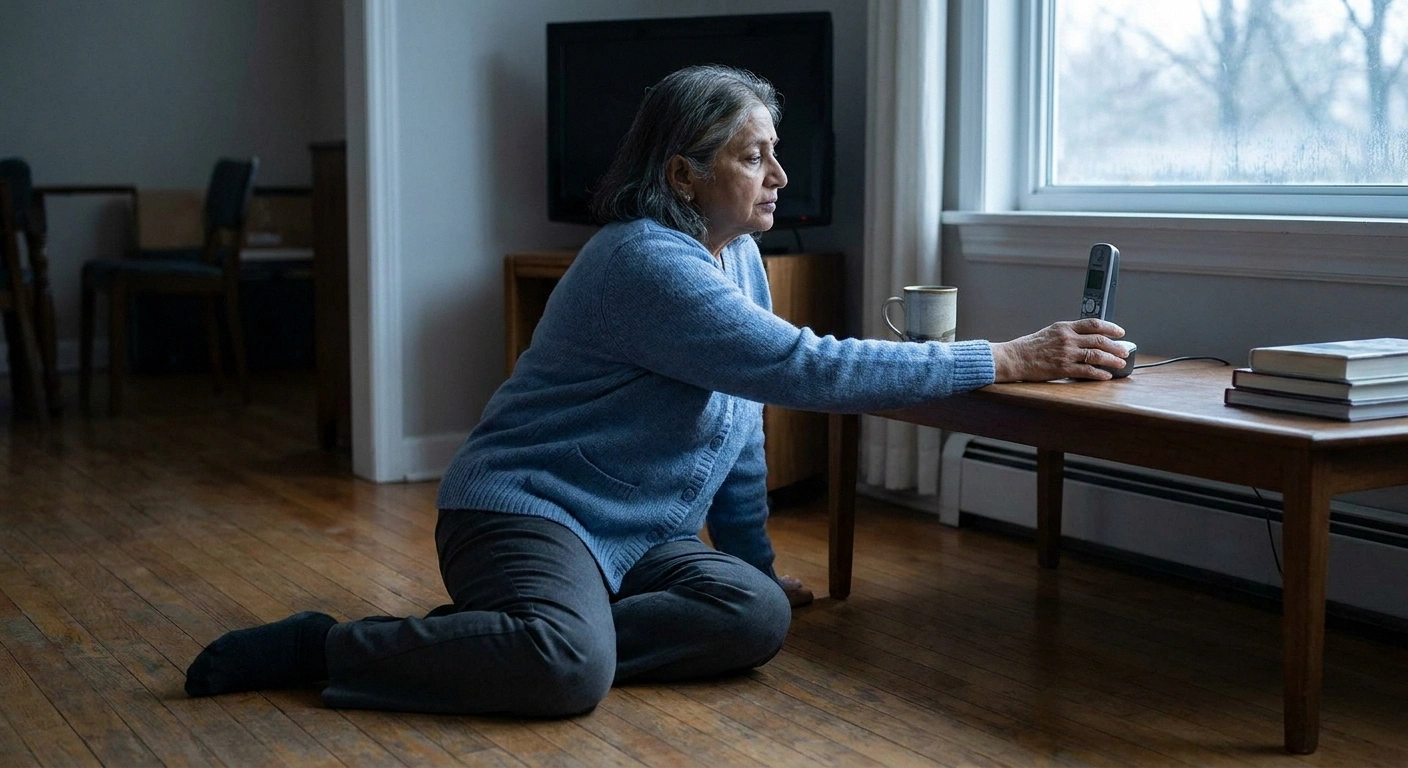
Two of my own habits, which no study has tested: I fold a bath towel under my knees, because I can't trust them to tell me when the floor is too hard, and the first few times I practiced, I made sure someone else was home. The trials that taught this skill were supervised, and that seemed worth copying.
Afterward, look at your feet. NIDDK's advice is to “check your feet every day,” and a stretch on the floor is a good reminder to look for “cuts, sores, or red spots.” I check my knees and shins while I'm at it. Our daily foot care routine has the full checklist.
Practice It Backward, the Way Trainers Teach It
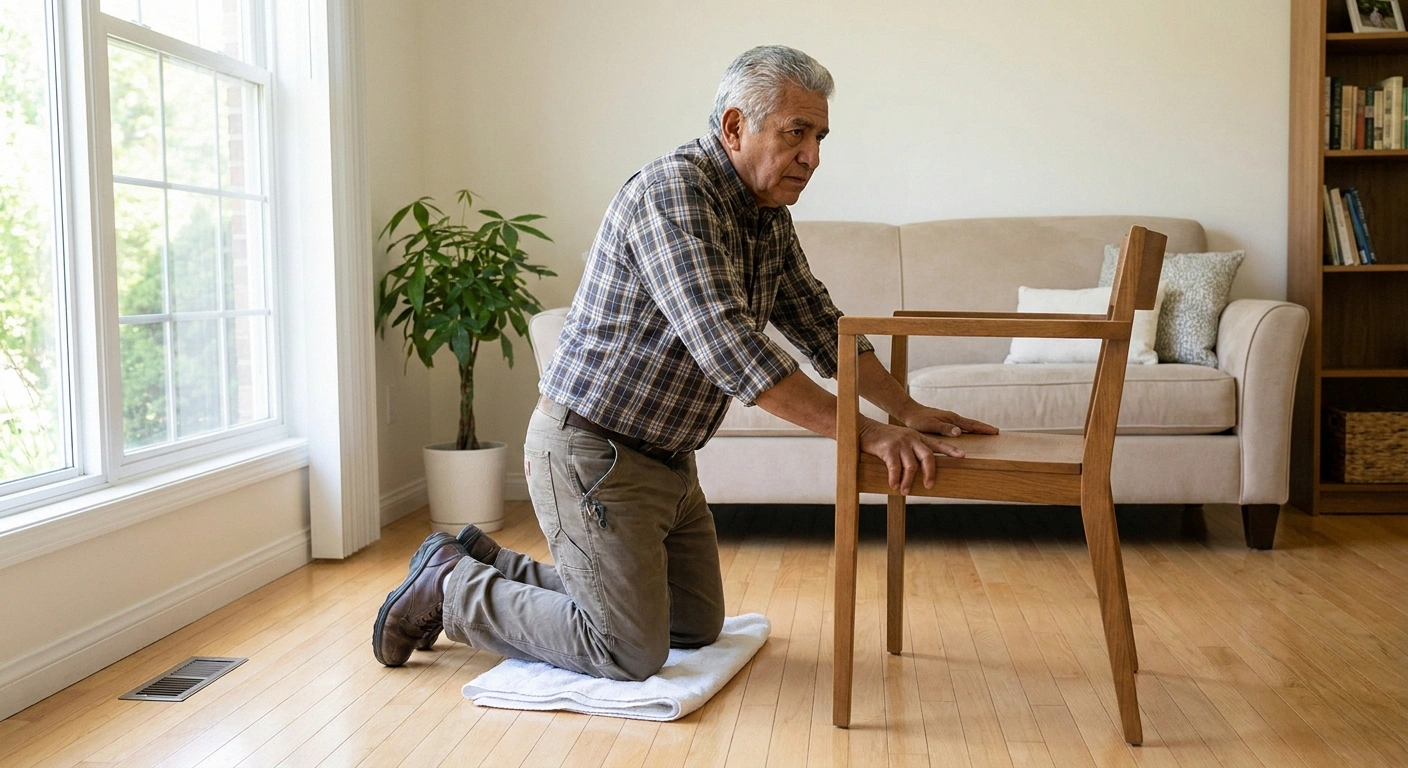
The 2022 World Falls Guidelines, written by an international panel of falls experts, say the skill of rising from the floor is best re-learned by practicing each movement separately, teaching the last step first. Therapists call it backward chaining. You don't begin by lying down on the floor and hoping — you begin at the chair, with the final move, and add one earlier stage at a time.
The evidence is promising, if still small. A 2020 review found 7 studies with 446 participants, average age 82.4, and concluded that the method helped people get up from the floor on their own, though study quality varied widely. The clearest recent result comes from a 2026 pilot trial: 61 adults aged 65 and older who attended weekly exercise classes were randomized, and 49 were analyzed. One group got five weekly 20-minute practice sessions beside a sturdy chair; the comparison group watched a video. Afterward, 100% of the trained group could get up from lying on their back, compared with 63% of the video group, and the time it took fell from 13.1 seconds to 7.1. No one was hurt during the sessions.
Two honest footnotes about that trial, published in Age and Ageing. Fear of falling, the trial's main goal, didn't change. And the trial excluded people awaiting knee replacement, people with poorly controlled conditions such as diabetes, and anyone with a body mass index of 30 or more; three participants with two replaced knees skipped the half-kneeling step entirely. As of October 2026, I couldn't find a floor-rising trial that enrolled people with neuropathy specifically.
A Practice Order You Can Follow
Participants found the move from half-kneeling to standing the hardest part, and some reported sore knees, which is one more reason to practice it first, while you're fresh. The order in the box below is my plain-English version of how the 2026 trial describes it. Move down a stage only when the one above it feels easy.
- Stage 1: at the chair
- Start half-kneeling with both hands on the seat, then rise and turn to sit. Stay here until it feels easy.
- Stage 2: hands and knees beside the chair
- Bring one foot forward into the half-kneel, then finish the way you practiced in stage 1.
- Stage 3: sitting on the floor
- Turn onto your hands and knees next to the chair, then finish with stages 2 and 1.
- Stage 4: lying on your side
- Push up to sitting and rest so your blood pressure can catch up, then finish with the stages above.
Getting Back Up: One Common Method, Step by Step
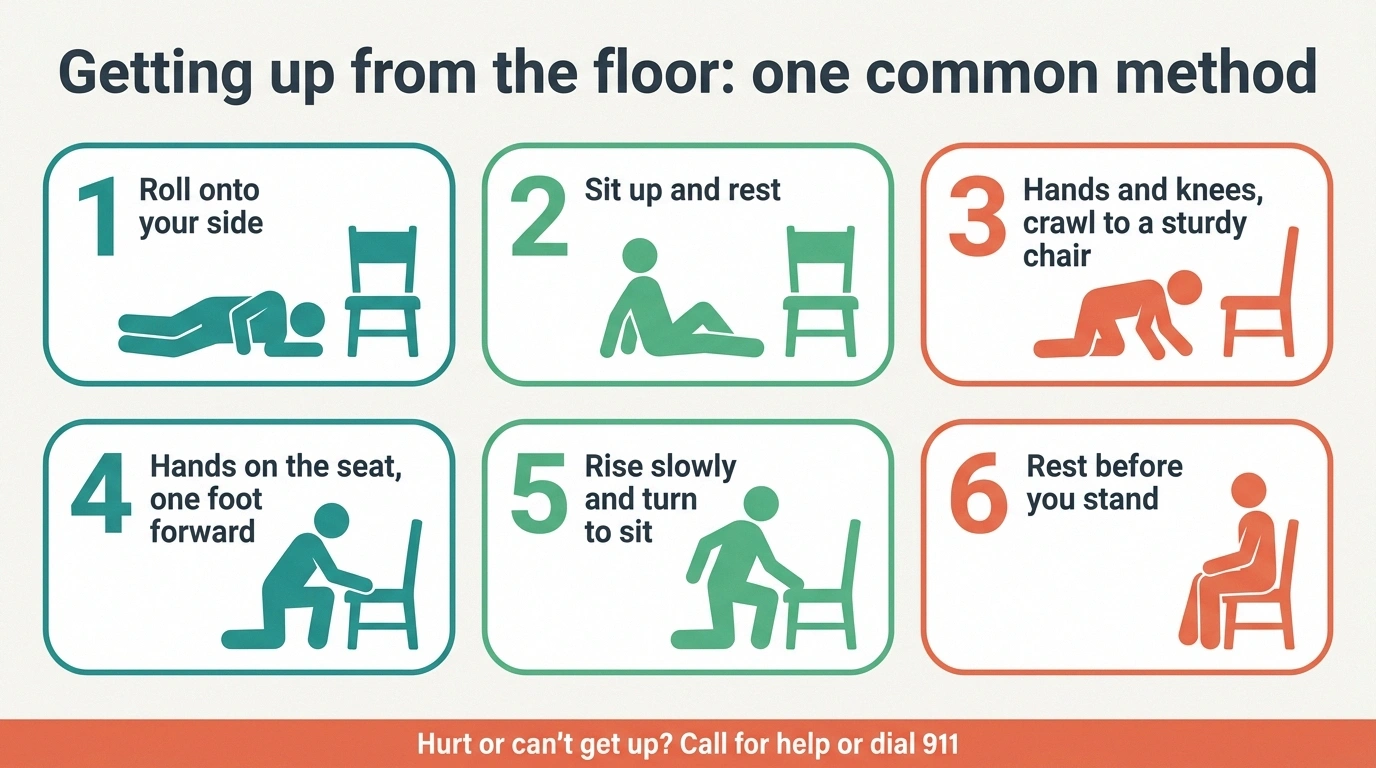
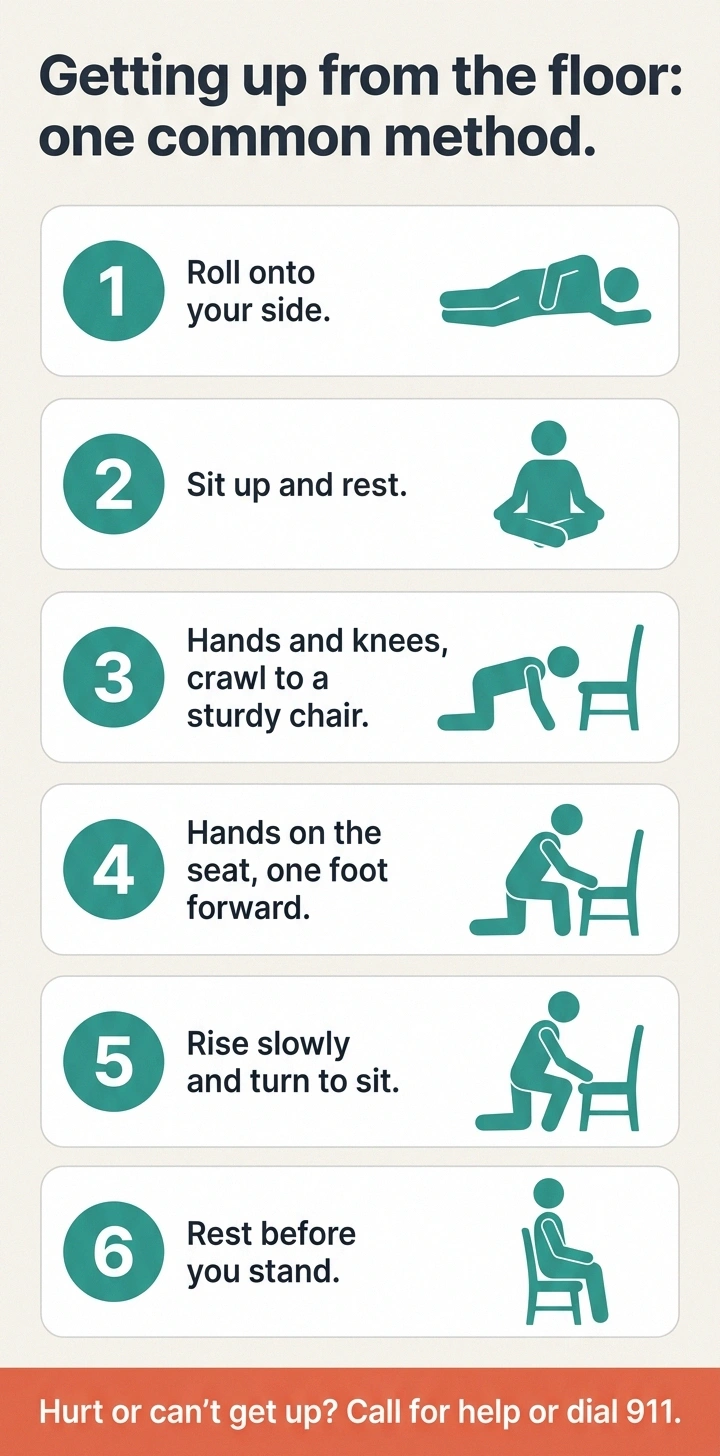
Public-health sources describe nearly the same sequence, give or take a step. The clearest public wording I found comes from that California handout, which says it was adapted from the National Library of Medicine's falls information. Here it is, with a few notes for numb feet and hands. One warning first, for the day you didn't get down on purpose: the handout cautions that “getting up too quickly or in the wrong way could make an injury worse,” and England's NHS treats a possible head, neck, back or hip injury as a reason to call for help instead of getting up. In the US, that means 911.
- Pause first. The handout says, “Stay as calm as possible” and “Take several deep breaths to try to relax.” If you got down on purpose, you're simply getting ready; if you slipped, this is when you check for pain.
- Roll onto your side. In the handout's words, “Roll over onto a side.”
- Sit up and wait. “Push into a seated position.” Then comes the line I wish every guide included: “Rest to let blood pressure adjust.” New York City's health department adds a simple rule: pause if you feel dizzy.
- Get onto hands and knees. “Slowly get up on hands and knees, and crawl to a sturdy chair.”
- Half-kneel at the seat. “Put hands on the chair seat and slide one foot forward so that it is flat on the floor.” The other knee stays down.
- Rise and turn. “From this kneeling position, slowly rise and turn to sit in the chair.”
- Rest before you stand. A British hospital physiotherapy booklet advises a good rest in the chair before you try standing, and that's the step I'd never skip with neuropathy.
The NHS version, from England's health service, ends a little differently: you stand up slowly while holding something stable, then sit down and rest. Either way, the chair does the heavy lifting with you — not your legs alone.
When Your Hands or Your Head Complain
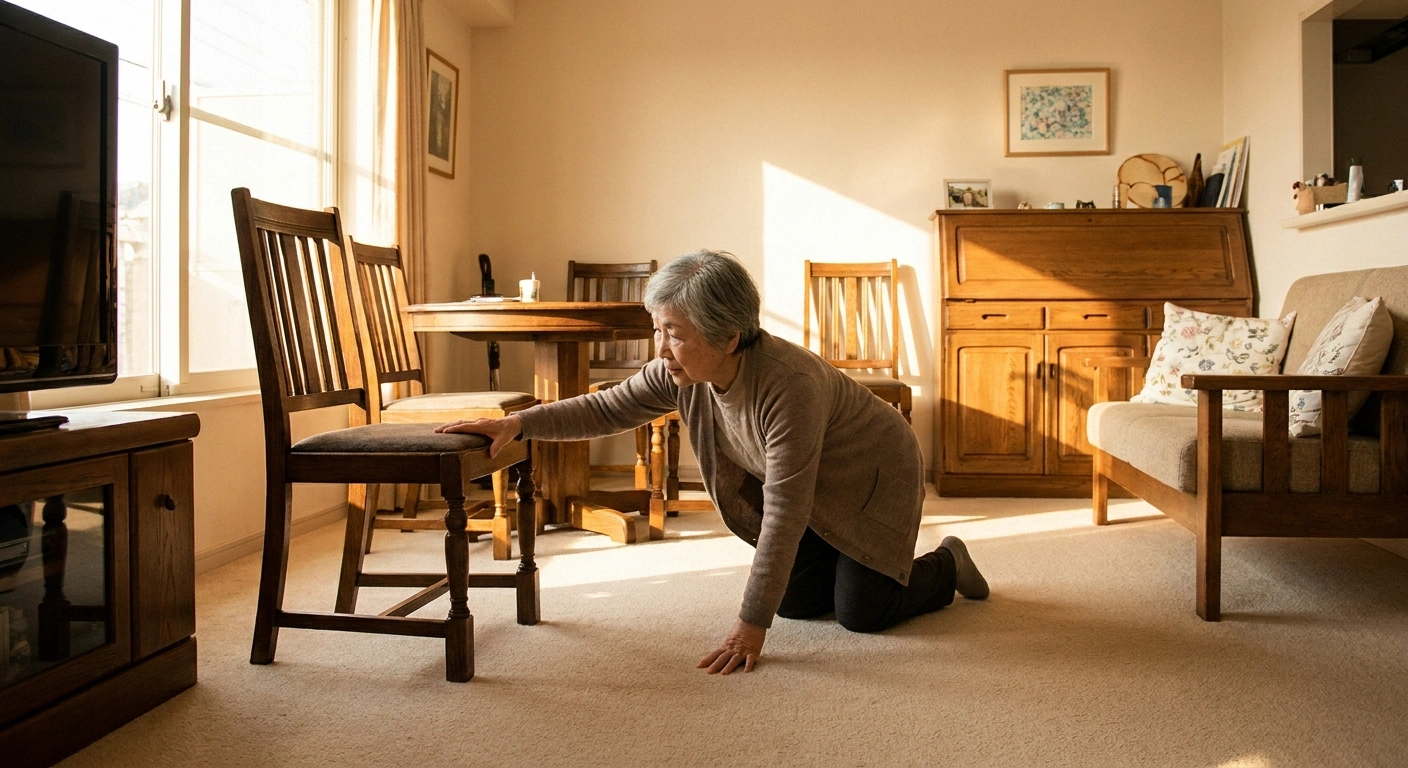
People don't all rise the same way, and that's fine. In one study of 53 community-dwelling adults over 60, 90.6% rolled first and then rose through a lopsided half-squat. In another, healthy older volunteers preferred three different techniques, and the researchers suggested working with a professional to find the one that suits you, then practicing it regularly.
Two adjustments help me. When my hands go on the chair seat, I look at them, because my fingertips won't tell me if a palm is half off the edge. And if the room swims when I sit up, I stay sitting — the handout's blood-pressure rest exists for exactly that moment.
Strength That Makes the Floor Easier

The federal Physical Activity Guidelines say older adults should do activities that include balance training, along with muscle-strengthening on “2 or more days a week.” Their examples of balance training include “practicing standing from a sitting position,” and they count gardening as the kind of mixed activity older adults are encouraged to do. If you love your garden beds, our page on gardening with neuropathy has kneeling and tool ideas.
Chair stands turn out to be a good stepping stone. In 45 adults aged 65 to 96, the ability to stand up from a chair five times in a row predicted whether they could get down to and up from the floor, with a sensitivity of 71% and a specificity of 93%. Those who couldn't do the chair test also couldn't manage the floor on their own. That doesn't prove chair practice alone restores floor rising, but it tells you where to start. MedlinePlus describes the 30-second chair stand test your provider may use, done with your arms crossed over your chest.
For people with neuropathy specifically, strength and balance clearly can improve. In a 12-week trial of 42 people with type 2 diabetes and neuropathy, supervised resistance training improved walking distance and the five-times sit-to-stand test. In a study of 20 people with diabetic neuropathy, the 10 who did a three-week program of focused exercise improved on clinical balance measures. What hasn't been shown is fewer falls: the one trial that counted falls, with 79 people, found no difference, and a 2021 meta-analysis called the effect on fall risk unclear. So I'd practice for strength and confidence, not because a study promises fewer falls.
What the Research on Floor Rising Shows
You may have seen headlines about the “sitting-rising test,” where you lower yourself to the floor and get back up with as little help from hands and knees as possible. In a Brazilian clinic study published in 2012, 2,002 adults aged 51 to 80 took the test, and lower scores went with higher death rates over about six years. A 2025 follow-up in the European Journal of Preventive Cardiology, of 4,282 adults aged 46 to 75, found the same pattern over a median of 12.3 years.
| 78.2% | of 307 Norwegian women aged 75 and older got up from lying on the floor without help. Those who couldn't had about twice the odds of a serious fall injury later. |
| 24% vs 13% | of frail older adults in congregate housing couldn't rise without support, versus with furniture to push on (Michigan, 1997). |
| 220 of 596 | falls without injury ended with the person unable to get up without help (New Haven, ages 72 and up). |
| 1 in 8 | older adults who fall report lying on the floor for more than an hour, according to the World Falls Guidelines. |
| 6.6 to 7.3 | rise tasks completed, on average, after six training sessions over two weeks for older adults who needed help with daily mobility; their rise times didn't change. |
Those are associations — the people tested had no relevant physical limitations, none of the studies looked at neuropathy, and nobody has shown that practicing the test helps you live longer. I mention it only because the headlines don't always say so.
The more useful research is about who can get up at all, and who gets taught. In two Michigan studies of older adults in congregate housing, 24% and 38% couldn't rise from the floor without help. And in a 1993 survey in England, only 11% of physiotherapists and 21% of occupational therapists said they would teach older people at risk of falling how to get up. If you want this skill, you may have to ask for it by name.
The Day You Can't Get Up
This section is separate on purpose, because it's a different situation: you're on the floor, and the method above isn't working. It happens more than people admit. In a 1993 study of New Haven residents aged 72 and older, 47% of the 313 people who fell without injury couldn't get up after at least one fall. Among people over 90 in Cambridge, England, 80% of those who fell couldn't get up at least once, and 30% lay on the floor for an hour or more. The box here sums up what US sources tell you to do.
- Use a phone or alert button if you can reach one, or call out loud for help.
- If you're hurt or can't get up on your own, call 911 or ask someone to call.
- If you're alone, get into a comfortable position and wait for help to arrive.
- Keep warm. If you're not badly hurt, move your arms and legs gently and shift position about every 30 minutes.
- Afterward, see a provider even if you don't think you're badly hurt, and write down when, where and how the fall happened.
That same Cambridge study found something worth sitting with: when people fell alone and couldn't get up, they didn't use their call alarm in 80% of those falls. The World Falls Guidelines say alarms and phones still matter for people who live alone, and that regaining the getting-up skill matters too. An alert button only helps if it's on you and you're willing to press it.
For perspective on how common falls are, in the latest national figures I could open, CDC reported that in 2020 about 14 million US adults 65 and older (27.6%) said they'd fallen in the past year, and in 2021, 38,742 died from falls. Tell your doctor about every fall, even one that ends with you laughing on the rug. A 2016 CDC release noted that less than half of older adults who fall say anything to their doctor.
If You're the Helper
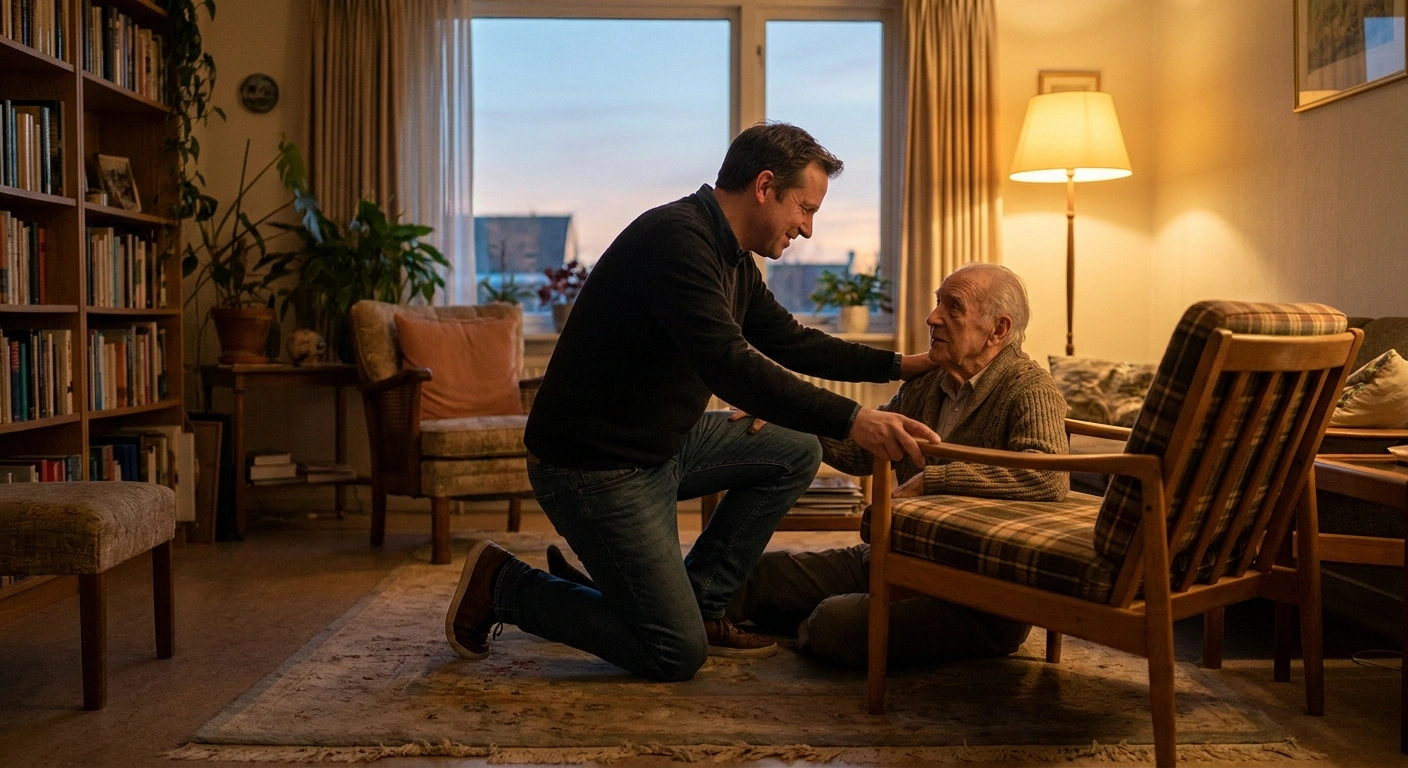
England's NHS gives clear advice for anyone who finds someone on the floor: keep them comfortable and warm, carefully help them get up if they're able to, but don't try to lift them yourself. If they might be injured, seem confused or can't move a limb, leave them where they are, keep them warm and call 911. In practice, that means the person on the floor does the work while you steady the chair, slide it close, and talk them through the steps. If they're hurt or can't get up, call 911.
Getting a Therapist to Teach You
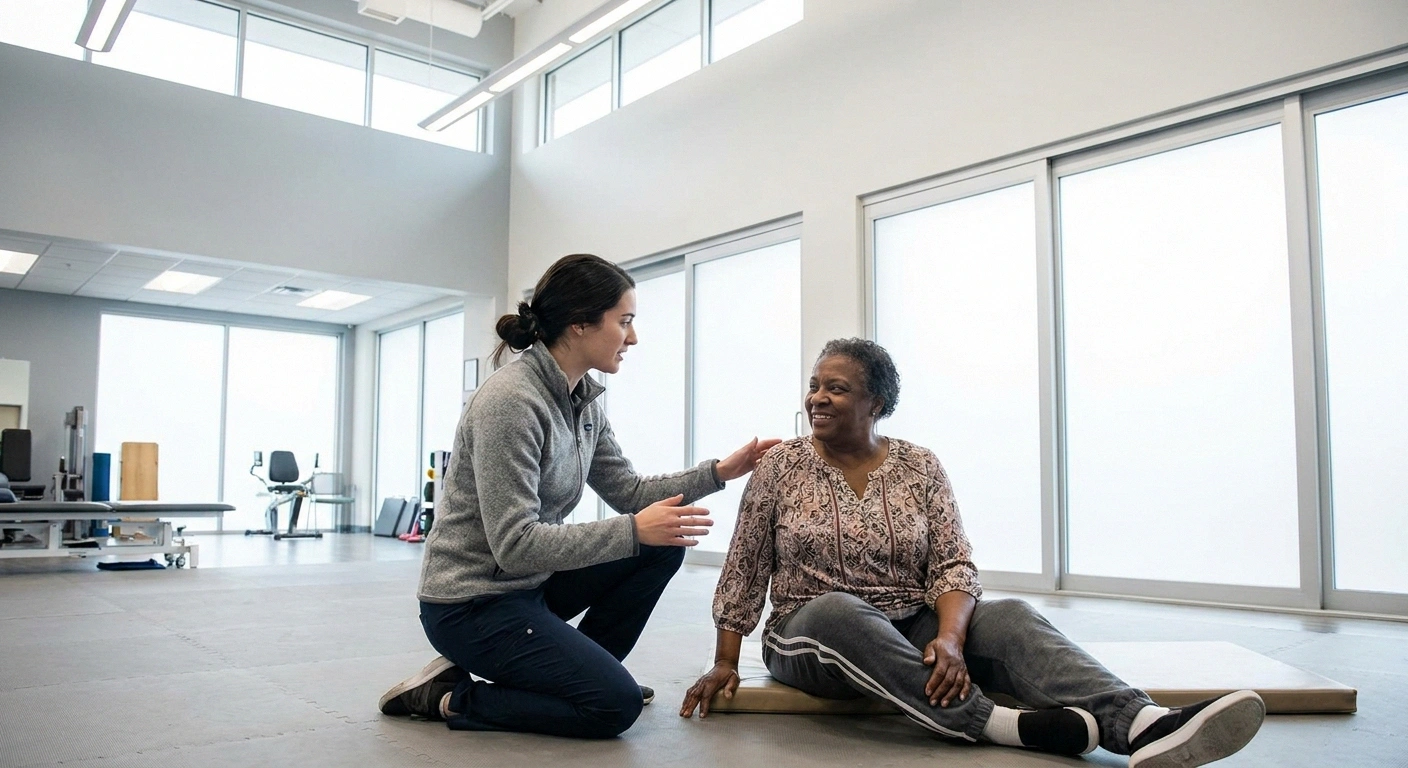
NIH's consumer health newsletter says doctors may suggest working with a physical therapist “to increase your strength and improve your balance,” and that “an occupational therapist can teach you about the safety hazards in your home.” Both can help with the floor, but a 2020 study from England found that neither therapists nor ambulance crews routinely teach getting up. Ask for it in so many words: Can you teach me to get down to the floor and back up, starting from the chair?
An occupational therapist can also look at the room where you'd practice and point out the hazards. Our page on how occupational therapy helps with neuropathy explains what a visit involves. And if you decide the floor isn't for you after all, that's a real choice, not a failure. The goal was always to make it a choice.
Frequently Asked Questions
How do you get up off the floor when your legs are weak or numb?
One common method that public-health sources teach: roll onto your side, push up to sitting and rest so your blood pressure can adjust, get onto your hands and knees, crawl to a sturdy chair, put your hands on the seat and bring one foot forward, then rise slowly and turn to sit. Rest in the chair before you stand.
Is it safe to sit on the floor if I have neuropathy?
It can be, with a plan: sit beside a sturdy chair or couch, keep your shoes on, and keep a phone within reach. If you have a recent injury or surgery, a joint replacement, bad knee pain, or dizziness when you stand, ask your doctor or a physical therapist before you practice.
What should I do if I fall and can't get up?
Use a phone or alert button if you can reach one, or call out for help; if you're injured or can't get up, call 911. If you're alone, get into a comfortable position and keep warm; if you're not badly hurt and moving doesn't make the pain worse, move your arms and legs gently and change position about every 30 minutes while you wait. Tell your doctor about the fall afterward.
Should I help someone up after a fall?
Keep them comfortable and warm, and help them get up only if they're able to do the work themselves. Don't try to lift them yourself. Steady a sturdy chair for them to push against, and call 911 if they're hurt or can't get up.
What is the sitting-rising test?
It scores how much help from hands and knees you need to sit down on the floor and get back up. In Brazilian clinic studies, lower scores were linked with higher death rates over the following years, but those were associations in people without relevant physical limitations, and neuropathy wasn't studied.
What exercises make getting up from the floor easier?
Federal guidelines recommend balance training plus muscle-strengthening on at least 2 days a week, and they list practicing standing from a sitting position as balance training. Chair stands are a good starting point. A physical therapist can also teach floor rising directly, starting from the chair and working down.
Why do I get light-headed standing up from the floor?
When autonomic neuropathy reaches the nerves that control blood pressure, they can react too slowly to a change in position, so standing from lying or sitting may leave you woozy. Some medicines add to it. Rest sitting up before you rise, and tell your doctor promptly if the dizziness is new, keeps happening or has caused a fall. Don't change blood pressure or nerve-pain medicines on your own.
About the Author