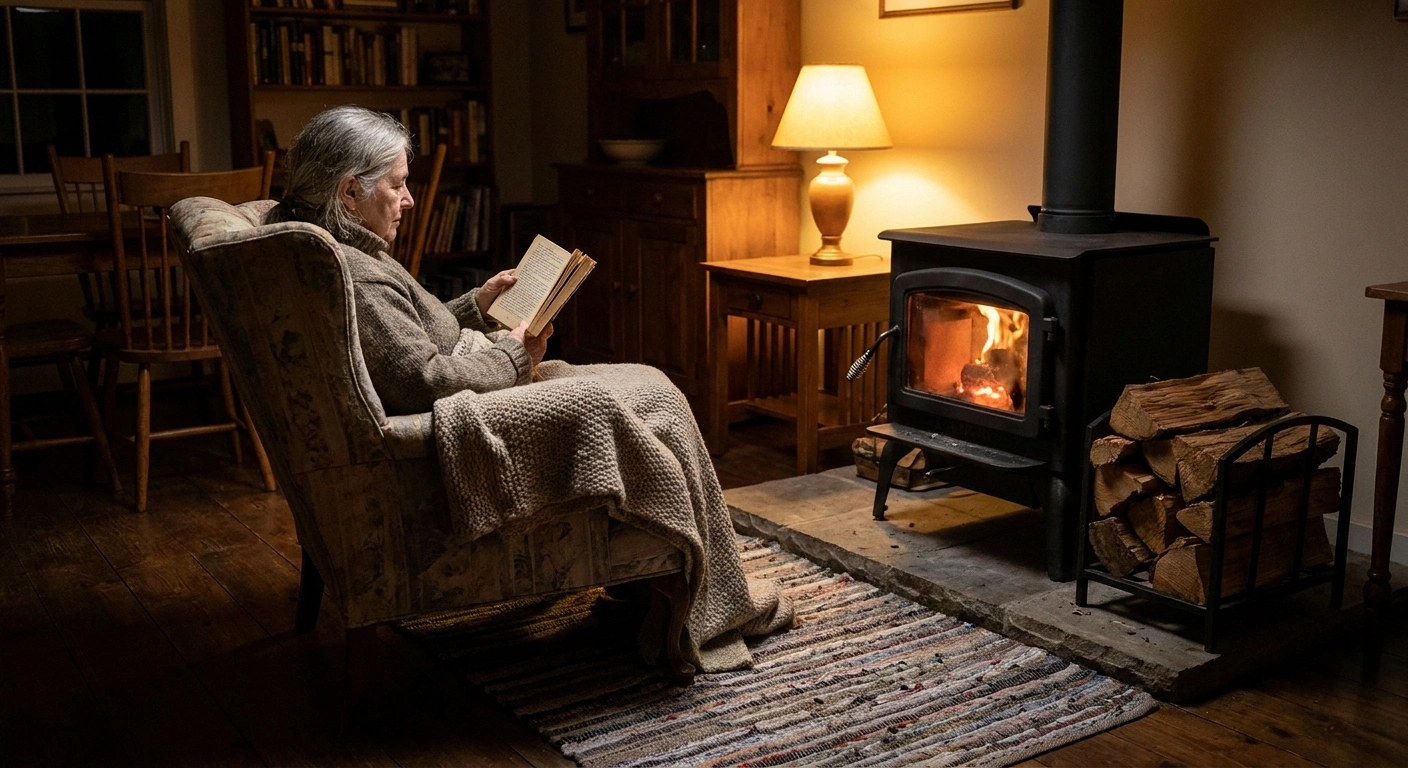
Fire departments have a rule they repeat every winter: keep anything that can burn at least three feet from a fireplace or stove. They wrote it for curtains, armchairs, dog beds and stacks of newspaper—nobody had your feet in mind.
But if neuropathy has turned your toes and soles quiet, that rule fits you better than it fits the curtains. Skin that can’t feel heat behaves a lot like fabric near a fire. It sits there, warming up—until something changes that you didn’t see coming.
I grew up in a farmhouse where the wood stove was the center of every winter evening, and I still think there’s nothing better than a real fire on a cold night. So this isn’t about giving that up. It’s about where to sit, what to touch, which jobs to hand off, and what to look for afterward. I’m a patient advocate living with neuropathy, not a doctor, and I’ll tell you where each fact comes from.
Why Radiant Heat Is Sneakier Than a Hot Surface
A heating pad burns by contact. You press skin against something warm and leave it there. A fireplace works differently. It throws radiant heat across the room, the same way the sun warms your face on a cold day even when the air is freezing. The heat lands on whatever is facing the flames, and the closer you are, the more of it lands.
| Skin temperature | Approximate time |
|---|---|
| 44°C (111°F) | About 6 hours |
| 45°C (113°F) | About 3 hours |
| 50°C (122°F) | About 5 minutes |
| 55°C (131°F) | About 30 seconds |
| 60°C (140°F) | About 5 seconds |
Figures from the 1947 Moritz and Henriques hot-water studies, as tabulated in later burn reviews. Real-world times vary with skin thickness, pressure and circulation. At the bottom of the table, only pain pulls you away in time. At the top, it’s hours of sitting still that does the harm, which is exactly what a long, cozy evening looks like.
That’s why the shins and the tops of the feet take the brunt of it. When you sit facing a fire with your legs stretched toward the hearth, those are the surfaces pointed straight at the heat. The air around your ankles might feel pleasant. The skin itself—the part facing the flames—can be climbing well past that.
Burns are about heat and time together. The classic work here comes from Moritz and Henriques, two researchers who published their thermal injury studies in 1947. Their numbers, still quoted in burn reviews today, show that skin held at about 44°C (111°F) needs hours before deep damage sets in, while at 60°C (140°F) it takes only seconds. Most of us live our whole lives without thinking about that curve, because pain pulls us away long before we get far along it.
Neuropathy takes away the pull—quietly, and without any sense that something’s missing. A person with full sensation shifts in their chair, tucks their feet back, or reaches for a footstool without ever noticing they did it. Those little moves are the body’s own temperature control. Take away the feeling and the moves stop happening.
If you’ve read my heating pad safety guide, this will sound familiar. The fire isn’t more dangerous because you have neuropathy. You just lose the warning that would have made you move.
Who Should Treat the Hearth Like a Stove Top
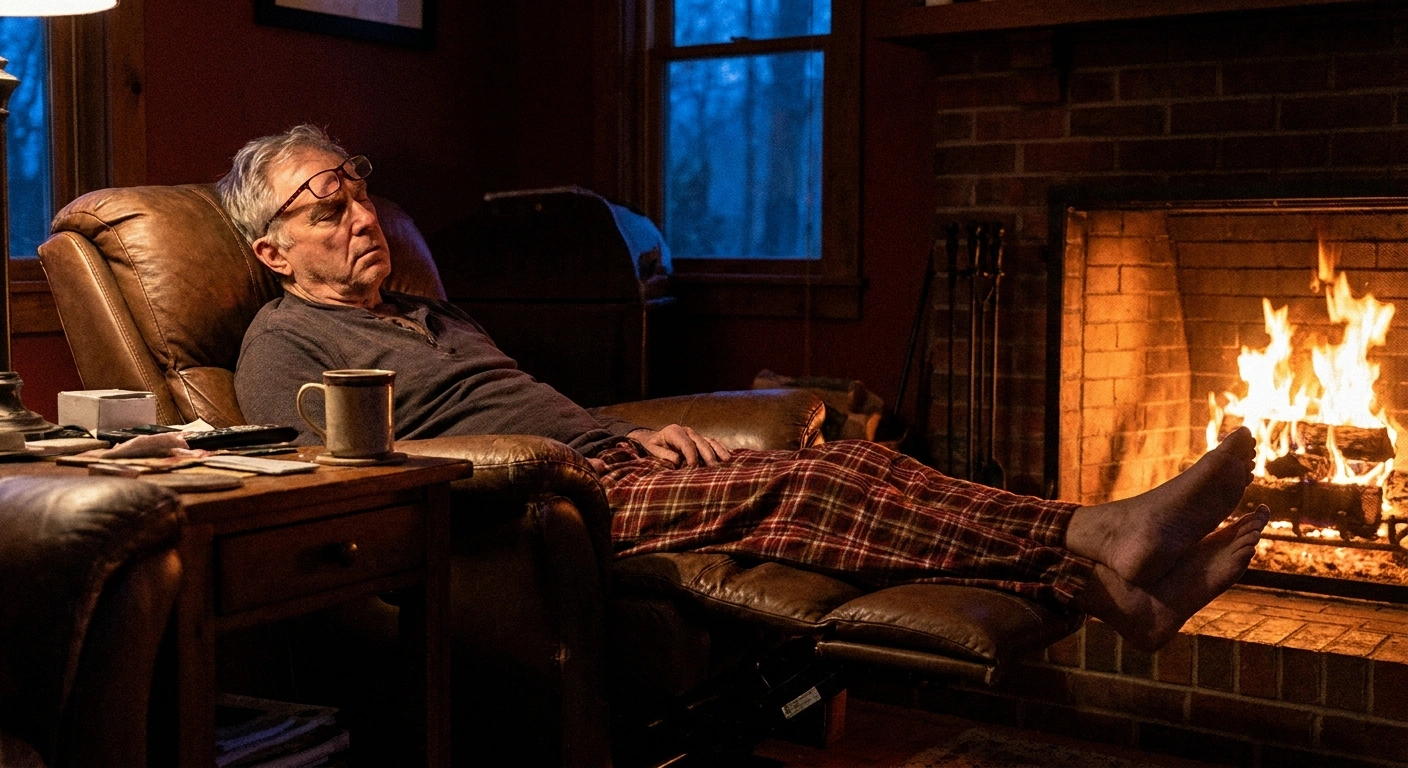
Not everyone with neuropathy has the same risk near a fire, and it helps to be honest about that. The most common pattern, the kind linked to diabetes, starts in the toes and works its way up. If your numbness stops at your ankles, your feet are the part to protect, and your hands are probably still giving you good information.
The risk climbs in a few situations:
- Numbness has reached your shins. The front of the lower leg is the classic target for fireside heat, and it’s often covered only by thin pajama pants or nothing at all.
- Your fingertips are going numb too. Loading logs, adjusting a gas knob or closing a stove door all bring your hands close to very hot metal and glass.
- You can’t tell warm from hot. Some people with small fiber neuropathy still feel touch but lose temperature sense first. Your foot may feel “fine” while it can’t report heat at all.
- You doze off in the evening. A warm fire, a full stomach and a nerve pain medication that makes you sleepy is a common combination. An hour can pass without a single shift of your legs.
- You have diabetes or poor circulation. A burn that would heal in a week on healthy skin can turn into a wound that lingers for months.
That last point isn’t hypothetical. A ten-year review of lower-leg and foot burns in people with diabetes at one burn center found 68 patients. Thirteen of those burns came from warming feet on or near a heat source like a heater. The authors titled their paper with a phrase I haven’t forgotten: small burns that lead to major problems.
A separate case series looked at 16 people with diabetic neuropathy who were admitted for heat burns from things like heaters, footbaths and heating pads. Seven of them developed wound infections. Three needed amputations. Those are hospital cases, so they show the worst end of the range, but they show why a fireplace deserves a plan.
The Hot Glass Problem With Gas Fireplaces
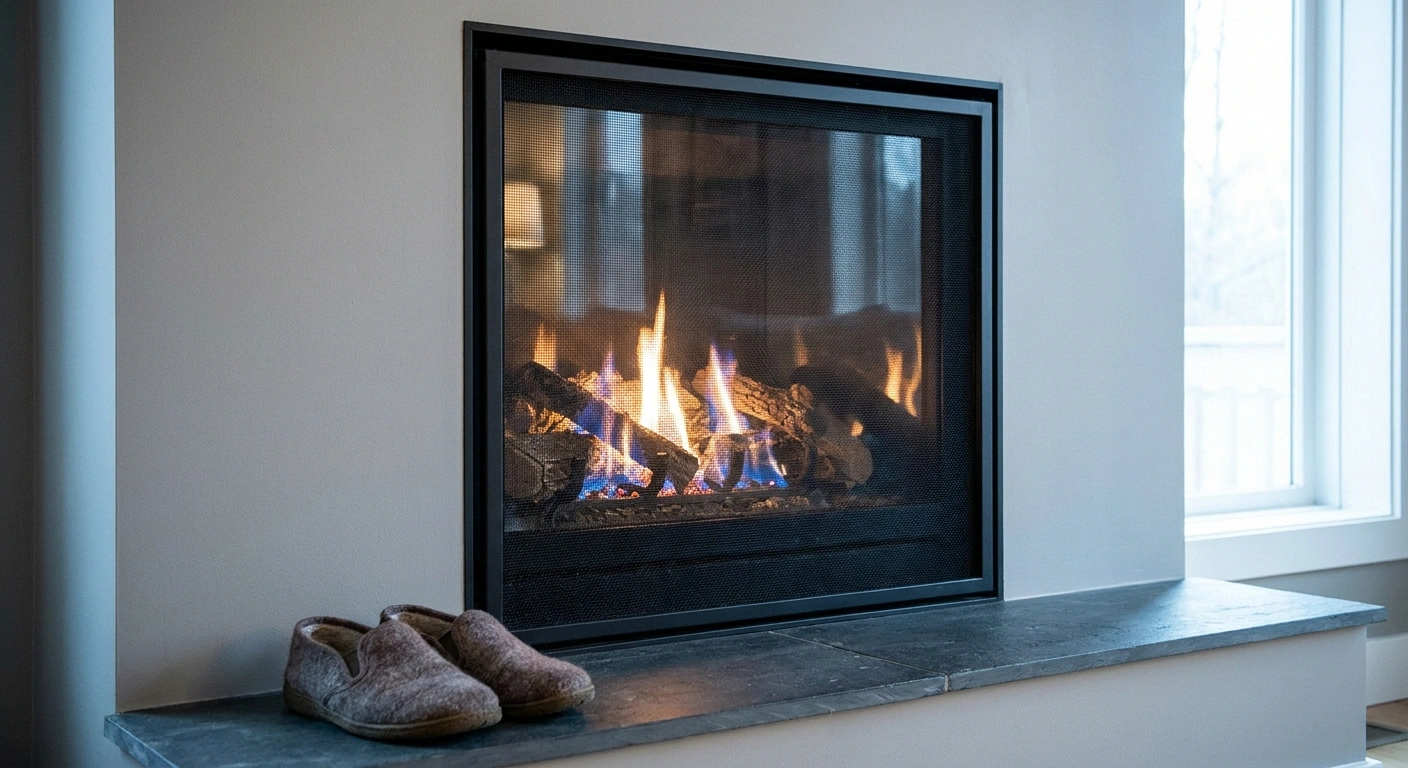
Gas fireplaces feel tame—no smoke, no sparks, no ash, and a wall switch to turn them on. That’s exactly why the glass front catches people off guard.
Four numbers to know about the glass front
- 200°F+
- How hot the glass can get, reported by a children’s hospital burn program.
- About 6 minutes
- How fast it can get there after the flame comes on.
- About 45 minutes
- Average time to cool to a safe temperature after you switch it off.
- 172°F and 2015
- Units made since January 2015 must ship with a barrier screen if the glass passes 172°F. Older units were not retrofitted, so look for a mesh screen in front of yours.
A children’s hospital burn program reports that the glass on a gas fireplace can pass 200°F in about six minutes, and takes around 45 minutes on average to cool back down after the flame goes out. Most of the public warnings about this are aimed at toddlers, who put their hands flat on the glass. For an adult with neuropathy, the more likely contact is a foot resting on the raised hearth, or a hand braced against the glass while reaching for the remote or the control panel underneath.
Newer units help. Since 2015, glass-fronted gas fireplaces and stoves made for the U.S. market have had to come with a protective screen or barrier if the glass gets hotter than 172°F. Older units weren’t retrofitted, though, and a lot of homes still have them. If yours has no mesh screen in front of the glass, that’s worth fixing. The hearth industry group advises checking with your fireplace maker before adding an aftermarket screen, since some can interfere with how the unit runs.
The 45-minute cool-down matters too. Turning off the fireplace doesn’t make it safe to touch—not for a while. If you’re the one who wipes the glass or tucks a blanket nearby at bedtime, give it the better part of an hour first.
Loading Wood and Handling Ash With Numb Hands
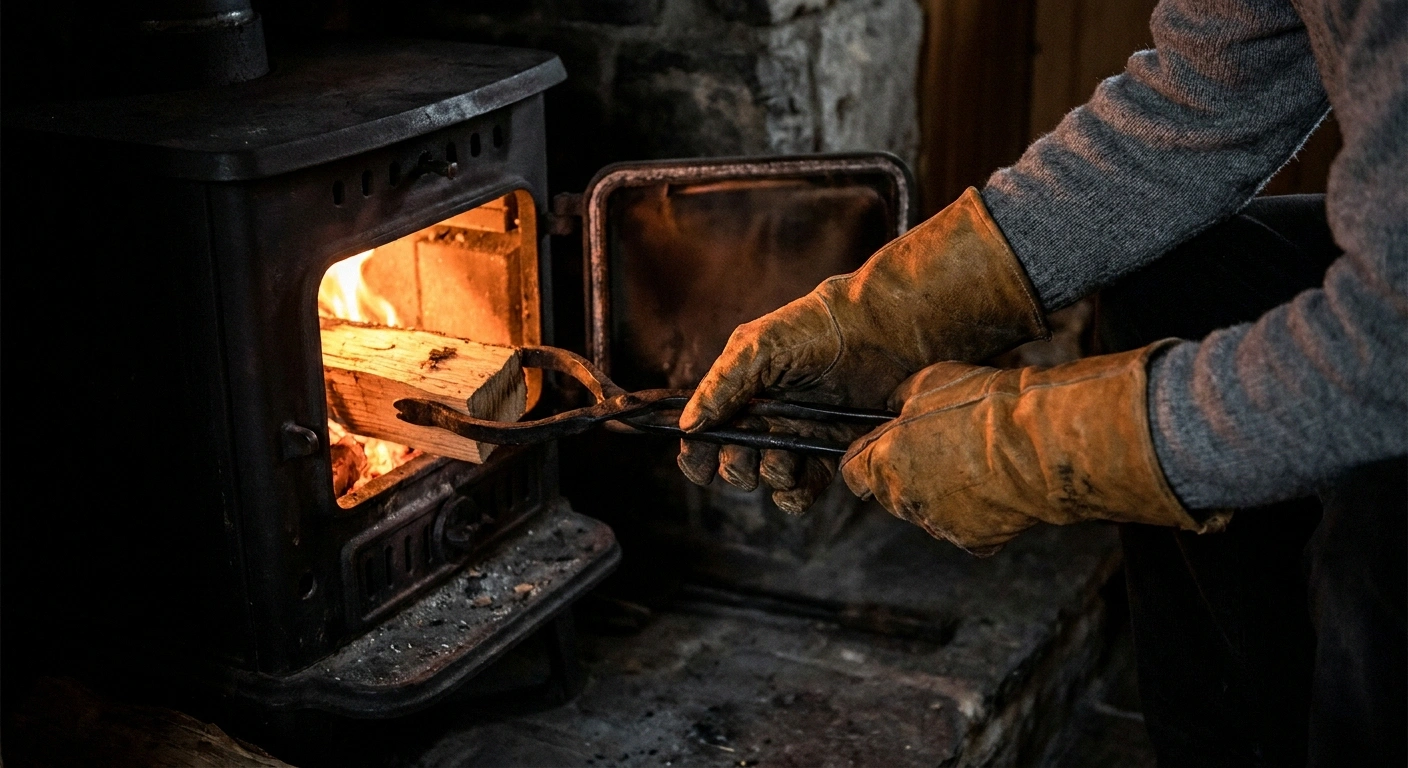
A wood stove asks more of your hands than a gas fireplace does. You split kindling, carry logs, open a cast iron door, push burning wood around with a poker and eventually shovel out ash. Every one of those steps is easier to get wrong when your fingertips are dull—and the mistakes don’t hurt at the time.
Here’s what tends to go wrong, and the small fix for each:
- Splinters and scrapes you don’t feel. Rough bark can tear skin on numb fingers and you won’t know until you see blood on the log. Wear lined leather work gloves for carrying wood, and look at your hands afterward.
- Grabbing the stove door handle. Many stove handles get hot enough to burn. Use the tool that came with the stove, or a long welder’s-style fireplace glove that covers your wrist.
- Reaching in to nudge a log. Use long tongs or a poker every time. Reaching in “just for a second” is how most hand burns from stoves happen.
- Brushing against the stove body. A running wood stove’s sides and top are far hotter than any glass front. Stove thermometers commonly mark their normal burning range somewhere in the hundreds of degrees Fahrenheit, so there’s no safe way to lean on one.
- Carrying ash. Ash can hold live coals for a surprisingly long time. Fire safety groups recommend a metal can with a tight lid, set outside and well away from the house. Don’t carry a hot bucket against your leg.
If your hands are badly affected, this is a job worth handing to someone else, at least for the hot parts. Plenty of people with neuropathy still split and stack wood happily in daylight. The loading and the ash are where the burns come from.
Where to Put Your Chair (and Your Feet)
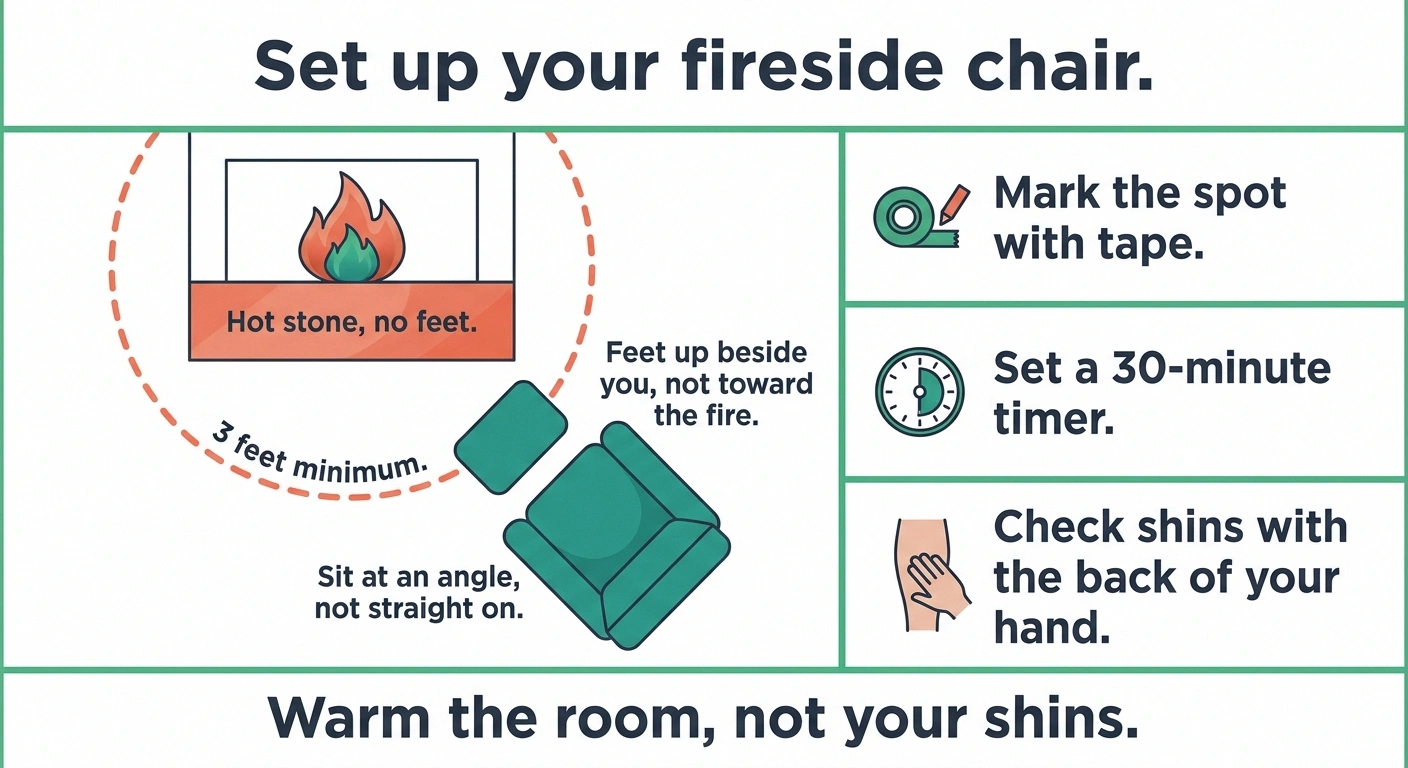
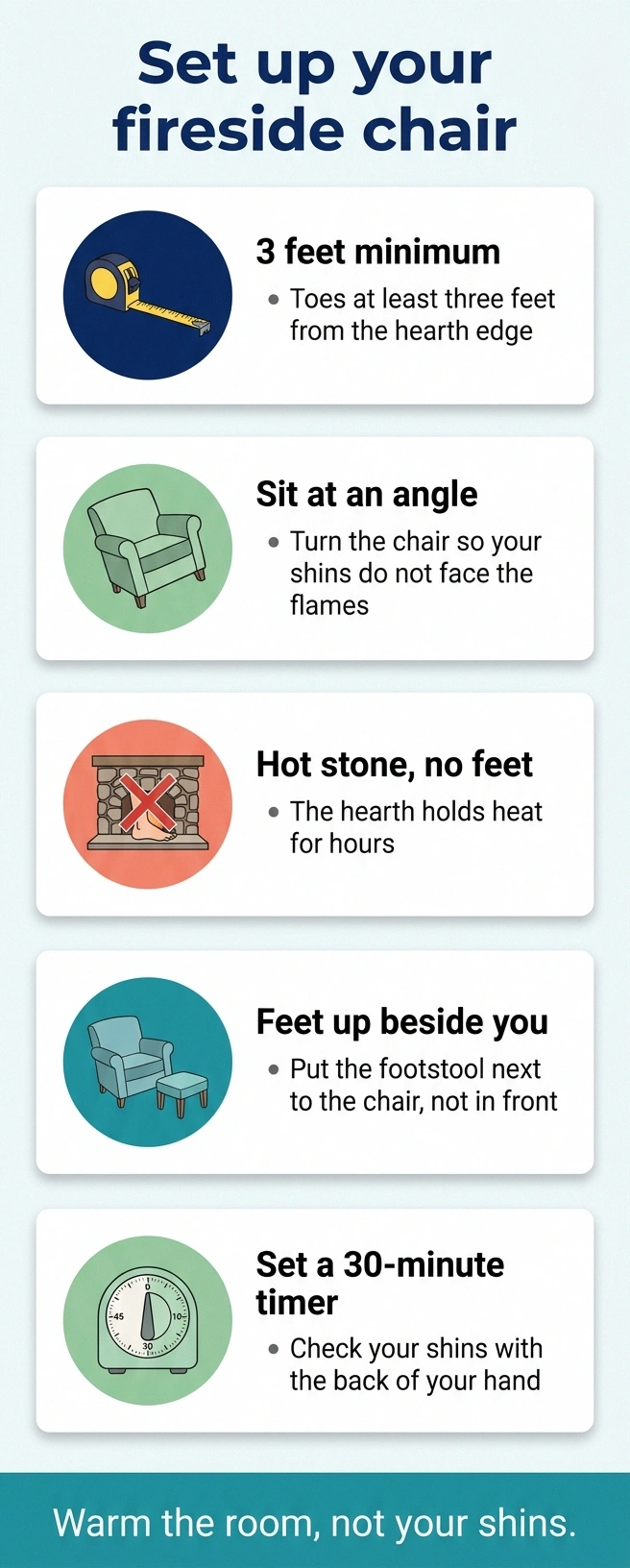
This is the change that makes the biggest difference, and it costs nothing. Most of us set up the fireside chair by feel. We scoot closer until it’s cozy. With numb feet, that “cozy” signal comes mostly from your face, hands and upper body, which can still feel fine while your shins are much too close.
A few simple setup rules:
- Measure once, then mark it. Put your chair so your toes, with legs stretched out, are at least three feet from the hearth edge or stove. A strip of tape on the floor, or a rug edge, gives you a line you can see.
- Sit at an angle, not straight on. Turning the chair partly sideways keeps your shins from facing the fire directly. Your side gets the warmth instead of the front of your legs.
- Keep feet off the hearth. Stone and brick hearths soak up heat for hours. Resting your feet on one is a contact burn waiting to happen, even after the fire has died down.
- Use a footstool that stays put. If you like your feet up, put them on a stool beside your chair, not in front of it toward the fire.
- Cover your legs with a layer. A blanket or thick lounge pants over your shins takes the edge off radiant heat. Just keep it well clear of the fire itself.
One check I like: after twenty minutes by the fire, put the back of your hand on your shin. Your hand is likely to feel more than your leg does. If the skin feels hot to your hand, move back.
Toasted Shins: The Slow Mark of Too Much Fireside Time
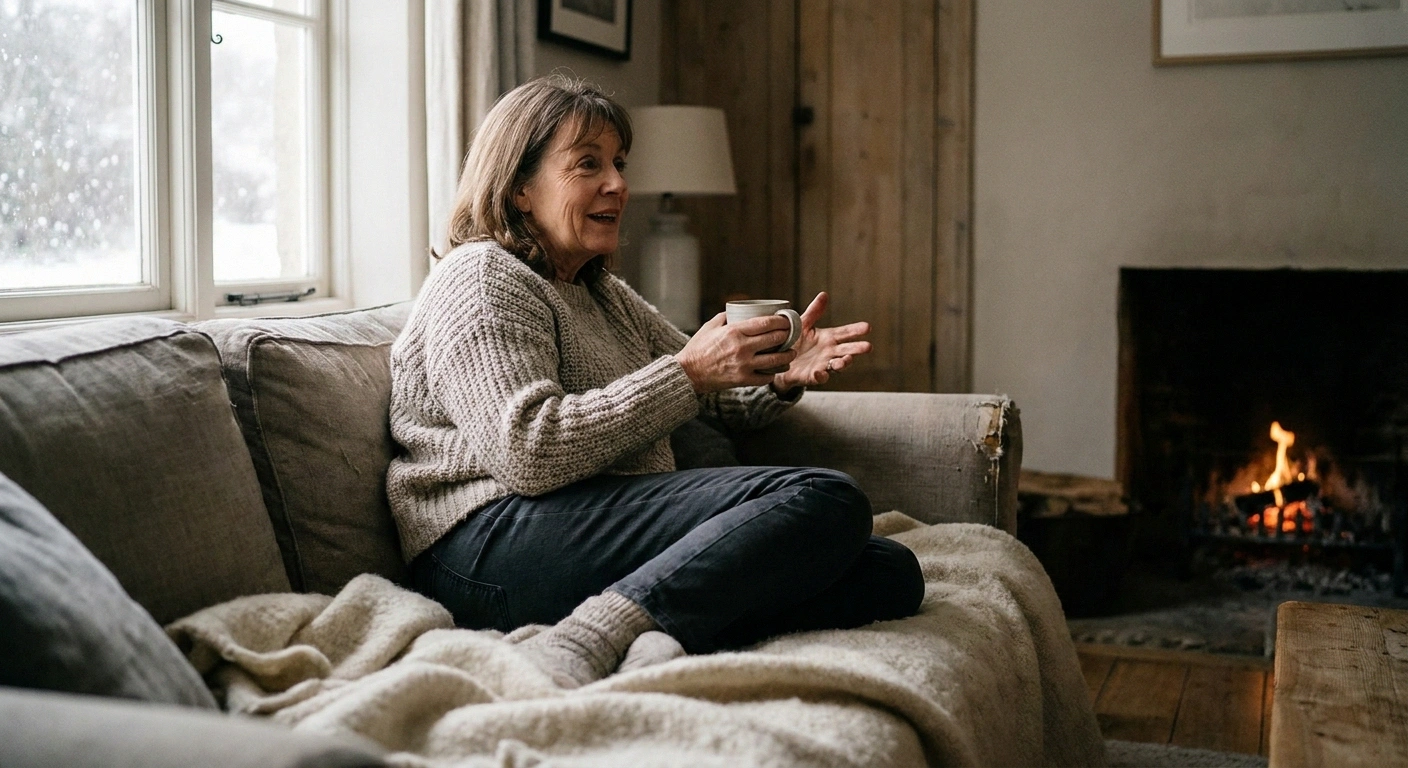
Not every heat injury is a blister. There’s a quieter skin change called erythema ab igne, which roughly means “redness from fire.” People sometimes call it toasted skin syndrome, and in older medical writing it was nicknamed “toasted shins,” because it so often showed up on the legs of people who sat close to open fires or coal stoves every winter.
It looks like a lacy, net-like pattern of red or brownish skin. It comes from repeated heat that’s warm but not hot enough to burn on any single evening. Many people have no symptoms at all, though some notice mild itching or a slight burning feeling. These days dermatologists see it more often from laptops, space heaters and heated car seats, but the fireplace is where it got its name.
Why care about a rash? Two reasons—one practical, one rare. It’s a clear sign your skin is getting more heat than it should, night after night. And in rare cases, long-standing patches have been linked to skin cancer. One published case described a woman who sat by a stove for 35 years and developed squamous cell carcinoma inside an old patch on her lower legs. That’s unusual, but it’s real.
The good news is that early patches often fade once the heat stops. If you spot that net-like pattern on your shins, move your chair back and let a dermatologist look at it, especially if any part of it thickens, scales or forms a sore.
Smoke, Carbon Monoxide and Sleepy Evenings
Burns aren’t the only fireside risk, and these next ones aren’t about neuropathy at all. They just tend to hit the same people at the same time of day.
Before the next cold snap: two alarms and one appointment
- Carbon monoxide alarm on every floor and outside the bedrooms. Press the test button once a month and replace the unit by the date printed on the back.
- Smoke alarm in the room with the fireplace or stove, or just outside it. If your hearing is fading, ask about models with a strobe or a bed shaker.
- Chimney inspection once a year, before the first fire of the season. Write the date on the calendar page for next October now.
Wood fires and gas fireplaces can both produce carbon monoxide if something isn’t venting right: a blocked flue, a damper left partly closed, a cracked heat exchanger. Carbon monoxide has no smell—none at all. Its early signs are headache, dizziness, nausea and unusual sleepiness, which is easy to blame on a warm room or an evening dose of gabapentin. A working carbon monoxide alarm takes the guessing out of it.
Chimneys are the other piece. Creosote, the tarry residue from burning wood, builds up inside the flue, and fire departments report that it plays a role in roughly one in four home heating fires. An annual chimney inspection is the standard advice, and it’s one of those chores that’s easy to put off for a year or two.
And then there’s falling asleep. A dozing person can’t respond to a rolling log, a spark on the rug or a shin that’s getting too hot. If you know the fire makes you drowsy, put a kitchen timer next to your chair. When it goes off, you check your legs, look at the fire, and decide whether to add wood or call it a night.
A Fireside Routine That Keeps the Warmth
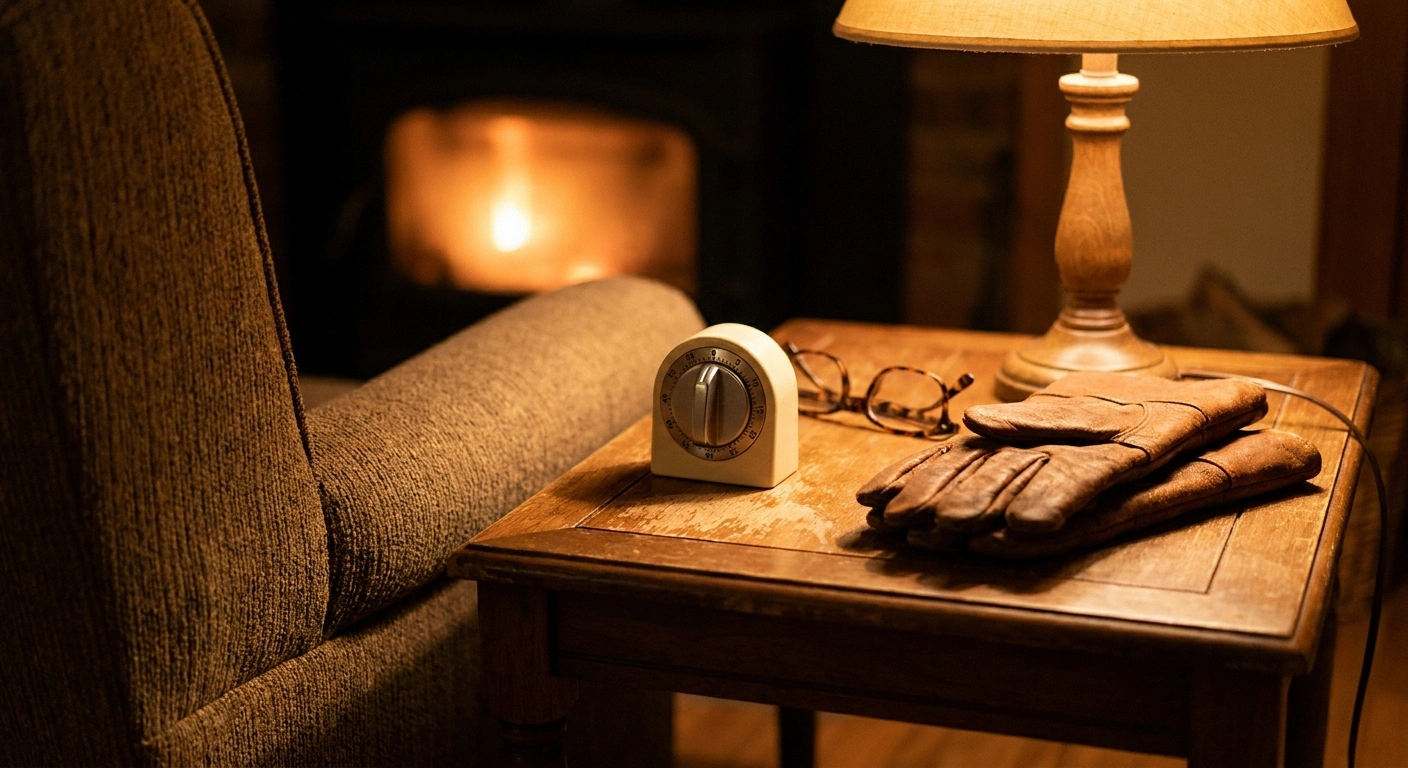
Here’s the routine I’d suggest. It sounds like a lot written down, but after a week it runs on autopilot.
Before you light it
- Check the screen or barrier is in place.
- Put your chair at its marked spot, angled away from straight-on.
- Put on socks and lounge pants or a lap blanket. My guide to socks for neuropathy covers seamless, cushioned options that also keep cold feet comfortable.
- Gloves and tongs within reach, not across the room.
While it’s burning
- Set a 30-minute timer and do a quick shin check with the back of your hand when it rings.
- Use tools for every log and every adjustment. No bare hands inside the firebox.
- Keep feet off the hearth, even once the fire looks low.
At bedtime
- Let the fire burn down; never leave it roaring when you go to bed.
- Close the glass doors or screen.
- Take off your socks and look at your feet and shins under good light, including the soles and the backs of your heels. A hand mirror helps.
That last step is the one that catches problems early. It’s the same daily check I describe in my neuropathy foot care routine, just timed for after the fire instead of after a walk.
If You Find a Burn Later
Here’s the uncomfortable truth about burns on numb skin—you usually find them by looking, not by feeling. A red patch on the shin, a blister on the top of a foot, a shiny spot on the sole where you rested it on warm stone. Sometimes it’s a sock stuck to the skin when you pull it off.
Call the same day, not next week, if you see
- Any blister or broken skin on a numb foot, if you have diabetes or poor circulation
- Skin that looks white, waxy, leathery, gray or charred, even without pain
- Redness that spreads past the burn edge, or warmth, swelling or pus over the next few days
- Fever or chills after a burn
- A burn larger than the palm of your hand, anywhere
Take a phone photo when you first find it and another each morning. Changes are easier to judge side by side than from memory.
First, cool it. Run cool tap water over the area for about 20 minutes. Skip ice, butter, toothpaste and the other old remedies; they can make the damage worse. Cover it loosely with a clean, non-stick dressing.
Then take it seriously, even if it looks small. On skin that can’t feel, a burn can be deeper than it appears, and you won’t have pain to tell you it’s getting worse. Leave blisters intact rather than popping them. If you’re not sure what a blister needs, my blister care guide for neuropathic feet walks through it.
If you have diabetes or circulation problems, call your foot doctor or clinic the same day for any burn that broke the skin or blistered. A small wound on a foot that can’t feel it can grow into a diabetic foot ulcer faster than most people expect, and it’s much easier to treat in the first day or two than in the second week.
Finally, figure out how it happened. Was the chair too close? Did you doze off? Did you rest your feet on the hearth? The answer tells you which part of the routine to tighten. I’d rather you change one habit than give up the fire.
Warm Feet Without the Fire Doing the Work
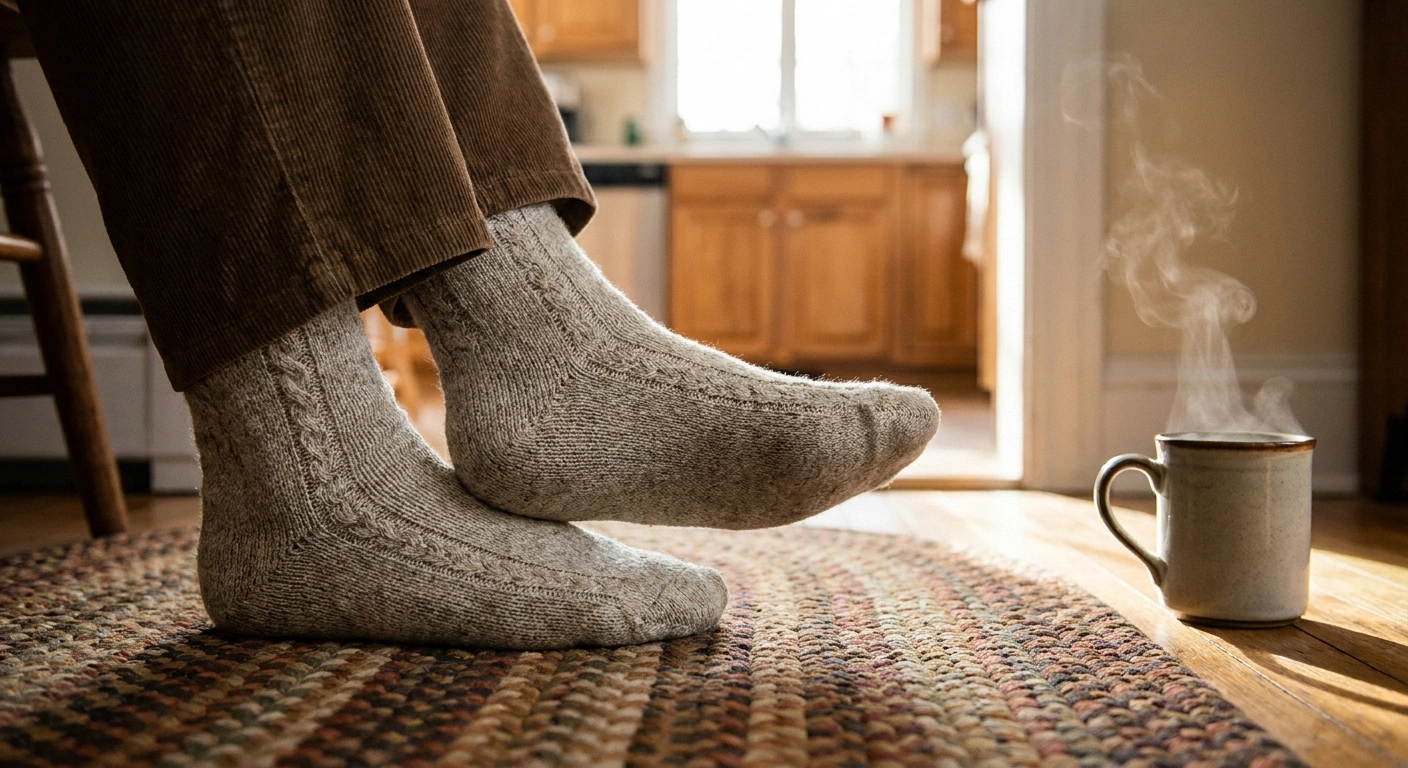
A lot of us end up by the fire because our feet feel icy, and the fire is the most satisfying fix. With neuropathy, though, cold feet are often a nerve signal rather than true coldness. Your feet may be a normal temperature and still feel frozen. I wrote about this in my piece on why neuropathy feet feel cold, and it changes how you warm up.
Gentler options that don’t depend on aiming heat at numb skin:
- Warm wool or thermal socks put on before your feet get cold, not after.
- Moving: ankle circles, toe curls or a few minutes of walking around the house gets blood flowing better than any fire.
- A warm drink and warm layers on your core. When your trunk is warm, your body sends more blood to your hands and feet.
- Warming the room instead of your legs. A fire that heats the whole room from a sensible distance does the job without a hot spot on your shins.
The fire can still be the heart of the evening—I’d never ask you to give that up. It just works best as something you sit near, not something you lean into.
Frequently Asked Questions
Is it safe to sit by a fireplace if I have neuropathy?
Yes, for most people, with some changes. Keep your chair so your outstretched feet are at least three feet from the hearth, angle it so your shins aren’t facing the flames directly, keep your feet off warm stone, and check your legs and feet when you get up. The risk is higher if your shins or hands are numb, if you have diabetes, or if you tend to doze off by the fire.
Can a fireplace burn you without touching it?
Yes. Fireplaces and wood stoves give off radiant heat that warms whatever faces them, including skin a few feet away. With normal feeling you would move before it got too hot, but numb skin cannot warn you, so the shins and tops of the feet can be injured over a long evening.
How hot does the glass on a gas fireplace get?
A children’s hospital burn program reports gas fireplace glass can pass 200 degrees Fahrenheit in about six minutes and takes about 45 minutes on average to cool after the fireplace is turned off. Units made since 2015 for the U.S. market must have a protective screen if the glass gets hotter than 172 degrees, but older units may not have one.
What is toasted skin syndrome from a fireplace?
Toasted skin syndrome, or erythema ab igne, is a lacy, net-like red or brown pattern on the skin caused by repeated heat that is not hot enough to burn in one sitting. It was once common on the shins of people who sat close to open fires. Early patches often fade once the heat stops, but a dermatologist should check any patch that thickens or forms a sore.
How far away from a wood stove should I sit?
Fire safety groups recommend keeping anything that can burn at least three feet from a heat source, and that is a sensible minimum for numb feet too. Mark the spot on the floor so your chair goes back to it, and move further back if your shins feel hot to the back of your hand.
What should I do if I find a burn on my foot after sitting by the fire?
Cool it under cool running water for about 20 minutes, leave any blister intact, and cover it with a clean non-stick dressing. If you have diabetes or poor circulation, call your foot doctor or clinic the same day for any burn that blistered or broke the skin, because burns on numb feet can be deeper than they look and can turn into slow-healing wounds.
Should I let someone else handle the wood stove if my hands are numb?
If your fingertips are numb, it is worth handing off the hot jobs, such as loading logs, opening the stove door and carrying ash. If you do them yourself, use long leather fireplace gloves and tongs every time, never reach into the firebox with bare hands, and check your hands afterward for burns or scrapes you did not feel.
About the Author