
Almost every article you’ll ever read about a nerve drug in development is written because something worked.
This one isn’t. Rozanolixizumab was tested in CIDP, the trial did what it was supposed to do to the immune system, and it left people no better off than placebo. The company moved on. The drug is approved for a different disease and is not coming to CIDP.
I’m writing it up anyway, and not out of thoroughness. Buried in that failed trial is a finding I think matters more to people living with CIDP than most of the good news I’ve covered this year — a number about the placebo group that raises a real question about how long maintenance infusions carry on without being re-tested.
Let’s take it in order.
What Rozanolixizumab Is
Rozanolixizumab, sold as Rystiggo, is a lab-made antibody from UCB. It’s given as an infusion under the skin rather than into a vein, which takes less time and can be done outside a hospital.
It’s approved for generalized myasthenia gravis in people who test positive for certain antibodies. It’s also been studied in immune thrombocytopenia. It is not approved for CIDP anywhere in the world, and after the results below, it isn’t being pursued for it.
Where It Sits Among CIDP Treatments
It helps to know what this drug was competing against, because CIDP has been treated the same way for a very long time.
Immunoglobulin therapy, given into a vein or under the skin, has been the backbone for decades. Steroids are the other mainstay. Plasma exchange gets used when the first two aren’t enough or aren’t tolerated, and it works by physically filtering antibodies out of the blood rather than by adjusting how the body handles them. All three predate any modern understanding of which antibodies are doing the damage.
That’s the gap this generation of drugs was meant to close: targeted therapy instead of broad immune modulation. CIDP shares that ambition with its acute cousin, Guillain-Barre syndrome, where the same shift is underway. So a well-designed trial of a precision antibody in CIDP carried more weight than one drug’s prospects, and its failure landed harder than the size of the study suggests.
Why Blocking FcRn Was Supposed to Work
To see why researchers had good reason to expect success, you need one piece of biology.
Your body treats antibodies — IgG — as valuable. Most proteins that get taken into a cell are broken down and recycled for parts. IgG gets rescued. A receptor called FcRn grabs IgG inside the cell and carries it back out intact, over and over. That salvage operation is why antibodies last around three weeks in your bloodstream instead of a couple of days.
Useful, until the antibodies are attacking you. In CIDP, the working theory is that misdirected antibodies target the myelin insulation on peripheral nerves, or the structures that anchor it. FcRn keeps rescuing those harmful antibodies right along with the useful ones.
Block the receptor and the rescue stops. IgG gets broken down instead of recycled, levels fall, and the theory says the attack should ease. It’s a clean idea, it’s how antibody-driven nerve damage is understood to work, and it had already proven itself in myasthenia gravis.
There’s an elegant footnote here too. Part of how IVIG is thought to help is by flooding the system with so much donor IgG that it saturates FcRn and crowds out the harmful antibodies. If that’s genuinely a mechanism, then blocking the receptor directly should get you to the same place more efficiently — no pooled plasma, no long infusion chairs.
The Trial, and What It Found
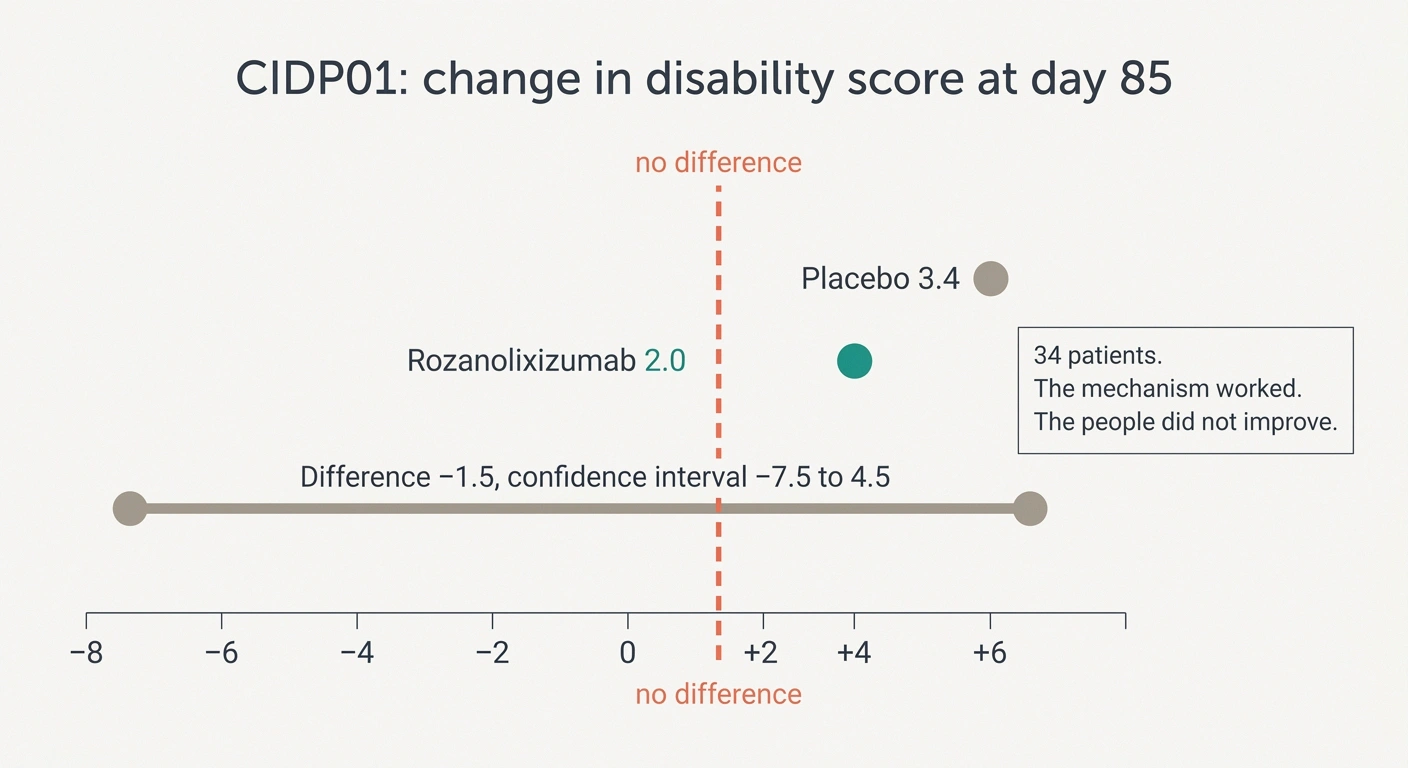
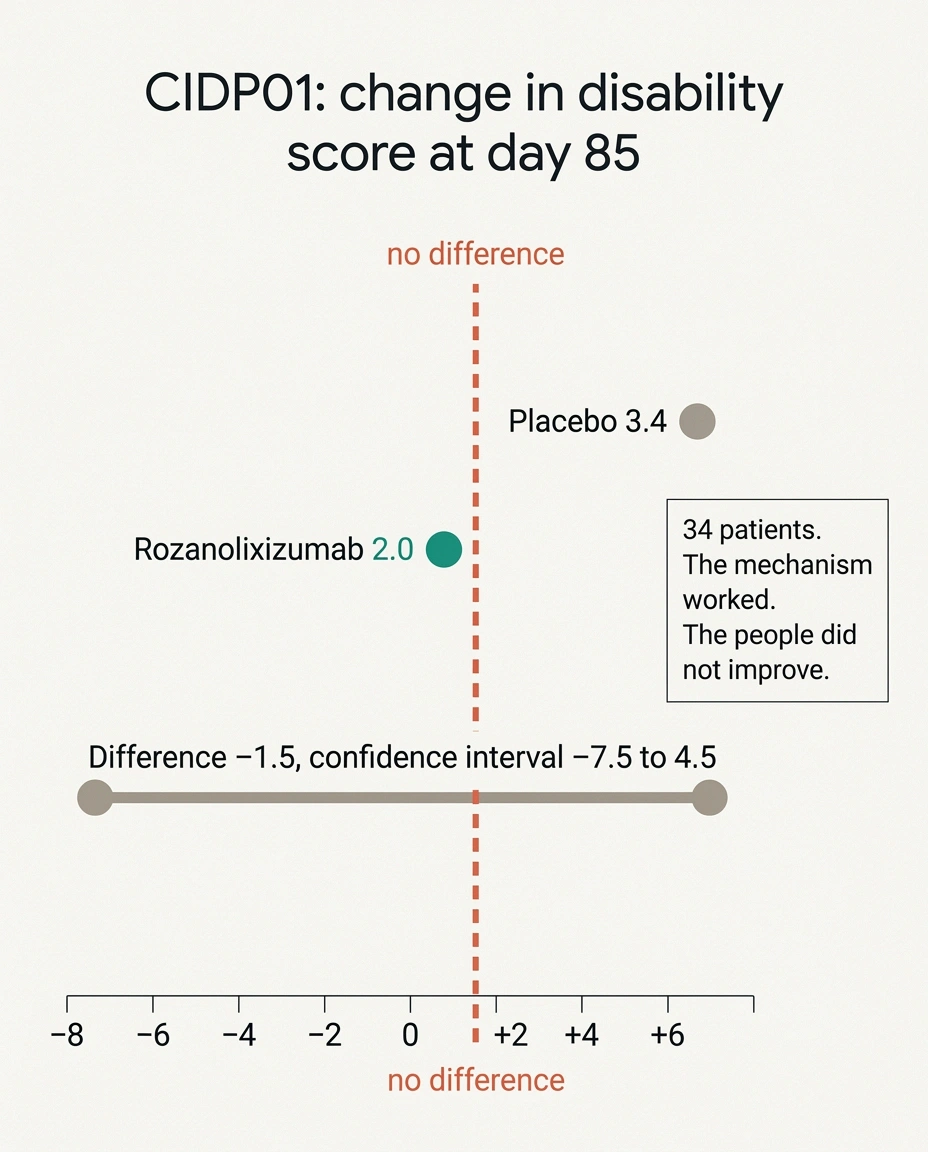
The study was called CIDP01. Thirty-four adults with definite or probable CIDP, all of them already on immunoglobulin maintenance therapy, split evenly into two groups of 17. Twelve weekly subcutaneous infusions of rozanolixizumab at 10 mg/kg, or placebo, across an 11-week treatment period. Both the participants and the investigators were blinded.
The reported difference was 1.5 points in the placebo group’s favour, with an interval running from 7.5 points worse to 4.5 points better. An interval that wide, straddling zero by that much, means the study could not distinguish the drug from nothing in either direction.
Width comes from sample size. With 17 patients per group, only an enormous effect could have produced a narrow interval, and no such effect appeared. This is the difference between “we showed it does not work” and “we could not tell” — and honest reporting of a small trial says the second.
It is why the placebo group’s numerically better score should not be read as the drug making people worse. In a study this size, that gap is comfortably within noise.
The main measure was iRODS, a disability scale built from questions about ordinary life — can you carry a shopping bag, get up from a chair, turn a key. It’s a good choice, because it tracks what people notice rather than what shows up on a nerve conduction study.
Here’s the result, on the change from baseline to day 85:
- Rozanolixizumab: 2.0 (standard error 3.2)
- Placebo: 3.4 (standard error 2.6)
- Difference: −1.5, with a confidence interval running from −7.5 to 4.5
Read that carefully. Both groups’ scores nudged upward over the study, which is ordinary drift rather than a treatment effect. The point is that the drug’s group nudged less. It isn’t just that the drug missed significance: the placebo group did numerically better, and the confidence interval is wide enough to swallow almost any conclusion. This isn’t a near miss that a bigger trial would have rescued. There’s no signal in it.
Meanwhile the drug did its job perfectly. IgG dropped by more than 80%, down to roughly 2 g/L, and stabilised there by about day 36. The mechanism worked exactly as designed. It bought no advantage over placebo.
Tolerability was unremarkable, which is worth noting since it wasn’t the problem: side effects occurred in 82% on the drug and 76% on placebo, close enough to be noise. Headaches came up in six people on rozanolixizumab and five on placebo, mild, clustered around dosing days.
The Extension Study Didn’t Rescue It
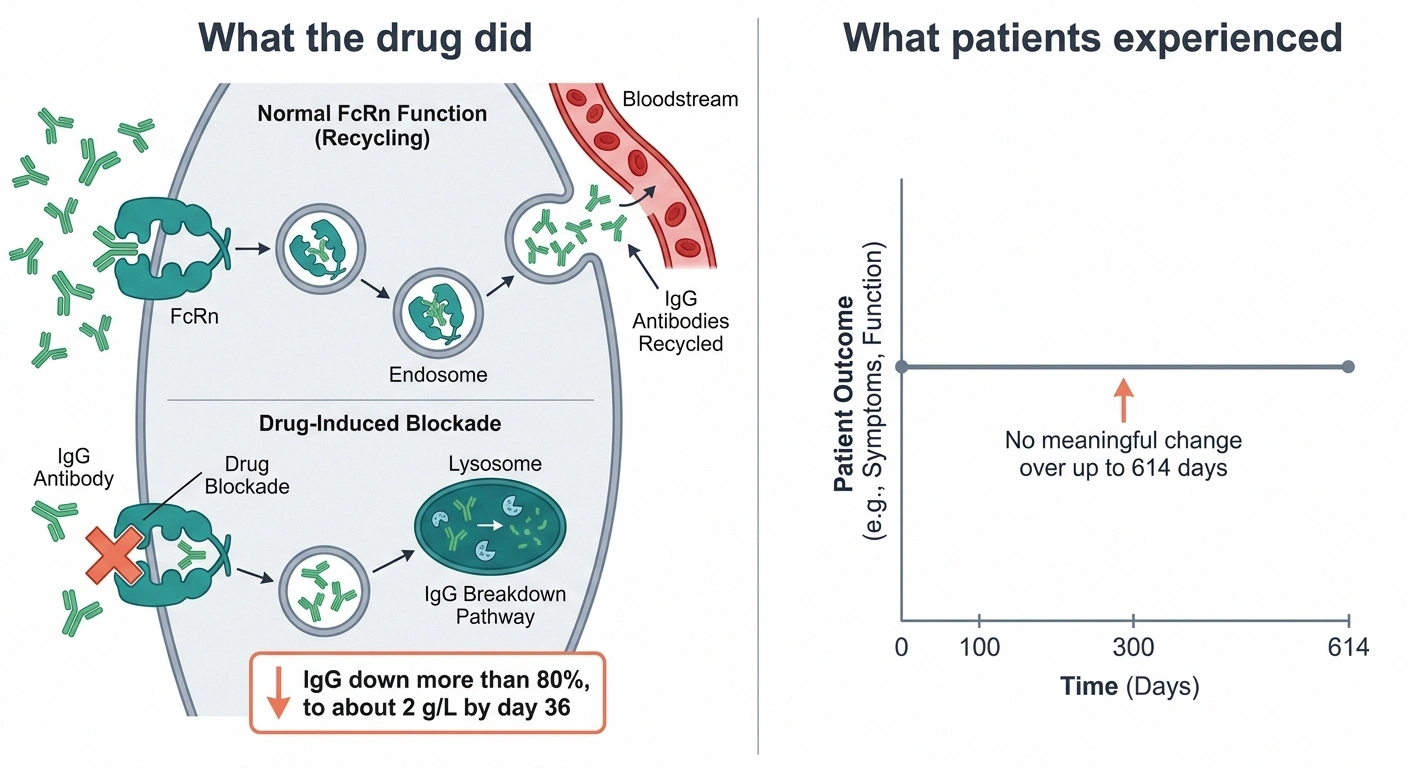
A follow-on open-label study, CIDP04, kept people on the drug for as long as 614 days. Everyone knew what they were taking.
What you can do. iRODS and similar scales ask about ordinary tasks: carrying a bag, standing from a chair, turning a key, washing your hair. This is what CIDP01 used as its main measure, and it is the one that maps onto a life.
How strong you are. Grip dynamometry and manual muscle testing produce a number a clinician records. Objective and reproducible, but a meaningful change in kilograms can still leave daily life unchanged.
What the nerves are doing. Conduction studies measure signal speed and size. They lag behind how you feel in both directions, improving after you already noticed and worsening before you do.
These three regularly disagree, which is worth knowing if your own results have ever seemed to contradict each other. A stable nerve study alongside a worsening ability to open jars is a recognised pattern, not a contradiction.
Over that stretch it stayed tolerable, and it produced no clinically meaningful benefit. Half the patients relapsed on combined assessments.
Extensions like this sometimes turn up a slow effect the shorter trial was too brief to see. This one didn’t. Nearly two years, and nothing.
It’s worth knowing why open-label extensions usually flatter a drug rather than sink it. Everybody knows they’re getting the active treatment, there’s no placebo group to be compared against, and people who stay enrolled for two years tend to be the ones who felt they were doing reasonably well. Every one of those pressures pushes the results in a positive direction.
So when an extension built that way still shows nothing, the finding carries more weight than its lack of a control group would suggest. This wasn’t a signal that needed longer to appear. There wasn’t a signal.
The Finding Hiding Inside the Placebo Group
Now the part I actually wanted to write about.
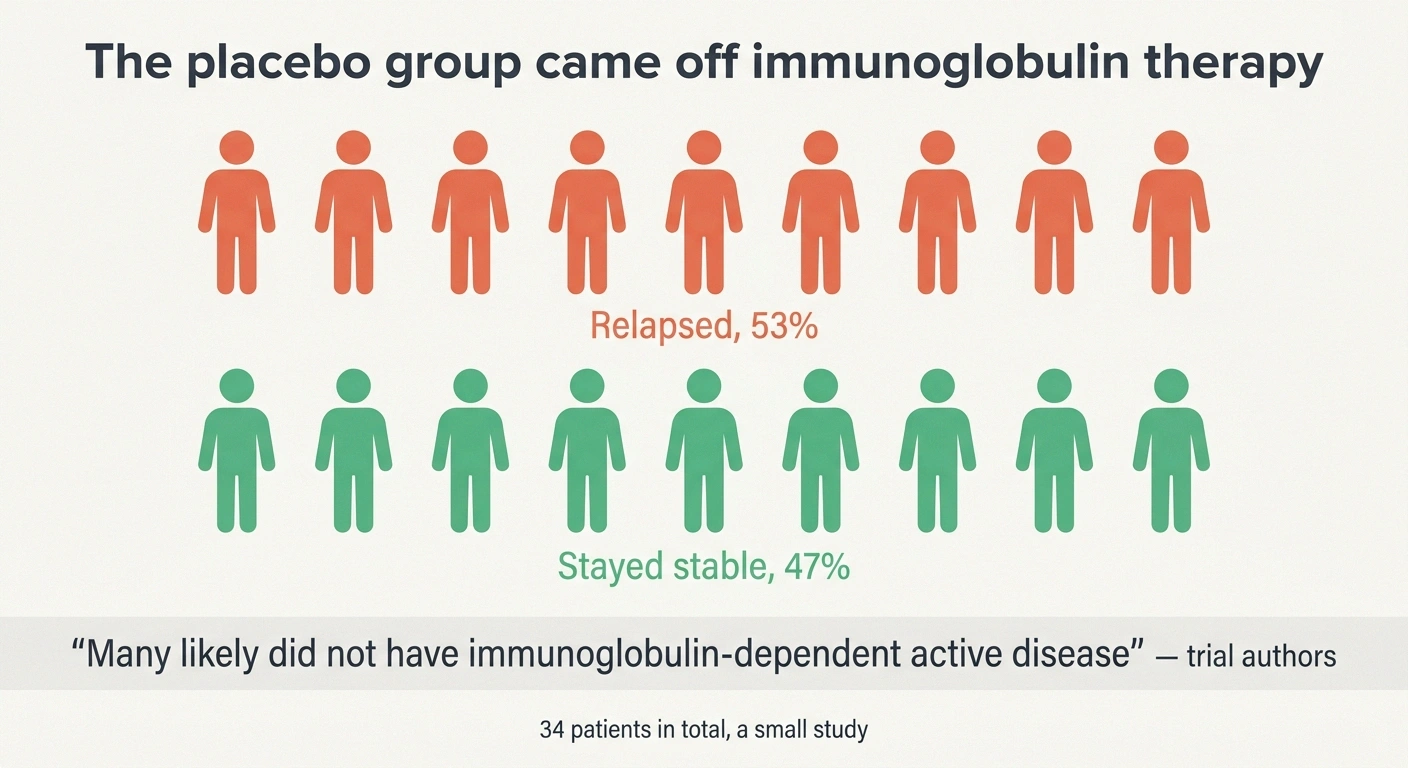
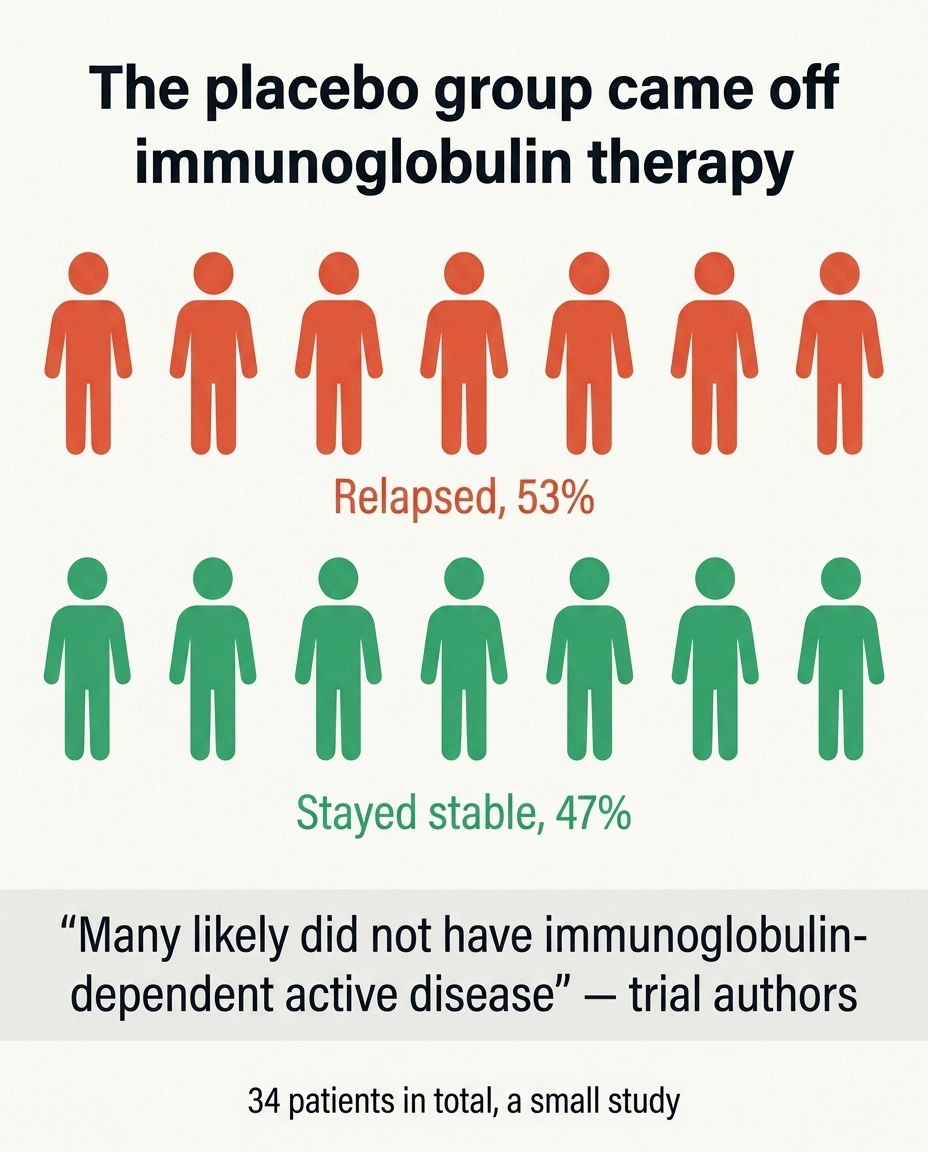
Everyone in this trial had CIDP and was on immunoglobulin maintenance. During the blinded period, that maintenance therapy stopped. So the placebo group was, functionally, a group of CIDP patients taken off their long-term treatment and watched.
They should have deteriorated. That’s what maintenance treatment is for.
Only 53% of them relapsed.
Just over half. Which means that close to half of a group of people carrying a CIDP diagnosis, receiving ongoing immunoglobulin therapy, came off that therapy and stayed stable through the study period.
The authors say so plainly: many of them likely did not have immunoglobulin-treatment-dependent active disease. In ordinary words — a substantial share of the people in that room may not have needed the treatment they were on, at least not at that moment.
I want to be measured about what this does and doesn’t establish. Thirty-four people is a small study. Everyone in it was well enough to be trial-eligible, which skews the picture. And “stable for eleven weeks” is not the same as “would be fine indefinitely,” because CIDP relapses can take months to declare themselves.
But this isn’t an isolated observation. Diagnostic uncertainty in CIDP is a known, documented, repeatedly measured problem, which is exactly why modern trials employ independent expert committees to re-check every diagnosis before anyone enrolls. The condition gets confused with other things, and once the label is on a chart, treatment tends to continue on momentum rather than on evidence that it’s still needed.
If you’ve been on maintenance immunoglobulin for years without a deliberate attempt to find your minimum effective dose, or to test whether you still need it at all, that’s a legitimate thing to raise with your neurologist. Not something to act on alone — stopping abruptly is genuinely risky, and the whole point is that some people in that trial did relapse. But a planned, monitored taper is a normal part of CIDP care, and it’s worth knowing that the last time researchers tried it under observation, nearly half the group held steady.
Why This Doesn’t Mean FcRn Blockers Fail in CIDP
Here’s the strongest evidence that the drug class is fine: another drug in it succeeded.
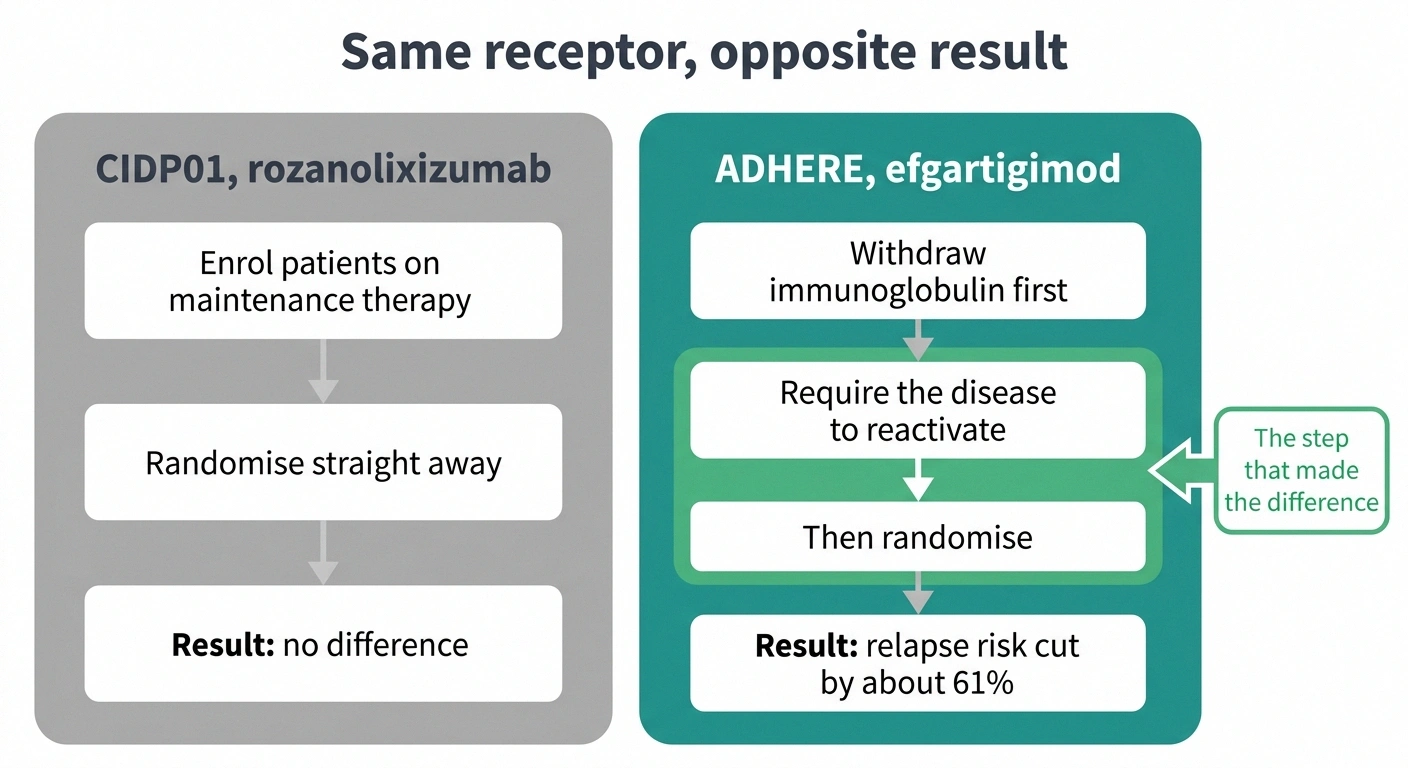
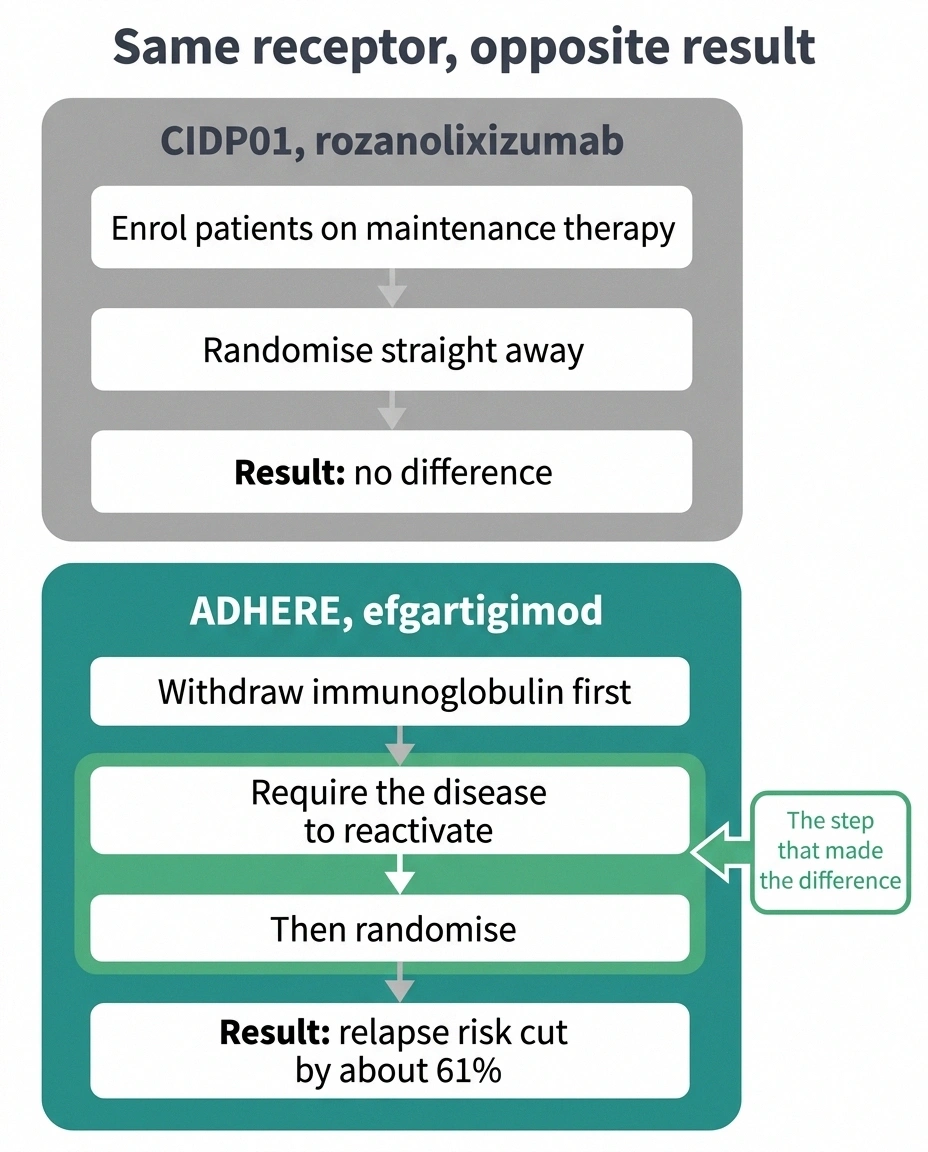
Efgartigimod, sold as Vyvgart Hytrulo, is also an FcRn blocker. It was approved by the FDA for CIDP in 2024 on the strength of the ADHERE trial — the first approval in CIDP beyond immunoglobulin therapy itself. Relapse rates in ADHERE were 26% on drug versus 54% on placebo at week 24, and 34% versus 60% at week 48, working out to roughly a 61% reduction in relapse risk.
Same receptor. Same basic idea. Opposite outcome.
The difference sits in the design, and once you see it the whole thing clicks. ADHERE didn’t enroll people and hope they had active disease. It withdrew their existing treatment first and required them to actually deteriorate — to demonstrate treatment-dependent, active CIDP — before randomizing anyone. Only people whose disease had proven it was live went into the comparison.
CIDP01 skipped that step. It enrolled people on maintenance therapy and randomized them directly, and the 53% figure tells you what that let in. If half your placebo group doesn’t get worse without treatment, there is very little left for a drug to prevent, and a study this size has almost no chance of detecting what remains.
So the honest reading of CIDP01 isn’t “FcRn blockade doesn’t work in CIDP.” It’s closer to “this trial couldn’t have detected it if it did.” That’s a real and useful distinction, and it’s a lesson the field absorbed — the entry criteria for CIDP trials tightened considerably afterward, which you can see across the current pipeline.
The Switching Warning Nobody Put in a Headline

One more finding belongs in this article, because it’s genuinely actionable and it’s absent from every other page on this drug.
1. Will the two treatments overlap, or will there be a gap between my last infusion and the first dose of the new one?
2. How often will I be assessed in the first three months, and by which measures?
3. What specific change means we stop and go back, and who decides?
4. How quickly could I actually restart immunoglobulin if we needed to, including insurance approval time?
5. What is my baseline today, recorded as numbers rather than impressions?
Question four is the one people forget. A clinical decision to restart can be made in minutes; getting the therapy approved and scheduled can take considerably longer, and that delay is part of the risk.
With efgartigimod now approved, some people on long-term IVIG are considering a switch. It’s an appealing idea. A quick subcutaneous injection instead of hours in an infusion chair.
The trouble is that the pivotal trial never studied that switch. ADHERE withdrew immunoglobulin, waited for deterioration, then started the new drug. It did not test going directly from stable IVIG onto an FcRn blocker.
Since approval, clinicians have published case reports of CIDP patients deteriorating early after making exactly that transition. Whether that’s the gap between therapies, dosing timing, or something specific to individual patients isn’t settled. What’s clear is that “swap one for the other” has weaker evidence behind it than the approval headline implies.
If you’re weighing that change, the questions worth asking are concrete ones. Will there be an overlap period, or a gap? How will deterioration be monitored, and on what schedule? What’s the plan to get back on immunoglobulin quickly if things slip? And do you have a documented baseline — grip strength, walking measures, an iRODS score — so that “slipping” is something measurable rather than a debate about how you feel this week?
What This Changes For You

If you have CIDP, three things come out of this trial and none of them involve rozanolixizumab.
Ten-metre walk, timed. Mark a fixed distance indoors and time yourself at a comfortable pace. Same shoes, same time of day, once a fortnight.
Five sit-to-stands, timed. From the same dining chair, arms folded across the chest. Tracks proximal leg strength, which is often where CIDP shows first.
Grip, if you have a dynamometer. Inexpensive ones are adequate for tracking a trend. Three squeezes per hand, record the best.
The one task that matters to you. Buttons, stairs without a rail, carrying shopping from the car. Write down which task and how it went, in one line.
The value is entirely in having numbers from before something changed. Started after a decline begins, this records the decline; started now, it can prove one happened.
An approved FcRn option already exists. Efgartigimod is FDA-approved for CIDP. If your current treatment isn’t holding, or the infusion burden is wearing you down, there’s a real alternative to discuss — and plasma exchange remains on the table too.
Your diagnosis is worth re-checking if treatment isn’t working. CIDP gets confused with other conditions, some of which need entirely different treatment. Autoimmune nodopathies, driven by antibodies against the structures anchoring myelin, look like CIDP but respond poorly to standard therapy and need a different approach. If years of treatment haven’t helped, “maybe it isn’t CIDP” is a serious question, not a defeatist one.
Continuous treatment isn’t automatically the right dose. That 53% figure is the most quietly important number in the paper. Maintenance therapy tends to keep going because it started, and periodically testing whether the dose or interval can come down is standard practice that often gets skipped.
And one broader thing, which is really why I wrote this up. A failed trial isn’t a wasted one. This study produced a piece of information about who is being treated for CIDP that a successful trial would have sailed straight past. The drug went nowhere. The finding shouldn’t.
Frequently Asked Questions
Is rozanolixizumab approved for CIDP?
No. Rozanolixizumab, sold as Rystiggo, is approved for generalized myasthenia gravis in antibody-positive patients. It is not approved for CIDP in any country, and after the phase 2 results it is not being pursued for that indication.
Did rozanolixizumab work for CIDP?
No. In the CIDP01 trial, the change in iRODS disability score from baseline to day 85 was 2.0 on rozanolixizumab and 3.4 on placebo, a difference of −1.5 with a confidence interval from −7.5 to 4.5. The placebo group did numerically better. An open-label extension lasting up to 614 days also showed no clinically meaningful benefit.
Why did the trial fail?
The trial authors point to who was enrolled rather than to the drug itself. Participants were recruited while on immunoglobulin maintenance and randomized without first confirming their disease was still active. During the blinded period only 53% of placebo patients relapsed, which the authors interpret as evidence that many did not have immunoglobulin-dependent active disease. If half the comparison group does not worsen without treatment, there is little left to prevent, and a trial of this size has almost no chance of detecting a benefit.
What is an FcRn blocker?
FcRn is a receptor that rescues IgG antibodies from being broken down inside cells, recycling them back into the bloodstream. That salvage is why antibodies persist for about three weeks. An FcRn blocker prevents the rescue, so IgG is degraded instead and total antibody levels fall. In antibody-driven diseases, that includes the harmful antibodies. Rozanolixizumab reduced IgG by more than 80% in the CIDP trial.
Is rozanolixizumab the same as efgartigimod?
They are different drugs in the same class. Both block FcRn to reduce IgG. Efgartigimod, sold as Vyvgart Hytrulo, is FDA-approved for CIDP based on the ADHERE trial, which reported roughly a 61% reduction in relapse risk. Rozanolixizumab failed its CIDP trial. The most likely explanation is the difference in trial design rather than the molecules themselves.
Can I still get an FcRn blocker for CIDP?
Yes. Efgartigimod is FDA-approved for CIDP and is available by prescription. It is given as a subcutaneous injection rather than a lengthy intravenous infusion, which is one of the practical reasons people ask about it.
Does the 53% placebo figure mean I do not need my IVIG?
It does not mean that, and stopping immunoglobulin therapy on your own is genuinely risky, since about half the placebo group in that trial did relapse. What the figure supports is a conversation about whether your dose and interval are still right, particularly if you have been on the same regimen for years without a review. Planned, monitored dose reduction is a normal part of CIDP care.
Is it safe to switch from IVIG to an FcRn blocker?
That transition was not tested in the trial that led to approval, and case reports describe patients deteriorating early after making it. If a switch is under consideration, the practical questions are whether there will be an overlap or a gap between therapies, how deterioration will be monitored and how often, what the plan is for returning to immunoglobulin quickly, and whether a documented baseline exists so any decline can be measured rather than debated.
About the Author