
A few years into my neuropathy journey, I remember sitting in my doctor’s office staring at a lab report that changed everything. My vitamin B12 levels were low — not dangerously low, but low enough that my doctor said it could be making my tingling and numbness worse. “We can try injections,” she told me, “or we can start with a supplement and see how you respond.”
That conversation kicked off months of research, questions, and honestly, some confusion. If you’ve found yourself wondering whether B12 injections or oral supplements are the right choice for your neuropathy, you’re not alone. It’s one of the most common questions I hear from readers, and the answer isn’t as simple as “one is better than the other.”
So let’s walk through what the research actually says — and more importantly, what it means for those of us living with nerve pain every day.
Why Vitamin B12 Matters So Much for Your Nerves
Before we compare injections and pills, it helps to understand why B12 is such a big deal for nerve health in the first place. Vitamin B12 (also called cobalamin) plays a critical role in maintaining the myelin sheath — that protective coating around your nerve fibers that allows electrical signals to travel properly. Think of myelin like the insulation around electrical wires. When it breaks down, signals misfire, slow down, or stop entirely.
According to a 2020 systematic review published in Nutrients, B12 is thought to help with neuropathic pain through several mechanisms: promoting myelination, increasing nerve regeneration, and decreasing ectopic (abnormal) nerve firing. That review examined 24 published studies and found some evidence supporting B12 for both post-herpetic neuralgia and painful peripheral neuropathy.
B12 is also essential for DNA synthesis and red blood cell production. When your levels drop too low, your nerves don’t get the support they need to function — or to repair themselves. As I’ve covered in my article on vitamin deficiency and neuropathy, a B12 deficiency can actually cause peripheral neuropathy, and the damage may become permanent if it’s not caught early enough.
How B12 Deficiency Leads to Nerve Damage
Here’s what can be scary about B12 deficiency: you might not notice it until the damage has already started. Your body stores B12 in the liver, so a deficiency can take years to develop. By the time you’re feeling tingling, numbness, or burning in your hands and feet, your nerves may have already been affected.
B12 deficiency neuropathy typically starts subtly — a little numbness here, some tingling there — and can progress through the stages of neuropathy if left untreated. The good news? A study published in the Revue Neurologique found that peripheral neuropathy caused by B12 deficiency may recover completely with appropriate treatment, especially when caught early.
But here’s the nuance that matters: while B12 supplementation may stop further damage and improve symptoms, it may not fully reverse nerve degeneration that has already occurred, according to researchers at USC’s Ostrow School of Dentistry. That’s why getting your B12 levels checked sooner rather than later is so important — something I’d encourage you to discuss at your next neuropathy diagnostic workup.
Who’s at Risk for B12 Deficiency?
Not everyone with neuropathy has a B12 problem. But certain groups are more vulnerable than others:
- Older adults — As we age, our bodies become less efficient at absorbing B12 from food. The stomach produces less acid and intrinsic factor, both of which are needed to extract B12 from what we eat.
- Vegetarians and vegans — B12 is found primarily in animal products (meat, fish, eggs, dairy), so those on plant-based diets may not get enough through food alone. This is one reason dietary choices matter so much for people with neuropathy.
- People with digestive conditions — Celiac disease, Crohn’s disease, and other GI conditions can impair B12 absorption in the gut.
- Anyone who’s had gastric surgery — Procedures like gastric bypass can reduce the stomach’s ability to process B12.
- People with pernicious anemia — This autoimmune condition attacks the cells that produce intrinsic factor, making it nearly impossible to absorb B12 through the gut.
- People taking certain medications — Proton pump inhibitors (PPIs) for acid reflux and, notably, metformin for type 2 diabetes can deplete B12 levels over time.
The Metformin Connection: A Hidden Cause of B12 Depletion
This is something that doesn’t get enough attention, and it’s especially relevant for the many people living with diabetic neuropathy. Metformin — one of the most commonly prescribed medications for type 2 diabetes — has been shown to reduce B12 absorption in the gut.

A 2021 review in the World Journal of Diabetes confirmed that long-term metformin therapy is increasingly recognized as a cause of B12 deficiency, potentially resulting in peripheral neuropathy. According to the research, the prevalence of B12 deficiency in people with type 2 diabetes on metformin may exceed 50%.
Here’s why this matters so much: if you’re taking metformin and developing neuropathy symptoms, it can be difficult to tell whether the nerve damage is from diabetes itself, from B12 deficiency caused by your medication, or both. A 2025 study published in Diabetes Research and Clinical Practice using data from the All of Us Research Program found that long-term metformin use is associated with both an increased risk of B12 deficiency and peripheral neuropathy.
The American Diabetes Association now recommends that patients on metformin have their B12 levels monitored annually. If you’re on metformin and haven’t had your B12 checked recently, this is definitely something worth bringing up with your doctor.
If you’re taking metformin, the American Diabetes Association recommends getting your B12 levels checked annually. Ask your doctor to also measure methylmalonic acid (MMA) for a more complete picture — serum B12 alone can miss a functional deficiency.
B12 Injections: How They Work and Who They’re For
B12 injections — typically given intramuscularly (into the muscle) in the arm or thigh — deliver the vitamin directly into your bloodstream, bypassing the digestive system entirely. This is a big advantage for people whose bodies have trouble absorbing B12 through the gut.

A typical injection protocol might look like this:
Your doctor will adjust this schedule based on your specific situation — how severe your deficiency is, what’s causing it, and how you respond to treatment.
B12 injections may be particularly beneficial for:
- People with pernicious anemia or other absorption disorders
- Those with severe B12 deficiency
- Patients who haven’t responded to oral supplements
- People with significant GI issues that limit nutrient absorption
- Anyone experiencing rapid neurological decline who needs levels restored quickly
One study examined by researchers at India’s Indian Journal of Neurosciences noted that intramuscular injection of B12 is often preferred because it has well-defined pharmacokinetics and requires less frequent maintenance dosing compared to daily oral supplementation.
Oral B12 Supplements: More Effective Than You Might Think
Here’s something that surprises a lot of people: for many patients, high-dose oral B12 supplements can be just as effective as injections. This may seem counterintuitive — especially if your doctor has told you that absorption is the problem — but the science behind it is actually well-established.

Even when the normal absorption pathway through the gut is impaired (which relies on intrinsic factor), about 1% of an oral B12 dose can still be absorbed through passive diffusion. That means if you take a high enough dose — say 1,000 to 2,000 mcg daily — you may still absorb enough B12 to make a real difference.
A landmark 2021 randomized, double-blind, placebo-controlled trial published in Nutrients studied 90 patients with type 2 diabetes and neuropathy who were on metformin. Patients received either 1,000 mcg of oral methylcobalamin daily or a placebo for 12 months. The results were encouraging: the B12 group showed significant improvements in nerve conduction velocity, pain scores, quality of life, and even sudomotor (sweat gland) function compared to the placebo group, whose parameters actually worsened.
In a double-blind trial of 90 diabetic patients on metformin, 1,000 mcg daily of oral methylcobalamin produced significant improvements in nerve conduction velocity, pain scores, and quality of life over 12 months — while the placebo group’s parameters actually worsened.
Oral supplementation has some clear practical advantages:
- No needles required — a meaningful consideration for people who dislike injections
- Can be taken at home — no need for doctor’s office visits
- Generally less expensive — especially without insurance coverage
- Available over the counter — accessible without a prescription in most cases
The main limitation? Absorption. Some people simply don’t absorb enough orally, no matter how high the dose. And it may take longer to see results — typically 3 to 6 months of consistent daily use before improvements become noticeable.
Injections vs. Oral: What Does the Research Actually Show?
So here’s the million-dollar question: when you put them head-to-head, which one wins?
The honest answer is: it depends on your situation. The research suggests that both forms can be effective, but they may work better for different people under different circumstances.
The 2020 Nutrients systematic review that examined 24 studies on B12 for neuropathic pain found that both injection-based and oral protocols showed benefits. One study within that review (Xu et al.) compared subcutaneous B12 injections with oral B12 and found that while both groups saw pain reduction, the injections led to significantly greater improvement than oral supplementation.
Another study cited in that same review (Talaei et al., 2009) found that intramuscular B12 was actually more effective at reducing pain than oral nortriptyline — a commonly prescribed neuropathy medication. Both treatments showed significant results, but B12 came out on top.
That said, the Calgary Neuropathy Association puts it well: “Injections are often preferred for severe deficiencies or in cases of malabsorption, while oral forms can be effective in more mild cases.”
Here’s how I think about it as a general guideline (though always check with your doctor):
- ✓ Have a severe B12 deficiency (levels significantly below normal)
- ✓ Have pernicious anemia or another absorption disorder
- ✓ Have tried oral supplements without improvement
- ✓ Are experiencing rapidly worsening neurological symptoms
- ✓ Have had gastric surgery or significant GI disease
- ✓ Have a mild to moderate deficiency
- ✓ Don’t have significant absorption issues
- ✓ Prefer the convenience and lower cost of pills
- ✓ Are using B12 as a preventive or maintenance strategy
- ✓ Can commit to consistent daily supplementation
Methylcobalamin vs. Cyanocobalamin: Which Form of B12 Is Best?
If you’ve started shopping for B12 supplements, you’ve probably noticed there are different forms — and the labels can be confusing. The two most common are methylcobalamin and cyanocobalamin.
Methylcobalamin is the naturally occurring, bioactive form of B12. Your body can use it directly without needing to convert it first. It’s the form most commonly used in neuropathy research and the one most neurologists tend to recommend for nerve-related issues.
Cyanocobalamin is the synthetic form. It’s cheaper to produce and is what you’ll find in most standard multivitamins. Your body has to convert it to methylcobalamin (or adenosylcobalamin) before it can use it.
According to Healthline’s review of the evidence, a review of seven studies found that both methylcobalamin and cyanocobalamin-containing B-complexes were effective in reducing symptoms of diabetic neuropathy. However, most clinical trials specifically studying neuropathy outcomes — including the 2021 randomized controlled trial mentioned earlier — have used methylcobalamin.
For neuropathy specifically, many practitioners lean toward methylcobalamin because of its direct role in nerve function and myelin production. It’s also worth noting that people with certain genetic variations (like MTHFR mutations) may have difficulty converting cyanocobalamin and could benefit more from the methylated form.
If you’re exploring other supplements alongside B12, you might also want to look into alpha-lipoic acid, which research from USC suggests may work synergistically with B12 for nerve health, or acetyl-L-carnitine, another nutrient being studied for its potential nerve-supporting properties. My comprehensive guide to neuropathy supplements covers the full landscape of evidence-informed options.
How Long Does It Take for B12 to Help with Neuropathy?
This is probably the question I get asked the most, and I wish I had a more definitive answer. The truth is, it varies — a lot.
Based on the research I’ve reviewed:
- Some people notice improvement within a few weeks of starting injections, particularly a reduction in pain and burning sensations.
- Neurological improvements typically take 3 to 6 months of consistent treatment to become noticeable, according to Southwest Integrative Medicine.
- Full nerve conduction improvements may take 6 to 12 months, as demonstrated in the 2021 randomized controlled trial where oral methylcobalamin showed significant nerve conduction improvements at the 12-month mark.
- Some nerve damage may be permanent, particularly if the deficiency was severe or went untreated for a long time.
In the 2020 systematic review, one study (Xu et al.) noted statistically significant pain reduction after just 28 days of subcutaneous B12 injections. Another found that after 6 months of methylcobalamin treatment, patients experienced reduced pain and paresthesia along with improved nerve conduction velocities.
The key takeaway? Be patient, be consistent, and work closely with your doctor to monitor your progress. If you’re not seeing improvement after several months, it may be time to discuss adjusting your approach — whether that means switching from oral to injectable, increasing the dose, or exploring additional factors that could be contributing to your neuropathy.
What About Sublingual B12? A Middle Ground?
There’s a third option that sometimes gets overlooked: sublingual B12 — tablets or liquids that dissolve under the tongue. The idea is that B12 is absorbed through the mucous membranes in the mouth, partially bypassing the digestive system.

While there’s less research specifically on sublingual B12 for neuropathy compared to injections or standard oral supplements, some people find it to be a practical middle ground — better absorption potential than swallowing a pill, but without the needles and office visits of injections.
If you’re someone who doesn’t love needles but worries about oral absorption, sublingual methylcobalamin might be worth discussing with your healthcare provider.
Safety and Side Effects: What to Know
One of the reassuring things about B12 is its strong safety profile. Because it’s water-soluble, your body generally excretes any excess through urine rather than building up to toxic levels. The Calgary Neuropathy Association notes that “Vitamin B12 is relatively safe to take as it has a low toxicity.”
That said, a few things to be aware of:
- Injection site reactions — mild pain, redness, or swelling at the injection site are the most common side effects
- Rare allergic reactions — some people may have an allergic response, particularly to certain preservatives in injectable formulations
- GI symptoms — oral supplements can occasionally cause mild nausea or diarrhea
- Drug interactions — B12 can interact with certain medications, including some antibiotics and anti-seizure drugs
It’s also important to understand that taking extra B12 when your levels are already normal is unlikely to provide additional benefit for neuropathy. B12 supplementation appears most helpful when there’s an actual deficiency — or when it’s being used as part of a specific treatment protocol under medical guidance.
Getting Your B12 Levels Tested: What the Numbers Mean
If you’re considering B12 supplementation for neuropathy, the first step should always be getting tested. A simple blood test can measure your serum B12 levels. Here’s a general guide to what the numbers mean:
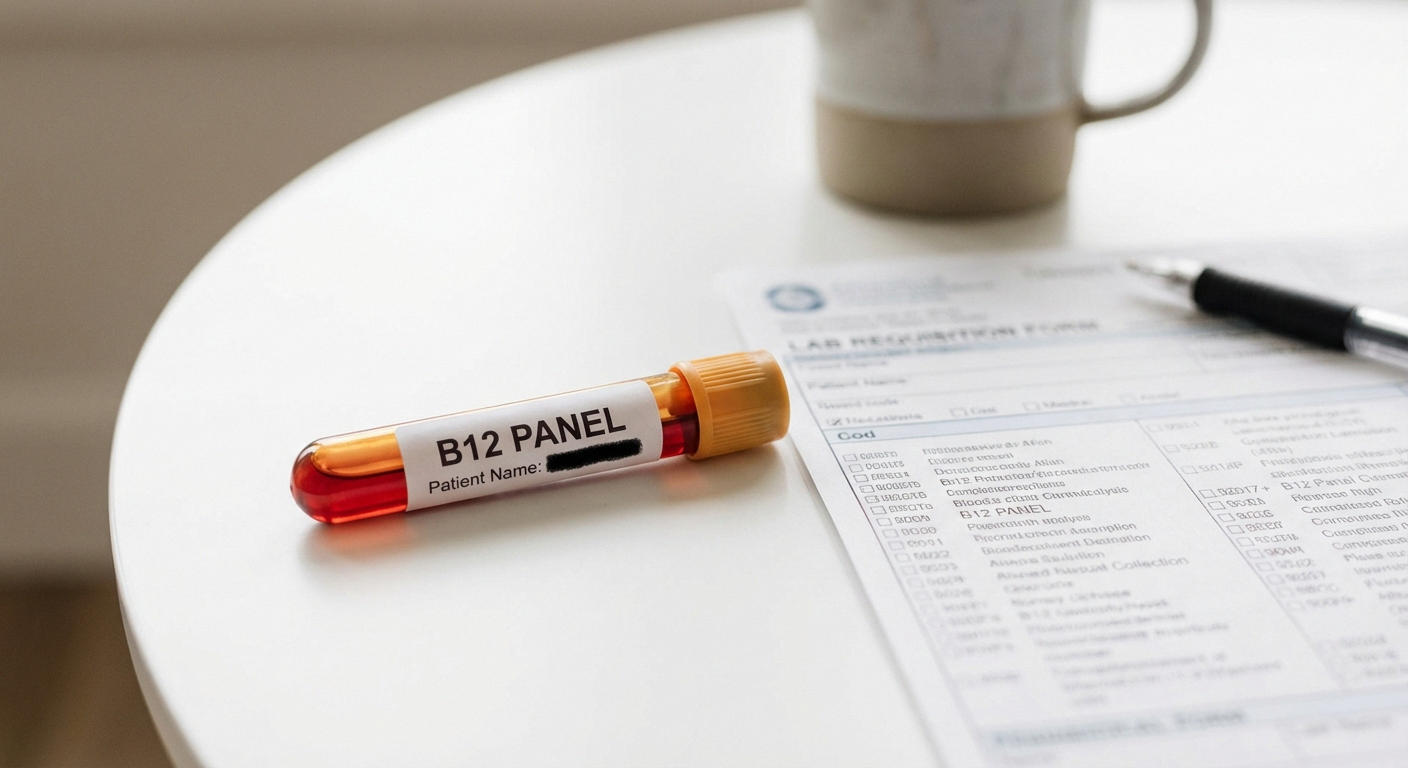
Your doctor may also order additional tests like methylmalonic acid (MMA) or homocysteine levels, which can reveal a functional B12 deficiency even when serum levels appear borderline normal. This is particularly important for people with diabetes — the 2021 randomized trial suggested that for diabetic patients over 60, the cut-off for B12 levels potentially leading to neurological dysfunction should be shifted from 150 to 400 pmol/L.
Frequently Asked Questions
Bringing It All Together
The research on B12 for neuropathy is genuinely encouraging — but it’s not a magic bullet. Whether you end up going with injections, oral supplements, or even sublingual tablets, the most important steps are the same: get your B12 levels tested, work with your doctor to find the right approach for your situation, and be patient with the process.
The most important steps are the same regardless of route: get your B12 levels tested, work with your doctor to find the right approach, and be patient with the process. For many people, B12 is one important piece of a larger neuropathy management puzzle.
For those of us living with neuropathy, every bit of potential relief matters. B12 supplementation — in whichever form your healthcare provider recommends — may be one piece of a larger puzzle that includes managing underlying conditions, making dietary adjustments, and exploring other evidence-informed supplements like alpha-lipoic acid or magnesium.
What I’ve learned after years of navigating this condition is that there’s rarely a single answer. But understanding your options — and knowing the right questions to ask — puts you in a much stronger position to advocate for your own care. And that, more than any supplement, is what makes the biggest difference.
As always, please talk with your healthcare provider before starting or changing any supplement regimen. Everyone’s situation is different, and what works for one person may not be right for another.
About the Author