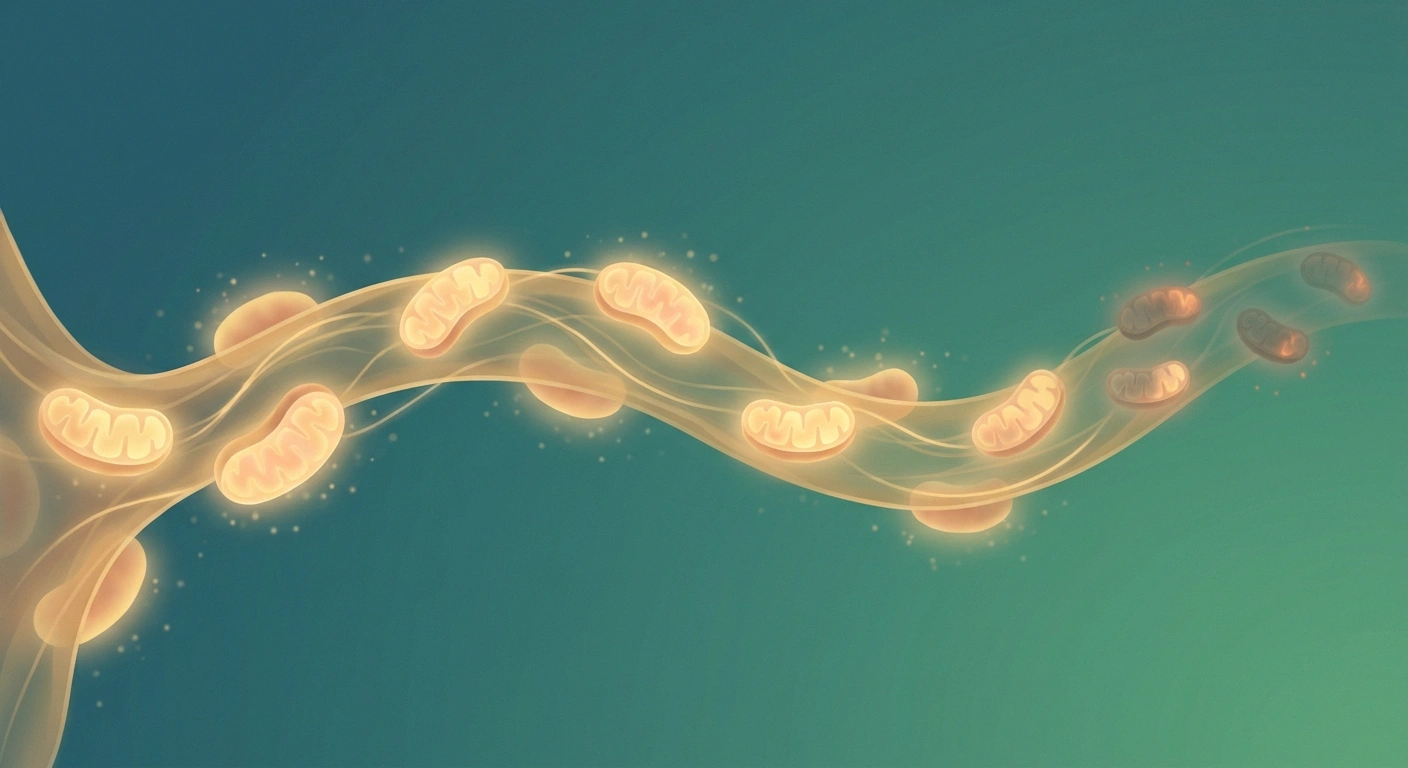
If you've spent any time in neuropathy forums or reading supplement labels, you've probably bumped into a cluster of words that sound like they belong in a biology textbook: mitochondria, oxidative stress, free radicals, cellular energy. They show up everywhere — in the reasoning behind alpha-lipoic acid, in why people talk about CoQ10, in explanations of why diabetes and chemotherapy damage nerves. For a long time I nodded along without really understanding what they meant, and I suspect I'm not alone in that.
So I want to do something here that I genuinely enjoy: take a piece of the science that sounds intimidating and walk through it slowly, in plain language, until it actually makes sense. Because once you understand what mitochondria are and what happens when they fail inside a nerve, a lot of the advice you've been given stops being a list of random recommendations and starts being a connected story. And a story you understand is one you can act on with far more confidence.
This is one of those topics where the “why” is the whole payoff. Stay with me through the mechanism, and the practical part at the end will land much harder.
Mitochondria, in Plain Words
Every cell in your body is a tiny factory, and like any factory it needs power to run. The power comes from microscopic structures inside the cell called mitochondria. You may remember the phrase “the powerhouse of the cell” from a long-ago science class — that's them. Their job is to take the fuel from the food you eat and the oxygen you breathe and convert it into a usable energy currency the cell can spend, called ATP.
Oxidative stress = more free-radical “exhaust” than the cell can clean up
Mitochondria turn food and oxygen into usable energy (ATP). The process makes a little unstable “exhaust.” When it outpaces the cleanup — too much made, or defenses failing — that imbalance is oxidative stress, and it's where nerve damage begins.
The way they do this is a bit like a hydroelectric dam. Inside each mitochondrion is a chain of protein machinery — the electron transport chain — that passes energy along step by step, like water flowing down through turbines, and at the end produces ATP. It's an elegant, efficient process. But like any energy-generating process, it has a byproduct. A small amount of “exhaust” is produced in the form of unstable molecules called reactive oxygen species — what most people loosely call free radicals.
In a healthy cell, this is fine. The cell has antioxidant defenses that mop up that exhaust, and the system stays in balance. Trouble starts when either the exhaust increases or the cleanup falters. That imbalance — too many free radicals for the defenses to handle — is what scientists mean by oxidative stress. Hold onto that phrase; it's the hinge the whole story turns on.
Why Nerves Are Uniquely Vulnerable
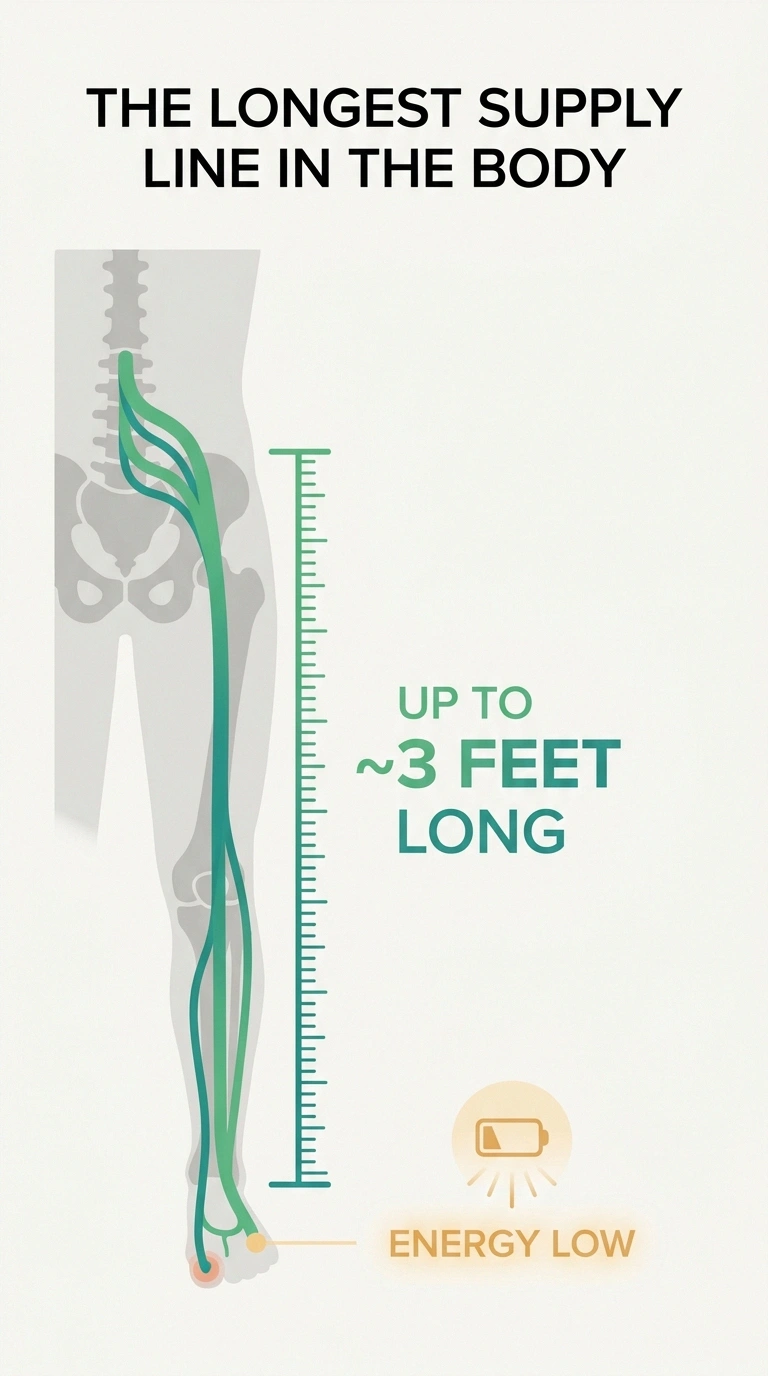
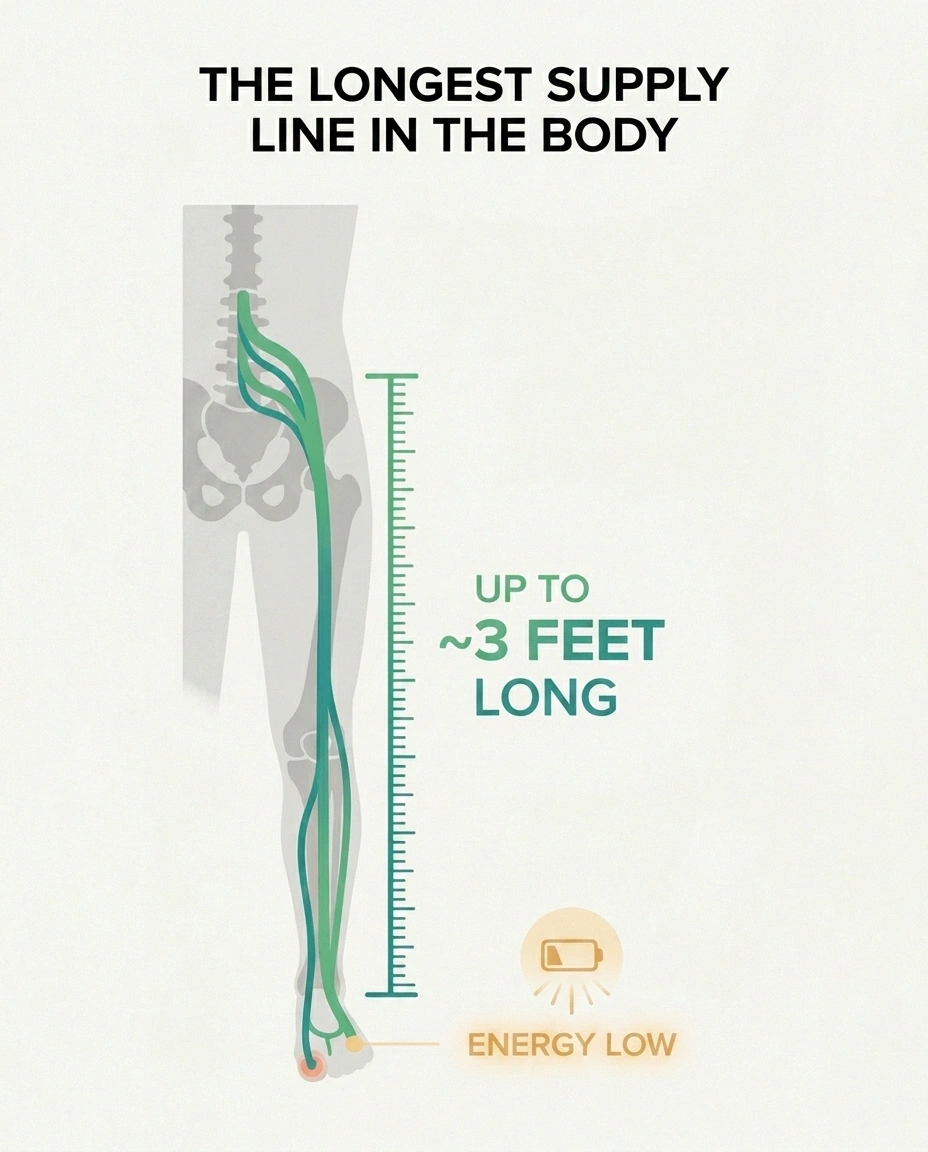
Here's the part that explains something you've probably wondered about: why does neuropathy almost always start in the feet and hands rather than, say, the chest or the face?
The nerve to your big toe can have an axon up to three feet long — the highest energy bill and longest supply line of any cell in your body. When energy production dips even slightly, the cells running on the thinnest margin fail first. That's not random. It's energy economics, and mitochondria are the bank.
Think about the nerve cells that run to your toes. The cell body might sit near your spine, but its axon — the long wire that carries signals — can be three feet long. That is an extraordinary distance for a single cell. Keeping that entire length powered, maintaining the electrical gradients along it, and shipping supplies (including fresh mitochondria) all the way down to the far tip takes a colossal, continuous amount of energy.
Those long nerves are, in effect, the cells with the highest energy bills and the longest supply lines in your whole body. So when energy production falters even a little, the cells that feel it first are the ones running on the thinnest margin — the longest nerves, ending in your feet, then your hands. This is why the classic pattern is “stocking and glove,” starting at the toes and creeping upward. It isn't random. It's an energy-economics story, and mitochondria are the bank. Our overview of the stages of neuropathy describes how that creeping progression tends to unfold over time.
How It Goes Wrong in Diabetic Neuropathy
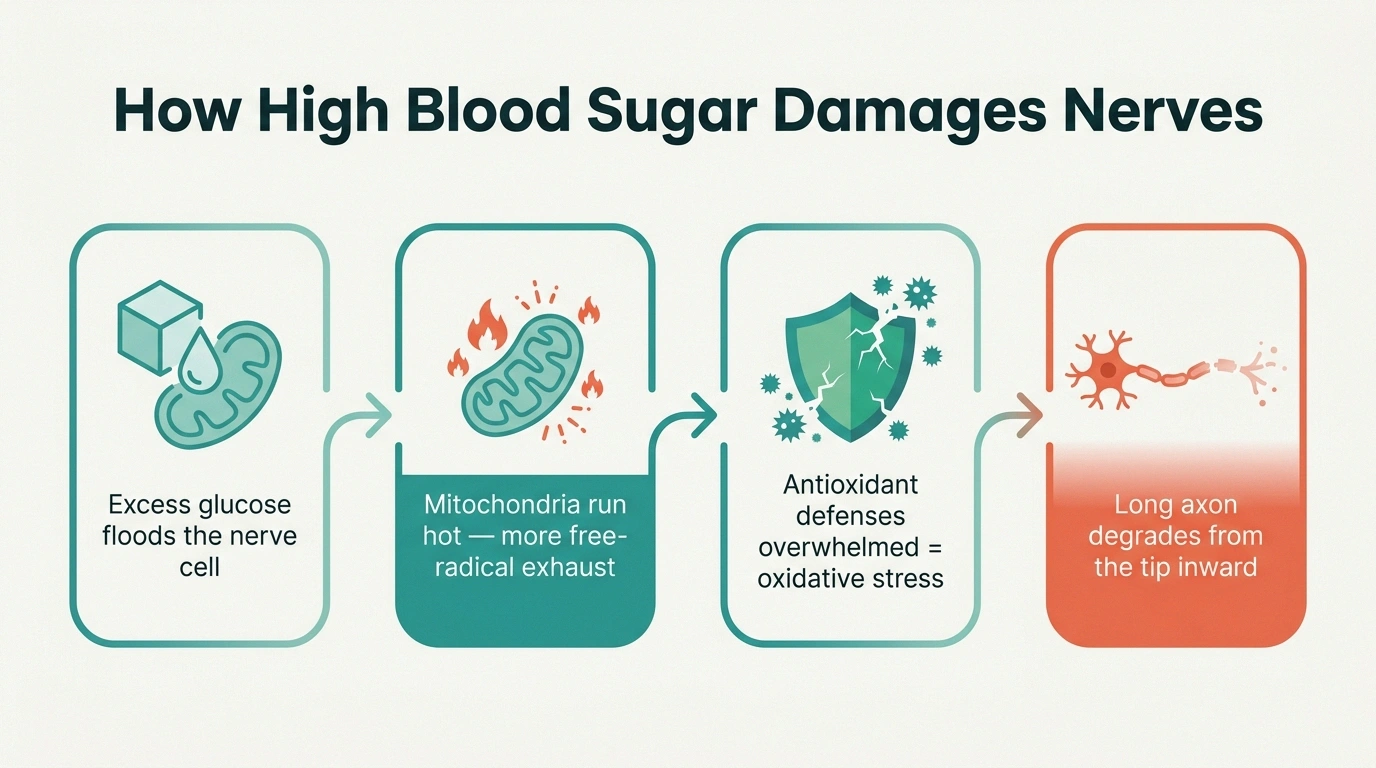
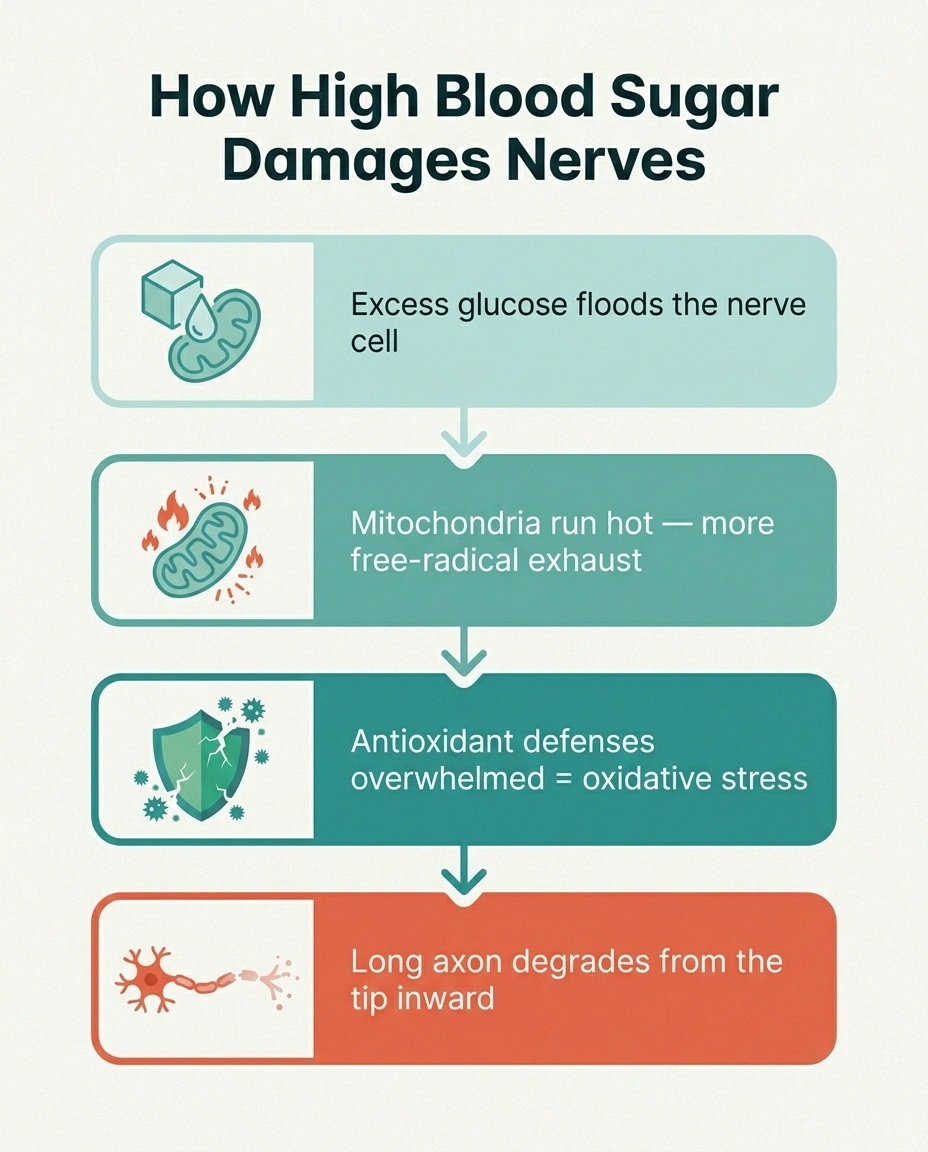
Diabetes is the single most common cause of neuropathy, and the mitochondrial story explains the mechanism beautifully — in a grim sort of way.
The Diabetic Neuropathy Cascade
High blood sugar floods nerve cells with excess glucose.
Mitochondria run hot and spill far more free-radical exhaust; AGEs gum up the machinery.
Antioxidant defenses are overwhelmed — sustained oxidative stress.
The long axon degrades from the far end inward — felt as burning, tingling, numbness.
When blood sugar runs high for long stretches, excess glucose floods into nerve cells. The mitochondria suddenly have far more raw fuel than they were built to handle, and they're forced to run hot. An overloaded electron transport chain doesn't just make more ATP — it spills out far more of that free-radical exhaust. At the same time, high sugar drives the formation of damaging molecules called advanced glycation end-products, or AGEs, which accumulate inside the mitochondria and gum up the very machinery that's supposed to produce energy cleanly.
So now you have a double hit: more exhaust being produced and the machinery itself being damaged so it works less efficiently and produces still more exhaust. The cell's antioxidant defenses get overwhelmed. That's oxidative stress, and sustained oxidative stress slowly degrades the axon — the long wire — from the far end inward. The result, felt in real life, is the burning, tingling, and numbness that those of us who live with diabetic neuropathy know intimately. The abstract phrase “oxidative stress” is, quite literally, what your feet are feeling.
The Housekeeping System That Breaks Down
Healthy cells don't just produce energy; they maintain their equipment, and this part is genuinely interesting.
Mitochondria aren't static. They constantly split apart and merge back together — a process scientists call fission and fusion — which lets the cell shuffle resources around and isolate damaged sections. And when a mitochondrion is too far gone to repair, the cell has a recycling program that digests it and clears it away, with a tongue-twisting name: mitophagy (think “mitochondria” plus “eating”). It's quality control. Damaged power units get flagged, broken down, and replaced.
In neuropathy, this housekeeping system falters. The balance between splitting and merging tips toward excessive fragmentation, and the recycling program slows down so damaged mitochondria pile up instead of being cleared. Now the cell is trying to run on a fleet of broken-down generators it can't retire. Energy output drops further, free-radical exhaust climbs higher, and the cell drifts toward inflammation and, eventually, the death of that nerve fiber. Understanding this is oddly reassuring, because it reframes neuropathy not as a mysterious curse but as a maintenance system under strain — and maintenance systems can sometimes be supported.
It's Not Only Diabetes: Chemo, Alcohol, Statins, and Age
The mitochondrial thread runs through many other causes of nerve damage, which is part of why it's such a useful concept to understand.
Chemo, alcohol, statins, and age all tug the same thread
Platinum chemo damages mitochondrial DNA. Heavy alcohol is a mitochondrial toxin. Statins can lower CoQ10. Aging lowers mitochondrial efficiency. Even “idiopathic” neuropathy may funnel through this same bottleneck.
Several chemotherapy drugs — particularly the platinum-based ones — are directly toxic to the mitochondria inside nerve cells; some bind to and damage the mitochondria's own small set of DNA, while others disrupt the transport that ships mitochondria down those long axons. That mitochondrial damage is now considered one of the leading drivers of chemotherapy-induced neuropathy. Alcohol, in regular heavy amounts, is a mitochondrial toxin too. Statins can lower the body's natural levels of CoQ10, a molecule the electron transport chain needs to function — which is one proposed reason a minority of people develop nerve symptoms on them, something we explore in our piece on statin-associated neuropathy. And ordinary aging gradually reduces mitochondrial efficiency, which helps explain why nerve resilience declines as we get older.
Even when the trigger is never identified — the frustrating category of idiopathic neuropathy — researchers increasingly suspect that mitochondrial dysfunction and oxidative stress are part of the final common pathway, the bottleneck many different causes funnel through on the way to nerve damage.
Oxidative Stress: The Hub Where Everything Meets
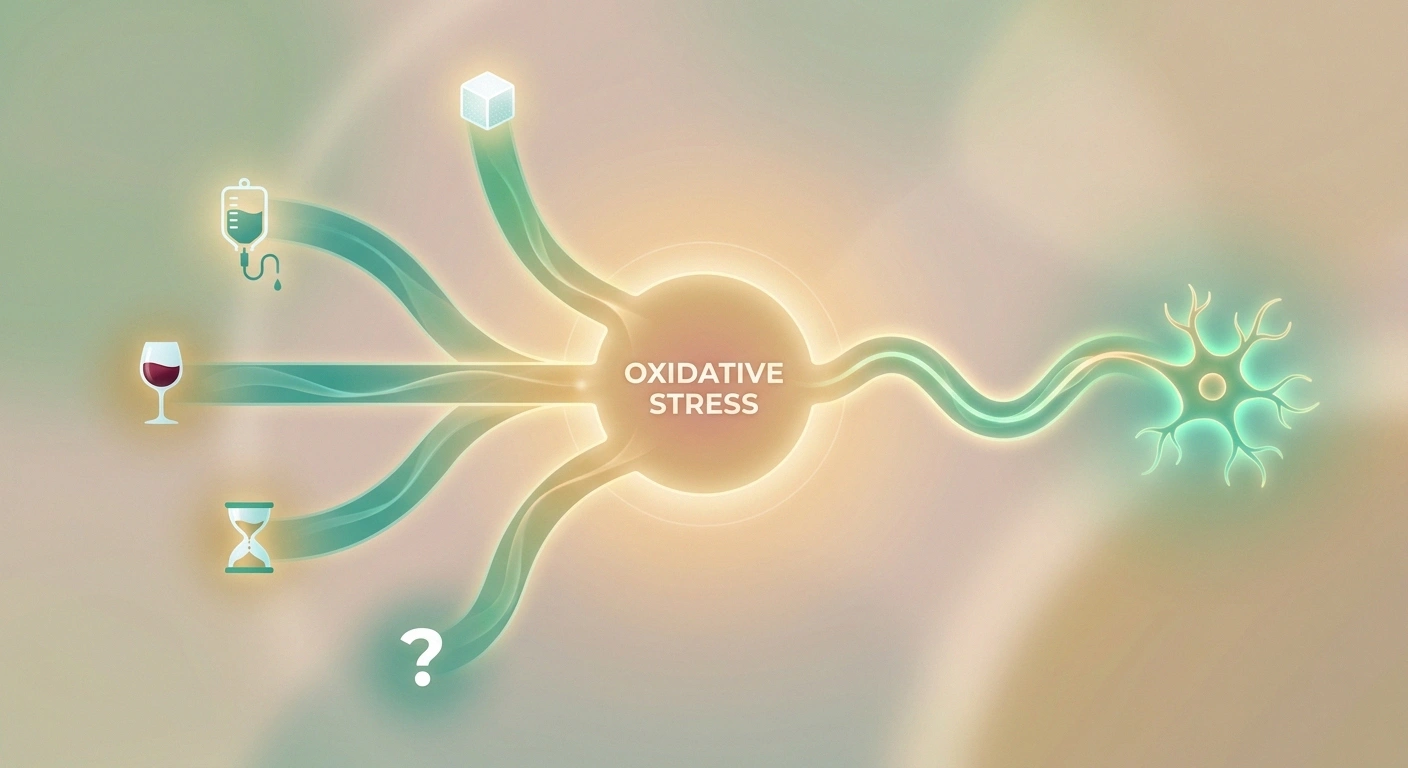
If you take one idea away from this article, make it this. Across all these different causes — high blood sugar, chemotherapy, alcohol, aging, the unknown — researchers keep arriving at the same central hub: oxidative stress driven by failing mitochondria.
Recent reviews describe oxidative stress as the integrating mechanism that ties together metabolic overload, inflammation, mitochondrial failure, and the damage to the tiny blood vessels that feed nerves. Different roads, same intersection. That matters enormously for the practical question, because it means the strategies that protect mitochondria and reduce oxidative stress aren't aimed at one cause of neuropathy — they're aimed at the bottleneck many causes share. That's why the same handful of recommendations keeps coming up regardless of why someone's nerves are struggling.
So What Can I Actually Do About It?

This is the payoff. Now that you understand the mechanism, the common advice stops being a random list and becomes a logical map. Each lever below targets a specific part of the story you just read. I want to be honest about the evidence as I go, because you deserve that.
Each Lever Targets a Piece of the Mechanism
Blood sugar, alcohol — turns down the overload at the source.
Signals the body to build more mitochondria (biogenesis).
ALA, acetyl-L-carnitine, CoQ10, B-vitamins map to specific steps — evidence varies.
No smoking, less alcohol, fewer blood-sugar surges.
Address the Upstream Driver
The most powerful mitochondrial intervention isn't a supplement — it's removing the thing that's overloading the mitochondria in the first place. For diabetic neuropathy, that means working with your medical team on blood sugar control. For alcohol-related damage, it means reducing or stopping alcohol. This is the unglamorous truth: turning down the source of the overload does more for mitochondria than anything you can buy in a bottle.
Exercise: The Closest Thing to a Mitochondria Button
Here's a fact I find genuinely motivating. Aerobic exercise is one of the few things proven to make your body build more mitochondria and improve the efficiency of the ones you have — a process called mitochondrial biogenesis. You are not stuck with the fleet you have. Movement, within the limits your body and your doctor allow, is a direct signal to manufacture new power units. It's free, and mechanistically it targets the exact problem this whole article describes.
The Mitochondria-Targeted Nutrients You Keep Hearing About
Now the supplement names make sense, because each maps to a piece of the mechanism. Alpha-lipoic acid is interesting because it's an antioxidant that works inside the mitochondria themselves and helps regenerate other antioxidants — and it has some of the more substantial human research behind it in diabetic neuropathy. Acetyl-L-carnitine helps shuttle fuel into the mitochondria to be burned for energy and has been studied for nerve pain and repair (with the honest caveat that in at least one prevention setting it appeared unhelpful or harmful — context matters). CoQ10 is literally a working component of the electron transport chain, which is exactly why statin users, who may be depleted of it, are a group of particular interest. And the B vitamins, especially B1 and B12, act as essential cofactors in the energy-production reactions themselves.
You'll notice none of those is described as a cure, and that's deliberate. The honest summary is that these are biologically rational because they target the actual mechanism, the evidence is strongest for alpha-lipoic acid and genuinely mixed for the others, and quality, dose, and your specific situation all matter. None of this replaces medical care or treating the underlying cause. Our overview of neuropathy supplements goes through the evidence for each in more depth, and it's a conversation to have with your doctor or pharmacist, especially because some of these interact with medications.
Stop Pouring Fuel on the Fire
Just as importantly, reducing the inputs that worsen oxidative stress matters as much as adding protective ones. Stopping smoking, moderating or eliminating alcohol, and eating in a way that doesn't subject your mitochondria to repeated blood-sugar surges are all, in mechanistic terms, ways of turning down the exhaust at the source rather than only mopping it up afterward.
An Honest Word About Hope and Limits

I want to be careful here, because this is exactly the kind of topic where overpromising does real harm. Understanding the mitochondrial mechanism does not mean there's a clean fix waiting at the bottom of a supplement bottle. The research is active and genuinely promising — there are scientists working hard on mitochondria-targeted therapies — but as of now, the strongest, most reliable levers are the dull, durable ones: control the underlying cause, move your body, don't poison the system, and use evidence-informed supportive nutrients thoughtfully and with medical input rather than as a substitute for care.
There's no bottle that fixes this — but understanding it is its own protection
The durable levers are the dull ones: control the cause, move your body, don't poison the system, use evidence-informed nutrients thoughtfully with medical input. Knowing how the machinery works lets you tell sensible advice from marketing — clarity nobody can sell you, and nobody can take away.
What understanding the mechanism does give you is something real: it turns scattered advice into a coherent picture, it helps you ask sharper questions, and it lets you tell the difference between a recommendation that's mechanistically sensible and one that's pure marketing. In a field crowded with people selling miracle cures to desperate people, knowing how the machinery actually works is one of the best forms of protection you have. That clarity, honestly, is its own kind of relief — and it's one nobody can take away from you.
Frequently Asked Questions
What do mitochondria have to do with neuropathy?
Mitochondria are the structures inside cells that produce energy. Nerve cells, especially the very long ones running to the feet and hands, have enormous energy demands. When mitochondria fail, those long nerves are the first to run short of power, and the failing mitochondria also produce excess free radicals that cause oxidative stress and gradually damage the nerve. Mitochondrial dysfunction and oxidative stress are now considered a shared mechanism in many types of neuropathy.
Why does neuropathy start in the feet?
The nerves reaching your toes have axons up to about three feet long and some of the highest, most continuous energy demands in the body, with the longest internal supply lines. When energy production drops even slightly, the cells running on the thinnest margin — the longest nerves, ending in the feet, then the hands — are affected first. This is why the classic pattern is a “stocking and glove” distribution that starts at the toes and creeps upward.
Can mitochondrial dysfunction in neuropathy be reversed?
It depends heavily on the cause and how advanced the nerve damage is. Removing the upstream driver — improving blood sugar control, stopping alcohol, addressing a toxic exposure — can reduce the ongoing mitochondrial strain, and the body can build new mitochondria through exercise. Established axon loss is harder to undo. The realistic goal for most people is to reduce ongoing damage and support the system rather than expecting a full reversal, and any plan should be guided by a clinician.
Do antioxidants like alpha-lipoic acid actually help nerves?
Alpha-lipoic acid is mechanistically rational because it is an antioxidant that works inside mitochondria and helps regenerate other antioxidants, and it has some of the more substantial human research among supplements for diabetic neuropathy. The evidence for other mitochondria-targeted nutrients is more mixed. None is a cure or a replacement for treating the underlying cause, and because some interact with medications, they should be discussed with a doctor or pharmacist.
Does exercise help mitochondria in neuropathy?
Yes, mechanistically this is one of the most compelling levers. Aerobic exercise stimulates the body to build more mitochondria and improve the efficiency of existing ones, a process called mitochondrial biogenesis. It directly targets the energy-shortage problem at the heart of the mitochondrial story. It should be done within the limits your body and healthcare provider advise, especially if you have balance issues or foot risks from neuropathy.
Can statins cause neuropathy through mitochondria?
Statins can lower the body's levels of CoQ10, a molecule the mitochondrial electron transport chain needs to function. This is one proposed mechanism for why a minority of people develop nerve symptoms while taking them. The overall relationship is debated and statins have important cardiovascular benefits, so anyone concerned should discuss it with their prescriber rather than stopping a statin on their own.
Is mitochondrial dysfunction the cause of all neuropathy?
Not the single original cause, but it appears to be a common final pathway. Many different triggers — high blood sugar, chemotherapy, alcohol, aging, and often even unidentified causes — seem to converge on mitochondrial dysfunction and oxidative stress as the bottleneck through which nerve damage actually happens. That convergence is why similar protective strategies are recommended across very different types of neuropathy.
What is oxidative stress in simple terms?
Producing energy creates a small amount of unstable “exhaust” molecules called free radicals, or reactive oxygen species. Normally the cell's antioxidant defenses neutralize them and the system stays balanced. Oxidative stress is what happens when there are more free radicals than the defenses can handle — either because too many are being made or because cleanup is failing. Sustained oxidative stress gradually damages nerve fibers, which is the core of the mitochondrial neuropathy story.
About the Author