There's a conversation that doesn't happen often enough in neuropathy clinics, and I want to start it here. If you have nerve damage — especially from diabetes — and you've noticed that your bladder isn't behaving like it used to, that's not just aging. It's almost certainly part of the same condition that's affecting your feet. And there's a real treatment path that most people don't know exists.
I've heard the same set of symptoms described a hundred different ways in support groups: “I just don't feel the urge anymore.” “My stream isn't what it was.” “I'm getting up four times a night.” “I keep getting bladder infections and my doctor just keeps prescribing antibiotics.” “I have these little accidents I'm too embarrassed to mention.” All of those phrases can be pointing at the same underlying problem — and most of the time, nobody has named it.
The medical name is neurogenic bladder. The specific form caused by diabetes is sometimes called diabetic cystopathy. It's incredibly common, it's underdiagnosed, and the longer it goes unrecognized the more it costs you in quality of life and kidney health. Let's walk through what's actually happening and what to do about it.
How Your Nerves Run Your Bladder (And Why That Matters)
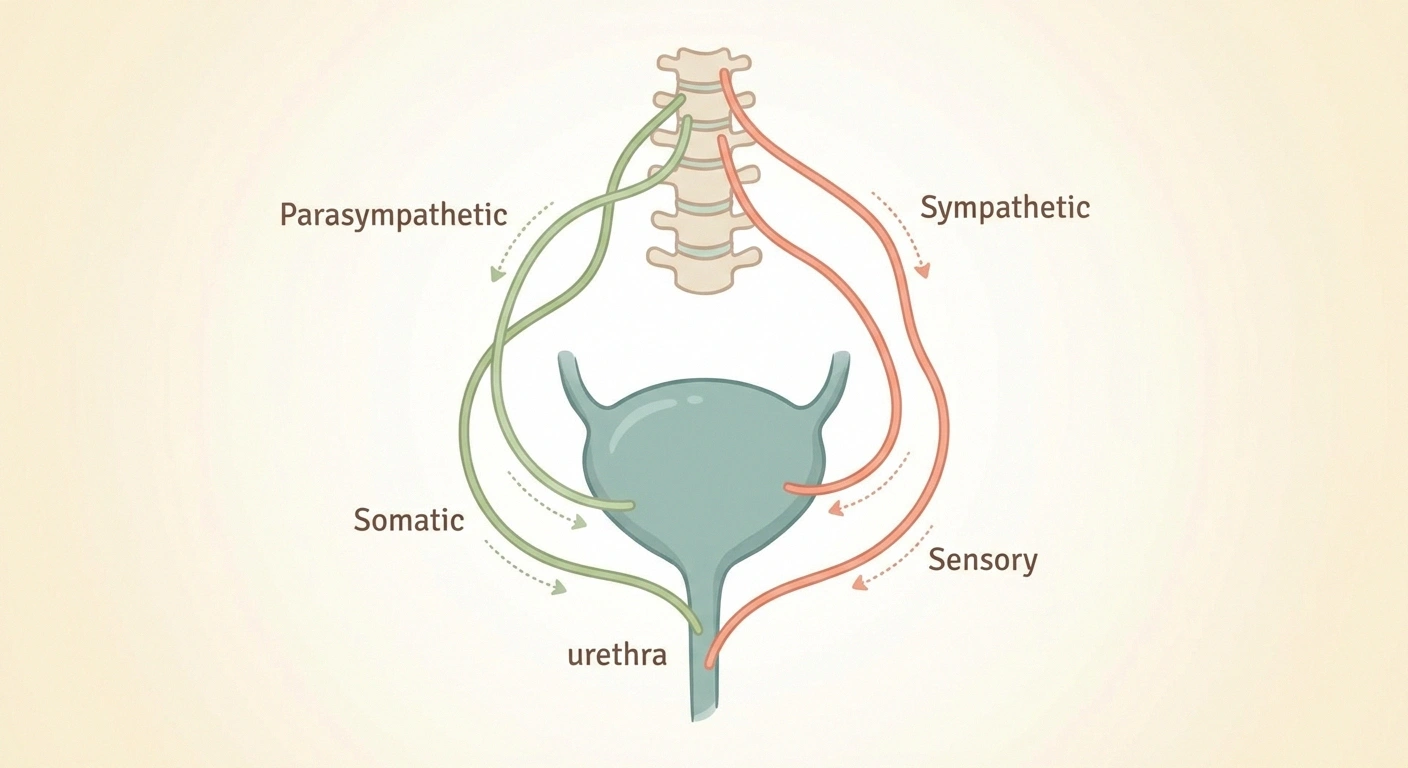
Your bladder seems like a simple organ, but it depends on a sophisticated nerve network that has to do four things in perfect coordination:
Your bladder needs four different nerve systems working together to fill, hold, and empty correctly. Neuropathy can damage any of them. When it does, the symptoms often get dismissed as aging — but they aren't, and they have real treatments.
- Sense when it's filling. Sensory nerves in the bladder wall pick up stretch as urine accumulates and tell your brain, “we're getting full.”
- Stay relaxed during filling. Sympathetic nerves keep the bladder muscle (the detrusor) quiet and the internal sphincter closed while you're holding it.
- Contract on command. When you decide to urinate, parasympathetic nerves trigger the bladder muscle to squeeze.
- Open the exit door. The pudendal nerve relaxes the external sphincter so the urine can leave.
This requires sensory nerves, sympathetic motor nerves, parasympathetic motor nerves, and somatic motor nerves all working correctly. Neuropathy can damage any of these. When it does, the bladder stops doing its job in predictable ways.
How Common Is This?
Bladder dysfunction from autonomic neuropathy affects up to 43 to 87 percent of patients with type 1 diabetes and roughly 25 percent of patients with type 2 diabetes who have autonomic neuropathy. Those are not small numbers. Yet I'd estimate fewer than half of those patients have ever heard the term “neurogenic bladder” from a doctor, because the symptoms develop so slowly that most people assume it's just aging or, in men, blame it on the prostate.
Diabetes is the most common cause, but it's not the only one. Multiple sclerosis, spinal cord injury, Parkinson's disease, stroke, B12 deficiency, alcoholic neuropathy, CIDP, and Guillain-Barré can all cause neurogenic bladder. If you have neuropathy from any cause, bladder symptoms deserve a closer look — they're not coincidence.
The Three Phases of Diabetic Bladder
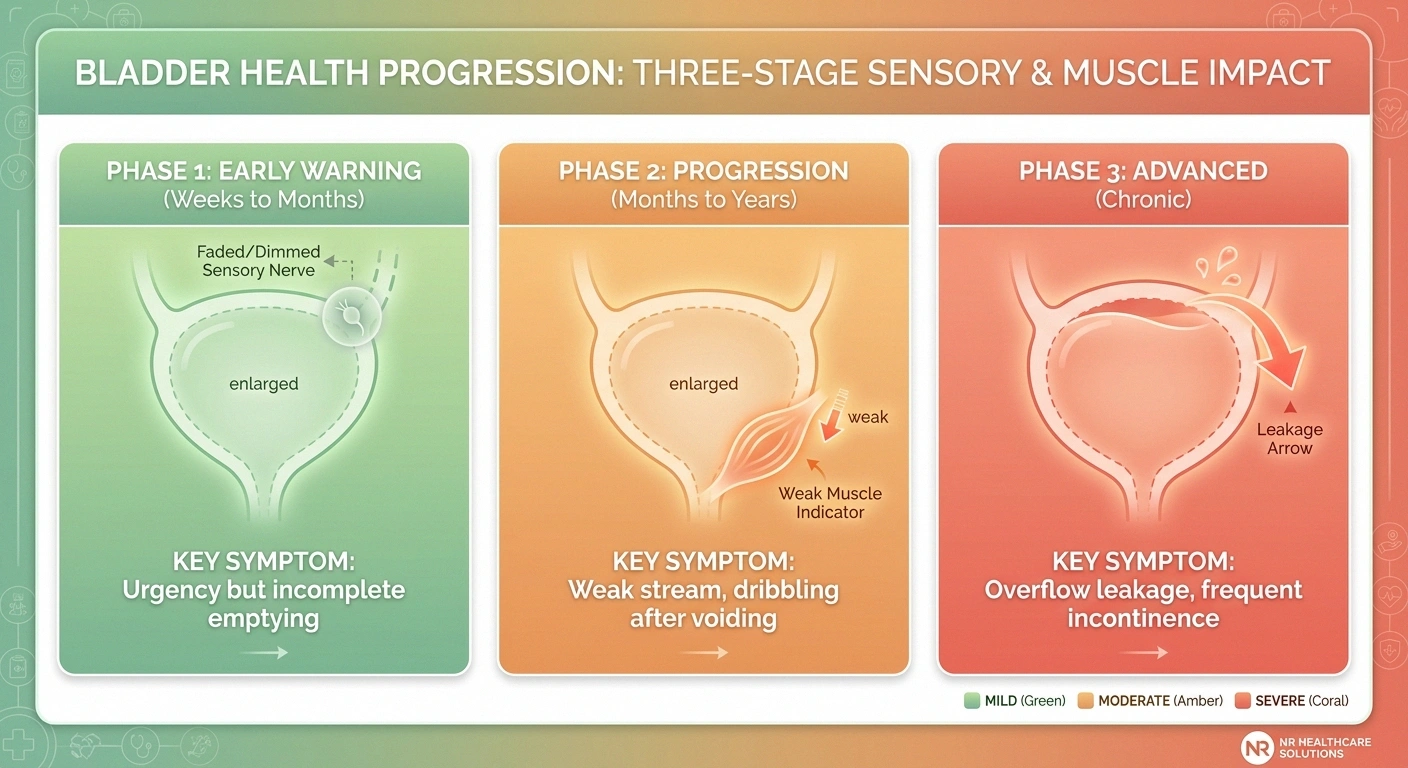
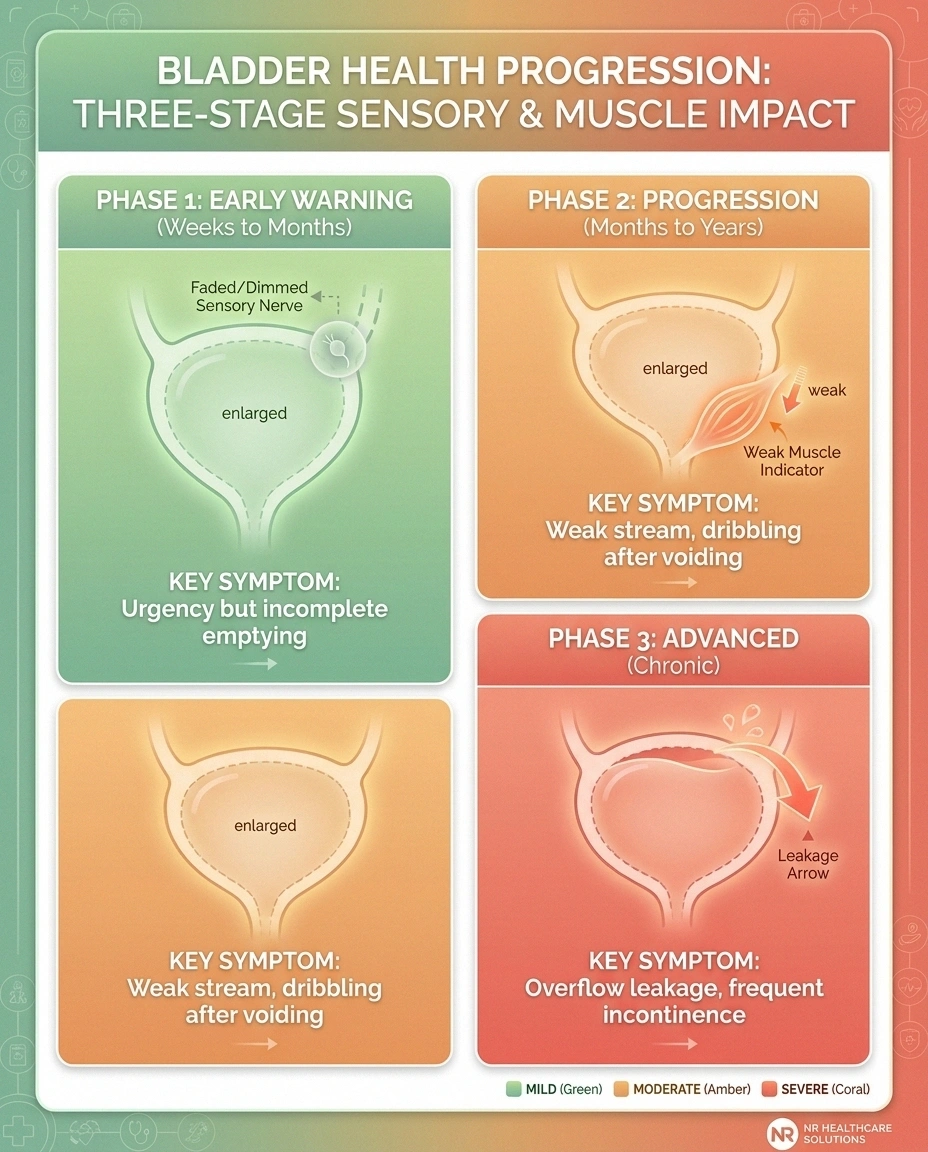
This condition typically progresses through three stages. Recognizing which one you're in helps frame both the urgency and the treatment options.
Phase 1: The Bladder You Can't Feel
This is the earliest sign, and almost nobody catches it. The sensory nerves that signal “I'm filling up” are damaged first. The result: people stop feeling the urge until the bladder is much fuller than it should be.
You might notice that you're going to the bathroom less often than your friends — maybe 2 or 3 times a day instead of 5 to 7. Your bladder is stretching to hold more urine because you don't get the early-warning signal anymore. The capacity that used to be 400 milliliters has stretched to 700, 800, sometimes over 1000 milliliters. Patients often think this is a good thing — “I have a big bladder!” — when really it's the opposite. A bladder that holds too much for too long becomes a bladder that doesn't empty well.
Phase 2: The Lazy Bladder
After years of holding too much urine, the bladder muscle (the detrusor) stretches like an old rubber band and loses its squeeze strength. Now even when you do urinate, you don't empty completely.
The symptoms in this phase are the ones most people eventually notice:
- Weak or slow stream
- Hesitancy — you stand there waiting for it to start
- Straining or pushing to urinate
- Stop-and-start flow
- Feeling like you're not empty when you walk away
- Going back to the bathroom 5 minutes later because you weren't done
- Getting up multiple times at night
In men, these symptoms get blamed on the prostate. Sometimes the prostate is genuinely contributing. But in a man with diabetes and neuropathy, the bladder muscle weakness is usually the bigger driver, and treating the prostate alone won't fix it.
Phase 3: Overflow Incontinence
The end stage. The bladder is so full and so weak that urine leaks out under pressure — like a glass that overflows when you keep pouring water in. It's not “urgency” leaking; it's “overflow” leaking. The bladder never gets a chance to empty properly, so it just spills.
This phase carries serious complications. Stagnant urine breeds bacteria, so urinary tract infections become recurrent. The back-pressure from a chronically full bladder can damage the kidneys (a condition called hydronephrosis). And the constant leakage destroys quality of life and confidence.
Symptoms Most People Don't Connect to Their Neuropathy
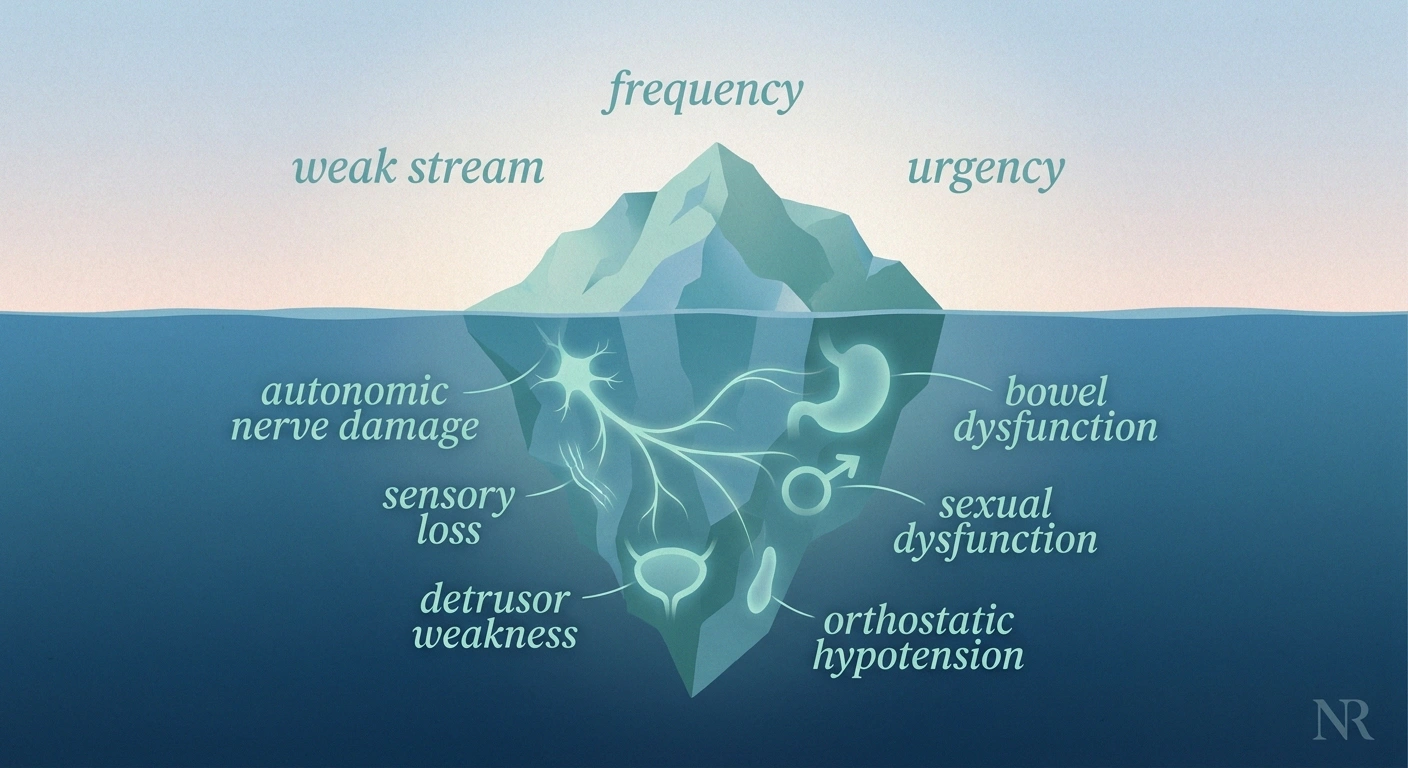
Beyond the obvious bladder symptoms, neurogenic bladder often comes packaged with other autonomic problems. If you have several of these together, it points strongly toward autonomic neuropathy:
- Going to the bathroom less often than peers
- Trouble starting the stream, even when the bladder feels full
- Weak or interrupted flow
- Sense of incomplete emptying
- Frequent nighttime urination (nocturia)
- More than 2 UTIs per year
- Sudden urgency followed by leakage
- New-onset bedwetting as an adult
- Constipation that's gotten progressively worse
- Erectile dysfunction or vaginal dryness
- Dizziness when standing (orthostatic hypotension)
- Sweating changes — too much in some areas, too little in others
The bladder, the bowels, the sex organs, and blood pressure regulation all share the same autonomic nervous system wiring. When that wiring fails in one place, it usually fails in others too.
How Doctors Make the Diagnosis

If you bring these symptoms to a doctor, here's what the workup should look like. If your visit ends with just an antibiotic prescription and no investigation, push back politely and ask for these tests.
Post-void residual is the single most actionable in-office test. Normal is under 50 milliliters. Over 100 is concerning. Over 200 is diagnostic of significant bladder dysfunction. It takes 2 minutes with an ultrasound scanner and changes how your doctor manages your symptoms. If your doctor doesn't measure it, ask why.
Bladder diary. This is the single most useful self-report tool. For 3 days, you log every time you urinate, how much (a simple measuring container helps), how much fluid you drink, and any leaks. The pattern this reveals is often diagnostic on its own.
Post-void residual (PVR). An ultrasound or in-office bladder scanner measures how much urine is left in your bladder right after you urinate. A normal result is under 50 milliliters. Over 100 is concerning. Over 200 is diagnostic of significant bladder dysfunction. This test takes 2 minutes and changes management.
Urinalysis and urine culture. To rule out an active infection that could be mimicking or worsening symptoms.
Renal ultrasound. If your post-void residual is high, your kidneys need to be checked for back-pressure damage. This is non-optional.
Urodynamic testing. The gold standard. A catheter measures pressure and flow during filling and voiding. It tells your urologist exactly which part of the bladder system is failing and guides treatment specifically.
Blood work. A1C to assess diabetes control, B12 level to rule out reversible cause, kidney function tests.
How It's Treated
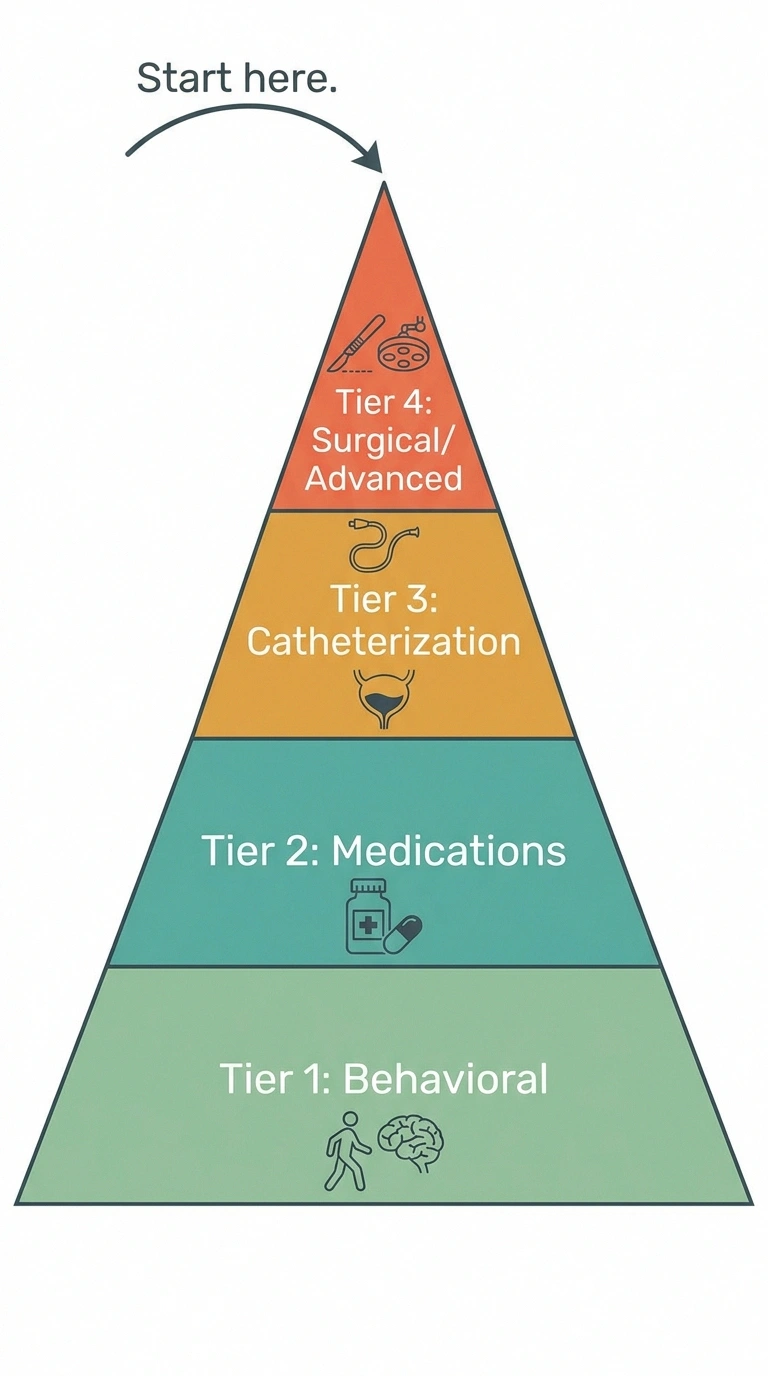
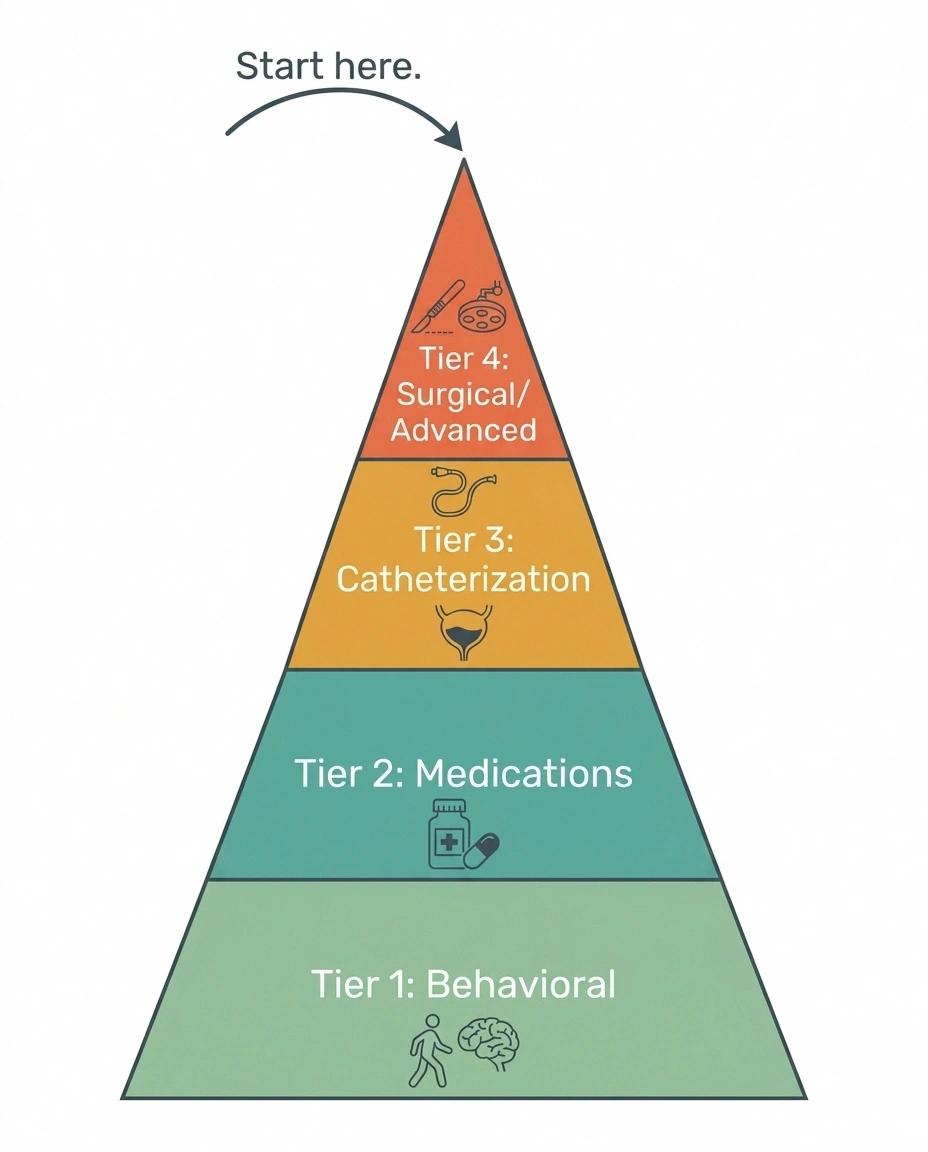
Treatment is tiered, starting with the simplest and progressing as needed. Most patients can get significant improvement from the first two tiers without ever needing surgery or catheterization.
Tier 1: Behavioral and Lifestyle
Timed voiding. Set a watch alarm and urinate every 3 to 4 hours by the clock, whether or not you feel the urge. The whole point is that you can't trust the urge signal anymore — so you take over with the clock.
Double voiding. After you finish urinating, wait 30 seconds, then try again. Often a second wave will produce another significant volume. This single habit dramatically reduces post-void residual.
Pelvic floor physical therapy. A trained pelvic floor PT can teach you which muscles to engage and which to relax during voiding. Many neurogenic bladder patients are unconsciously tightening when they should be relaxing.
Bladder training. For urgency-dominant patterns, gradually extending the intervals between voids can re-stretch the brain-bladder communication.
Diabetes control. Bringing your A1C down to under 7 percent slows the progression of autonomic neuropathy. It won't reverse existing damage, but it stops things from getting worse.
Caffeine and alcohol moderation. Both irritate the bladder lining and worsen urgency. The “is your coffee worth your bladder” question is a real one.
Tier 2: Medications
This is where treatment splits based on what your bladder is doing.
If you have urgency and leakage (overactive pattern), your urologist may prescribe:
- Mirabegron (Myrbetriq) or vibegron — beta-3 agonists that relax the bladder. Generally well-tolerated.
- Anticholinergics like oxybutynin, tolterodine, or solifenacin — older class, effective but can cause dry mouth, constipation, and importantly, can worsen retention if your bladder is already not emptying. These need careful use in neuropathy patients.
If you have retention (underactive pattern), options include:
- Alpha-blockers like tamsulosin — relax the bladder outlet to ease emptying.
- Bethanechol — a cholinergic that stimulates bladder contraction. Limited efficacy but sometimes used.
Tier 3: Catheterization
I want to talk about this honestly because it's the option most patients dread, but it's also one of the most life-quality-improving interventions in this whole condition.
Clean intermittent self-catheterization (CISC) is the gold standard for high-residual neurogenic bladder. You learn to insert a slim catheter yourself, 4 to 6 times a day, to empty the bladder completely each time. It sounds terrifying. It usually isn't. Patients consistently report that within 2 weeks of starting it:
- UTIs become much less frequent
- Sleep improves dramatically because you're not getting up to dribble all night
- Energy levels improve because urinary frequency stops dictating your day
- Kidney function stabilizes or improves
- Confidence returns because you're not worrying about leaks
Modern catheters are smooth, pre-lubricated, and discreetly portable. The technique can be taught in a single visit. The benefits compound week after week. If your post-void residual is over 200 milliliters and not responding to behavioral and medical treatment, CISC deserves an honest conversation rather than reflexive resistance.
Tier 4: Surgical and Advanced Options
Reserved for refractory cases:
- Sacral neuromodulation (Interstim) — an implanted device that stimulates the nerves controlling the bladder. Most useful for overactive patterns.
- Botox injection into the detrusor — quiets an overactive bladder muscle.
- Augmentation cystoplasty — surgical enlargement of the bladder using a piece of intestine. Major surgery, last-resort option.
- Urinary diversion — extreme cases, rare.
The Recurrent UTI Trap
I want to spend a minute on this because it's where so many patients get stuck. If you've had three or more urinary tract infections in a year, and your doctor's response has been “here's another antibiotic, come back if it returns,” you are not getting the workup you need.
Recurrent UTIs in a person with diabetes or other neuropathy are not just bad luck. They're often the visible top of a neurogenic-bladder iceberg. The post-void residual is high, urine is sitting stagnant, and bacteria are thriving. Throwing antibiotics at the infection without addressing the residual is treating the symptom, not the cause. You'll keep getting infections. The bacteria will become resistant. The kidneys will be at progressive risk.
The right move when you've had recurrent UTIs is a referral to urology, a post-void residual measurement, and a renal ultrasound. If your primary care doctor isn't initiating that workup, ask for the referral directly.
What Recovery Looks Like

I want to be honest about expectations because the wrong frame leads to either despair or false hope. Here's the truth:
Existing nerve damage rarely reverses. The autonomic nerves that control the bladder don't regenerate quickly, if at all. Tight diabetes control can stop progression but typically doesn't restore lost function.
What you can recover is quality of life and bladder function with the nerves you have left. Timed voiding, pelvic floor PT, the right medication for your pattern, and — when needed — clean intermittent catheterization can take someone from “I can't leave the house because of my bladder” to “I manage this, I sleep through the night, and my UTIs are rare.” That's a real and reachable outcome for most patients.
The key is recognizing the condition, getting the workup, and not accepting “it's just aging” as an answer when it isn't.
The Conversation to Have With Your Doctor
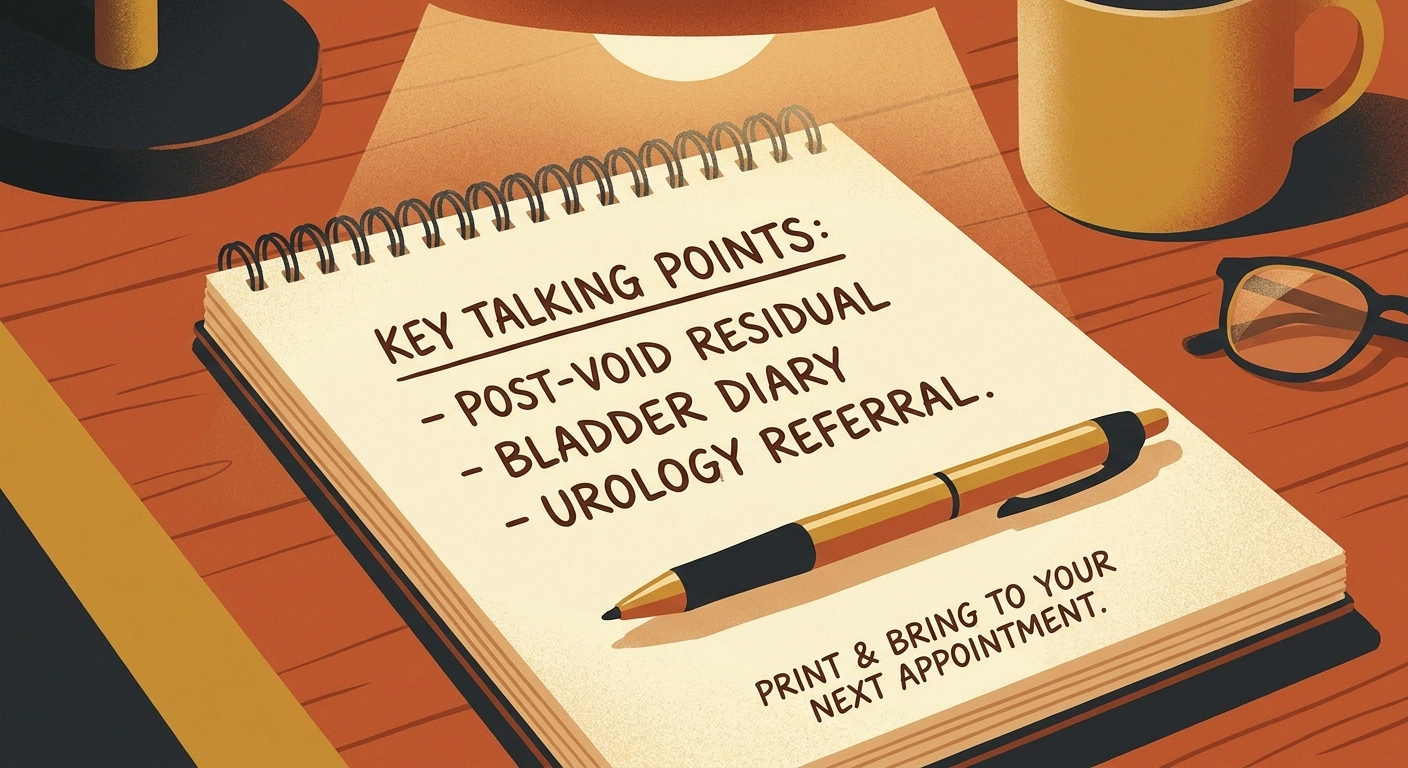
If you have neuropathy and any of the symptoms in this article, here's what I'd want you to say at your next visit:
- Post-void residual measurement — bladder ultrasound right after you urinate.
- Bladder diary review — bring a 3-day log of voids, volumes, and leaks.
- Urinalysis and culture — to rule out infection.
- Renal ultrasound if PVR is high — protect the kidneys.
- Urology referral if findings suggest neurogenic bladder.
- B12 level — to rule out a reversible nutritional cause.
“I've been noticing some bladder symptoms — going less often than I used to, weaker stream, feeling like I'm not empty when I'm done, and getting up at night. I know autonomic neuropathy can affect the bladder, and I'd like to be evaluated for neurogenic bladder. Can we get a post-void residual measurement and a referral to urology if it's high?”
That request, in those words, will redirect a visit that might otherwise end with another generic prescription into a proper workup. You're allowed to ask for the specific test by name. Doctors respond well to patients who have done their homework.
Frequently Asked Questions
Is neurogenic bladder the same as overactive bladder?
No, though they can look similar. Overactive bladder is a syndrome of urgency and frequency where the bladder muscle contracts at the wrong times. Neurogenic bladder is bladder dysfunction caused specifically by nerve damage, and it can show up as overactive, underactive, or a mix. The treatment differs because the underlying cause differs.
Will my bladder symptoms get better if I control my diabetes?
Tight diabetes control with A1C under 7 percent slows the progression of autonomic neuropathy. It typically doesn't reverse damage that's already there, but it can stop things from getting worse. Many patients see modest improvement in symptoms after a few months of good control, especially in earlier phases of the condition.
I'm a man with weak stream and frequent nighttime urination. Isn't this just my prostate?
It might be the prostate, or autonomic neuropathy, or both. The two conditions look very similar from the outside. The difference matters because treating the prostate alone won't fix a bladder dysfunction caused by nerve damage. A post-void residual measurement and urodynamic testing can distinguish them.
Are catheters really safer than my recurrent UTIs?
In most cases yes. The bacterial risk from clean intermittent self-catheterization done correctly is lower than the risk from chronically stagnant urine from a bladder that doesn't empty. Patients consistently see a major reduction in UTI frequency once they start CISC for high residuals. The technique is teachable in a single session and gets easier with practice.
Can pelvic floor physical therapy really help if my nerves are damaged?
Yes. Pelvic floor PT doesn't repair nerves, but it teaches you how to maximize what nerve function you still have. Many neurogenic bladder patients are unconsciously tightening their pelvic floor muscles when they should be relaxing, or vice versa. Coordinating what's still working buys you significant functional improvement.
How often should someone with neuropathy have their bladder checked?
If you have established autonomic neuropathy, an annual conversation about bladder symptoms is reasonable, with a post-void residual measurement at least once even if you have no obvious symptoms. Early detection in Phase 1 lets you start behavioral interventions before damage progresses.
Does neurogenic bladder lead to kidney damage?
It can, in advanced cases where bladder pressure backs up into the kidneys. This is why a renal ultrasound is part of the workup when post-void residual is high. Catching and treating elevated residual before back-pressure develops protects the kidneys.
Will I need to be catheterized for the rest of my life?
Not necessarily. Some patients use catheterization temporarily while behavioral and medical treatments take effect, then are able to stop. Others find catheterization is the best long-term solution and continue it indefinitely. For some, sacral neuromodulation eliminates the need. The plan should be reviewed periodically as your situation changes.
About the Author