The first time I tried to describe it to my doctor, I said, “It feels like I’m walking on a folded washcloth that isn’t there.” She nodded like she’d heard this before. Then she asked me to close my eyes and stand on one foot. I nearly toppled.
The strange sensation of walking on cotton, marbles, pebbles, or a wrinkled sock inside a shoe you’re not wearing is one of the most common and most disorienting complaints in peripheral neuropathy. It sounds like something out of a fairy tale. It is entirely physiological, and it tells your doctor a lot about which nerve fibers are affected. Let me walk you through what’s actually happening in your feet — and what you can do about it.
What “Walking on Cotton” Really Feels Like
Ask ten people with peripheral neuropathy to describe this sensation and you’ll get ten variations of the same experience. Some hear their own description in every one of them:
- Walking on a folded sock that isn’t there
- A layer of felt or cotton wool under the ball of the foot
- A small stone or pebble that never moves no matter how many times you shake out the shoe
- A wrinkle in the sock at the heel
- The whole foot feeling padded, muffled, or bunched up in fabric
- Marbles rolling under the toes
- Walking on a firm sponge or memory foam
These sensations tend to be worse at the end of the day, in tight shoes, on hard floors, and after standing for long stretches. Many people notice them especially when they get up in the morning or after sitting for a while — the first few steps feel like walking on cushions.
The reason all of these descriptions cluster together is that they all arise from the same underlying process: your brain is trying to interpret degraded, incomplete, or misfiring signals from the sensory nerves in your feet — and it fills in the gaps with a “best guess.” That best guess often takes the form of texture that isn’t there.
The Nerve Fibers That Tell Your Brain What the Floor Feels Like
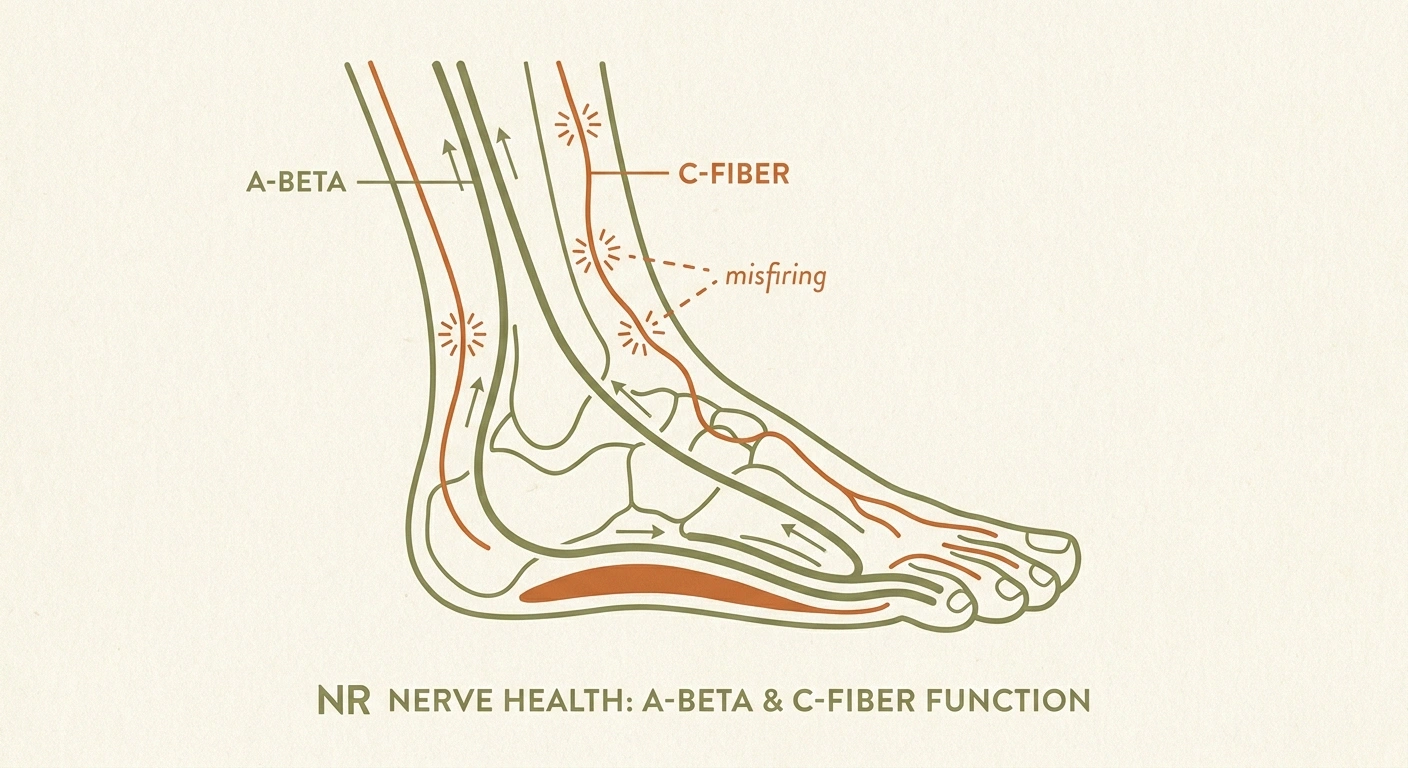
Your feet are wired with several very different kinds of nerve fibers, each carrying its own type of information. Understanding which are damaged tells you a lot about which strange sensation you feel:
- Walking on cotton or sponge
- Padded, muffled feet
- Wrinkled-sock sensation
- Reduced balance in the dark
- Phantom pebble or stone underfoot
- Marbles rolling under toes
- Burning combined with the texture
- Cold sensitivity
Large myelinated A-beta fibers carry vibration, light touch, position sense (proprioception), and the precise feel of firmness under your foot. When these degrade — as they do in classic length-dependent peripheral neuropathy, alcoholic neuropathy, B12 deficiency, and many other causes — the brain loses its high-resolution “map” of the sole. That map is what tells you “this is a smooth tile floor” or “this is my normal running shoe.” Without it, everything feels muffled, padded, or vaguely unreliable. This is where the cotton, sponge, and marshmallow sensations come from.
Small unmyelinated C-fibers and thinly myelinated A-delta fibers carry pain, temperature, and light touch of a different kind. When these misfire — as they do in small fiber neuropathy, diabetic neuropathy, and chemotherapy-induced neuropathy — they generate ectopic signals: nerve impulses that never came from an actual stimulus. Your brain receives what looks like “pressure at the ball of the foot” and interprets it as a small object rolling under the toes. Hence the phantom pebbles, marbles, and stones.
Many people have both fiber types affected at once. That’s why the cotton sensation and the pebble sensation often coexist in the same foot.
Your brain is guessing what your feet can’t tell it anymore.
Damaged large-fiber nerves stop reporting the fine texture of the floor. Your brain fills the gap with texture illusions — cotton, sponge, pebbles, wrinkled socks. The floor didn’t change. The map did.
Why Your Brain “Fills In” the Sensation of Something Under Your Foot
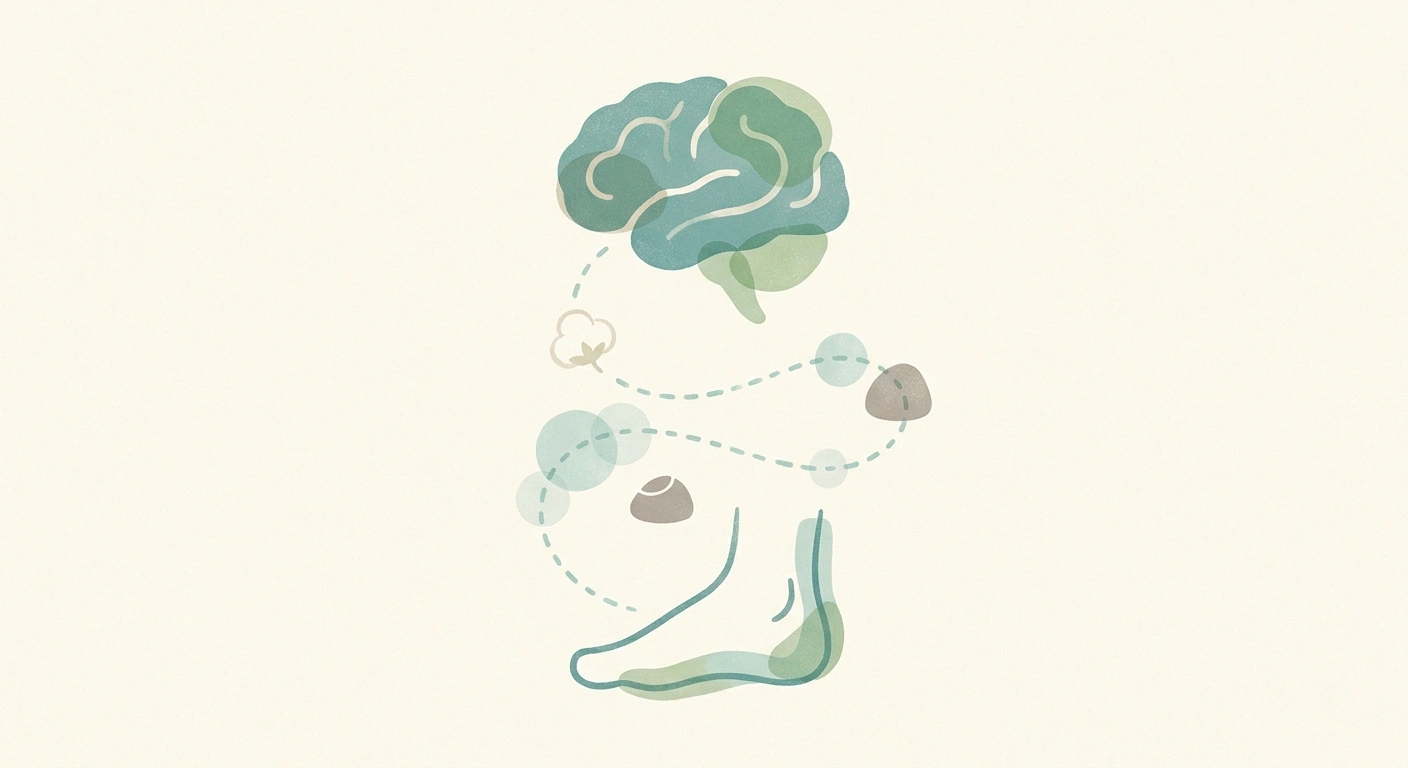
Your brain is not a passive receiver. It actively constructs your experience of the world based on the signals it gets. When a signal is weak or missing — like the reduced touch feedback from a damaged sole — your brain doesn’t leave a blank. It guesses.
Think of what happens when you try to walk down a familiar staircase in the dark. You still feel the steps. Your brain uses memory and expectation to fill in what your eyes aren’t providing. In neuropathy, something similar happens with touch. Your brain expects a certain amount of feedback from each step. When less arrives, it constructs a sensation to fill the void — and “padded” or “cotton-like” is a very common guess for reduced pressure feedback.
Neuroscientists have a name for the way the brain reorganizes itself when its usual inputs shift: cortical remapping. In peripheral neuropathy, the area of the somatosensory cortex that used to represent the sole in fine detail begins to lose its high-resolution structure. It gets sloppy. That sloppiness shows up as texture illusions — cotton, sponge, marbles, pebbles.
Which is a strange kind of relief to know. You are not imagining this. Your feet are not being sabotaged. Your brain is doing exactly what brains do when their sensors go quiet — it makes something up. Understanding the mechanism helped me stop being frightened by it.
When Does This Sensation Start? Early Warning or Later?
The “walking on cotton” feeling is often one of the earliest complaints in length-dependent peripheral neuropathy, appearing before pronounced pain or obvious weakness. It usually begins at the toes and gradually creeps up the ball of the foot, then the heel, then the ankle over months to years.
A few patterns are worth flagging:
- Slow, symmetric, both feet, toes first, then upward. Classic length-dependent pattern. Consistent with diabetic, idiopathic, alcoholic, B12-related, and chemotherapy-induced neuropathies.
- Rapid onset over days or weeks. Not typical of gradual neuropathies — worth a same-week doctor call to rule out compressive, inflammatory, or vitamin-related causes that can worsen quickly.
- One-sided only. Suggests a focal problem (nerve compression at the ankle or knee, a herniated disc affecting a specific nerve root, tarsal tunnel syndrome) rather than a systemic neuropathy.
- Accompanied by weakness or tripping. When the motor fibers are also affected, foot drop can appear alongside the sensory changes. This warrants a neurology referral.
Our overview of small fiber neuropathy and the broader page on stages of neuropathy give a fuller sense of where this sensation typically fits in the arc of the condition.
Real Objects vs Phantom Objects — How to Tell the Difference
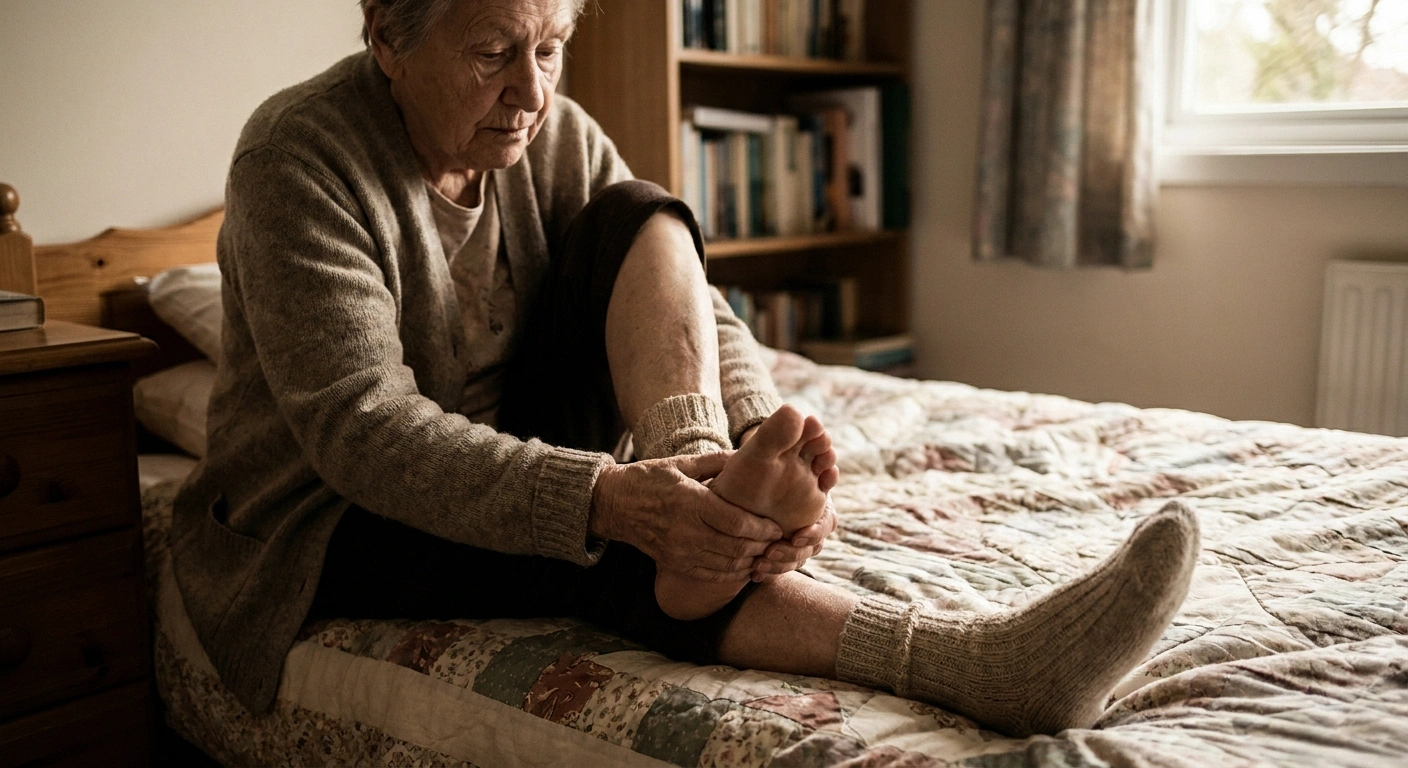
Not every stone-in-the-shoe feeling is neuropathy. Several structural problems in the foot produce genuine, focal sensations that mimic phantom textures — and they need very different treatment. If you sit down and take the shoe off, some clues help you tell them apart:
Morton’s neuroma. A thickening of the nerve between two toes, most often the third and fourth. It classically produces a “walking on a pebble” feeling in one specific spot, worse in tight shoes, better when the shoe comes off. If you squeeze the foot side-to-side and feel a click or a stabbing pain in that same spot (Mulder’s sign), it is likely a neuroma. A podiatrist can confirm.
Plantar fasciitis. Sharp pain under the heel that is worst with the first few steps in the morning and after long sitting. Usually not described as cotton or pebbles — more of a stab or bruise feeling — but occasionally people describe the tight underfoot band as “walking on something.”
Fat pad atrophy. The natural cushioning under the ball of the foot thins with age or diabetes. Walking on hard floors then feels like walking on the bones themselves, which some people describe as “no cushioning” or “walking on marbles” in the exact spot where the fat pad has thinned.
Tarsal tunnel syndrome. Compression of the tibial nerve at the inner ankle. Produces burning, tingling, and phantom-object sensations, often worse at night, sometimes helped by tapping the nerve at the ankle (Tinel’s sign there provokes tingling).
Metatarsalgia. Generalized ball-of-foot pain from overload or poor cushioning, especially in high-arched or aging feet. Feels like a bruise or a marble.
The pattern that most reliably points to peripheral neuropathy is: both feet, symmetric, no single “spot” you can point to, worse at the end of the day, often accompanied by numbness, tingling, or reduced ability to feel small textures like sock seams.
The Balance Problem You Might Not Have Connected Yet
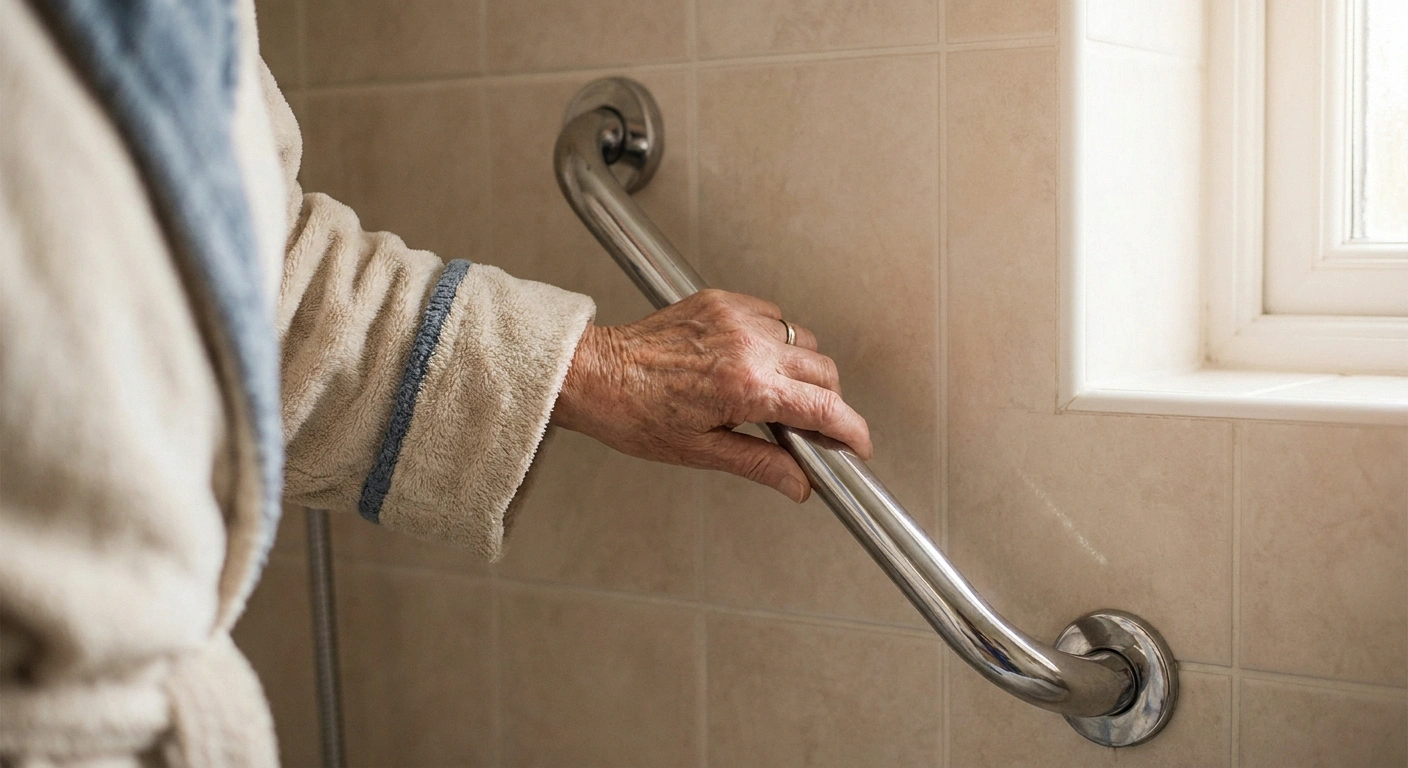
Here is where the cotton sensation stops being merely annoying and starts being a safety issue. When your feet can’t accurately report where the floor is, your balance goes with them. Proprioception — your body’s sense of where its parts are in space — depends heavily on those large A-beta fibers that also carry precise touch. When they degrade, your ability to stay upright without visual input degrades too.
Reduced sole sensation almost always brings reduced proprioception — your body’s sense of where its feet are in space. In the dark, on stairs, or on uneven surfaces, that combination is when falls happen. Add a night light, keep pathways clear, hold a rail on stairs, and consider a physical-therapy balance evaluation.
You may have noticed this if:
- You wobble when you close your eyes in the shower
- You feel unsafe walking in the dark to the bathroom at night
- You’ve reached for a wall or countertop more often lately
- You’ve had a trip or a near-fall that seemed to come out of nowhere
- Uneven ground (a lawn, a curb, a rug edge) feels riskier than it used to
Any of these deserve attention. Falls in older adults with neuropathy are a leading cause of serious injury, and they are largely preventable with balance work, lighting adjustments, and grab bars in the right places. Our page on neuropathy balance and fall prevention lays out the practical fixes that make the biggest difference.
What Helps the Cotton and Pebble Sensations Themselves
Treating the underlying neuropathy is the real long game — glucose control, correcting nutritional deficiencies, stopping toxic exposures, addressing autoimmune causes. But there are things that make the day-to-day sensation more tolerable while that work continues:
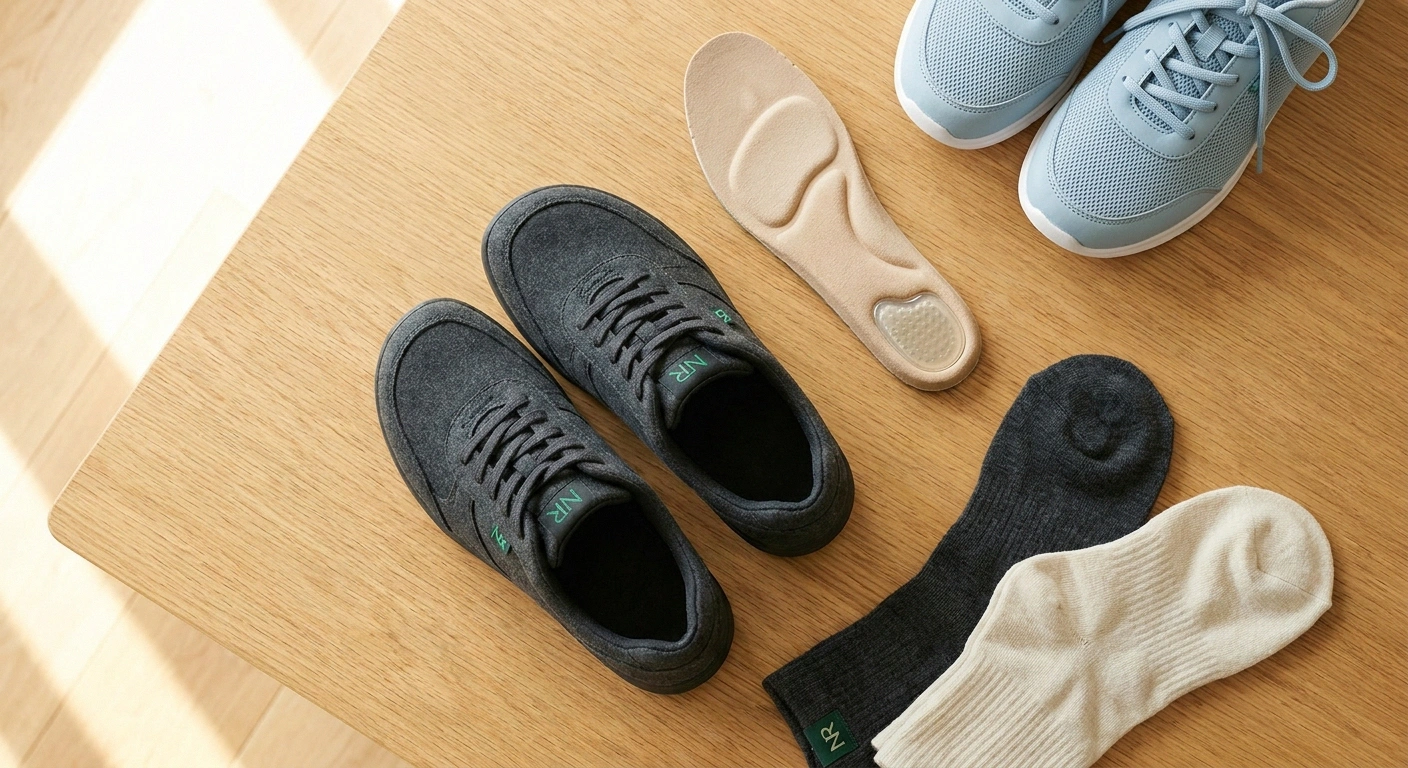
Better cushioning under the foot. Softer insoles (memory foam, gel, or EVA foam) inside shoes can actually dial down the phantom pebble sensation — partly by reducing genuine pressure points and partly by giving the remaining touch fibers a more consistent signal. Change insoles every three to six months as they compress.
Wide toe box, low heel-to-toe drop. Tight shoes squeeze already-irritated nerves and worsen phantom sensations. A shoe that lets your toes splay naturally, with a modest heel-to-toe drop (0-8 mm) and a stable heel counter, gives your feet the best chance. Our guide to the best shoes for neuropathy walks through what to look for.
Alternate two pairs of shoes. Wearing the same shoe every day creates predictable pressure points that neuropathic feet resent. Switching between two well-fitted pairs distributes the load and reduces the “always-on” phantom sensation.
Foot exercises to keep sensation and proprioception active. Marble pickups (using toes to lift small objects), towel scrunches, calf raises at the kitchen counter, and single-leg standing (near a wall) all encourage the remaining nerve fibers to stay engaged. Ten minutes a day, most days.
Regular walking on varied surfaces (safely). If your balance is good enough, walking on grass, sand, and gravel gently challenges the sensory system in ways a flat sidewalk cannot. If your balance is fragile, walk on flat, familiar terrain only. See our page on whether walking helps neuropathy for the fuller picture.
Address underlying deficiencies. If a blood test shows low B12, folate, or vitamin D, correcting those often reduces symptoms including the phantom-texture experience. Our page on vitamin deficiencies that cause neuropathy covers the panel to ask for.
Nerve-pain medications for the painful component. Cotton and pebble sensations by themselves are not typically painful, but when they are accompanied by burning or shooting pain, gabapentin, pregabalin, duloxetine, or a tricyclic like nortriptyline can quiet the misfiring nerves. This is a conversation with your prescriber, not something to buy on your own.
Alpha-lipoic acid. For diabetic neuropathy specifically, ALA has moderate evidence for reducing sensory symptoms over three to five months. Our overview of alpha-lipoic acid for neuropathy covers dosing and safety.
The Sensation and Sock Choices
Small thing, big effect. Socks that bunch, twist, or have thick seams magnify phantom-object sensations. So do socks that are too tight (they mimic compression the brain then reads as texture) or too loose (they actually create real folds under the foot).
A few small changes:
- Seamless or flat-seam socks, especially at the toe
- Merino wool or bamboo — moisture-wicking and comfortable at a range of temperatures
- Fit that hugs the foot without squeezing
- Change socks midday if you’re on your feet all day
- Skip cotton athletic socks that hold sweat and bunch as they slip
It sounds trivial. It isn’t. A single well-fitted seamless sock can meaningfully reduce the “wrinkle under the heel that isn’t there” sensation for many people.
When to See a Doctor About This Sensation

If the cotton or pebble sensation is new, worsening, or accompanied by other symptoms, it’s worth a visit. Specifically:
- The sensation is new within the last few months, or spreading up the leg
- One-sided (points at a focal nerve problem)
- Accompanied by weakness, tripping, or foot drop
- Painful enough to disturb sleep
- You’ve had a fall or near-fall you can’t explain
- You have diabetes and haven’t been screened for neuropathy in the last year
- New within the last few months, especially if it’s spreading up the leg
- One-sided (suggests a focal nerve issue rather than a systemic neuropathy)
- Accompanied by weakness, tripping, or foot drop
- Accompanied by pain that keeps you up at night
- You’ve had a fall or a near-fall you can’t fully explain
- You have diabetes and haven’t had a neuropathy screen recently
- You’ve been on a chemotherapy known to cause neuropathy
Your primary care doctor is a reasonable first stop. They can order a basic blood panel (glucose, HbA1c, B12, folate, TSH, kidney function, and a few others depending on your history), do a bedside monofilament and vibration exam, and refer you to neurology or podiatry as appropriate. Our overview of what to expect from a neuropathy diagnostic workup lays out the sequence.
A neurologist can order nerve conduction studies (EMG/NCS) to characterize large-fiber involvement, and a skin biopsy if small fiber neuropathy is suspected. Not every case needs the full workup — but when the pattern is atypical, escalating, or paired with weakness, the tests earn their place.
Living With the Sensation Without It Living With You
I want to close with what I’ve learned over years of my own feet lying to me. The cotton sensation, the pebble sensation, the wrinkle that isn’t there — these are companions I’ve had for a long time now. I’ve stopped waiting for them to leave. I have, however, gotten skilled at making them smaller.
My best days are the ones with proper insoles, seamless merino socks, a morning ten minutes of foot exercises, a slow walk in the afternoon, and shoes that fit. My worst days are the ones after a lot of standing, when I’ve forgotten to swap into fresh socks, or when I’ve tried to squeeze into shoes that weren’t right. The sensations don’t disappear on the good days; they recede. That’s what “better” looks like with neuropathy, and it turns out to be enough to live well.
If you’re new to this, the most helpful thing I can tell you is that the phantom textures don’t mean something is loose or broken inside your foot. It’s a signal, not damage in progress. Treat the underlying cause where you can. Cushion, protect, and move where you can’t. And be patient with your feet — they are doing their best with what they have left.
Frequently Asked Questions
Is the “walking on cotton” feeling always neuropathy?
Not always. Structural foot problems like Morton’s neuroma, fat pad atrophy, plantar fasciitis, and tarsal tunnel syndrome can produce similar sensations, usually in a focal spot on one foot. Bilateral, symmetric cotton or pebble sensations across both feet — especially with numbness, tingling, or reduced sense of small textures — point more strongly toward peripheral neuropathy.
Why does this sensation get worse at night or when I’m tired?
Damaged nerves misfire more when you’re not moving and when your body is running low on the compensatory circuits it uses during the day. Rest and quiet make the phantom signals louder because there’s less competing input. Fatigue also amplifies the brain’s tendency to “fill in” the missing sensory data with texture illusions. It doesn’t mean the nerve damage is getting worse.
Can better shoes actually make the cotton sensation go away?
Not fully, but they can dial it down meaningfully. Cushioned insoles, wide toe boxes, and stable heel counters reduce the real pressure irritation that piles on top of the phantom sensation. Combined with seamless socks and rotating between two pairs of shoes, many people report the sensation becomes background noise rather than a constant presence.
Does gabapentin help with the walking-on-cotton feeling?
It can help the painful component of neuropathy (burning, shooting pain) more reliably than the pure sensory illusion of cotton or pebbles. Some people notice the phantom textures quiet down along with the pain; others notice no change to the texture sensation but real relief from the burning. It’s worth trying if pain is prominent — the decision belongs to you and your prescriber.
If my feet feel like cotton, does that mean I have small fiber neuropathy?
Not necessarily. Large-fiber (A-beta) damage produces the padded, muffled cotton sensation more classically than small fiber damage does. Small fiber neuropathy tends to produce burning, cold, and phantom pebble sensations. Many people have both. A skin biopsy is the definitive test for small fiber neuropathy, and a nerve conduction study is the standard test for large-fiber involvement.
Should I worry about falls if I feel like I’m walking on cotton?
Take it seriously. Reduced sensation in the soles usually goes hand in hand with reduced proprioception, which raises fall risk — especially in the dark, on uneven surfaces, and when tired. It’s worth checking your home for tripping hazards, installing better lighting on the path to the bathroom, considering a night light, and adding balance exercises to your daily routine. A physical therapist can teach a good starter set.
Can this sensation go away on its own?
Sometimes. If it’s caused by a reversible problem — B12 deficiency corrected with supplementation, a compressive lesion released with surgery, a chemotherapy stopped in time — the sensation can improve significantly, though rarely to zero. If it’s caused by longstanding diabetic or idiopathic neuropathy, the sensation usually stabilizes with good management rather than disappearing. Realistic goals are important.
Does massaging my feet help this sensation?
Yes for many people. Gentle self-massage of the sole and toes gives your remaining touch fibers real input, which can quiet the phantom-texture illusions for a while and improves the brain’s sensory map over time. Use a tennis ball under the foot while seated, or roll a frozen water bottle under the arch for a few minutes. Our page on foot massage for neuropathy covers technique and safety.
Nothing on this page is medical advice. If your foot sensations are new, spreading, one-sided, or accompanied by weakness or falls, please see a doctor. Janet writes as a patient advocate who has lived with neuropathy — not as a medical professional.
About the Author