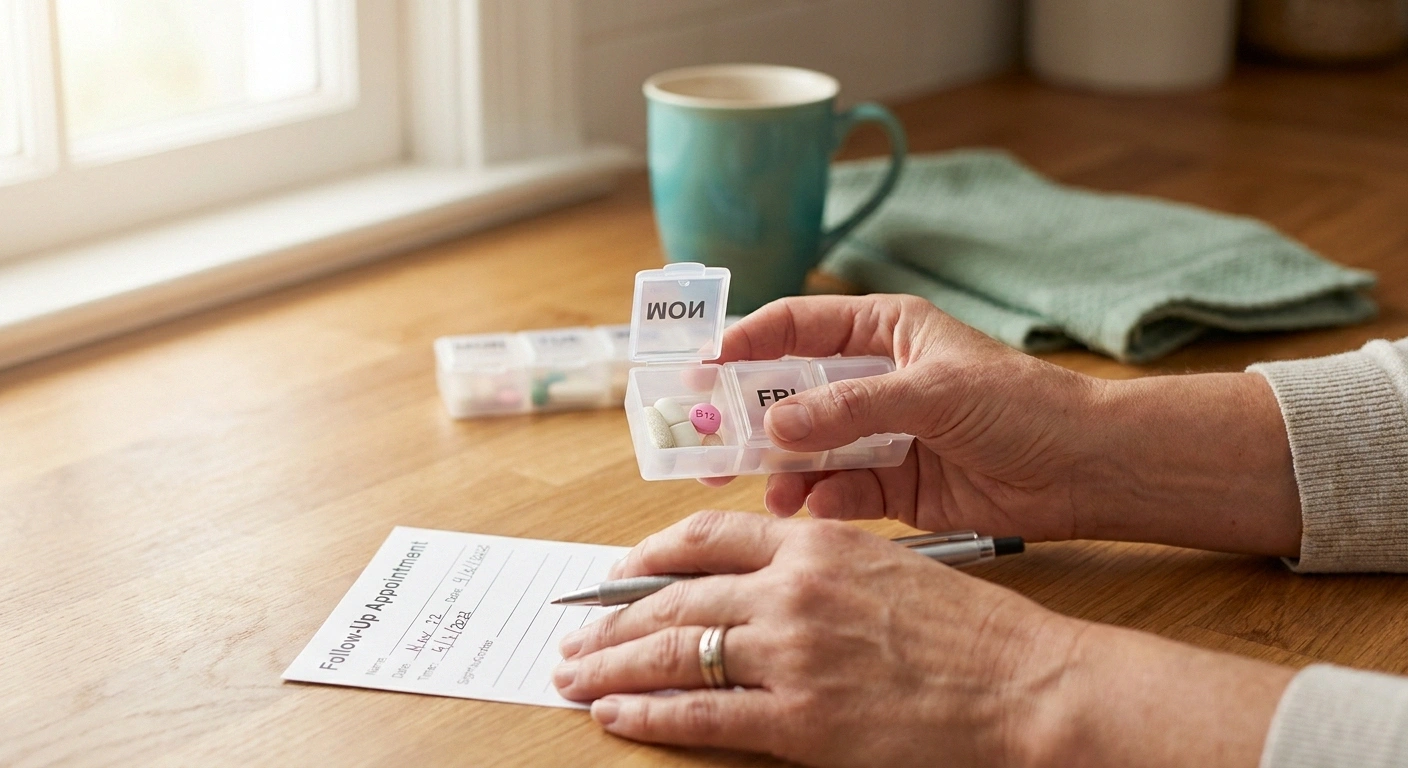
When my friend Elena decided to have a gastric bypass, we spent an entire afternoon at my kitchen table going over her surgeon's paperwork. The weight-loss numbers, the recovery timeline, the diet phases — all of it was clearly laid out. But buried in a footnote on page fourteen was a single sentence that stopped me cold: “Failure to take recommended vitamin supplements may lead to permanent nerve damage.”
Elena had never heard the word neuropathy before. She'd been so focused on the surgery itself that the long, quiet work of protecting her nerves for the rest of her life hadn't fully landed. That afternoon started a conversation I've had many times since — with people considering weight-loss surgery, people six months out and starting to feel strange tingling in their feet, and caregivers trying to make sense of a loved one's post-surgical change.
Bariatric surgery can be genuinely life-changing. It can send type 2 diabetes into remission, drop blood pressure, take pressure off arthritic joints, and give people back energy they hadn't felt in years. But it also fundamentally changes how the digestive tract absorbs certain vitamins that nerves cannot live without. When that absorption drops and supplementation doesn't fully compensate, nerves are one of the first systems to suffer.
The good news is that most bariatric-related neuropathy is preventable. And even when it develops, catching it early gives most people a real chance at recovery. This is a guide to how the risk unfolds over time, how to protect yourself before and after surgery, and what the warning signs look like — written for the person sitting where Elena sat that afternoon, or maybe a little further down the road.
Why Bariatric Surgery Puts Your Nerves at Risk
Peripheral nerves need a steady supply of specific nutrients to keep their protective myelin coating intact and to conduct signals cleanly. When those nutrients drop below a certain floor for long enough, the nerves start misfiring — first with tingling and burning sensations, then with numbness, and eventually with weakness if the deficiency continues.
Bariatric procedures cause deficiencies in three main ways:
They cut down absorption surface area. Roux-en-Y gastric bypass and duodenal switch operations reroute food past parts of the small intestine where key vitamins are absorbed. Even if you eat perfectly, your intestine simply has less contact time with those foods.
They reduce stomach acid and intrinsic factor. Sleeve gastrectomy and gastric bypass both remove or bypass most of the stomach's acid-producing cells. Stomach acid is required to strip vitamin B12 from food, and a protein called intrinsic factor — made by those same cells — is required to absorb B12 in the intestine. Without them, B12 simply passes through, no matter how much you eat.
Sleeve gastrectomy also permanently removes a significant portion of the parietal cells that make intrinsic factor, which is why B12 supplementation is a lifelong commitment after sleeve — not a temporary phase.
They shrink food volume dramatically. After surgery, most people eat one to three ounces of food per meal for the first few months. That's not enough volume to deliver adequate thiamine, folate, or minerals from food alone, especially during rapid weight loss when the body is burning through reserves.
Layered on top of these mechanisms is one that gets less attention: rapid weight loss itself pulls the protective fat cushion away from superficial nerves. Nerves that were fine when they had a padded layer around them can become compressed against bone or ligament as that padding disappears, producing a different kind of nerve trouble than a pure vitamin deficiency.
The First Three Months: The Thiamine Emergency Window
Thiamine — vitamin B1 — is the nutrient I worry about most in the first ninety days after surgery. Your body only stores about two to three weeks' worth. That's a very small buffer compared to B12, which can float on hepatic stores for years. When intake drops or vomiting starts, thiamine bottoms out fast.
Studies of early post-bariatric patients show thiamine deficiency in roughly nine to nineteen percent within the first few months. Most neurologic symptoms from thiamine deficiency appear four to twelve weeks after surgery — right when many people are struggling with the transition from liquid to pureed to soft foods, sometimes with nausea and vomiting mixed in.
The nerve pattern that thiamine deficiency causes has a name from an older era: dry beriberi. It looks like a rapidly progressive tingling and burning in the feet and calves, often with weakness following behind. Some people describe their legs feeling “heavy” or “wooden” within weeks. A more severe form, Wernicke's encephalopathy, adds confusion, memory problems, unusual eye movements, and coordination trouble — this is a medical emergency and needs intravenous thiamine immediately.
Two rules I share with anyone in the first three months after surgery:
Any post-bariatric patient who is vomiting more than a couple of days needs thiamine — usually intravenous, not oral. If you're vomiting, you're not absorbing your multivitamin, and the clock is short. Call your surgeon's office. Don't wait until Monday.
Never accept a glucose IV in the emergency room without thiamine first if you've had bariatric surgery. Sugar without thiamine can push a marginal patient into Wernicke's. This is a well-known medical rule but one that busy ER teams sometimes miss. It's worth having on a card in your wallet.
Three to Twelve Months: The B12 and Slow-Burn Deficiency Zone

Once you're past the thiamine emergency window, the risk shifts to a slower kind of trouble — one that builds up quietly and shows up in labs before it shows up in your body. This is the zone where most classic post-bariatric neuropathy takes root.
Beriberi, Wernicke's — fast
Slow, symmetric numbness
Copper, compression, drift
The main players here are vitamin B12, folate, and vitamin B6 — the same nutrients that show up in any discussion of vitamin-deficiency-driven nerve damage. What makes the bariatric setting different is the pace. Your liver stored years of B12 before surgery. Those stores are still there. But they drain — sometimes over six months, sometimes over three years — and the drainage is invisible until symptoms start.
Classic B12 deficiency neuropathy is a stocking-and-glove pattern — numbness and tingling that starts in the toes and fingertips and creeps upward symmetrically over months. It can be accompanied by balance trouble in the dark (the affected sensory nerves normally tell your brain where your feet are), memory changes, and, in advanced cases, weakness. If you also see anemia on lab work, that's a signal the deficiency has been going on for a while.
This is where the question of B12 injections versus oral supplements becomes practical. After gastric bypass or sleeve gastrectomy, oral B12 often simply doesn't absorb well enough — even at high doses — because the intrinsic factor pathway is gone. Sublingual B12 (dissolved under the tongue) bypasses that pathway partially. Monthly intramuscular injections bypass it entirely. Which you need depends on which procedure you had, your lab results at three and six months, and your surgeon's follow-up protocol.
Folate and B6 usually track together with the multivitamin. The most common failure point is simply not taking the bariatric-specific multivitamin twice a day, every day. Regular over-the-counter multivitamins are underdosed for post-bariatric absorption — you'll see recommendations for “bariatric” or “post-surgical” multivitamins for a reason.
One Year and Beyond: Copper, Compression, and Long-Term Watch Points

By the time you're a year out, weight has stabilized for most people and food volume has climbed back up. But two long-tail risks emerge that are worth naming.
The first is copper deficiency. This one is uncommon but distinctive. Copper is absorbed in the upper small intestine — exactly the region that gastric bypass bypasses. It usually takes years for copper to bottom out, but when it does, it produces a very specific combination: tingling and numbness in the legs, balance trouble that gets much worse when you close your eyes, and sometimes weakness. Zinc supplements — often taken for skin or hair after surgery — can actively worsen it, because zinc competes with copper for absorption.
The second is compression neuropathy from rapid weight loss. When someone loses eighty or a hundred pounds, the fat pads that used to cushion superficial nerves are gone. Nerves that pass close to bone — the peroneal nerve at the outside of the knee, the ulnar nerve at the elbow, the lateral femoral cutaneous nerve at the front of the hip — can suddenly be squeezed by everyday positions that never caused trouble before. This shows up as a numb patch on the thigh, tingling in the pinky and ring finger, or foot drop, and it's a different mechanism from vitamin deficiency — different treatment, too. Padding, position changes, and sometimes a referral to a hand or foot specialist matter more here than another supplement.
The other long-term consideration is that if you had type 2 diabetes before surgery, weight loss and blood sugar improvement can actually help stabilize diabetic neuropathy. Some people notice symptoms plateau or improve after bariatric surgery. But this benefit is real only if the nutritional side is being managed — a person who reverses their diabetes but develops severe B12 deficiency has traded one nerve problem for another.
The Three Neuropathy Patterns You Might See
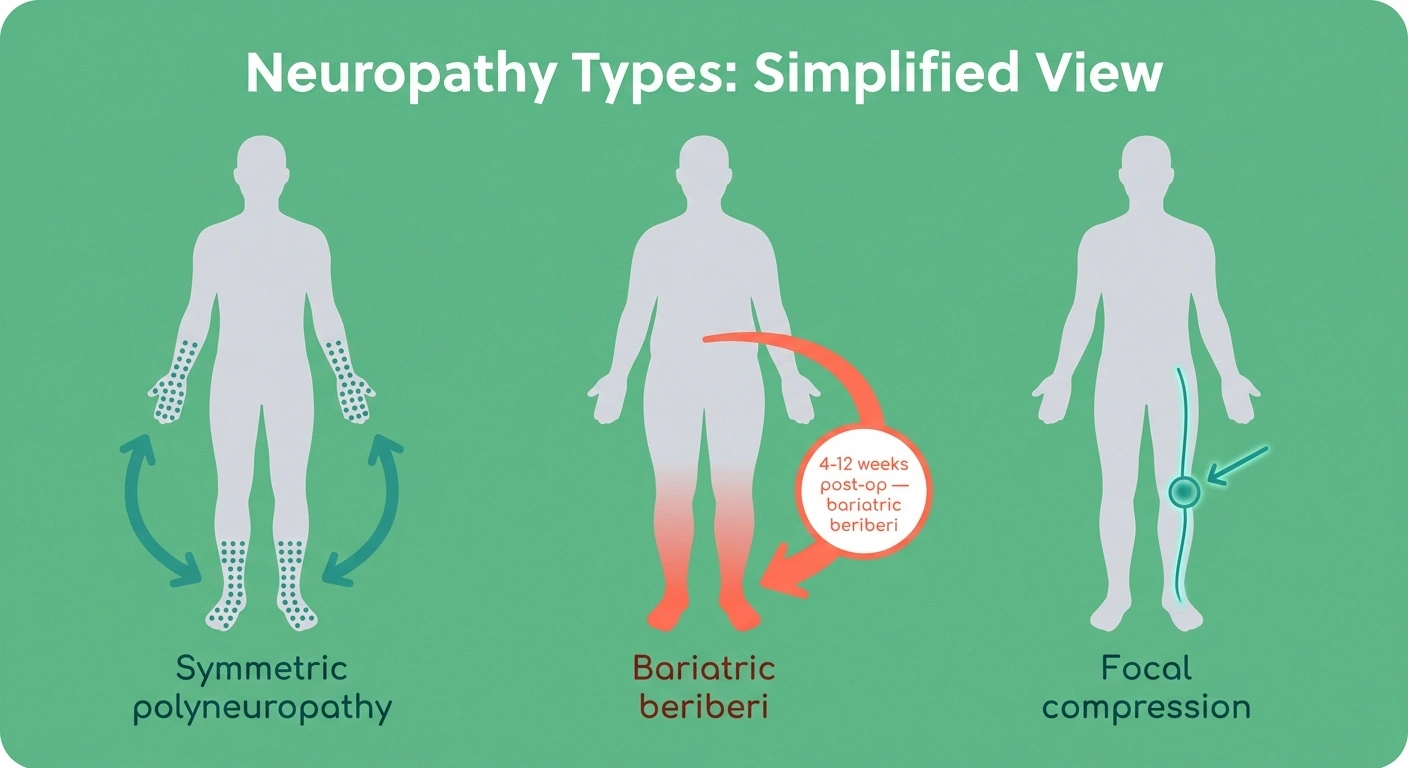
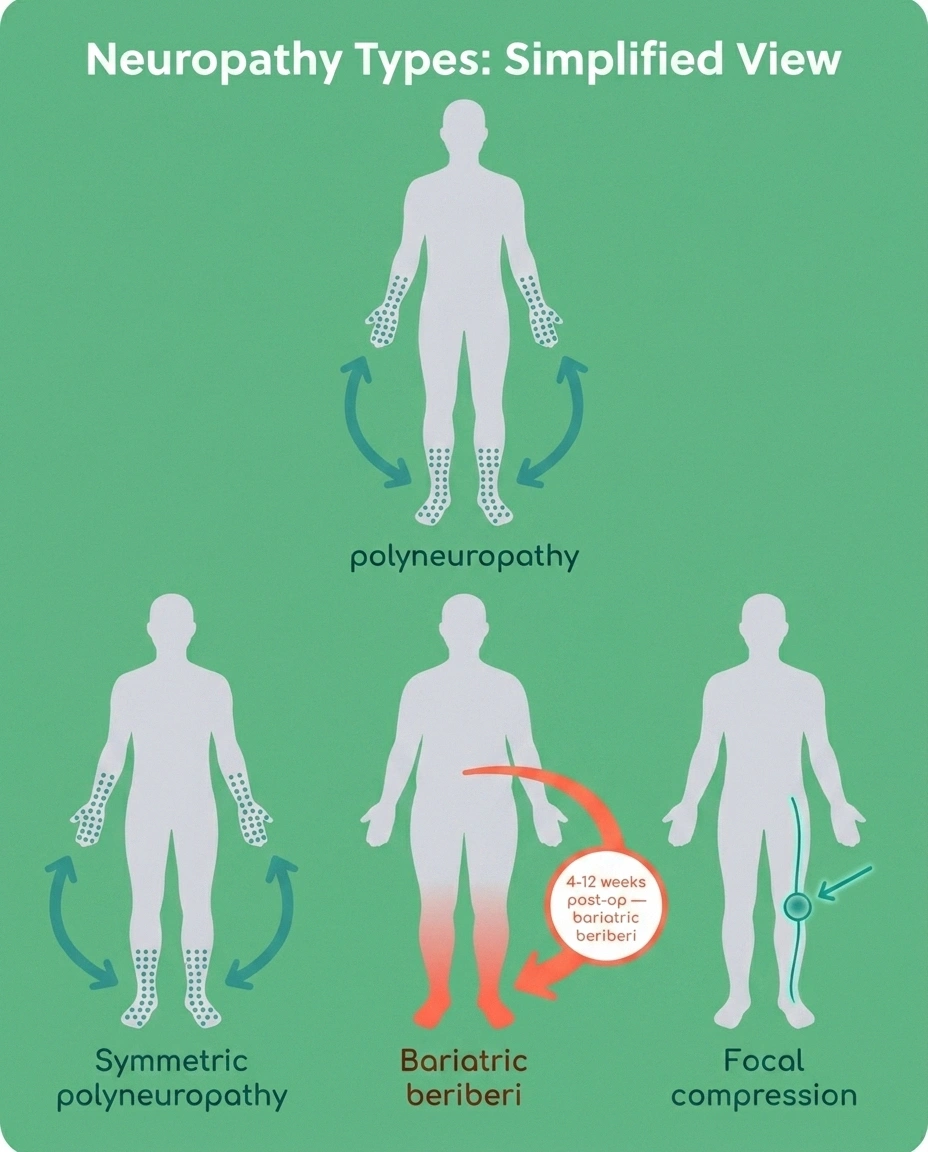
Post-bariatric nerve trouble doesn't always look the same. Recognizing the pattern helps your care team point testing and treatment in the right direction faster.
| Pattern | Timing | Feel | Root cause |
|---|---|---|---|
| Distal symmetric | 6-24 mo | Stocking-glove tingling | B12, folate, B1 |
| Bariatric beriberi | 4-12 wk | Fast, may include weakness | Thiamine (B1) |
| Focal compression | Any time (peak 3-12 mo) | One nerve, one patch | Fat loss around nerve |
Pattern 1: Classic distal symmetric polyneuropathy. Symmetrical tingling, burning, or numbness that starts in the toes and moves up the feet and into the shins. This is what most people picture when they hear the word neuropathy, and it's the most common post-bariatric presentation. It's usually driven by B12, folate, or thiamine deficiency, and it responds to nutritional correction if caught before nerve loss becomes permanent.
Pattern 2: Bariatric beriberi (thiamine-related). Rapid onset — sometimes weeks. Often preceded by significant vomiting. May include leg weakness alongside sensory symptoms. Sometimes comes with mental status changes (confusion, memory trouble) that signal Wernicke's encephalopathy. This is the pattern that most demands urgent evaluation, because the window for full recovery is narrow.
Pattern 3: Focal nerve compression from weight loss. A distinct patch of numbness, tingling, or weakness that follows one specific nerve — not a symmetric pattern. Foot drop from peroneal nerve compression, ulnar nerve tingling in the pinky and ring finger, or a numb outer thigh (meralgia paresthetica) are classic examples. These often improve with padding, positioning, and time as the body adjusts to the new weight — supplements alone don't fix them.
Sometimes people have more than one pattern at once. A person with severe B12 deficiency who's also lost a hundred pounds might have both symmetric burning feet and a compressed peroneal nerve. Your neurologist can usually sort out which is which with a good exam and, if needed, nerve conduction studies — a subject we cover in more depth in the article on how neuropathy gets diagnosed.
Before Surgery: What to Ask Your Team

The single strongest predictor of avoiding post-bariatric neuropathy is a comprehensive pre-op nutritional screen followed by structured follow-up. Here are the questions I'd want on the table at the pre-surgery consultation:
“Have my baseline B12, folate, thiamine, vitamin D, iron, and ferritin levels been checked?” A surprising number of people are already low on one of these before surgery. Correcting a deficiency ahead of time gives you a bigger buffer for the post-op period.
“What supplement protocol will I be on, and when do we start?” The right answer usually involves a bariatric-specific multivitamin twice daily, a calcium citrate + vitamin D combination, and — depending on procedure — an ongoing B12 plan (sublingual daily or monthly injection). Iron for menstruating women. Some programs add extra thiamine for the first several months.
“How often will my labs be drawn, and by whom?” The consensus recommendation is labs at three, six, and twelve months post-op, then annually. In practice, patients whose labs get drawn on that schedule and whose values are actually reviewed have dramatically lower rates of deficiency neuropathy than patients who fall out of follow-up. Ask specifically who is responsible for reviewing your labs — some surgeons hand this off to a bariatric dietitian or a primary care doctor, which is fine as long as someone owns it.
“What do I do if I'm vomiting for more than a day or two?” This should have a clear answer with a phone number. Prolonged vomiting is a thiamine emergency, and the answer is not “wait it out and start Gatorade.”
“How will you monitor for neuropathy specifically?” Some programs include a short foot exam and questionnaire at each follow-up visit. Others rely on the patient reporting symptoms. Knowing which model your program uses tells you how much of the vigilance falls on you.
After Surgery: Your Supplement and Follow-Up Playbook

Post-op, the day-to-day work of protecting your nerves is a routine — small, repeatable, and easy to under-value. Every person's exact regimen should come from their bariatric team based on their procedure and labs. But the general framework looks like this:
Take a bariatric-specific multivitamin twice daily, every day, for life. The word “bariatric” is doing real work here — it means the vitamin is dosed and formulated for post-surgical absorption, with higher levels of the nutrients most likely to run low. If cost is an issue, ask your program about generic options or patient assistance — the multivitamin is not the place to economize.
Take vitamin B12 as directed by your team. For most bypass and sleeve patients, this means either 350-500 mcg of sublingual B12 daily or a monthly intramuscular injection. Oral B12 alone often is not enough — this is one of the most consistent findings in the post-bariatric neuropathy literature.
Take calcium citrate with vitamin D — split into two or three doses across the day. Calcium is capped by absorption per dose, and citrate (not carbonate) is the preferred form after gastric surgery. This is more about bones than nerves, but the two systems talk to each other more than people realize.
Get labs at three, six, and twelve months, then annually. Put them on your calendar the day you get home from the hospital. If your program doesn't reach out to schedule them, reach out to your program.
Watch for the warning signs (in the next section) and don't wait to report them. The earlier a deficiency is caught, the more nerve tissue is salvageable. This is one area where “let me see if it goes away” is exactly the wrong instinct.
Be careful with alcohol. Post-bariatric physiology absorbs alcohol differently, and there's a documented pattern of increased alcohol use after surgery. Alcohol destroys thiamine and worsens B vitamin deficiencies — combining post-bariatric malabsorption with alcohol is a fast track to alcohol-related nerve damage. If drinking creeps up, mention it to your team without judgment — it's a known post-surgery issue.
When to Get Checked Right Now

Some symptoms after bariatric surgery deserve a same-day or next-day call to your surgeon's office, not a “wait for the next appointment” approach. Here's the list I keep taped inside the pantry:
- New burning, tingling, or numbness in your feet or hands
- Any balance change, especially in the dark
- Weakness in a foot or hand (foot drop, wrist drop, dropped objects)
- Confusion, memory changes, or unusual eye movements
- Vomiting for more than a day or two
- New vision changes or reduced color perception
New burning, tingling, or numbness in feet, hands, or both — even mild. This is the earliest sign of nerve involvement and the point where nutritional correction has the highest success rate.
Any change in balance, especially in the dark or with eyes closed. This can be the first sign of B12 or copper deficiency affecting the sensory nerves that keep you upright.
Weakness in a foot or hand. Foot drop (a foot that catches on the floor because you can't lift the toes cleanly) or wrist drop is not something to sleep on.
Confusion, memory changes, or unusual eye movements. These are Wernicke's encephalopathy warning signs and warrant an emergency evaluation. Say “I had bariatric surgery” as your first sentence at the ER — it changes how they work up your case.
Vomiting more than a day or two. Even if you feel okay otherwise, prolonged vomiting depletes thiamine fast. Call the surgeon's office — most programs have a plan that includes IV thiamine in the office or ER before things escalate.
Vision changes. Optic nerve damage from B12, thiamine, or folate deficiency is rare but reported. New blurriness or reduced color vision after bariatric surgery deserves both a neurologist and an ophthalmologist.
Can Bariatric-Related Neuropathy Get Better?

This is the question I get asked most, and I want to answer it honestly.
Small-fiber symptoms — burning, tingling, temperature sensitivity — that are caught within a few months of onset and treated aggressively with the right supplements often improve substantially over six to twelve months. Some people describe the burning fading first, then the tingling shrinking to a smaller area, then eventually going quiet altogether. Others land at a “much better but not gone” endpoint that they can live with.
Larger nerve fiber damage — the kind that causes numbness, weakness, or balance trouble — is harder. Once axons (the long conducting fibers of nerves) have died, they can regrow, but only slowly (roughly one millimeter a day) and only if the underlying deficiency is fully corrected. Long-standing deficiencies that went untreated for a year or more usually leave some residual numbness or balance change.
Copper myelopathy is the one to name specifically: even with copper replacement, recovery is often partial. Early recognition matters most here.
The reason to be honest about this is that it flips the conversation from “will it get better?” to “let's not let it get worse.” Prevention beats correction, and correction beats compensation. Every reader in the pre-op or early-post-op phase reading this has time on their side — the whole system of supplements and follow-up exists exactly to keep you out of the harder scenarios.
Some tools that help while nerves heal are worth knowing about even if they don't fix the underlying problem. Well-cushioned shoes with stable heel counters take pressure off feet that don't have their normal protective sensation. Gentle daily walking improves circulation and helps preserve muscle. Topicals and other conservative approaches can help with symptom management while the nutritional side does its slow work.
If Elena's afternoon at my kitchen table taught me anything, it's that the difference between a good bariatric outcome and a hard one often comes down to what happens after you leave the operating room. Not the procedure. The follow-through. Your team can build the framework. Your job — and it's a real job, not a small one — is to take the vitamins, keep the appointments, watch for the signs, and call when something doesn't feel right. That's what protects your nerves for the long haul.
Frequently Asked Questions
How common is neuropathy after bariatric surgery?
Estimates vary by procedure and follow-up quality, but published studies commonly report peripheral neuropathy in around 10 to 16 percent of post-bariatric patients over long-term follow-up. Rates are meaningfully lower in patients who stay compliant with supplements and attend regular follow-up appointments, and higher after malabsorptive procedures like gastric bypass and duodenal switch than after sleeve gastrectomy.
How soon after bariatric surgery can neuropathy start?
Thiamine-related neuropathy can appear as early as four to twelve weeks post-op, especially in patients with prolonged nausea or vomiting. B12-related neuropathy typically develops later — often six to twenty-four months out — because the body's B12 stores take time to deplete. Copper deficiency usually takes years and shows up in patients who are five or more years post-surgery.
Which bariatric procedure has the highest neuropathy risk?
Duodenal switch and biliopancreatic diversion have the highest published risk, followed by Roux-en-Y gastric bypass, followed by sleeve gastrectomy. Adjustable gastric band has the lowest nutritional risk of the common procedures because it doesn't reroute or remove absorption surface. That said, no procedure is risk-free without proper supplementation.
Will taking a regular multivitamin protect me?
Usually not enough. Regular over-the-counter multivitamins were designed for people with normal digestive tracts and normal food volumes. Post-bariatric patients need bariatric-specific formulations with higher levels of B12, thiamine, iron, and other key nutrients, plus often separate B12 (sublingual or injection) and calcium citrate with vitamin D. Your bariatric team can point you to specific brands they recommend.
Can bariatric surgery ever improve diabetic neuropathy?
In some cases, yes. When bariatric surgery drives type 2 diabetes into remission and blood sugar stabilizes, some patients see their diabetic neuropathy symptoms plateau or partially improve — especially if it was caught relatively early. But this benefit depends on the nutritional side being managed well. A patient whose diabetes improves but who develops severe B12 deficiency can end up worse off in nerve terms.
If I'm having neuropathy symptoms years after my surgery, is it still bariatric-related?
Possibly, and it's worth investigating. Copper deficiency in particular tends to show up late — sometimes a decade after surgery — and is often missed because clinicians don't think to test it. B12 and folate can also drift out of range slowly if follow-up labs fall off the calendar. A neurologist familiar with post-bariatric care and a full nutrient panel is the right combination to sort it out.
Are B12 injections better than oral B12 after gastric bypass?
After gastric bypass or sleeve gastrectomy, many patients do better with either monthly intramuscular B12 or high-dose sublingual B12 than with standard oral pills. The reason is that oral B12 absorption depends on intrinsic factor from stomach cells, and those cells are largely gone after these procedures. Your specific plan should come from your bariatric team based on your labs, but if you've been on oral B12 and your levels aren't holding, ask about switching.
Can I ever stop taking the supplements?
For most malabsorptive procedures — gastric bypass, duodenal switch, biliopancreatic diversion — supplementation is a lifelong commitment. Sleeve gastrectomy patients usually need lifelong B12 as well, because the parietal cells that make intrinsic factor were removed. The specific mix and dosing may shift over time based on your labs, but the framework of “daily bariatric multivitamin plus B12 plus calcium plus periodic labs” doesn't have an expiration date.
About the Author