
Your B12 came back normal. Your feet still burn.
That combination sends more people with Parkinson's down a dead end than almost any other result on a lab report, because a normal serum B12 sounds like a closed door. It is not. In the specific case of someone taking levodopa, a normal B12 number can sit on top of a genuine tissue-level shortage, and there are two other tests that would show it.
The connection between levodopa and peripheral neuropathy is one of the better documented drug-nerve relationships in neurology, and one of the least discussed in the exam room. It has a clean biochemical explanation, a specific set of blood tests, a real prevention strategy, and one significant trap that catches people who try to fix it on their own.
Here is how it works and what to ask for.
What Levodopa Does on Its Way Out
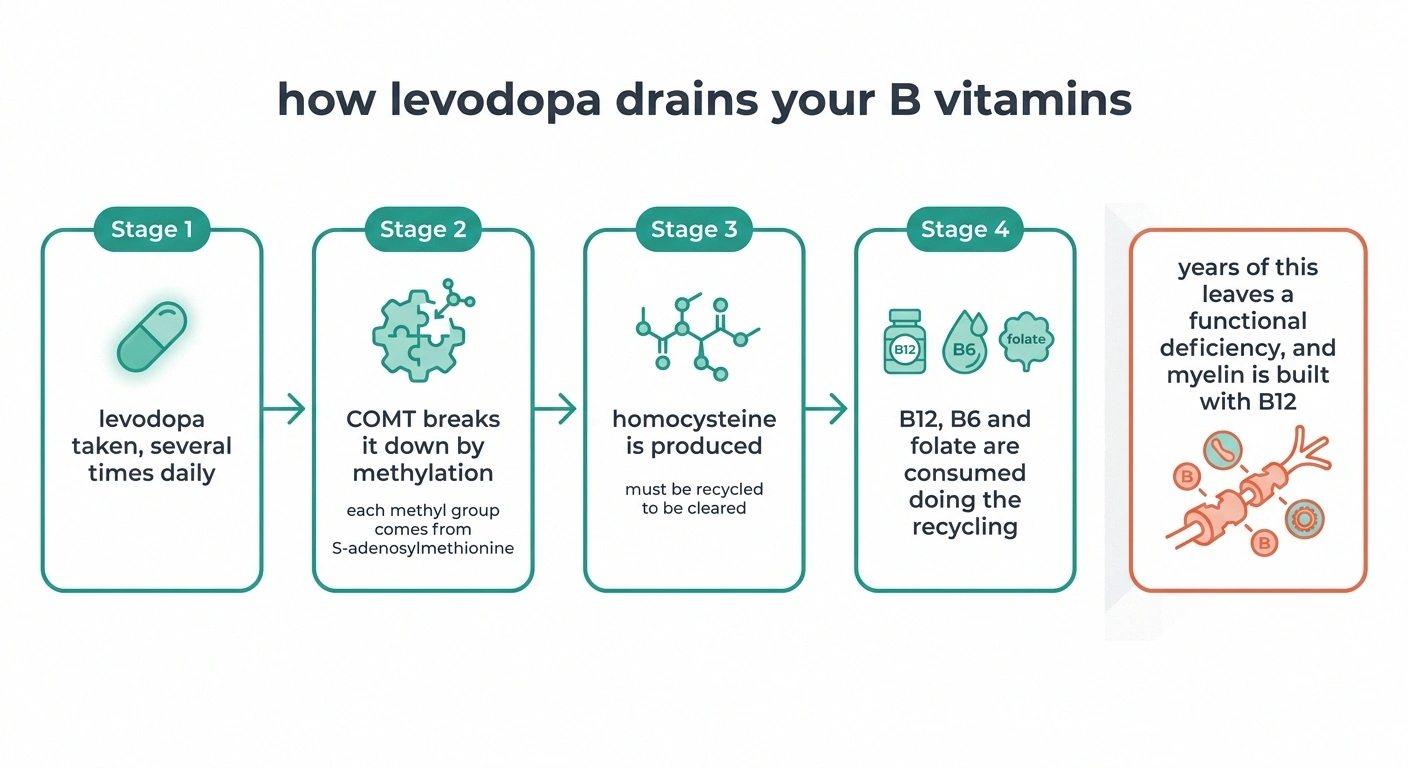
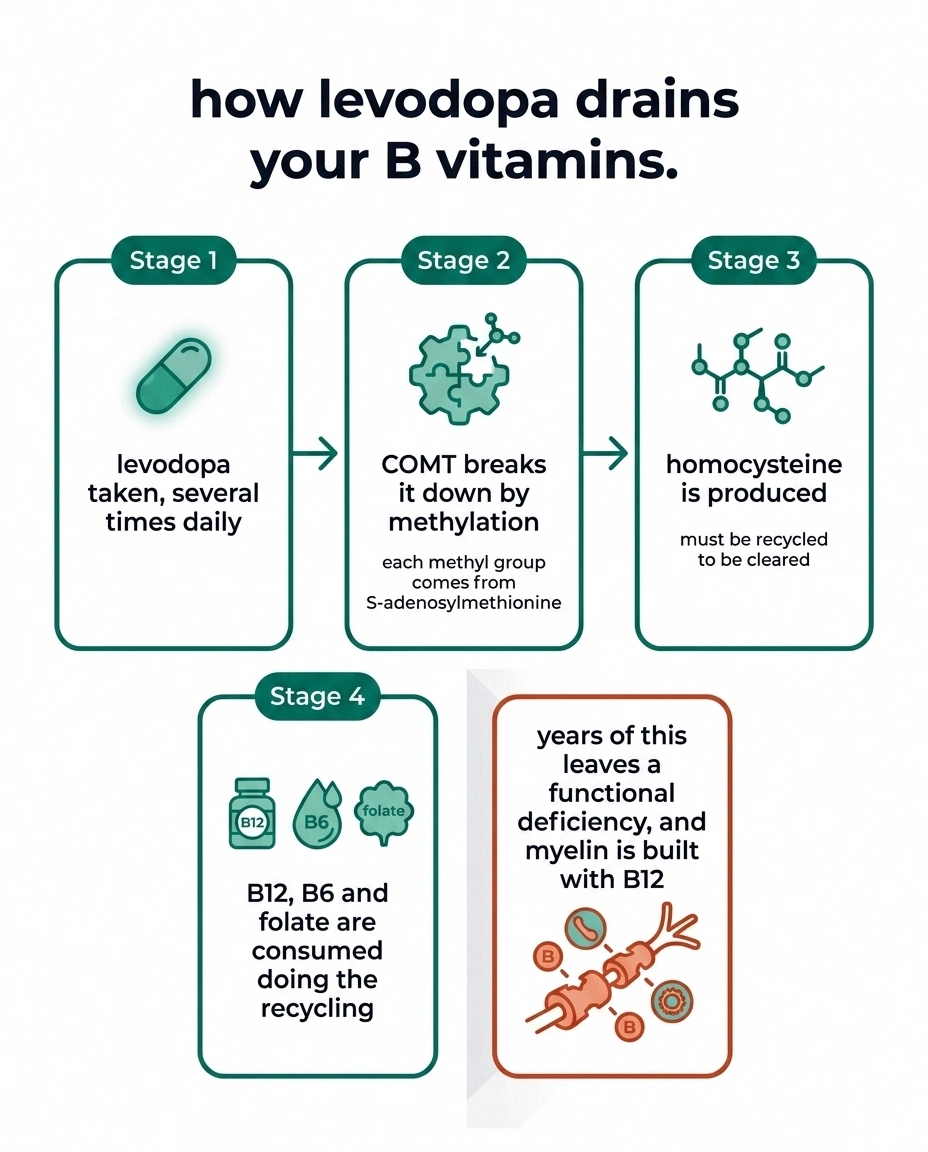
Levodopa does not simply do its job and disappear. Your body has to break it down, and one of the main routes is an enzyme called COMT, short for catechol-O-methyltransferase.
The name gives away the mechanism. COMT works by methylation, which means attaching a small chemical tag called a methyl group onto the levodopa molecule so it can be cleared. Each methyl group has to come from somewhere, and the body's universal donor is a compound called S-adenosylmethionine.
Every time that donor hands off a methyl group, it becomes homocysteine.
Homocysteine is not meant to accumulate. Under ordinary conditions the body recycles it promptly, and that recycling depends on three cofactors: vitamin B12, vitamin B6, and folate. They are the workers on the cleanup crew.
Now put someone on levodopa several times a day for years. The methylation demand runs high and continuously. The cleanup crew works overtime, and the cofactors get consumed faster than a typical diet replaces them. Homocysteine climbs. B12 and folate reserves drain.
The result is a functional B-vitamin deficiency created by a medication, and the nervous system pays for it first. B12 is required to build and maintain myelin, the insulating sheath around nerve fibers. Without enough of it, the longest peripheral nerves start losing insulation and function, which produces the familiar pattern: numbness and burning in the feet that climbs slowly upward over months.
This is the same category of problem seen with other long-term medications. The parallel case that most people have heard of is metformin and B12 depletion, which works through a different mechanism but produces a strikingly similar clinical picture.
Why the Standard B12 Test Misses It
Serum B12 measures how much B12 is floating in your blood. What matters clinically is how much is actually getting used inside cells, and those two numbers can diverge.
Asking for two extra tests, in one sentence
Neither test is unusual or expensive, but neither appears on a default neuropathy order set, so they have to be named:
“I've been on levodopa for [number] years. Could we add methylmalonic acid and homocysteine to the blood work, since a normal serum B12 wouldn't rule out a functional deficiency?”
Naming the reason matters more than naming the tests. It signals you are asking about functional status rather than requesting a repeat of something already done.
A substantial portion of circulating B12 is bound to a protein that does not deliver it to tissue. Someone can carry a respectable-looking total while the usable fraction runs low. Laboratory reference ranges compound the problem, because the lower bound on many B12 ranges sits well below the level at which neurological symptoms begin appearing.
Two tests read the functional picture instead:
Methylmalonic acid, usually written MMA. This compound builds up when B12 is not available to process it inside cells. An elevated MMA indicates functional B12 deficiency regardless of what the serum number says. In one study of Parkinson's patients, serum MMA correlated with the presence of neuropathic pain.
Homocysteine. Elevated when B12, B6, or folate are insufficient for the recycling job, and directly elevated by levodopa's methylation demand. It is the marker that ties the medication to the deficiency.
The strength of the combination shows in the numbers. Among 34 Parkinson's patients found to have peripheral neuropathy with no other identified cause, 32 of them, or 94 percent, had abnormal B12, homocysteine, or MMA. Almost everyone. The deficiency was there to be found in nearly every case where someone thought to look.
If you have had B12 checked and told it was fine, the question worth asking is whether MMA and homocysteine were included. Usually they were not. Our guide to interpreting neuropathy blood test results covers how to read these values once you have them.
Is This the Parkinson's or the Medication?

Both, in proportions that remain genuinely contested. This deserves a straight answer rather than a tidy one.
Parkinson's disease itself is associated with peripheral neuropathy independent of any treatment. The abnormal alpha-synuclein protein that characterizes the disease has been found in peripheral nerve tissue and in the skin. Add the fact that Parkinson's is a condition of later life, when diabetes and age-related nerve changes are common anyway, and the background rate of neuropathy in this population is already elevated before a single tablet is taken.
Layered on top of that is the levodopa effect, and the evidence for it is strong. Peripheral neuropathy in Parkinson's is consistently associated with levodopa exposure, particularly at higher cumulative doses. A 2026 analysis in Muscle & Nerve examining this question concluded that neuropathy is a common comorbidity in Parkinson's, strongly associated with levodopa exposure and especially with higher doses, and called for routine clinical, neurophysiological, and biochemical monitoring alongside preventive vitamin strategies.
The useful reframe is that the attribution question does not change what you do next. Whether the neuropathy is mostly disease, mostly drug, or a mix, the B-vitamin status is testable, the deficiency is correctable, and correcting it is worth doing either way. The broader relationship between the two conditions is covered in our article on Parkinson's disease and neuropathy.
What does change with attribution is expectation. Neuropathy driven by a correctable vitamin deficiency can improve with correction. Neuropathy from the disease process itself is less likely to reverse, though it may stabilize.
The Intestinal Gel Raises the Stakes
For advanced Parkinson's, levodopa-carbidopa intestinal gel, known as LCIG and sold as Duopa or Duodopa, delivers medication continuously through a tube into the small intestine. It solves a real problem with motor fluctuations. It also delivers a higher and steadier total levodopa exposure, and the neuropathy data reflect that.
Studies have consistently reported higher rates of peripheral neuropathy with intestinal gel delivery than with oral therapy. Cases tend to be sensorimotor polyneuropathy, with some appearing over weeks and others over years.
Two findings from this literature are worth carrying into a decision about starting the infusion.
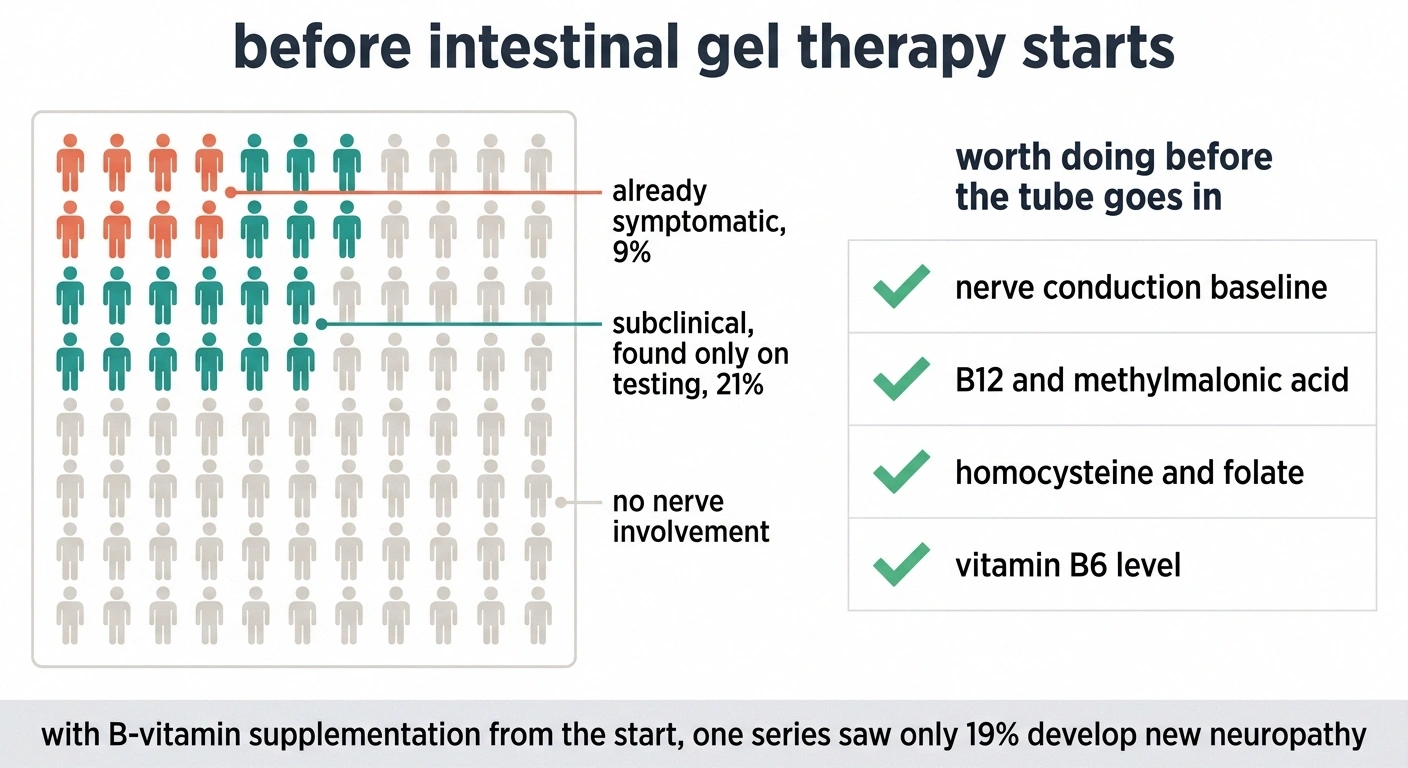
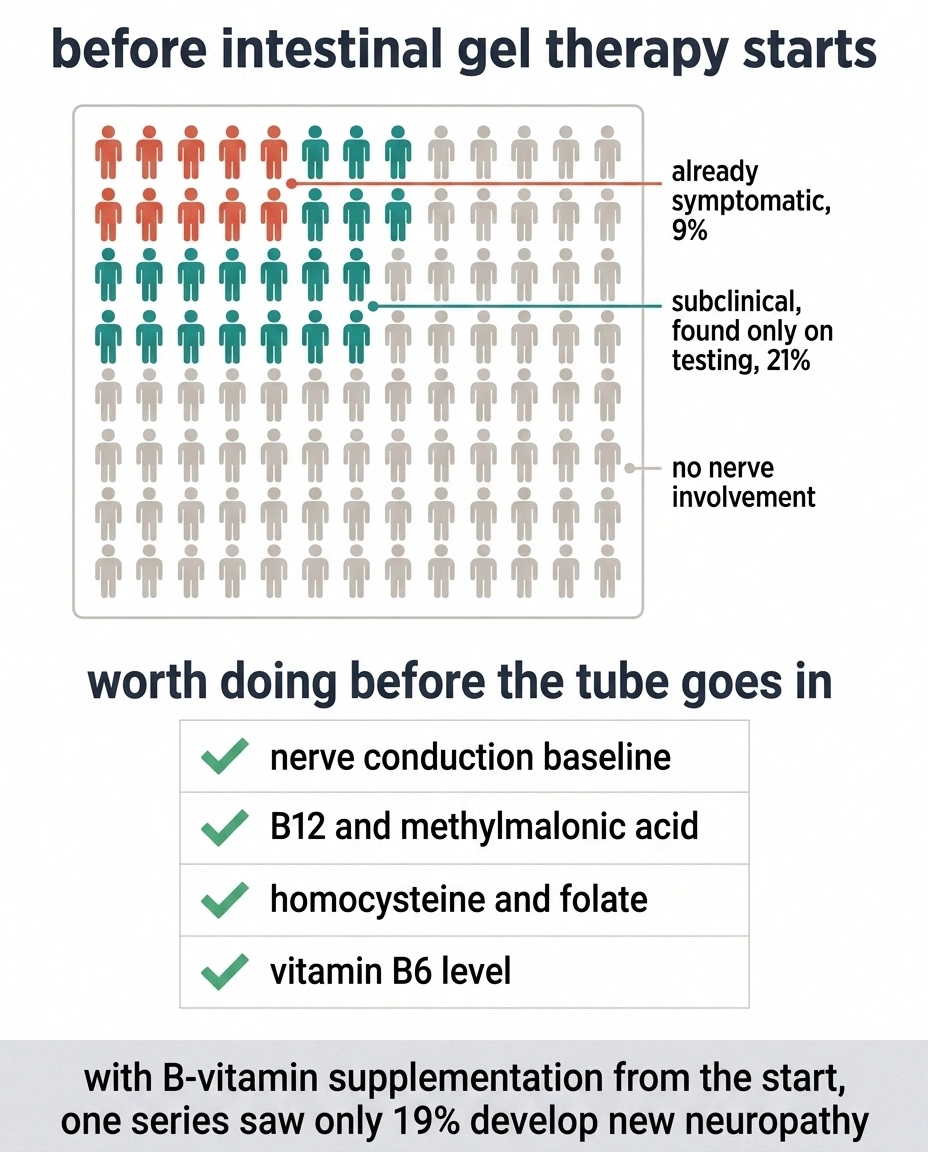
The first is that baseline matters enormously. In one cohort assessed before starting LCIG, 9 percent already had symptomatic neuropathy and another 21 percent had subclinical neuropathy detectable on testing but not yet causing symptoms. Nearly a third of candidates already had nerve involvement before the tube was placed. Without a baseline assessment, any symptoms appearing later get attributed to the infusion by default, correctly or not.
The second finding is the encouraging one. In a series of 30 patients started on LCIG with early and continuous B-vitamin supplementation from the outset, the rate of new-onset polyneuropathy was 19 percent, and it stayed stable across long-term follow-up. That is a low figure for this population, and it suggests the supplementation strategy meaningfully changes the trajectory when it starts at the beginning rather than after symptoms appear.
If intestinal gel therapy is on the table, the window before it starts is the highest-leverage moment in this entire story. Baseline nerve testing and baseline B12, MMA, homocysteine, and folate levels cost very little and make everything that follows interpretable.
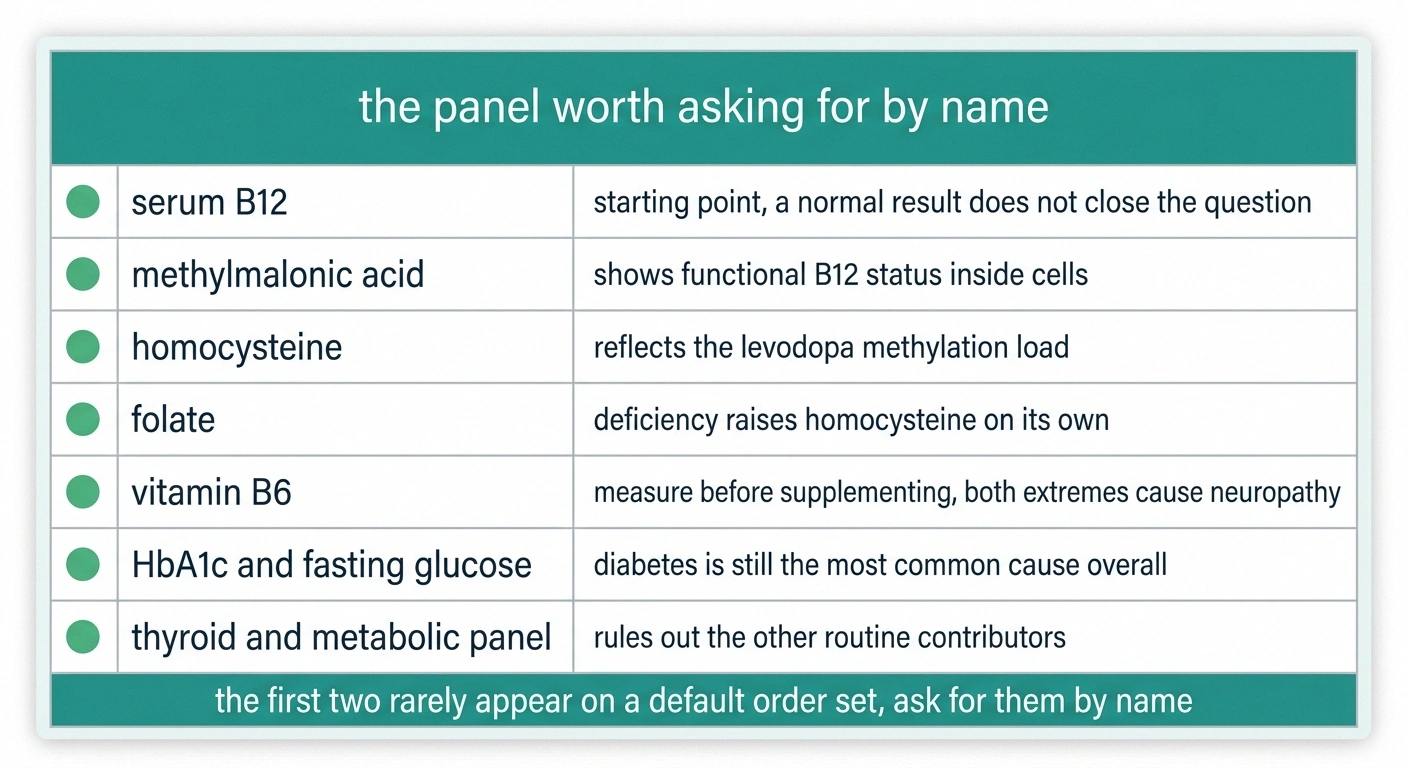
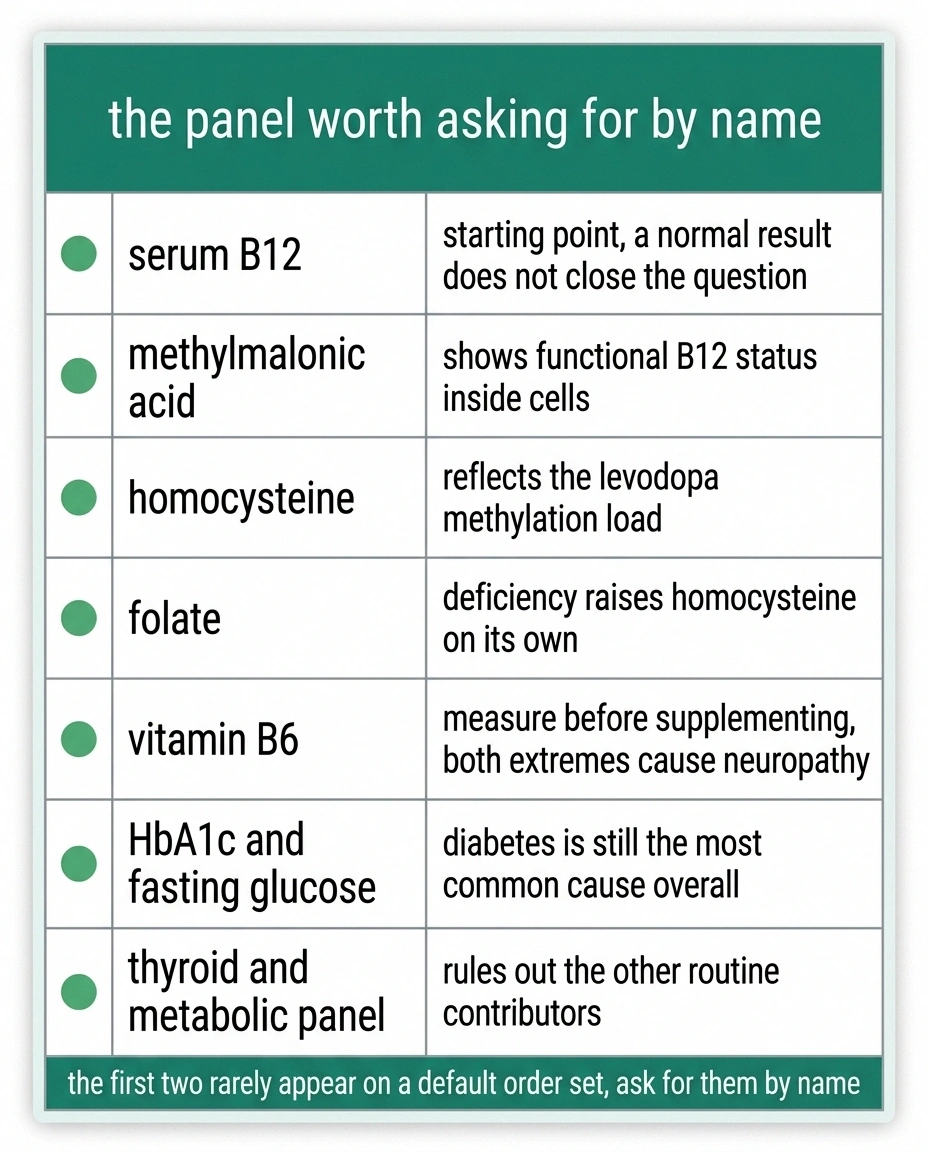
The Lab Panel Worth Asking For
A complete picture for someone on levodopa with nerve symptoms includes:
- Serum B12 as the starting point, understanding that a normal result does not settle the question
- Methylmalonic acid for functional B12 status at the cellular level
- Homocysteine for the combined B12, B6, and folate picture and the levodopa methylation load
- Folate, since deficiency here elevates homocysteine independently
- Vitamin B6, which is worth measuring rather than assuming in either direction, for reasons covered in the next section
- Hemoglobin A1c and fasting glucose, because diabetes remains the most common cause of neuropathy generally and coexists frequently
- Thyroid function and a basic metabolic panel to rule out the other routine contributors
This is a standard neuropathy workup with MMA and homocysteine specifically added. Neither is exotic, and neither is expensive, but neither appears on a default order set. You may have to ask for them by name. Our overview of lab tests for neuropathy covers the broader panel in detail.
The B6 Trap
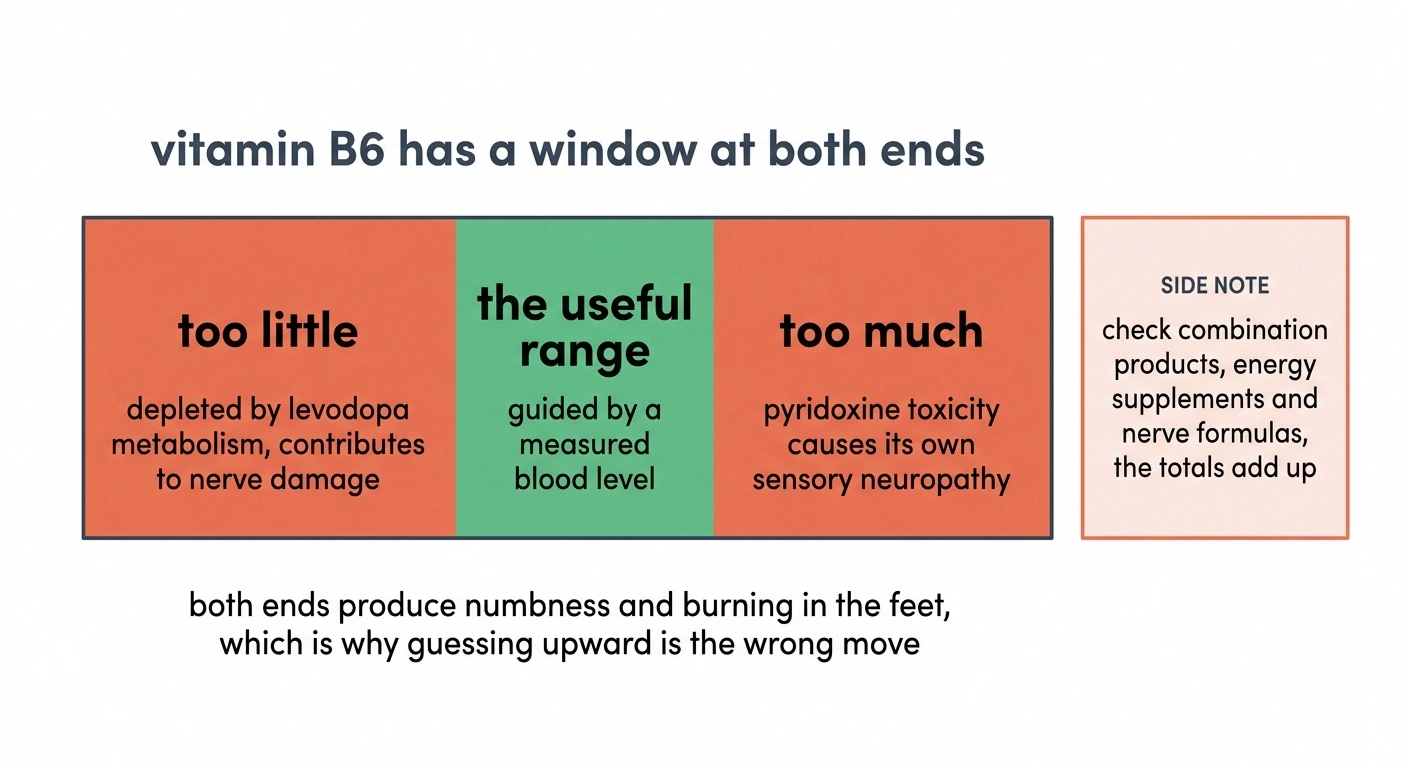
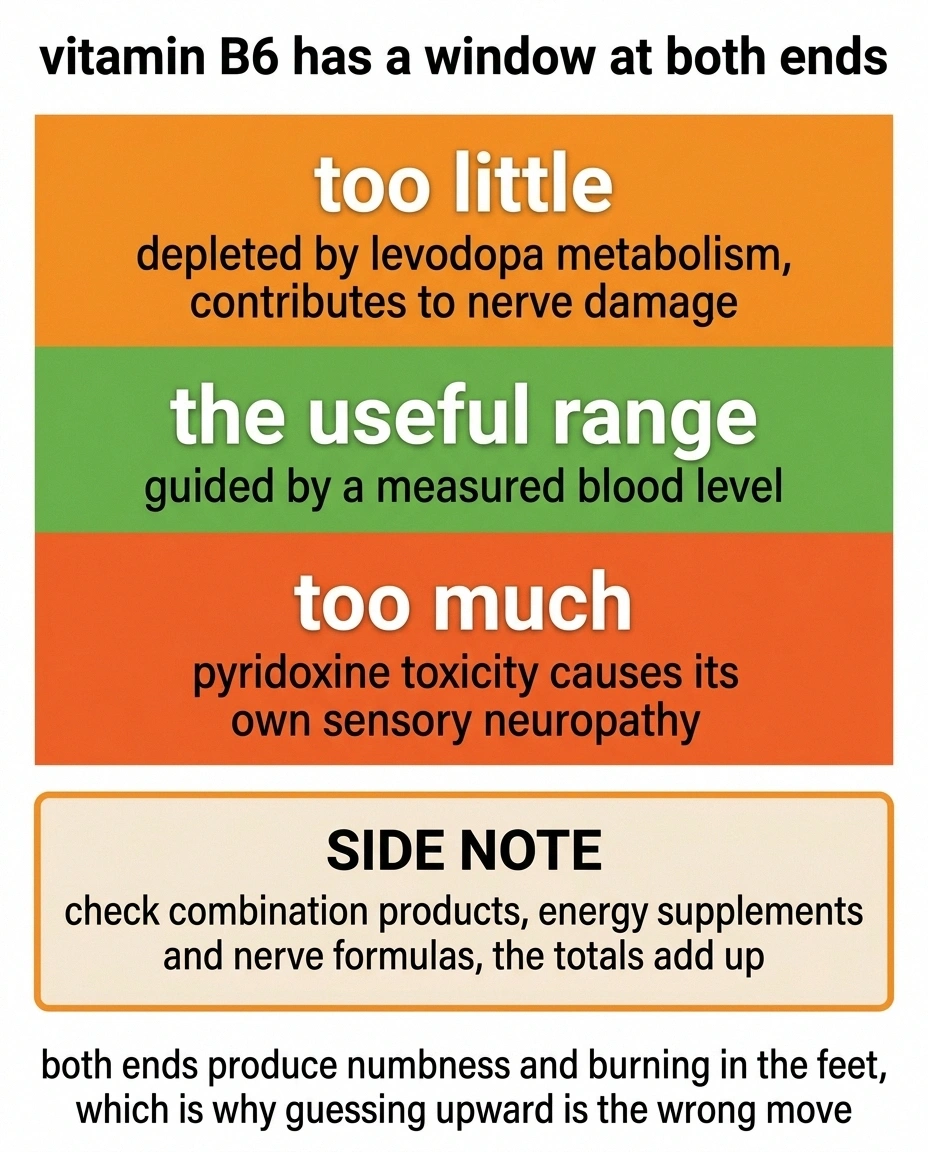
This is the section to read twice, because the intuitive response to everything above is to buy a B-complex supplement, and B6 is where that goes wrong.
Audit the shelf before you add anything
B6 appears in more products than most people realize, and nobody adds the columns up. Check every label you take daily and write the milligrams next to it.
| Where to look | Listed as | Your amount |
|---|---|---|
| Daily multivitamin | Vitamin B6, pyridoxine HCl | ____ mg |
| B-complex | P5P, pyridoxal-5-phosphate | ____ mg |
| Nerve support formula | Often the highest single source | ____ mg |
| Energy drink or shot | Frequently well above daily needs | ____ mg |
| Fortified cereal or shake | Per serving, and servings vary | ____ mg |
Take the total to your appointment. It is a more useful number than any single label.
Vitamin B6 in excess causes peripheral neuropathy. Not a theoretical risk, not a rare idiosyncrasy: a well-documented sensory neuropathy from pyridoxine toxicity, producing numbness, burning, and unsteadiness in the feet. The symptoms are close enough to B12-deficiency neuropathy that the two are easily confused, and someone who overshoots on B6 while trying to fix a B12 problem can end up worse with a lab panel that looks like it should be improving.
The doses involved are not extreme. High-dose B6 supplements sold over the counter, taken daily over months, are enough. B6 also appears in many combination products, energy supplements, and nerve-support formulas, and people frequently take several at once without adding up the total.
The detail that makes this cruel is that B6 is one of the cofactors depleted by levodopa metabolism, so the person taking it has a legitimate reason to. The correct move is to measure the level and let the dose follow the result rather than guessing upward. Our article on vitamin B6 toxicity neuropathy covers the thresholds and the recovery picture.
A historical note that still causes confusion: decades ago, high-dose B6 was known to interfere with levodopa by accelerating its breakdown before it reached the brain. Modern formulations combine levodopa with carbidopa specifically to block that peripheral breakdown, which largely resolves the interference concern. It does not resolve the toxicity concern. Those are two separate issues, and only one of them was fixed by carbidopa.
What Correction Actually Looks Like
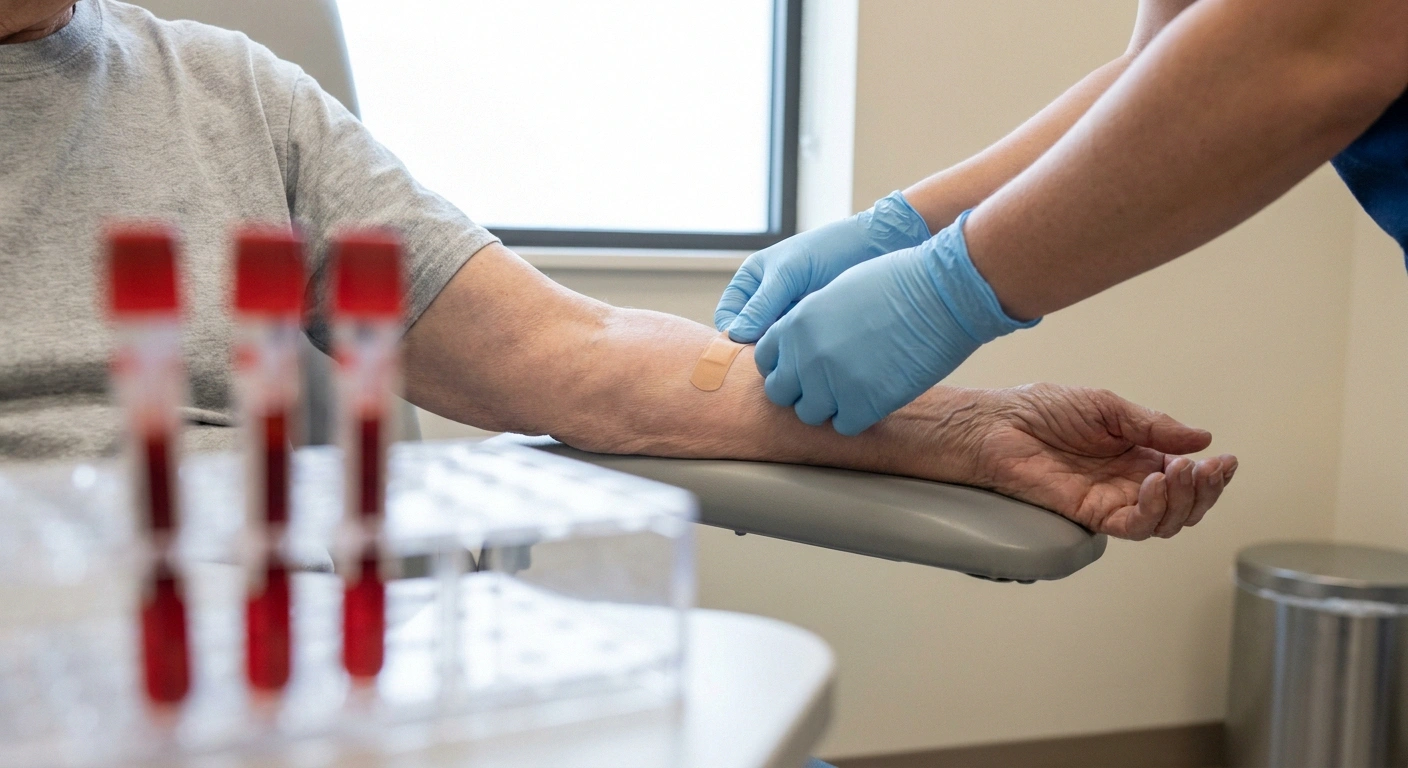
When testing confirms a deficiency, treatment is straightforward in principle.
Labs move first, symptoms move later
Weeks 2 to 8. Homocysteine and methylmalonic acid typically begin falling. Nothing has changed in your feet yet, and that is expected rather than a sign the plan is wrong.
Month 3. Recheck levels. This is the point at which the biochemistry should confirm the deficiency is being corrected.
Months 3 to 12. Symptom change, if it comes. Burning and numbness generally ease before balance and coordination do, because the fibres carrying position sense recover slowest.
Ongoing. Levodopa keeps creating the demand, so replacement continues and levels get rechecked rather than confirmed once.
Stopping progression counts as a result. Damage present for years is less likely to fully reverse than damage caught in its first months, which is the whole argument for testing early.
B12 replacement is given orally at high dose or by injection. Injections are typically chosen when absorption is questionable or when neurological symptoms are present and speed matters. The comparison between the two routes is covered in our piece on B12 injections versus oral supplements. For most people, high-dose oral B12 works well, and the injection is a matter of certainty rather than superiority.
Folate is replaced alongside it, and some people use the active form, methylfolate, particularly where genetic variation in folate processing is suspected.
B6 is replaced only to the measured need, at conservative doses, with follow-up testing.
The realistic expectation: homocysteine and MMA typically respond within weeks to a couple of months. Symptoms respond more slowly, because nerve fibers repair at their own pace, and the fibers involved here are the longest in the body. Improvement over six to twelve months is a reasonable frame. Numbness and burning often ease before balance and coordination do.
Correction may also stop progression rather than reverse it, which is a genuine result even when it does not feel like one. Nerve damage that has been present for years is less likely to fully reverse than damage caught early, which is the entire argument for testing sooner.
Most of what holds true for vitamin deficiency neuropathy generally holds true here, with the levodopa-specific wrinkle that the depleting force continues as long as the medication does. Correction is not a one-time fix. It is ongoing replacement against an ongoing drain, and levels need periodic rechecking rather than a single confirmation that things improved.
Falls, and Why This Combination Is Worse Than Either Part
Parkinson's already impairs balance through rigidity, altered gait, postural instability, and slowed righting reflexes. Peripheral neuropathy removes the sensory information from the feet that the balance system uses to make corrections.
Two systems, both offline
- What Parkinson's takes
- The correction. Rigidity, altered gait, postural instability and slowed righting reflexes mean the recovery movement arrives late or not at all.
- What neuropathy takes
- The signal. Without reliable sensation from the soles, the balance system does not learn it needs to correct until the body is already tilting.
- Why it is not simple addition
- Losing the sensor and the actuator together removes both halves of one loop. Fall prevention deserves to start the same week as the blood work, not after the results come back.
The four changes with the best return: light the route to the bathroom, remove the small rugs, put a firm-soled shoe on indoors, and start using the cane before it feels necessary.
Losing the sensor and the actuator at the same time is not additive. It multiplies. Someone with Parkinson's and neuropathy in the feet has a fall risk substantially higher than either condition alone would suggest, and the practical consequence is that fall prevention deserves to be treated as urgently as the neuropathy workup itself.
Lighting on the route to the bathroom, grab bars where you turn, removing the small rugs, footwear with a firm sole that transmits ground contact, and a cane or walker used before it feels necessary rather than after a fall. The full set of strategies is in our guide to neuropathy and fall prevention.
What to Raise at Your Next Neurology Visit
A short list that tends to move things forward:
- Can we check MMA and homocysteine along with B12, given how long I have been on levodopa?
- What is my current total daily levodopa dose, and has it increased over the past year?
- Should I be on preventive B12 and folate rather than waiting for a deficiency to appear?
- Has my B6 level been checked, and does anything I am taking contain B6?
- If intestinal gel therapy is being considered, can we get baseline nerve testing and baseline vitamin levels first?
- Are my balance problems being attributed entirely to Parkinson's when some of them may be coming from my feet?
That last question is the one that opens the most doors. Sensory loss in the feet gets absorbed into the Parkinson's diagnosis routinely, because unsteadiness is expected and nobody is surprised by it. The neuropathy hides inside a symptom everyone already has an explanation for. Naming it separately is what gets it tested.
Frequently Asked Questions
Can levodopa cause peripheral neuropathy?
The evidence strongly supports an association. Levodopa is broken down partly by the COMT enzyme through methylation, a process that consumes vitamin B12, B6, and folate and generates homocysteine. Long-term use at higher doses depletes those vitamins and elevates homocysteine, and both changes damage peripheral nerves. Peripheral neuropathy in Parkinson's is consistently linked to cumulative levodopa exposure, with higher rates at higher doses and with continuous intestinal infusion.
Why is my B12 normal if levodopa depletes it?
Serum B12 measures total circulating B12, much of which is bound to a protein that does not deliver it to tissue. Functional deficiency at the cellular level can exist alongside a normal-looking serum value. Methylmalonic acid and homocysteine reflect whether B12 is actually being used inside cells and are the more informative tests. Among Parkinson's patients with otherwise unexplained neuropathy, 94 percent in one study had an abnormality in B12, homocysteine, or methylmalonic acid.
Should everyone on levodopa take B vitamins?
Preventive B12 and folate supplementation is a reasonable strategy that many movement disorder specialists use, and one series of patients on intestinal gel who received B-vitamin supplementation from the start showed a low 19 percent rate of new neuropathy over long-term follow-up. B6 is the exception and should be guided by measured levels rather than taken at high dose routinely, because excess B6 causes its own peripheral neuropathy. Decide this with the clinician managing your Parkinson's rather than at the supplement aisle.
How do I know whether my neuropathy is from Parkinson's or from the medication?
Often you cannot separate them cleanly. Parkinson's is associated with peripheral neuropathy independently of treatment, and both conditions are common in the same age group where diabetes also contributes. What testing can establish is whether a correctable vitamin deficiency is part of the picture, and that part is worth correcting regardless of how the remainder is attributed.
Does the intestinal gel cause more neuropathy than pills?
Reported rates are higher with levodopa-carbidopa intestinal gel than with oral therapy, which fits the pattern of neuropathy tracking with total levodopa exposure. The picture is complicated by the fact that many candidates already have neuropathy before starting: one cohort found 9 percent symptomatic and 21 percent subclinical neuropathy at baseline. Baseline nerve testing and vitamin levels before starting infusion therapy make later changes far easier to interpret.
Can this neuropathy be reversed?
Partly, and it depends on how long it has been present. Correcting a B12 or folate deficiency often stops progression and can improve symptoms over six to twelve months, since nerve repair is slow. Long-standing damage is less likely to fully reverse. Because levodopa continues to create the demand that caused the deficiency, replacement is ongoing rather than a single course, and levels need periodic rechecking.
What is homocysteine and why does it matter here?
Homocysteine is a byproduct of methylation reactions, including the one that clears levodopa. The body recycles it using B12, B6, and folate. When those run short or the methylation load runs high, homocysteine accumulates. Elevated levels are associated with peripheral nerve damage and are the marker that most directly connects levodopa therapy to the deficiency picture.
How quickly should I expect blood levels to improve after starting supplementation?
Homocysteine and methylmalonic acid usually respond within a few weeks to a couple of months of adequate replacement. Symptoms lag behind the lab values, sometimes considerably, because peripheral nerve fibers repair slowly and the affected fibers are the longest in the body. A recheck of levels at roughly three months, with symptom assessment continuing well past that, is a reasonable rhythm.
About the Author