
The message from my neighbor Ruth arrived at 11 p.m. on a Tuesday. “My hands are tingling. I've been shaking them out to try to make it stop. My son is convinced it's carpal tunnel — I'm convinced it's the neuropathy running in my family. Who's right?”
Ruth's question is one of the most common ones I hear. Hand numbness and tingling send a lot of people down two different rabbit holes — carpal tunnel syndrome and peripheral neuropathy — and the two conditions get talked about as if they were the same thing. They aren't. They come from different problems, have different patterns, need different tests, and respond to different treatments. Getting them mixed up can mean months on a wrist splint that was never going to help, or missing a nutritional deficiency that's quietly damaging nerves throughout the body.
The good news is that once you know what to look for, you can usually make a pretty educated guess about which one you're dealing with — and, importantly, whether you might have both, which turns out to be more common than most people realize. This is a guide to sorting it out, understanding what testing your doctor might use, and knowing when to be seen quickly.
What Carpal Tunnel Syndrome Actually Is
Carpal tunnel syndrome is a single-nerve, single-spot problem. The median nerve runs from your neck, down your arm, and into your hand. On its way into the palm, it passes through a narrow, bony-and-ligamentous tunnel at the wrist — the carpal tunnel. When that tunnel gets crowded — from swelling, thickening of the ligament roof, or repeated wrist positions that squeeze the space — the median nerve gets compressed. That compression is what produces the classic symptoms.
The median nerve doesn't cover the whole hand. It covers the thumb, the index finger, the middle finger, and the thumb-side half of the ring finger. That's the whole territory. The pinky and the outer half of the ring finger are supplied by a different nerve — the ulnar — which passes into the hand outside the carpal tunnel and is unaffected. This is one of the most useful distinguishing features of carpal tunnel: if your pinky is tingling too, it isn't purely carpal tunnel.
Carpal tunnel has a signature timing. It's worse at night. People wake up at 2 a.m. with hands that feel dead or on fire, get up, and shake their hands out until the feeling comes back. During the day, activities that flex the wrist — reading a book in bed, holding a phone up to the ear for a long call, gripping a steering wheel on a long drive — reliably trigger it.
Risk factors include repetitive wrist work, pregnancy (fluid retention crowds the tunnel), hypothyroidism, obesity, rheumatoid arthritis, previous wrist fractures, and — importantly — diabetes. The overlap with diabetes is one of the reasons carpal tunnel and neuropathy get so often confused.
Left untreated for a long time, carpal tunnel can progress from intermittent tingling to constant numbness to weakness — specifically weakness of the thumb-base muscles, which show up as trouble pinching, dropping small objects, and eventually visible flattening at the base of the thumb. But this progression takes months to years and can usually be interrupted at any point along the way with the right treatment.
What Peripheral Neuropathy Actually Is
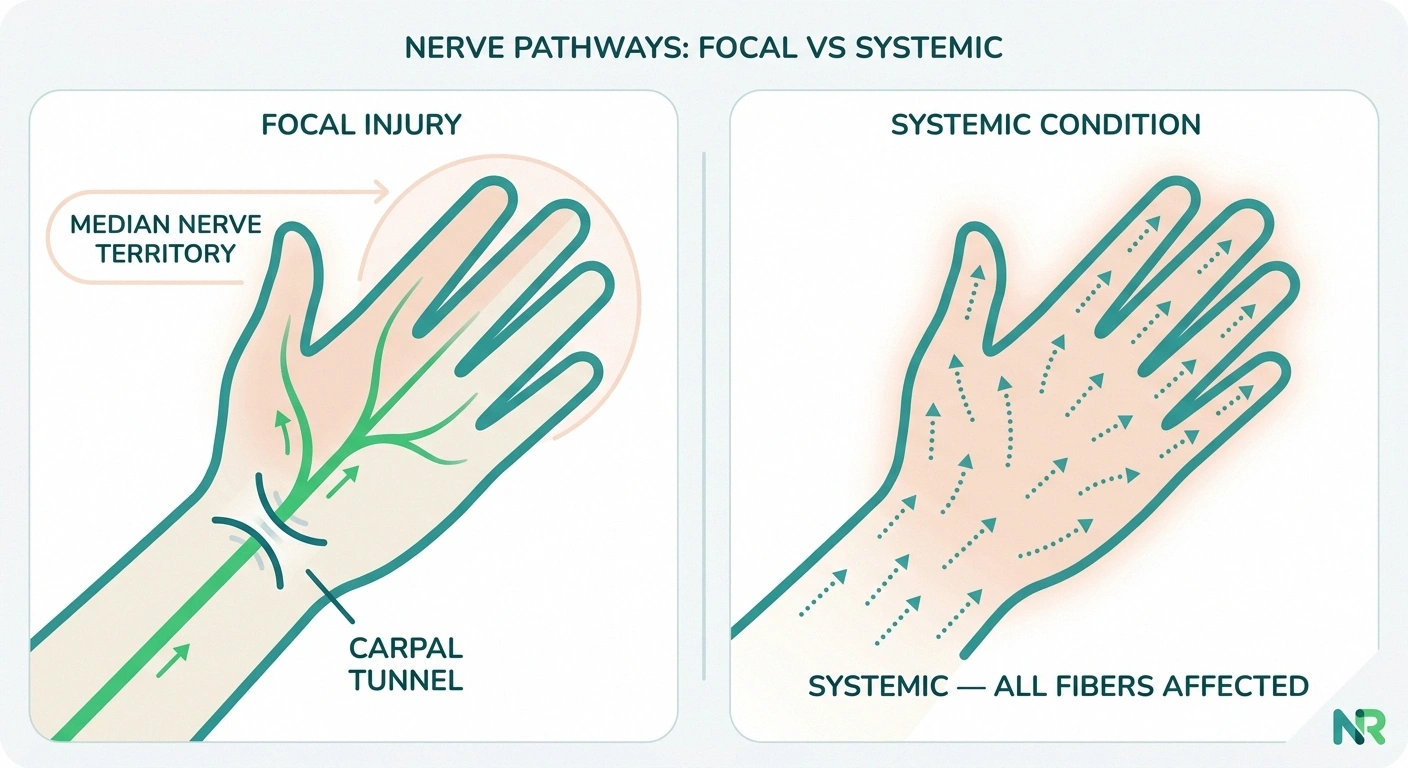
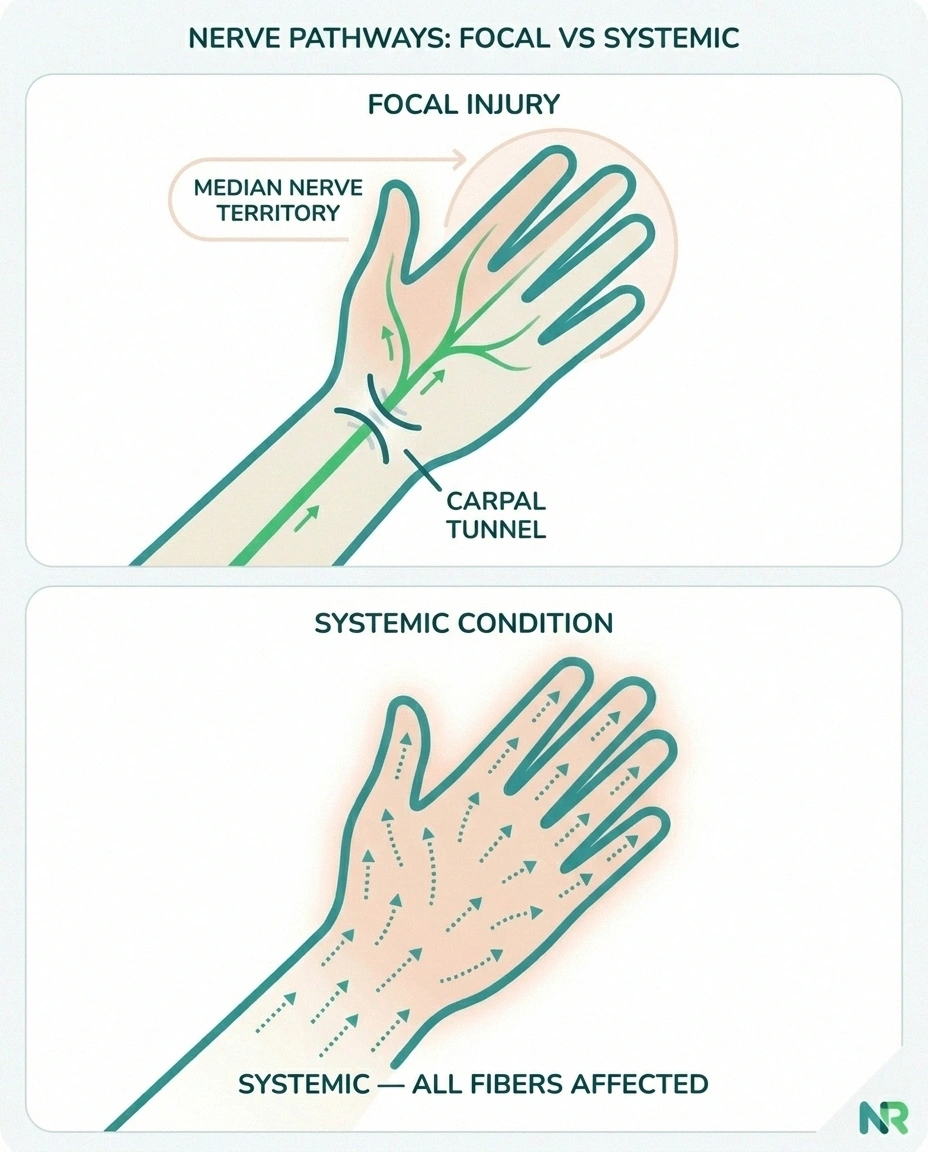
Peripheral neuropathy is a whole-system problem. Instead of one nerve getting squeezed at one spot, many nerve fibers throughout the body are damaged — usually because of something affecting the whole nervous system at once. Diabetes is the most common driver by a wide margin, but the list of causes is long: chronic alcohol use, chemotherapy, B12 or thiamine deficiency, autoimmune conditions, certain medications, hereditary factors, and a not-small “we can't find the reason” category we call idiopathic neuropathy.
Peripheral neuropathy has a signature shape too, and it's very different from carpal tunnel. It's symmetric. Whatever is affecting your left hand is affecting your right hand in the same way. It's length-dependent — the longest nerves get damaged first, which is why feet almost always develop symptoms before hands. And it usually involves all the fingers, not a specific subset. The classic description is “wearing invisible gloves and stockings.” Some people describe it as burning, some as tingling, some as pins-and-needles, and some as a dead-numb feeling. Others live with sharp shooting pains or allodynia, where light touch — a bedsheet at night, a breeze on the skin — feels wrong or painful. If you want the full picture of what those sensations look like from the inside, the small-fiber neuropathy overview covers the fine-tingling end of the spectrum in more depth.
The nighttime pattern with peripheral neuropathy is real but has a different mechanism than carpal tunnel. During the day, the nervous system has lots of competing signals to sort through, and mild nerve misfiring can get lost in the noise. At night, when the world quiets down, that background misfiring becomes the main thing you feel. That's why so many people find their neuropathy is worse at night even though nothing has actually changed in the nerves themselves.
Peripheral neuropathy usually creeps in slowly — over months to years — and doesn't get triggered by specific wrist positions. Shaking your hands out doesn't help it. It doesn't wake you up abruptly the way carpal tunnel does. It's more of a constant, evolving background presence.
Six Questions That Usually Sort Them Out

Here's the mental checklist I run through when someone describes hand symptoms to me. No single answer is diagnostic — a doctor still needs to weigh the whole picture — but this framework does a good job of pointing in the right direction.
| Question | Carpal Tunnel | Neuropathy |
|---|---|---|
| Which fingers? | Thumb, index, middle, half of ring | All fingers |
| Same on both hands? | Often one-sided or uneven | Symmetric |
| Feet also affected? | No | Often yes (usually first) |
| Wake with dead hand, shake it out? | Classic pattern | Not typical |
| Triggered by wrist position? | Yes — flexion is the trigger | No |
| Systemic drivers? | Repetitive work, wrist injury, thyroid, pregnancy | Diabetes, chemo, alcohol, B12, family history |
1. Which fingers are affected? If it's your thumb, index finger, middle finger, and the thumb-side of your ring finger — with the pinky spared — that's a carpal tunnel pattern. If it's all your fingers, or if the tingling is diffuse across the whole hand without respecting those boundaries, that's more consistent with neuropathy.
2. Are both hands affected in the same pattern? Carpal tunnel is often one-sided, at least at first, and even when it's bilateral one side is usually clearly worse than the other. Peripheral neuropathy is symmetric — whatever your left hand is doing, your right hand is doing about the same.
3. Do your feet also have symptoms? This is a big one. If you have tingling, numbness, or burning in both feet, that strongly suggests peripheral neuropathy, since carpal tunnel doesn't cause foot symptoms. It's possible to have both conditions at once, in which case the foot symptoms come from the neuropathy and the wrist-specific symptoms come from the carpal tunnel.
4. Does it wake you up at night, and does shaking your hand make it stop? This is a very classic carpal tunnel pattern. If you find yourself waking up with a dead hand, sitting on the edge of the bed, and shaking it out until the feeling returns, that's a hallmark story. Peripheral neuropathy tends to be present more constantly and doesn't respond to shaking.
5. Does the tingling get triggered by specific hand positions? Reading a book with your wrist flexed, holding a phone up to your ear for a long call, driving with your hands at the top of the wheel — if these things reliably bring on symptoms within minutes, that's a positional pattern that fits carpal tunnel. Peripheral neuropathy is not position-dependent in that way.
6. What's your medical picture? Do you have diabetes or prediabetes? A history of chemo? Heavy alcohol use? A known B12 issue? A family history of neuropathy? Any of these tilts the picture toward peripheral neuropathy. Do you have hypothyroidism, rheumatoid arthritis, a wrist injury, or a job with a lot of repetitive wrist work? Those tilt toward carpal tunnel.
When It's Actually Both

Here's the twist that catches a lot of people — and their doctors — off guard. Carpal tunnel and peripheral neuropathy commonly coexist, especially in people with diabetes. The reason is straightforward: diabetes makes nerves more vulnerable everywhere, including at compression points like the wrist, so a diabetic person can develop both a systemic length-dependent neuropathy and a localized median-nerve entrapment at the same time.
When this happens, the picture is a hybrid. There's a background of burning or tingling that's symmetric across both hands and also present in the feet — the neuropathy piece. Layered on top is a positional worsening at night and with wrist flexion, and thumb-side-heavy hand symptoms — the carpal tunnel piece.
Why does the hybrid case matter so much? Because if only the carpal tunnel gets addressed — with a splint, an injection, or even surgery — the underlying neuropathy keeps burning and the person feels like the treatment failed. And if only the neuropathy gets treated — with better blood sugar control and gabapentin — the persistent nighttime hand symptoms and the median-nerve-specific weakness stay right where they are.
This is why “my carpal tunnel surgery didn't really work” is a story worth pausing on. Sometimes it means the surgery was the wrong call. But often it means there was an unrecognized neuropathy underneath, and the surgery worked exactly as it should have on the carpal tunnel piece — the remaining symptoms are a different problem that needs a different approach.
Testing Your Doctor May Order
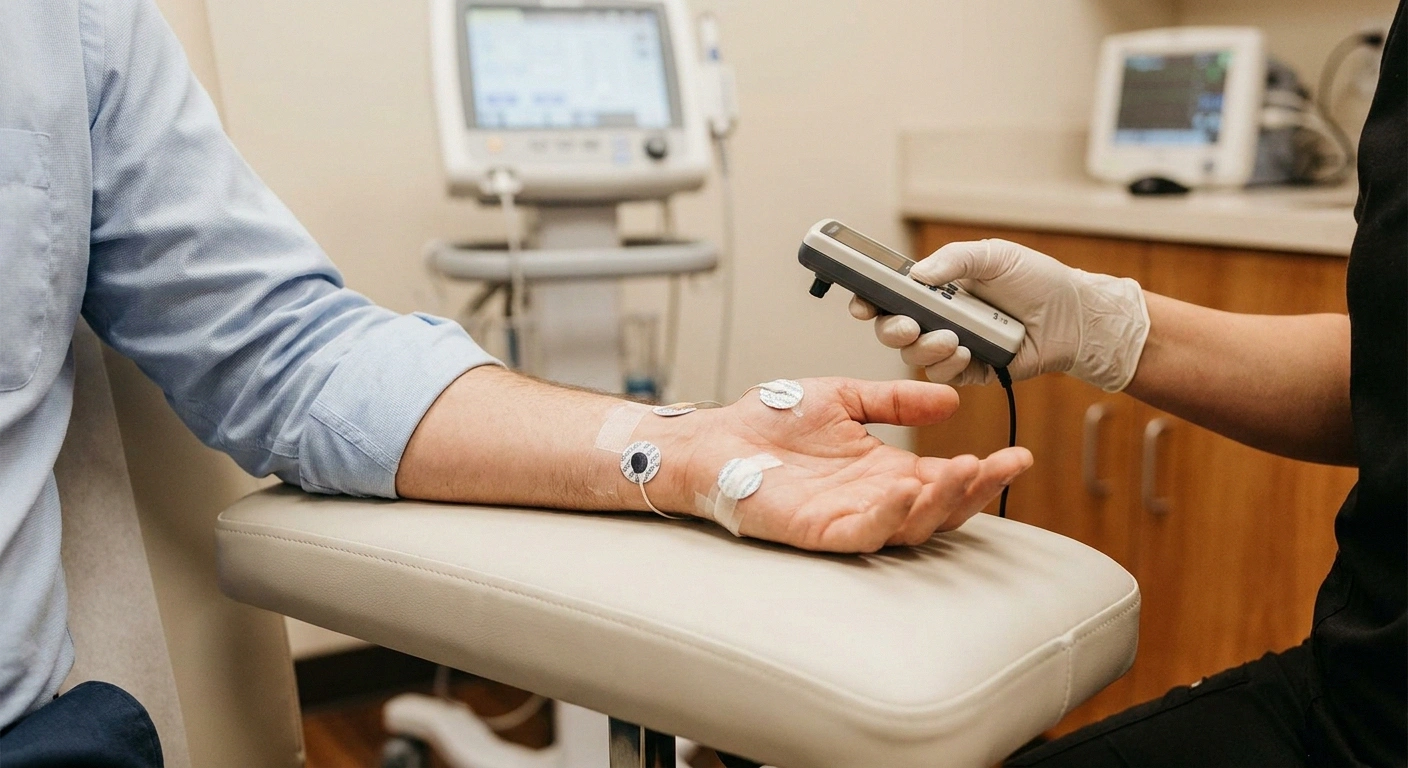
The three main tests that come up in this differential are the clinical exam, nerve conduction studies with EMG, and blood work. They each answer a slightly different question.
The clinical exam includes some quick maneuvers. Phalen's test asks you to flex both wrists and press the backs of your hands together for about a minute — if this reproduces your symptoms, it points toward carpal tunnel. Tinel's sign involves the doctor tapping over the median nerve at the wrist — a positive result is a tingling shock that travels into the fingers. For neuropathy, the exam usually includes touching a thin plastic filament (a monofilament) to different spots on your feet and hands to test for loss of protective sensation, tapping a tuning fork to test vibration sense, and checking reflexes at the ankles and knees.
Nerve conduction studies and electromyography (EMG) are the gold standard for sorting out this differential. The nerve conduction study measures how fast electrical signals travel down specific nerves. In carpal tunnel, the study shows the median nerve slowing down as it crosses the wrist, while the ulnar nerve at the same wrist is normal. That focal, single-nerve pattern nails the diagnosis. In peripheral neuropathy, multiple nerves show slowed conduction or reduced signal strength in a symmetric, length-dependent pattern. The two patterns coexisting in one study is exactly how the hybrid case gets confirmed. If you want more depth on this testing, the article on neuropathy diagnosis walks through what to expect at these appointments.
Blood work isn't for carpal tunnel — it's for finding the cause of peripheral neuropathy. Standard panels usually include A1C or fasting glucose, vitamin B12, folate, thyroid, complete blood count, comprehensive metabolic panel, and often B6, thiamine, and immunoelectrophoresis if the workup is more thorough. Sometimes autoimmune markers get added if there's a specific suspicion. Blood work catches the treatable causes — a low B12 or a previously undiagnosed thyroid problem can flip the whole treatment plan.
Why Sorting Them Out Actually Changes What Helps

The treatments for these two conditions are genuinely different, which is why getting the diagnosis right matters more than just satisfying curiosity.
For carpal tunnel, the first-line treatments are conservative and mechanical. A wrist splint worn at night keeps the wrist in a neutral position and prevents the nighttime flexion that squeezes the nerve. Activity modification and ergonomic changes take pressure off during the day. A cortisone injection can bring down inflammation inside the tunnel and buy months of relief. Carpal tunnel release surgery — a small procedure that cuts the transverse carpal ligament roof of the tunnel — is highly effective for people whose symptoms don't settle with conservative measures. Most people who need surgery do well.
For peripheral neuropathy, the treatment is fundamentally about the underlying cause plus symptom management. If diabetes is the driver, tighter blood sugar control is job number one — this is the single most important thing a person with diabetic neuropathy can do. If B12 is low, replacement helps. If a medication is contributing, changing it (with the prescriber's guidance) can slow or reverse the damage. On top of the cause work, symptomatic treatment includes medications like gabapentin, pregabalin, or duloxetine; topical treatments; physical therapy; and lifestyle supports. A range of conservative and complementary approaches also has a real role, especially for the mild-to-moderate cases and the parts of symptom management that meds don't fully cover.
A wrist splint won't touch peripheral neuropathy. Gabapentin won't fix carpal tunnel. And when the two coexist, both treatments may need to happen in parallel.
Overlap Conditions Worth Ruling Out
A few other conditions can look like either carpal tunnel or peripheral neuropathy — worth having on the radar in case your symptoms don't fit either pattern cleanly.
Cubital tunnel syndrome is compression of the ulnar nerve at the elbow. Instead of thumb-side tingling, it produces pinky and outer-ring-finger tingling and can weaken the small muscles of the hand. Symptoms often flare with the elbow bent for long periods — sleeping with the arm folded, leaning on the elbow during long phone calls. This is the “cousin” of carpal tunnel and gets missed sometimes because both involve compressive nerve entrapment in the arm.
Cervical radiculopathy is a pinched nerve root in the neck, usually from disc or arthritis changes. It can radiate down the arm and produce tingling in the hand, but typically also involves neck pain, worsens with certain head positions, and follows a specific arm pattern related to which cervical nerve is affected.
Thoracic outlet syndrome is less common — compression of nerves and blood vessels as they pass out of the neck into the arm. Symptoms are often position-dependent and involve the whole arm rather than a specific hand pattern.
De Quervain's tenosynovitis is thumb-side wrist pain — not a nerve problem at all, but tendon inflammation. It sometimes gets initially confused with carpal tunnel because both live at the wrist.
If your symptoms don't fit a clean carpal tunnel or clean neuropathy picture, it's worth mentioning these to your doctor as possibilities worth ruling out.
When to Be Seen Right Away

Most hand tingling isn't a same-day emergency. But a few patterns deserve a prompt evaluation rather than a “let me try a splint and see” approach.
Constant numbness — not just tingling — in specific fingers. If you can't feel a piece of paper or a coin between your fingertips, the nerve involvement has crossed a threshold that responds better to earlier treatment.
Visible hand weakness or muscle wasting. Flattening at the base of the thumb, trouble opening a jar you used to open easily, dropping small objects because your grip fails — these are signs of nerve or muscle damage that has progressed and warrant timely attention.
Symptoms that started abruptly. Carpal tunnel and peripheral neuropathy both usually creep in over weeks to months. Sudden-onset hand numbness — especially with any weakness, facial changes, speech changes, or one-sided symptoms elsewhere — needs an urgent evaluation to rule out something like a stroke or an inflammatory nerve condition.
Symptoms after a fall, injury, or new medication. These give clues to a specific cause worth naming quickly.
Any progression from tingling to burning to numbness to weakness in a short period. The direction of change matters — nerves that are getting worse fast need faster answers.
Frequently Asked Questions
Can carpal tunnel turn into peripheral neuropathy?
No — they're different conditions with different mechanisms. Carpal tunnel is compression of one nerve at one spot. Peripheral neuropathy involves many nerve fibers throughout the body. What can happen is that someone develops both over time, especially if they have diabetes or another systemic condition. The carpal tunnel doesn't “become” the neuropathy — the two are coexisting.
Can peripheral neuropathy be misdiagnosed as carpal tunnel?
Yes, and it happens. A person with mild peripheral neuropathy affecting their hands may get labeled as carpal tunnel because the symptoms sound similar at a first pass. This is one of the reasons nerve conduction studies matter — they can distinguish a single-nerve compression at the wrist from a diffuse systemic nerve problem. If a “carpal tunnel” diagnosis isn't responding to standard treatment, it's reasonable to ask whether the diagnosis should be re-examined.
Which is more common?
In the general population, carpal tunnel is more common. In older adults, in people with diabetes, and in people who have both conditions coexisting, peripheral neuropathy becomes a much larger share of the picture. Both are common enough that hand symptoms should never be assumed to be one or the other without an actual exam.
Does a positive Phalen's test rule out neuropathy?
No. A positive Phalen's test — where flexing the wrists reproduces tingling — supports carpal tunnel but does not rule out coexisting peripheral neuropathy. Someone can have both. The exam finding tells you carpal tunnel is present; it doesn't tell you it's the only thing present.
Do wrist splints help peripheral neuropathy?
Not directly, no. Wrist splints work by keeping the wrist in a neutral position to reduce median-nerve compression at the carpal tunnel. Peripheral neuropathy isn't caused by compression, so a splint doesn't address it. That said, if someone has both conditions, a splint can still help the carpal tunnel piece even if the neuropathy piece is unchanged.
If I have diabetes and hand tingling, is it carpal tunnel or diabetic neuropathy?
It could be either — or both. Diabetes doubles or triples the rate of carpal tunnel, and it's the leading cause of peripheral neuropathy in the United States. A diabetic patient with hand symptoms often has both conditions at once, and sorting them out usually requires a clinical exam plus nerve conduction studies. The treatment often involves addressing both in parallel.
Can I have carpal tunnel in my feet?
Not exactly, but there is an analogous condition. Tarsal tunnel syndrome is compression of the tibial nerve at the ankle, and it produces burning and tingling in the sole of the foot — a foot equivalent to carpal tunnel. It's much less common than carpal tunnel and often overlaps with or gets confused for peripheral neuropathy in the foot.
How long does a nerve conduction study take?
Usually thirty to sixty minutes. The technician places small electrodes on your arm or leg and delivers brief, mild electrical pulses along specific nerves while measuring the response. EMG, often done at the same visit, involves a thin needle placed into a few muscles to measure their electrical activity. Both are uncomfortable but not painful for most people, and there's no downtime afterward.
About the Author