
I met a man at an amyloidosis patient conference last spring — I'll call him Marcus — who spent almost eight years being told his creeping numbness, foot drop, and unpredictable blood pressure were “just idiopathic neuropathy.” Eight years. Gabapentin, duloxetine, physical therapy, cardiology workups, a stretch where a specialist floated autoimmune. Then his adult daughter, of all people, mentioned in passing that his father had died of what the family always called “a bad heart” in his early 60s. That single family-history comment, in front of a new neurologist, was the moment the mystery broke open. A blood test a few weeks later confirmed a mutation in the TTR gene. Marcus had hereditary transthyretin-mediated amyloidosis. And for the first time in eight years, there was actually a treatment to start.
The treatment was eplontersen — brand name WAINUA — the first antisense oligonucleotide the FDA has approved for hATTR polyneuropathy. What made it hit different for Marcus: after training, he could give himself the monthly injection at home. No infusion chair. No premedication. A month of nerve-preserving treatment delivered through an autoinjector he keeps in his refrigerator.
Eplontersen isn't a cure and it isn't for most people with peripheral neuropathy. But if you or someone you love is dealing with unexplained progressive polyneuropathy — the kind that keeps slowly worsening without a clear reason — it belongs on your radar. This is the article I wish Marcus had found five years earlier.
What hATTR Amyloidosis Actually Is
Hereditary transthyretin-mediated amyloidosis is a long name for a specific kind of misfolding problem. Let me break it down piece by piece so the rest of this article makes sense.
Key takeaway
Eplontersen (WAINUA) is the first FDA-approved antisense oligonucleotide for hereditary ATTR polyneuropathy in adults. It works by binding TTR messenger RNA inside liver cells and triggering its destruction before the amyloid-forming protein can be built. It doesn't cure hATTR and it doesn't reverse damage already done. What it does, for most patients, is slow or halt a progressive disease — and it's the only ATTR-PN treatment currently designed to be self-administered at home via monthly autoinjector.
Your liver makes a protein called transthyretin, or TTR for short. Its normal job is boring but important: it carries thyroid hormone and vitamin A through your bloodstream. In most people, TTR does that quietly for a whole lifetime. But some people are born with a mutation in the TTR gene — one of more than 130 known variants — that makes the protein unstable. Instead of folding neatly and doing its delivery work, the misfolded protein clumps together into sticky deposits called amyloid fibrils. Those deposits settle into tissues year after year and cause damage.
When the deposits collect on peripheral nerves, the result is hATTR polyneuropathy — the “hATTR-PN” you'll see in medical literature. When they collect in the heart muscle, the result is hATTR cardiomyopathy (hATTR-CM). Many patients end up with both, sometimes at once and sometimes years apart. Autonomic nerves — the ones running the automatic parts of your body — get hit too, which is why so many patients also develop autonomic neuropathy that touches blood pressure regulation, digestion, and bladder function.
The “hereditary” part matters practically because the mutation is passed from parent to child, and each first-degree relative of someone with the diagnosis has a 50% chance of carrying it. There's also a non-hereditary form called wild-type ATTR — where the normal (unmutated) protein becomes unstable with age — that mostly affects the heart. Eplontersen is currently FDA-approved specifically for the hereditary polyneuropathy form in adults, not for wild-type ATTR. That distinction matters when you're talking with a specialist about whether the drug fits your situation.
For a fuller picture of the condition — genetics, staging, clinical landscape — see our companion piece on ATTR amyloid neuropathy. This article is focused specifically on eplontersen as a treatment.
How TTR Amyloid Damages Nerves (and Why It Gets Missed for Years)
To understand what eplontersen is fighting, it helps to picture how amyloid damages nerves in the first place. Year after year, misfolded TTR fibrils settle around nerve fibers — first the small unmyelinated fibers that carry pain and temperature signals, then the larger fibers that carry position sense and motor commands. The nerve is essentially being smothered by protein sludge that shouldn't be there.
Ask about TTR testing if any of these fit
- Progressive polyneuropathy without a clear cause (no diabetes, alcohol, B12 deficiency, or chemotherapy history).
- Family history of neuropathy, unexplained heart failure, or unexplained progressive illness in parents, siblings, or grandparents.
- Bilateral carpal tunnel syndrome, especially before age 60 and especially if surgery was needed on both hands.
- Autonomic symptoms — orthostatic dizziness, GI slowing, bladder issues, erectile dysfunction — layered on top of neuropathy.
- Ancestry from a known founder population (Portuguese, Swedish, Japanese, or West African / African American).
A blood-based TTR gene test is inexpensive relative to the stakes and takes minutes to order. Eight years of unnecessary progression is not.
That's why hATTR polyneuropathy so often starts as burning feet, numb toes, or vague pain that a general neurologist can easily mistake for small-fiber neuropathy without an identifiable cause. Over the next few years, larger fibers get involved. Balance deteriorates. Legs weaken. Autonomic symptoms creep in — orthostatic dizziness, GI slowing, bladder issues. Patients often notice bilateral carpal tunnel syndrome years before the neuropathy diagnosis is made.
The reason this gets missed for years is that it looks like more common conditions. Nine times out of ten, progressive polyneuropathy is diabetes, alcohol, a B-vitamin deficiency, or chemotherapy history. The one time out of ten it's hATTR, the fingerprint gets lost in the noise. Patients accumulate labels like idiopathic neuropathy and move from one specialist to another without ever being sent for the specific genetic test that would end the mystery.
The good news is that specialists have started to recognize a cluster of clues — what neurologists sometimes call the “hATTR phenotype.” Progressive polyneuropathy plus a family history of neuropathy, unexplained heart failure, or early bilateral carpal tunnel — especially before age 60 — pushes the suspicion for hATTR way up. When the suspicion is there, the answer is a straightforward blood-based genetic test.
How Eplontersen Works — The Antisense Oligonucleotide Approach
Here is where the story gets genuinely futuristic. Eplontersen doesn't work like the drugs most of us grew up with. It doesn't block a receptor, kill a bacterium, or dial down inflammation. It reaches into your liver cells and switches off the gene that's making the bad protein in the first place. Same broad goal as vutrisiran, different molecular class.
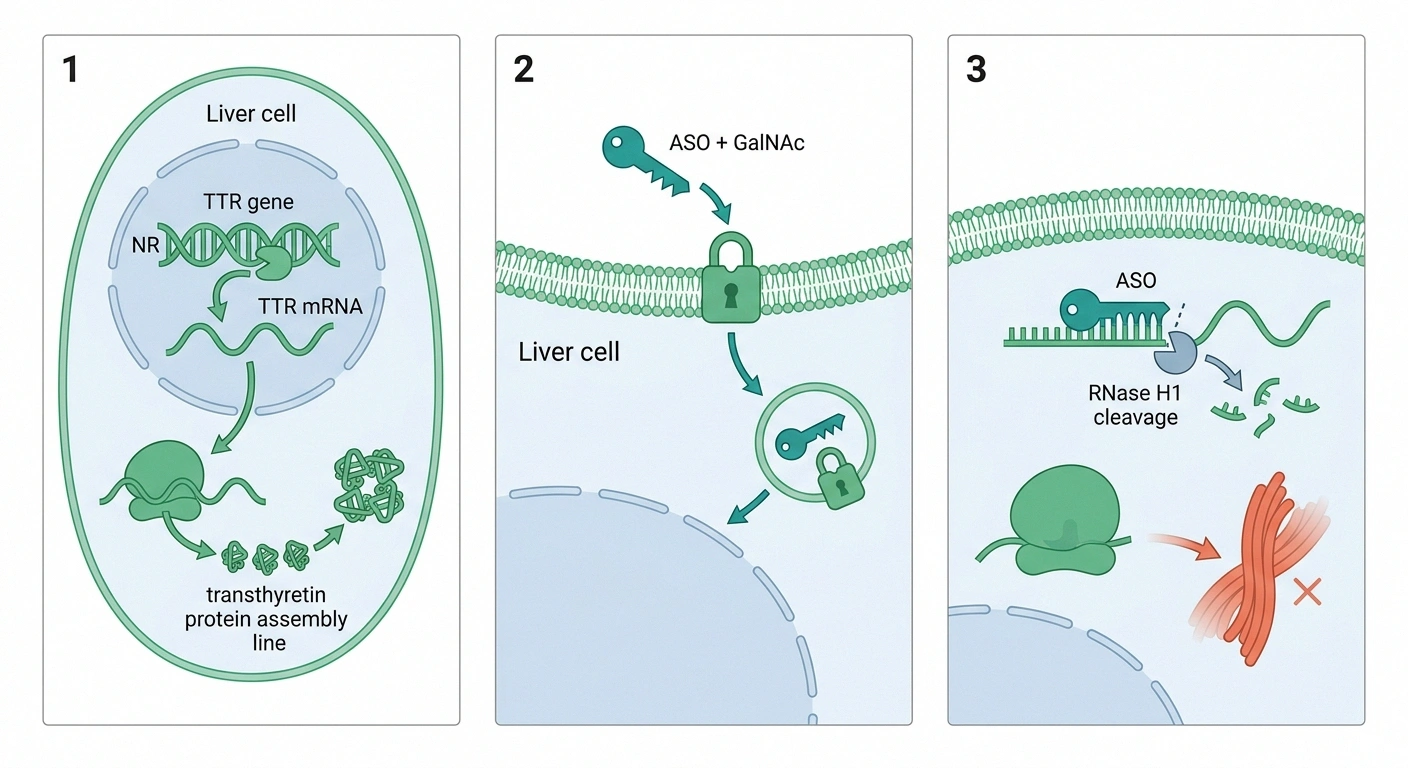
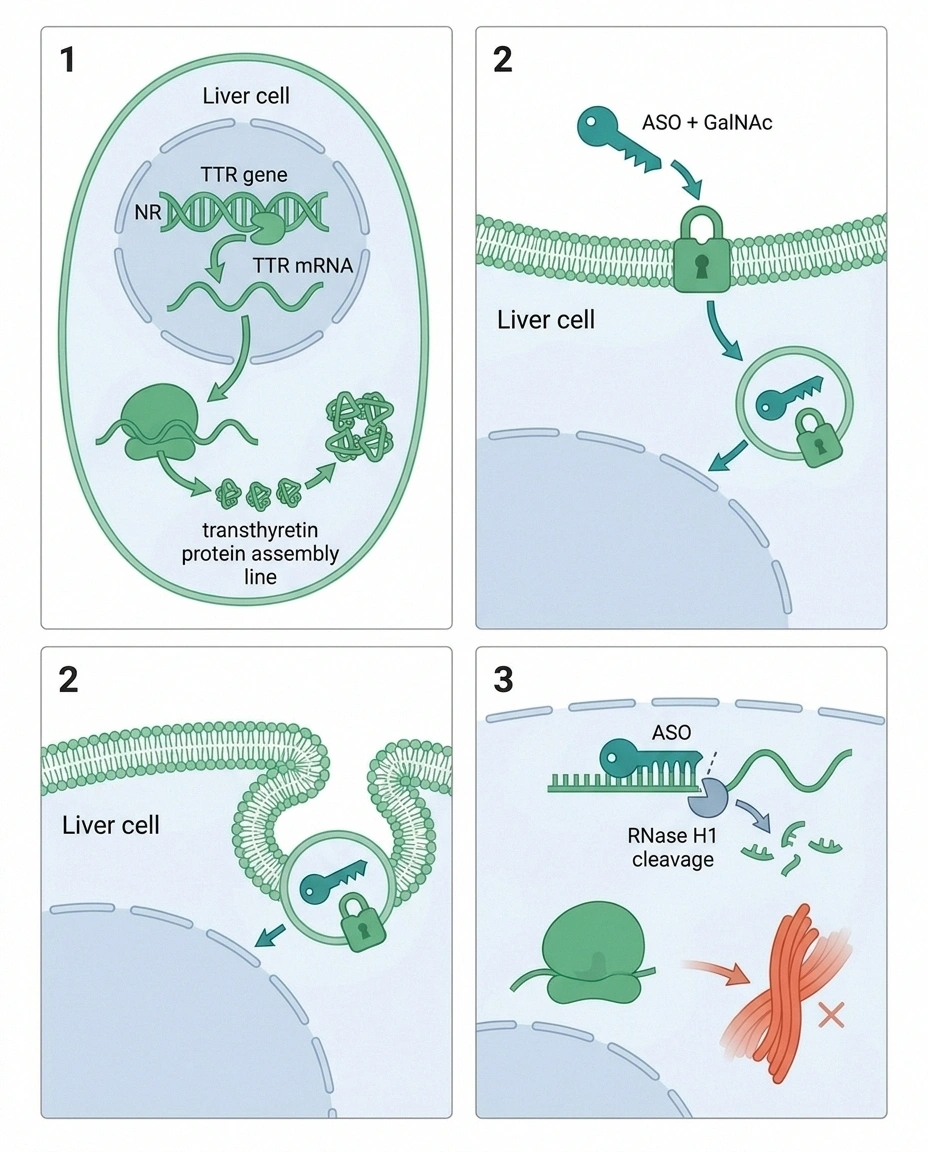
Here's the plain-English version. Genes live in your DNA. To make a protein, your cell copies the relevant piece of DNA into a working blueprint called messenger RNA, or mRNA. That mRNA then travels to the cell's protein-building machinery, which reads the blueprint and assembles the actual protein. Eplontersen is a small piece of engineered genetic material — an antisense oligonucleotide, or ASO — that's custom-designed to bind to the TTR mRNA blueprint. When it finds that blueprint inside a liver cell, it triggers an enzyme called RNase H1 to cut the mRNA apart before the cell can use it. The blueprint is destroyed. The protein doesn't get built.
The result: your liver produces dramatically less TTR protein — mutant and normal versions both. In the pivotal NEURO-TTRansform trial, serum TTR levels dropped roughly 81% from baseline and stayed there through 66 weeks. Less circulating TTR means less protein available to misfold into amyloid, which means the steady damage to nerves and heart slows down.
One elegant piece of the design: eplontersen is chemically attached to a sugar molecule called GalNAc that liver cells specifically recognize and pull inside. That means the drug is delivered directly and selectively to hepatocytes — the liver cells that make almost all the body's TTR — without having to reach every cell in the body. This targeted delivery is why it can be given as a small subcutaneous injection under the skin rather than an IV infusion.
A fair question: what about the TTR your body still needs to carry thyroid hormone and vitamin A? The remaining 15–20% of normal TTR production is enough to handle those transport jobs for most people. The one caveat is that patients on eplontersen take a daily vitamin A supplement at the recommended daily allowance to keep retinol levels healthy.
What NEURO-TTRansform Tells Us
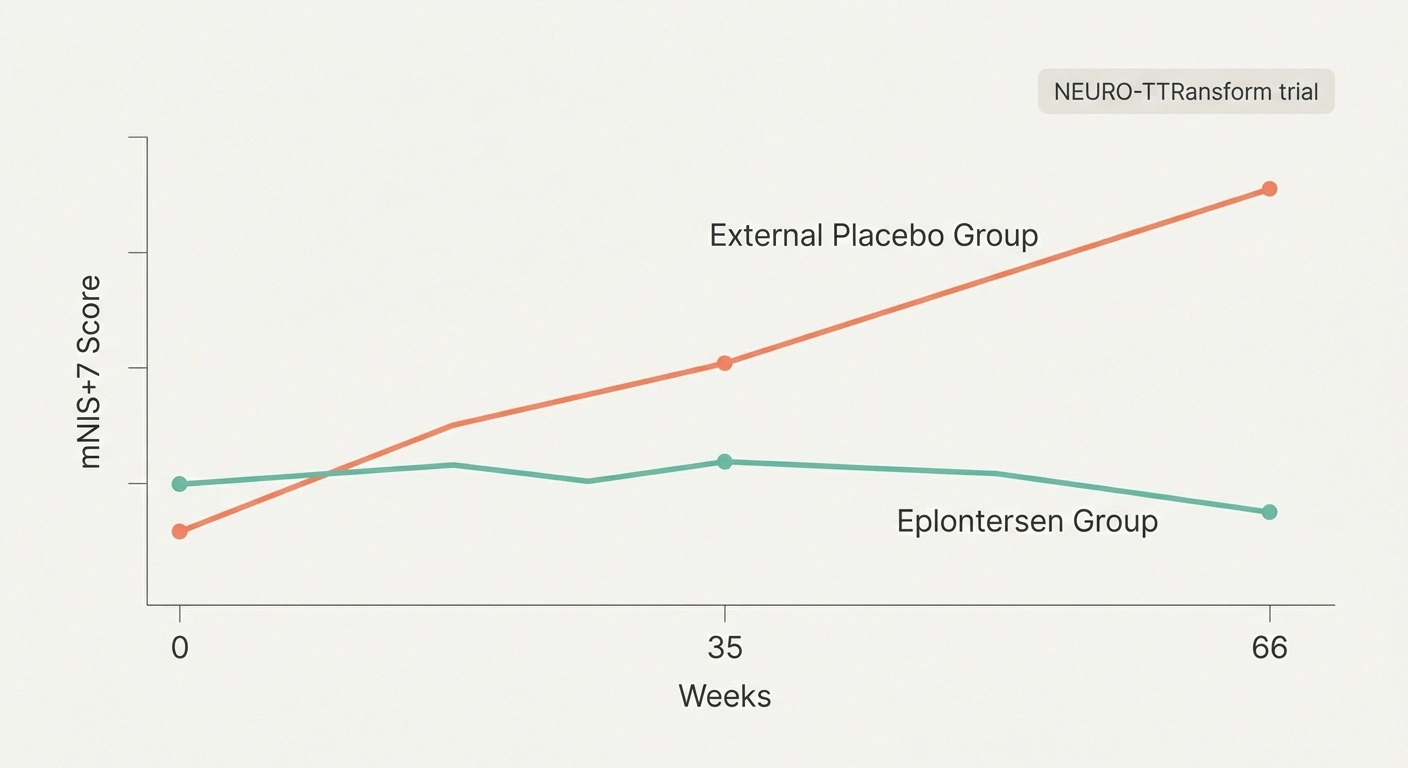
The pivotal trial that got eplontersen approved was called NEURO-TTRansform — a global, open-label, randomized study that ran from January 2020 through July 2023 and enrolled 168 adult patients with Stage 1 or Stage 2 hATTR polyneuropathy. Everyone in the trial had confirmed genetic disease and measurable neuropathy, and the study compared eplontersen against an external placebo group drawn from an earlier trial called NEURO-TTR. That external-placebo design is standard in rare-disease research where leaving people untreated for over a year would be ethically difficult.
Research says
In the NEURO-TTRansform trial (N = 168, run January 2020 through July 2023), eplontersen lowered serum TTR levels by approximately 81% from baseline and produced a sustained neuropathy benefit at both 35 and 66 weeks versus the external placebo comparator group — meaning patients on eplontersen largely stabilized while untreated patients continued to worsen. Quality-of-life and neuropathy symptom scores favored eplontersen at both trial timepoints, and no thrombocytopenia signal or required routine platelet monitoring was observed.
The primary endpoints were serum TTR concentration and a neuropathy severity score called mNIS+7 — a composite of physical exam findings, sensory testing, and nerve conduction measures. Higher scores mean worse neuropathy. In the external placebo group, mNIS+7 scores got worse over 35 and 66 weeks, exactly what you'd expect for an untreated progressive disease. In the eplontersen group, scores stayed essentially flat at 35 weeks and remained meaningfully lower than the placebo trajectory at 66 weeks. Serum TTR levels dropped about 81% from baseline. Quality-of-life scores and neuropathy symptom scores also favored eplontersen at both timepoints.
What that means in patient language: on eplontersen, the disease's forward march slowed dramatically. Untreated hATTR polyneuropathy generally worsens over 12 to 18 months in ways measurable in a clinic exam. On the drug, most patients don't show that worsening. For a condition that used to be relentlessly one-directional, “stayed stable” is a meaningful clinical win. Longer-term data — how patients do over 5, 10, or 20 years on the drug — is still being collected. The broader question of whether nerve damage can ever be fully undone is covered in can neuropathy be reversed; eplontersen fits the “progression can often be halted” pattern.
How Eplontersen Compares to Vutrisiran and Patisiran
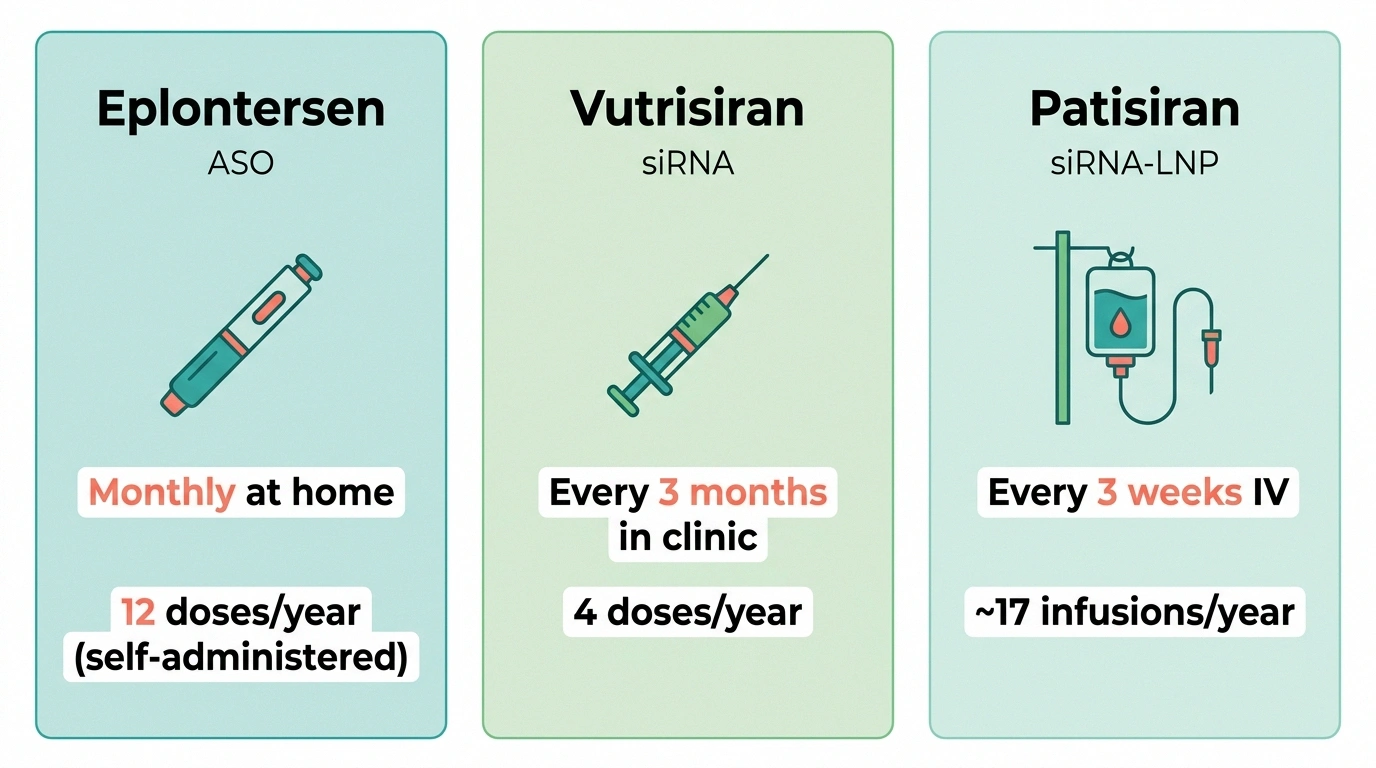
Eplontersen isn't the only drug in this space, and understanding where it fits is useful when you're weighing options with a specialist. Four disease-modifying drugs a US patient might hear about for hATTR polyneuropathy break down like this.
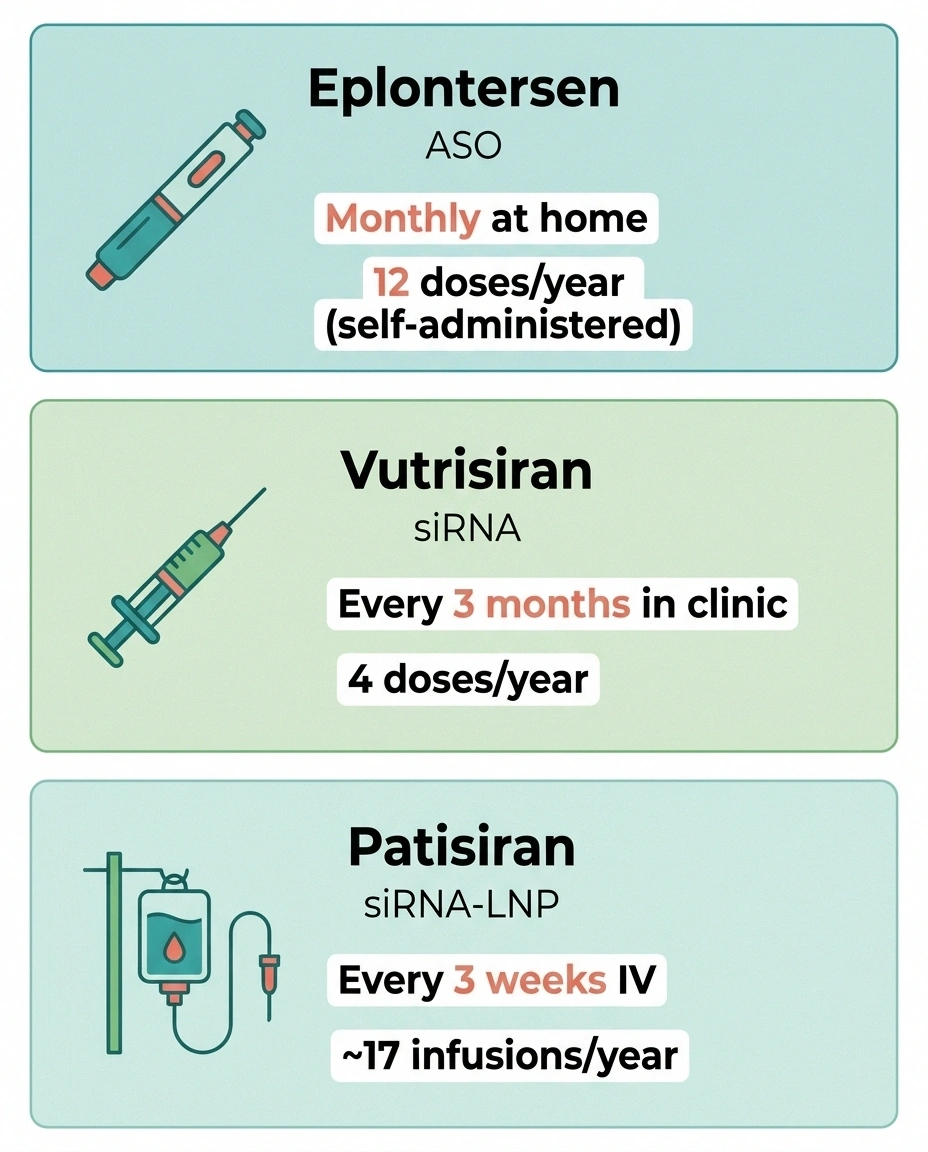
The TTR-lowering drugs at a glance
Route: Subcutaneous autoinjector
Frequency: Monthly at home
Premedication: None required
Route: Subcutaneous injection
Frequency: Every 3 months in clinic
Premedication: None required
Route: IV infusion
Frequency: Every 3 weeks
Premedication: Steroids & antihistamines
All three lower TTR protein and slow hATTR neuropathy. Choice usually comes down to dosing preference (monthly at home vs. quarterly in clinic vs. every 3 weeks IV), insurance formulary, and specialist experience.
Patisiran (ONPATTRO) was the first TTR-silencing drug FDA-approved for hATTR polyneuropathy, back in 2018. It's an siRNA delivered as an intravenous infusion every three weeks — roughly 17 appointments per year, each requiring premedication with steroids and antihistamines to prevent infusion reactions. It works well, but the logistical commitment is real.
Vutrisiran (AMVUTTRA) is the next-generation siRNA. Same silencing approach, but GalNAc chemistry lets it be given as a subcutaneous injection every three months — four doses per year, no infusion center, no premedication. It's usually given in a clinic setting by a healthcare professional.
Inotersen (TEGSEDI) was FDA-approved the same year as patisiran. It's an older-generation antisense oligonucleotide — same molecular class as eplontersen — but without GalNAc liver-targeting. It required weekly injections plus routine monitoring for low platelets and kidney effects, and carried a black box warning for both. It's been largely superseded.
Eplontersen (WAINUA), FDA-approved December 2023, is the newer ASO — 45 milligrams once monthly by subcutaneous autoinjector. It uses GalNAc targeting, so it doesn't carry the platelet or kidney warnings inotersen did, and no routine platelet monitoring is required. And unlike vutrisiran or patisiran, eplontersen is the only ATTR-PN treatment currently designed for patient self-administration at home, after appropriate training.
Head-to-head data comparing eplontersen directly against vutrisiran doesn't exist. Both drugs lower TTR by roughly the same margin (~80%) and both show meaningful neuropathy stabilization in their pivotal trials. Choice usually comes down to dosing preference (monthly at home vs. quarterly in clinic), insurance formulary, and specialist experience. A separate drug worth knowing about — tafamidis (VYNDAQEL, VYNDAMAX) — is an oral pill that stabilizes the TTR protein rather than silencing it. In the US, tafamidis is approved for ATTR cardiomyopathy, not polyneuropathy, so it isn't a direct alternative to eplontersen for polyneuropathy patients.
The Self-Injection Question — What Home Dosing Actually Looks Like
This is where eplontersen genuinely stands apart from the other TTR-lowering drugs, and the practical difference is bigger than it sounds on paper.

The path from suspicion to treatment
Every step above is a decision point — none of it is automatic. The bottleneck for most patients is Step 1, not Step 4.
Eplontersen is delivered by a single-use autoinjector — a prefilled pen roughly the size of a magic marker. After appropriate training with the care team, patients (or a designated caregiver) can administer the monthly injection at home. The autoinjector is stored in the refrigerator, taken out about 30 minutes before injection to warm to room temperature, then delivered into the abdomen or upper thigh. The injection itself takes about 10 to 15 seconds. No fasting, no premedication, no clinic requirement. Most patients describe a brief pinch or sting, similar to a subcutaneous insulin injection.
For patients still working full-time, or living hours from an amyloidosis center, or dealing with the fatigue that comes with any chronic disease, the difference between “twelve clinic trips per year” and “twelve minutes in your own kitchen” is not small. It's the difference between organizing your calendar around treatment and having treatment fit around your life.
Most specialists want the first one to two doses given in a clinical setting so the patient can be trained on technique and any early tolerability concerns can be caught. From there, the pattern shifts to self-administration with periodic follow-up — labs to confirm TTR is staying suppressed, neurological exam every few months, and cardiology follow-up if there's cardiac involvement.
Living with a progressive disease is its own kind of work, and the psychological weight is real. If you're facing a new diagnosis, see our piece on neuropathy and mental health. You're not carrying this alone.
Side Effects and What to Watch For
Eplontersen has a favorable safety profile compared to earlier options in this class. The most common side effects reported in NEURO-TTRansform were injection-site reactions — mild redness, tenderness, or bruising — along with vitamin A deficiency symptoms and occasional headache or upper respiratory infections. Serious adverse events attributed to the drug were uncommon.
Two things worth knowing specifically. First, vitamin A. Because TTR carries vitamin A in the bloodstream, lowering TTR lowers circulating vitamin A. Patients on eplontersen take a daily vitamin A supplement at the recommended daily allowance, and care teams monitor levels and any eye symptoms — night vision changes in particular — as part of routine follow-up. Second, unlike the older ASO inotersen, eplontersen does not carry a black box warning for thrombocytopenia or kidney injury, and no routine platelet or renal monitoring is required. That's a meaningful safety improvement.
Because home self-administration is part of how this drug is used, patients also get instructions on missed doses, safe storage of the autoinjector (out of reach of children, appropriate refrigerator temperatures), and what to watch for at each injection site. Any dosing question — including missed-dose recovery — should be handled by your amyloidosis specialist, not by an article on the internet.
What This Costs and How Patients Access It
Now the harder part: cost. The list price of eplontersen is approximately $462,000 per year. That's twelve monthly doses at roughly $38,500 each. Yes, you're reading that correctly. It's an orphan drug for a rare disease, and it's priced accordingly. Very few patients pay anything close to list price, but the sticker on the shelf is real and it can be jarring the first time you see it.

In practice, insurance coverage is where the real story is:
- Medicare Part B typically covers eplontersen as a physician-administered category medication (even when delivered at home, it's often reimbursed through the physician-administered pathway rather than pharmacy benefit). Beneficiaries pay standard coinsurance unless they have supplemental coverage.
- Commercial insurance usually covers it with prior authorization, which requires documentation of the genetic diagnosis and confirmed polyneuropathy.
- WAINUA together, the Ionis and AstraZeneca patient support program, helps navigate prior authorization, provides copay assistance for eligible commercial patients, and offers a free-drug program for eligible uninsured or underinsured patients who meet income criteria.
Most patients ultimately pay a manageable amount out of pocket — sometimes very little — but getting there can take weeks and involves paperwork, denials, appeals, and often a specialty pharmacy handoff. Amyloidosis centers usually have dedicated staff who navigate this daily. If cost feels like an immovable barrier, tell the specialist's office. They have options and workarounds most patients don't know about.
When to Ask Your Neurologist About TTR Testing
Eplontersen isn't a drug you start based on symptoms alone. FDA approval is specifically for adults with confirmed polyneuropathy of hereditary transthyretin-mediated amyloidosis. Three things need to be established before treatment: a confirmed pathogenic mutation in the TTR gene (blood-based genetic test), confirmed peripheral neuropathy linked to that mutation (nerve conduction studies, EMG, exam, sometimes biopsy or specialty imaging), and adult status with no contraindications.
The bigger picture
Eplontersen is part of a broader shift — gene-silencing therapies moving out of research and into ordinary clinical use. For patients with hATTR, that means a disease that used to be a relentless slide is now a disease that can often be halted with a monthly injection you give yourself at home. For the wider world of medicine, it means the door is open for antisense and RNA-interference approaches to eventually reach many more genetic conditions. If you have hATTR, or if your family carries the mutation, the most important step remains getting to a specialist who knows this landscape. The treatment options now exist. The bottleneck, still, is diagnosis.
The specialist doing this work is usually a neurologist with expertise in amyloidosis or a physician at an amyloidosis center. If you're not sure whether your current neurologist is set up to handle hATTR, ask directly: “Do you manage patients on TTR-lowering therapies for ATTR polyneuropathy?” A specialist who doesn't will usually refer you to someone who does.
There's a growing consensus among amyloidosis specialists that earlier treatment leads to better long-term outcomes — nerves lost don't easily come back. If you've received a diagnosis of “idiopathic” progressive neuropathy, especially at any of the stages of neuropathy where symptoms are advancing, asking about TTR testing is entirely appropriate. For a broader look at how neuropathy gets worked up, see how neuropathy is diagnosed. The blood test takes minutes to order and days to result. Getting a clear yes or no changes everything about what happens next.
Frequently Asked Questions
Is eplontersen a cure for hATTR amyloidosis?
No. Eplontersen silences production of the TTR protein so that new amyloid deposits are dramatically reduced, but it doesn't remove amyloid that has already accumulated in nerves or the heart, and it doesn't correct the underlying genetic mutation. It slows or halts progression of the disease in most patients and can produce stabilization or modest improvement in neuropathy scores over the trial window. It's a durable treatment, not a cure, and it's given on an ongoing basis.
How is eplontersen different from vutrisiran?
Both drugs lower TTR production in the liver and both use GalNAc chemistry to target liver cells specifically. The key differences are molecular class and dosing. Eplontersen is an antisense oligonucleotide given as a monthly subcutaneous injection, and it's designed for patient self-administration at home after training. Vutrisiran is an siRNA given as a subcutaneous injection every three months in a clinical setting. Head-to-head trial data doesn't exist. Both drugs produce roughly comparable TTR reduction and neuropathy stabilization in their respective pivotal trials.
Can I really give myself the injection at home?
Yes, after appropriate training. Eplontersen is delivered by an autoinjector — a prefilled pen device — that most patients or a designated caregiver can use at home. The care team typically walks the patient through the first one or two doses in a clinical setting to confirm proper technique before transitioning to self-administration. This home-dosing option is a defining practical feature of eplontersen compared to other TTR-lowering drugs, which are given in clinics or infusion centers.
What are the most common side effects of eplontersen?
The most commonly reported side effects were injection-site reactions such as mild redness or tenderness, symptoms related to lowered vitamin A levels, and occasional headache or upper respiratory infections. Because TTR carries vitamin A through the bloodstream, patients on eplontersen take a daily vitamin A supplement at the recommended daily allowance and are monitored for vitamin A related eye symptoms. Unlike an older antisense drug in this class, eplontersen does not carry a black box warning for low platelets or kidney injury, and routine platelet and kidney monitoring is not required.
Is eplontersen approved for wild-type ATTR amyloidosis?
No. The current FDA approval for eplontersen is specifically for polyneuropathy of hereditary transthyretin-mediated amyloidosis in adults. Wild-type ATTR — the non-inherited form that mostly affects the heart in older adults — is not currently a labeled indication. If you have wild-type ATTR, your amyloidosis specialist can walk through what treatments are and aren't options for your specific situation, including drugs approved for ATTR cardiomyopathy.
Do my children need to be tested if I have hATTR?
This is a conversation to have with a genetic counselor. Each first-degree relative — parents, siblings, and children — has a 50% chance of carrying the same mutation. Adult family members can choose whether to be tested, and there are meaningful pros and cons on both sides of that decision. Genetic counseling before and after testing is strongly recommended so that whichever way the decision goes, it's made with full understanding of the implications for insurance, family planning, and future health monitoring.
What if I've been told I have idiopathic neuropathy but I have a family history of unexplained illness?
Ask your neurologist about TTR genetic testing. The combination of progressive polyneuropathy plus family history of neuropathy, unexplained heart failure, or bilateral carpal tunnel syndrome is exactly the constellation that amyloidosis specialists look for. A blood-based genetic test is the definitive answer, and it takes minutes to order. Getting a clear yes or no changes everything about what happens next, and if the answer is yes, treatment options like eplontersen become available.
How much does eplontersen cost?
The list price is approximately $462,000 per year, but very few patients pay anywhere near that. Medicare Part B typically covers it as a physician-administered category medication, most commercial insurance plans cover it with prior authorization, and the manufacturers' WAINUA together patient support program offers copay assistance and a free-drug program for eligible uninsured or underinsured patients. If cost feels like a barrier, the specialist's office and the manufacturer's assistance program are where the real answer lives, not the sticker price.
About the Author