
Charles was sixty-eight when his cardiologist finally put a name to what had been slowly closing in on him for three years. A retired police captain from Ohio, he'd started noticing shortness of breath climbing the stairs to his grandkids' bedrooms, then swelling in his ankles, then a strange tingling that crept up from his toes. Two cardiologists had shrugged and blamed age. The third ordered a specialized bone scan of his heart and, for the first time, used a phrase Charles had never heard before: wild-type transthyretin amyloidosis. He had a rare disease. And there was a pill that could slow it down.
The pill was tafamidis, sold under the brand names Vyndaqel and Vyndamax. Charles started taking one capsule a day. Over the next eighteen months, his shortness of breath stopped getting worse. His heart function held steady. And to his surprise, the tingling in his feet, which none of his doctors had really connected to his heart until then, also stopped progressing. His neurologist called it a bonus, since the drug's US approval is for the heart form of ATTR, not the nerve form. But Charles didn't much care about the paperwork. What he cared about was that the disease had stopped chasing him.
Tafamidis isn't for most people with neuropathy. It's for a specific, rare, and often under-diagnosed condition called ATTR amyloidosis. If someone you love has been diagnosed with ATTR, or if your family carries a history of unexplained heart failure and nerve symptoms, this drug belongs in your vocabulary. This is the article I wish Charles had been handed on day one.
What ATTR Amyloidosis Actually Is
Transthyretin, or TTR for short, is a small transport protein your liver builds every day. Its normal job is to ferry thyroid hormone and vitamin A around your bloodstream. In healthy people, four TTR subunits click together into a shape called a tetramer, which is stable, does its delivery work, and eventually gets broken down like any other protein.
Key takeaway
Tafamidis is a small oral pill that holds the TTR tetramer together so it doesn't break apart into the misfolded pieces that form amyloid. It doesn't lower how much TTR your liver makes and it doesn't remove amyloid already deposited. What it does, for most patients, is dramatically slow the pace of new damage to nerves and heart. The earlier it starts, the more tissue there is to protect.
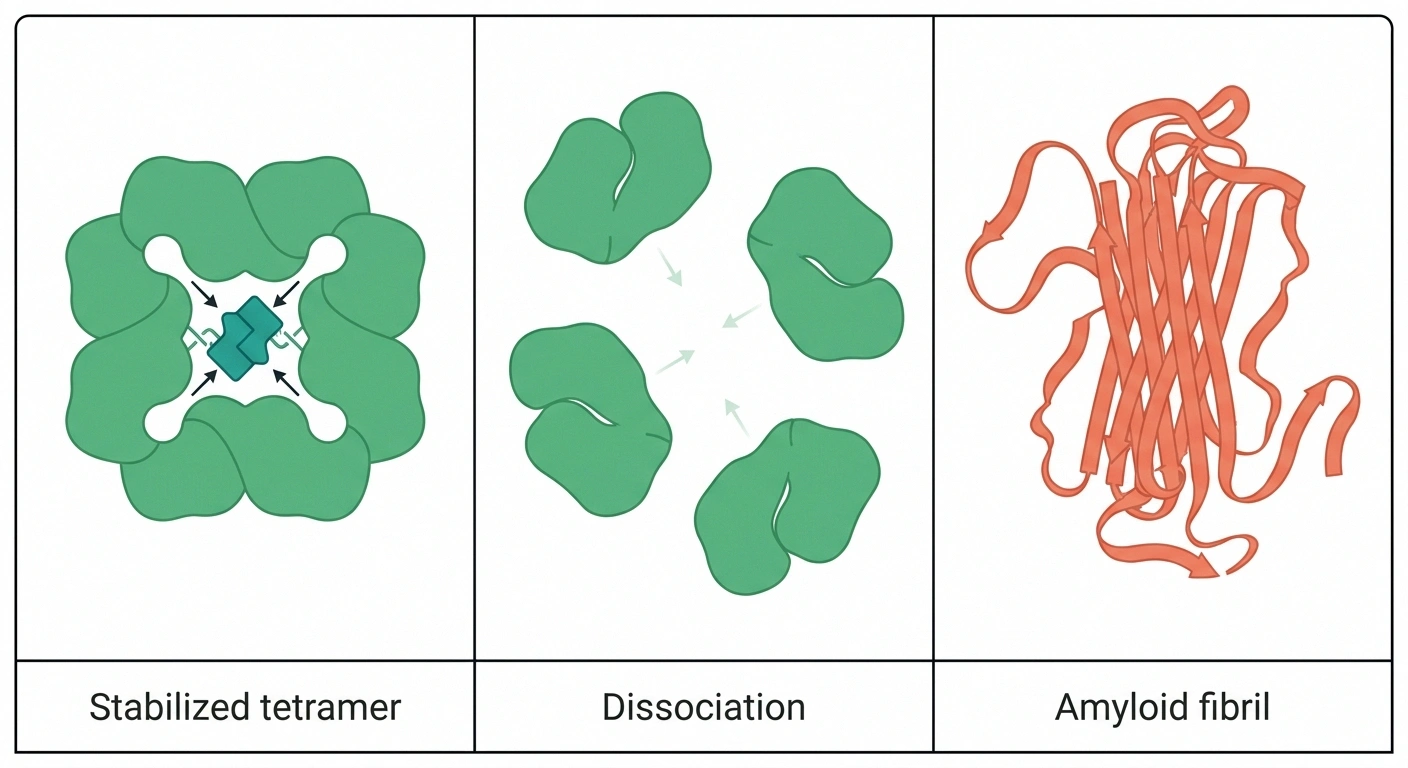
ATTR amyloidosis is what happens when that tetramer becomes unstable. Instead of holding together, the four subunits break apart. The free subunits, called monomers, then misfold into flat sticky ribbons that clump into deposits known as amyloid fibrils. Those fibrils drift through the bloodstream and settle into tissues, where they accumulate silently over years or decades.
When amyloid deposits collect on peripheral nerves, the result is ATTR polyneuropathy, or ATTR-PN. When they collect in the heart muscle and stiffen it, the result is ATTR cardiomyopathy, or ATTR-CM. Many people develop both, sometimes years apart. The disease comes in two flavors. Hereditary ATTR (hATTR) is driven by an inherited mutation in the TTR gene, and it can present nerve-dominant, heart-dominant, or as a mix. Wild-type ATTR affects people with a normal, unmutated TTR gene where the protein just becomes unstable with age. Wild-type is far more common than most doctors realize and mostly hits older men, often with a background of bilateral carpal tunnel in both hands and slowly worsening heart function.
If you'd like the full clinical picture, how the disease presents, how it's diagnosed, and how the genetics play out across a family, see our companion article on ATTR amyloid neuropathy. What follows here focuses specifically on tafamidis and what it does inside that biological story.
How Tafamidis Works: Kinetic Stabilization Explained
To see what tafamidis does, picture the TTR tetramer as a small piece of furniture, four legs bolted together. In healthy people the bolts stay tight and the piece holds its shape. In ATTR, the bolts loosen. The legs separate one by one. Once separated, the individual pieces can't do their transport job anymore, and worse, they warp into the flat sticky shapes that pile up as amyloid.
Timing is not optional
- Tafamidis prevents new amyloid from forming. It does not clear amyloid already deposited on nerves or in the heart.
- Nerve fibers already lost to amyloid rarely come back, and cardiac tissue already infiltrated stays infiltrated.
- The larger the reservoir of healthy tissue at the start of treatment, the greater the long-term benefit.
- If ATTR is on the differential, push for the confirmatory workup (PYP scan, TTR gene test, or biopsy) rather than watchful waiting.
Every month of delay costs tissue that the drug cannot recover.
Tafamidis is a small molecule that slides into a specific spot on the tetramer, the same pocket that normally holds thyroid hormone, and acts like an internal brace. With tafamidis in place, the four subunits stay bolted together. The tetramer holds its shape. Fewer monomers break free, fewer amyloid fibrils form, and the ongoing damage to nerves and heart slows.
The technical name for this approach is “kinetic stabilization.” Kinetic because it slows the rate of tetramer breakdown. It doesn't stop it entirely, but it dramatically reduces how often the disassembly happens. Stabilization because the drug's job is simply to hold the existing protein together, not to change how much of it is being produced. This is a fundamentally different strategy from the newer siRNA and antisense drugs, which reach into liver cells and reduce how much TTR gets made in the first place.
Here's the plain-English version of the difference. The silencing drugs turn down the faucet, so less TTR flows into the bloodstream to begin with and there's less material available to misfold. Tafamidis leaves the faucet alone but reinforces every drop that comes out so it doesn't fall apart. Both strategies reduce amyloid formation over time. They just do it from opposite directions.
The amyloid ATTR deposits on nerves damage them in the same order for most patients. First the small unmyelinated fibers that carry pain and temperature signals, which is why the earliest complaints often look like small-fiber neuropathy of unknown cause. Then the larger fibers that carry balance and motor commands. One important consequence of the tafamidis approach: existing amyloid deposits, the ones already sitting on your nerves or infiltrating your heart muscle, are not removed by the drug. Tafamidis doesn't clear amyloid; it prevents new amyloid from forming. Damage that has already happened is likely to stay. This is why every amyloidosis specialist will tell you the same thing about timing: the earlier tafamidis is started, the more nerve fiber and heart tissue there is to protect.
Vyndaqel and Vyndamax: The Two Formulations
Tafamidis is sold in the United States under two brand names, both made by Pfizer. Same active drug, two different chemical forms and pill routines.

Vyndaqel is the older formulation, tafamidis meglumine, packaged as 20-milligram soft capsules. The prescribed dose is four capsules once a day. Vyndaqel came first because it was the version used in the original polyneuropathy trials in Europe, where it was approved back in 2011.
Vyndamax is the newer formulation, tafamidis free acid, packaged as a single 61-milligram capsule taken once a day. Pfizer introduced Vyndamax in 2019 alongside the FDA approval for ATTR cardiomyopathy specifically to solve the adherence problem. Taking one pill a day is measurably easier than remembering four, especially for older patients or anyone already juggling a stack of cardiac medications.
The two formulations deliver the same molecule to the same target and produce the same clinical effect. Most US patients starting tafamidis today are prescribed Vyndamax. Vyndaqel is still available and still used in some cases, but the one-a-day version has become the default for most amyloidosis programs. Both are oral, both are taken with or without food, and neither requires refrigeration.
A note on the FDA labels: both Vyndaqel and Vyndamax were approved in 2019 for ATTR-CM, the cardiomyopathy of ATTR, wild-type or hereditary. In the United States, tafamidis is not FDA-approved for the polyneuropathy form. In the European Union, the same drug has been approved for ATTR polyneuropathy since 2011, which is why so much of the older neuropathy data comes from European clinics. Some US neurologists prescribe tafamidis off-label for mixed cardio-neuro cases, and many US patients with an ATTR-CM diagnosis also see stabilization of their nerve symptoms while taking it. But formal US approval is CM-specific, and that reality shapes access.
What the Clinical Trials Showed
Tafamidis has a longer paper trail than almost any other drug in the ATTR space. Two lines of evidence built it, one for nerves and one for the heart.
Research says
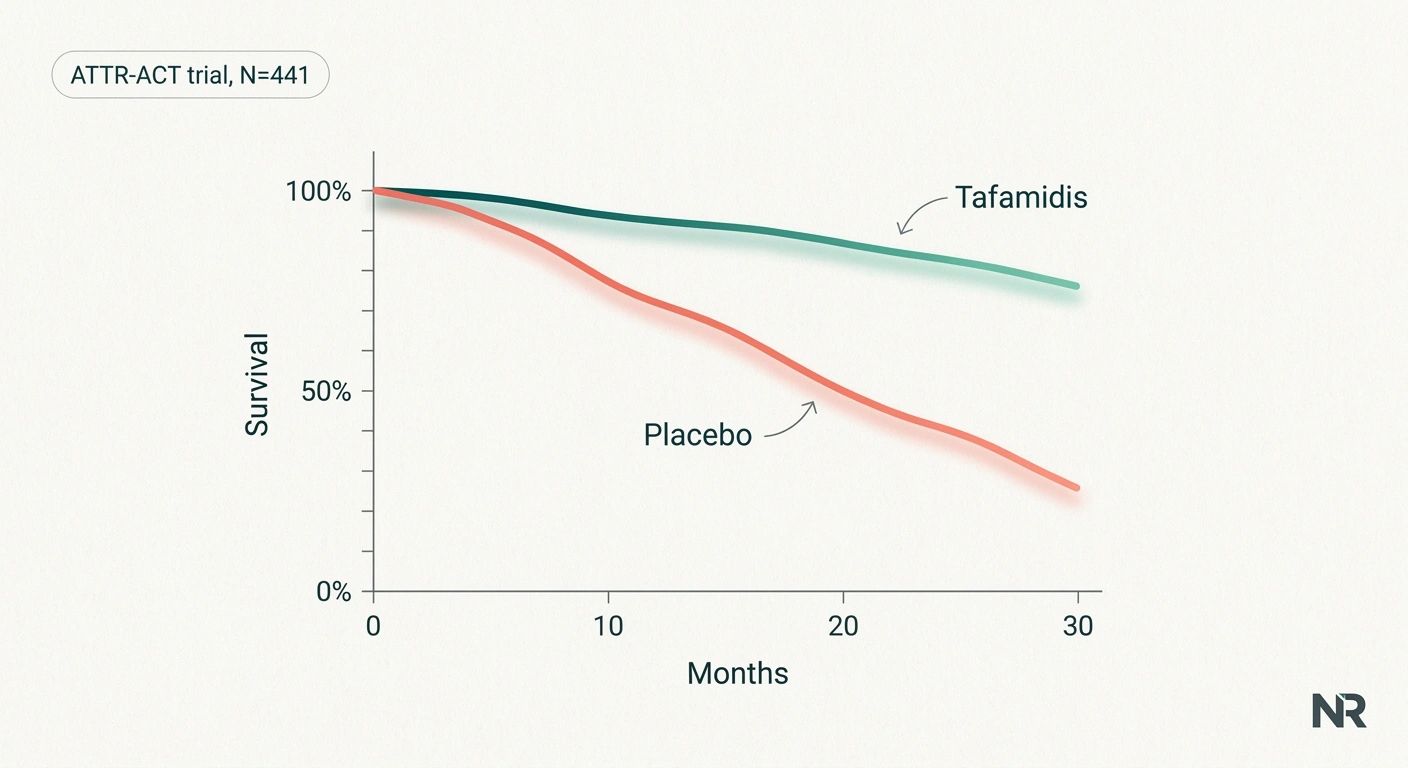
In the ATTR-ACT trial (Maurer et al., NEJM 2018; N = 441), tafamidis reduced all-cause mortality by roughly 30% compared with placebo over 30 months in patients with ATTR cardiomyopathy, along with fewer cardiovascular hospitalizations and less decline in six-minute walk distance. The earlier polyneuropathy trial (Coelho et al., 2012; N = 128, 18 months) showed significant slowing of neurologic decline on the NIS-LL and Norfolk QOL-DN scores, with the strongest signal in patients treated early in their disease course.
The neuropathy evidence starts with an 18-month randomized trial published by Coelho and colleagues in 2012, which enrolled 128 adults with early-stage hereditary ATTR polyneuropathy, most of them carrying the Val30Met mutation, the most common variant in Portuguese and Swedish populations. The primary endpoints were a physical exam-based neuropathy score called the NIS-LL (Neuropathy Impairment Score, Lower Limbs) and the Norfolk Quality of Life-Diabetic Neuropathy questionnaire, which measures how symptoms affect daily function. Compared with placebo, patients on tafamidis showed significant slowing in their neurologic decline. The signal was strongest in patients treated earlier in their disease course, when there was more healthy nerve tissue left to protect.
A related phase 3 program run by Ando and colleagues in 2011 provided the pharmacokinetic and safety data that supported the European approval. Merlini's long-term extension study, published in 2013, followed patients out beyond the original 18-month window and showed the stabilization held over time. Together, these trials formed the basis for the European Medicines Agency's 2011 approval of tafamidis for ATTR polyneuropathy, the first-ever approved treatment for that condition.
The cardiomyopathy evidence comes from a much larger trial called ATTR-ACT, published by Maurer and colleagues in the New England Journal of Medicine in 2018. ATTR-ACT enrolled 441 patients with ATTR cardiomyopathy, both wild-type and hereditary, and randomized them to tafamidis or placebo for 30 months. The headline result: patients on tafamidis had roughly a 30% reduction in all-cause mortality compared with placebo, along with fewer cardiovascular hospitalizations and less decline in six-minute walk distance. It was one of the first mortality-reducing trials ever run in ATTR-CM, and it changed practice quickly. The FDA approved tafamidis for ATTR-CM in May 2019 on the strength of that data.
An honest caveat about the polyneuropathy data: the original trials focused heavily on the Val30Met mutation and on patients in the early stages of the disease. Patients with more advanced neuropathy or with other TTR variants may respond differently, and the size of the neurologic benefit is generally described by specialists as “slowing progression” rather than “reversing damage.” That framing matters. Tafamidis buys nerve tissue time. For patients with a long history of being labeled with idiopathic neuropathy before the true diagnosis finally arrived, that time is precious. But it is not the same signal as the more dramatic mNIS+7 improvements later seen with the silencing drugs in advanced polyneuropathy patients.
Tafamidis Compared to the TTR Silencers
Ten years ago there was one class of TTR-modifying drug. Today there are three, and the choice between them is one of the most active conversations in amyloidosis medicine. Understanding how tafamidis compares to the newer options helps a lot when you're sitting in the specialist's office.
The three classes of TTR-directed drugs
Route: Oral capsule
Frequency: Once daily
US label: ATTR-CM
Effect on TTR level: Unchanged (stabilizes existing protein)
Route: Subcutaneous injection
Frequency: Every 3 months
US label: hATTR-PN
Effect on TTR level: ~80% reduction
Route: Subcutaneous injection
Frequency: Monthly
US label: hATTR-PN
Effect on TTR level: ~80% reduction
Heart-dominant disease usually starts with tafamidis. Nerve-dominant disease usually starts with a silencer. Mixed disease is a specialist call.
Tafamidis (Vyndaqel, Vyndamax) is the stabilizer. It's an oral capsule, taken once a day for Vyndamax or four times a day for Vyndaqel. Side effects are mild. There's no infusion, no injection, and no lab monitoring required beyond routine follow-up. The mechanism, holding tetramers together, reduces the pace of new amyloid formation but doesn't lower the amount of TTR circulating in the bloodstream.
Patisiran (Onpattro) and vutrisiran (Amvuttra) are the siRNA silencers. They reach into liver cells and shut down TTR mRNA, the blueprint the cell uses to build the protein. On these drugs, circulating TTR levels drop by around 80%. Patisiran is an intravenous infusion every three weeks. Vutrisiran is a subcutaneous injection every three months. Both are FDA-approved specifically for hereditary ATTR polyneuropathy. See our detailed piece on vutrisiran for hATTR polyneuropathy for a deeper dive into the injection option.
Inotersen and eplontersen are the antisense oligonucleotide (ASO) drugs. They also reduce TTR production, but through a different molecular route. Inotersen is a weekly subcutaneous injection with a black box warning for low platelets and kidney effects. Eplontersen, approved in late 2023, is a monthly subcutaneous injection without those warnings. Both are FDA-approved for hATTR polyneuropathy in the United States.
How specialists choose between them, in broad strokes: when the disease is dominated by cardiac symptoms, meaning stiffened heart muscle, heart failure, and the wild-type ATTR pattern, tafamidis is often first-line because it has the strongest cardiomyopathy mortality data and it's an oral pill. When the disease is dominated by polyneuropathy (burning, numbness, weakness, autonomic dysfunction), the silencing drugs are usually where the conversation starts, because they produce a much larger reduction in circulating TTR and tend to show more robust neurologic stabilization or improvement. When the disease is mixed, the call gets nuanced. It depends on which symptoms are progressing fastest, how the patient tolerates injections versus pills, and what insurance will cover.
A newer question: can these drugs be combined? Some amyloidosis centers have started using tafamidis plus a silencer in patients with aggressive mixed disease, on the theory that stabilizing the existing protein while also reducing new production may give better results than either alone. Combination therapy is not yet standard care, and clinical trials are underway. If your specialist raises the possibility, it means you're being managed at a program on the leading edge of the field.
What Treatment Looks Like Day to Day
Being on tafamidis is one of the least invasive experiences a person with a serious diagnosis can have. No IV chair, no injection appointment, no premedication. You take one capsule a day (Vyndamax) or four capsules a day (Vyndaqel), with or without food, and you go on with your life.

There are no required lab draws for the drug itself. Your specialist will still monitor your overall health, with cardiac imaging every six to twelve months for CM patients and nerve exams for those with polyneuropathy. But tafamidis doesn't require the platelet counts or urine tests that some of the other TTR-targeted drugs do.
Follow-up is typically multidisciplinary. Patients with ATTR-CM are usually managed by a cardiologist familiar with amyloidosis. Patients with ATTR-PN are usually managed by a neurologist with amyloidosis experience. Patients with mixed disease often work with both, ideally at a coordinated amyloidosis center. The visits themselves are about tracking the trajectory of the disease over months and years, meaning is progression slowing, is heart function holding, are new symptoms emerging, rather than about the drug itself.
One thing worth naming: the psychological weight of a rare-disease diagnosis is real, and it doesn't go away just because the daily routine of the medication is simple. Adjusting to a lifelong treatment, coordinating care across specialists, and living with a progressive condition is a lot of quiet work. If ATTR has brought autonomic symptoms into your life, dizziness on standing, GI slowing, bladder issues, that alone can reshape the day. And if you're still in the early workup phase and don't yet have a diagnosis, our overview of how neuropathy is diagnosed lays out the usual path.
Side Effects, Cost, and Access
The safety profile of tafamidis is one of its selling points. In the pivotal trials, the most common side effects were essentially indistinguishable from placebo. Diarrhea was reported in roughly one in ten patients. Some patients described mild upper abdominal pain or an occasional urinary tract infection. No infusion reactions, because there's nothing to infuse. No black box warnings. No mandatory monitoring for platelets or kidney function.

The bigger picture
Fifteen years ago, ATTR amyloidosis was a diagnosis with no disease-modifying treatment. Today, patients have four FDA-approved options in the United States and more in Europe, each targeting the same disease through a different molecular route. Tafamidis was the first, and for many patients with heart-dominant ATTR it remains the anchor of the treatment plan. The bottleneck now is diagnosis, not therapy. If ATTR is on the table, the most valuable step is getting to an amyloidosis specialist who can confirm it, quantify how much tissue is still healthy, and match the drug class to the disease pattern.
The one clinical caveat: tafamidis does not remove amyloid that has already deposited. It slows the formation of new amyloid, which slows the disease. Nerve damage or heart damage that was already present when treatment started is likely to stay. That's not a side effect in the pharmacologic sense, but it's a fact patients and families need to hold clearly. Early treatment protects more tissue than late treatment.
Now the harder part: cost. Tafamidis has historically been one of the most expensive cardiac medications in the world, with a US list price of roughly $225,000 per year. It's an orphan drug for a rare disease and priced accordingly. Very few patients pay anywhere near that number, but the sticker on the shelf is real, and the coverage conversation is often complicated.
- Medicare Part D covers tafamidis as an oral capsule. Patients typically face high specialty-tier copays but often hit the catastrophic-coverage threshold quickly given the drug's price.
- Commercial insurance generally covers tafamidis with prior authorization, which requires documentation of a confirmed ATTR-CM diagnosis by bone scan, biopsy, or genetic testing.
- Pfizer Bridge Program and the manufacturer's copay assistance programs help many commercially insured patients bring out-of-pocket costs down to a manageable level. Free-drug programs exist for eligible uninsured patients who meet income criteria.
In practice, most patients starting tafamidis do get on it and stay on it. The amyloidosis specialty centers have staff who navigate prior authorization every day, and the patient-assistance infrastructure is well-developed. If cost is a barrier, the specialist's office is the first place to raise it. They have workarounds that individual patients rarely know exist. Never assume the sticker price is what you'll actually pay.
Frequently Asked Questions
Is tafamidis FDA-approved for polyneuropathy in the United States?
No. In the United States, tafamidis is FDA-approved for the cardiomyopathy form of ATTR, both wild-type and hereditary. It is not approved for the polyneuropathy form. In the European Union, the same drug has been approved for ATTR polyneuropathy since 2011. Some US neurologists prescribe tafamidis off-label for patients with mixed cardio-neuro disease, and patients with an ATTR-CM diagnosis often see nerve-symptom stabilization while on it. But formal US approval is cardiomyopathy-specific, which shapes both prescribing and insurance coverage.
What is the difference between Vyndaqel and Vyndamax?
Both are brand names for tafamidis, made by Pfizer. Vyndaqel is the older formulation, a 20-milligram capsule of tafamidis meglumine taken four times a day. Vyndamax is the newer formulation, a single 61-milligram capsule of tafamidis free acid taken once a day. They deliver the same active drug to the same target and produce the same clinical effect. Most US patients starting tafamidis today are prescribed Vyndamax because taking one pill a day is easier than remembering four.
How is tafamidis different from patisiran or vutrisiran?
Tafamidis stabilizes the TTR protein so the existing tetramers don't fall apart into monomers that misfold into amyloid. Patisiran and vutrisiran are silencing drugs that reduce how much TTR the liver produces in the first place. Tafamidis is an oral capsule with mild side effects. Patisiran is an intravenous infusion every three weeks. Vutrisiran is a subcutaneous injection every three months. Tafamidis is generally first-line when the disease is heart-dominant. The silencers are typically first-line when polyneuropathy is dominant.
Can tafamidis reverse damage that has already happened?
No. Tafamidis prevents new amyloid from forming, but it does not remove amyloid that has already deposited in your nerves or heart. Damage present when treatment starts is likely to stay. That is why every amyloidosis specialist emphasizes early treatment. The more healthy nerve tissue and heart muscle you have left when you start, the more the drug has to protect.
What are the most common side effects?
The most commonly reported side effects in the clinical trials were mild diarrhea, occasional upper abdominal pain, and an occasional urinary tract infection. Roughly one in ten patients reported diarrhea, and the other findings were less common. No black box warnings apply, and no routine monitoring of platelets or kidney function is required. Most patients tolerate tafamidis well.
How is ATTR diagnosed before starting tafamidis?
Diagnosis usually involves imaging, tissue confirmation, or genetic testing depending on the presentation. For ATTR cardiomyopathy, a specialized bone scan called a PYP scan is often the key test. For hereditary ATTR polyneuropathy, blood-based genetic testing of the TTR gene confirms the mutation. A tissue biopsy stained for amyloid may also be used. Many patients also see a neurologist for nerve conduction studies to characterize any neuropathy component.
How much does tafamidis cost?
The US list price is roughly $225,000 per year, making it one of the most expensive cardiac medications on the market. Very few patients pay anywhere close to that number. Medicare Part D covers tafamidis with high specialty-tier copays that typically trigger catastrophic coverage quickly. Commercial insurance covers it with prior authorization. The Pfizer Bridge Program and manufacturer copay assistance help most patients bring out-of-pocket costs down to a manageable level, and free-drug support exists for eligible uninsured patients.
If I have small-fiber symptoms and a family history, should I ask about TTR testing?
Yes, especially if the family history includes unexplained heart failure, early-onset carpal tunnel syndrome, or progressive nerve symptoms. Small-fiber involvement is one of the earliest neurologic signs of ATTR, and it is often mistaken for other causes. A conversation with your neurologist about TTR genetic testing takes minutes to arrange, and a clear answer changes everything about what happens next.
About the Author