
Your foot feels like someone inflated it overnight. Tight across the top, full and heavy, two sizes too big for the body it belongs to.
Then you look down. The shoe fastens on the same hole it always did. Your sock leaves no mark. Put both feet side by side and they are identical twins. Nothing about the foot in front of you matches the foot you are feeling.
That mismatch is the entire subject of this article, and it has a name. Some clinicians call it ghost swelling. It is a sensory distortion rather than fluid, and it is one of the more disorienting things nerve damage does, because a sensation this specific feels like it has to be reporting something real.
There are three possible situations you could be in right now, and they need very different responses. The foot might not be swollen at all, in which case the feeling is nerve-generated and manageable. The foot might genuinely be swollen, in which case the cause is worth finding. Or the foot might be swollen on one side only, warm to the touch and pink, which in a person with neuropathy is the one version that should not wait until next week.
Sorting yourself into the right one takes about a minute, so let us start there.
Press Your Thumb Into It
Sit down, take your sock off, and put your thumb on the bony top of your foot or on the front of your shin just above the ankle. Press firmly. Count slowly to ten. Lift.
Ten seconds of pressure, then look
Top of the foot, or the front of the shin just above the ankle. Press firmly, count to ten, lift, and read the skin.
Skin springs back
No fluid has collected. Your circulation, heart and kidneys are not being implicated by this finding, which is genuinely worth knowing.
Read the first half of this article.
A dent stays behind
Pitting edema. Actual fluid in the tissue, with a findable cause. Note whether it is one foot or both, since that single detail splits the causes almost in half.
Read the second half of this article.
Two limits on the test, stated honestly: very early fluid can be too subtle for a thumb to catch, and long-standing swelling can firm up enough that it stops pitting. A negative result in someone whose shoes have genuinely stopped fitting deserves a second look.
Now look at the skin where your thumb was.
If a dent stays there for several seconds after you lift, you have pitting edema, which means actual fluid has collected in the tissue. If the skin springs straight back with no mark, no fluid has collected, and whatever you are feeling is being generated by nerves rather than by volume.
Do it on both feet and compare. This is the same maneuver a clinician performs, it costs nothing, and it settles the question that most people spend weeks turning over.
What the Dent Test Tells You
A lingering dent means fluid, and fluid means a cause worth identifying, which the second half of this article covers.
No dent means no pitting fluid, which is reassuring as far as it goes. It does not amount to a clean bill of health for your circulation, your heart or your kidneys, and it is not the same as a normal examination. What it does tell you is that the specific thing you are feeling is unlikely to be fluid, which is worth pausing on before moving to the frustrating part: the sensation is still there and now has no obvious explanation.
One caveat keeps this honest. Very early or mild fluid retention can be hard to catch with a thumb, and swelling that has been present a long time can become firm enough that it stops pitting. So a negative test in someone whose shoes have genuinely stopped fitting deserves a second opinion rather than a shrug. For most readers, though, the result matches what their eyes are already telling them.
Ghost Swelling, and Why the Brain Invents It
Your brain does not receive a picture of your foot. It receives a stream of signals from receptors in skin, muscle and joint, and it assembles a model of the foot from that stream. Size, shape, position, pressure: all of it is constructed, continuously, from data.
Damage the sensory nerves supplying that data and the model degrades. Pressure signals arrive amplified or scrambled. Position signals arrive late. The brain builds the best foot it can from unreliable inputs, and the foot it builds is frequently bigger, thicker and heavier than the real one.
The closest familiar comparison is phantom limb sensation, where people feel a limb that is no longer there. The mechanism is related, except here the limb is still attached and simply being misreported. In both cases the brain is doing normal work on abnormal information.
People find this explanation more reassuring than they expect. The sensation stops feeling like a warning you cannot decode and starts feeling like a known bug with a known cause.
Other Ways to Check Without a Doctor
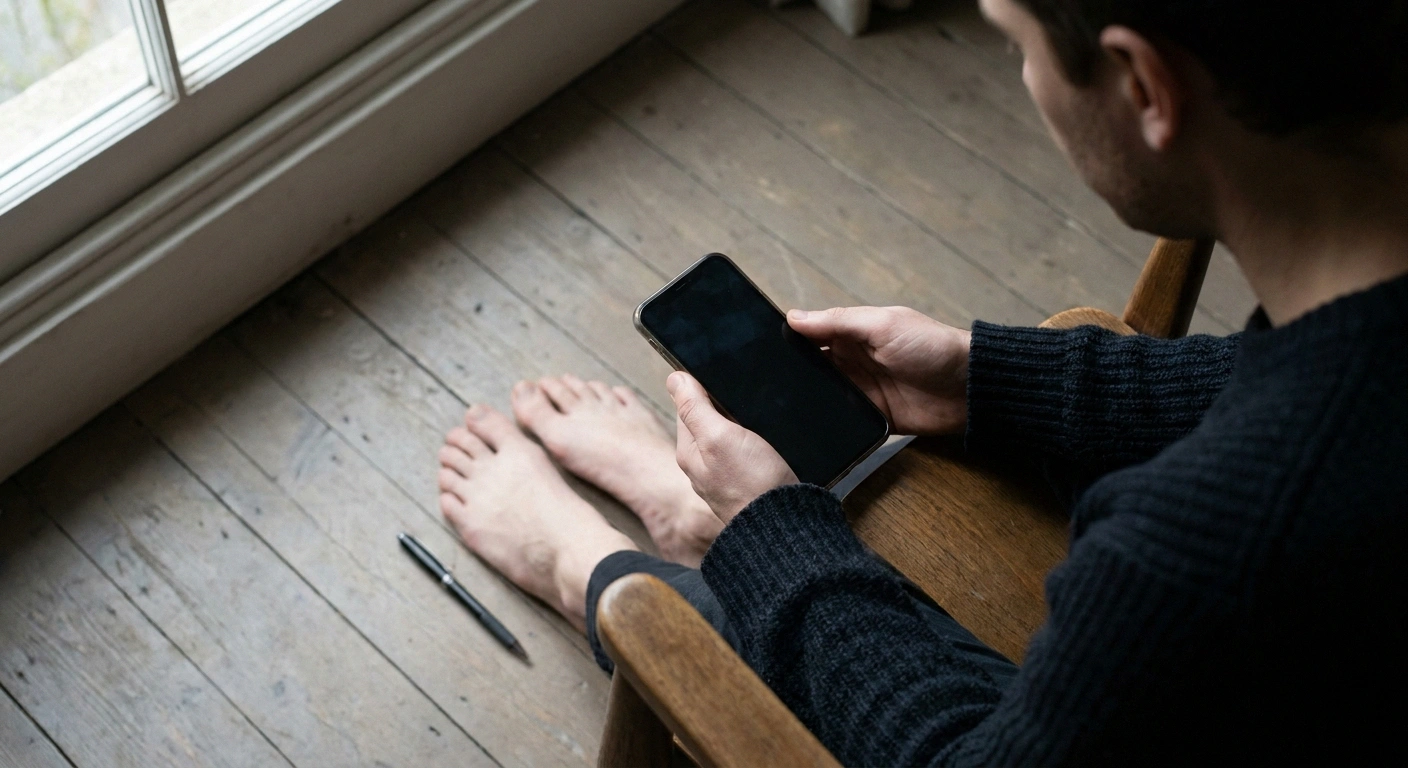
The thumb press is the main event, but a handful of other checks help on days when you distrust the result.
Five checks you can run before anyone examines you
| Check | Points to fluid | Points to sensation |
|---|---|---|
| Sock groove at the ankle | Visible line lasting minutes | No mark at all |
| Shoe fastening position | Buckle moved a hole, laces let out | Unchanged from last month |
| Morning weight, three days running | Two to three pounds gained quickly | Steady |
| Both feet side by side | One clearly larger | Identical |
| Back of hand on each foot | One noticeably warmer | Same temperature |
The last row is the one people skip and the one that changes urgency. Use the back of your hand rather than your palm, and check both feet within a few seconds of each other.
Look for a sock line. Elastic leaves a groove on a swollen ankle that is visible for a while after the sock comes off. No groove, no swelling.
Check your shoe fastenings. Which hole is the buckle on, which eyelets are you lacing to, does the strap sit where it did last month. Genuine swelling changes those numbers and does it fairly quickly.
Weigh yourself at the same time on several consecutive mornings. Fluid has mass. Two or three pounds appearing in a couple of days points toward retention somewhere in the body; a stable weight argues against it.
And photograph both feet together, from above, in the same light. Comparing a photo from three weeks ago against today beats memory every time, and memory is unusually bad at judging the size of your own body parts.
What It Feels Like From the Inside
The descriptions people bring are remarkably consistent, which is worth saying because plenty of readers have wondered whether they are imagining it.
Feet that feel puffy, or bound, or wrapped in something. A sense of walking on inflated pads. Skin that feels stretched tight across the top of the foot. Toes that feel fat and crowded against each other. A heaviness that makes each step feel like more work than it is.
Many people also report that it changes through the day, worst in the evening, which mimics real edema closely enough to be confusing. That timing has a simpler explanation: nerve symptoms generally intensify with fatigue and with hours spent upright, so the sensation follows the same daily curve real swelling does.
The Tight Sock Cousin
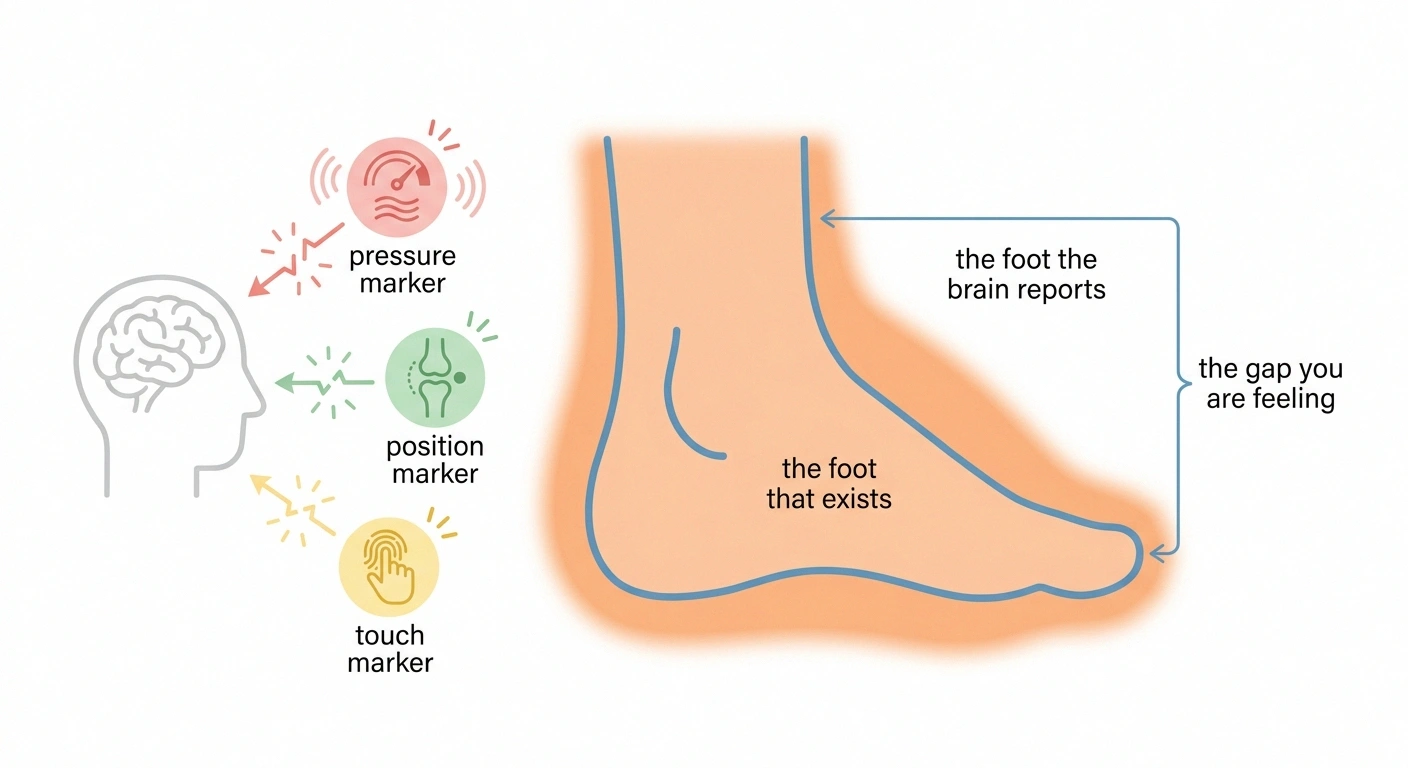
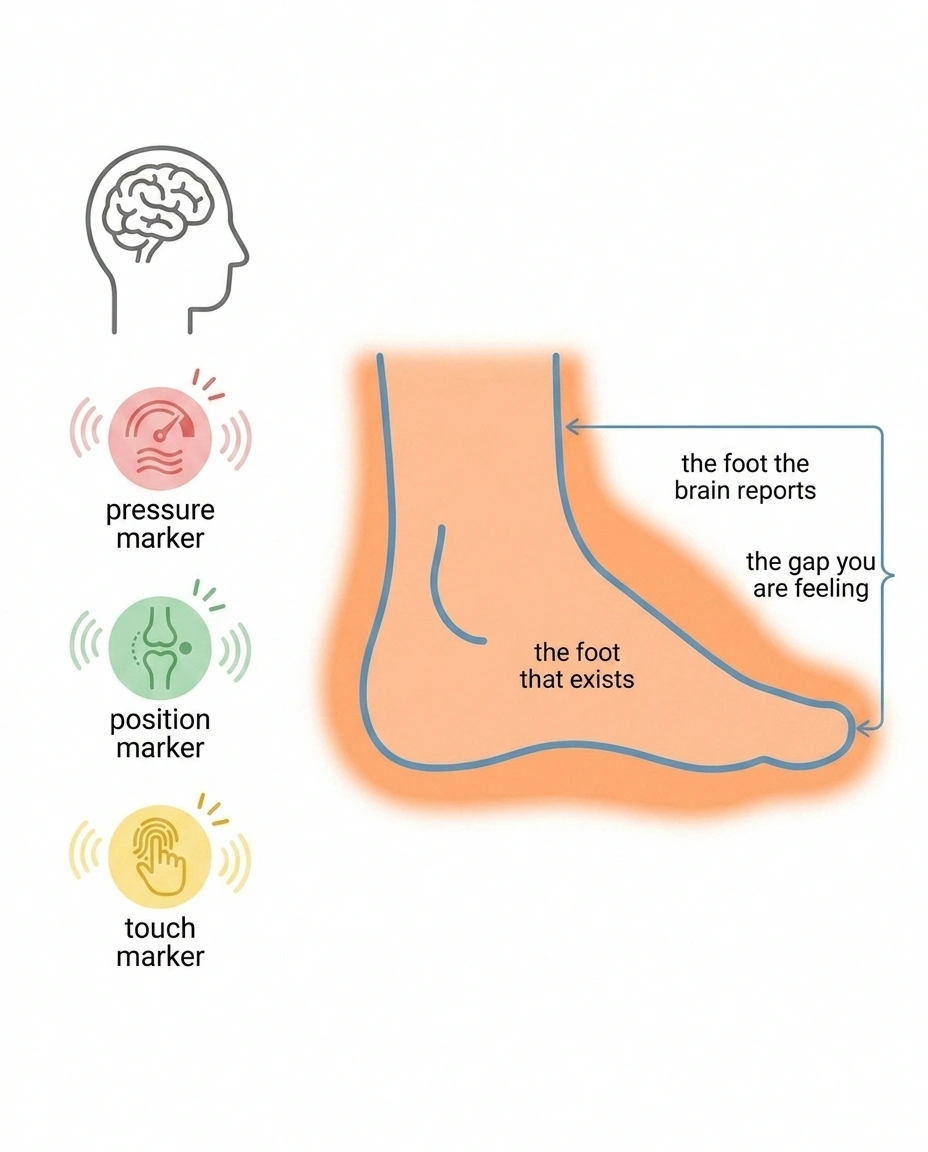
Ghost swelling has a close relative that a lot of people experience alongside it: the constant feeling of wearing a sock, a band or a compression sleeve when the foot is bare.
Both come from the same source. Damaged fibers carrying pressure and touch information fire spontaneously, and the brain interprets a steady background of pressure signals the only way it knows how, as something wrapped around the foot. Some people get the band, some get the fullness, and plenty get both at once.
The overlap matters because it tells you what you are dealing with. A foot that feels swollen and also feels wrapped, with no visible change to either, is a sensory story from start to finish. Our overview of small fiber neuropathy covers why these particular fibers produce such vivid and specific misinformation.
Why Shoes That Fit Still Feel Too Small
This is the practical consequence, and it causes real problems.
Nerve-damaged skin is often more sensitive to pressure, not less, even where it is also numb. A perfectly correct shoe registers as a vice. So people size up. They buy a wider fitting, then a wider one again, chasing a feeling of constriction that no shoe can fix because the constriction is not coming from the shoe.
Then the real problem starts. A shoe that is too large lets the foot slide with every step. Sliding creates friction. Friction creates blisters and hot spots. And a foot with reduced sensation does not report any of that until something has already gone wrong, which is precisely the chain that leads to a wound in someone who was only trying to be comfortable.
Get measured properly rather than sizing by feel. Our guide to choosing shoes for neuropathy covers what to look for, and the short version is that a shoe should be judged by measured fit and by what your skin looks like each evening, not by how tight it feels while you are wearing it.
When the Swelling Is Real
If your thumb left a dent, the sensation has a physical basis and the question becomes where the fluid is coming from.
Dependent swelling is the most common and most benign version: fluid pools in the lowest part of the body when you sit or stand for long stretches, and it resolves overnight. Venous insufficiency, where leg veins struggle to return blood upward, produces swelling that worsens through the day and often comes with skin changes around the ankle over time.
Beyond those, real edema in both legs can point toward the heart, the kidneys or the liver, and those deserve investigation rather than compression socks. Low protein in the blood, thyroid disease and some hormonal states also produce it.
Swelling in one leg only, particularly with calf pain or tenderness, raises the question of a clot. That belongs in an urgent care setting the same day, not in a wait-and-see plan.
Medications That Cause Genuine Swelling
This section deserves its own space, because the medications most likely to be causing your swelling are disproportionately the ones prescribed to people reading this site.
Check the timing against your prescriptions
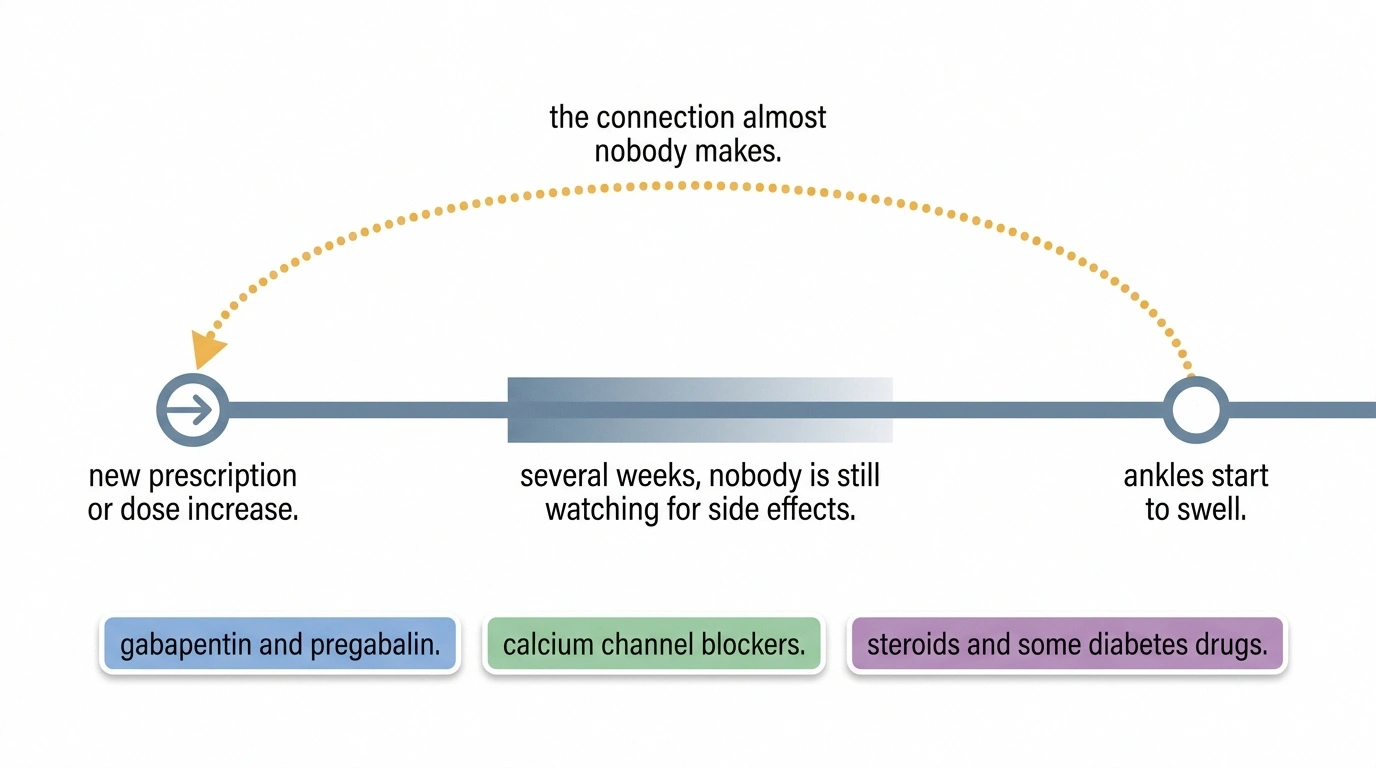
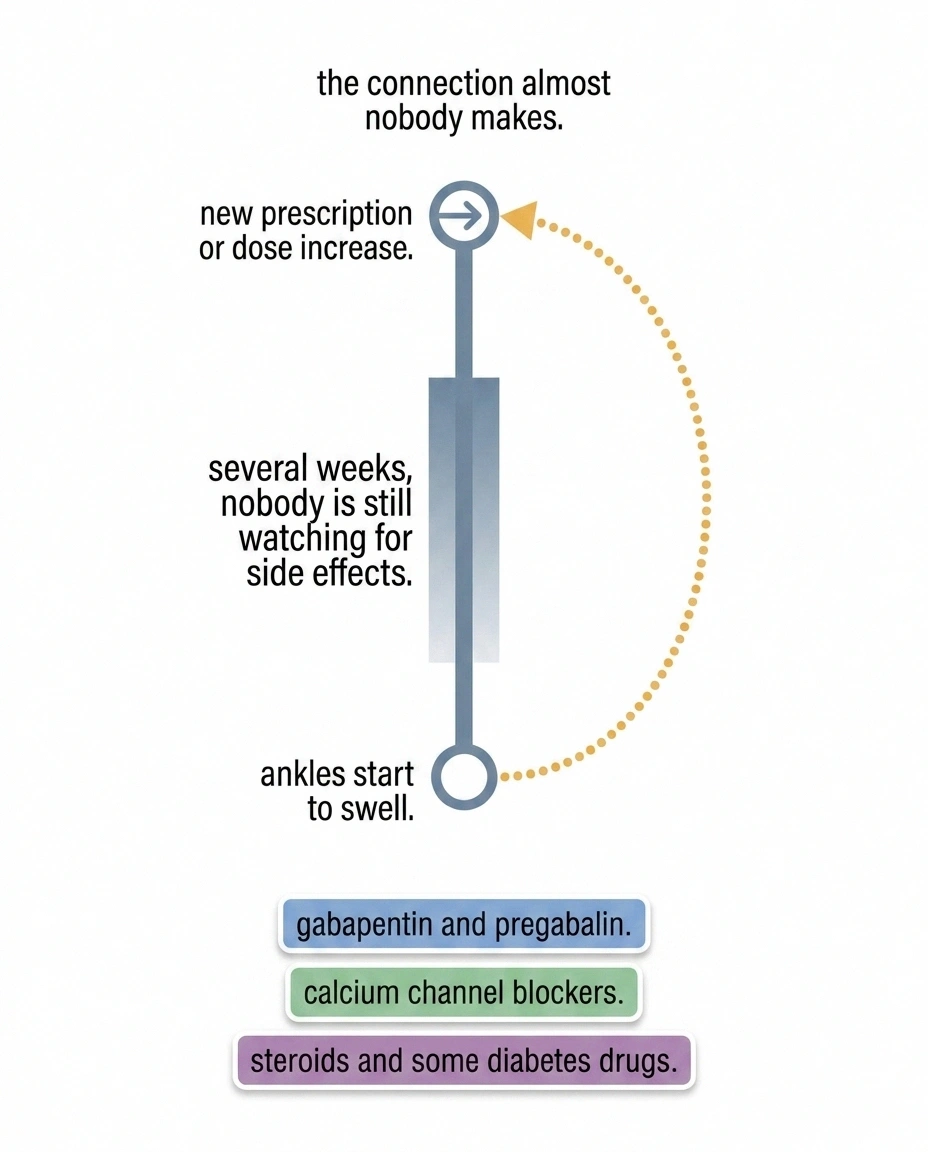
Medication swelling is missed because it starts weeks after the prescription, long after anyone is still watching for side effects.
Gabapentin and pregabalin
A recognized cause of peripheral edema, frequently dose-related. Disproportionately relevant here because so many readers take one of them for nerve symptoms. Ask specifically if swelling began within a few months of starting or increasing the dose.
Calcium channel blockers
Amlodipine in particular is a leading cause of ankle swelling. Often improves on a lower dose or a different blood pressure agent, without giving up control.
Also worth naming out loud
Certain diabetes medications, several anti-inflammatories, steroids and some hormone therapies. Bring the full list rather than the ones you think are relevant.
Nothing here is a reason to stop a medication on your own. A dose adjustment or a switch within the same class usually solves it.
Gabapentin and pregabalin both cause peripheral edema in a meaningful minority of users. It is a recognized effect, it is often dose-related, and it is missed constantly, because the swelling starts weeks after the prescription and nobody connects the two. If your feet started swelling within a few months of starting or increasing either one, that is a specific and highly worthwhile conversation to have.
Calcium channel blockers used for blood pressure, particularly amlodipine, are another leading cause of ankle swelling. Certain diabetes medications, several anti-inflammatories, some hormone therapies and steroids can all do it.
None of this is a reason to stop anything on your own. It is a reason to bring a full medication list and ask the question directly. A dose reduction is often the first thing tried. Worth knowing, though: gabapentin and pregabalin both cause this, so switching from one to the other frequently does not help, and a genuine change usually means a different class of medication rather than a neighbour within the same one.
The One-Sided Warm Foot
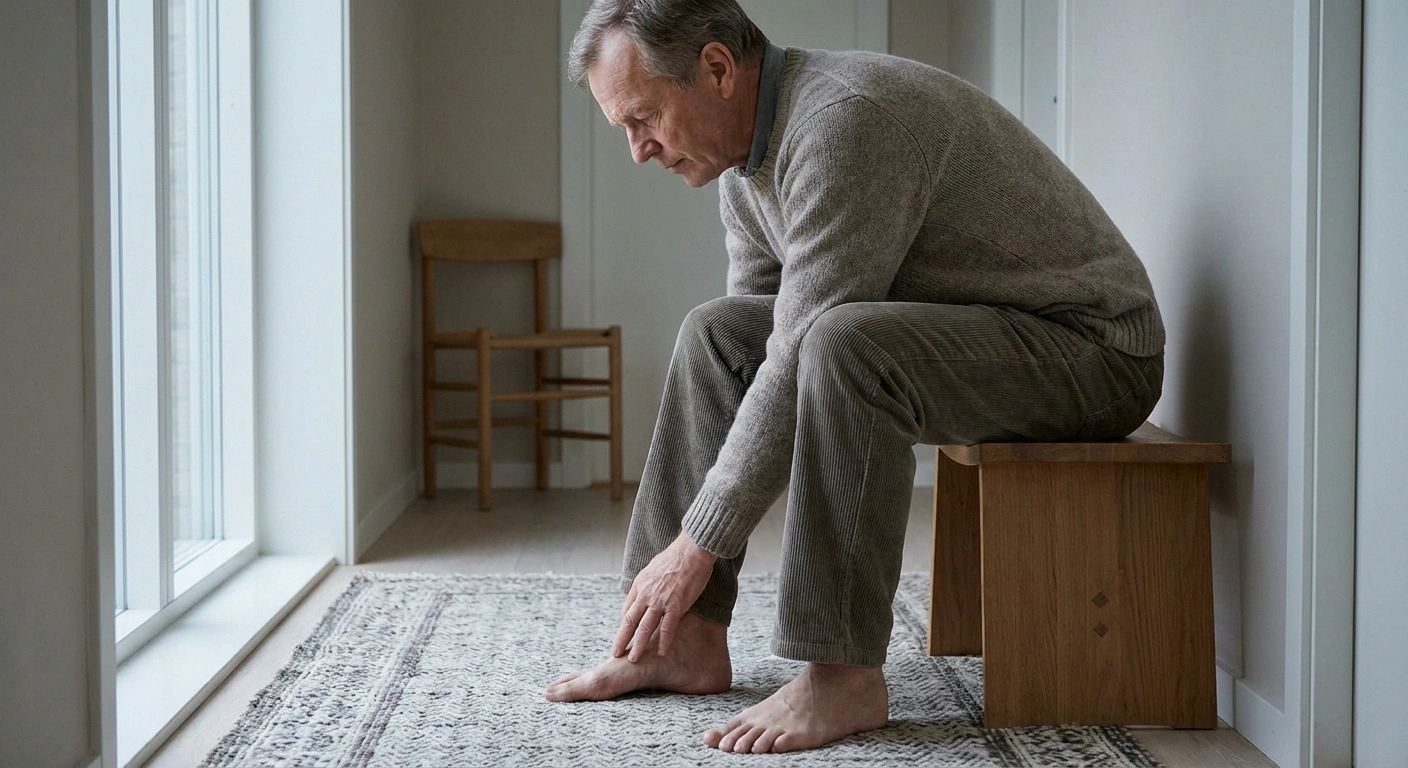
Now the part that matters most, and the reason a page about a mostly harmless sensation needs a serious section in the middle of it.
Three findings together, in a foot with neuropathy: call today
Swollen on one side only
Warmer than the other foot
Skin pink or red, usually no wound
The trap is pain. Charcot foot is frequently mild or painless, because the nerves that would report a fracture are the damaged ones. People delay precisely because it does not hurt enough to seem serious, and in this specific pattern the absence of pain raises concern rather than lowering it.
Treatment during the active phase is offloading, meaning weight off the foot entirely. Outcomes track closely with how early that starts, and every additional week of ordinary walking spends bone that does not come back.
If one foot is swollen and the other is not, and the swollen one feels warm compared to its partner, and the skin looks pink or red, stop assessing and make a call today. That combination in a person with neuropathy is how Charcot foot presents.
Charcot foot is a breakdown of the bones and joints of the foot that happens when protective sensation is lost. The bones fracture and shift under ordinary walking, and because the nerves that would normally scream about it are damaged, the person keeps walking. Left alone, the arch can collapse and the foot can permanently change shape.
The cruelty of it is that pain is often mild or absent. People routinely delay because it does not hurt enough to seem serious. A foot that is visibly swollen, noticeably warmer than the other and not especially painful is more concerning in this context, not less.
How Charcot Foot Hides
It gets missed because it impersonates ordinary problems convincingly.
It looks like cellulitis, but there is usually no wound, no cut and no obvious entry point for infection, and the person is not systemically unwell. It looks like a clot, but the swelling stays in the foot rather than extending up the calf. It looks like a sprain, but there is frequently no injury anyone can remember, or only something trivial like stepping off a kerb awkwardly.
Two signs make it recognizable. The temperature difference between the two feet is real and measurable, and it is often marked. And elevating the foot for several minutes tends to reduce the redness and swelling in Charcot, while an infected foot usually stays angry.
If you have neuropathy and diabetes, treat this pattern as urgent by default. The single factor most associated with keeping the foot intact is how early it is caught, and the treatment during the active phase is offloading, which means getting weight off it completely. Every day of ordinary walking on an active Charcot foot spends bone you do not get back.
What Happens If You Keep Walking On It
Worth being concrete, because vagueness here has a cost.
The active phase involves bones that are softened and joints that are unstable. Walking on that structure drives fragments out of position. The arch can drop until the middle of the foot becomes the lowest point, a shape sometimes called rocker-bottom, at which point the skin over that new pressure point ulcerates. Ulcers on an insensate foot are how amputations begin.
Caught early and offloaded, the process settles and the foot consolidates, often in a shape that is workable with the right footwear. Caught late, the deformity is permanent and everything afterward is management.
The gap between those two outcomes is measured in weeks of walking. That is the entire reason this section exists in an article about a sensation that is usually nothing.
Living With the Sensation Day to Day
Assuming the checks came back clean and you are dealing with ghost swelling, here is what actually helps.
Steady temperature helps more than most people expect. Feet that get cold amplify almost every nerve sensation, including this one. Warm socks in the evening, and not letting the feet get chilled on a tile floor, reduce the intensity for a lot of people.
Movement helps. Ankle circles, pointing and flexing, and a short walk break every hour give the nervous system genuine proprioceptive input to work with, which crowds out the manufactured kind.
Firm, even pressure works for some and is intolerable for others. A light compression sock provides constant real input that can override the phantom signal, and it is worth a trial with one condition attached: get it cleared first. Compression is genuinely unsafe in reduced arterial circulation, and it is the wrong move in unexplained swelling, in fragile or broken skin, and in some heart and kidney conditions. Since peripheral artery disease and neuropathy overlap heavily in the same people, this is not a formality. Our piece on compression socks for neuropathy covers how to choose a level and when compression is a bad idea.
Elevation is worth doing even when there is no fluid, because it changes the sensory input and often quiets the feeling regardless of whether it changes anything physical.
And keep looking at your feet. Reduced sensation plus a false sense of what your foot is doing is exactly the combination that lets a small injury go unnoticed. Our guide to daily neuropathy foot care covers the two-minute inspection habit, which matters more for this readership than any single product.
What to Say at the Appointment

Bring the results of your own checks rather than the sensation alone. That one change transforms the conversation.
Say whether the thumb press left a dent. Say whether it is one foot or both. Say whether shoe fastenings have changed. Say whether the affected foot feels warmer than the other, because that question is not always asked and it is the one that matters most. Give the timeline, and note anything that changed in the weeks before it started, especially a new medication or a dose increase.
If you take gabapentin, pregabalin or a blood pressure medication, say the name out loud. The connection is easy to make when someone raises it and easy to miss when nobody does.
And if you feel foolish reporting a foot that looks normal, do not. A sensation that has changed how you walk, what shoes you buy and how well you sleep is a legitimate clinical problem whether or not it shows up on inspection.
What Actually Helps Both Versions

A few things pay off no matter which category you turned out to be in.
The weekly photo, done so it is actually comparable
Gradual change is nearly invisible in a mirror and obvious in a side-by-side. Consistency is what makes the comparison mean anything, so fix these five variables and change nothing else.
- Same day and time each week. Morning is best, before hours upright have had a chance to move fluid.
- Both feet in one frame, side by side, shot from directly above while seated.
- Same light. Same room, same window, no flash, since flash flattens the colour difference you are trying to catch.
- Something for scale in the corner of the shot. A pen or a credit card works.
- Bare feet, socks off for at least ten minutes, so any elastic marks have faded and are not mistaken for swelling.
Keep them in one album. The comparison that matters is not this week against last week, it is this week against three months ago, and that is the one nobody can hold in their head.
Glucose control does more for nerve symptoms over time than anything else available, and it also reduces the risk of the complications this article warns about. Our overview of diabetic neuropathy covers what the targets mean in practice.
Getting off your feet at intervals helps real swelling and phantom swelling alike, for different reasons in each case.
Shoes that fit measured dimensions rather than felt ones protect the skin in both scenarios.
And a weekly comparison photo of both feet, taken from above in the same light, is the cheapest early-warning system available to anyone with reduced sensation. Change that develops gradually is nearly invisible in the mirror and obvious in a side-by-side photo, and gradual change is exactly what you most want to catch. Knowing where you sit in the progression of neuropathy makes it easier to judge what is worth watching and what is worth reporting.
Frequently Asked Questions
Why do my feet feel swollen when they are not?
Damaged sensory nerves misreport pressure and volume, and the brain builds its model of your foot from those reports. When the data is unreliable, the model comes out larger and heavier than the real foot. The sensation is often called ghost swelling, and it belongs to the same family as phantom limb sensations, except that the limb is still present and simply being described incorrectly.
How can I tell if my foot is really swollen?
Press a thumb firmly into the top of the foot or the shin just above the ankle and hold for ten seconds. A dent that lingers after you release means fluid has collected. Skin that springs straight back means it has not. Back that up by checking for a sock groove, noting which hole your shoe strap fastens on, comparing both feet side by side, and weighing yourself on several consecutive mornings.
Does neuropathy itself cause swelling in the feet?
Nerve damage alone does not usually cause fluid to accumulate. It can contribute indirectly, because reduced activity and impaired autonomic control of blood vessels both encourage pooling. Real swelling in someone with neuropathy is more often explained by circulation, heart, kidney or medication factors, and those are worth identifying rather than attributing to the neuropathy.
Can gabapentin or pregabalin make your feet swell?
Yes, both are recognized causes of peripheral edema, and the effect is frequently dose-related. Because the swelling appears weeks after starting or increasing the medication, the connection is commonly missed. If swelling began within a few months of a new prescription or a dose increase, raise it specifically. A dose reduction is often tried first. Since both drugs cause the effect, switching between them frequently does not help, and a real change usually means moving to a different class.
When is a swollen foot an emergency with neuropathy?
When one foot is swollen and the other is not, the swollen one feels warm compared with its partner, and the skin looks pink or red. In a person with neuropathy that pattern can indicate Charcot foot, in which bones fracture and shift under ordinary walking. Pain is often mild or absent because the nerves that would signal it are damaged, so a lack of pain should not be read as reassurance.
What is the difference between Charcot foot and an infection?
Charcot usually appears without a wound or an obvious entry point for bacteria, and the person is not generally unwell. Elevating the foot for several minutes tends to reduce the redness and swelling in Charcot, while an infected foot typically stays inflamed. Both need prompt assessment, and telling them apart properly requires imaging and examination rather than home observation.
Should I buy bigger shoes if my feet feel swollen?
Not on the strength of the feeling alone. Measure first. Nerve-damaged skin often perceives ordinary pressure as constriction, so people size up repeatedly chasing a tightness the shoe is not causing. Oversized shoes let the foot slide, which creates friction and blisters that reduced sensation will not report until damage is done.
Will the feeling of swollen feet ever go away?
It fluctuates for most people rather than disappearing outright, and it commonly quiets when the underlying nerve irritation is addressed. Better glucose control, correcting a vitamin deficiency, steady foot temperature, regular movement and a trial of light compression all reduce intensity for some people. Many find it becomes far less intrusive simply once they know what it is and stop interpreting it as a warning.
About the Author