The question comes up in every support group I have ever been part of, usually from someone holding their morning mug a little guiltily. “Is my coffee making this worse?” And the honest answer — the one that took me far too long to land on — is the same one that fits most things in chronic illness: it depends, and it depends in ways you can actually figure out.
I’m Janet Ellis. I write here as someone who lives with neuropathy, not as a doctor. I have spent years sorting through what the research says about caffeine and nerve pain, and I have also spent years watching what it actually does in real people in real kitchens. What follows is both — the science and the patterns — so you can decide what your relationship with coffee should look like.
The Short Answer Nobody Wants to Hear
There is no universal rule here. For some people with neuropathy, moderate caffeine is fine, neutral, or even mildly helpful. For others, it is a clear trigger. The research itself reflects this split — caffeine has been shown to increase pain sensitivity at lower doses through certain adenosine receptors, and to decrease pain sensitivity at higher doses through different mechanisms. Both findings are real. They just describe different doses and different people.
Caffeine affects neuropathy through three different mechanisms — adenosine receptors, vasoconstriction, and sleep disruption. Whether it helps, harms, or is neutral depends on your dose, your timing, and your nerves. The only way to know for you is a structured two-week self-test.
So if you came here hoping someone would tell you “yes, drink it” or “no, quit,” I am going to disappoint you on purpose. The more useful answer is to understand what caffeine is actually doing to nerves and circulation, then run a simple two-week test on yourself with that understanding in mind.
What Caffeine Actually Does to Your Nervous System
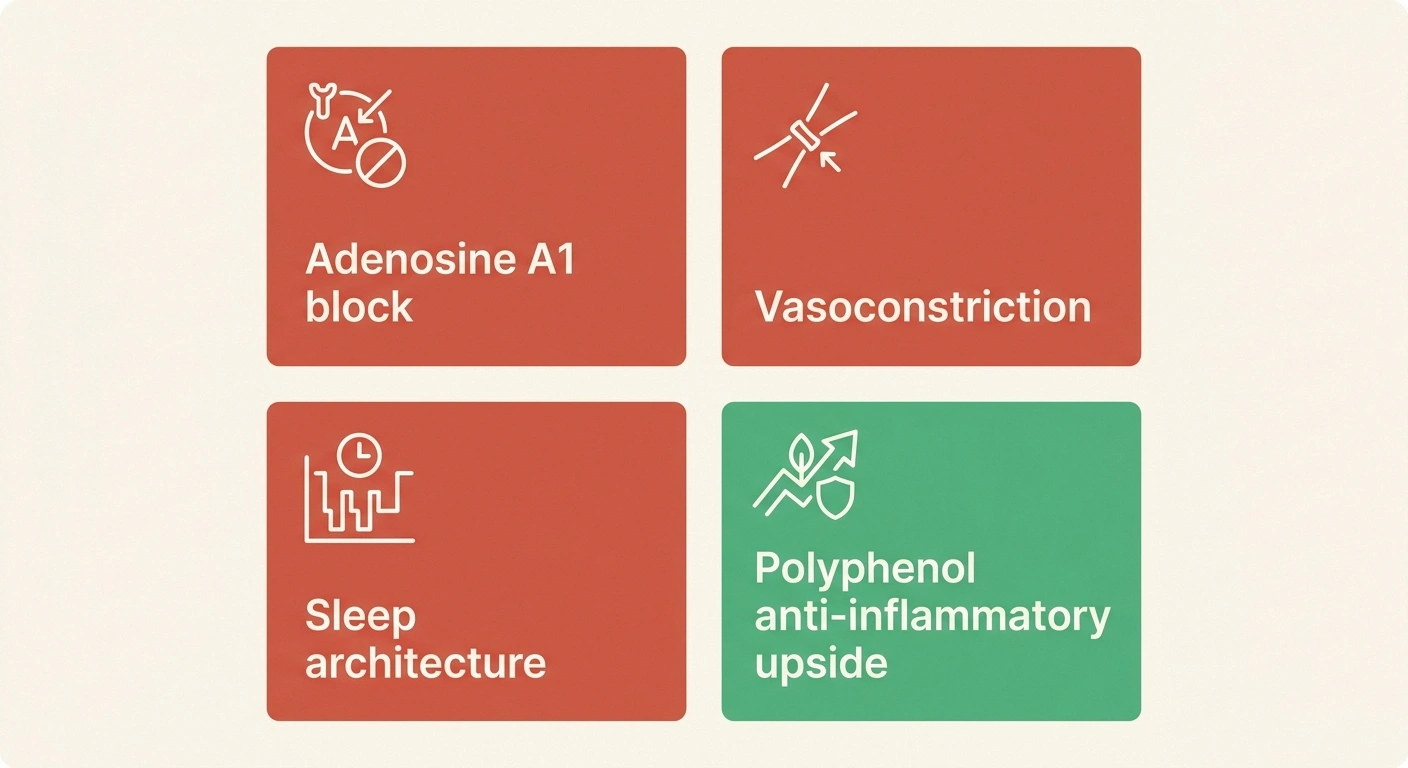
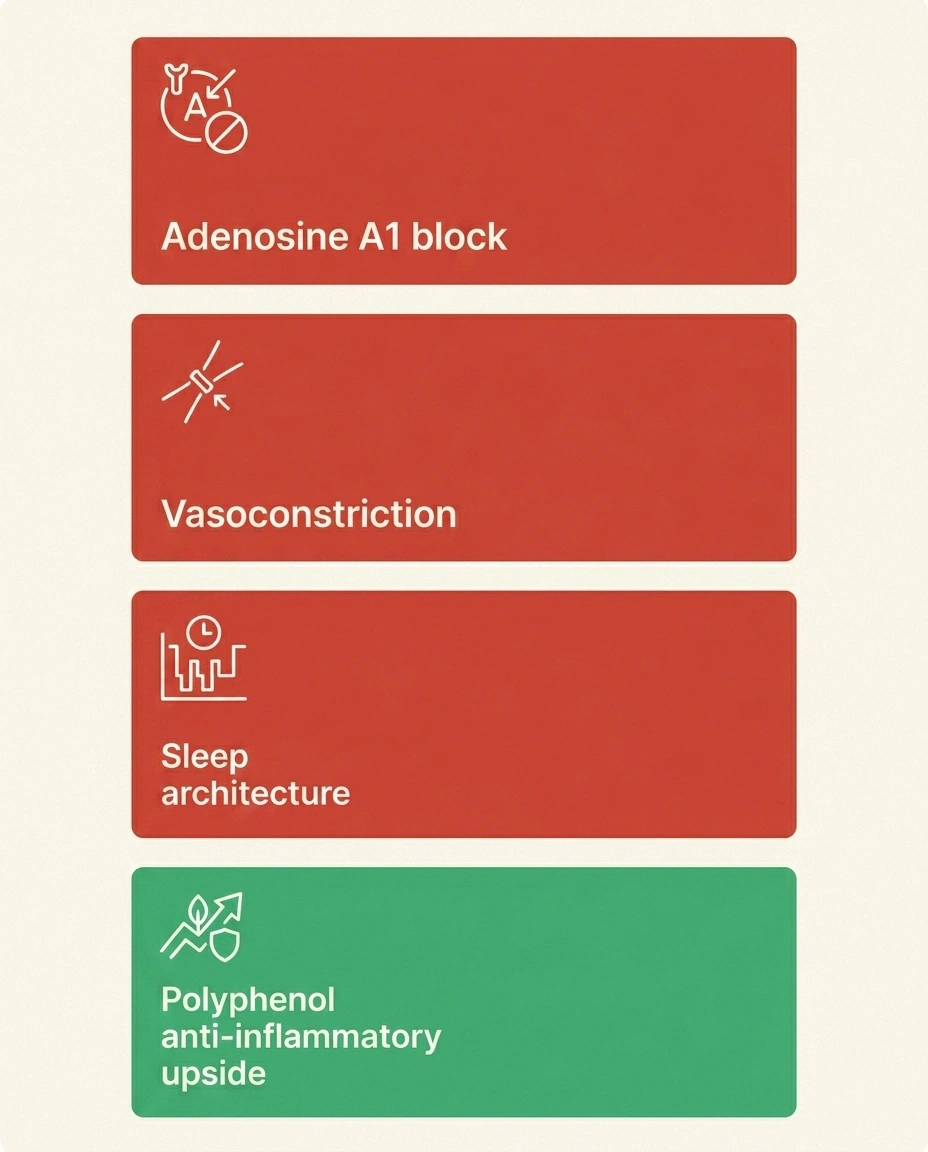
Caffeine has several effects that matter for nerve pain, and they pull in different directions, which is why the experience varies so much from person to person.
How Caffeine Touches Nerve Pain
First, it blocks adenosine receptors in the brain and nervous system. Adenosine is the molecule that builds up while you are awake and makes you feel tired — caffeine blocks the receptors, you feel alert. But adenosine also plays a role in pain modulation, and the A1 adenosine receptor in particular is involved in dampening pain. At lower-to-moderate doses, blocking that receptor can effectively turn down your built-in pain-quieting system, which shows up as more sensitivity to ordinary stimuli.
Second, caffeine narrows blood vessels — vasoconstriction. This is why caffeine is part of some headache medications (constricting the dilated vessels of a migraine helps). But peripheral nerves depend on a steady blood supply through the tiny capillaries that feed them. Anything that pinches that supply, even mildly, can worsen the underlying conditions in nerves that are already short on circulation. People with diabetic neuropathy, where small-vessel circulation is already compromised, are most likely to feel this.
Third, caffeine is a stimulant that affects sleep, and sleep is where nerves heal. Even caffeine consumed in the early afternoon — well before bedtime for many people — measurably reduces deep sleep that night for some metabolisms. Poor sleep amplifies pain perception the following day. That is one of the most consistent findings in all of pain research.
Fourth, at higher doses, caffeine can engage other receptors and pathways that genuinely reduce certain types of pain — which is why higher-dose effects in research sometimes look protective. That is real too, but “higher dose” in these studies is often well past what you would actually drink.
The Sleep Angle Is Bigger Than People Realize

If I had to name the single most underrated way caffeine affects neuropathy, it would not be the immediate nerve effect — it would be what it does to sleep architecture. People with neuropathy already tend to sleep poorly. The pain is louder at night, the position changes are more disruptive, restless-leg patterns are more common. Layering caffeine-disrupted sleep on top of that is a setup for a worse next day.
Caffeine’s average half-life in adults is roughly five hours — meaning a 3 p.m. coffee still has a meaningful amount circulating at 11 p.m. Even when subjects “didn’t feel it,” sleep studies have measured reduced deep-sleep time the same night. Poor sleep is one of the most consistently documented amplifiers of next-day pain perception.
The thing that surprises people is that the cutoff for “afternoon caffeine doesn’t affect my sleep” is much earlier than they think. Caffeine has a half-life of roughly five hours in most adults, longer in some, shorter in others. That means a 3 p.m. coffee still has a meaningful amount circulating at 11 p.m., even if you do not feel it. If your nights are bad and you drink caffeine after noon, that is one of the higher-leverage changes you can experiment with — earlier in the day, and a hard cutoff. Our piece on why neuropathy gets worse at night covers the wider sleep picture.
What “Tingling After Coffee” Usually Means
A pattern I hear often: “Within ten or fifteen minutes of finishing my coffee, my feet start to tingle.” Sometimes hands too. Sometimes a buzzing sensation rather than a true tingle. People often arrive at the worry that caffeine is “causing” neuropathy. It is almost certainly not. What is more likely happening is that caffeine’s vasoconstriction is briefly reducing blood flow to nerves that are already short on supply, which makes existing nerve dysfunction more noticeable for a short window. The underlying nerve was already irritated; the coffee made you feel it.
That distinction matters because it changes the response. You are not racing to undo damage — you are managing a transient flare. A glass of water (caffeine is mildly dehydrating), gentle foot movement, and a little time usually settle it. If it happens reliably with coffee and resolves within an hour, that is information: your nerves are sensitive to vasoconstriction, and that is a good reason to lean toward less caffeine, not more.
Coffee Is Not Just Caffeine
Worth saying clearly: coffee contains a lot more than caffeine. The most relevant one for nerve health is chlorogenic acid, a polyphenol with genuine anti-inflammatory and antioxidant activity. Several population studies have linked regular coffee consumption to a slightly lower risk of developing type 2 diabetes — the leading cause of peripheral neuropathy worldwide.
That is not the same as “coffee treats neuropathy,” and it does not erase the caffeine-specific concerns. But it does mean that for some people, the right move is not to quit coffee entirely; it is to choose a form that gives you the polyphenols with less caffeine — like half-caf, decaf, or fewer cups of regular. Coffee is more than its stimulant.
The Decaf Question
If you have tried switching to decaf and still get symptoms, you are not imagining it. Decaf is not caffeine-free — most decaf still contains roughly 2 to 7 milligrams of caffeine per cup (compared to 80 to 100 for regular). For very sensitive people, that is enough. Decaf is also acidic, which can independently bother some people with reflux-sensitive nerve symptoms.
If decaf still triggers you, the next step is usually a switch — to caffeine-free herbal teas (chamomile, rooibos, ginger), or to roasted-grain or chicory beverages that mimic coffee without the plant alkaloids.
Other Drinks That Are Quietly Caffeinated
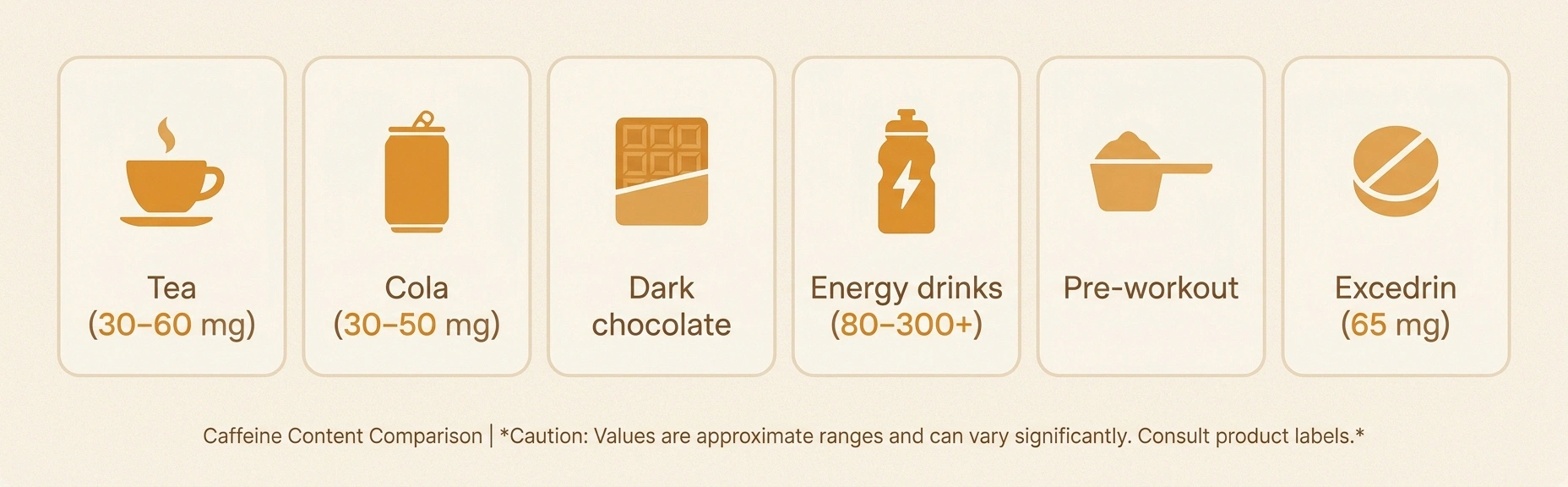
If you are doing a caffeine experiment, the coffee is the obvious one. The less obvious sources catch people:
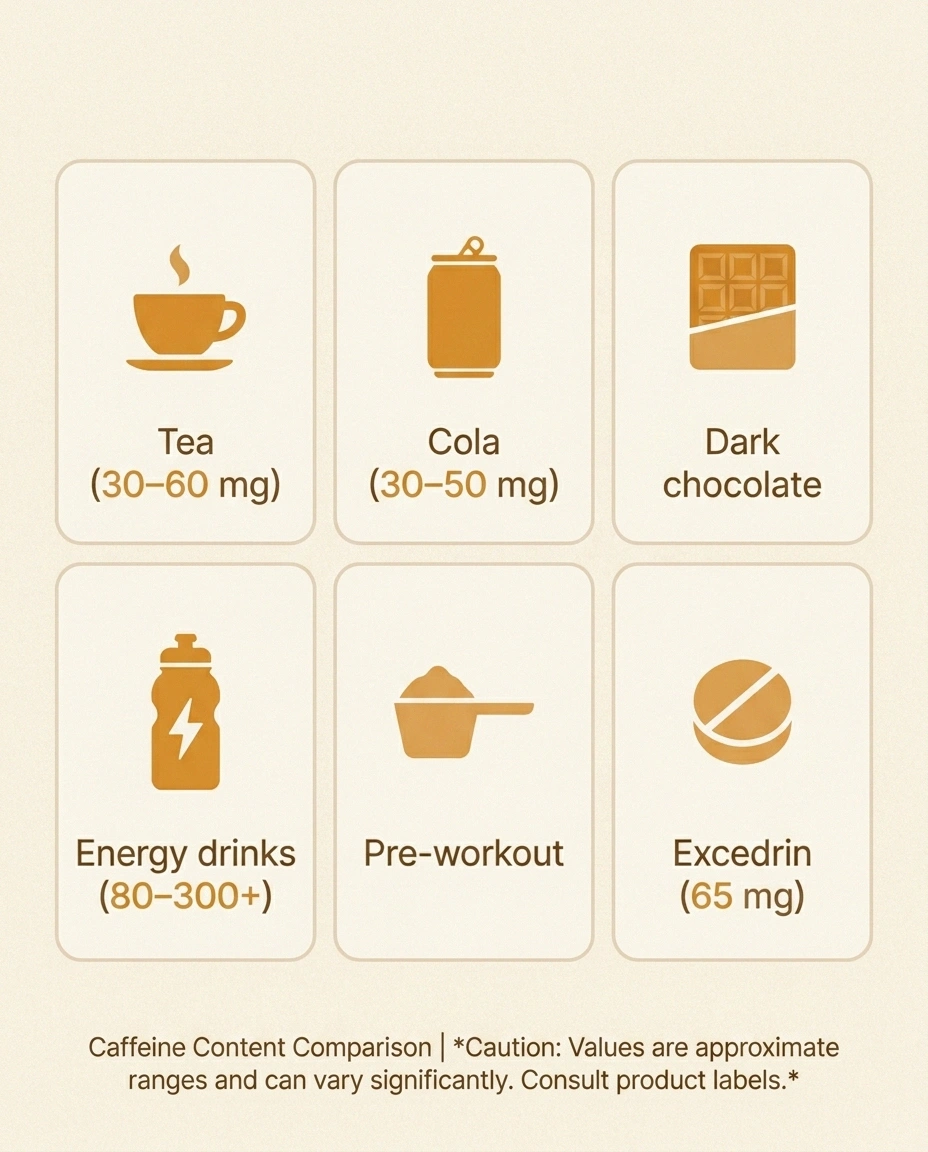
If you only cut coffee but keep tea, cola, dark chocolate, and pre-workout in your day, your “caffeine experiment” isn’t running. Tea has 30–60 mg/cup, energy drinks 80–300+, Excedrin 65 mg per dose. Cut all sources for the test period.
- Tea — black and green both contain meaningful caffeine (~30 to 60 mg per cup), white tea less. Matcha is concentrated and surprisingly potent.
- Cola and most diet sodas — ~30 to 50 mg per can.
- Energy drinks — 80 to 300+ mg per can; the outliers can rival several cups of coffee in one serving.
- Pre-workout supplements — often 150 to 300 mg per scoop.
- Chocolate, especially dark — a couple of squares can add up over an evening.
- Some over-the-counter pain medications (Excedrin and similar) — often 65 mg per dose.
If you are trying to figure out whether caffeine is affecting your symptoms and you only cut coffee while keeping the rest in your day, your experiment is not really running. Cut all sources together for the test period.
The Two-Week Self-Test
Here is the cleanest way I have found to actually answer “is caffeine affecting my neuropathy” for any given person. It takes two weeks, costs nothing, and tells you more than any blog ever will.
The Two-Week Caffeine Self-Test
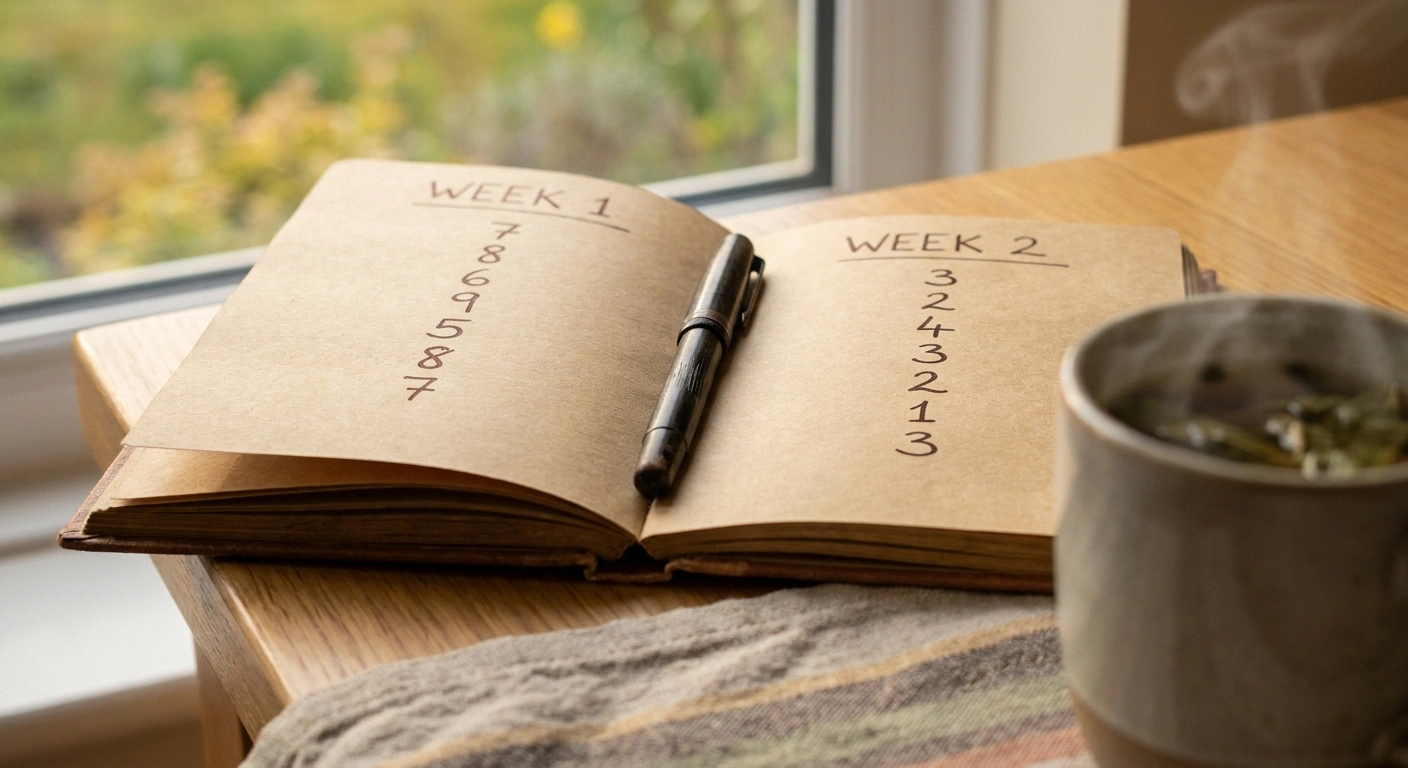
For one week: keep your normal caffeine pattern. Each evening, rate your neuropathy symptoms (pain, tingling, burning, numbness) on a simple 0-to-10 scale. Note your sleep quality the same way. Write the numbers in the same notebook every night. Do not change anything else.
For the second week: cut all caffeine — coffee, tea, cola, dark chocolate, the lot. Replace your morning ritual with something warm and caffeine-free so the routine survives. Continue rating symptoms and sleep every evening. Expect a headache for the first two or three days as you taper off caffeine — this is normal and resolves.
At the end of two weeks, you have a real comparison. If the second week’s numbers are clearly better, caffeine matters for you and you have a decision to make about how much to bring back, when, and in what form. If the numbers are about the same, caffeine is not the driver of your symptoms, and you can stop worrying about your morning cup. Either answer is freeing in its own way. Our guide to keeping a neuropathy symptom diary walks through this kind of structured tracking in more detail, and the broader flare-up trigger guide shows how to test other suspects the same way.
If You Are Going to Drink It, How to Drink It Smarter

For most people who land on “I do want to keep my coffee,” a few simple adjustments meaningfully reduce the downside without forcing you to quit.
If You’re Keeping Coffee — Drink It Smarter
- Hard cutoff at noon. Earlier if your sleep is fragile.
- One to two cups maximum, not the open-pot habit.
- Always with food and water, never on an empty stomach.
- Drink an extra glass of water for each cup — caffeine is mildly dehydrating, and nerves like hydration.
- Consider half-caf as a middle ground — preserves the ritual, halves the dose.
- If your neuropathy has a clear blood-sugar connection, do not pair coffee with a sweet pastry; you are stacking a vasoconstrictor on a glucose spike, both of which stress small vessels. See our diabetic neuropathy guide.
None of this is rocket science. It is just paying attention.
When to Quit Entirely

There are a few situations where I would push harder toward eliminating caffeine, at least for a meaningful trial period.
- If your nights are consistently terrible and you drink anything caffeinated after noon.
- If you reliably get tingling, buzzing, or a clear symptom flare within an hour of a cup.
- If your neuropathy is primarily diabetic and your blood sugar is unstable — caffeine can affect insulin sensitivity in some people.
- If you are on a medication where caffeine matters (some heart medications, certain anxiety medications, some thyroid medications). Ask your pharmacist.
- If anxiety is meaningful in your pain picture — caffeine amplifies the body’s stress response, which amplifies pain perception.
Quitting cold turkey gives you a headache, usually peaking around day two. Tapering over a week is gentler. Either way, two weeks in you will know whether caffeine had a hand in your symptoms.
The Bigger Picture
Caffeine is one variable in a much larger picture. People who feel best with neuropathy tend to be the people who have, over time, identified their personal trigger list and made small ongoing adjustments — not the people who have eliminated everything in fear. The goal of an experiment like this is not to find another thing to be afraid of. It is to find out whether this particular thing matters for you, and then to make a real choice based on a real answer.
If caffeine turns out to be a clear factor, you have one more lever to pull. If it does not, you have permission to stop worrying about it. Both outcomes are wins.
Frequently Asked Questions
Does coffee cause neuropathy?
No. There is no credible evidence that coffee causes neuropathy. The underlying causes of nerve damage are conditions like diabetes, autoimmune disease, B12 deficiency, certain medications, chemotherapy, and others. What coffee can do is briefly worsen existing symptoms in some people through vasoconstriction and adenosine effects — making the existing nerve dysfunction more noticeable rather than causing new damage.
Why do my feet tingle after I drink coffee?
Caffeine narrows blood vessels, including the tiny capillaries that feed peripheral nerves. If your nerves are already short on circulation — as is often the case in neuropathy — that brief reduction in blood flow can make existing nerve dysfunction more noticeable for a short window. A glass of water, gentle movement, and time usually settle it within an hour. If it happens reliably, that is a useful signal that less caffeine probably suits you better.
Should I quit caffeine if I have neuropathy?
Not automatically. The honest answer depends on you. Run a two-week self-test: one week with your normal caffeine pattern, one week with none. Rate your symptoms each evening. If the no-caffeine week is clearly better, caffeine matters for you. If it is the same, it does not, and you can drink your coffee in peace.
Is decaf coffee safe for neuropathy?
For most people, yes — though decaf is not actually caffeine-free, containing roughly 2 to 7 milligrams per cup. For very sensitive people, that residual amount can still trigger symptoms. Decaf also has the polyphenols and antioxidants that may be part of why moderate coffee consumption is associated with slightly lower diabetes risk in population studies.
What drinks are best for neuropathy?
Caffeine-free herbal teas (chamomile, ginger, rooibos), water, and bone broth are gentle defaults. Green tea in modest amounts contains polyphenols that may support nerve health, with much less caffeine than coffee. Avoid sugary drinks if your neuropathy is diabetes-related, and avoid energy drinks regardless. Hydration itself matters more than the specific drink — dehydration worsens nerve symptoms.
Does caffeine affect neuropathy medications?
It can. Caffeine has minimal direct interactions with the most common neuropathy medications (gabapentin, pregabalin, duloxetine), but it can mask the drowsiness that some of these cause — which feels like a benefit but is actually losing a useful safety signal. Caffeine matters more for some heart, thyroid, and anxiety medications. If you take prescription medication, ask your pharmacist about caffeine specifically.
How much caffeine is too much for nerve pain?
The honest answer is “less than you think, and individual.” Most adults can handle up to 400 mg per day (about three to four cups of coffee), but in people with sensitive nerves, the threshold is often lower — many feel best at one to two cups, taken in the morning only. The two-week self-test is the most reliable way to find your number.
Will I get a headache if I quit caffeine?
Probably, especially if you currently drink several cups per day. The headache usually peaks around day two and resolves within a week. Tapering by half a cup per day for a few days before stopping is gentler than quitting cold turkey. Stay well hydrated through the taper.
About the Author