My friend Lorraine was a wedding dancer. That is a phrase her family made up because at every wedding, every baptism, every fiftieth anniversary party, Lorraine was the one who got dragged out to the dance floor first and did not sit down until the DJ started packing up. She met her husband in a swing dance class in the 1970s. She kept dancing through decades of marriage, three children, retirement, and the death of her husband. And then, at seventy-two, she was diagnosed with peripheral neuropathy and stopped dancing entirely. When she told me that at our support group meeting last year, I could see it in her face — she had lost something that mattered, and she was not sure she was allowed to have it back.
I have very good news for Lorraine, and for you. Dancing with neuropathy is not off the table. In fact, for many people it is one of the safer and more joyful forms of movement they can do. Dancing challenges balance in a controlled and playful way, keeps you engaged socially, moves your feet through many more positions than walking alone does, and gives you something to look forward to. The trick is knowing which forms of dancing fit your body, what small adjustments make the difference between a fun evening and a bad fall, and how to hold onto the parts of dancing that make it dancing rather than reducing it to something clinical. This article is for anyone with neuropathy who used to dance and is not sure if they still can, or who is thinking about starting because they have heard that dance-based movement helps with balance. I am a patient advocate, not a medical professional. Please talk with your provider before starting any new activity, and if you have significant balance problems, a history of falls, or advanced neuropathy affecting your feet, get a physical therapy evaluation first.
Why Dancing Actually Helps Neuropathy
The value of dancing for people with neuropathy is not just about the joy — though the joy matters enormously. It is also about what happens to your feet, your balance, and your brain during dance.
Key takeaway
Dancing with neuropathy is genuinely possible for most people, and often protective — it trains balance, teaches your feet new positions, retrains your rhythm, and keeps you socially connected. The trick is picking the right style, the right shoes, and the right pace for your body today, and being willing to dance a little differently than you used to.
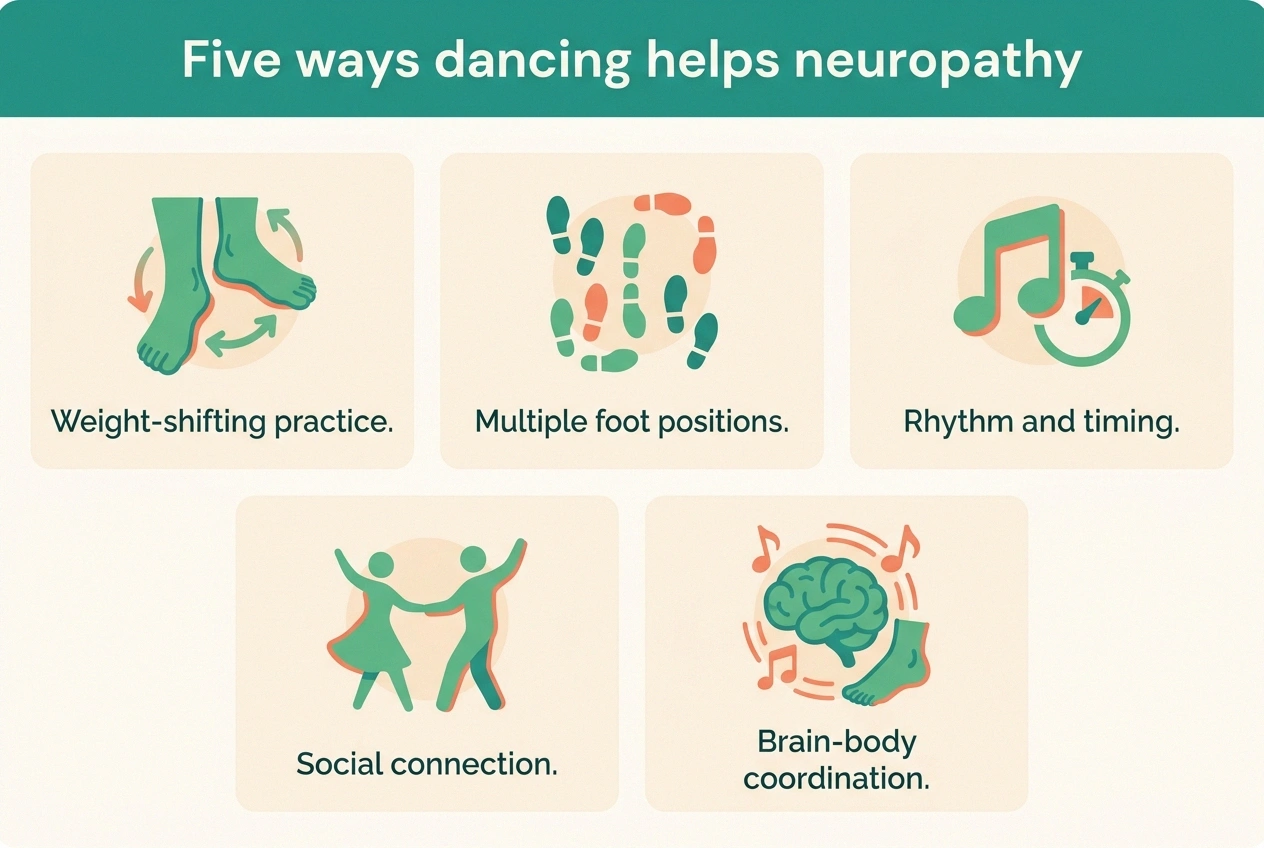
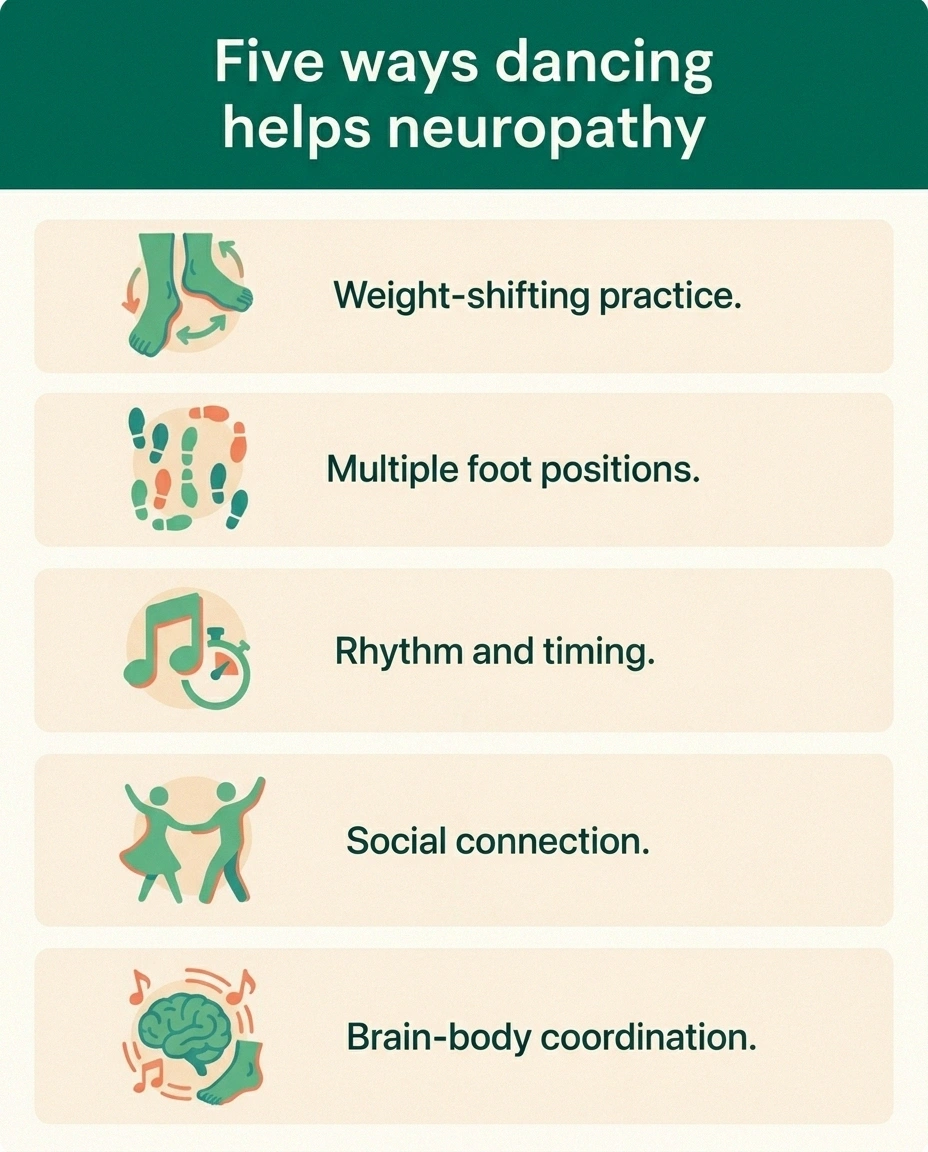
Weight-shifting practice. Every step in every dance shifts your weight from one foot to the other, sometimes forward and back, sometimes side to side. This is the exact skill that neuropathy quietly erodes because you cannot feel your feet as clearly as you used to. Practicing weight shifts with music and rhythm builds the balance muscles that daily walking does not fully train.
Multiple foot positions. Walking uses one foot pattern. Dancing uses many — pivots, side steps, cross-steps, back-steps, sway. Your feet learn to place themselves in a wider range of positions, which is protective when you have to step around an obstacle at home or catch yourself on uneven ground.
Rhythm and timing. Music gives you an external pacing signal. People with neuropathy often walk faster or slower than they intend because their internal feedback about foot placement is dulled. Dancing to a beat retrains that rhythm and can carry over into everyday walking.
Social connection. Neuropathy can be isolating. Dance venues — whether formal ballroom classes, community line-dancing groups, church socials, or living-room sessions with grandchildren — put you back in a context where movement is shared. The social connection matters for mood and mental health almost as much as the physical movement matters for balance.
Brain-body coordination. Learning steps, remembering sequences, and moving to music engage the parts of the brain that coordinate balance and motor control. Research has consistently shown that dance-based interventions can meaningfully improve balance, reduce fall risk, and improve quality of life in older adults, including those with peripheral neuropathy. This is not just “exercise.” It is targeted training.
All of that said, dancing is also a fall risk if not adapted to your specific situation. That is what the rest of this article is about — making the adjustments that let you keep dancing safely.
The Five Neuropathy Considerations Before You Step Onto the Floor
Here are the five specific things that matter most in adapting dancing to a body with neuropathy. Think of them as a pre-flight checklist. You do not need every one to be perfect. You need to think through each one honestly.
Your pre-dance neuropathy check
- 1. Balance and fall risk — recent falls? holding onto furniture? one-leg balance?
- 2. Your feet — supportive shoes? foot inspection before/after? no numb-foot barefoot on hard floors?
- 3. Autonomic function — orthostatic dizziness? warm venue plans? hydration?
- 4. Cardiovascular capacity — recent activity level? provider clearance for exertion?
- 5. Medication timing — no dance at peak drowsiness from gabapentin, pregabalin, tricyclics.
1. Balance and fall risk. Neuropathy affects the sensory information your feet send to your brain about where they are in space. That is what makes fall prevention such a central concern. Before starting a new dance activity, honestly assess: Have I fallen in the last year? Do I hold onto furniture when I walk in unfamiliar places? Can I stand on one leg for five seconds without touching anything? Can I turn my head while walking without losing my balance? If several of those raise concerns, please get a balance and fall prevention evaluation from your provider before adding dance.
2. Your feet. Numbness in the soles affects your ability to feel the floor, feel foot placement, and feel developing hot spots or blisters. Before every dance session, do a foot inspection. Wear supportive shoes appropriate for the dance style. Do not dance barefoot on hard floors if your soles are numb. Check your feet after every session for redness, blisters, or unnoticed injuries. Preventing foot injuries is essential foot care discipline that must scale up when you add new activities.
3. Autonomic function. Autonomic neuropathy can cause your blood pressure to drop when you stand up quickly or exert yourself — a phenomenon called orthostatic hypotension. In the dance context, this shows up as dizziness or lightheadedness during fast turns, quick standing after sitting, or exertion in warm venues. If you have autonomic symptoms, dance in cool venues, avoid rapid spins, stay well hydrated, and know that quickly standing after being seated is when the risk is highest.
4. Cardiovascular capacity. Dancing is exercise. If you have heart conditions, blood pressure medications, or if you have not been physically active recently, start slowly. Your provider can help you figure out what intensity is appropriate. Ballroom dancing at a moderate tempo can burn as many calories as brisk walking; upbeat social dancing can be significantly more intense.
5. Medications and dizziness. Many medications used for neuropathy pain — including gabapentin, pregabalin, and low-dose tricyclics — can cause drowsiness or dizziness. Time your dose so you are not at peak medication effect during the dance session. If you have started a new medication and have not yet fully adjusted, hold off on dancing until you know how it affects your balance.
Which Dance Styles Fit a Neuropathy Body Best
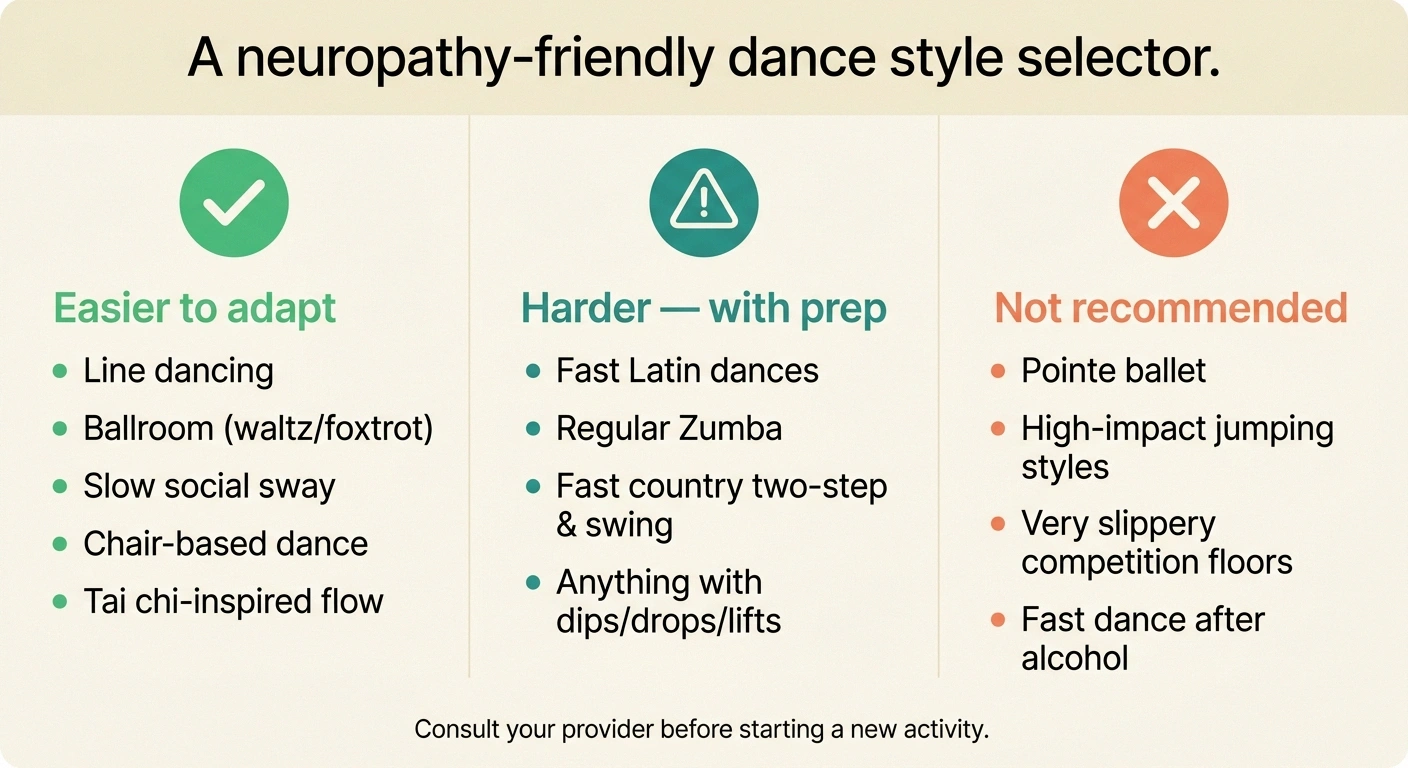
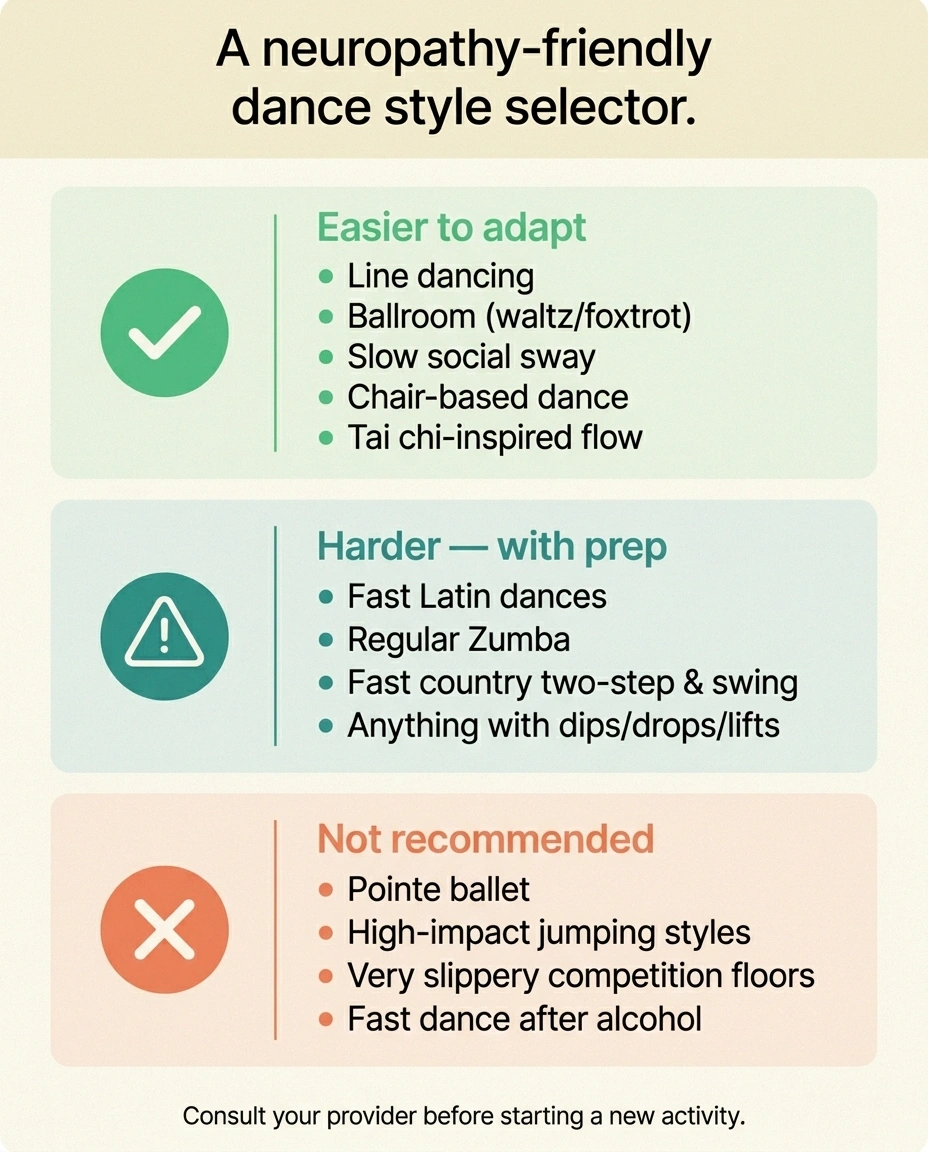
Not every dance style is equally suited to a body with neuropathy. Some are much easier to adapt than others. Here is a rough guide.
A neuropathy-friendly dance style selector
- Line dancing
- Ballroom (waltz/foxtrot)
- Slow social sway
- Chair-based dance
- Tai chi-inspired flow
- Fast Latin dances
- Regular Zumba (try Gold)
- Fast country two-step, swing
- Anything with dips or drops
- Pointe ballet
- High-impact jumping styles
- Very slippery competition floors
- Fast dance after alcohol
Consult your provider before starting a new dance activity, especially if you have significant balance concerns.
Easier to adapt (many people with neuropathy do well):
- Line dancing. No partner required. Choreographed steps mean you know what is coming. Easy to sit out any move that is too much. Group setting lets you follow more experienced dancers. Common at senior centers, community centers, and country dance halls.
- Ballroom (waltz, foxtrot). Slower tempos, deliberate steps, and having a partner to hold onto for balance. The waltz's rhythm and weight-shifting pattern is particularly good for balance retraining.
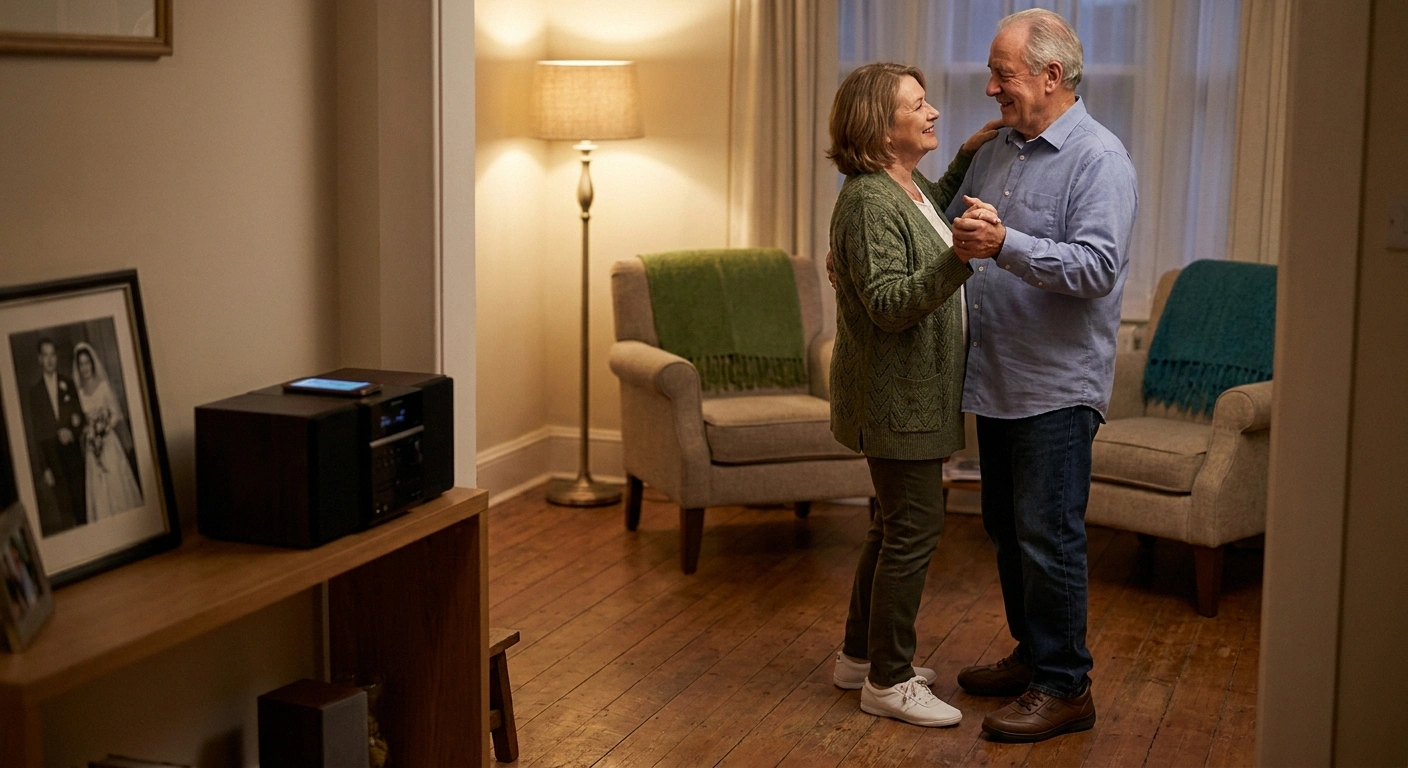
- Slow social dancing. The “high school prom” style of swaying in place with a partner. Extremely low fall risk. Easy at family events and church socials.
- Chair-based or seated dancing. A real form of dance done seated, with arm movements, upper body sway, and light foot work. Often taught at senior centers and specifically designed for people with mobility limitations. Do not underestimate it — the mood and social value are the same.
- Tai chi–inspired flowing movement. Not technically dance, but adjacent — the slow, deliberate weight shifts and flowing patterns of tai chi are among the most evidence-supported balance interventions for older adults with neuropathy. Many communities offer tai chi classes for seniors, and the movement transfers directly to more graceful traditional dancing.
Harder to adapt (do these only with proper preparation):
- Fast Latin dances (salsa, bachata, merengue at fast tempos). Quick turns and weight shifts on the ball of the foot can be tricky when foot sensation is reduced. Consider learning at slower tempos in a class setting first.
- Zumba and dance fitness at pace. Excellent workouts, but the pace can be more than a body with balance concerns can safely maintain. Look for “Zumba Gold” or similar slower-paced versions designed for older adults.
- Country two-step and swing at fast tempos. Fun and popular but involve quick turns. Start with beginner classes.
- Anything with drops, dips, or lifts. These require more sensory feedback from the feet than most neuropathy bodies can safely provide. Skip or modify.
Not recommended for most people with significant neuropathy:
- Pointe ballet or high-impact jumping styles. These require intact foot sensation to protect against ankle sprains and stress injuries.
- Dance on very slippery surfaces (some competition floors, sanded ballrooms). If your feet are numb, you cannot feel the floor's friction changes and are at higher fall risk.
- Fast tempo dances after significant alcohol. Alcohol impairs balance further, and neuropathy already impairs balance. Adding both together is a fall waiting to happen.
The Right Shoes Make Everything Different
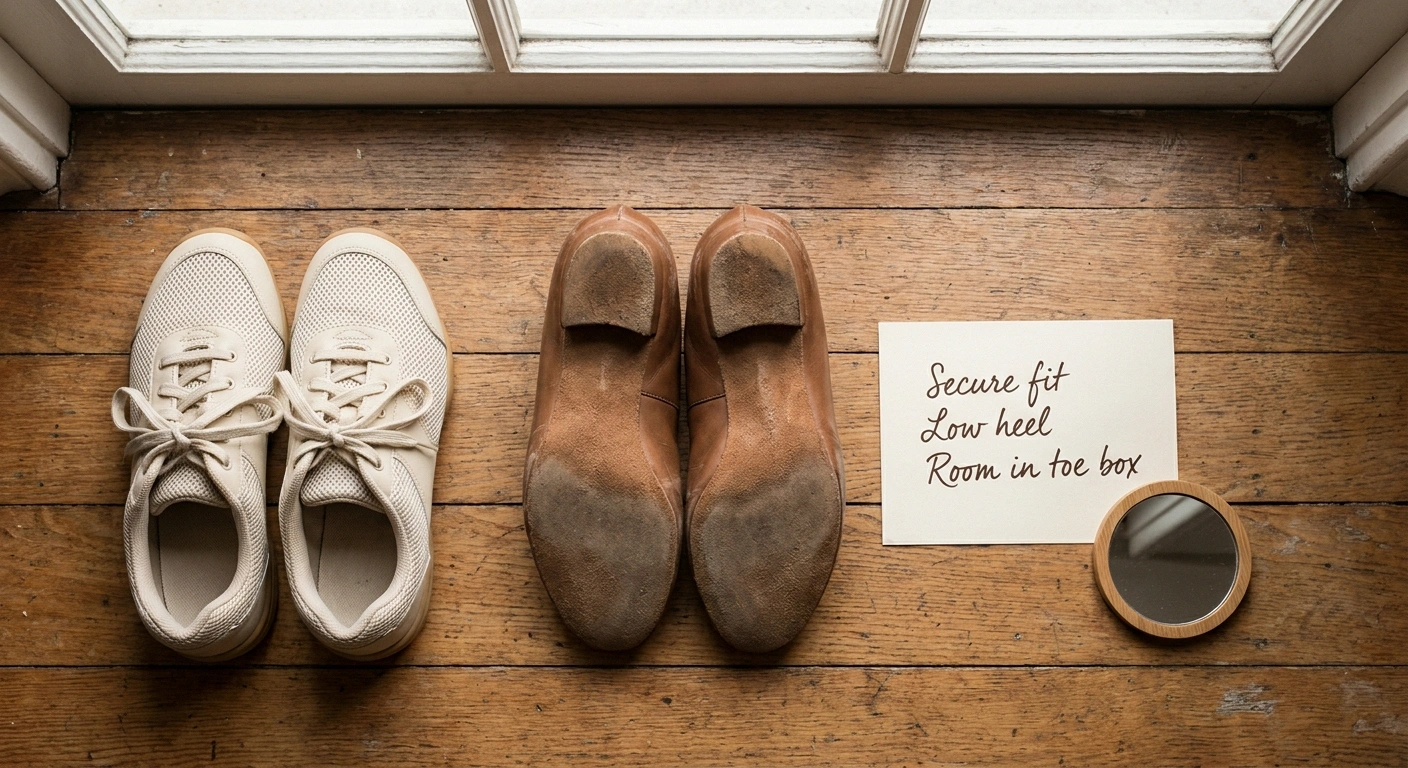
Shoes are the single most impactful decision you make as a dancer with neuropathy. Get this right and many other risks shrink dramatically. Get it wrong and everything else you do is playing catch-up.
The neuropathy dance-shoe checklist
- ✓ Secure fit — foot does not slide inside the shoe
- ✓ Low heel — zero to one inch, no higher
- ✓ Firm arch and heel counter — not squishable
- ✓ Sole matches the floor — rubber for community centers, suede for traditional ballroom
- ✓ Room in the toe box — toes can wiggle freely
- ✓ Laced or Velcro closure — not slip-on
Dance sneakers by Bloch, Capezio, and Sansha combine the pivoting of a dance shoe with the support of an athletic shoe — a good match for many people with neuropathy.
What you want in a dance shoe with neuropathy:
- Secure fit. Your foot should not slide inside the shoe. A shoe that is a little too loose is more dangerous than one that is a little too snug (as long as there are no pressure points).
- Low heel. A heel between zero and one inch is a good target. Higher heels shift weight forward onto the ball of the foot, which is the numbest area for many people and reduces balance surface area.
- Supportive arch and firm heel counter. The shoe should feel like it holds your foot in place, not like you are standing on a flat pad. The heel counter (the back of the shoe) should be firm, not squishable.
- Non-slip but not sticky sole. A pure leather or suede sole (common in ballroom shoes) can be too slippery on some floors and too grippy on others. Traditional ballroom shoes with suede soles work in traditional ballroom venues; a rubber-soled dance sneaker works better on community-center floors and other surfaces. Match the sole to the floor.
- Room in the toe box. Squeezed toes are a hidden injury waiting to happen. There should be enough room to wiggle your toes freely.
- Laced or Velcro. Slip-on shoes without a fastener are less secure. If you cannot easily bend to tie laces, look for good Velcro alternatives or long shoe horns that let you get into a laced shoe more easily.
Many dancers with neuropathy do well with what are called “dance sneakers” — sneakers designed with a lightweight split sole and a small heel, made specifically for dance movements. Bloch, Capezio, and Sansha all make versions. They combine the pivoting ability of a dance shoe with the support of an athletic shoe. If you already have supportive walking shoes that work well for your feet, dance sneakers built on similar principles are often a natural next step.
Adapting Common Dance Moves for Neuropathy
Some dance moves are inherently harder with neuropathy. Here are the most common ones and how to modify them.
Fast turns and spins. Skip them or slow them down. If a dance calls for a spin, either take a smaller turn (half rather than full) or step through it slowly rather than pivoting on the ball of the foot. Losing spatial orientation during a fast spin is a major fall trigger when foot feedback is reduced.
Balancing on one foot. Many dance moves have moments where all weight is on one foot. Keep the non-weight-bearing foot close to the ground so you can catch yourself quickly if balance shifts. Avoid moves that require lifting a foot high off the floor.
Dips and drops. Skip these. Recovering from a dip requires strong sensory feedback from the feet to know where the floor is. Substitute a gentle sway or a slow forward-and-back rock.
Fast weight shifts. Slow down the tempo mentally by taking every other beat. Many dance styles are designed to be dance-able at multiple speeds; you do not have to move at the tempo the DJ is playing. Half-time is perfectly fine.
Dancing backwards. This is one of the highest-risk directions for anyone with balance concerns because you cannot see where you are stepping. In partner dancing, one partner leads and one follows — if you are the follower, you often move backward. If backward movement worries you, request to lead instead. It changes the role but keeps you facing forward.
Cross-steps that put one foot in front of the other. These can put your feet in an unstable narrow base. Keep them shorter and slower than you might naturally, and make sure your weight is stable on the standing foot before the cross-step happens.
The Venue Matters More Than You Think
The floor, the lighting, the crowd density, and the temperature all affect how safe a given dance venue is for you. Here is what to look for.
The floor. A well-maintained wood floor is the gold standard. Concrete floors are hard on knees and hips. Very smooth ballroom floors can be slippery. Rubberized flooring (some gym floors, some community centers) is grippy in a way that can catch shoes. If you do not know the floor, arrive early and take a slow walk across it to feel how it handles.
Lighting. Dim mood lighting looks romantic on wedding dance floors but is a fall risk when you cannot feel your feet — because you also cannot see clearly where they are. Look for venues with reasonable ambient light, or dance closer to the light source. Christmas parties in dim rooms are one of the trickiest venues.
Crowd density. A crowded dance floor is a fall waiting to happen. Elbows, unexpected bumps, and unpredictable movement paths from other dancers make it much harder to keep your balance. Look for less-crowded moments (early in the evening, between popular songs) or less-crowded venues.
Temperature. Warm venues combined with autonomic neuropathy is a specific concern. Blood pressure can drop when you exert in the heat, especially if you have not stayed well hydrated. Look for cool venues, take breaks, drink water, and if you feel lightheaded, sit down immediately.
Access to a chair. This sounds small but is not. Being able to sit for a song or two, or rest between numbers, transforms a two-hour event from exhausting into enjoyable. Choose venues where you can easily find a seat.
Dancing With a Partner Who Understands
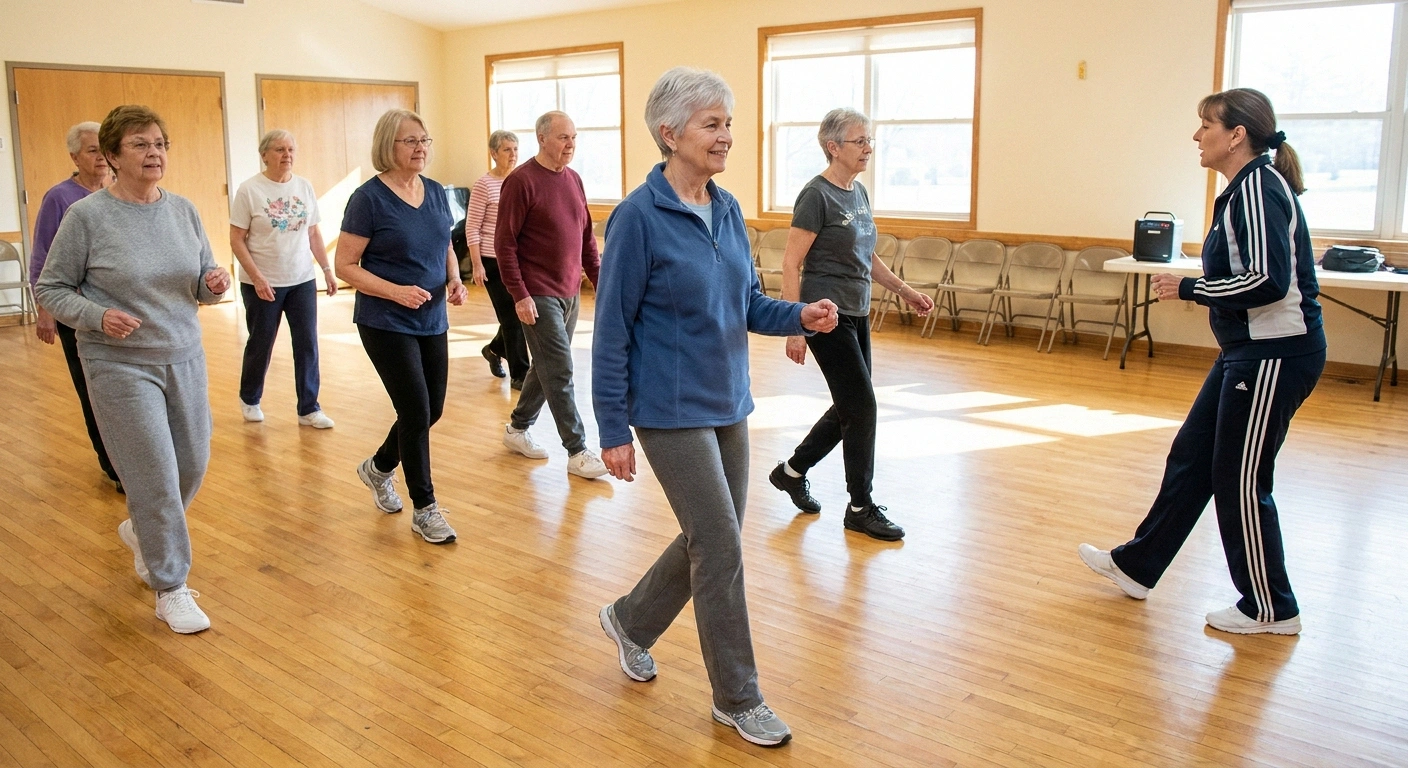
Partner dancing has a specific advantage for people with neuropathy — the physical connection with a partner gives you an additional balance reference and an extra pair of hands to catch you if something goes wrong. But a partner who does not know about your neuropathy may unknowingly do things that make dancing harder or more dangerous.
Have the conversation. Whether the partner is a spouse, a family member, a dance instructor, or a stranger asking you to dance, a short honest conversation is worth it. Something as simple as, “I have some numbness in my feet, so I dance a little slower than the music. If we can skip the spins tonight, I'd love to dance with you.” Most partners are happy to modify. Most partners appreciate knowing.
Ask a dance instructor to work with your body. If you are taking classes, share with the instructor at the start of the session. Good instructors can adapt exercises, offer alternative moves, and pair you with a patient partner during class rotations.
The lead-follow dynamic. Traditionally in partner dancing, one person leads and one follows. If you have balance concerns, being the lead has some advantages — you always face forward, you initiate the moves so you know what is coming, and you set the tempo. Historically this has been a gendered role but does not have to be; many modern dance communities welcome anyone leading.
Family and community dancing. The best dance for many people with neuropathy is not a formal dance class or ballroom event — it is the slow-sway with a spouse at a fortieth wedding anniversary, the line dance at a family reunion, the goofy fake-waltz with a grandchild in the kitchen. These low-stakes settings preserve everything valuable about dancing while removing much of the pressure of a public floor. Do not underestimate them.
What NOT to Do — Common Mistakes I See
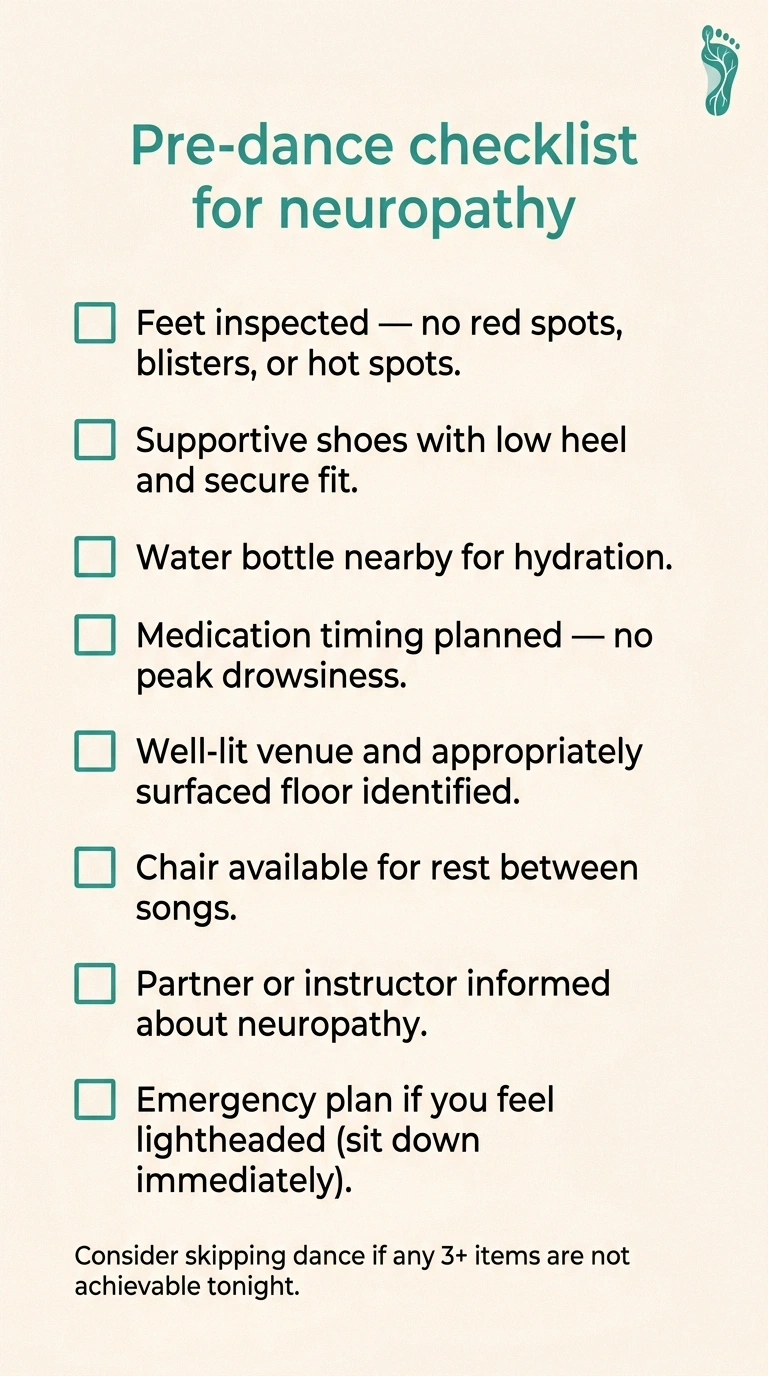
Pushing through when you feel tired or unsteady. This is the single most common mistake. Fatigue makes balance worse, and neuropathy already reduces the safety margin. When you start to feel wobbly, sit down for a song. Rest is not failure; it is smart pacing.
Dancing in shoes you can't feel are hurting. Because your soles are numb, a pressure hot spot or a developing blister may not register during the dance. By the end of the evening, a full blister has formed. Always inspect your feet before and after dancing, and if you are wearing new shoes, keep the session short.
Underestimating alcohol's effect on balance. One or two drinks may seem harmless, but alcohol impairs balance and slows reflexes, on top of neuropathy already doing the same. Save the drinking for after the dancing, or drink very moderately.
Not asking about medication timing. If your neuropathy medication makes you drowsy at peak effect, timing that peak to happen during your dance session is asking for a fall. Either adjust the timing (with your provider's OK) or plan sessions for times when the medication is not at peak.
Trying to dance the same way you danced twenty years ago. This is the hardest one emotionally. Your body has changed. Your dancing has to change too. That does not mean giving up dancing — it means dancing differently. Slower tempos, simpler moves, fewer spins, more sway. The goal is joy, not nostalgia.
Dancing alone at home without a plan for falls. Solo dancing in the kitchen while a favorite song plays is one of life's small pleasures. But if you fall while alone, help is far away. If you dance alone, do it near sturdy furniture, on a floor without rugs to trip on, and preferably with your phone in your pocket and a medical alert device if you have one.
Building Toward Dancing From a Sedentary Baseline
If you have been mostly sedentary and want to start dancing, a graduated approach makes sense. Here is a rough progression that many patients I know have used successfully.
Weeks 1-4: Build the base. Walking daily, some gentle standing exercises, basic balance work (standing at the kitchen counter, doing gentle weight shifts). This is not dance yet; it is the foundation.
Weeks 4-8: Seated or supported dancing. Chair-based dance videos on YouTube, holding onto a counter or barre while swaying to music, gentle upper-body dance movement. This introduces the rhythm and mood of dancing without the fall risk of unsupported foot work.
Weeks 8-12: Introductory class. A beginner line-dance class, a beginner ballroom class, or a slow social dance session at a senior center. The class setting gives you an instructor, a group of supportive peers, and clear expectations.
Beyond three months. Regular attendance at your chosen style, gradual expansion of what you feel confident doing, and honest conversation with yourself about what is fun and what is not. Do not force yourself to keep going to a class you dread. Try a different style. Try a different venue. The style that fits your body may not be the one you thought it would be.
Signs That Dancing Is No Longer Safe for You
I want to close this article honestly. Dancing works for most people with neuropathy who take the appropriate precautions. But for a small number of people, it eventually becomes too much of a fall risk to safely continue. Here are the signs that suggest it is time to modify heavily or step away.
Signs it may be time to modify heavily or shift to seated dance
- → A serious fall during dance (once = specific circumstance; twice = safety margin too thin)
- → Rapidly progressing neuropathy affecting balance month-over-month
- → New autonomic symptoms — fainting, near-fainting, significant lightheadedness during sessions
- → Recurring unnoticed foot injuries after dance sessions
- → Loss of joy — dancing feels only like fear of falling
Chair-based dance stays accessible for almost everyone. The joy adapts. The music does not stop.
A serious fall while dancing. One fall may be a specific circumstance. Two falls suggest the safety margin is too thin.
Rapidly progressing neuropathy affecting balance. If your neuropathy is worsening and your balance is deteriorating month over month, adjust your dancing to easier and easier forms — and consider transitioning to fully seated dance as the primary form.
New autonomic symptoms during dance. Fainting, near-fainting, or significant lightheadedness during dance sessions is a sign to talk with your provider before continuing.
Recurring foot injuries. If you are consistently coming home with blisters, hot spots, or minor injuries from dancing that you did not notice during the session, the fit between the activity and your foot sensation is not working. Try seated dance or shift the activity entirely.
A significant loss of confidence. Dancing that no longer feels joyful because you are afraid of falling has lost its value. Trust your instincts. Move to safer forms.
Even when full traditional dancing has to be set aside, chair-based dance and gentle rhythmic movement stay accessible for almost everyone. The joy adapts. The music does not stop.
A Note on Lorraine
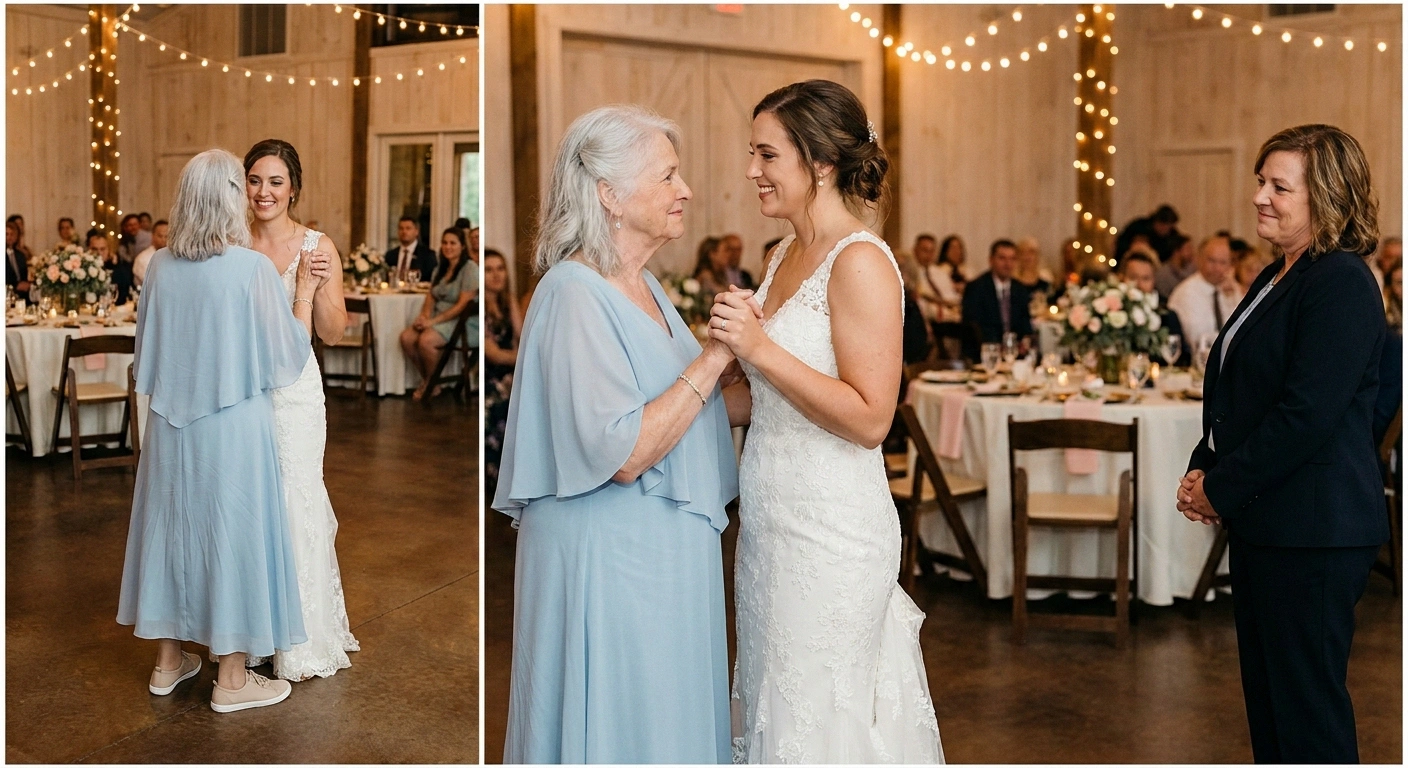
Lorraine, the seventy-two-year-old wedding dancer, did come back to dancing. She started with a seniors' line-dance group at her local community center. She had a full foot inspection routine before and after every class, wore dance sneakers she picked out specifically for the class floor, and told the instructor about her neuropathy on the first day. She skipped the fast turns. She sat out about one song in four. She danced at her granddaughter's wedding six months in, moving slower and simpler than she used to, but she danced. She sent me a photo. She looked exactly the way you'd hope she'd look — surrounded by family, laughing, on her feet, moving to the music.
Getting your provider's OK — a quick script
Before starting a new dance activity, especially with balance concerns, share this at your next visit:
You can too. It might look a little different. It will still be dancing.
Frequently Asked Questions
Is dancing safe if I have peripheral neuropathy?
For most people with peripheral neuropathy, dancing is not only safe but genuinely beneficial when adapted appropriately. Choose dance styles that fit your balance level, wear supportive shoes, inspect your feet before and after each session, dance on well-lit and appropriately surfaced floors, avoid alcohol during dance, and stop when you feel tired or unsteady. If you have significant fall risk, advanced neuropathy, autonomic symptoms with dizziness, or a history of recent falls, please talk with your provider and get a physical therapy evaluation before starting a new dance activity. Chair-based and seated dancing remain safe options even for people with significant balance concerns.
What are the best dance styles for someone with neuropathy?
The dance styles most often successful for people with neuropathy are line dancing (no partner required, choreographed steps, easy to modify), ballroom styles at moderate tempo (waltz and foxtrot are particularly good), slow social dancing (the “high school prom” sway), chair-based dancing designed for older adults, and tai chi-inspired flowing movement. Styles that are harder to adapt include fast Latin dances, high-tempo Zumba, and anything with dips, drops, or lifts. Pointe ballet and high-impact jumping styles are generally not recommended for people with significant neuropathy affecting foot sensation.
What kind of shoes should I wear for dancing with neuropathy?
You want dance shoes that fit securely (foot does not slide inside), have a low heel of zero to one inch, provide firm arch and heel support, have an appropriate sole for the floor you are dancing on (rubber for community centers, suede for traditional ballroom), have room in the toe box for your toes to wiggle, and can be laced or Velcroed rather than slip-on. Dance sneakers made by companies like Bloch, Capezio, and Sansha combine dance-friendly pivoting with athletic-shoe support and work well for many people with neuropathy. Avoid dancing barefoot on hard floors if your soles are numb, and never dance in a shoe you cannot get on and off easily.
Can dancing improve my neuropathy symptoms?
Dance-based movement will not fix the underlying nerve damage of neuropathy, but it can meaningfully improve balance, reduce fall risk, improve mood and social connection, and support cardiovascular fitness — all of which contribute to living better with neuropathy. Published studies of dance interventions in older adults, including some studies specifically involving peripheral neuropathy patients, have shown improvements in balance measures, gait speed, and quality of life. Dance is not a treatment for the disease process, but it is a genuinely valuable part of managing life with it.
How do I tell my dance partner about my neuropathy?
Keep it short and practical. Something like, “I have some numbness in my feet, so I dance a little slower than the music. Can we skip the spins tonight, and I'll let you know if I need to sit for a song?” Most partners appreciate knowing and are happy to modify. If the partner is a dance instructor, share at the start of class so they can adapt exercises and pair you with a patient partner. Family members and long-term partners benefit from a slightly longer conversation — what your specific concerns are, what moves you want to avoid, and what would help if you feel unsteady.
What if I fall while dancing?
The immediate priority is not to hurt yourself worse. If you fall, do not try to spring up quickly — take a moment to assess whether you are injured. Move to a seated position first if you can, then to standing when steady. If you have hit your head, are dizzy, or are in significant pain, get evaluated. A single fall is not necessarily a reason to stop dancing, but it is a reason to reassess: what caused the fall (shoes, floor, tempo, tiredness, alcohol), and what will change next time. If falls happen more than once during dance sessions, the fit between the activity and your current safety margin is not working, and it is worth talking with your provider or a physical therapist about modifications or a different style.
Can I still dance at weddings and family events even if I have neuropathy?
Absolutely. In many ways, these low-stakes family settings are the best dance venues for people with neuropathy — slower tempos, forgiving atmosphere, familiar people around you, and the option to sit out any song without judgment. Slow-swaying with a spouse, a sibling, or a grandchild during a family event captures much of what dancing means without the risk profile of a fast-paced public floor. Wear appropriate shoes, watch out for dim lighting on unfamiliar floors, drink modestly if at all, and enjoy yourself. These are among the most meaningful dance experiences you can have.
What is chair-based dancing and is it a real form of dance?
Chair-based dance (also called seated dance) is a genuine, choreographed form of dance done from a seated position. It involves upper-body rhythm and expression, arm movements, gentle foot work, and full engagement with music. It is regularly taught at senior centers and by adaptive dance instructors, and it preserves nearly all the psychological, emotional, and social benefits of standing dance while eliminating the fall risk. For people whose balance is limited enough that standing dance is unsafe, chair-based dance is not a lesser form — it is the appropriate form. Community and YouTube resources make it accessible for home practice.
About the Author