The save-the-date comes in July for a Saturday in September. Grandma's side, the park pavilion out past the county line, eleven until whenever people run out of steam.
And your first thought is not about seeing your cousins. It is about the parking lot, and how far it is to the pavilion, and whether there will be a chair with arms on it.
That is a familiar place to be, and I want to say something about it before the practical part starts. Wanting to know the logistics before you say yes does not make you a difficult guest or a person who has given up. It makes you someone with a body that requires planning. Reunions are one of the harder events on the calendar for anyone with nerve pain, because they combine everything that goes wrong: unpredictable ground, seating designed for a church basement, hours of standing, heat, and a crowd of relatives who last saw you in better shape.
All of it can be planned around. Not eliminated, planned around. What follows is the whole day, in order, from three weeks before the drive to the morning after.
The Question Behind the Invitation
Before any planning happens, decide what you actually want out of this day, because that answer changes every choice underneath it.
Pick your goal first, because it sets the whole day
These three plans look nothing alike, and choosing between them in advance is what stops you staying until dark out of politeness.
Arrive mid-afternoon, sit down, spend thirty unhurried minutes with them, leave.
Total time on your feet: parking lot to chair, twice.
Arrive early, take a central seat on the traffic path, let people come to you, leave after the meal.
The trick: position beats circulation.
The demanding version. Needs a real break mid-afternoon, shorter conversations, and a cleared calendar the next day.
Budget for it: plan the recovery day before you go.
Some reunions are about seeing one particular person. If your aunt is ninety-one and this is likely the last time, the entire day can be built around thirty good minutes with her, and everything else is optional. Some reunions are about being seen, about not becoming the relative who stopped showing up. And some are genuinely about the whole crowd.
Name yours. A person aiming for thirty minutes with one aunt can arrive at two and leave at four and count the day a total success. A person trying to see everyone needs a completely different plan, more stamina management, and probably a shorter conversation with each person.
The failure mode is going in with no goal, staying until the end because leaving feels rude, and paying for it for three days. Deciding in advance is what protects you from that.
Three Weeks Out: What to Find Out
Call whoever is organizing. Not to ask for special treatment, just to find out what you are walking into.
Five questions cover almost everything. What is the ground like between the parking and the tables, grass or gravel or paved. Are there bathrooms in a building or portable units in a field. Is there shade, and is it seating shade or standing shade. Are the chairs folding, benches, or something with arms. And how far is the walk from where cars park.
People are almost always happy to answer, and organizers often fix things once they know. More than one reunion has ended up with a table moved closer to the parking area because somebody asked a question three weeks in advance.
If it is a park you have never seen, look it up on a map with the satellite view on. You can see the parking, the pavilion, the distance and the terrain in about a minute, and knowing beats guessing.
What to Pack That Nobody Tells You
The standard advice covers sunscreen and water. These are the ones that come from experience.
Two lists, and the second one is the one that saves the day
Everyone tells you
- Sunscreen
- Water
- A hat
- Your medication
Nobody tells you
- Spare socks in a sealed bag. Damp skin blisters faster, and you may not feel it happening
- A small towel to sit on. Metal chairs and benches get hotter than reduced sensation can judge
- Your own bottle. A shared cooler means walking to it every single time
- One extra dose. These days run past everyone's estimate
- A long-sleeve layer. Shade plus breeze plus sitting still chills the legs fast
A second pair of socks, sealed in a bag. Feet get damp on grass and in heat, and damp skin blisters faster than dry skin, which matters a great deal when you might not feel the blister forming. Changing socks at two in the afternoon is one of the highest-value two minutes of the day.
A small towel to sit on. Picnic benches and metal folding chairs get hot enough to be genuinely uncomfortable against the backs of your legs, and reduced sensation makes it harder to judge how hot.
Your own water bottle, because refilling from a cooler means walking to the cooler every time. Snacks that do not depend on the buffet timing. Medication packed with the doses you would normally take at home, plus one extra, since these days run long.
A light long-sleeve layer, even in September. Shade plus a breeze plus sitting still can chill the legs fast, and cold legs make nerve symptoms noticeably louder for most people.
If you already wear compression socks, a reunion is a day to wear them rather than a day off, since hours of sitting upright in heat is exactly the situation they are built for.
Bring Your Own Chair
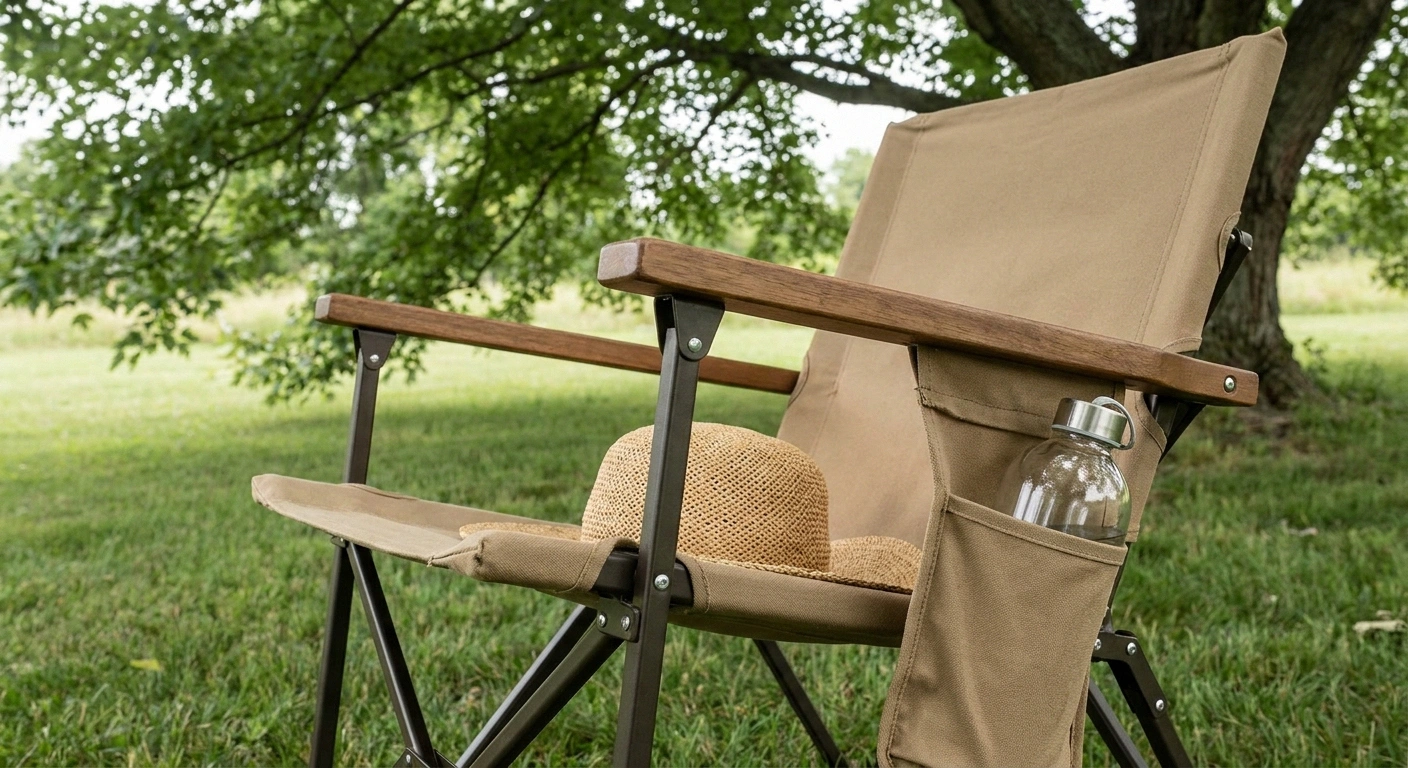
This is the single highest-leverage decision of the whole day, and it deserves its own section.
Folding chairs and picnic benches have no arms. Standing up from a seat with no arms is a whole-body effort that uses your legs, your balance and your core all at once, and if you do it thirty times across an afternoon you will feel every one of them. A camp chair with solid armrests turns each of those into a simple push.
Nobody thinks twice about someone bringing a chair to an outdoor event. If anything, three other people will ask where you got it by four o'clock.
Pick one that sits higher than a standard camp chair if you can, since low seats are the difficult ones. Check that the arms are rigid rather than fabric loops. And put your name on the underside, because a good chair at a reunion will absolutely be borrowed.
If bringing a chair is genuinely not possible, the fallback is claiming a seat at the end of a row, near a table edge or a post, so you have something solid to push up against.
The Drive, and Arriving Early
Long drives stiffen everything, and arriving stiff means starting the day already behind.
Stop every hour or so, even if it costs you fifteen minutes. Walk to the end of the rest area and back. The point is not exercise, it is preventing the leg-lock that sets in after ninety unbroken minutes in a car seat.
Then arrive early, and be deliberate about it. Early arrival is not politeness, it is strategy. You get the parking spot closest to the pavilion. You get first pick of shade. You get to set your chair where you want it rather than where there is space left. And you get to greet people as they trickle in, sitting down, instead of joining a crowd that has already formed standing circles.
That last part is underrated. Arriving late to a reunion means walking into a room made of standing conversations, and standing conversations are the hardest thing on the schedule.
Claiming Your Spot
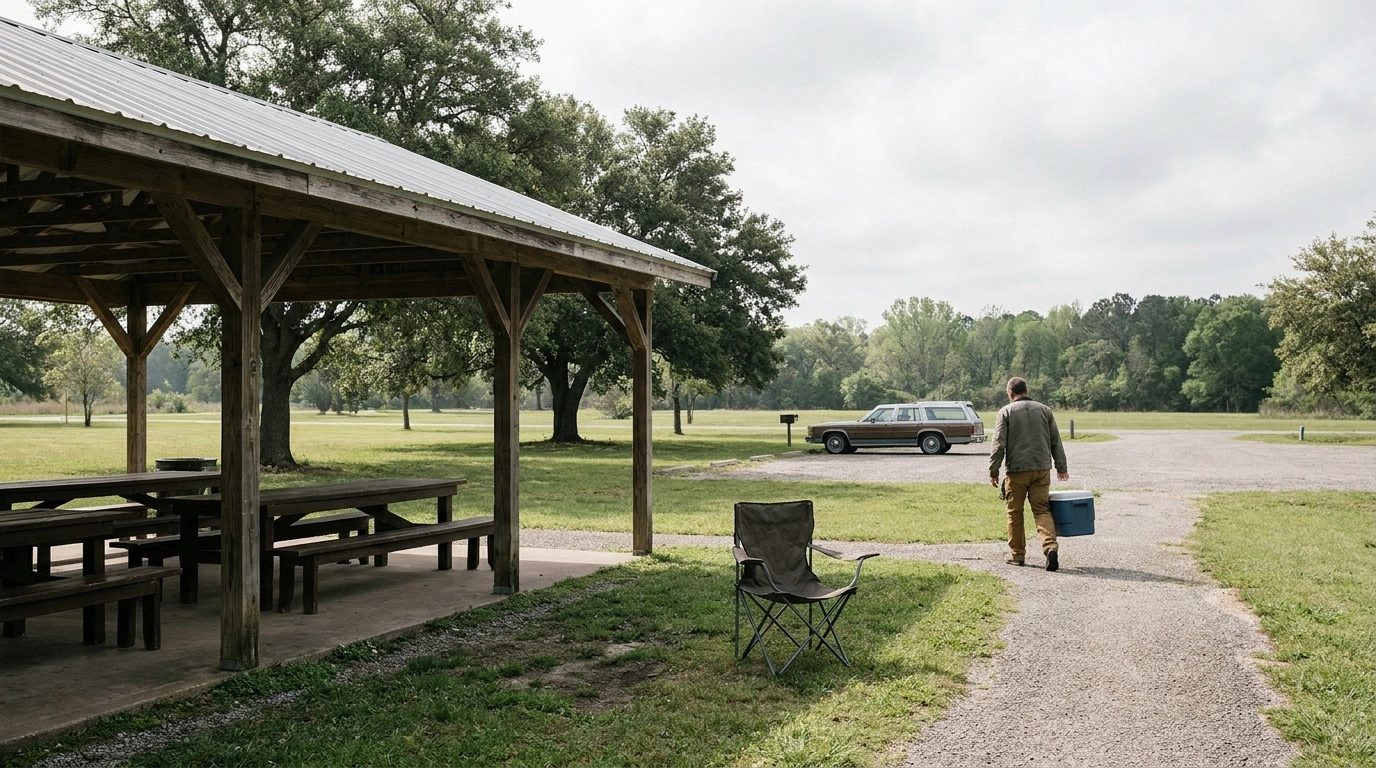
Where you put your chair determines most of your day, so choose it like it matters.
You want shade that will still be shade in three hours, which means thinking about where the sun is heading rather than where it is now. You want to be near enough to a bathroom that the trip is not an expedition. You want the ground under and around you to be reasonably flat and firm, since a chair leg sinking into soft grass is how people go over backward.
And you want to be somewhere central enough that people come to you. This is the quiet trick of the whole day: if you position yourself where the traffic naturally flows, near the food table or on the path between the parking and the pavilion, you will see nearly everyone without walking to any of them.
Put a bag on the chair next to you for whoever you are with, and put your water and your spare socks underneath. That is your base now. Everything else is a short trip out and back.
The Buffet Line
The food line is a standing block disguised as a meal, and it catches people out because nobody counts it as an activity.
Twenty minutes of shuffling, standing still, holding a plate with one hand while serving with the other, then carrying a full plate and a drink back across uneven ground. It is genuinely one of the harder physical sequences of the day, and it lands right when everyone is at their most crowded.
Three ways around it. Go last, when the line has gone and you can walk straight up. Ask someone to bring you a plate, which any relative will do gladly and most will be pleased to be asked. Or go first, before the line forms, if the food is out early.
If you do go through the line, carry the plate and let someone else carry the drink, because two hands full is how spills and stumbles happen on grass. Balance with reduced foot sensation is already working harder than it looks, and our guide to fall prevention with neuropathy covers why carrying loads changes the equation more than most people expect.
Group Photos and the Standing Blocks
Every reunion has four or five moments where everyone is expected to be upright at once. Knowing them in advance lets you spend your standing budget on purpose.
The group photo is the big one, and it always takes longer than anyone says. Somebody is missing, then the camera needs adjusting, then a child has wandered off. Fifteen minutes of standing on grass is a realistic estimate.
Fix this by telling the photographer you will sit in the front row. Front rows are seated in almost every group photo ever taken, so this is not an accommodation, it is the standard arrangement. Say it early, before people start arranging themselves, and someone will bring a chair over.
The other standing blocks are the blessing or toast before the meal, the arrival rush when a carload of people you have not seen shows up at once, and any organized activity. Sit for the ones you can. Nobody is counting. The same sit-and-stand problem comes up at services and ceremonies, and our guide to managing sitting and standing at worship services covers tactics that transfer directly to a pavilion.
Grass, Gravel, and Everything You Walk On
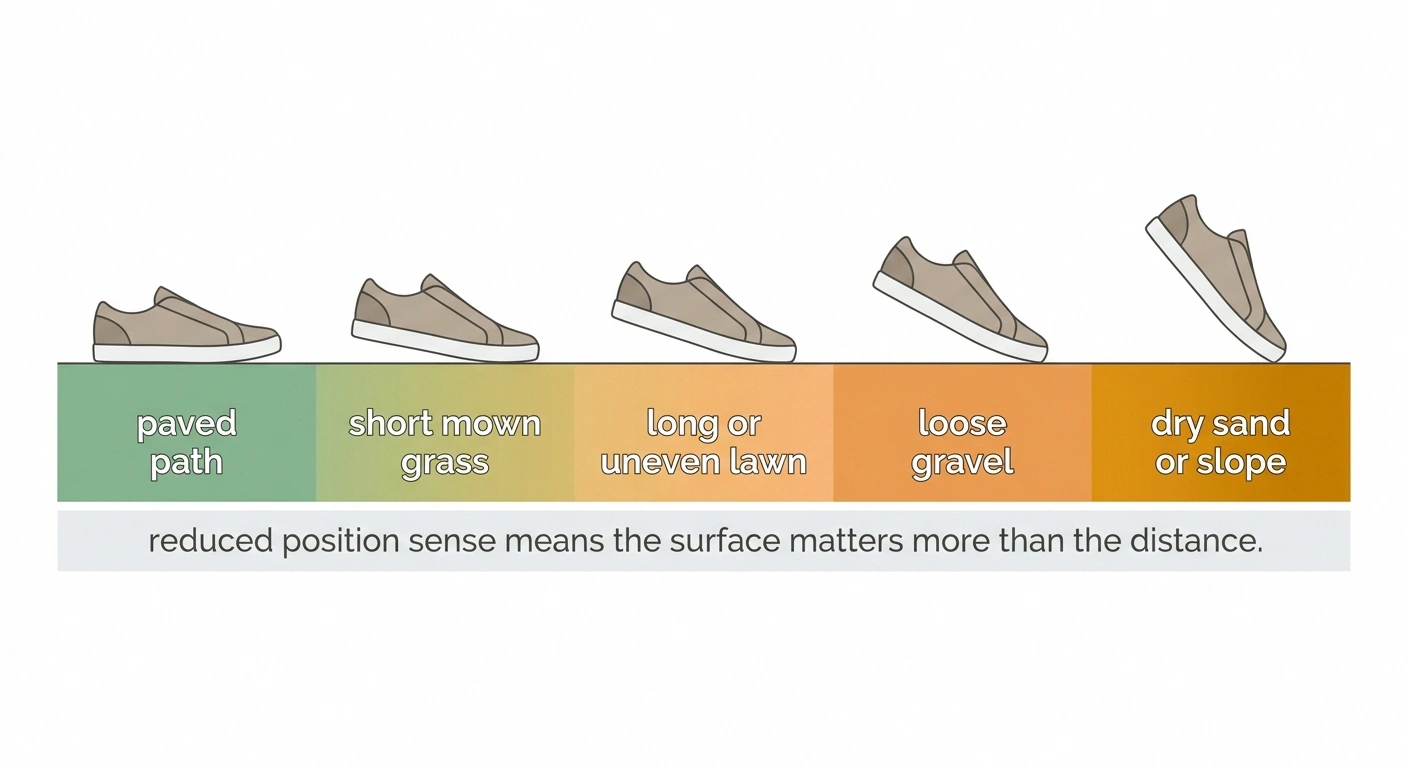
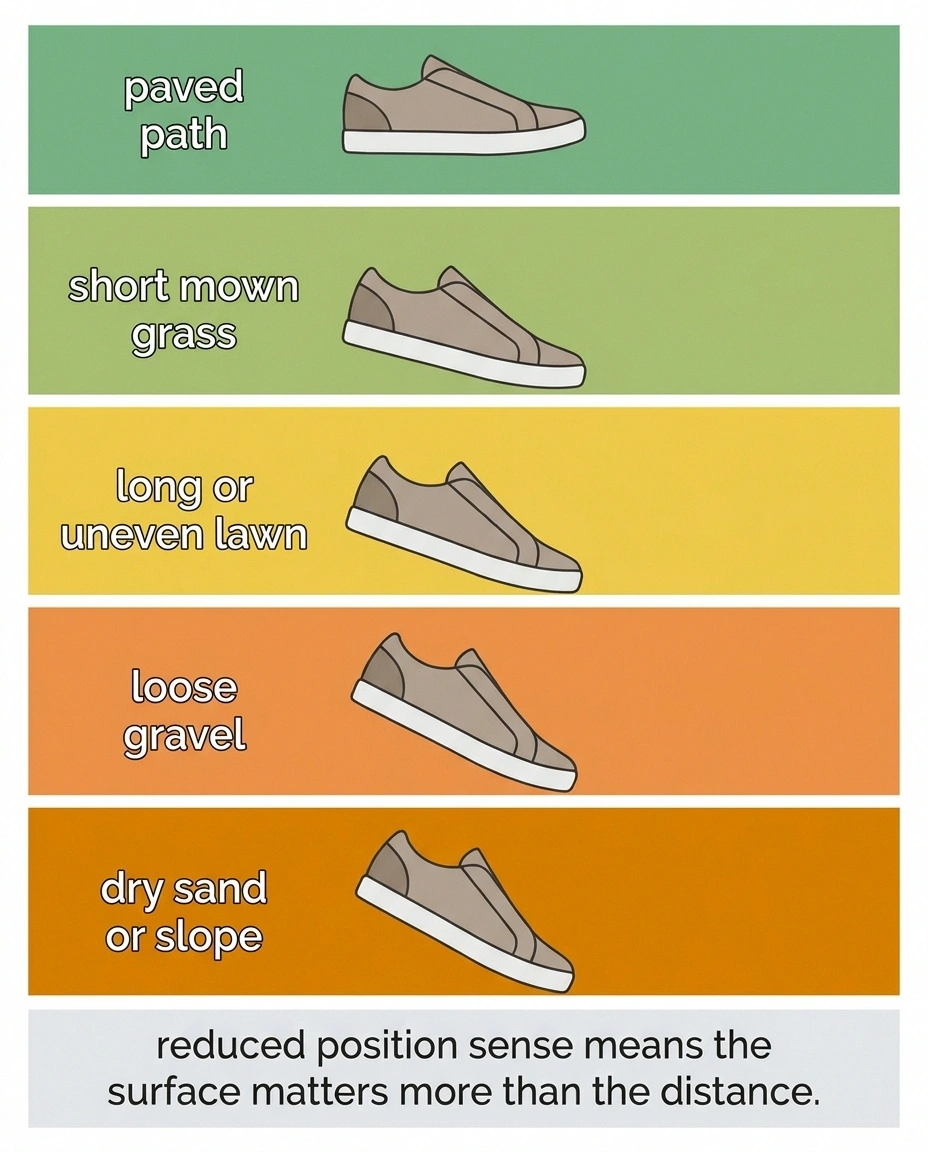
The terrain is the real hazard at these events, not the distance.
What you are walking on, easiest to hardest
Reduced position sense means your feet report less about what they have just landed on, so the surface matters more than the distance. Take the longer route on the better surface.
Paved path or pavilion floor. Predictable. Walk this even when it adds fifty feet.
Short mown grass, recently cut. Manageable. Stay on the mown lines rather than cutting across.
Long or uneven lawn. Hides dips, roots, mole runs, sprinkler heads and mower ruts. Slow down.
Loose gravel. Shifts underfoot after your weight is already committed. Take an arm here if one is offered.
Dry sand or a sloped lakeshore. The hardest surface at any outdoor event. Worth simply not crossing.
One timing note that applies to all five: most outdoor falls happen in the last twenty feet, when someone is nearly at their chair and has stopped paying attention.
Lawns look flat and are not. They hide dips, mole runs, sprinkler heads, tree roots and the ruts left by whoever mowed. Gravel parking areas shift underfoot. Sand near a lake is worse than either. All of these punish reduced position sense, because your feet are sending back less information about what they just landed on.
Closed, supportive, laced shoes matter more here than at an indoor event, and this is not the day for sandals no matter what the forecast says. Our guide to choosing shoes for neuropathy covers what to look for in a shoe that will spend eight hours on uneven ground.
Walk the mown paths rather than cutting across. Take the long way on pavement when there is one. Use a stick or a pole if it helps, and consider that a walking pole reads as outdoorsy rather than medical, which matters to some people at a family event.
And go slower than feels necessary. Most outdoor falls happen in the last twenty feet, when someone is nearly at their chair and stops paying attention.
Heat, and Why It Makes Everything Louder
Plenty of people find their symptoms worse in hot weather, and a reunion in a field in August is heat with no escape from it.
Drink before you are thirsty. Thirst arrives late, and by the time it shows up you have already lost ground. A bottle at your chair that you sip steadily beats large amounts drunk occasionally.
Sit in shade rather than sun even when the sun feels pleasant, because the cost shows up two hours later rather than immediately. A hat with a real brim does more than a cap. Loose, light-coloured, breathable clothing over your legs beats bare skin in direct sun.
If there is air conditioning anywhere, a car, a hall, a bathroom building, use it for ten minutes in the middle of the afternoon. Sitting in your own car with the vents up for a quarter of an hour is not antisocial, it is maintenance, and people who do it routinely last hours longer than people who tough it out. If you run the engine to do it, park in the open rather than against a wall or in a garage, keep the exhaust clear of long grass or a snowbank, and do not doze off in there. Carbon monoxide from a blocked tailpipe is a real and quiet hazard, and a shaded hall is the better option whenever one exists.
The Long Middle of the Day
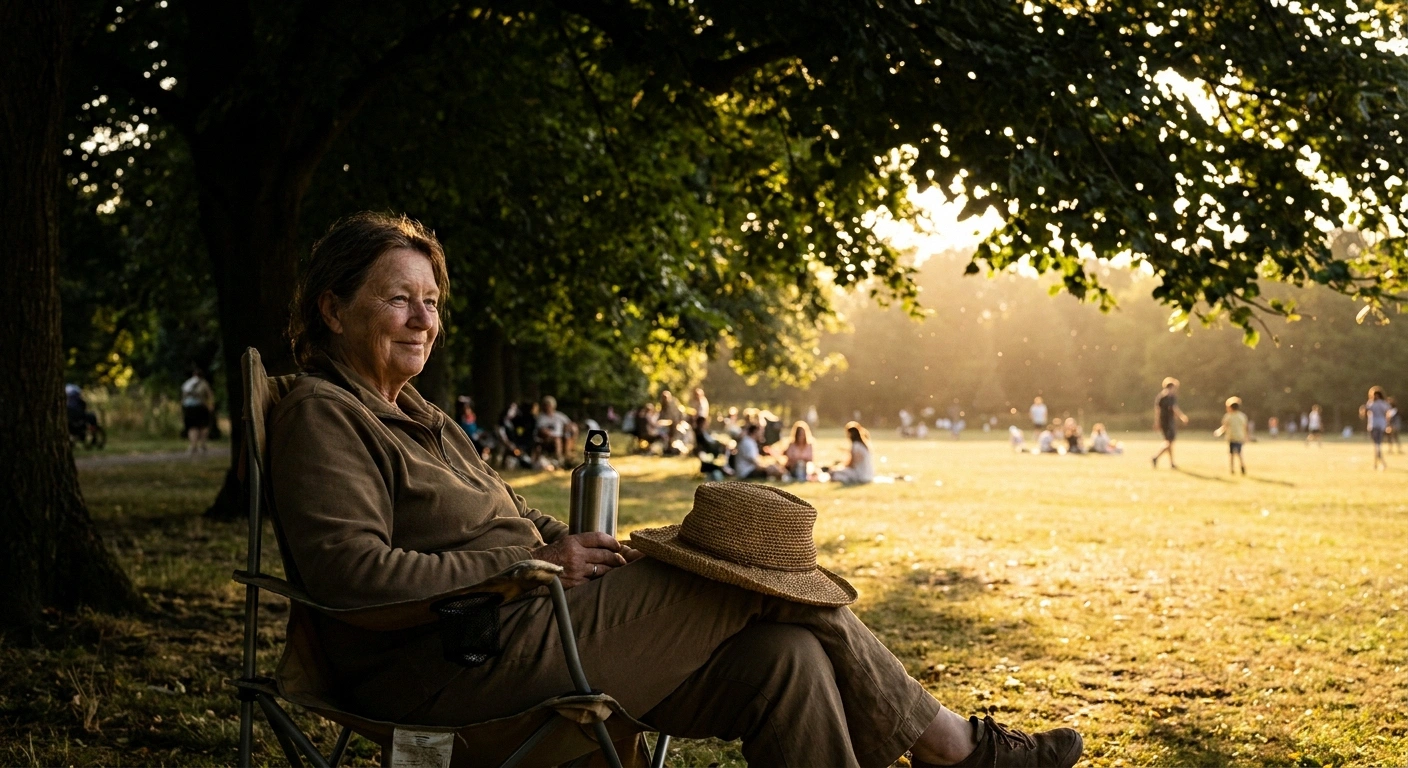
The stretch between the meal and the goodbyes is where reunions go wrong. The structure disappears, the day loses its shape, and it is easy to end up sitting in the same position for three hours or wandering aimlessly for the same three hours.
One worked example of an eleven-to-five reunion
Not a prescription. A shape to adapt, showing where the standing blocks actually fall and where the breaks have to go to absorb them.
Neither works well. Sitting completely still lets everything stiffen and lets circulation stagnate. Constant movement burns the reserve you need for the drive home.
What works is alternating on a rough schedule. Twenty or thirty minutes seated in conversation, then stand and take a short deliberate walk, even if the walk is only to the cooler and back. Move your ankles while you are sitting. Our overview of how walking affects neuropathy explains why frequent short movement generally beats one long stretch of activity.
Give yourself one genuine break somewhere in there. Twenty minutes in the car, or a walk to the far end of the park with one person, or simply sitting somewhere quieter. Reunions are loud and social and that has a cost of its own, separate from the physical one.
What to Say When Someone Says You Look Fine
Here is the part that nobody packs for, and for a lot of people it is the hardest thing about the day.
Someone will say you look great. Someone will ask why you are sitting again. A cousin will suggest a supplement their neighbour swears by. And an uncle will tell you that you just need to walk more, with complete confidence and no ill intent whatsoever.
Have one sentence ready and reuse it all day. Something like: “The nerves in my feet are damaged, so I sit more than I used to, but I am glad to be here.” It closes the topic without inviting debate, and having it prepared means you are not composing an explanation while irritated.
For the supplement advice, “I will look into it, thank you” costs nothing and ends the conversation. You are not obliged to litigate anything at a picnic table.
Invisible conditions carry a particular kind of weariness at family events, and it is worth naming rather than pretending it is only about chairs and terrain. Our piece on the emotional side of living with neuropathy covers that ground more fully.
Saying Goodbye Without a Receiving Line
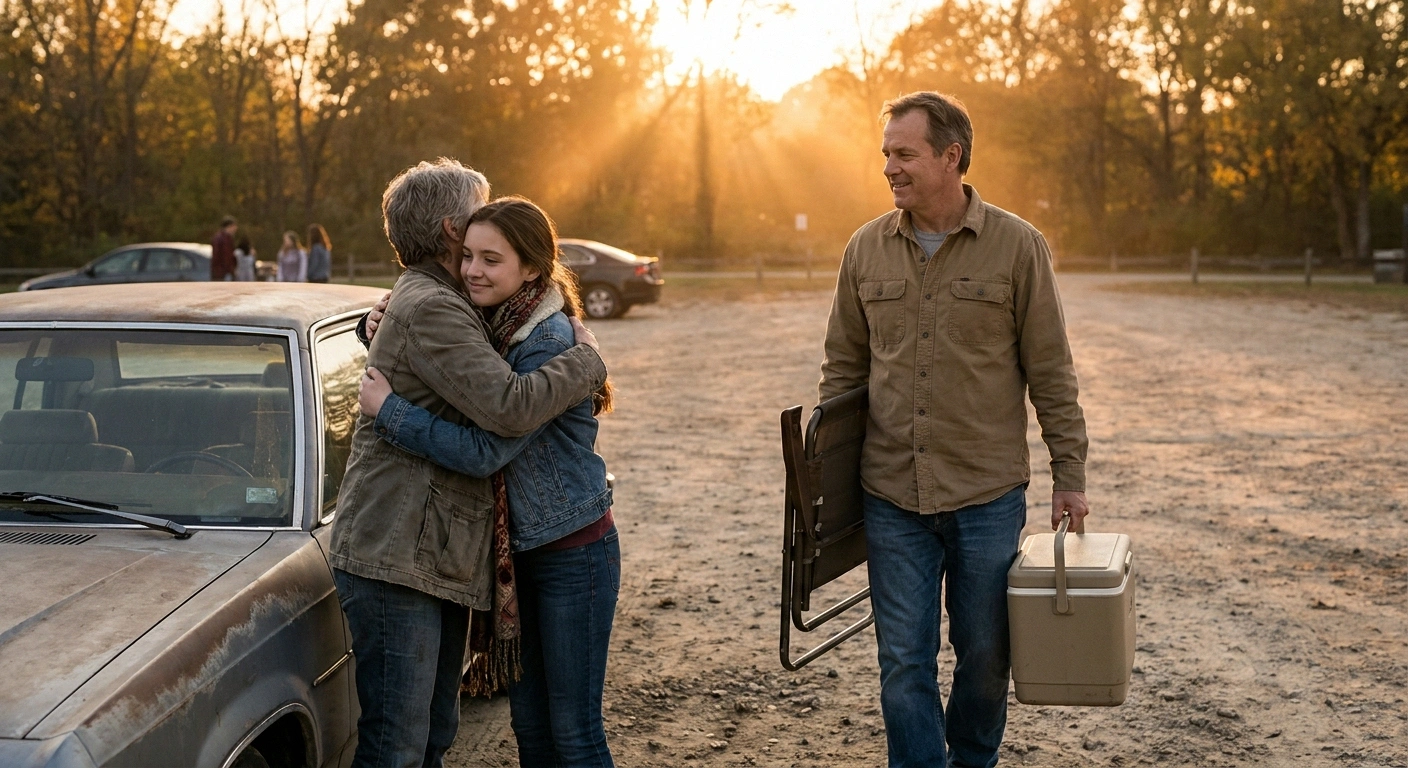
Leaving a reunion can take forty-five minutes if you let it become a lap of the entire pavilion, and that lap is often the most expensive walking of the day, done at the point when you have the least left.
Decide your departure time before you arrive and tell one person. Having a stated time means you are following a plan rather than making an excuse, which makes it far easier to hold.
Then leave the way people at conferences do. Say goodbye to the people who matter most while you are still seated and they come to you, over the fifteen minutes before you go. Then make the exit itself short.
Get someone to walk you to the car and carry the chair. Somebody will offer. Let them.
That Night: The Two Minutes That Matter Most
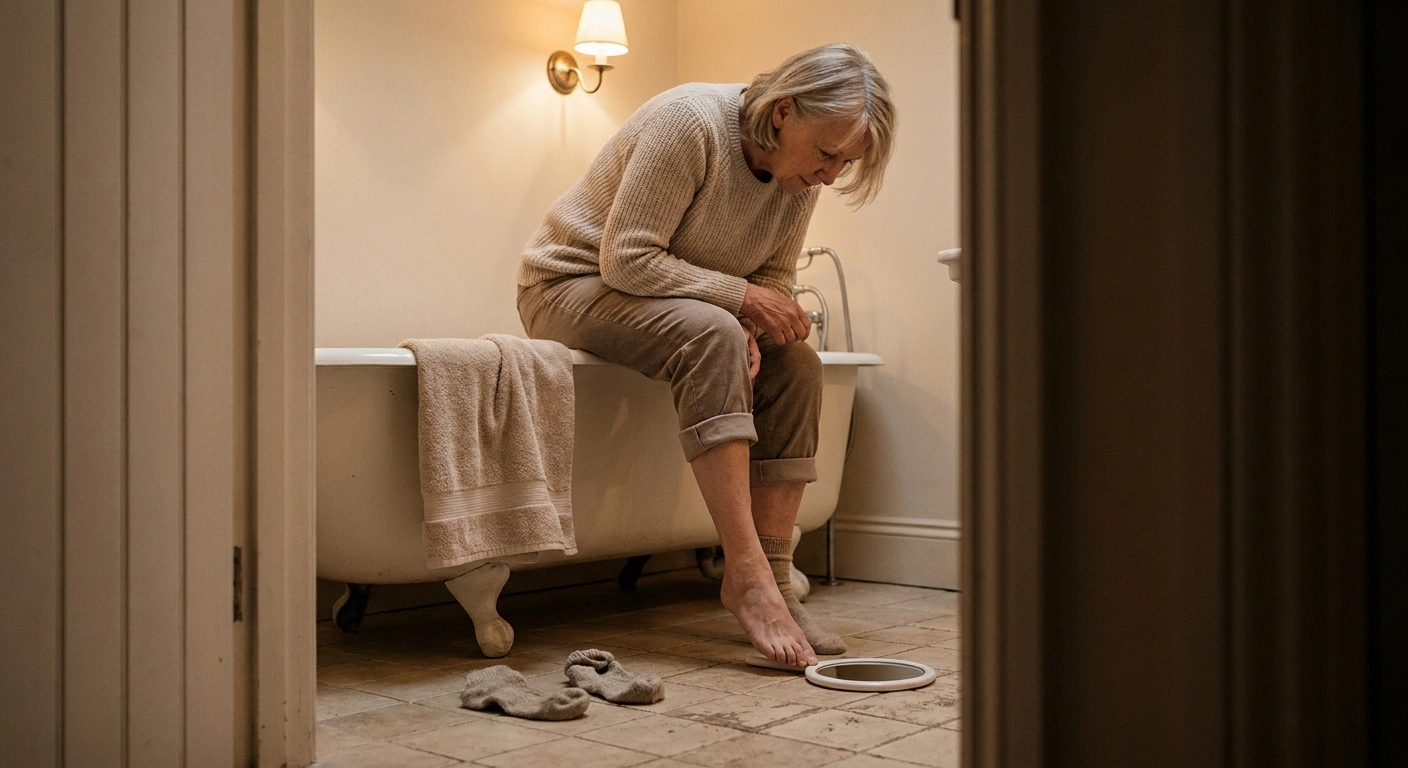
When you get home, before anything else, take your shoes and socks off and look at your feet properly. Under good light. Tops, soles, between every toe, and around both heels.
Seven places to look, in this order
Good light, shoes and socks off, roughly two minutes. Reunion night is the highest-yield foot check of the year, because a whole day on rough ground is precisely when something goes unnoticed.
Use a mirror flat on the floor, or take a photo of each sole with your phone, if bending to see is difficult. What you are hunting for is a red patch, a blister forming, a small cut from gravel, or a spot that looks different from its twin on the other foot. Found tonight, that is a plaster. Found on Wednesday, it can be a great deal more than that.
A full day in shoes on rough ground with reduced sensation is exactly the situation in which a blister, a hot spot, a small cut from a piece of gravel, or a seam rub goes completely unnoticed. Found the same evening, that is a plaster and an easy week. Found four days later, it can be something considerably more involved.
Use a mirror on the floor or your phone camera for the soles if bending is difficult. This habit is covered properly in our guide to daily neuropathy foot care, and reunion nights are the single most important night of the year to actually do it.
Most of what you find is a plaster and an early night. Some of it is not. Call in the next day or two for any break in the skin that is more than superficial, anything with drainage or an odour, redness that is spreading rather than settling, a warm puffy area, a blister you cannot see the base of, or a dark or blackened patch. Same day if you also have a fever or feel unwell. On a foot with reduced sensation, a wound will not hurt enough to tell you how serious it is, so the decision has to come from what it looks like rather than from what it feels like.
Then get your feet up. Legs elevated for twenty minutes while you sit does more for how tomorrow feels than almost anything else available at that hour.
The Day After, and Planning for It
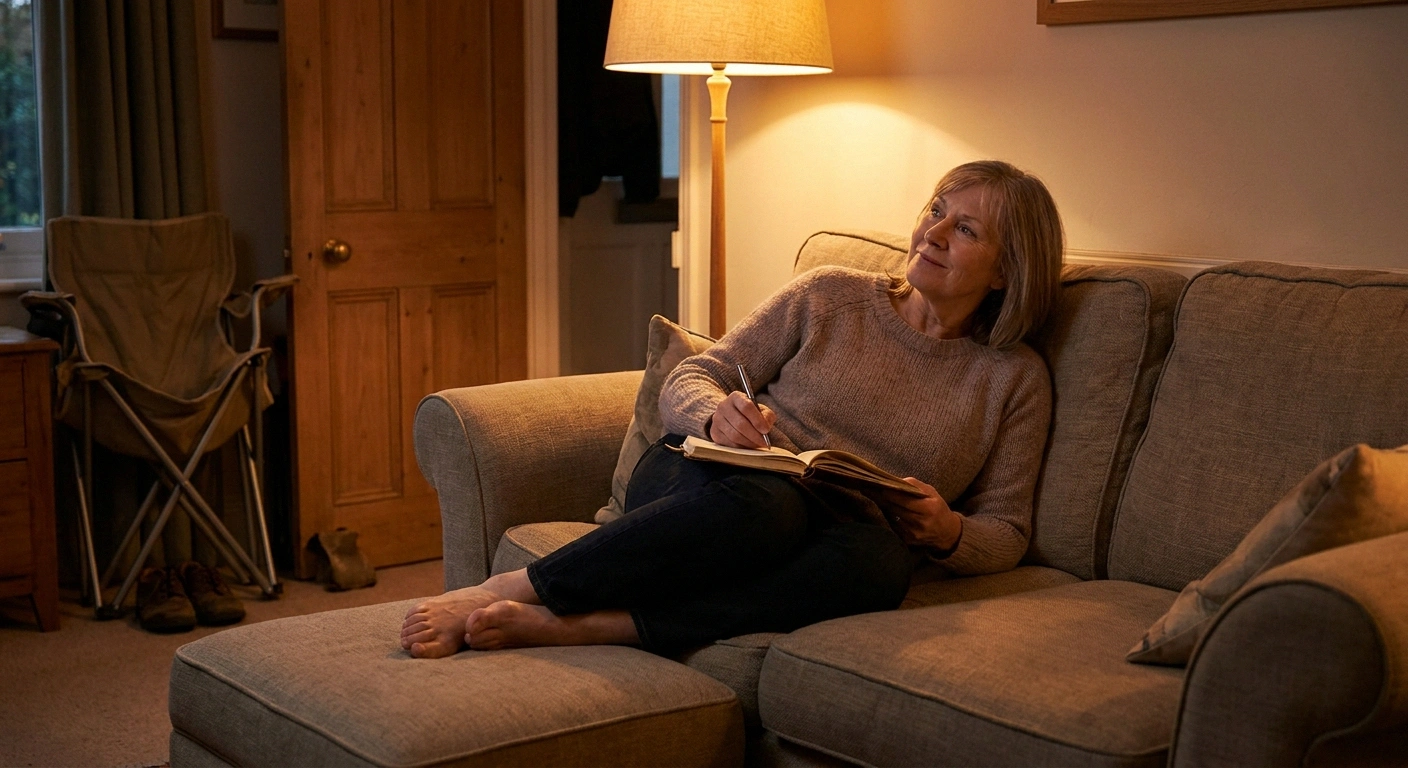
Plan the following day as part of the reunion rather than as an afterthought, because it is part of the reunion whether you plan it or not.
Put nothing in the calendar. No errands, no appointments, no committing to anything that requires being anywhere at a particular time. If the reunion is a Saturday, Sunday belongs to recovering from Saturday.
Expect symptoms to be louder than usual, and expect that to be temporary. A flare after a long, hot, physically demanding day is a reaction, not a decline, and it settles.
Keep gentle movement going. Complete stillness on the recovery day tends to make things stiffer rather than better, so short easy walks around the house beat lying down all day.
And take five minutes to write down what worked. Which chair, where you put it, what you wished you had packed, how long you actually lasted before fading. There will be another reunion, and a note written the day after is worth far more than what you will remember about it next summer.
Frequently Asked Questions
Should I tell my family about my neuropathy before the reunion?
Telling one person, usually the organizer or whoever you are closest to, is worth doing and telling everyone is not necessary. One informed relative can quietly handle the seating, walk with you across rough ground, and head off the more tiring questions before they reach you. That is a much lighter arrangement than explaining yourself repeatedly across an afternoon.
What is the best chair to bring to an outdoor family reunion?
A camp chair with rigid armrests and a seat that sits higher than standard. The armrests are the critical feature, since standing up from an armless folding chair uses your legs, balance and core all at once, and you may do it thirty times in a day. Check that the arms are solid rather than fabric loops, and mark the underside with your name.
How do I handle the buffet line when standing is difficult?
Skip it as a line entirely. Go first before it forms, go last after it clears, or ask a relative to bring you a plate. If you do go through, carry the plate and let someone else carry your drink, because crossing grass with both hands full is where spills and stumbles happen.
How can I stay comfortable at an outdoor reunion in hot weather?
Sip water steadily rather than drinking a lot occasionally, sit in shade that will still be shade in three hours, wear a brimmed hat and loose light clothing, and take a ten to fifteen minute break in air conditioning in the middle of the afternoon. A car with the engine running and the vents up counts. People who take that break routinely outlast people who tough it out.
What should I wear on my feet for a reunion on grass?
Closed, supportive, laced shoes, and not sandals regardless of the weather. Grass hides dips, roots, ruts and sprinkler heads, and reduced position sense means your feet report less about what they have just landed on. Bring a sealed spare pair of socks and change them in the afternoon, since damp skin blisters faster than dry skin.
How long should I plan to stay at a family reunion?
Decide before you arrive and tell one person, which makes the departure a plan rather than an excuse. Match the length to what you actually want from the day. Someone whose real goal is half an hour with one elderly relative can arrive mid-afternoon, leave two hours later, and have gotten everything they came for.
What do I say when relatives give unsolicited advice about my nerve pain?
Prepare one sentence and reuse it. Something like “the nerves in my feet are damaged, so I sit more than I used to, but I am glad to be here” closes the subject without inviting debate. For supplement suggestions, “I will look into it, thank you” is complete and costs nothing. You are not obliged to argue the evidence at a picnic table.
Why do my symptoms get worse the day after an event like this?
A long day combines standing, uneven ground, heat, disrupted routine and less sleep, and nerve symptoms generally intensify with all of those. A flare afterward is a reaction to the load rather than a sign the condition has progressed, and it usually settles within a day or two. Keeping the following day free and doing gentle movement rather than lying still shortens it.
About the Author