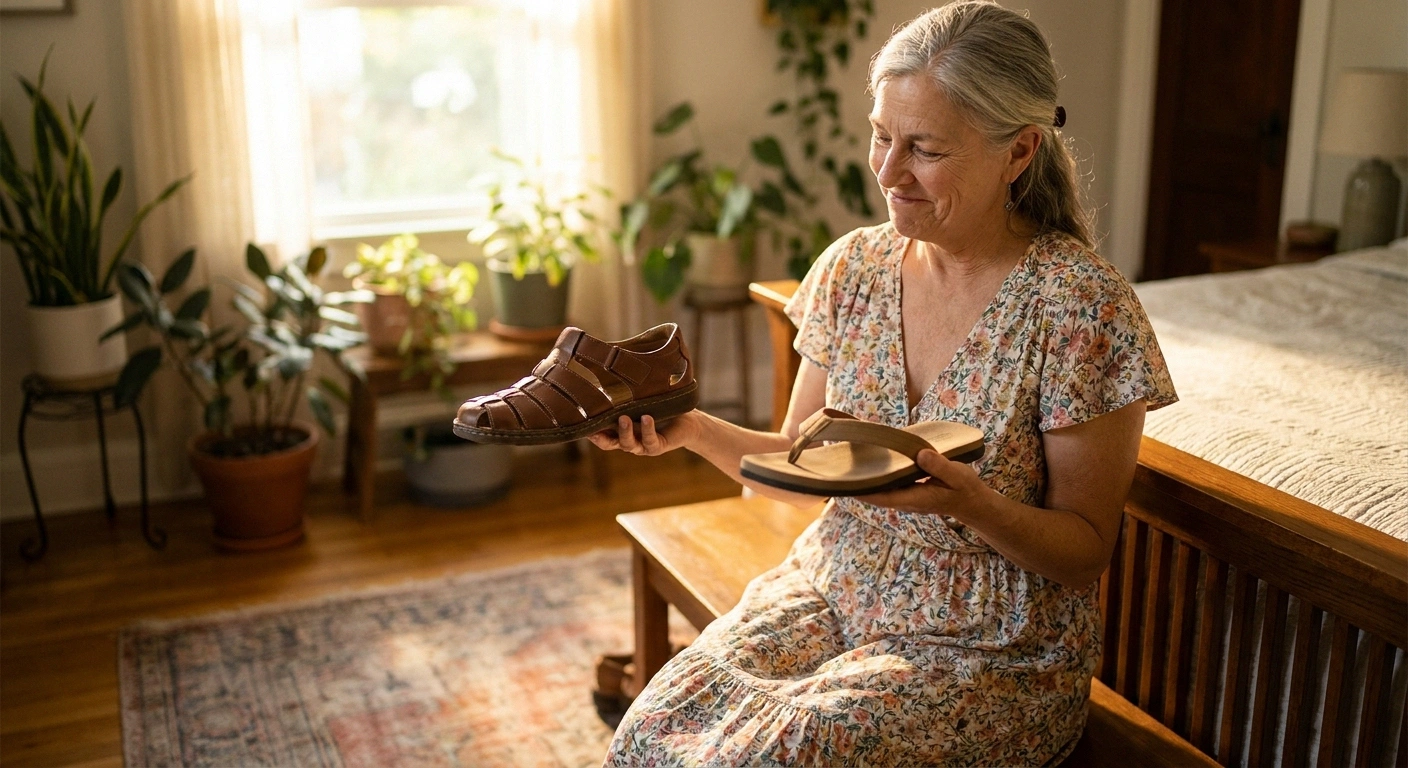
Every June, without fail, I get a version of the same question from women in my support group. “Janet,” they'll say, “the podiatrist says no sandals. But it's ninety-five degrees and I'm going to my granddaughter's outdoor wedding. Am I really supposed to wear sneakers under my dress?” Or: “We're going on a cruise. My daughter got me a beautiful pair of Roman-style sandals as a gift. Can I wear them?” Or, the version that makes me wince: “I wore flip-flops around the pool for a couple of hours yesterday and now I have a blister on the top of my foot that I never felt happening.”
Here is the honest truth about summer footwear when you have neuropathy: the standard “no sandals, ever” advice you'll hear from a lot of medical sources is technically the safest recommendation, but it's not the whole picture. You are a person with a life, not a medical case study, and there are going to be days when a fully-closed sneaker isn't what makes sense — the wedding, the beach day, the pool afternoon, the vacation walk on a warm boardwalk. What you need is not a blanket rule but a decision framework: which sandals, in which situations, with which safety practices. Once you have that framework, you can walk into a shoe store, look at a sandal, and tell within thirty seconds whether it's a reasonable choice for your feet or something to leave on the rack. That framework is what this article is about. I am not a medical professional; I am a patient advocate who has spent a lot of years walking this line myself and helping others do the same.
Why Summer Footwear Is Genuinely Risky for Neuropathy
Before we get to what you can wear, I want to name what makes sandals and flip-flops legitimately more dangerous for neuropathy feet than for feet with normal sensation. Understanding the actual mechanism helps you evaluate any sandal on your own, rather than relying on a brand list that might not include your favorite shop.
Key takeaway
Neuropathy + sandals is not an automatic no. It is a decision framework — closed-toe fisherman sandals with a back strap are the safest category and can genuinely be part of your summer wardrobe. Flip-flops with only a thong strap are the one sandal category to eliminate entirely. Everything else falls in between and needs the five-point evaluation before you buy or wear.
The four core risks of open-toe footwear when your feet don't feel normally are these: reduced protection, poor support, unstable gait mechanics, and inability to detect dangerous surfaces. Each one deserves a moment.
Reduced protection. An exposed foot is exposed to everything a shoe would ordinarily block. Dropped kitchen knives at picnics. Sharp shells on the beach. A stubbed toe against a chair leg that a person with normal sensation would recoil from but that a numb foot barely registers until the bruise appears. Hot pool decks and asphalt that burn the top and sides of the foot without triggering pain. Bee stings and ant bites on toes you can't see behind you. Sunburn on the tops of the feet that you didn't feel developing. If you have significant sensation loss, every one of these is a risk that closed-toe footwear reduces almost to zero and open-toe footwear leaves fully in play.
Poor arch and heel support. Most sandals — especially the cheap and the pretty ones — have shallow, flat footbeds with minimal contour and no meaningful midsole support. Walking in unsupported footwear all day changes your gait, strains your plantar fascia, and accelerates the callus formation that neuropathy patients already have to watch. Over time, this shows up as new heel pain, worsening arch collapse, or thicker calluses that themselves can develop pressure sores.
Unstable gait mechanics. Flip-flops in particular require your toes to actively grip the sole to keep the sandal on your foot. This clenching action is a whole-day workout for the small muscles between the toes, and it changes how you walk in ways that increase fall risk. Your foot doesn't push off cleanly. Your gait becomes a shuffle. If you have any balance impairment already — and many people with neuropathy do, from proprioception loss — flip-flops meaningfully raise your fall risk. Broader information on balance and fall prevention applies here directly.
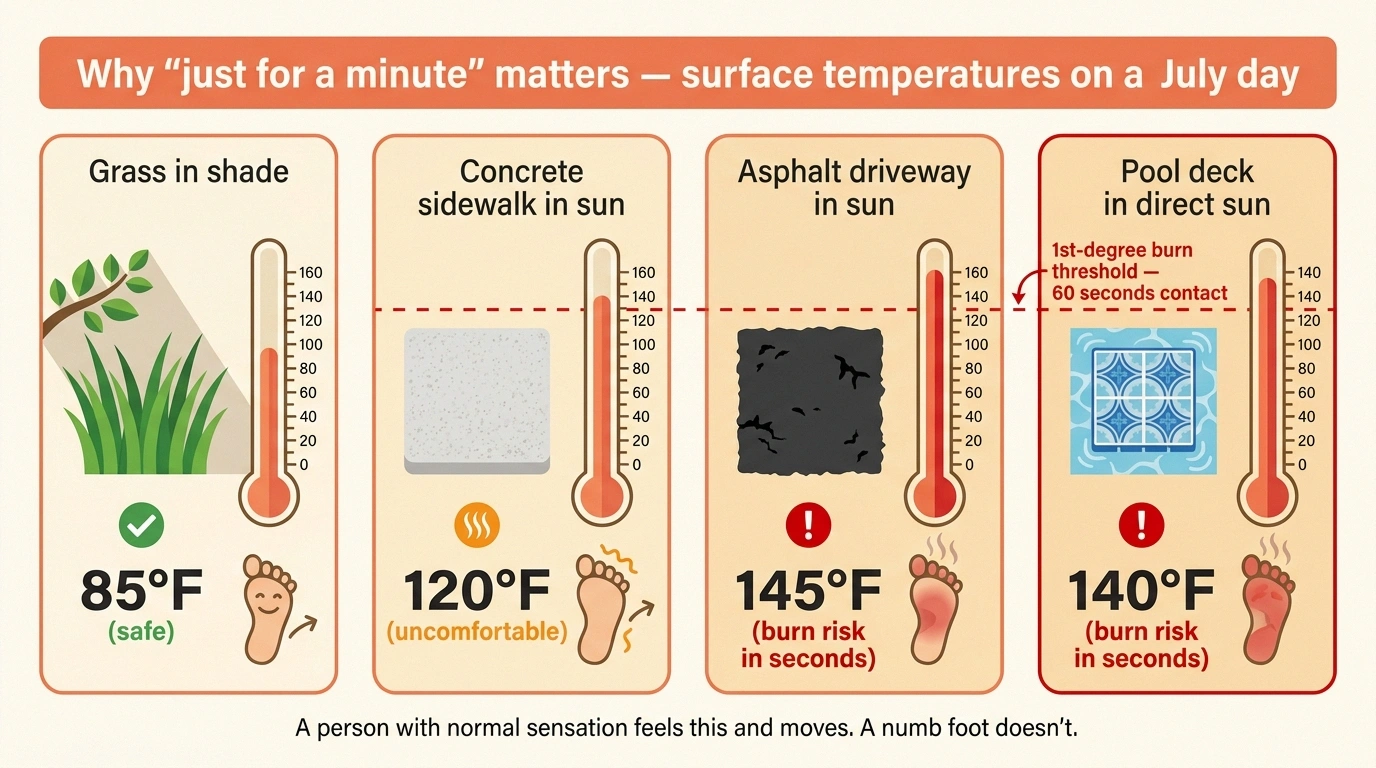
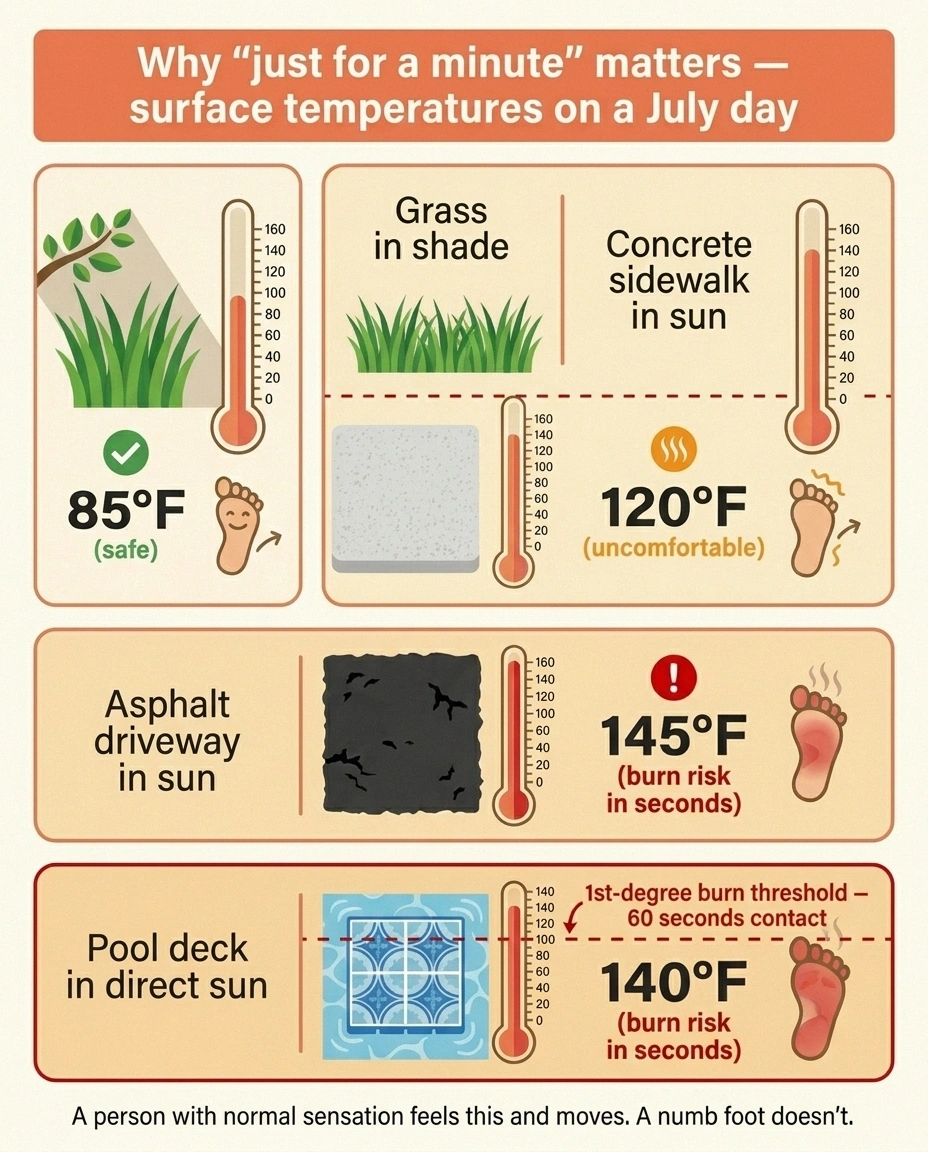
Inability to detect dangerous surfaces. A summer sidewalk in the American South can hit 130 to 160 degrees. Poolside concrete in July commonly reaches 140. Beach sand in direct sun regularly hits 130. A person with intact sensation feels this instantly and shifts their weight or hops to shade. A person with numb feet can stand on 140-degree concrete for the ten seconds it takes to develop a first-degree burn without any warning signal at all. This is the risk that produces the “I don't know when this blister happened” stories in every summer support group meeting.
The Five-Point Sandal Evaluation Framework
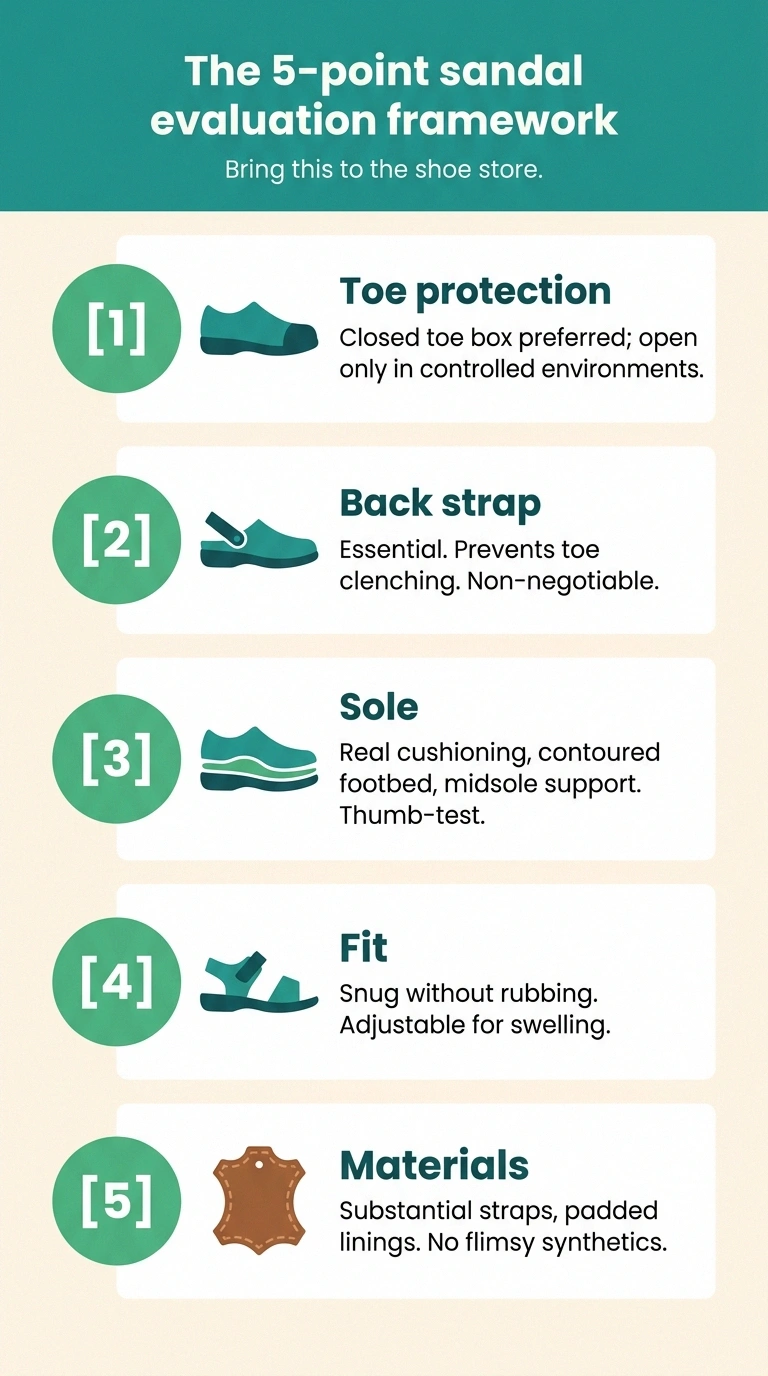
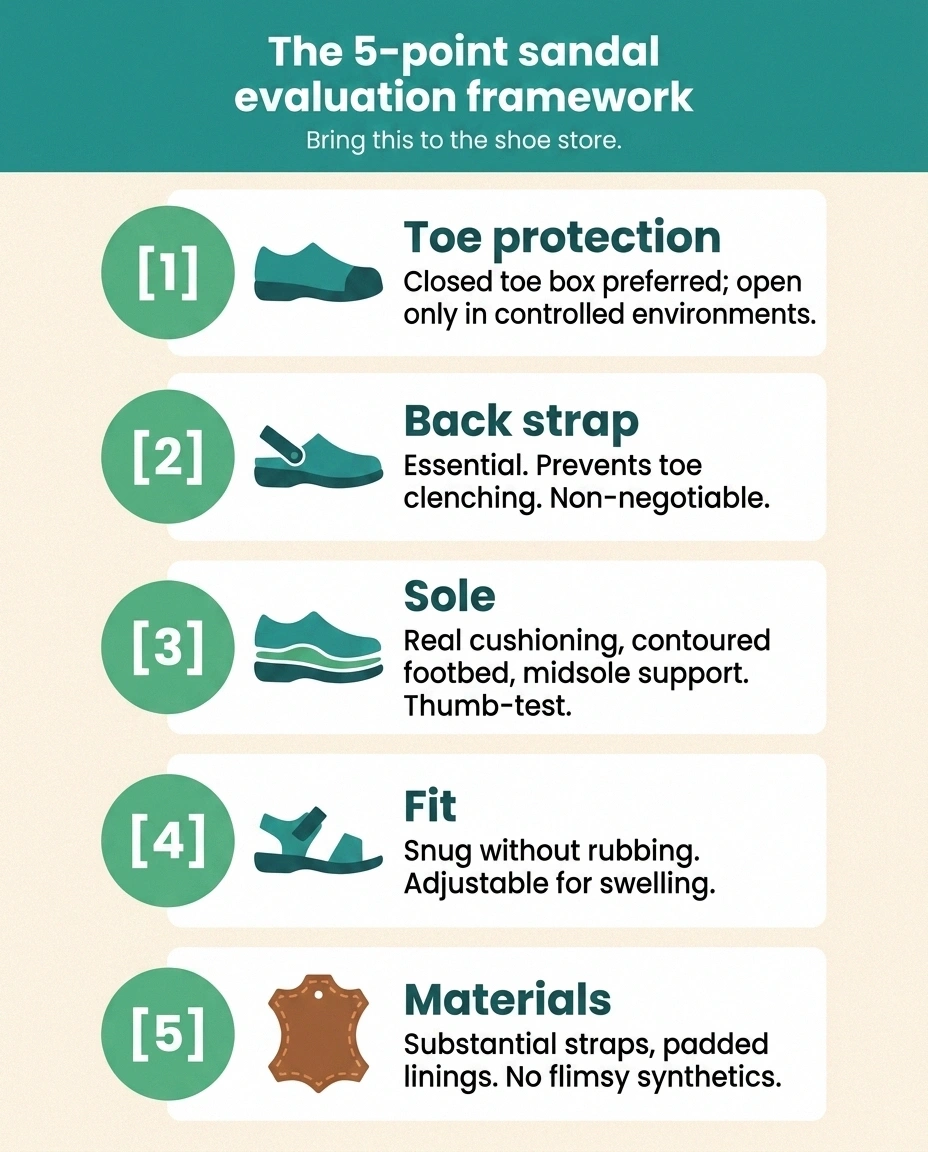
Here is the framework I teach in my community. When you pick up a sandal, evaluate it against these five features. A sandal that scores well on all five is a reasonable choice. A sandal that fails on two or more should stay on the rack.
The four risks a numb foot faces in sandals
One: Toe protection. Is there a closed toe box, or are your toes exposed? Closed-toe fisherman-style sandals — the kind with leather or webbing wrapping around the front of the foot — protect against stubbed toes, dropped objects, sun exposure, and hot surface contact. Fully open-toe sandals leave every one of those risks in play. Closed-toe options like Keen Newport, Merrell fisherman styles, and Ecco Yucatan are examples worth knowing.
Two: Straps. How many straps are there, and is there a back strap around the heel? A back strap is nearly non-negotiable. Without one, your foot has to grip the sandal to keep it from flying off, which is what flip-flops force you to do. A good sandal has at least two straps across the foot plus a heel strap, and ideally the straps are adjustable — Velcro, buckles, or laces — so you can accommodate any swelling that comes with a long hot day. Adjustability also lets you tighten the fit if your feet slim down over the course of a walk.
Three: Sole. Is there real cushioning, a contoured footbed, and adequate midsole support? Cushioning matters because numb feet can't sense small impacts, and small impacts accumulate into bruising and callus over the day. A contoured footbed keeps your arch supported and stops the foot from flattening into an inefficient shape. A slight rocker profile in the sole helps your gait remain smooth. When you press on the sole with your thumb, it should have real cushion — not the tissue-thin foam of a cheap fashion sandal.
Four: Fit. Does the sandal fit correctly, with no rubbing points, no slipping, and adequate width? Neuropathy feet often have subtle changes over the years — wider forefoot, some claw-toe deformity, a bunion or two. A well-fitting sandal accommodates these. Rubbing at any strap point is a red flag; on a neuropathy foot, that rubbing can create an invisible blister within a single afternoon. If you can slip a finger between the strap and your foot without effort, the strap is too loose. If the strap leaves an indentation in your skin after ten minutes, it's too tight.
Five: Materials. Are the materials substantial, and are the strap linings padded? Real leather, quality webbing, and molded EVA or cork footbeds hold up. Thin synthetics, cheap foam, and rigid unpadded straps do not. Padded strap linings prevent friction blisters — the invisible-injury risk that numb feet run all day. When you look at a strap, ask yourself whether you would want that exact material rubbing against your skin for six hours. If not, put it back.
The Green-Yellow-Red Ranking of Sandal Types
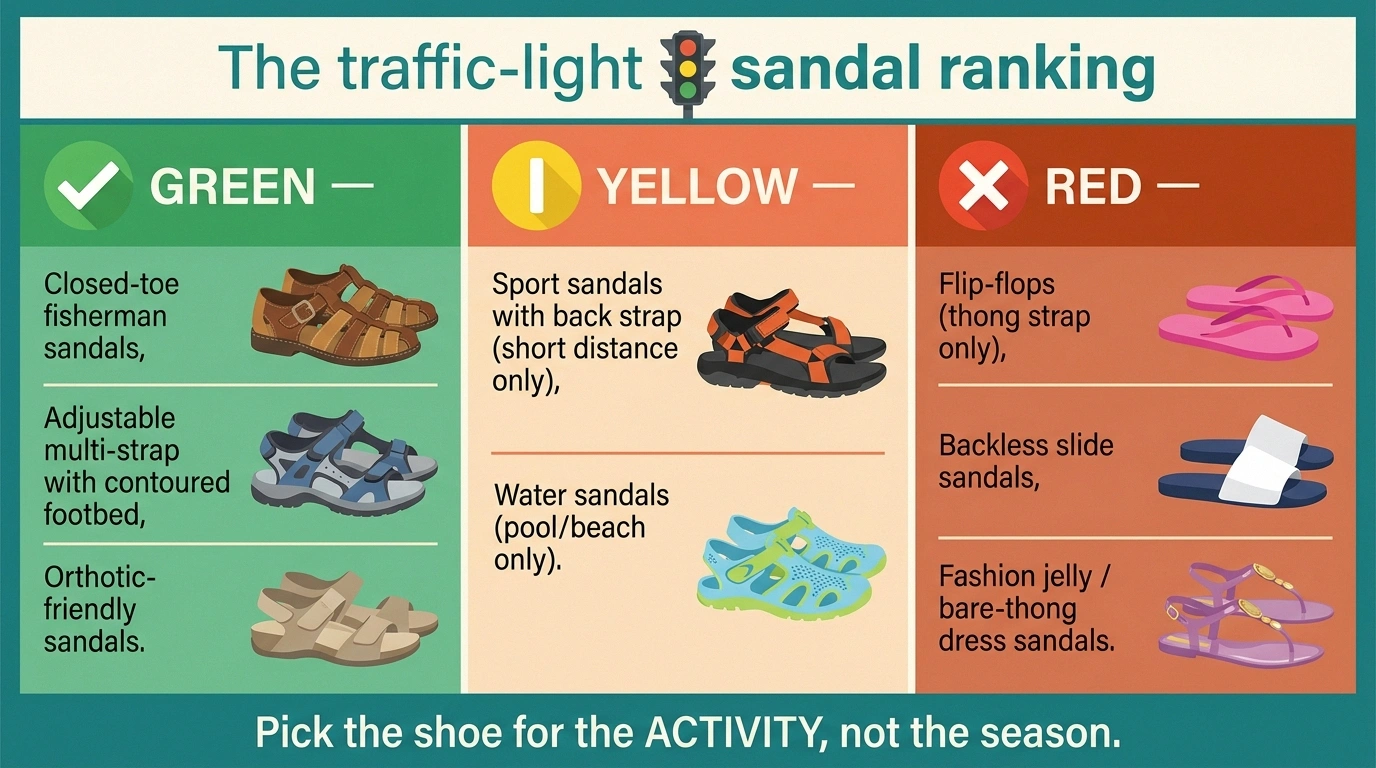
Applying the five-point framework to the sandal types you'll actually encounter in stores gives a useful traffic-light ranking.
The traffic-light sandal ranking
GREEN — reasonable choices for most neuropathy feet:
Closed-toe fisherman-style sandals are the safest sandal category. Keen Newport, Merrell All Out Blaze, and Ecco Yucatan-style sandals close over the toes, have back straps, offer meaningful cushioning, and use quality materials. They look like sandals but function much closer to a shoe. If you're going to buy one summer sandal, this is the category.
Adjustable multi-strap sandals with contoured footbeds — Birkenstock Arizona-style, Naot, and Vionic sandals — are the next category up. They leave the toes open, so they earn some yellow-flag caveats, but they provide arch support, back straps, and adjustable fit. They are appropriate for controlled environments — dinner out, sitting on the porch, short walks around the neighborhood — but not for long-distance walking or hot pavement.
Orthotic-friendly sandals — Aetrex, OrthoFeet, Vionic Tide and Rest series — have removable footbeds so you can insert custom orthotics or over-the-counter arch supports. If you already wear orthotics in your shoes, this category is essential because it lets you carry your foot support into the sandal world.
YELLOW — okay in controlled situations only:
Sport sandals with back straps — Teva Original Universal, Chaco Z-cloud — are okay for short-distance beach, boat, or pool use. They have back straps and decent cushioning but leave the toes exposed. Not for extended walking. Not for hot pavement.
Closed-toe water sandals — Keen Newport H2, Teva Hurricane XLT — are the good option specifically for pool and beach environments where water is a factor. They protect the toes, have back straps, and are designed to drain and dry quickly. They combine reasonable safety with actual functionality for aquatic environments.
RED — avoid entirely with neuropathy:
Flip-flops with a thong strap only. No back strap, no meaningful support, and the toe-clenching requirement changes your gait in dangerous ways. The single worst summer footwear choice for numb feet. If you take one thing from this article, please: no flip-flops.
Backless slide sandals — pool slides, Nike Benassi, Adidas Adilette — have no heel strap and slip off easily. They may seem harmless for a few minutes on a pool deck, but they consistently produce falls and are behind more emergency-department visits than any other summer footwear category.
Fashion “jelly” sandals, bare-thong dress sandals, and any sandal that requires gripping with your toes to stay on. These prioritize appearance over any protective function. There are dressy sandals that meet the framework above — Naot has dressier styles, Vionic has metallic finishes, and many brands offer leather-wrapped versions that look elegant with a summer dress — but the bare-thong dress sandal is not one of them.
Choosing the Shoe for the Activity, Not the Season
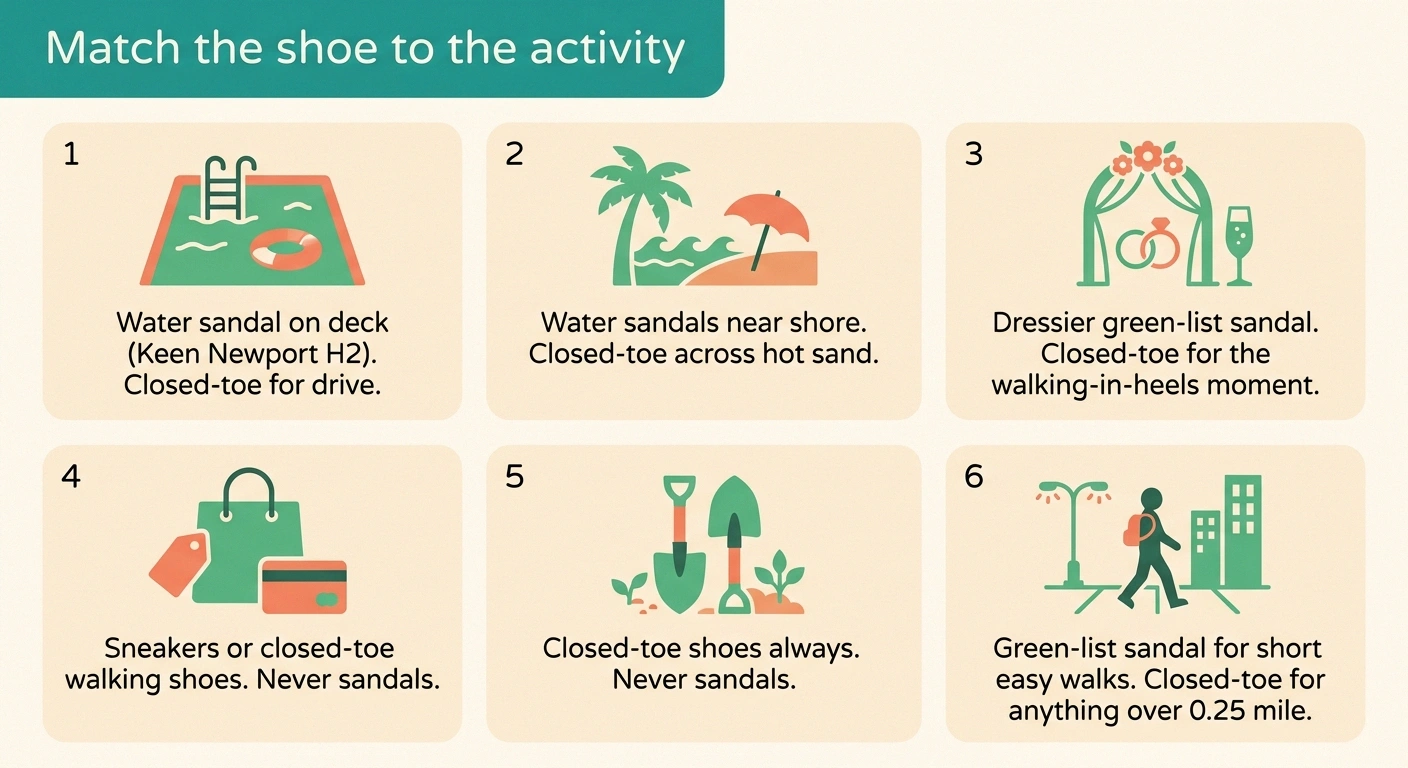
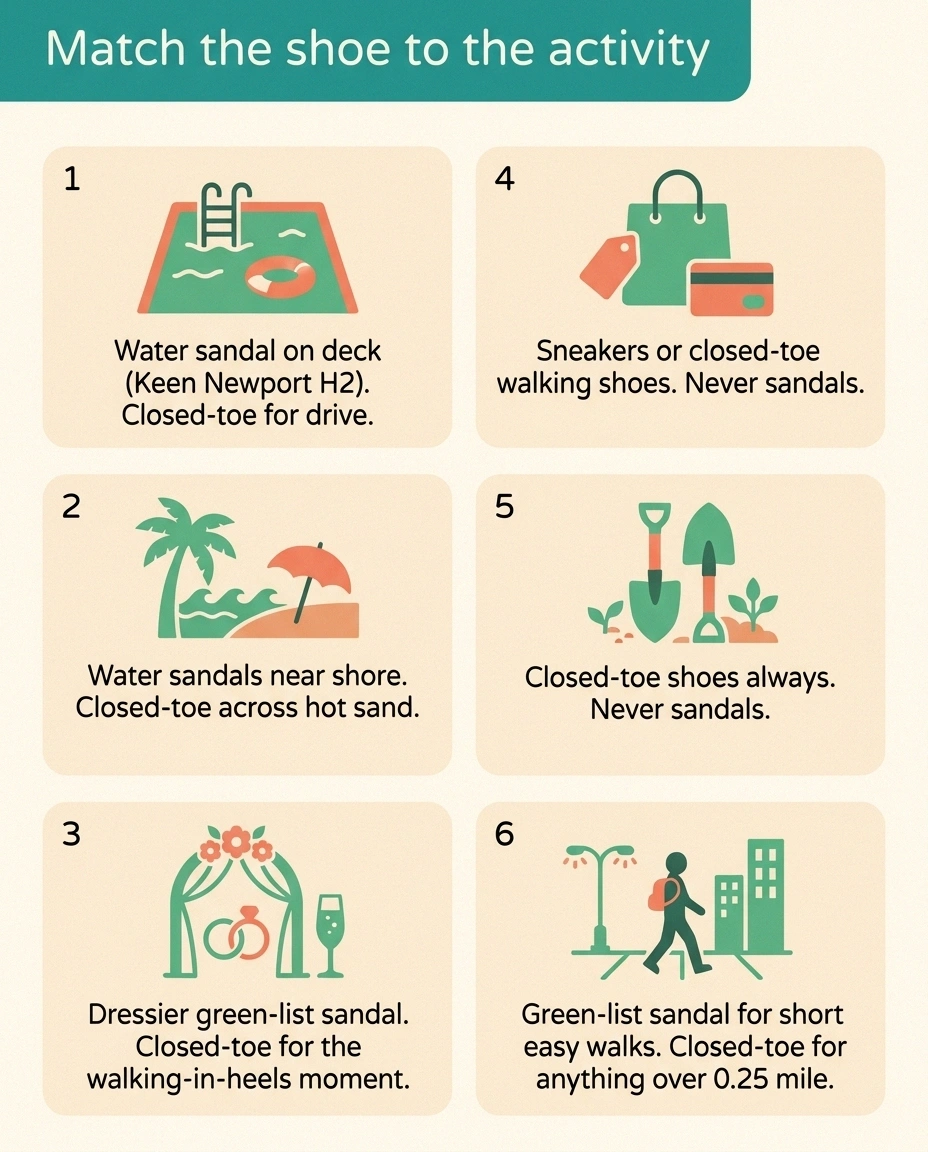
The most useful mental shift I can offer is this: pick the shoe for the activity, not for the weather. Summer is not the reason to wear sandals; the specific situation is. And the same person may reasonably wear a green-list sandal for one activity and a closed-toe supportive shoe for another an hour later.
Match the shoe to the activity
A pool day: acceptable to wear water sandals like Keen Newport H2 on the pool deck if you're careful about the deck temperature. Fully appropriate to switch to a good closed-toe walking shoe for the drive home.
A beach day: acceptable to wear water sandals to and from the water, and possibly to walk on shaded wet sand near the water's edge. Not acceptable to walk barefoot across hot sand between the parking lot and your beach chair — always keep some form of footwear on. A closed-toe shoe for the walk from the car, then switch to sandals near the water, is a reasonable pattern.
A summer wedding or garden party: acceptable to wear a dressier green-list sandal for the ceremony and seated portions. If there's a walk to and from a distant parking lot on a hot day, close-toed dress shoes are safer for the walk, then change into the sandal when seated.
A shopping trip in a mall or on a downtown street: sneakers or closed-toe walking shoes. Not sandals. The distance is unpredictable, the surface temperature is unpredictable, and you'll likely be on your feet for hours.
Yard work, gardening, or any activity around tools, hoses, or plants: closed-toe shoes with real soles. Never sandals. The risk of a dropped rake, a stepped-on bee, a splinter, or a tool falling on the foot is entirely too high.
A short walk on a summer evening around your neighborhood: green-list sandals are reasonable if the surface is cool and the sidewalk is smooth. If you're doing a real walk of more than a quarter mile, or the pavement has been in direct sun until recently, switch to a closed-toe walking shoe.
Daily Foot-Care Habits That Matter More in Summer
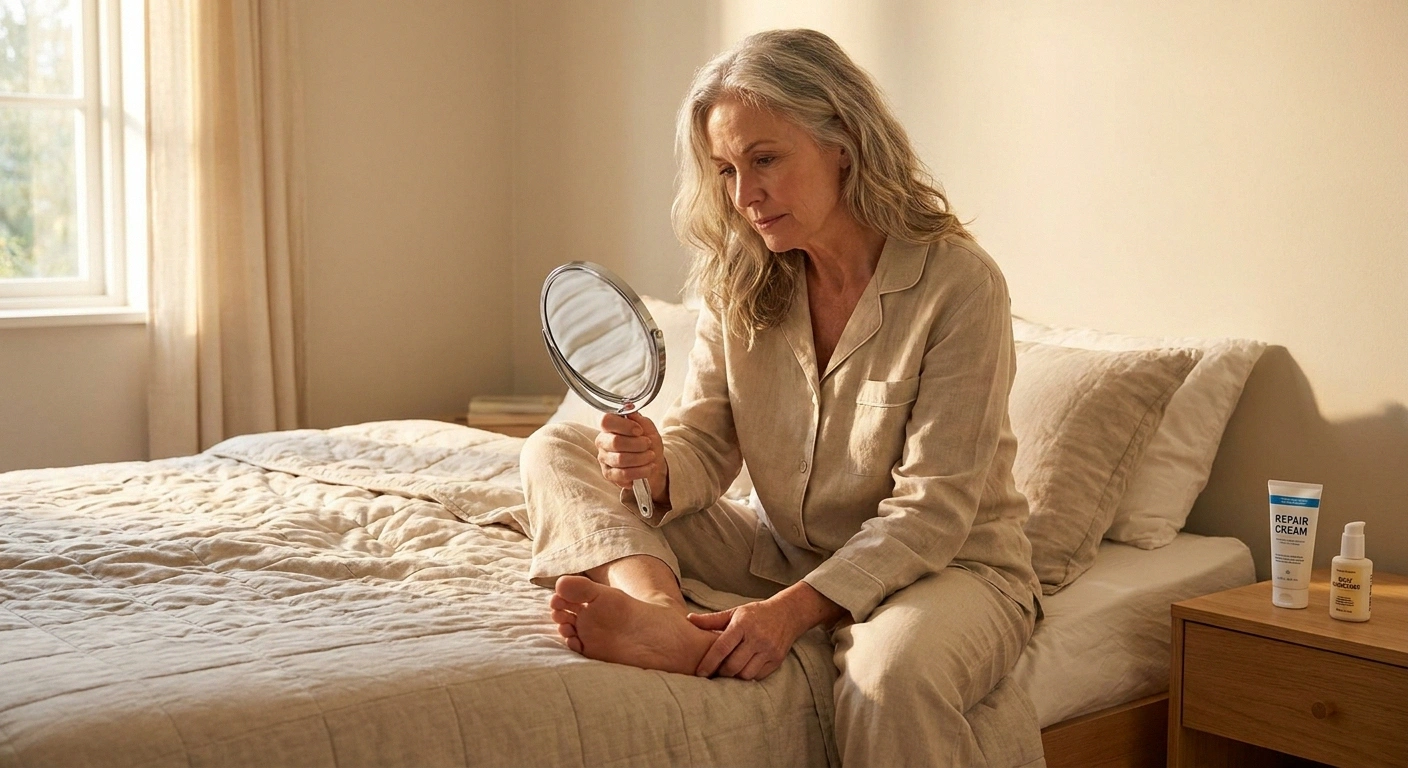
The general foot-care routine for neuropathy applies year-round, but summer amplifies several of its steps. If you're going to spend more time in less-protective footwear, your daily inspection routine becomes non-negotiable.
Summer neuropathy foot-care checklist
- ☑ Check both feet twice a day — morning and before bed. Look at tops, bottoms, between toes, heel, outer edges.
- ☑ Sunscreen the tops of your feet — burns on numb skin happen invisibly.
- ☑ Test surface temperature with the back of your hand before stepping barefoot or in thin sandals.
- ☑ Shake sand and small stones out of sandals regularly during any beach or gravel-path day.
- ☑ Rinse feet after pool or beach, dry thoroughly (especially between toes), apply moisturizer.
- ☑ Break in new sandals gradually — one hour at a time for the first three or four wears.
Check both feet twice a day. Morning, before your day starts. Evening, before bed. Look at the tops, the bottoms, between every toe, around the heel, and along the outer edges. Use a mirror or ask a family member for the areas you can't see. You are looking for redness, blisters, cuts, bruises, sunburn, insect bites, or any sign of injury. In summer especially, sunburn on the tops of feet and small cuts from beach shells or lawn debris are common finds that a person with normal sensation would notice as they happened.
Apply sunscreen to the tops of your feet. This is one of the most overlooked steps. Numb skin still burns; it just doesn't hurt. A person with normal sensation would feel the burn developing and cover the feet. A neuropathy patient often discovers a serious sunburn only that evening. If you're wearing sandals, sunscreen the entire top surface of the foot including the ankle and any exposed skin.
Test surface temperatures before stepping. Before you walk barefoot or in thin sandals on any surface you're unsure of — pool deck, sand, tile floor at a resort — test it first. Use the back of your hand for a five-second test. If it feels uncomfortable to the back of your hand, it will burn your feet in seconds, and you won't feel it happening. If you're at a pool where the deck looks hot, wear water sandals through the entire deck area without exception.
Keep sand and small stones out of your sandals. A tiny piece of gravel inside a sandal can create a pressure sore over the course of a day. If you're on the beach or a gravel path, stop periodically and shake out your sandals. If you feel any unusual sensation — even a vague awareness — investigate immediately.
Rinse feet after pool or beach. Chlorinated pool water and salt water both dry the skin, and cracked dry skin becomes an entry point for infection. Rinse with fresh water, dry thoroughly especially between the toes, and apply a moisturizing cream. Options for maintenance are covered in neuropathy foot creams in more depth.
Watch for blisters aggressively. New shoes and sandals need a break-in period, and the friction-blister risk is highest in the first few wears. On a normal foot, you feel the blister forming. On a neuropathy foot, you might discover it that night. For the first three or four wears of any new sandal, limit your time to an hour or two and inspect your feet afterward.
Special Considerations for Diabetes Plus Neuropathy
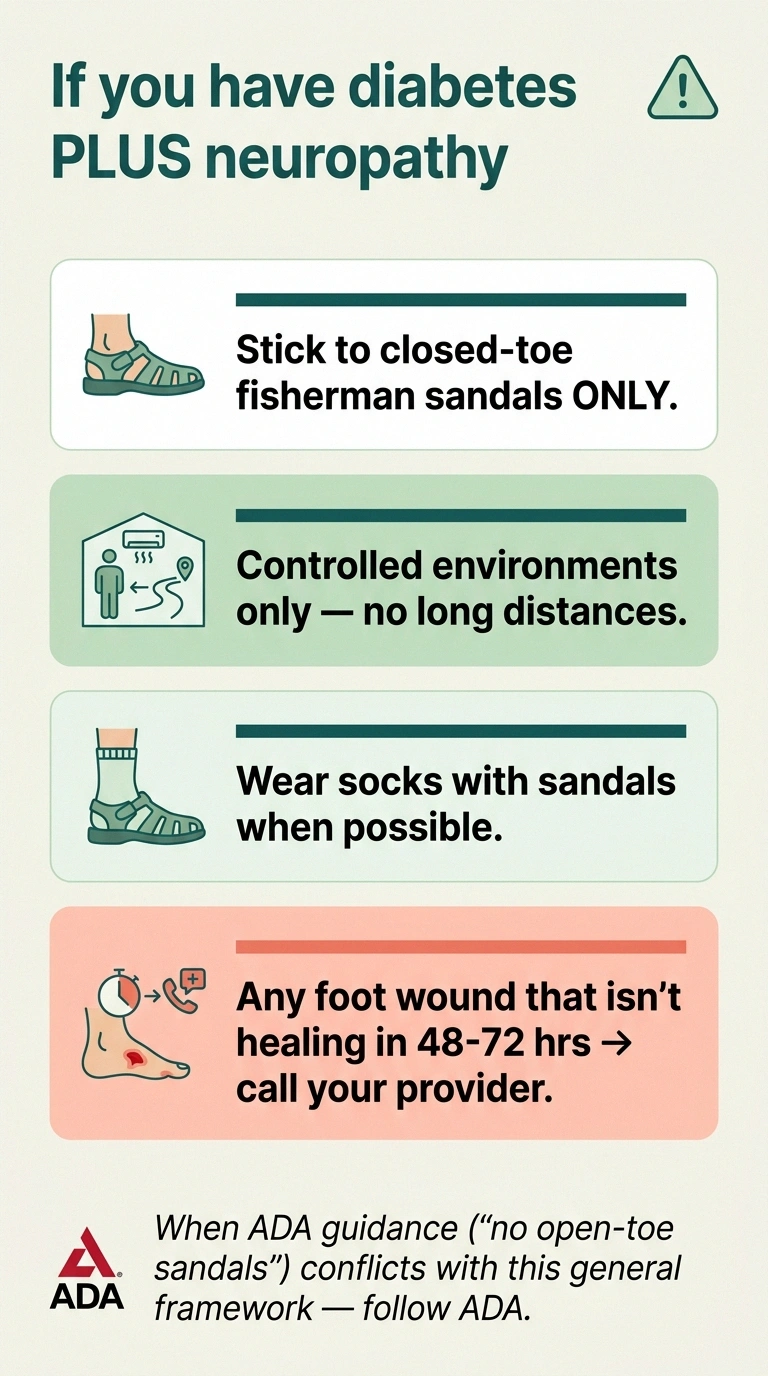
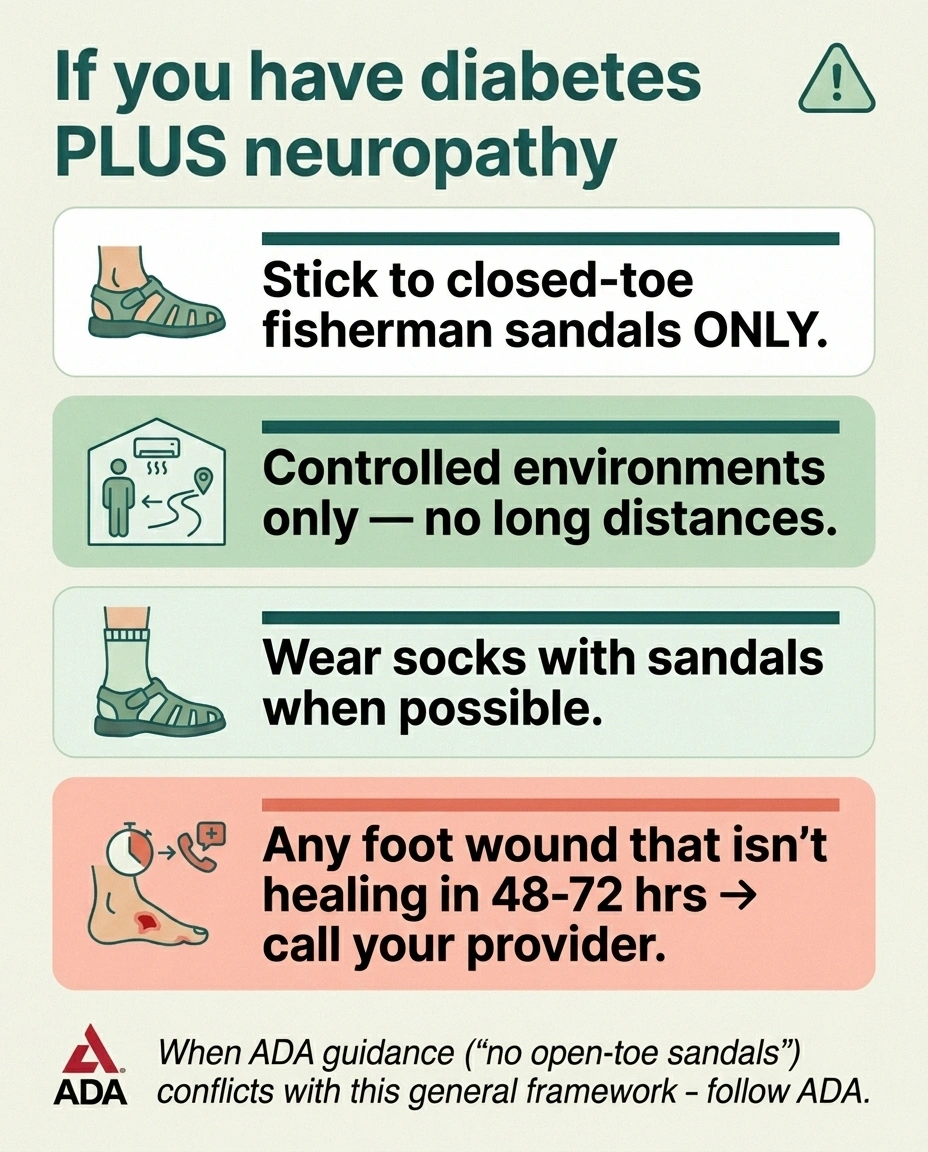
If you have diabetes on top of your neuropathy, the risk calculus shifts further. Diabetic neuropathy carries an additional layer of concern because impaired circulation and reduced immune response mean that a small injury on a diabetic neuropathic foot can turn into a serious complication faster than on a foot with neuropathy alone. The American Diabetes Association's formal position discourages open-toe sandals entirely for people with diabetic peripheral neuropathy — and if your foot has any history of ulceration or Charcot foot, that recommendation is close to absolute.
In real life, most people with diabetic neuropathy still want to make some accommodations for summer culture. If that is you, the practical version of the risk-reduction approach is: stick to closed-toe fisherman-style sandals only, in fully controlled environments only. Skip the beach walking sandals category entirely. Wear socks with your sandals if the sandal design allows it — this reduces friction blisters significantly. Prescription therapeutic footwear may be covered by Medicare for eligible patients, and some brands make closed-toe extra-depth sandal-style therapeutic shoes that fall within that program. Broader diabetic neuropathy foot care guidance takes priority over any general summer-footwear framing here — when there's a conflict, the diabetes-specific guidance wins.
What NOT to Do — Common Summer Footwear Mistakes
These are the mistakes I see repeatedly in my community. Reading through them is worth the two minutes if you're getting ready for a summer season with new sandals or an old pair.
Wearing flip-flops for yard work or gardening. A dropped trowel, a hidden thorn, a bee on the clover, or a stubbed toe against a garden edging — all of these become significant injuries on a numb foot in flip-flops. Yard and garden work requires closed-toe shoes with real soles, always.
Wearing flip-flops or bare-thong sandals for travel. Airport walks are longer than people plan for. Boarding onto and off of buses, ferries, and shuttles happens in crowds where feet get stepped on. Rental car pickup counters are farther from parking than anyone expects. Travel days call for a proper closed-toe shoe.
Standing on hot pool decks or asphalt in sandals with thin soles. Even a two- or three-minute stand on 140-degree pavement can burn your feet through a thin sandal sole. If the ground is hot, keep moving to shaded areas and check the sole thickness of what you're wearing.
Wearing new sandals for a full-day event. Break in new sandals gradually — an hour at a time for the first several wears — before committing to a whole day. The risk of a friction blister forming on a numb foot without notice is highest in the first few wears.
Buying sandals based on how they look in the store without checking the sole. Many fashion sandals labeled “supportive” or “orthotic-friendly” have shallow, unsupportive footbeds. Always press on the sole with your thumb and feel whether there's genuine cushioning and arch contouring. If the sole flexes easily when you twist it, it's not supportive enough for a long day.
Wearing the same sandal every day for the whole summer. Rotating between two or three pairs — a closed-toe walking shoe, a green-list sandal, and a water sandal — reduces the pressure-point buildup that a single pair causes. Your foot doesn't get sensitized to any single fit point.
Ignoring the first hot spot. If you notice a warm, slightly reddened area anywhere on your foot after a sandal wear, that is the pre-blister stage and it's your one warning. Stop wearing that sandal immediately, treat the area gently, and reevaluate whether the sandal fits properly at all.
The Sandal Shopping Checklist

When you go sandal shopping this summer — whether in a store or online — take this checklist with you.
The 30-second in-store test
Pick up any sandal in a store. Ask these five questions. If you can't answer YES to at least four, put it back.
- Toes: Are my toes protected by a closed toe box, or at minimum covered by significant strap material?
- Back strap: Is there a heel strap keeping the sandal on my foot without toe-clenching?
- Sole: Does the footbed have real, thumb-testable cushioning and arch contour?
- Fit: When I try it on, is it snug without pinching, and can I adjust it if my feet swell?
- Materials: Are the straps padded where they touch my skin? Are the materials substantial rather than flimsy?
Bonus: try the sandal on late in the day when your feet are largest, walk in the store for at least 5 full minutes, and buy from a retailer with a generous return policy.
First, know the activity you're buying the sandal for. Beach or pool? Neighborhood walking? Wedding? Vacation touring? The activity determines the category.
Second, apply the five-point framework: closed toe, back strap, real sole, correct fit, quality materials. If the sandal fails two or more, walk on.
Third, try on the sandal at the time of day your feet are typically largest — late afternoon or evening. Feet swell over the course of a day, and a sandal that fits perfectly in the morning may be too tight by dinner.
Fourth, walk in the sandal in the store for five minutes minimum. Not thirty seconds. Notice any rubbing, any slipping, any pressure point. If it's uncomfortable in five minutes, it will be worse after five hours.
Fifth, if you use orthotics, bring them and check that they fit inside the sandal. Some sandals have removable footbeds specifically to allow custom orthotics; others do not.
Sixth, check the store's return policy. Even after passing every in-store test, a sandal can reveal problems after a day of real use. A generous return policy (30 days, no questions) is a strong reason to buy from that retailer.
Frequently Asked Questions
Are Birkenstocks safe for neuropathy?
Birkenstock Arizona and similar contoured-footbed sandals are in the yellow-to-green category for many neuropathy patients — they have back straps in some models, adjustable straps, and genuinely supportive cork footbeds. They're a reasonable choice for controlled short-distance wear (around the house, quick errands, dinner out) but not for long walks or hot pavement. Choose the two-strap-plus-back-strap models over the single-strap slides.
Can I wear socks with sandals?
Yes, and honestly, this combination is protective for neuropathy feet even if the fashion aesthetic is polarizing. Socks reduce friction blister risk, add a layer of cushioning, and add UV protection. Thin merino wool socks with sport sandals like Keen Newports are a genuinely reasonable and comfortable pairing.
What about hiking sandals?
Purpose-built hiking sandals like Keen Newport H2 and Chaco Z-cloud have back straps, closed or semi-closed toe boxes, and real support. They're reasonable for short hikes on smooth trails and around water. They are not appropriate for rocky trails, hot dry hikes, or any hiking distance beyond a few miles — the neuropathy foot needs the fuller protection of a closed-toe hiking shoe or boot for anything more.
Is going barefoot at home safe?
Barefoot indoors carries less risk than barefoot outdoors, but it still carries some — stubbed toes on furniture, dropped kitchen knives, hot floors near a stove. Many neuropathy specialists recommend wearing supportive slippers or house shoes even indoors. This is a personal-preference call that depends on your specific foot risk. If you have a history of foot ulcers, going barefoot at home is not advisable.
Are wedge sandals okay?
Wedge sandals raise the heel and shift your weight forward onto the ball of the foot — a poor mechanical choice for neuropathy feet, which often already have callus and pressure issues at the forefoot. If you want a slight heel for a dressier occasion, look for a low-heel supportive brand like Naot's dressier line, which balances a small heel with a contoured footbed.
What about at the beach or pool where flip-flops are the norm?
Water sandals like Keen Newport H2 are the right answer for water environments. They protect the toes, drain quickly, and have back straps. There is no situation on a beach or by a pool where flip-flops are safer than a proper water sandal for a person with neuropathy.
My podiatrist says no sandals ever — is this article contradicting that?
Not really. Your podiatrist is giving you the safest possible advice based on your specific foot history — and if you have significant risk factors like a history of foot ulcers, Charcot foot, poorly controlled diabetes, or advanced neuropathy, “no sandals” may be the right answer for you. This article gives a middle-ground framework for people whose neuropathy is mild-to-moderate and who are otherwise low-risk. When a podiatrist's specific advice conflicts with a general framework like this one, follow the podiatrist.
How often should I replace my sandals?
More often than you probably think. The cushioning in most sandal footbeds compresses out after 300-500 miles of wear or one to two summer seasons of regular use, even if the sandal still looks fine. Once the cushioning is gone, you're walking on a hard surface with no shock absorption — a real problem for neuropathy feet. If you can press your thumb into the footbed and feel no give, it's time for a replacement.
What if I develop a blister or sore on my foot?
Treat it seriously. Clean the area gently with mild soap and water, apply a thin layer of antibiotic ointment, and cover with a non-stick bandage. Do not pop blisters. Watch daily for redness spreading beyond the blister edge, increased pain, warmth, or drainage — all signs of infection. If any of those appear, or if the wound does not begin healing within a few days, contact your provider. On a diabetic neuropathic foot, any wound that does not heal quickly is a reason to be seen sooner rather than later.
About the Author