If you've been living with the daily grind of diabetic nerve pain — the burning, the stabbing, the way your feet feel like they're on fire at 2 a.m. — you already know how few real options exist. Gabapentin makes you foggy. Lyrica makes you gain weight. Duloxetine helps some people, does nothing for others, and puts a lot of us to sleep. And opioids? The medical world spent a decade backing away from them for chronic nerve pain, and for good reason.
So when a genuinely new drug shows up in the pipeline — one that doesn't work like anything we already have — it's worth paying attention. Not with breathless hope, because most experimental drugs don't cross the finish line. But with the kind of steady, informed curiosity that lets you have a real conversation with your neurologist and know what questions to ask.
That's what I want to give you today. A clear, honest look at nispomeben — a non-opioid oral drug that's been quietly working through clinical trials, why it's different from everything else being tried, and where it actually stands right now.
What Is Nispomeben?
Nispomeben is an experimental oral pill developed by a Swiss pharmaceutical company called Novaremed. You may also see it referred to by its older research name, NRD.E1 (sometimes written NRD135S.E1) — same drug, just an earlier label from before the international nonproprietary name was assigned.
✓ Key Takeaway
Nispomeben (also called NRD.E1) is an experimental once-daily oral pill being developed for painful diabetic neuropathy. It has FDA Fast Track designation but is not yet approved — the pivotal Phase 2b trial completed in September 2025 with results still pending public disclosure as of mid-2026.
It's being developed for one specific job: relieving the chronic pain that comes with painful diabetic peripheral neuropathy. That's the burning, tingling, and stabbing pain that develops in the feet and legs (and later the hands) of people with long-standing diabetes when high blood sugar damages the small nerve fibers.
The drug is taken by mouth as a once-daily tablet. In the most recent trial, the dose being studied is 80 milligrams once a day. That's it — one pill, once, no titration ramp of the kind gabapentin requires.
The U.S. Food and Drug Administration has granted nispomeben what's called Fast Track designation for painful diabetic peripheral neuropathy. Fast Track doesn't mean the drug works. It means the FDA agrees that painful DPN is a serious condition with an unmet need — and that if the trials succeed, the agency will work with the developer to move the review along faster than usual. It's a signal about the disease, not a verdict on the drug.
Why Nispomeben Isn't Like Anything We Already Have
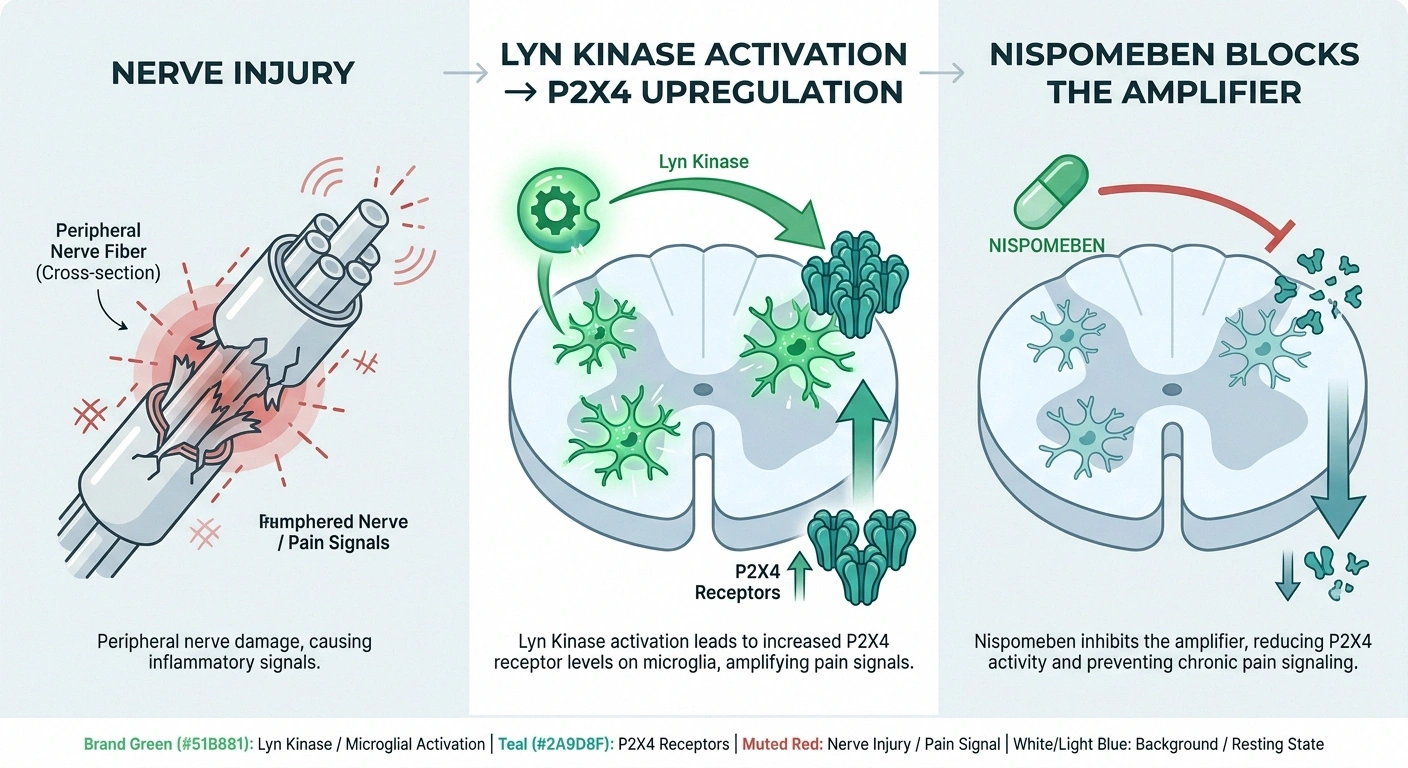
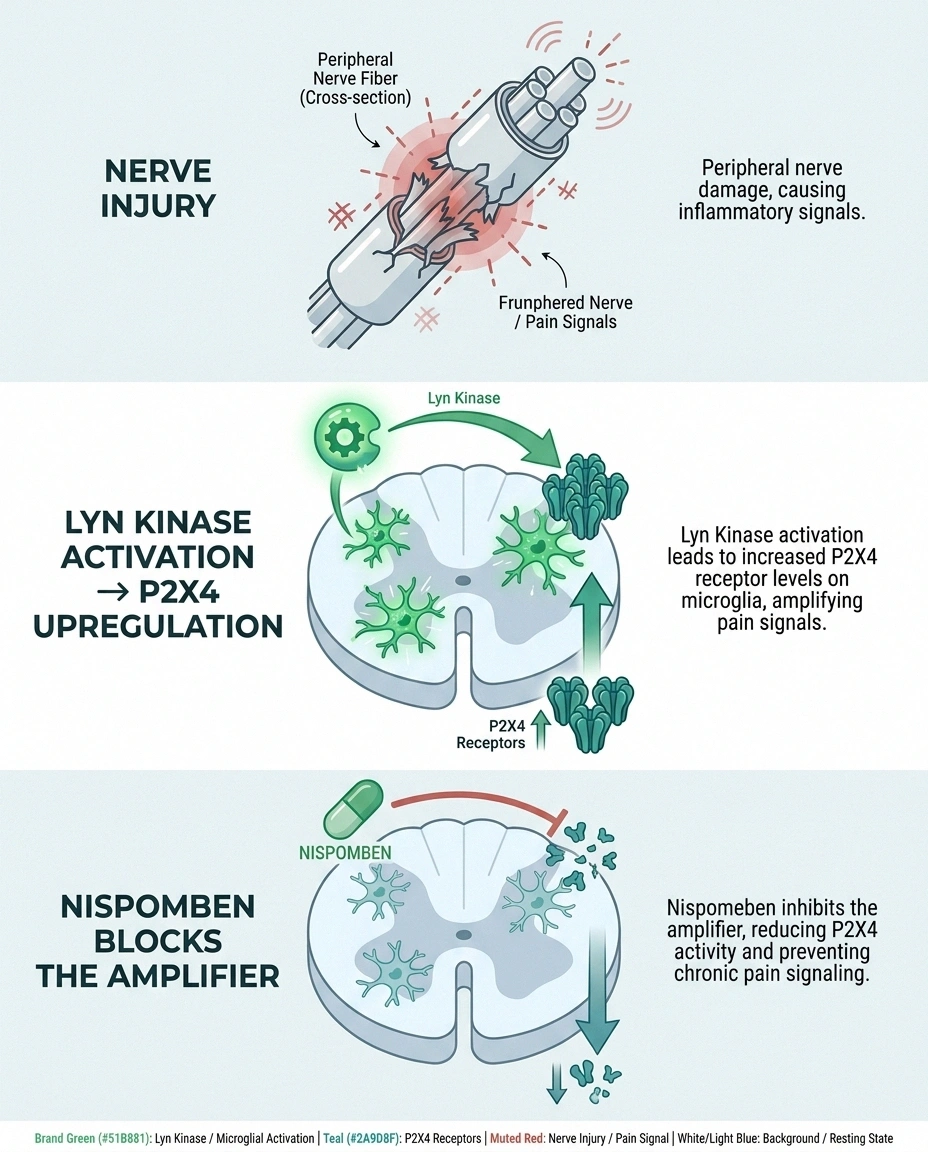
Here's the piece that makes nispomeben genuinely interesting: its mechanism of action is unlike any medication currently approved for nerve pain.
🔬 The Research Says
In laboratory studies, nispomeben interferes with Lyn tyrosine kinase phosphorylation at position Y-507 — a step upstream of the P2X4 receptor upregulation that drives chronic neuropathic pain in spinal microglia. This is a genuinely novel target: no currently approved nerve-pain medication touches this pathway.
Source: Tiecke et al., European Journal of Pain, 2022
Almost every drug currently used for diabetic neuropathy works on one of a handful of familiar targets:
- Gabapentin and pregabalin (Lyrica) attach to calcium channels on nerves and calm down over-firing
- Duloxetine (Cymbalta) and venlafaxine raise serotonin and norepinephrine levels in the pain-processing pathways
- Tricyclics like amitriptyline hit similar neurotransmitter systems
- Opioids attach to opioid receptors
- Topical creams (lidocaine, capsaicin) either block sodium channels or deplete substance P at the skin surface
Nispomeben doesn't do any of that. In the lab, it doesn't bind to opioid receptors. It doesn't touch serotonin, GABA, NMDA, or cannabinoid receptors. It doesn't interact with sodium channels or calcium channels. It sails right past the standard pain-related targets.
What it appears to do — based on the research Novaremed has published — is modulate an enzyme called Lyn tyrosine kinase. Lyn kinase is involved in a chain reaction that ends up cranking up something called the P2X4 receptor on microglia (the immune cells of the spinal cord and brain).
Here's the short version of why that matters. When nerves are chronically injured — as happens in diabetic neuropathy — microglia in the spinal cord start expressing more P2X4 receptors on their surface. Those receptors, once activated, drive the release of inflammatory signals that amplify pain messages coming up from the feet. It's one of the mechanisms behind what's called central sensitization — where the nervous system winds itself up until normal signals feel like alarms.
Nispomeben appears to interfere with the Lyn phosphorylation step that turns up P2X4 production. In simpler terms: instead of blocking pain messages once they're already screaming, it may quiet the amplifier that makes them scream in the first place.
That's the theory. Now let's talk about what the actual studies have shown.
What the Phase 2a Trial Actually Showed

The first meaningful human trial of what was then called NRD.E1 was published in the European Journal of Pain in 2022. It was a proof-of-concept study — small, short, but well-designed.
Phase 2a vs. Phase 2b: What Changed
Phase 2b is where a real efficacy answer becomes possible.
The trial enrolled patients with moderate-to-severe painful diabetic neuropathy and gave them three weeks of NRD.E1 or placebo. The researchers measured how much pain scores dropped compared with the placebo group.
The result: a clinically relevant, placebo-corrected reduction in pain. In plain English, the drug helped more than the placebo did by an amount that wasn't just statistical noise. Just as important, the drug was well tolerated. There were no serious adverse events, no severe side effects, and no dose-related safety problems in the study.
That's the ideal Phase 2a result: a signal that something is working, without any red flags that would stop development.
But before you get too excited, understand what a Phase 2a trial is — and isn't. It's small. It's short. It's a first look. Many drugs show good early signals and then fizzle in larger studies, either because the effect was smaller than it looked in a tiny sample, or because side effects emerged only with longer exposure. Phase 2a is a green light to keep going, not a green light to celebrate.
Phase 2b — The Study That Actually Matters

The Phase 2a signal was enough for the National Institutes of Health to fund a much larger, more rigorous Phase 2b trial. This is the trial that determines whether nispomeben goes on to Phase 3 — or joins the long list of promising nerve-pain drugs that didn't pan out.
Here's what the Phase 2b (called EN21-01) looks like:
- 127 patients — adults and older adults with painful diabetic peripheral neuropathy
- 12 weeks of treatment — four times as long as the Phase 2a
- Once-daily 80 mg oral nispomeben vs. placebo
- Multicenter, randomized, double-blind, placebo-controlled — the gold standard for testing whether a drug actually works
- Primary endpoint: reduction in chronic pain compared with placebo
- Secondary endpoints: safety, tolerability, pharmacokinetics, effects on sleep, effects on quality of life
Novaremed announced that the last patient's last visit was completed in September 2025, and topline results were expected to be released in late 2025.
As of when I'm writing this, in the summer of 2026, I have not seen a definitive public announcement of the topline results. That doesn't mean the trial failed — companies sometimes take extra time to analyze data, prepare for scientific presentations, or coordinate with regulatory partners before releasing top-line numbers. But it does mean anyone claiming to know the outcome right now is probably guessing. When results are released, they'll come through Novaremed's press releases and, eventually, through peer-reviewed publication.
What “Good Results” Would Actually Look Like
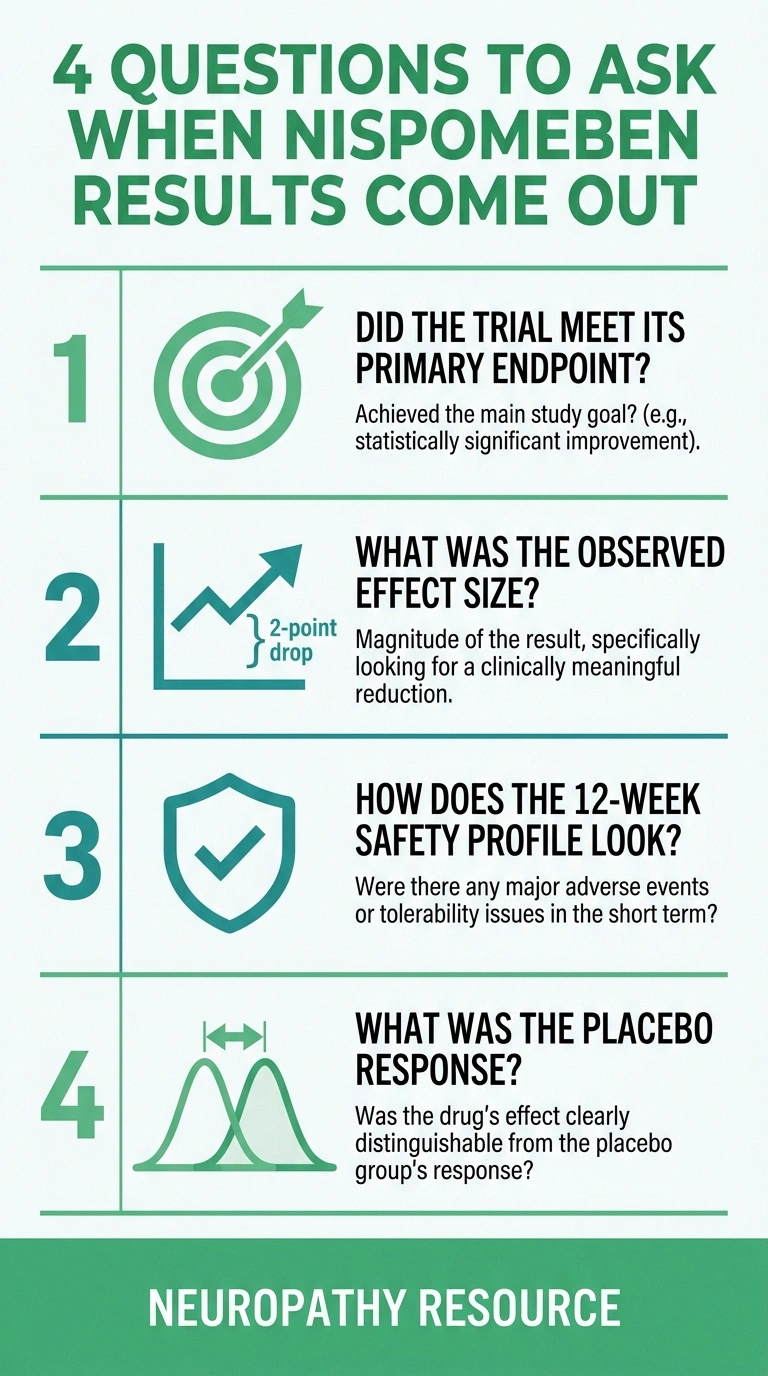
If and when nispomeben's Phase 2b results are announced, here's what to look for. Because the words a press release uses can make almost any result sound promising:
1. Did it hit the primary endpoint? This is the single most important question. The primary endpoint was a statistically significant reduction in pain compared with placebo at 12 weeks. Either the drug beat placebo by a meaningful margin, or it didn't. If a press release talks a lot about secondary endpoints and quality-of-life scores without leading with the primary endpoint result, that's usually a warning sign.
2. How big was the effect? Statistical significance and clinical significance are two different things. A drug can beat placebo by a tiny amount that reaches statistical significance in 127 patients but wouldn't feel like much to the average person taking it. Look for the actual point difference on the pain scale — a two-point reduction on an 11-point scale is generally considered clinically meaningful for chronic pain.
3. What did the safety data look like at 12 weeks? The Phase 2a was only three weeks. The Phase 2b is the first look at what happens when people take this drug for three months. Any signal of liver enzyme changes, cardiac effects, or dose-related side effects will shape whether Phase 3 goes forward and at what dose.
4. Was the placebo response high or low? In pain studies, placebo responses can be huge — sometimes 30 to 40 percent of patients report meaningful improvement on a sugar pill. A drug has to beat that response, not just help people. If nispomeben helped people but placebo helped them just as much, that's not a win.
Where This Fits in the Broader Nerve-Pain Pipeline
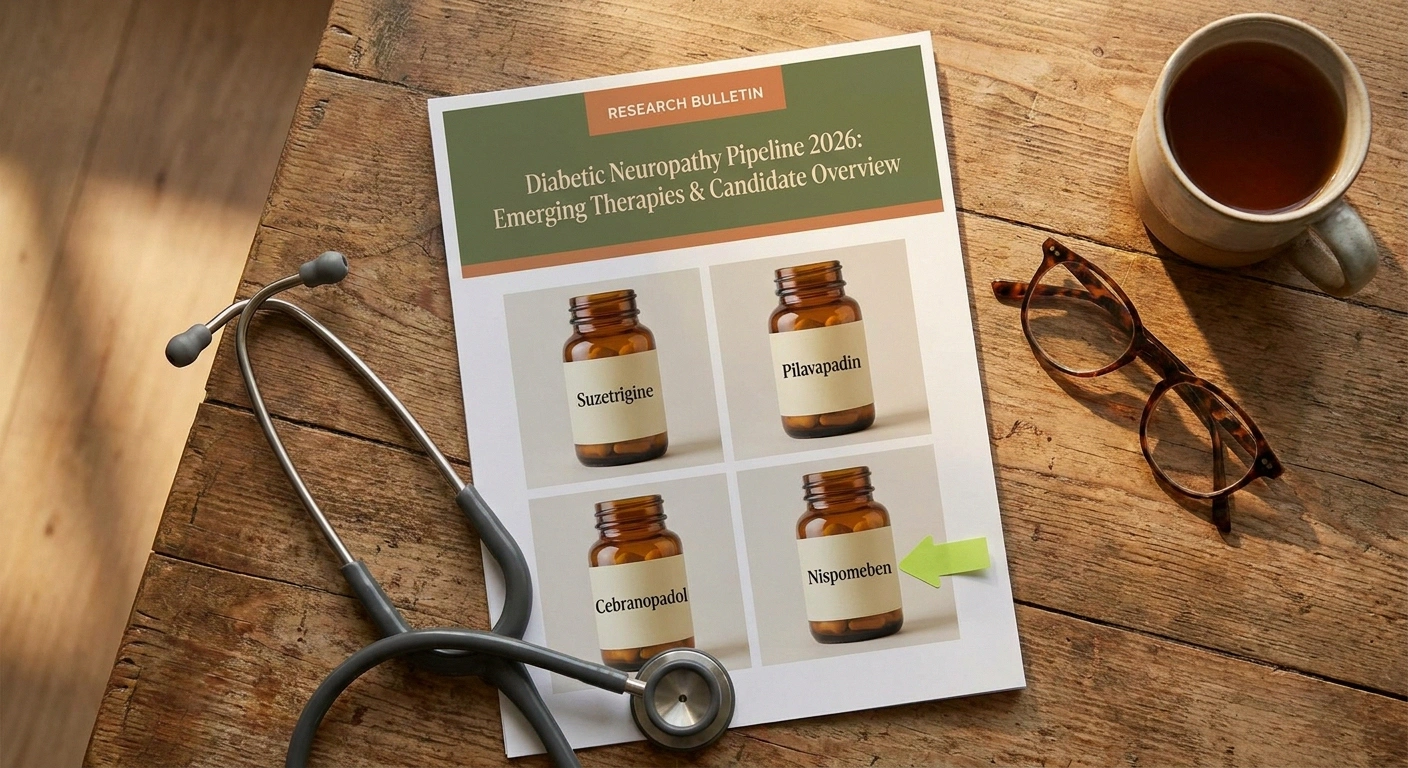
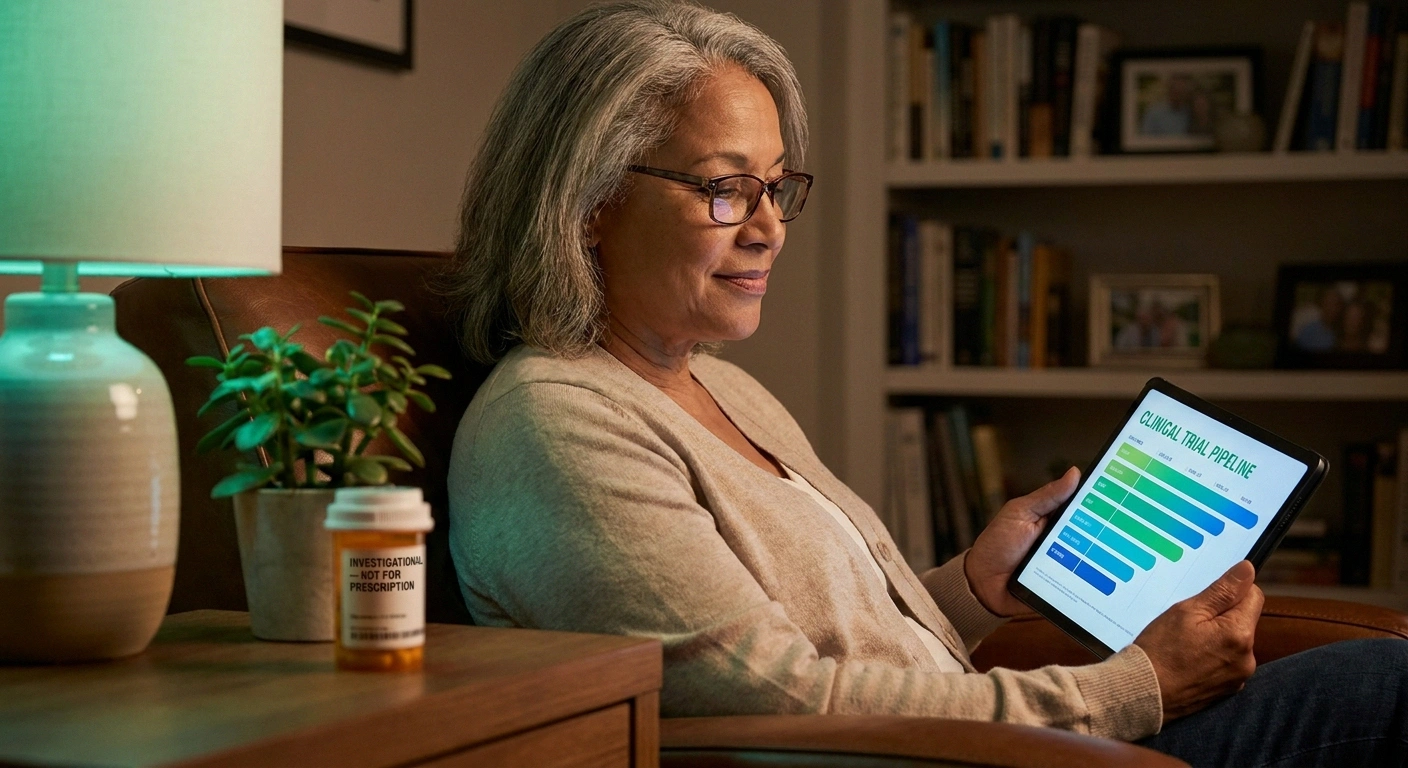
Nispomeben isn't the only new drug being developed for painful diabetic neuropathy. It's part of a genuinely encouraging wave of research after decades where the treatment options barely changed. A few candidates you may hear about in the same conversation:
⚠️ A Careful Note About Pipeline Drugs
Most drugs that reach Phase 2b never get FDA approved. Some fail on efficacy in Phase 3. Others fail on safety when studied for longer periods. Some run into funding problems or get shelved after a company pivot.
Following a pipeline drug is fine. Rearranging your treatment plans around one is not. Anything you'd need to stop taking to “wait for nispomeben” would leave you without pain relief for years, and the drug may never arrive.
- Suzetrigine (Journavx) — Vertex Pharmaceuticals' NaV1.8 sodium channel blocker. Approved for acute pain in early 2025 and being studied for chronic pain conditions including DPN. A completely different mechanism from nispomeben.
- Pilavapadin (LX9211) — an AAK1 inhibitor from Lexicon Pharmaceuticals. Its own Phase 2b results, announced in early 2025, were mixed — didn't hit the primary endpoint but showed some signals worth pursuing.
- Cebranopadol — a mixed opioid/nociceptin agonist from Tris Pharma. Not truly non-opioid, and has faced its own regulatory questions.
What makes nispomeben stand out is that it's the most advanced candidate hitting the Lyn/P2X4 microglial pathway. If it works, it opens up an entirely new class of nerve pain treatments — a class that could eventually be combined with existing drugs to hit pain from multiple angles at once.
The Realistic Timeline (Please Read This Section Twice)
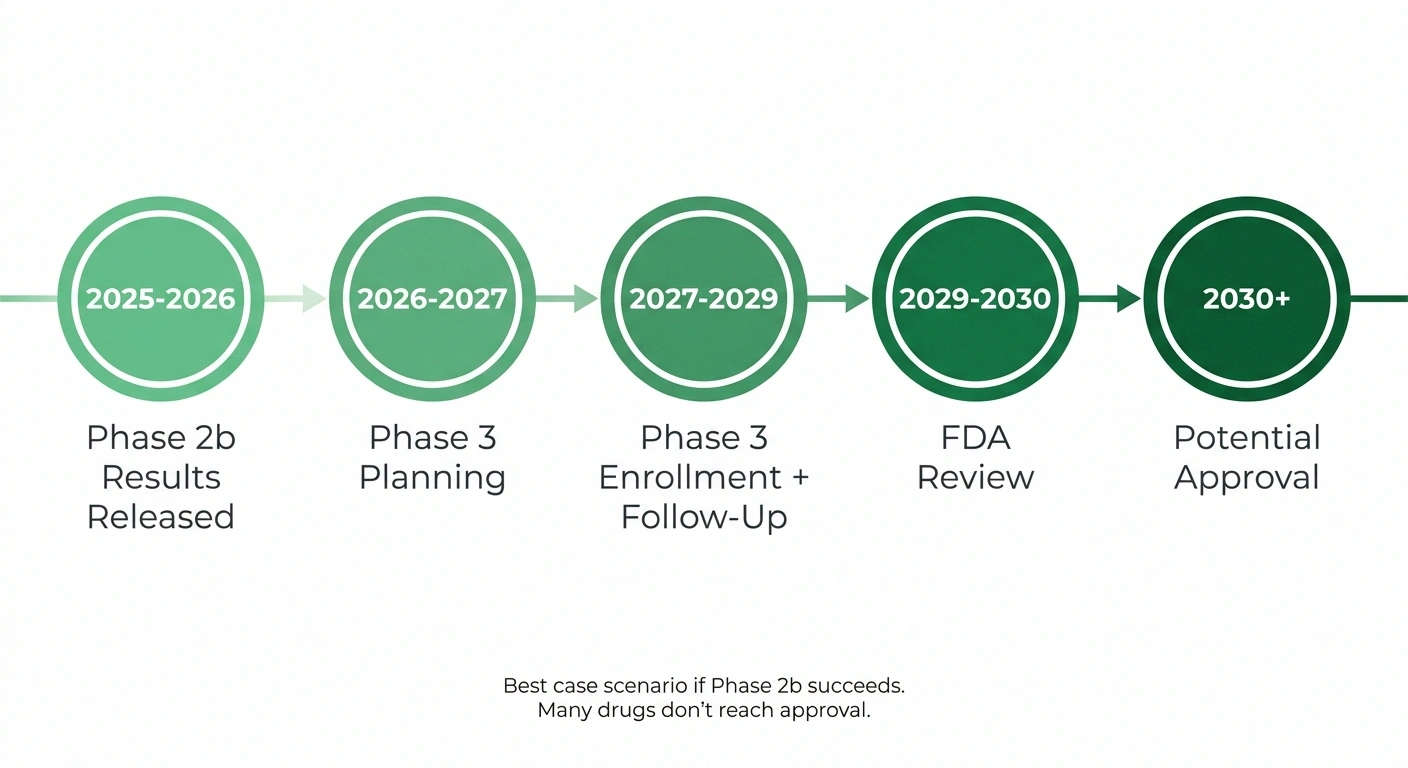
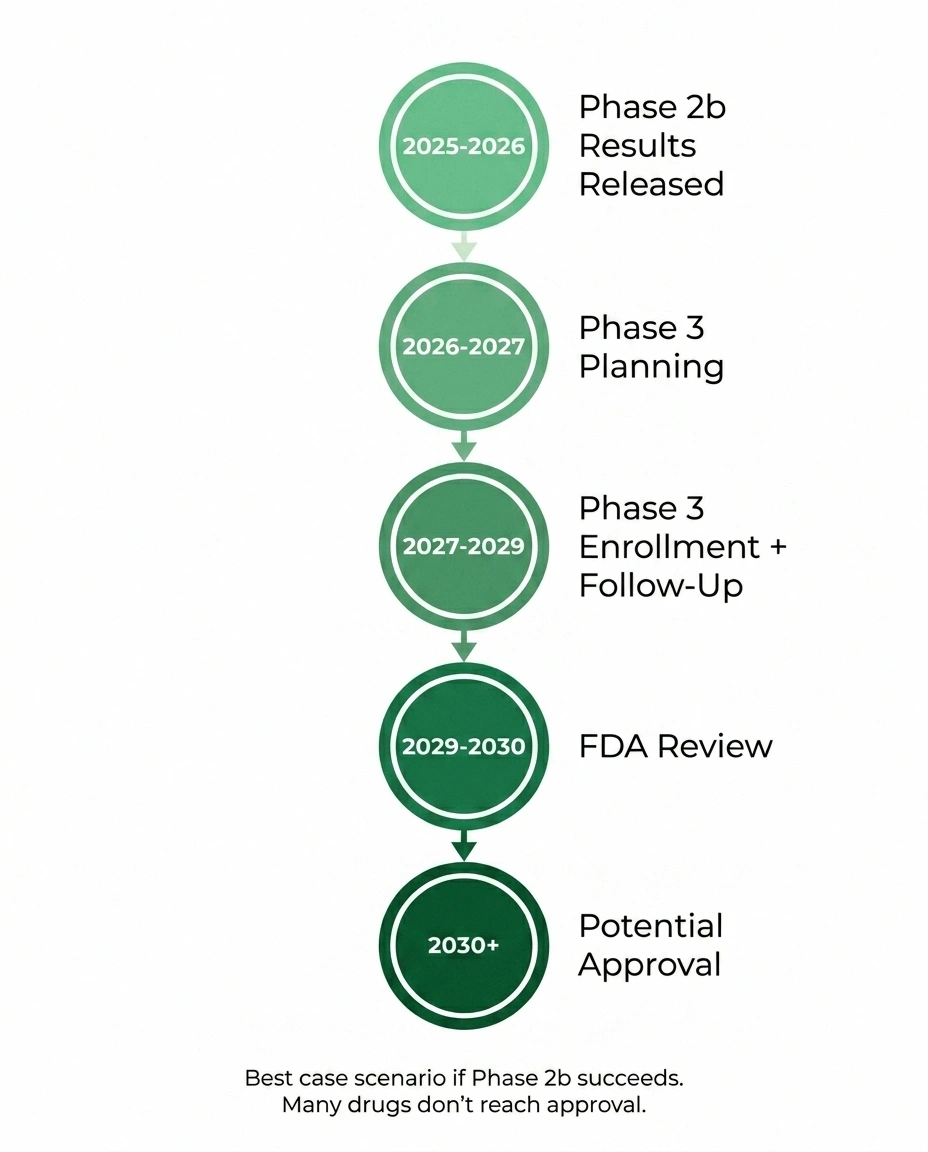
This is the part I want you to sit with, because I know how easy it is to see “new drug in trials” and start counting the months until you can ask for it.
From Phase 2b to Pharmacy: The Realistic Path
Best case: 3–5 years from today. Realistic case: late 2020s to early 2030s if everything goes right.
The best-case, everything-goes-right timeline for nispomeben looks something like this:
- Phase 2b topline results: released late 2025 through 2026 (as of this writing, still pending public confirmation)
- Phase 3 planning and design: 6–12 months after positive Phase 2b
- Phase 3 enrollment and follow-up: 18–36 months
- Data analysis, NDA submission, FDA review: 12–18 months (Fast Track designation may shorten this modestly)
Add it up. Even under the most favorable scenario, we're talking about three to five years minimum before nispomeben could be on pharmacy shelves — and that's if the Phase 2b succeeds, if the company or a partner has funding to run Phase 3, and if nothing surprising emerges in the safety data.
More realistic scenario, factoring in the actual rate at which nerve-pain drugs cross the finish line: many promising Phase 2b candidates never reach the market. If nispomeben makes it, we're likely looking at 2029 to 2031. If it doesn't, the underlying research still helps the next generation of Lyn/P2X4-targeted drugs, but that's cold comfort for someone in pain today.
What This Means for What You Should Do Right Now
If you're living with diabetic neuropathy pain today, here's what nispomeben's existence actually changes for you: not much, in the short term.
✓ What Actually Changes Today
- Your treatment plan: nothing changes. Keep taking what works.
- Your blood sugar goals: nothing changes. Tight control remains the biggest lever.
- Your foot care: nothing changes. Daily checks still matter.
- Your conversation with your neurologist: now includes a legitimate reason to ask “what trials might I qualify for?”
It doesn't change your current treatment plan. It doesn't mean you should stop taking what's working for you. It doesn't mean you should skip the appointment to talk about adjusting your gabapentin. What it does is give you one more reason to stay engaged with your neurologist over the years to come — because the pipeline is more active now than it's been in a generation, and the treatments available in 2028 will likely look different from what's available today.
In the meantime:
- Keep working with your endocrinologist on blood sugar control — this remains the single most powerful lever for slowing neuropathy progression
- Optimize what's already available. Many people are on a less-than-ideal current regimen and could get better relief by working with a pain specialist to combine approaches (medication + topical + non-drug)
- Take care of your feet. Daily foot care prevents complications while you're waiting for better drugs
- If you're interested in participating in future trials, ClinicalTrials.gov is the official registry — search by “diabetic neuropathy” and your state
Should You Talk to Your Doctor About Nispomeben?
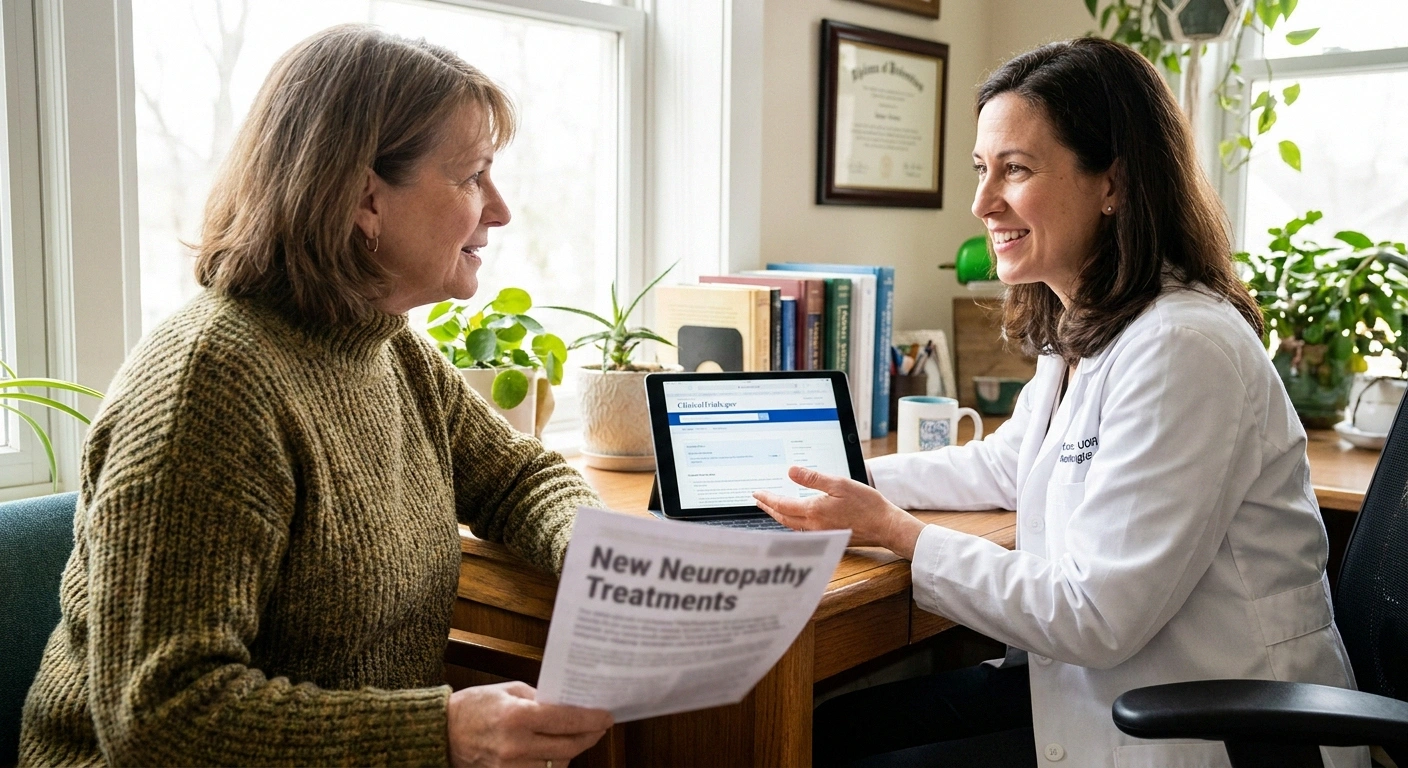
Not to prescribe it — no one can. But absolutely worth mentioning if you're already having a broader conversation about “what else is out there” or “what's coming.”
4 Questions to Ask When Results Are Announced
Your neurologist will be tracking pipeline drugs like this one, and they may know whether any trial sites in your area are recruiting. If your pain is not well controlled on current standard-of-care treatments and you meet the study criteria (usually: type 2 diabetes, painful DPN of at least six months, minimum pain score threshold), trial participation is one legitimate way to get access to an experimental drug years before it might be approved.
Trial participation isn't for everyone. There's paperwork, there are visits, there's a real chance you get placebo, and you have to weigh those trade-offs honestly. But for the right person, it's a meaningful option and often includes very close medical monitoring at no cost.
The Honest Bottom Line
Nispomeben is one of the most scientifically interesting drugs in the diabetic neuropathy pipeline. It targets a mechanism nothing else on the market touches. Early trials showed a clean safety profile and a real (if modest) efficacy signal. It has FDA Fast Track designation. The Phase 2b trial that will make or break its future is complete, with results pending public disclosure as I write this.
None of that means it will work. Most experimental drugs don't. But the underlying research is legitimate, the trial design is rigorous, and the mechanism is different enough that if it does work, it opens a genuinely new door in a field that hasn't seen a new door open in a long time.
My honest advice, patient advocate to patient: keep it on your radar, don't rearrange your life around it, and check back in a year. The people I've talked to who navigate chronic conditions best are the ones who stay informed but don't chase every headline — the ones who optimize what's available today while watching the horizon for what's coming.
If you want to keep tabs on nispomeben directly, the two most reliable sources are ClinicalTrials.gov (search NRD.E1 or nispomeben) and Novaremed's own press releases. Everything else is downstream commentary — sometimes accurate, sometimes not.
And in the meantime, take care of your feet. Sleep the best you can. Move within your comfort zone. Have the honest conversations with your medical team about what's working and what isn't. Those are the levers you have today — and they matter, regardless of what any drug in trials does or doesn't turn out to do.
Frequently Asked Questions
Is nispomeben available now?
No. Nispomeben is investigational, meaning it is being studied in clinical trials but has not been approved by the FDA or any other regulatory agency. It is not available by prescription and cannot be requested from your pharmacy. The only current way to access it is through participation in an active clinical trial.
What is the difference between nispomeben and NRD.E1?
They are the same drug. NRD.E1 (sometimes written NRD135S.E1) is the original research code the drug was given by Novaremed during early development. Nispomeben is the international nonproprietary name it was assigned as it advanced through clinical trials. If it eventually gets FDA approval, it will also be given a brand name at that point.
How is nispomeben different from gabapentin or Lyrica?
Gabapentin and Lyrica (pregabalin) work by binding to calcium channels on nerves and calming down over-active nerve firing. Nispomeben appears to work through an entirely different pathway involving an enzyme called Lyn kinase and a receptor called P2X4 on spinal microglia. This is a completely different mechanism from any currently approved nerve pain drug. If nispomeben works, it would represent a new class of medication for nerve pain, not a variation on existing classes.
Can you take nispomeben with opioids?
This question can't be answered yet in a real-world sense because nispomeben is not approved and cannot be prescribed alongside other medications outside of clinical trials. In the lab, nispomeben does not bind to opioid receptors and works through an unrelated pathway. That means if it were approved, there is no obvious biological reason it could not be combined with opioids. But drug-drug interaction studies still need to be completed as part of the regulatory approval process. Anyone in a current trial follows the specific concomitant medication rules of that study.
How can I join a clinical trial for nispomeben?
The most reliable source is ClinicalTrials.gov, the U.S. National Institutes of Health registry of clinical trials. Search for nispomeben or NRD.E1 to see any trials currently enrolling in your area. The Phase 2b trial completed enrollment in 2025, so any current opportunity would be an extension study, an open-label study, or a future Phase 3 trial (if planned). Your neurologist can also help you identify trial sites and determine whether you meet the eligibility criteria.
Are there side effects reported so far?
In the Phase 2a trial, nispomeben was well tolerated. There were no serious adverse events, no severe side effects, and no dose-related safety problems reported over the three-week treatment period. This is a strong early signal, but the Phase 2b trial gave patients the drug for 12 weeks — four times as long — and its safety profile at that duration has not been publicly announced yet as of this writing. A longer treatment period is when side effects that were not visible in shorter trials sometimes emerge.
When will nispomeben be approved by the FDA?
No one knows. The Phase 2b trial has to succeed first — if it doesn't, the drug may not advance at all. Assuming positive Phase 2b results, a Phase 3 trial would need to be designed, funded, run, and analyzed, followed by FDA review. Under the most favorable scenario, that path takes three to five years from now, meaning a potential approval window in the late 2020s or early 2030s. Fast Track designation can shorten some steps but does not eliminate the requirement for adequate Phase 3 evidence. Many drugs that reach Phase 2b do not ultimately get approved.
Should I stop my current neuropathy medication because of nispomeben?
No — and please don't. Nispomeben is not available and may or may not be available years from now. Whatever medication is helping you today is what should keep helping you today. If your current regimen isn't working well, that's a conversation to have with your neurologist about optimizing what is available now — trying different combinations, adjusting doses, or adding non-drug approaches. Do not stop or change any prescription medication without your prescribing doctor's guidance.
About the Author