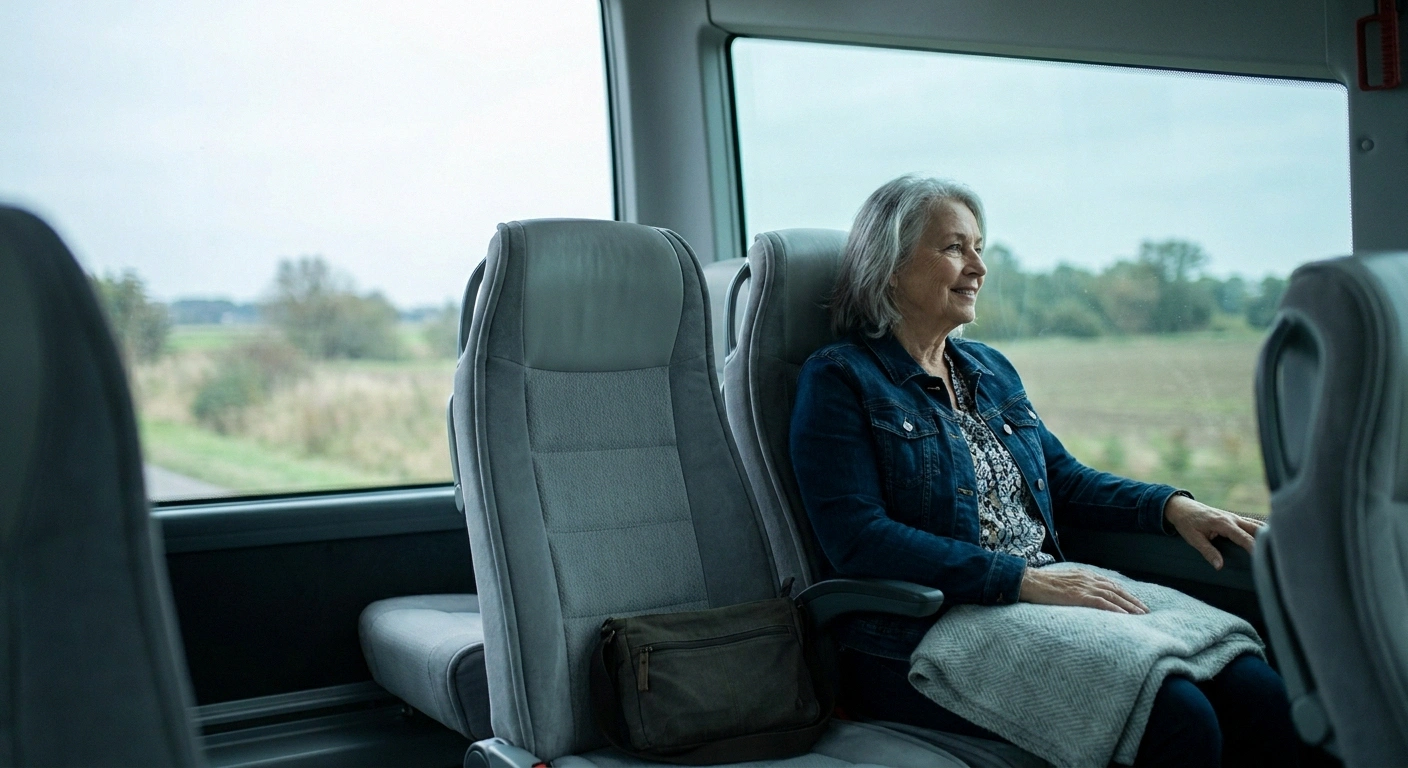
The brochure says “Day 4: scenic drive through the valley, arriving late afternoon.” What it does not say is how many hours that is, how many times the coach stops, or how long each stop lasts.
For most travelers those details are trivia. For anyone whose feet burn after twenty minutes of sitting still, they are the entire trip.
Coach tours are genuinely one of the better travel formats when walking is difficult. Somebody else drives, the luggage gets handled, the hotels are already booked, and you are never navigating a foreign train station with a suitcase. The tradeoff is specific and worth naming plainly: for long stretches, you cannot get up when your body asks you to.
Which means nearly everything that makes a coach tour comfortable has to be decided before you board.
The One Thing You Give Up on a Coach
At home, when your legs start complaining, you stand up. In a car you pull over. On a plane you can usually walk the aisle. That small freedom is doing more work than most people notice, right up until it is gone.
Six questions for the booking call
Tour brochures describe scenery, not logistics. These six answers tell you more about whether a trip will suit you than the itinerary does, and every one of them is easier to change before you pay.
- What is the longest single driving stretch on the whole tour? This one number predicts your comfort better than the total trip length.
- Are seats assigned for the trip, rotated daily, or first come? Determines whether you can request a fixed seat or need to arrive early every morning.
- How many passengers, and what is the coach capacity? A 56-seat coach carrying 40 people is a materially different experience from one carrying 54.
- Which excursions involve the most walking or uneven ground? Ask for specifics in miles or minutes, not adjectives. This is what lets you plan your skips in advance.
- Is there a genuine rest day or a light day built in? If not, you are building one yourself, and it helps to know that going in.
- Can luggage be collected from and delivered to the room? Some tours leave bags in the lobby, which turns into a corridor haul at the end of a long day.
Ask a person, not a website. A booking agent who cannot answer question one is telling you something useful about how the operator handles mobility questions generally.
A moving coach removes it. The aisle is narrow, the vehicle sways, and drivers generally prefer passengers seated while underway for good reason. So the two-hour stretch between stops is a fixed quantity you have to plan around rather than negotiate with.
Everything else in this article follows from that. Since you cannot add movement whenever you want it, the goal becomes getting the maximum benefit from the movement you are given and reducing how much you need in between.
The seated version is not nothing, and it works better than people expect. Every twenty minutes or so, run through a short sequence without leaving your seat: ankle circles in both directions, ten of each foot. Then heel raises with the toes planted, then toe raises with the heels planted, twenty of each. Press both feet flat into the floor and hold for five seconds, release, repeat five times. Roll the shoulders. The calf muscles are what pump blood back up out of your legs, and that pump runs on movement rather than on time passing.
Set a reminder on your phone for the first day or two. After that it becomes automatic and you will do it without thinking.
Choosing Your Seat Like It Matters
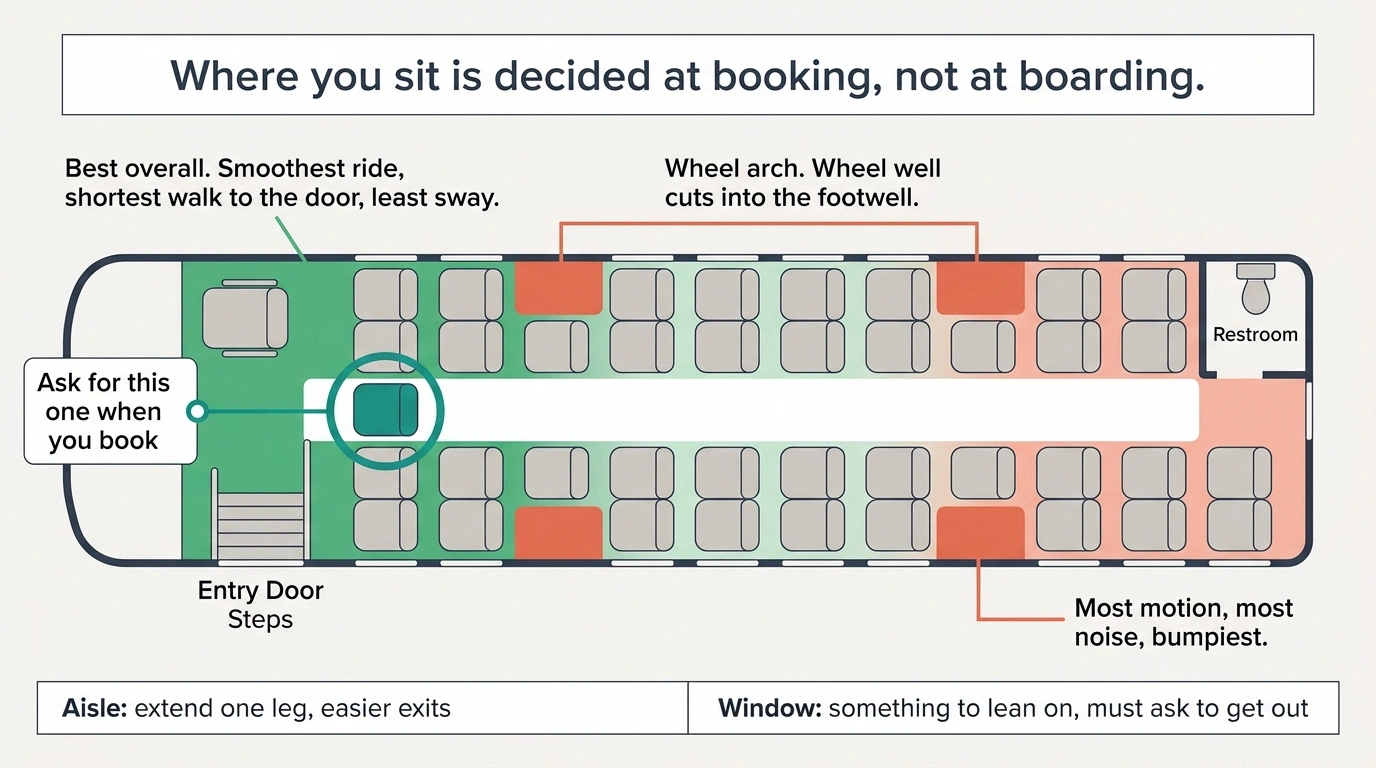
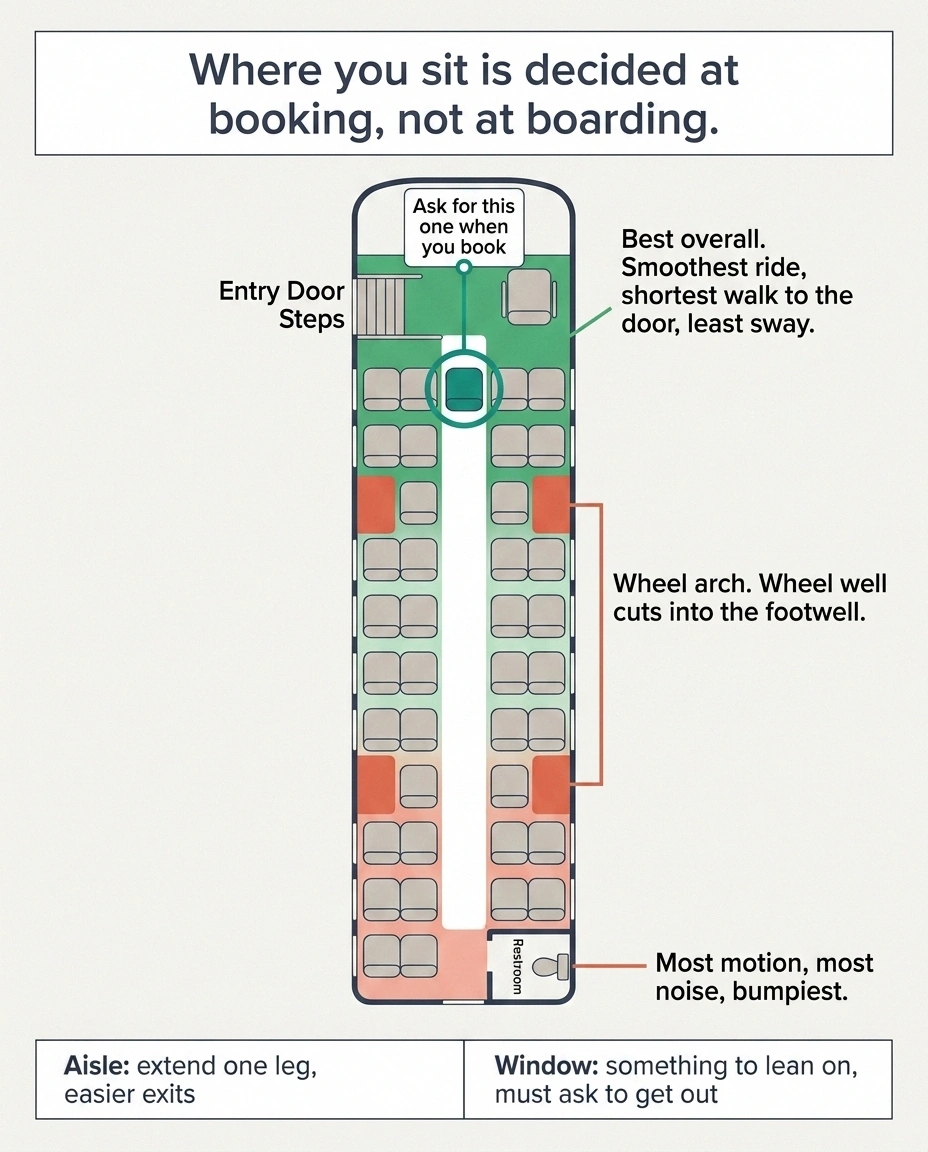
Many tour operators rotate seat assignments daily so everyone gets a turn at the front. Some assign them for the whole trip. Either way, this is a conversation worth having before departure rather than a lottery you accept.
What actually differs from row to row:
- Front rows have the shortest walk to the door, the smoothest ride, and the least sway. They are also the most requested, which is exactly why asking early matters.
- Over the wheel arches, usually a row or two behind the front door and again toward the rear, the wheel well intrudes into the footwell. Less room to stretch out, and sometimes a raised floor.
- The back third gets the most motion, the most engine noise, and the bumpiest ride. It is close to the onboard restroom, which sounds like an advantage and mostly is not, given how the vehicle moves.
- Aisle seats let you extend one leg into the aisle, which is a genuine relief valve, and make it easier to get out at stops. You also get bumped by people passing.
- Window seats give you a wall to lean against and somewhere to prop a pillow, but you have to ask your neighbor to move every time you want out.
For most people with neuropathy, an aisle seat in the front third is the best combination available. Ask for it when you book, not when you board.
One thing to bring regardless of where you sit: something to raise your feet slightly. A small inflatable footrest, a firm tote bag, or a rolled jacket under the heels changes the angle at the back of your knees and helps with the swelling that builds over a long driving day. Slight elevation is enough. You are not trying to recline.
The Two-Hour Clock and How to Spend It
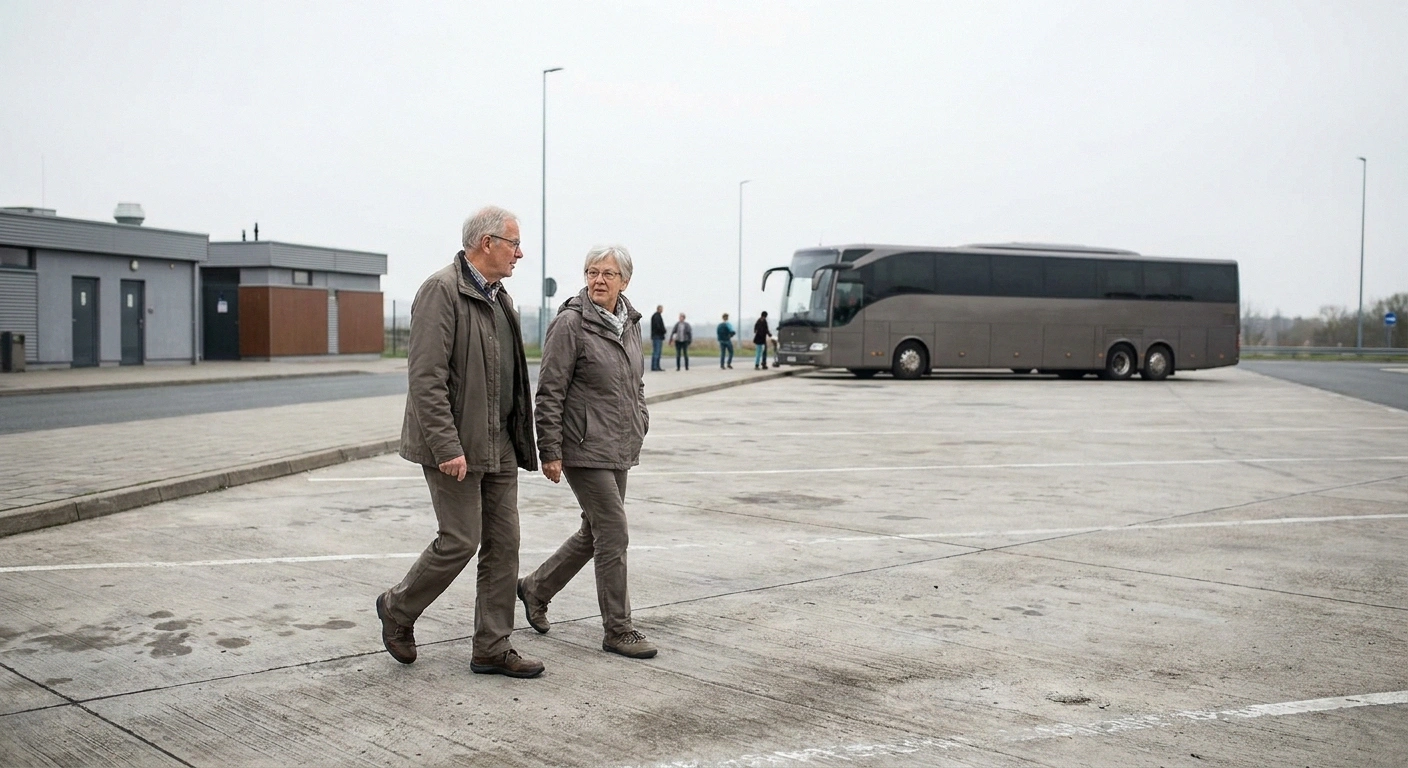
Coaches typically stop every two to two and a half hours, and stops run somewhere between fifteen and thirty minutes. That window is the most valuable resource of your travel day, and most people waste it by treating it as a break rather than as a task list.
A 25-minute stop, allocated on purpose
Most people spend the first ten minutes queueing and the last five hurrying. Reversing that order is free and changes how the next two hours feel.
- Restroom first, before the queue exists
- Twenty people are heading for two facilities. Ninety seconds of decisiveness saves eight minutes of standing.
- Walk the perimeter, do not stand by the door
- This is the segment that does the actual work, and it is the one that gets sacrificed when the order slips.
- Reboard three minutes early, every time
- No queue on the steps, no pressure from behind, and time to arrange your footrest before the coach moves.
A sequence that works:
Restroom first, immediately. Go before the line forms. Twenty people are heading for the same two facilities and the queue can consume your entire stop.
Then walk, deliberately. Five to seven minutes of actual walking, not standing around near the door. Circle the parking area, walk the length of the building and back. This is where the real benefit sits, and it is the part people skip because it feels less urgent than coffee. Steady walking is one of the better things you can do for circulation and for symptoms generally, which is worth remembering when you are deciding whether it is worth the effort. There is more on why in the overview of walking with neuropathy.
Then whatever else you need. Coffee, snacks, a look at the gift shop, a phone call home.
Then back on board early. Two or three minutes before the stated time. You get to settle without a queue behind you, arrange your things, and start the next stretch calm rather than rushed.
One more thing about the two-hour clock: it interacts badly with diuretics. If you take a water pill, the timing is worth thinking through before the trip rather than discovering the mismatch somewhere in the countryside. That is a reasonable question to raise with whoever prescribes it.
Those Three Steps at the Door
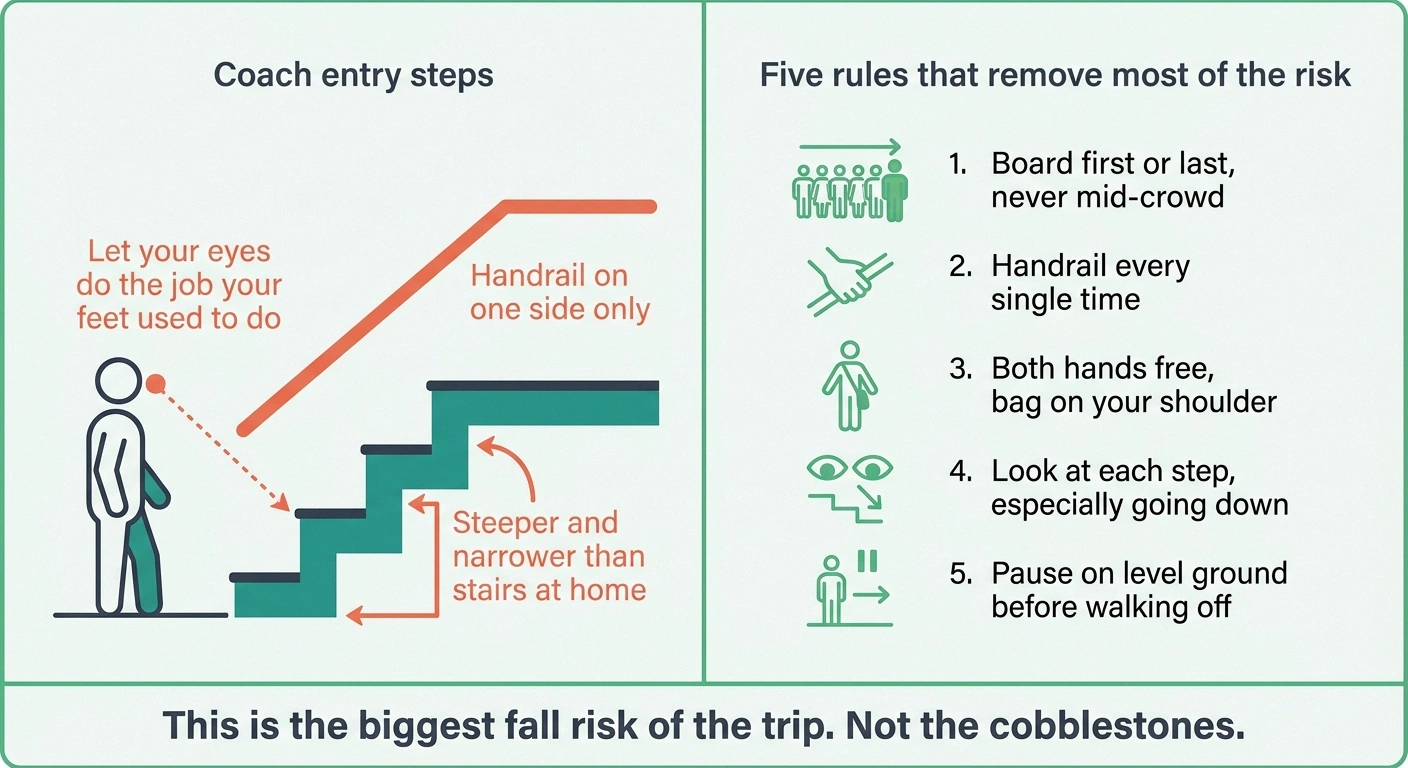
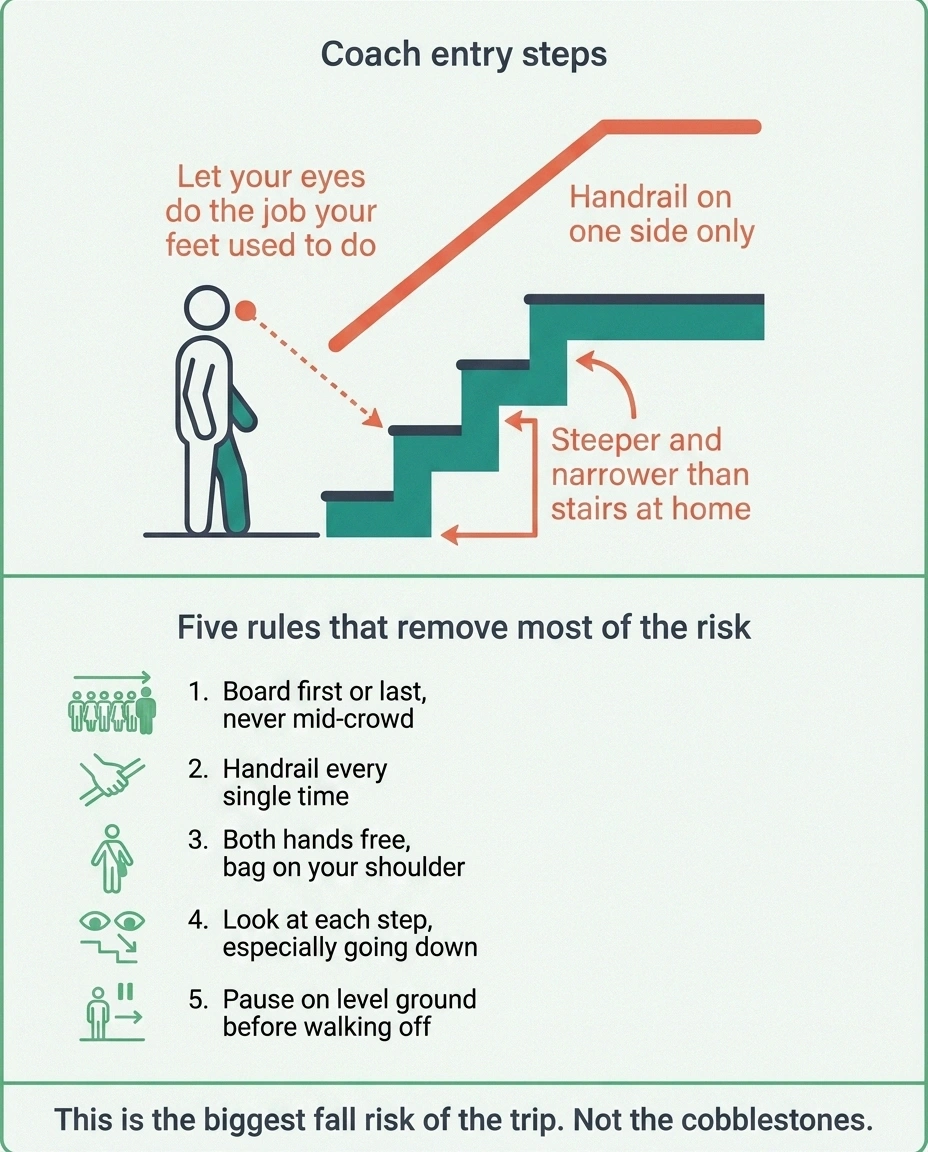
Coach entry steps are steeper and narrower than almost any stairs you use at home, and there is usually a handrail on one side only. You will climb them and descend them several times a day, often with people waiting behind you.
That combination is the fall risk of the whole trip, more than any cobblestone street or hotel bathroom. Numb feet that cannot confirm the edge of a step, a steep riser, and social pressure to hurry.
What removes most of it:
- Board first or board last. Never in the middle of the crowd. Most tour directors will happily arrange this once they know, and boarding order is the single easiest accommodation to get.
- Use the handrail every time. Every time, including the times you feel steady, because feeling steady is not information you can fully trust with reduced sensation.
- Keep both hands free. A bag in one hand and a coffee in the other means no hand on the rail. Anything you carry should be over your shoulder or on your back.
- Look at each step. Descending especially. Let your eyes do the job your feet used to do.
- Pause at the bottom. A second or two on level ground before walking off, particularly if you have been sitting for two hours and your feet feel unreliable.
Footwear does a lot of quiet work here. Something with a firm sole, real grip, and a secure fastening that stays on without your toes gripping to hold it. Slip-ons and backless shoes make steps considerably harder than they need to be. If you are choosing a pair for the trip, the guide to shoes that work with neuropathy covers what to look for, and a tour is not the moment to break in something new.
Balance and steps deserve more attention than they usually get on a trip like this. If falls are already a concern for you, the practical strategies in the guide to balance and fall prevention translate directly to coach travel.
Pack Small, Pack Low
Overhead bins on a coach sit high, and the lids are heavier than airline bins. Reaching up, taking weight overhead, and lowering something down is a demanding sequence for hands that have lost grip strength or sensation, and the consequence of dropping something is not just embarrassment.
Five minutes the night before beats twenty in the morning
Do these tonight
- Refill the day bag and set it by the door
- Load tomorrow's doses plus one spare
- Fill the water bottle and leave it out
- Set out clothes, including long trousers
- Check both feet under a good light
- Charge the phone and any devices
Leave for the morning
- Nothing that requires a decision
- Nothing that requires finding something
- Nothing that requires bending down
A 7am departure means a 6am start, in an unfamiliar room, probably before coffee. Every decision moved to the previous evening is one you make while rested rather than rushed.
The fix is to make the bin irrelevant.
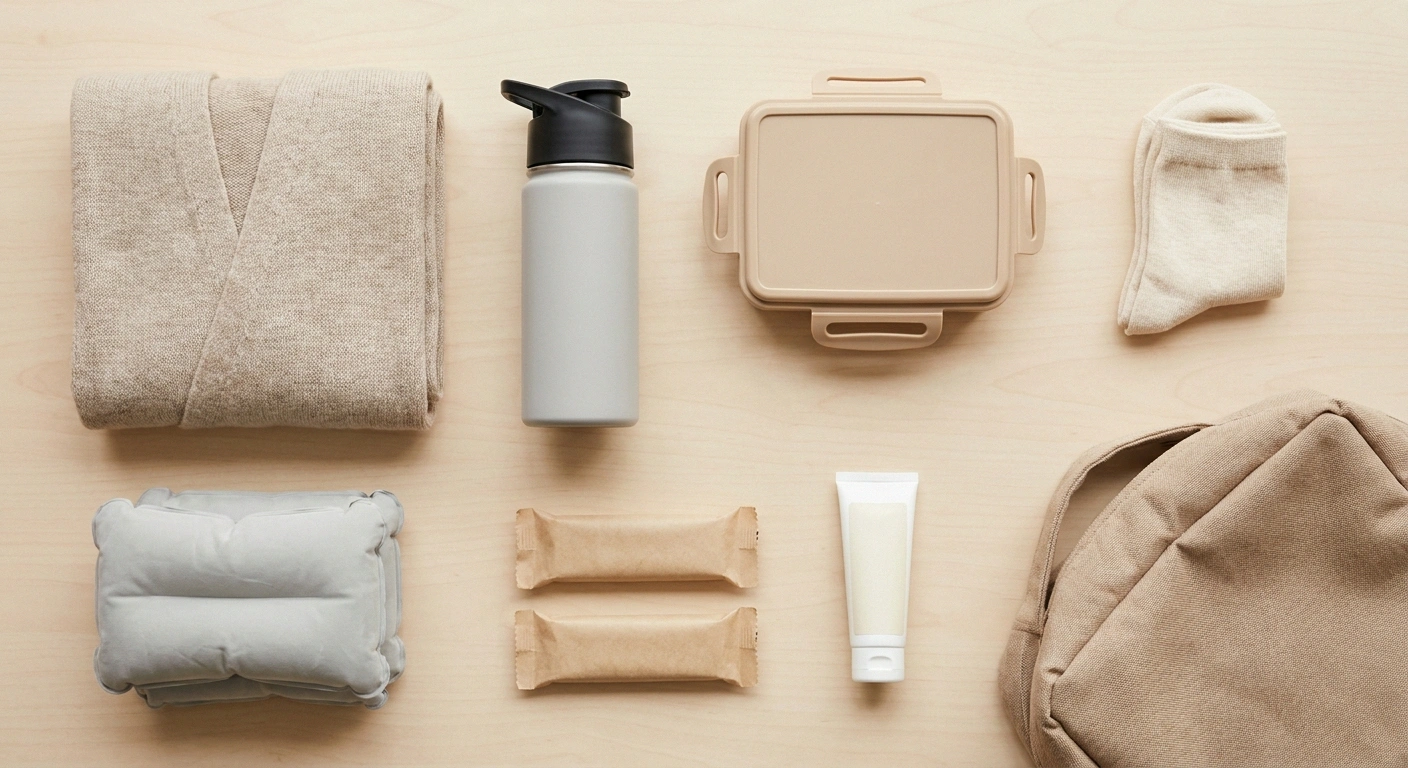
Carry one small bag that fits under the seat in front of you, holding everything you might want during the driving day. Anything you would not want to ask for help retrieving does not go overhead.
What earns a place in the under-seat bag:
- All medication for the day, plus a spare dose, in something you can open without fine finger control
- A light layer or wrap, because coach air conditioning is aggressive
- Water, and enough of it
- The footrest or a rolled item to elevate your feet
- A spare pair of socks
- Any topical cream you use for symptom relief
- Snacks, so a delayed lunch stop does not become a blood sugar problem
If gripping and manipulating small objects is difficult, packing choices matter more than usual. Pill organizers with large tabs, bags with big zipper pulls, and a water bottle that opens with one hand all reduce the number of small frustrating moments in a day, and the strategies in the guide to managing neuropathy in the hands apply directly to travel packing.
Cold Air, Long Days, and Pill Timing
Three practical realities that catch people out on multi-day tours.
The air conditioning is colder than you expect. Vents blow down from directly overhead and cannot usually be redirected far. Cold worsens nerve pain for a great many people, and you cannot leave. A light blanket or wrap is not an optional comfort item on a coach, and long trousers beat shorts on driving days regardless of the weather outside.
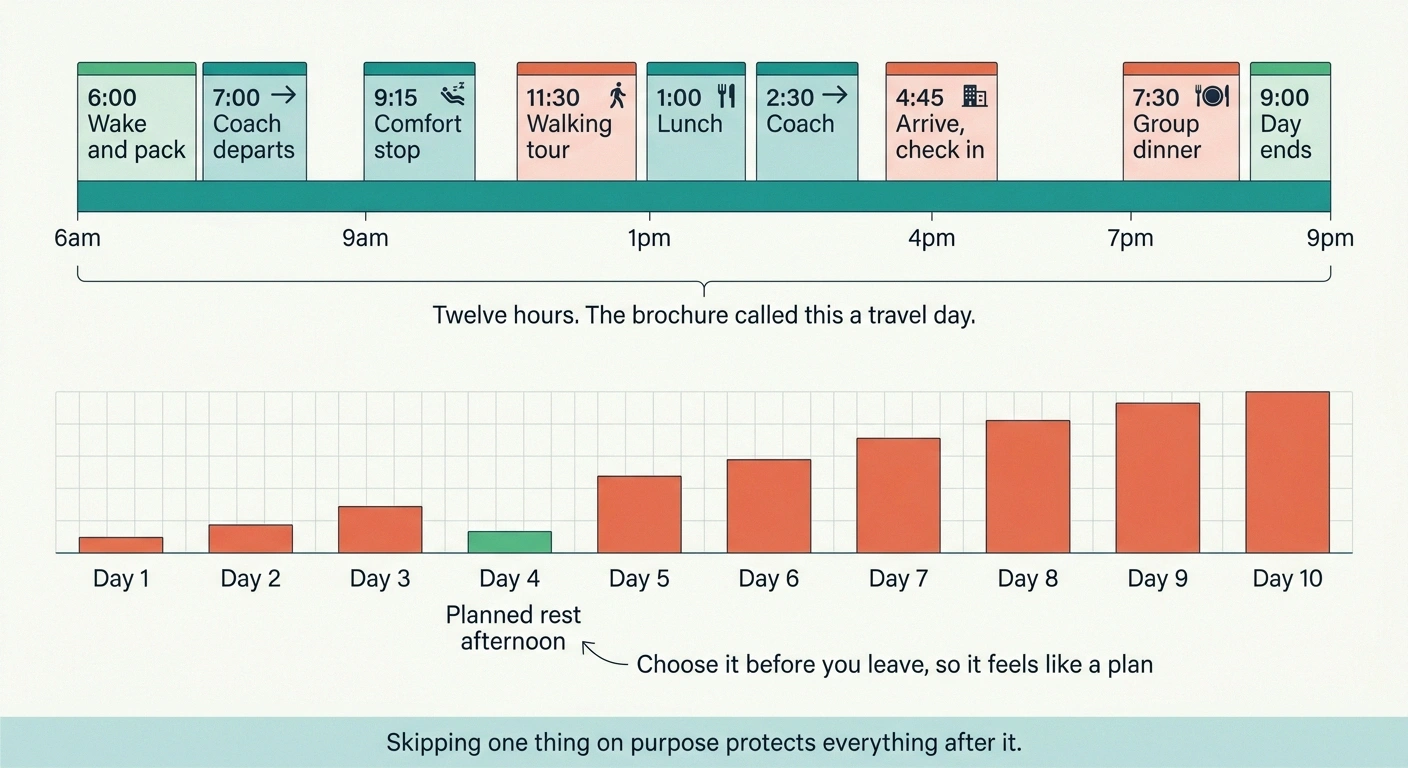
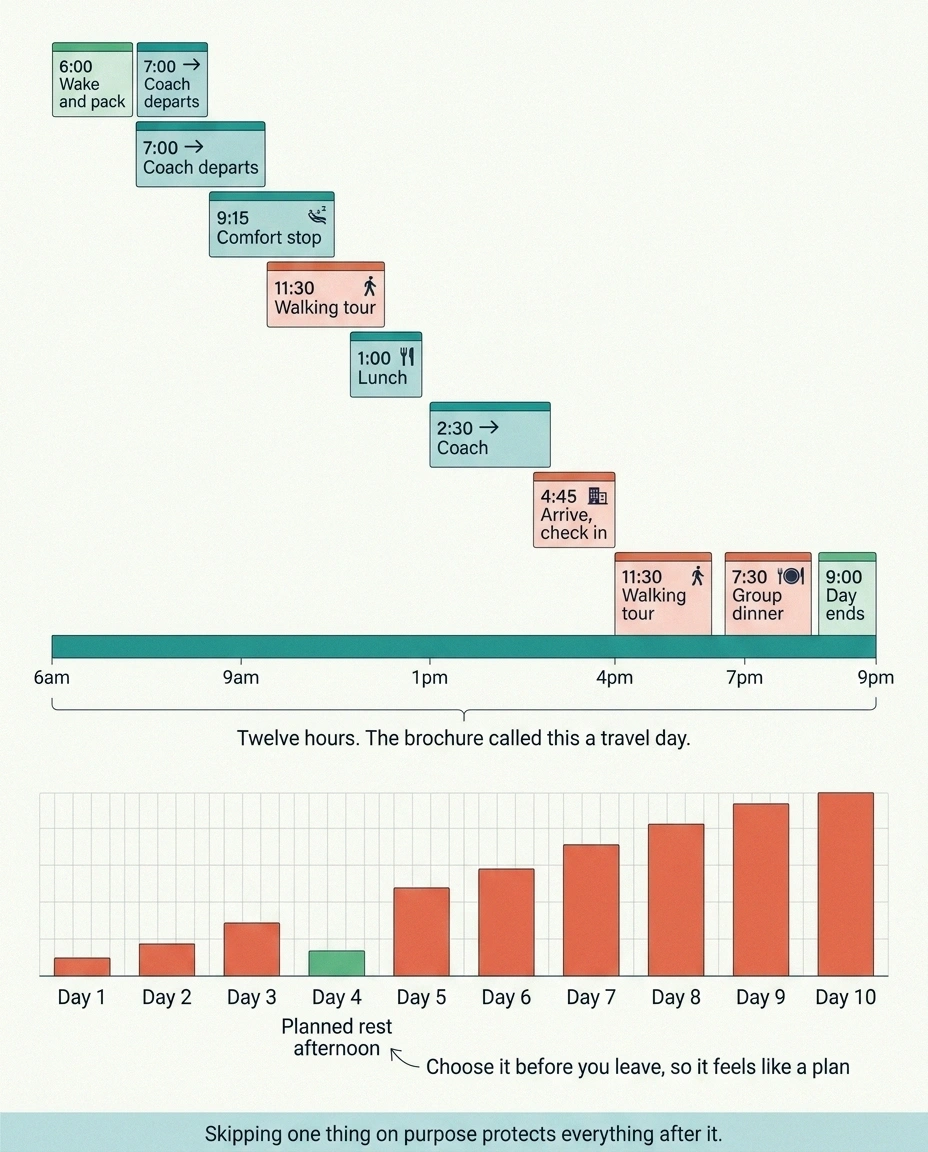
The days are longer than the itinerary suggests. A tour day that starts with a 7am departure and ends with a 7:30pm dinner is a twelve-hour day, and there may be ten of them in a row with no rest day. Fatigue accumulates, and symptoms accumulate with it.
The strongest move available is deciding in advance to skip something. Not because you failed at the trip, but because a scheduled quiet afternoon on day four is what keeps days five through ten enjoyable. Choose it before you leave, so it feels like a plan rather than a defeat in the moment. Nearly everyone who has done a long tour with a chronic condition arrives at this conclusion; the ones who arrive at it in advance have a better time.
Medication timing drifts. Early departures, late dinners and time zone changes all push doses around. Set alarms rather than relying on mealtimes as your cue, since mealtimes are exactly what a tour schedule scrambles.
Compression socks are worth considering for the long driving days specifically, since sitting still for hours is precisely the situation where they help most with swelling. Whether they suit you depends on your circulation and other conditions, which the overview of compression socks and gloves goes into. Worth settling before you travel rather than buying a pair at a rest stop.
Tell the Tour Director on Day One
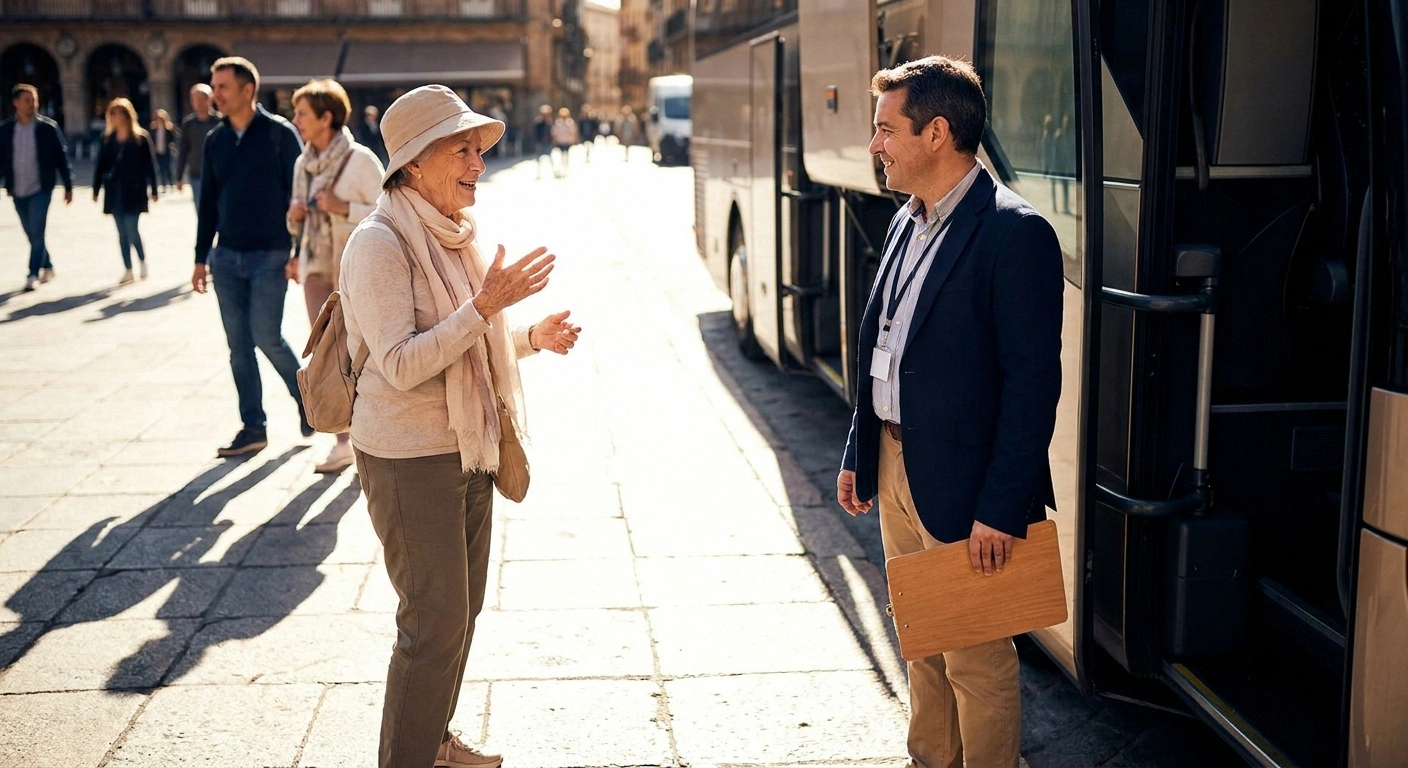
One short conversation at the start changes the entire trip, and most people put it off out of a reluctance to be a bother.
Do not wait until you get home
The instinct on a trip is to not make a fuss and to deal with it later. These four are worth interrupting a tour for, and every one of them gets substantially harder the longer it waits.
- Any open area, blister or sore on your foot. Not tomorrow, not at home. A wound on a foot that cannot feel it, spending twelve hours a day in a warm shoe, is the situation this whole condition warns about.
- Swelling in one leg only, particularly with pain, warmth or redness in the calf. Long seated travel is exactly the setting where a clot occurs, and one-sided is the distinguishing detail.
- Chest pain or sudden breathlessness, at any point, with or without leg symptoms.
- Running out of a medication. Start solving it the day you notice, not the day you take the last one, because a foreign pharmacy and a missing prescription take time to resolve.
Before you leave, put a photograph of your medication list and your insurance card on your phone. Tour directors deal with medical situations regularly and can usually reach a local clinic faster than you can. That is what they are there for.
Tour directors manage groups with mobility needs constantly. It is routine work for them, not an imposition, and they cannot accommodate what they do not know about. A quiet word during the first stop is enough:
“I have nerve damage in my feet. Steps are the hard part, so I would like to board first or last rather than in the middle, and I may sit out some of the walking excursions. Nothing to worry about, I just wanted you to know.”
What you get back is more than most people expect: a consistent seat near the front, boarding order in your favor, a heads-up when an excursion involves significant walking or uneven ground, a word to the driver about waiting rather than rushing, and sometimes a better position on the walking tours themselves.
Say it on day one. A director who learns on day six that you have been struggling has lost five days of chances to help.
One habit for the evenings, easy to skip and worth protecting: check your feet before bed, every night. Look at the soles with a mirror, check between the toes, and pay attention to anything red or rubbed. New shoes, unfamiliar surfaces, longer days on your feet and reduced sensation add up to blisters that go unnoticed, and a blister found on day three is a minor annoyance while one found on day nine is a problem you are managing rather than a trip you are enjoying. The full routine is in the guide to daily foot care, and it takes about a minute.
Frequently Asked Questions
How often do bus tours actually stop?
Most coach tours stop roughly every two to two and a half hours on driving days, with stops lasting fifteen to thirty minutes. Sightseeing days involve much more frequent stops, while transfer days between cities can involve longer stretches. This varies by operator, so ask specifically before booking rather than assuming, and ask about the longest single driving stretch on the itinerary. That number tells you more about your comfort than the total trip length does.
Can I get up and walk around while the coach is moving?
Generally you can walk to the onboard restroom, but extended aisle walking while underway is usually discouraged and sometimes prohibited for safety, since the vehicle sways and a fall in a moving coach is serious. With reduced sensation and balance this restriction is protective rather than restrictive. Plan on seated exercises during driving stretches and use every scheduled stop deliberately for real walking.
Which seat is best on a tour bus if I have neuropathy?
An aisle seat in the front third of the coach suits most people. The front has the smoothest ride and the shortest walk to the door, and an aisle seat lets you extend one leg and get out easily at stops. Avoid the rows directly over the wheel arches, where the wheel well reduces footwell space, and avoid the rear third, which has the most motion. Request this when you book, since many operators either assign seats in advance or rotate them daily.
Should I bring a cane or walking stick even if I do not usually use one?
Many people find it useful on a tour even when they manage fine at home, because touring involves far more standing, uneven surfaces, and unfamiliar ground than an ordinary week. A folding cane stores easily under your seat and is available for cobblestones, gravel paths, and long museum visits without committing you to using it constantly. Trekking poles serve a similar purpose for anyone who dislikes the look of a cane.
What if I cannot manage a walking excursion?
Skipping excursions is completely normal and tour directors expect it. You can usually stay on the coach, wait in a cafe near the drop-off point, or arrange to meet the group at a later stop. Ask on day one which excursions involve the most walking or the most uneven ground, then plan your skips in advance rather than deciding in the moment. Choosing your rest days deliberately preserves far more of the trip than pushing through everything and paying for it later.
Is the onboard restroom usable?
It exists and it works, but it is small and the coach is moving, which makes balance a genuine consideration with reduced sensation in your feet. It is best treated as an option for real need rather than routine use. Plan around the scheduled stops where possible. If you are seated far from it, that is one more argument for a seat in the front third.
How do I handle swelling in my feet and ankles on long driving days?
Three things help most in combination. Elevate your feet slightly using a footrest or bag under your heels, which changes the angle behind your knees. Do the seated ankle and calf exercises every twenty minutes or so, since the calf muscles are what pump fluid back up. And walk properly at every stop rather than just standing near the coach. Compression socks are worth discussing beforehand for the driving days specifically. Some swelling by evening is normal on a travel day; swelling in only one leg, or swelling with pain, warmth or redness, is not, and should be looked at rather than waited out.
About the Author