Somewhere in your inbox, or maybe just in the back of your mind, there's a question you haven't said out loud yet: what if the tingling in my fingers doesn't go away? If you're starting paclitaxel or docetaxel, or if you're a few cycles in and your feet have started to feel like they belong to someone else, you are not imagining it and you are not alone. I hear from readers in this exact spot every week, usually somewhere between their second and fourth infusion, right around when the numbness stops being a curiosity and starts being a worry.
I'm Janet. I'm not a doctor, and nothing here replaces a conversation with your oncology team. What I can offer is what I've learned from years of talking with people living through chemotherapy-induced peripheral neuropathy (CIPN), combined with the research I've dug through so you don't have to do it from a hospital waiting room chair. This article walks through what taxane drugs actually do to your nerves, what the symptoms typically feel like and when they show up, what's genuinely being studied to prevent or ease this, what hasn't panned out (including one supplement that made things worse in a real clinical trial), and what to do with all of it once you have it.
One thing up front, because it matters more than anything else in this article: report symptoms to your oncology team early. Dose adjustments preserve nerve function better than any supplement can restore it once it's gone. And please, do not stop paclitaxel or docetaxel on your own — that decision belongs to you and your oncologist together, weighing your cancer treatment against your nerves.
What Are Taxane Chemotherapy Drugs, and Who Gets Them
Taxanes are a family of chemotherapy drugs derived originally from the Pacific yew tree, and they've become some of the most widely used cancer treatments in the world. If you've been prescribed one, you've probably heard it by its brand name rather than its chemical one:
- Paclitaxel (Taxol) — one of the oldest and most common taxanes, used for breast, ovarian, and lung cancers, often given on a weekly schedule
- Docetaxel (Taxotere) — used for breast, lung, prostate, and head and neck cancers, typically given every three weeks
- Nab-paclitaxel (Abraxane) — a protein-bound version of paclitaxel designed to reduce allergic reactions, used for breast, lung, and pancreatic cancers
- Cabazitaxel (Jevtana) — typically reserved for prostate cancer that has stopped responding to other taxanes
All four drugs work the same basic way inside a cancer cell, which is also, unfortunately, how they end up causing trouble in your nerves.
How Taxanes Damage Nerves: The Microtubule Mechanism
You don't need a biology degree to understand this, and honestly, understanding it helped me make sense of why the numbness so many people describe behaves the way it does.
Taxanes bind the microtubule “cables” nerve cells use to transport proteins to nerve endings. The longest nerves — the ones running to your feet and hands — depend most on that supply line, which is why taxane neuropathy predictably starts there and hits the smallest nerve fibers first.
Every cell in your body, including your nerve cells, relies on tiny internal structures called microtubules. Think of them as cables running the length of the cell. In your longest nerve fibers — the ones that run from your spinal cord all the way down to your toes — those cables carry proteins and nutrients an enormous distance, from the cell body down to the very end of the nerve. That transport system is called axonal transport, and it depends entirely on the microtubule cables staying flexible and functional.
Taxanes work by binding to microtubules and locking them in place. That's exactly what you want inside a cancer cell, because it stops the cell from dividing and kills it. But your nerve cells have microtubules too, and when a taxane binds to them, the cables jam. Proteins and cellular machinery that need to travel down the length of the nerve get stuck. The nerve endings, farthest from the cell body and most dependent on that supply line, are the first to suffer.
This is why taxane neuropathy predictably starts in the feet and hands, the longest nerves in the body, and why it tends to hit the smallest, most delicate nerve fibers first before it ever touches the larger fibers that control strength and reflexes.
What Taxane Neuropathy Actually Feels Like

If you've talked with anyone else going through chemo, you may have heard descriptions of neuropathy that don't quite match what you're feeling. That's because different chemo drugs damage nerves in different patterns, and taxane neuropathy has its own particular signature.
Report symptoms to your oncology team early — dose adjustments preserve function better than any supplement can restore it. And do not stop paclitaxel or docetaxel without your oncologist's guidance. That decision belongs to you and your care team together, weighing cancer control against nerve preservation.
Most people describe it starting as tingling or a pins-and-needles sensation in the toes and fingertips, the classic “stocking-glove” distribution, meaning it follows the shape of where a sock or glove would sit on the body. Over time, for many people, that tingling progresses into burning, and for some it becomes sharp, stabbing pain. Because taxanes damage small nerve fibers before larger ones, an early symptom many people don't expect is a loss of proprioception, your sense of where your feet are in space without looking at them. That can show up as balance problems, a wider stance while walking, or catching your foot on things you'd normally step over without a second thought.
Some people also develop allodynia, where things that shouldn't hurt, bedsheets against the feet, a light touch on the fingertips, become painful. It's disorienting the first time it happens, and it's a real, physical phenomenon, not something imagined.
One thing worth knowing if you've researched other chemo drugs: taxane neuropathy generally feels different from oxaliplatin neuropathy, which is common in colorectal cancer treatment. Oxaliplatin causes a distinctive acute, cold-triggered reaction, throat tightness or hand cramping when touching something cold, right after infusion. Taxanes generally don't work that way. Instead, taxane neuropathy tends to build gradually across the course of treatment rather than flaring with cold exposure.
The Acute Pain Syndrome Nobody Warns You About
Here's something that catches a lot of people off guard, and I wish more oncology teams walked patients through it before the first infusion. One to three days after a paclitaxel infusion, many patients develop a wave of deep, aching pain in the legs, lower back, hips, or joints. Doctors call it paclitaxel-associated acute pain syndrome, or P-APS. It can feel like the worst flu-body-ache you've ever had, and it typically fades within a few days.
P-APS isn't the same thing as the nerve tingling and burning of CIPN, and it usually resolves on its own or with over-the-counter pain relief your oncology team approves. But it's not entirely separate from your longer-term nerve health either. Some research suggests that patients who experience more severe P-APS episodes may have a higher likelihood of developing chronic CIPN later in treatment. That's part of why it's worth reporting the severity of this pain to your team rather than just quietly toughing it out.
Timeline: Onset, Coasting, and Recovery
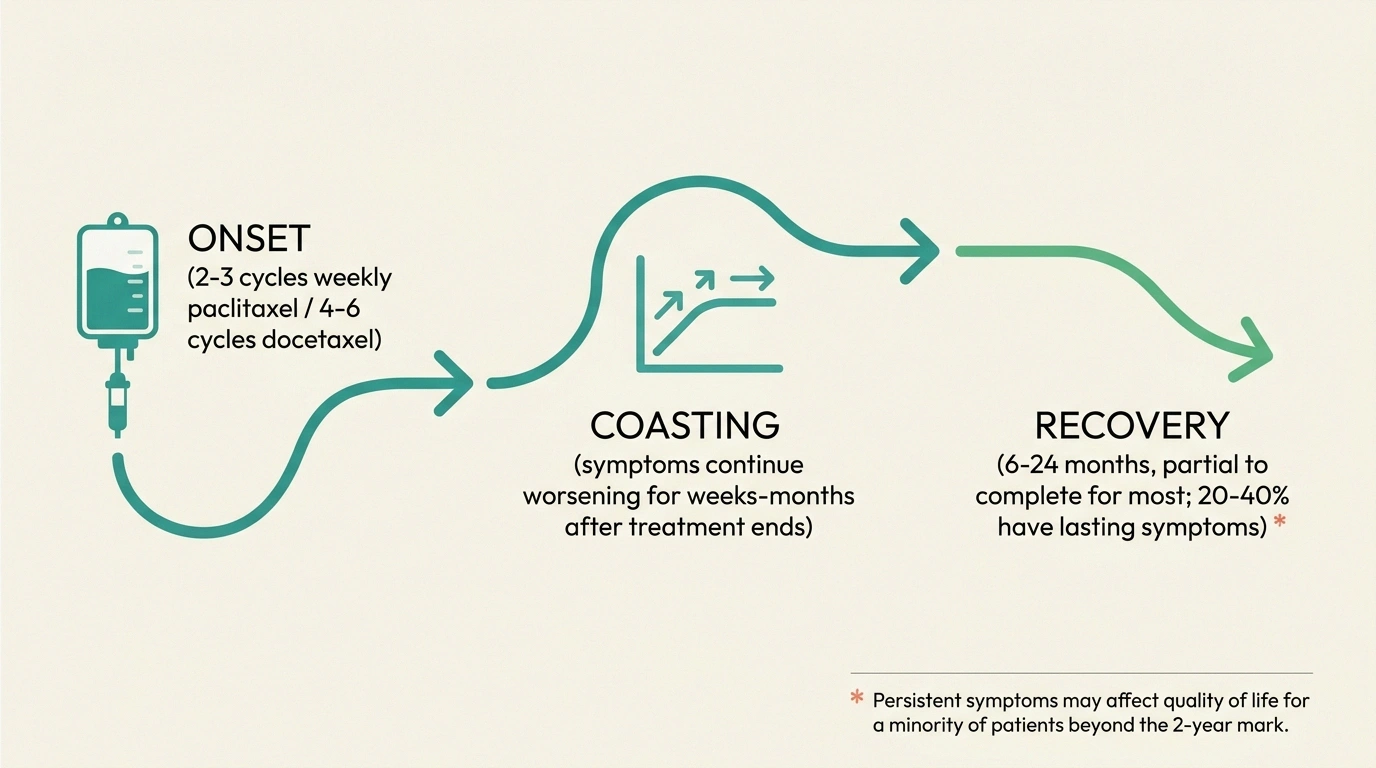
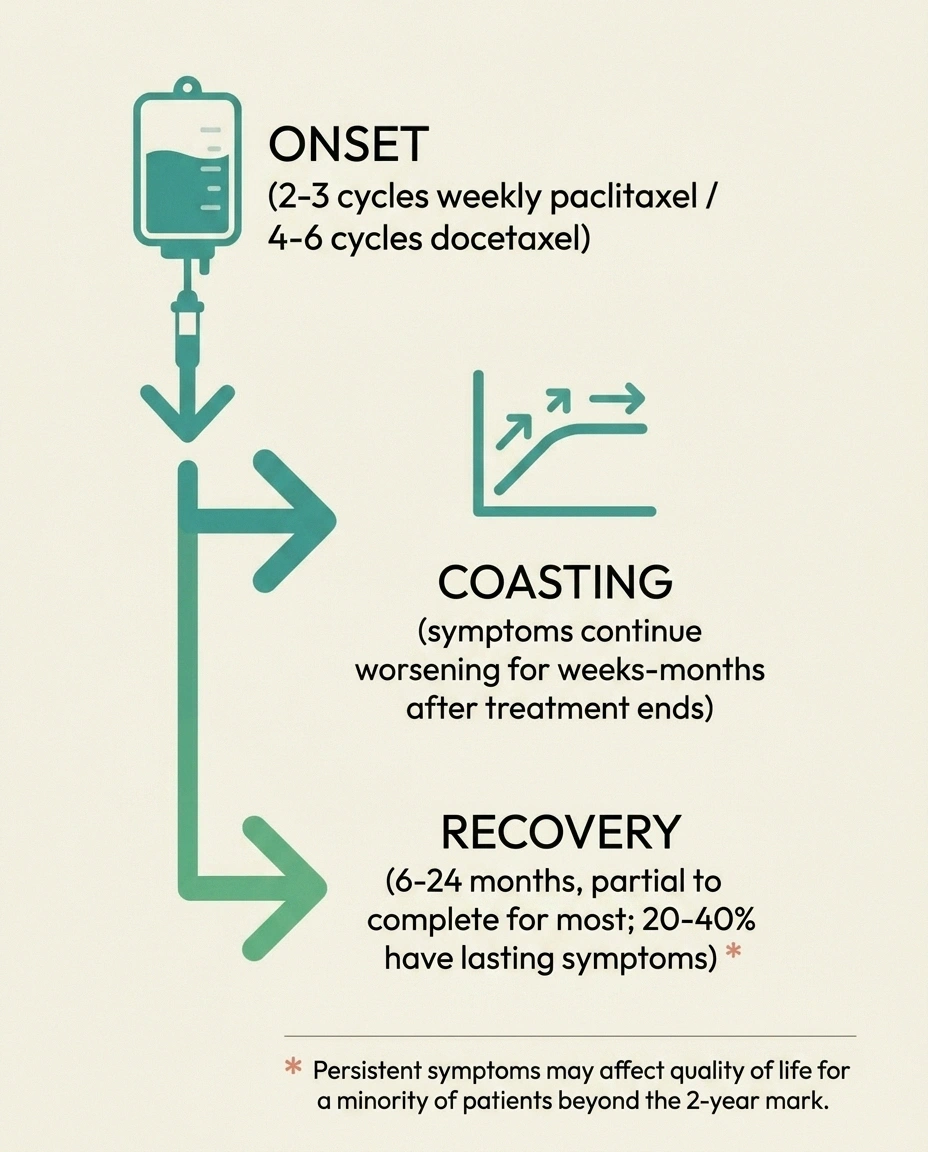
One of the most common questions I hear is some version of “when does this start, and does it ever end?” Here's the honest timeline, drawn from what the research shows across large groups of patients. Your own experience may land earlier or later than these averages.
For people on weekly paclitaxel, symptoms often begin appearing after about 2 to 3 cycles. For docetaxel, typically given every three weeks, onset tends to show up a bit later, often after 4 to 6 cycles, though this varies by dose and individual sensitivity.
Here's the part that surprises people most: neuropathy from taxanes frequently keeps getting worse for weeks to months after chemotherapy ends. Oncology teams call this “coasting,” and it happens because the nerve damage that occurred during treatment continues to play out even once the drug is out of your system. If your symptoms are worse a month after your last infusion than they were during treatment, that's a recognized pattern, not a sign that something new and separate is happening.
Recovery, when it happens, is usually slow. Most people see partial to complete improvement over 6 to 24 months after finishing treatment. But I want to be honest with you rather than falsely reassuring: research consistently finds that somewhere around 20 to 40 percent of patients treated with taxanes have some degree of persistent neuropathy symptoms that don't fully resolve, even years out. Where you land on that spectrum depends heavily on your cumulative dose, your individual nerve sensitivity, and how early symptoms were caught and managed.
Dose Thresholds and Regimens: Why Your Protocol Matters
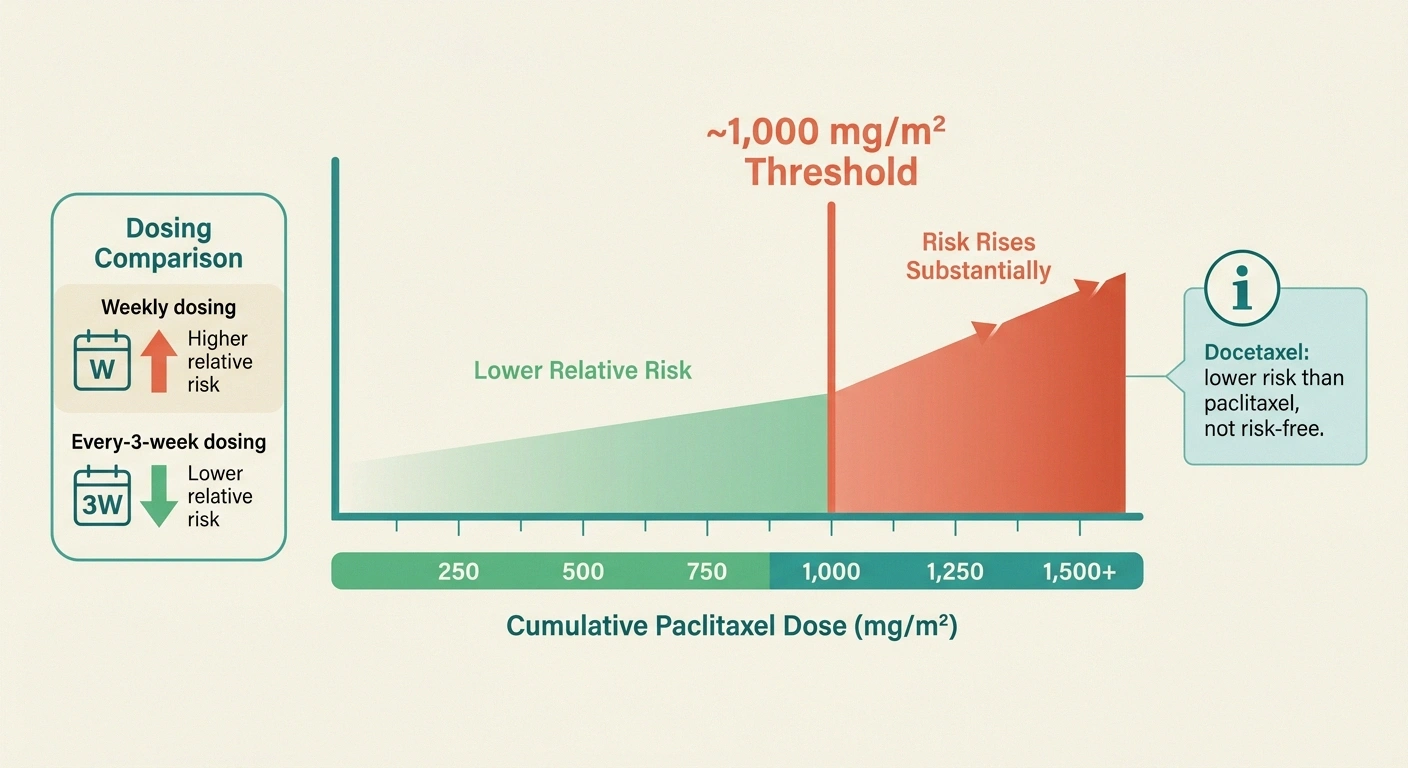
Not every taxane regimen carries the same neuropathy risk, and understanding why can help you have a more informed conversation with your oncologist.
| Factor | Paclitaxel (Taxol) | Docetaxel (Taxotere) |
|---|---|---|
| Overall neurotoxicity | Higher | Lower, but not risk-free |
| Key risk threshold | Cumulative dose ~1,000 mg/m² | Rises with cumulative dose and prior taxane exposure |
| Schedule effect | Weekly dosing more neurotoxic than every-3-week | Typically dosed every 3 weeks |
| Typical onset | 2–3 cycles (weekly regimen) | 4–6 cycles |
| Common cancers treated | Breast, ovarian, lung | Breast, lung, prostate, head & neck |
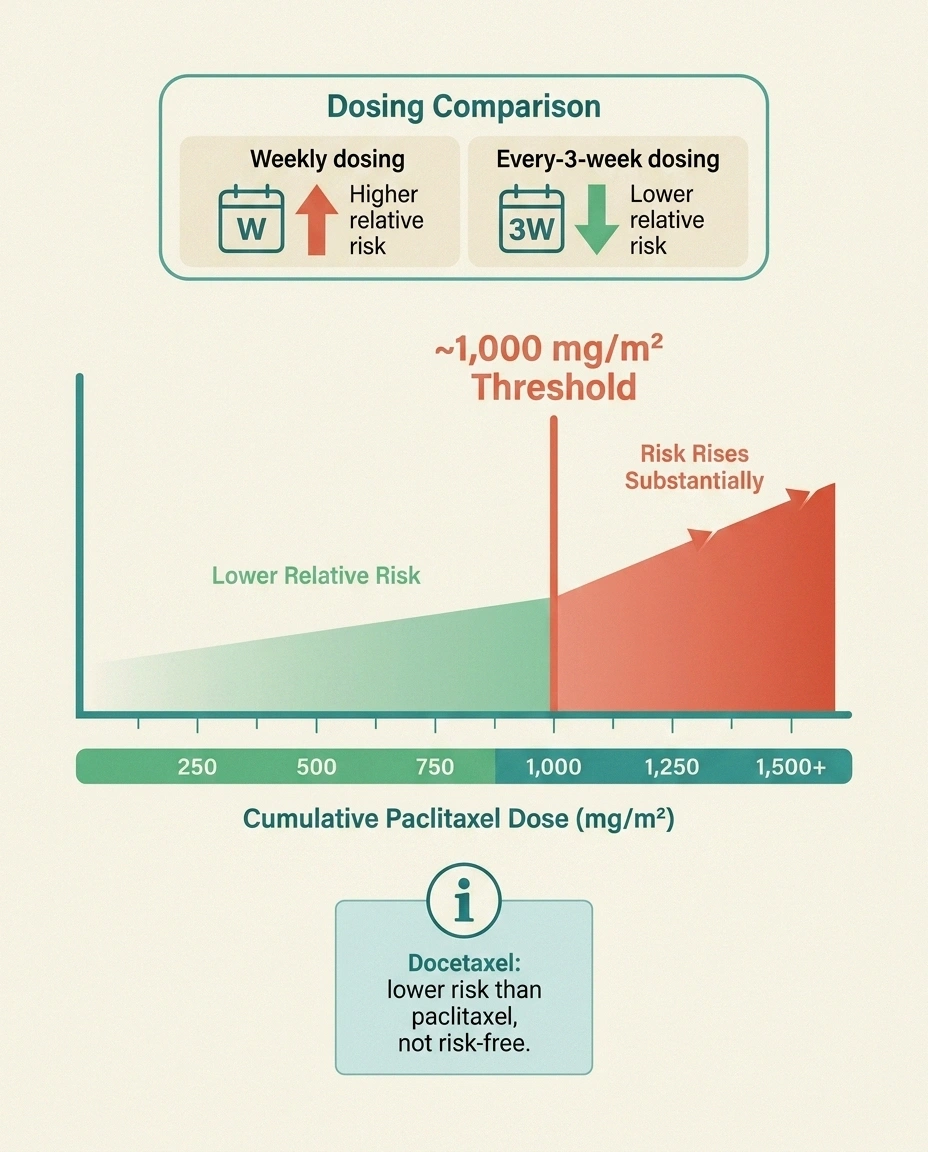
For paclitaxel, research has identified a meaningful jump in risk once cumulative dose crosses roughly 1,000 mg/m². Below that threshold, risk is present but comparatively lower; above it, the odds of developing significant CIPN rise substantially. Your oncology team tracks this cumulative number across your entire treatment course, not just a single infusion.
Dosing schedule matters too. Weekly paclitaxel dosing tends to be more neurotoxic than dosing given every three weeks, even at similar total cumulative doses, because the nerves have less recovery time between exposures. That doesn't make weekly dosing the wrong choice. For many cancers it's the more effective regimen for tumor control, but it's a real tradeoff your oncologist is weighing on your behalf.
Docetaxel is generally considered less neurotoxic than paclitaxel, but “less” doesn't mean “risk-free.” Patients on docetaxel absolutely develop CIPN, particularly at higher cumulative doses or with prior taxane exposure.
When Dose Reduction Comes Up
If your neuropathy reaches what's classified as Grade 2, meaning it's noticeably interfering with daily activities like buttoning clothes, typing, or walking normally, this is typically the point where your oncologist raises the possibility of reducing your dose or adjusting your schedule. This is a genuinely difficult conversation because it means weighing cancer control against nerve preservation, and there's no universal right answer. It depends on your specific cancer, how your tumor is responding, and how much the neuropathy is affecting your life and safety.
This decision belongs to you and your oncologist, together, based on your full clinical picture. It is never something to decide alone by simply skipping doses or stopping treatment without telling your team.
Prevention Strategies Being Studied
If you're wondering whether there's something you can do proactively, the honest answer is that researchers are actively working on this, and a few approaches show real promise, though none are considered settled standard-of-care yet. Our broader guide to preventing chemotherapy-induced neuropathy covers this ground in more depth across chemo classes, but here's what's specifically relevant to taxanes:
Cryotherapy — wearing frozen gloves and socks during infusion, the idea being that cold temporarily constricts blood flow to the extremities and reduces how much drug reaches those nerve endings. Evidence is mixed but growing, and a number of infusion centers now offer this as an option.
Compression gloves and socks during infusion — similar logic to cryotherapy, using pressure instead of cold. A trial out of a Tokyo-based research group found modest but measurable positive results using compression garments during paclitaxel infusion.
Scrambler therapy — a non-invasive electrical stimulation approach that some smaller studies suggest may help with established CIPN pain, though it's more established as symptom management than true prevention.
SP16 — an investigational peptide currently being studied specifically for CIPN prevention. Our deep dive on SP16 covers where that research currently stands.
Cilengitide and GM1 ganglioside — both have been studied as potential nerve-protective agents, with mixed results so far. Neither is currently a standard recommendation.
The throughline across all of these: they're being studied, and some show real promise, but none of them are a substitute for the conversation about dose and schedule with your own oncology team, or for reporting symptoms as they happen.
Duloxetine and What Helps Once Pain Sets In

If CIPN has already developed and is causing pain, there is one medication with genuinely strong evidence behind it: duloxetine. A landmark Phase 3 trial known as CALGB 170601 found that duloxetine meaningfully reduced pain from chemotherapy-induced neuropathy, and it remains the only agent to show this level of evidence in a rigorous randomized trial for CIPN specifically. Our full guide to duloxetine for neuropathy covers dosing, side effects, and what to expect if your oncologist suggests trying it.
Gabapentin and pregabalin are also commonly prescribed for neuropathic pain generally, and many patients and doctors reach for them because they're familiar tools for nerve pain. Worth knowing: the evidence specifically supporting these two drugs for CIPN is weaker than the evidence for duloxetine, though individual response varies, and your prescriber may still consider them reasonable options depending on your overall situation.
What Hasn't Been Proven — Handle These Claims With Caution
This is the section I feel most strongly about, because well-meaning supplement marketing can genuinely steer people toward something that doesn't just fail to help. It can make things worse.
Duloxetine (CALGB 170601): the only Phase 3 trial to show a medication meaningfully reduces established chemotherapy-induced nerve pain — it remains the best-evidenced treatment option once CIPN pain has set in.
Acetyl-L-carnitine (Hershman 2013): a randomized trial in women on taxane chemotherapy for breast cancer found ALC patients ended up with worse neuropathy scores than the placebo group, not better. It is not recommended for preventing taxane CIPN.
Acetyl-L-carnitine (ALC) is the clearest example. It's a supplement that gets recommended for nerve health in general contexts, and it would be reasonable to assume it might help with chemo-related nerve damage too. But a real, rigorous clinical trial run by Hershman and colleagues, published in 2013, tested ALC specifically in women undergoing taxane-based chemotherapy for breast cancer, and the results were the opposite of helpful. Patients taking ALC in that trial ended up with worse neuropathy scores than the placebo group, not better. If you've read elsewhere that ALC supports nerve health, that may hold true in other contexts, but for taxane chemotherapy neuropathy specifically, the trial evidence points away from it. Our full write-up on acetyl-L-carnitine covers this trial and the broader evidence in detail.
Other supplements sometimes marketed for CIPN prevention or relief, vitamin E, glutathione, glutamine, have mixed to weak evidence. Some small studies show hints of benefit, others show none, and none have the kind of consistent, replicated, large-trial support that would justify a confident recommendation either way.
The pattern worth remembering: “used for nerve health” is not the same claim as “proven to prevent or reduce chemotherapy-induced neuropathy.” Always run any supplement by your oncology team before starting it during active treatment. Some can interact with chemotherapy or interfere with how it works.
When to Call Your Doctor Right Away

Most of what I've described so far is something to track, report, and discuss at your regular appointments. But there's a shorter list of symptoms that deserve a same-day or next-day call, not a “mention it at my next visit” approach:
- New weakness — trouble lifting your foot when you walk (foot drop), or a noticeable drop in your hand grip strength
- Balance changes that increase your fall risk — stumbling, near-falls, or a sudden change in how steady you feel on your feet
- Symptoms that are clearly escalating between visits — pain, numbness, or tingling that's spreading or intensifying faster than it has been
These symptoms matter because they can signal that the neuropathy is moving from an annoying-but-manageable stage into something affecting your safety and function, and because the sooner your team knows, the more options they have, including dose or schedule adjustments that can help preserve the nerve function you still have. Numbness and reduced feeling in the hands, in particular, can affect grip and fine motor control in ways that are worth flagging even when they seem minor. If your hands are affected, our guide to neuropathy in the hands covers the glove-distribution pattern and what's typically involved in evaluating it.
Living With Taxane Neuropathy: Practical Adaptations
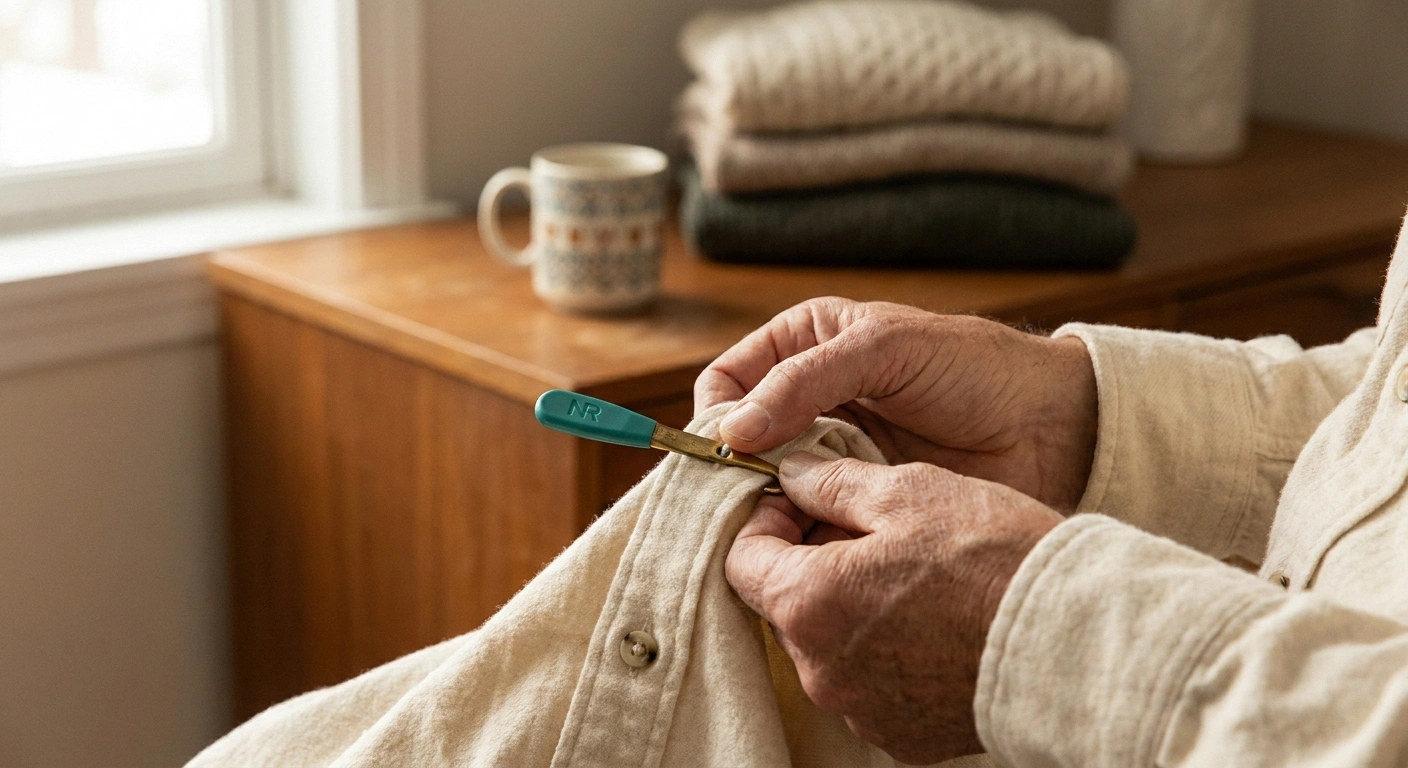
While you and your oncology team are working through the medical side of this, day-to-day life doesn't pause. A few adaptations that people in my community have found genuinely helpful:
For hands: Button hooks and zipper pulls can make dressing far less frustrating when fine motor control is affected. Key turners add leverage for numb fingers. Some people switch to slip-on shoes and magnetic or velcro closures rather than fighting with buttons and laces every morning.
For balance and fall prevention: Remove throw rugs and clear walking paths at home. Good, supportive shoes matter more than they used to. This isn't the season for going barefoot on hardwood or wearing shoes with no tread. A cane or trekking pole, even temporarily, isn't a sign of giving up. It's a tool that keeps you moving safely. If balance has become a real concern, ask your oncology team about a physical therapy referral. Gait and balance training makes a measurable difference for a lot of people.
For your care team relationship: Say something early, every time. I know it can feel like complaining, or like you don't want to be “that patient” who's always reporting a new symptom. But your oncology team can't act on what they don't know about, and the patients who do best with CIPN long-term are consistently the ones who spoke up early rather than waiting to see if it would pass on its own. Bring a written symptom log to appointments if that helps you remember details under pressure: what you're feeling, where, how it's affecting your daily tasks, and whether it's better, worse, or the same since your last visit.
And if the emotional weight of all this, the uncertainty, the frustration of a body that doesn't quite work the way it used to, is wearing on you, that's real too, and you're not weak for feeling it. It deserves its own honest conversation with your care team, not just a footnote to the physical symptoms.
If nothing else stays with you from this article, let it be this: taxanes are powerful, necessary cancer treatments, and for most people the benefit of taking them clearly outweighs the risk of nerve damage. But you are the person who feels your symptoms first, and speaking up early is the single most useful thing you can do to protect your long-term nerve function. Our overview of chemotherapy-induced peripheral neuropathy is a good next stop if you want the fuller picture across chemo drug classes, not just taxanes.
Frequently Asked Questions
What does taxane chemotherapy neuropathy feel like compared to other chemo neuropathy?
Taxane neuropathy typically starts as tingling or pins-and-needles in a stocking-glove pattern across the feet and hands, progressing to burning and sometimes sharp pain, along with balance problems from lost proprioception. It generally builds gradually across treatment rather than flaring suddenly. This is different from oxaliplatin, used in colorectal cancer, which causes an acute, cold-triggered reaction right after infusion. Taxanes generally do not cause that cold-sensitivity pattern.
How soon after starting paclitaxel or docetaxel does neuropathy usually start?
For weekly paclitaxel, symptoms often begin after about 2 to 3 cycles. For docetaxel, typically dosed every three weeks, onset tends to appear later, often after 4 to 6 cycles. Individual timing varies based on cumulative dose, prior chemotherapy exposure, and personal nerve sensitivity, so these are averages rather than guarantees.
Will my neuropathy go away after chemo ends?
Symptoms often continue worsening for weeks to months after treatment stops, a pattern called coasting, before they start improving. Recovery is usually gradual, with partial to complete improvement over 6 to 24 months for most patients. Around 20 to 40 percent of patients have some degree of persistent symptoms that do not fully resolve, even years later, so honest expectation-setting matters alongside hope for recovery.
Should I take acetyl-L-carnitine to protect my nerves during chemo?
No, not for taxane chemotherapy neuropathy specifically. A rigorous clinical trial published in 2013 tested acetyl-L-carnitine in women receiving taxane-based chemotherapy for breast cancer and found that patients taking it had worse neuropathy scores than those on placebo, not better. Always discuss any supplement with your oncology team before starting it during active treatment, since some can interact with chemotherapy.
Can my dose be reduced if neuropathy gets bad, and will that hurt my cancer treatment?
Yes, dose reduction or schedule adjustment is a standard tool oncologists use once neuropathy reaches a level that interferes with daily activities, often called Grade 2. Whether and how to adjust depends on your specific cancer, how it is responding to treatment, and how much the neuropathy is affecting your safety and function. This is a decision made jointly with your oncologist based on your full clinical picture, never something to decide alone by skipping doses.
What's the difference between paclitaxel and docetaxel in terms of nerve damage risk?
Paclitaxel carries a meaningful jump in neuropathy risk once cumulative dose crosses roughly 1,000 mg/m², and weekly paclitaxel dosing tends to be more neurotoxic than dosing every three weeks. Docetaxel is generally considered less neurotoxic than paclitaxel overall, but it is not risk-free, and patients on docetaxel can still develop significant CIPN, particularly at higher cumulative doses or with prior taxane exposure.
About the Author