The question comes up at nearly every support group meeting, usually from someone holding a business card. A friend swears by their chiropractor. The office has a sign in the window about nerve pain. The appointment is already booked for Thursday.
What people want to know is whether they should go. That turns out to be the wrong question, and answering the right one makes the visit far more useful.
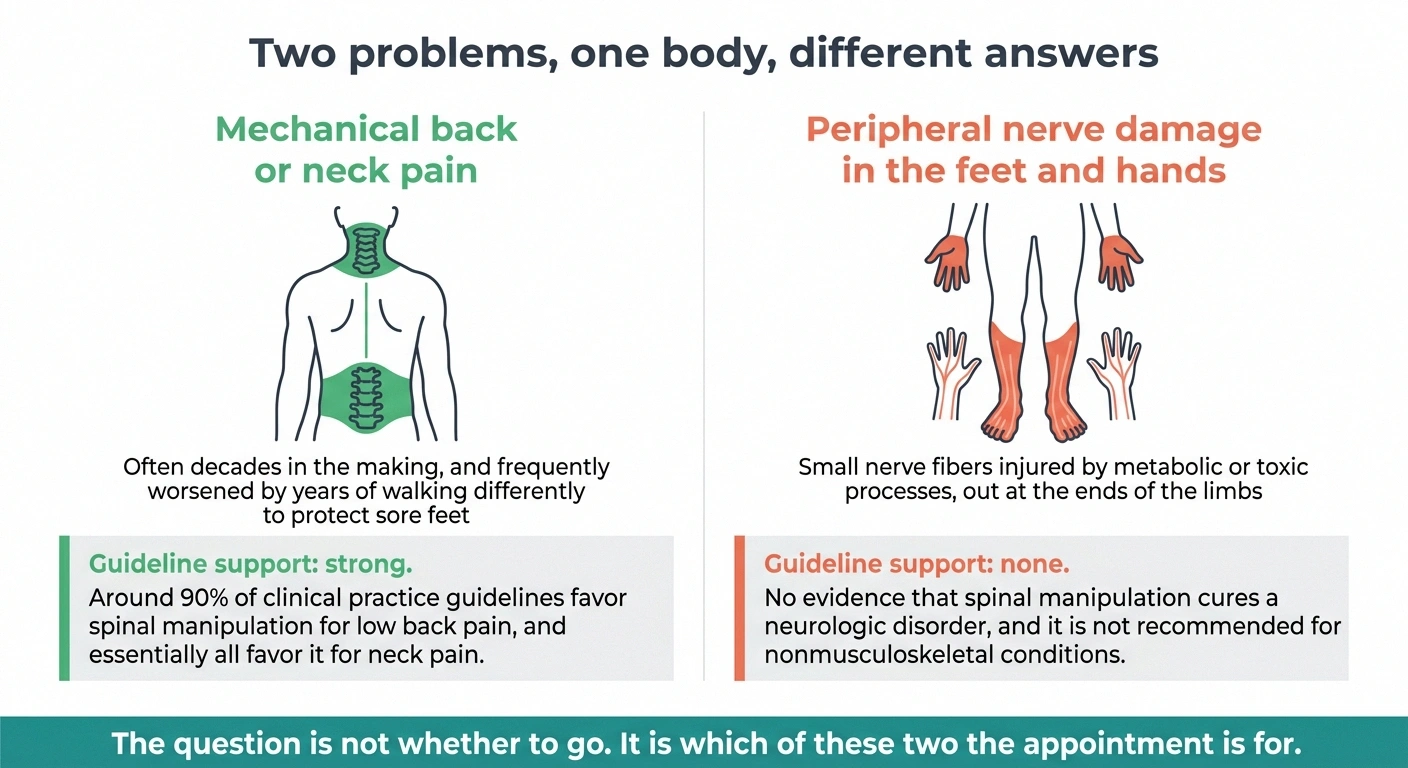
Because most people with peripheral neuropathy are carrying two separate problems at once. There is the nerve damage in the feet or hands. And there is the back or neck pain that decades of living, and often years of walking differently to protect sore feet, have produced alongside it.
Chiropractic care has solid support for the second problem. It has none for the first. So the question worth walking in with is not whether to go, but which of your two problems this appointment is for. Everything below follows from getting that straight.
What the Evidence Supports and What It Does Not
Being specific here saves a lot of disappointment later.
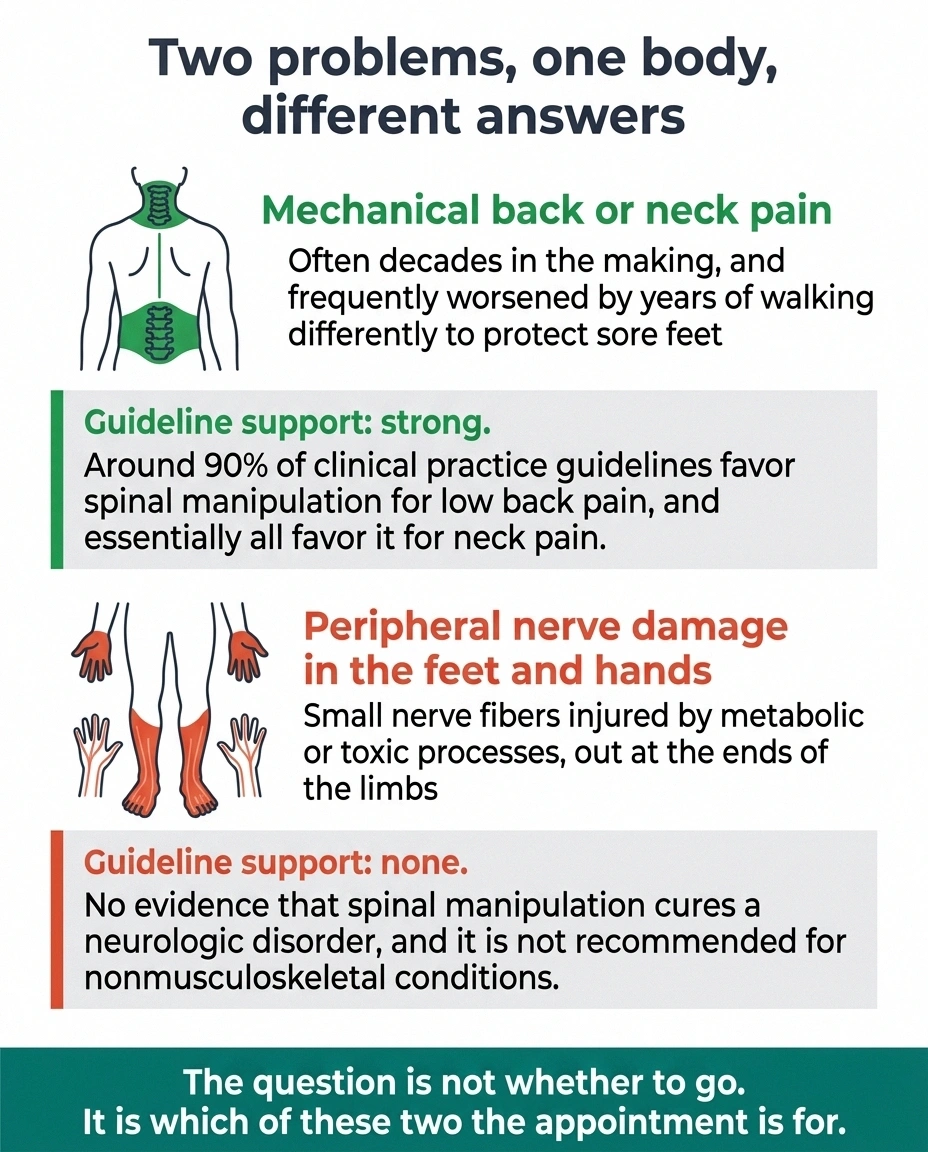
Where the support is strong: spine pain. Among clinical practice guidelines that address spinal manipulation, roughly 90% favor it for low back pain and essentially all of them favor it for neck pain. That is a solid consensus by the standards of musculoskeletal medicine.
Where it is absent: peripheral nerve damage. There is no evidence that spinal manipulation cures a neurologic disorder. For extremity problems the evidence is described as insufficient or conflicting, and manipulation is not recommended for conditions outside the musculoskeletal system.
The reason is anatomical rather than political. Diabetic neuropathy, chemotherapy-related nerve damage and most idiopathic neuropathy involve the small nerve fibers out in the feet and hands, injured by metabolic or toxic processes. Nothing about that injury is caused by spinal alignment, and nothing about adjusting the spine reaches it.
Which is a genuinely different statement from “a chiropractor cannot help you.” If your lower back has been aching for two years, that is a real problem, it is degrading your sleep and your walking, and it sits squarely inside what chiropractic care addresses well.
The Overlap Case, Where It Gets Interesting
Some symptoms that look like peripheral neuropathy are not.
Which pattern matches yours
Neither column is a diagnosis. Both can be true at once, which is the point of noticing.
| What you notice | Points toward the spine | Points toward peripheral nerves |
|---|---|---|
| Where it is | A stripe down one leg, often past the knee | Both feet, roughly evenly, like socks |
| How it started | Fairly suddenly, sometimes after a specific movement | Gradually over years, toes first, creeping upward |
| Position | Changes clearly with posture, often eased by leaning forward | Largely unaffected by how you sit or stand |
| Time of day | Worse with activity and loading | Often worst at night, lying still in bed |
| Back pain alongside it | Usually present, and usually came first | May be present, but arrived separately |
Write down which cells match you and bring the list. It takes two minutes and it changes what the examination looks for.
Nerve compression in the lower spine produces numbness, tingling and burning in the legs and feet. So does peripheral neuropathy. They can feel remarkably similar from the inside, and a person can have both simultaneously, which is more common than either the neurology side or the chiropractic side tends to acknowledge.
The distinction matters because the spinal version responds to treatments that do nothing for the peripheral version. We cover the differences in radiculopathy versus neuropathy and in spinal stenosis versus neuropathy, and the pattern clues are worth knowing before your appointment.
Some quick differentiators. Symptoms in a stripe down one leg suggest a nerve root. Symmetric symptoms in both feet, starting at the toes and moving upward over years, suggest peripheral neuropathy. Symptoms that change noticeably with position, worse standing and better sitting or leaning forward, point toward the spine. Symptoms that are worse at night in bed and unaffected by posture point away from it.
If your pattern looks spinal, a chiropractor is a reasonable person to see about it.
What to Say in the First Five Minutes

Bring these, and say them before anyone touches you.
Say these before anyone touches you
Each item changes which techniques are appropriate. Several are reasons to modify or avoid an adjustment entirely.
- Osteoporosis or osteopenia, including a borderline bone density scan you were told not to worry about
- Any prior stroke or TIA, and any diagnosed vascular disease
- Blood thinners, including daily aspirin, which people routinely leave off a medication list
- Inflammatory arthritis, particularly rheumatoid arthritis, which can affect the upper cervical spine
- Prior spinal surgery or hardware, with the level named if you know it
- Any cancer history involving bone, however long ago
- Where your sensation is reduced, stated as a boundary: “from mid-calf down”
Write the list on your phone rather than reciting it. Intake forms often ask about conditions in categories broad enough that people answer no truthfully and still leave out the thing that mattered.
- Your diagnosis and its cause, if known. “Diabetic peripheral neuropathy, diagnosed 2021” tells the practitioner more than “nerve pain in my feet.”
- Every condition on this list that applies to you: osteoporosis or osteopenia, any prior stroke or TIA, blood thinners, vascular disease, inflammatory arthritis, prior spinal surgery or hardware, or any cancer history involving bone. Each one changes what techniques are appropriate, and several are outright contraindications for certain adjustments.
- Your full medication list, including gabapentin, pregabalin, duloxetine and amitriptyline. Several of these affect balance and blood pressure, which matters on and off a treatment table.
- Where you cannot feel normally. This is the one specific to you and the one most often left unsaid. Say it plainly: “I have reduced sensation from mid-calf down, so I may not feel discomfort in my feet the way you would expect.”
- What you actually want from the visit. Back pain relief, or an opinion on whether your leg symptoms are spinal. Naming it keeps the visit from drifting toward a program.
Why Numbness Changes the Rules

Manual therapy relies on a feedback loop most people never think about. The practitioner applies pressure, the patient’s body signals discomfort, and the practitioner adjusts. When sensation is reduced, that loop is broken at the patient’s end.
Saying it in a way that is actually useful
Manual therapy runs on your feedback. When sensation is unreliable, the phrasing has to change to compensate.
Instead of: “That feels fine.”
Say: “That should be uncomfortable and I am not feeling much, so treat my answer as unreliable there.”
Instead of: “I think my leg is okay.”
Say: “Can you check where my foot is? I cannot confirm the position by feel.”
Instead of: “I’ll be fine getting down.”
Say: “I need a hand off the table every time, even when I look steady.”
Ask to keep your shoes on until you are on the table. A treatment room floor in socks removes the one source of foot grip you still have.
Three practical consequences.
You may not feel too much pressure until afterward. Report by observation rather than by sensation. “That should be uncomfortable and I am not feeling much” is genuinely useful information for the person working on you.
Positioning is riskier than it looks. Numb feet in an awkward position for several minutes can end up compressed or strained without any warning signal. Ask to have your foot position checked before a longer technique, and say so if you cannot verify it yourself.
Getting on and off the table is the real hazard. Adjustment tables are high, sometimes moving, and often approached in socks. If position sense is impaired, this is exactly the setup that produces falls. Ask for a hand every single time, and keep your shoes on until you are on the table.
Questions to Ask Before You Commit to Anything
Five questions, and the answers tell you most of what you need.
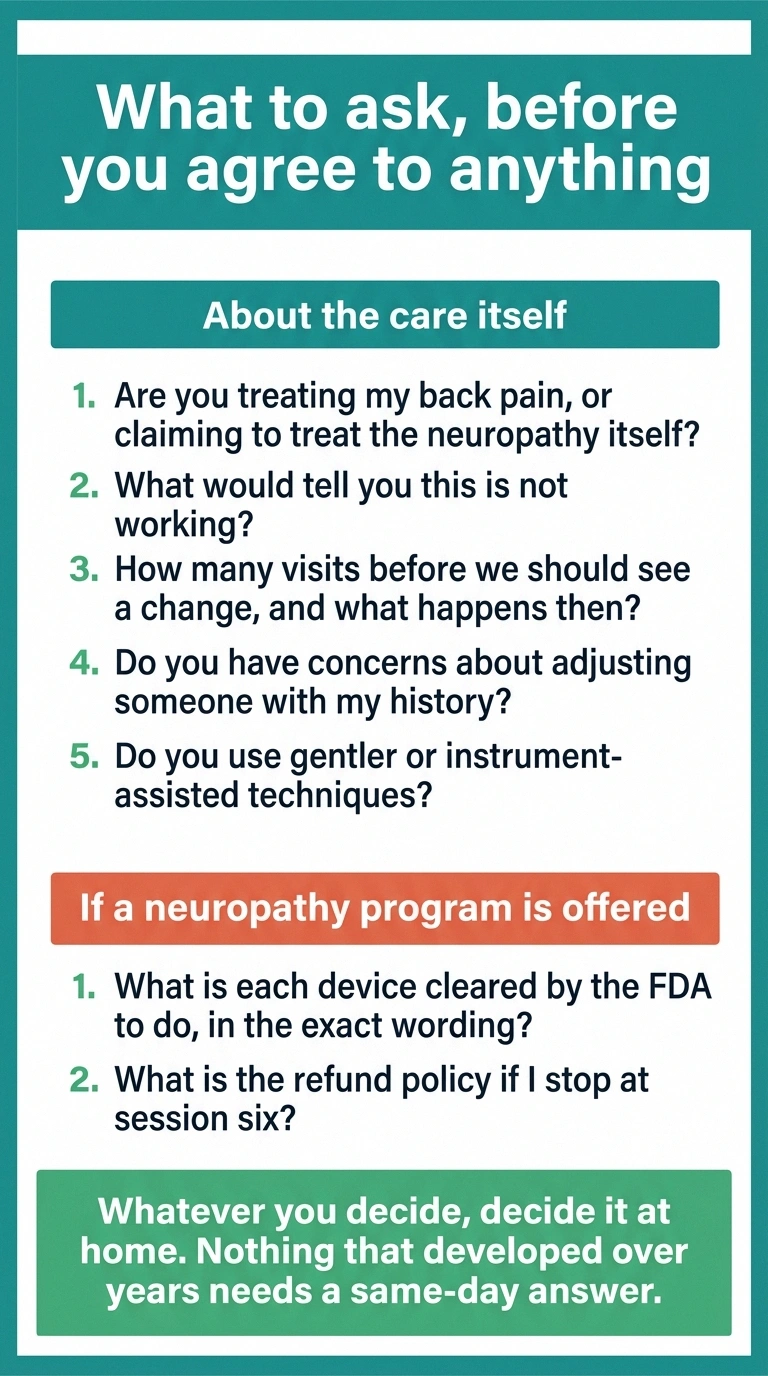
- “Are you treating my back pain, or are you claiming to treat the neuropathy itself?” The most important question on the page. A clear answer to the first is a good sign. A confident claim to the second is not.
- “What would tell you this is not working?” A practitioner with a clinical model has an endpoint in mind. One without will describe more sessions.
- “How many visits before we should see a change, and what happens then?” For mechanical back pain, meaningful change usually appears within a handful of visits. A plan requiring twenty before any assessment is a plan built around a package.
- “Do you have concerns about adjusting someone with my history?” The answer should be considered rather than reflexive. Careful screening for contraindications is the standard of care, and a practitioner who has nothing to say about your osteoporosis has not thought about it.
- “Do you use gentler techniques?” Low-force and instrument-assisted methods exist and are often more appropriate for older patients or those with bone density concerns. A practice with only one setting is worth noting.
The Neuropathy Program Conversation
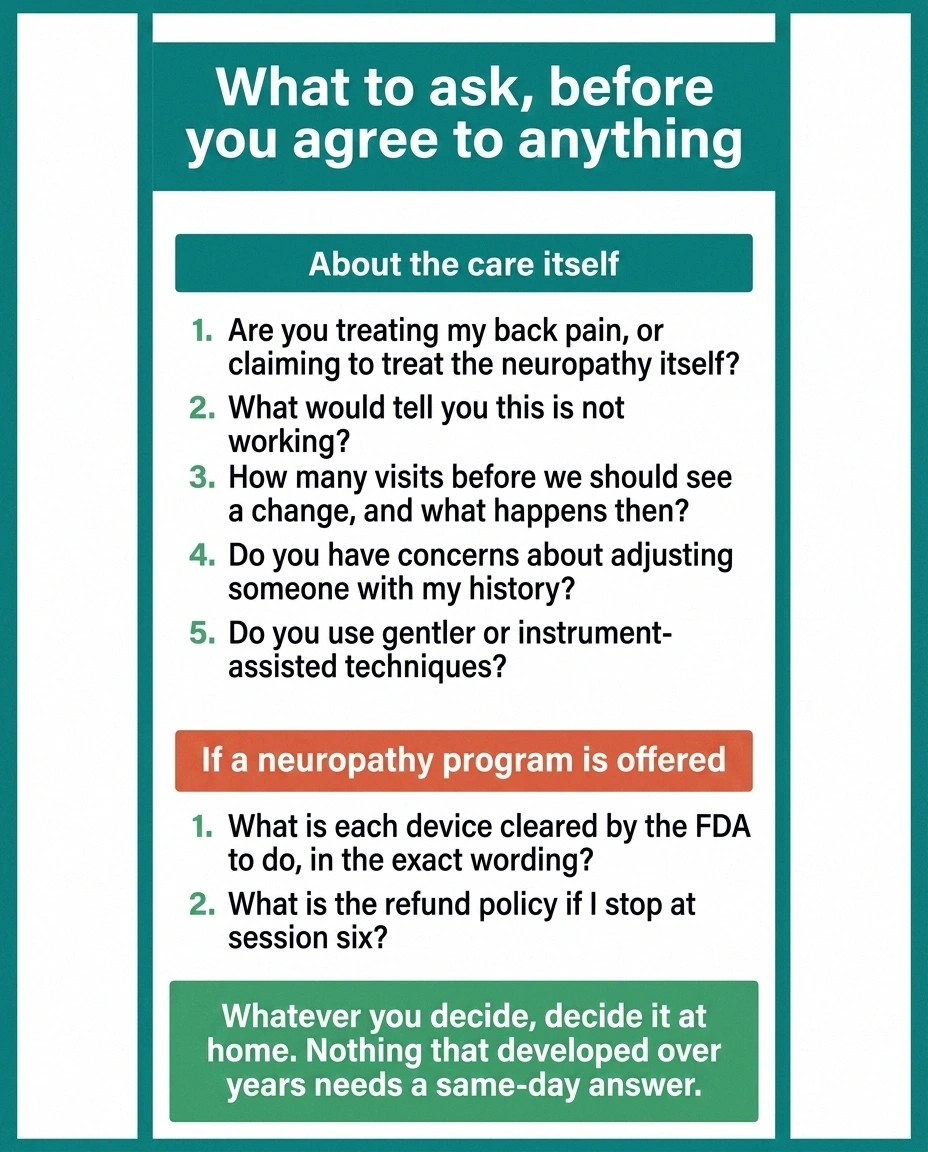
Some chiropractic offices market a dedicated neuropathy program, typically bundling infrared light therapy, electrical stimulation, supplements and a fixed number of visits, sold as a package running into the thousands.
Treat that as a completely separate decision from the adjustment you came in for. It is a different product with different evidence and a different price, and the fact that it is offered by someone whose core work is well supported does not transfer that support to the package.
Two questions specifically. What is each device cleared by the FDA to do, in the actual regulatory wording rather than a summary? And what is the refund policy if you stop at session six? The individual components sometimes have modest evidence behind them, which we cover in infrared therapy for neuropathy. Modest is the accurate word, and it is rarely the word used in the room.
Whatever you decide, decide it at home. Nothing about a condition that developed over years requires a same-day commitment.
What Else Might Fit Better
Depending on what you are actually trying to solve, other options may map more directly onto the problem.
For balance, gait and fall prevention, physical therapy is the better-aimed tool, and our guide to physical therapy for neuropathy covers what a course looks like. For nerve pain specifically, acupuncture has a larger body of neuropathy-specific research than spinal manipulation does. And if a chiropractor has recommended dry needling, that is a distinct technique with its own considerations.
None of this rules out chiropractic. It is a matter of matching the tool to the problem, which is easier once you have separated the two problems in your own mind.
After the Visit

Mild soreness for a day or two is common and expected. What is not expected, and what warrants prompt medical attention rather than a follow-up adjustment, is new weakness, a noticeable increase in numbness, any change in bladder or bowel control, or severe headache, dizziness or visual change following neck work.
Expected soreness, and the things that are not
Expected: mild aching or stiffness for a day or two, similar to the day after unfamiliar exercise. It should be improving by day three, not building.
Not expected, and worth a same-day medical call rather than a follow-up adjustment:
- New weakness in a leg or arm, or a foot that catches when you walk
- A noticeable increase in numbness, or numbness spreading to a new area
- Any change in bladder or bowel control
- Severe headache, dizziness, visual change or slurred speech following neck work
Serious complications are rare, and the reason to know this list is that reduced sensation delays the usual warning. Symptoms you would normally notice within minutes may not register for hours.
Write down what was done and how you felt over the following three days. Memory blurs, and a short written record is what lets you judge whether the visits are earning their place. If leg symptoms improve after spinal work, that is a real clue about where they were coming from, and worth bringing back to whoever manages your neuropathy. Our notes on talking to your doctor about nerve pain cover how to present that without it turning into a debate about chiropractic.
Frequently Asked Questions
Can a chiropractor help neuropathy?
Not the peripheral nerve damage itself. There is no evidence that spinal manipulation cures a neurologic disorder, and it is not recommended for nonmusculoskeletal conditions. It can help back or neck pain occurring alongside neuropathy, and it may help leg symptoms that are actually coming from spinal nerve compression rather than from peripheral neuropathy.
Is chiropractic adjustment safe if I have nerve damage?
Serious adverse events are rare and transient soreness is the usual one, but screening matters more than average in this group. Osteoporosis, spinal instability, vascular disease, prior stroke, blood thinners and connective tissue disorders all change what is appropriate. Disclose everything on that list before the first adjustment.
What should I tell the chiropractor before my first visit?
Your specific diagnosis and its cause, your full medication list, any bone density or vascular conditions, prior spinal surgery, and exactly where your sensation is reduced. That last item is easy to leave out and it directly affects how the practitioner should interpret your feedback during treatment.
How do I know if my leg symptoms are spinal or peripheral?
Pattern gives useful clues. Symptoms in a stripe down one leg suggest a spinal nerve root. Symmetric symptoms in both feet progressing slowly upward from the toes suggest peripheral neuropathy. Symptoms that change clearly with posture point toward the spine, while symptoms that worsen at night in bed point away from it. Both can be present at once, so this is a question for examination rather than self-diagnosis.
Should I buy a chiropractic neuropathy program?
Evaluate it separately from the adjustment. These packages typically bundle light therapy, electrical stimulation and supplements at a price in the thousands, and the evidence for the components is modest at best. Ask what each device is cleared by the FDA to do in its exact wording, ask about the refund policy, and take the written plan home before deciding.
How many visits before I know if it is helping?
For mechanical back or neck pain, a meaningful change generally shows within a handful of visits. If nothing has shifted after several sessions, that is information worth acting on. A plan that requires twenty visits before any reassessment is structured as a package rather than as a course of care.
What if I cannot feel my feet during the adjustment?
Say so out loud at the start, and report by observation instead of sensation. Ask to have your foot and leg positioning checked before longer techniques, since a numb limb can be compressed without producing any warning. Ask for assistance getting on and off the table every time, because that transition is where falls actually happen.
Will insurance cover chiropractic for neuropathy?
Coverage generally follows the diagnosis code. Spinal manipulation for back or neck pain is commonly covered within visit limits, including under Medicare Part B for spinal subluxation. Package programs marketed for neuropathy usually are not, which is often why they are sold as cash packages. Verify before you start rather than after.
About the Author