I was at the farmers' market last Saturday when Eleanor caught me by the heirloom tomatoes. She was holding a bottle of resveratrol capsules from the natural-foods stall across the way, frowning at the label.
“Janet, you write about this stuff. Is this for real or am I about to waste sixty dollars?”
It was the right question. Resveratrol has been buzzed about for two decades — the French paradox, the red wine longevity headlines, the lab studies showing it does almost everything good a molecule could do. But when you ask whether it actually helps a person sitting in front of you with diabetic neuropathy, the answer is more interesting than either “yes it's a miracle” or “no it's hype.” It's the story of a molecule that does beautiful work in a petri dish, performs reliably in a diabetic rat, and then runs into a wall called your liver.
Let me walk you through what's real, what's hopeful, and what to do with a bottle of capsules if you're inclined to try.
What Resveratrol Is and Why It Got Famous
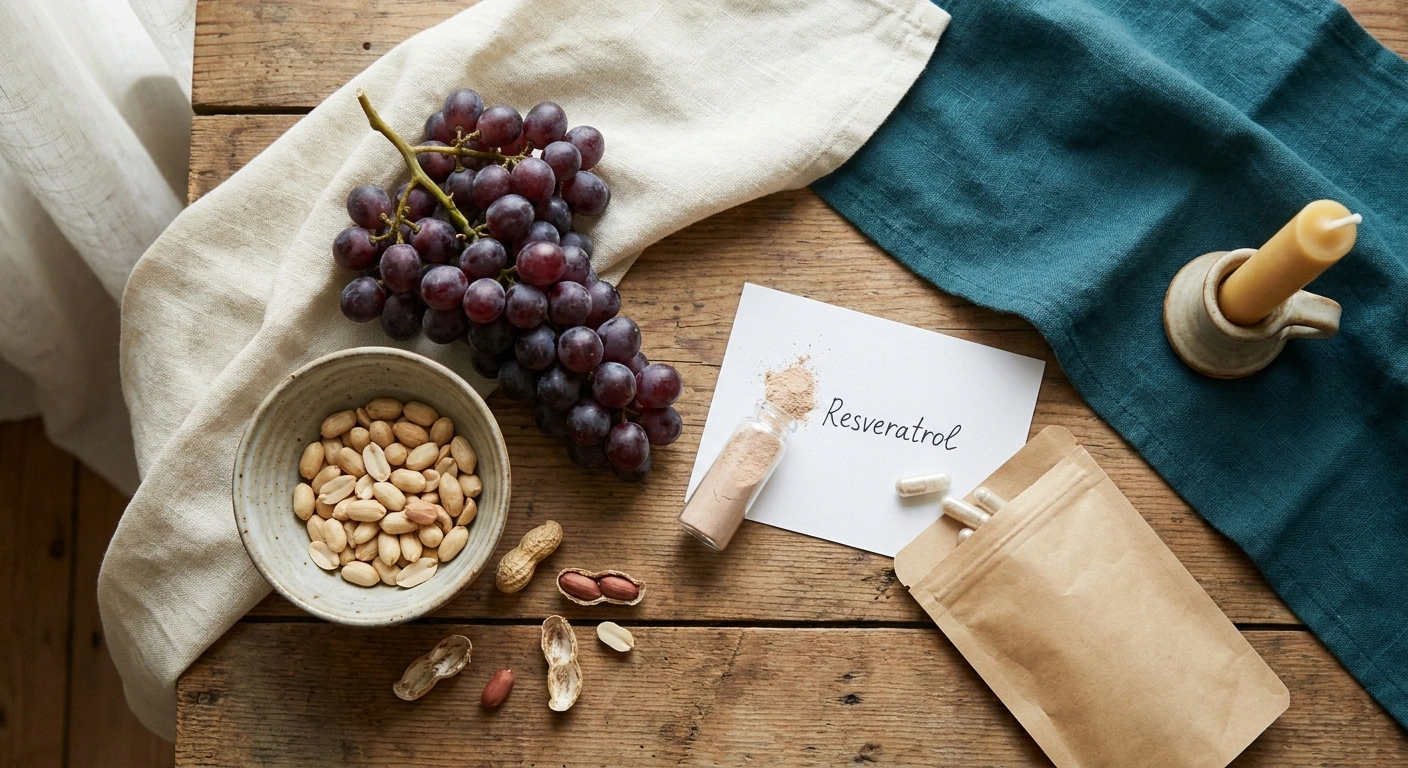
Resveratrol is a plant compound called a polyphenol, more specifically a stilbene. Grapes make it when they're stressed by fungus or sun. Peanuts make it too, and Japanese knotweed makes a lot of it, which is where most supplement-grade resveratrol actually comes from.
Key Takeaway
Resveratrol has a beautiful mechanism story in lab and animal studies, but a real bioavailability ceiling in humans. The honest framing: promising add-on after foundational care, modest expected effect, never a cure. The “drink red wine for resveratrol” story is fiction — you would need 100+ bottles a day to match study doses.
The molecule got its fifteen minutes of fame in the early 2000s when researchers were trying to explain the so-called French paradox — the puzzling observation that the French ate a lot of cheese and butter and yet had less heart disease than they statistically should have. Red wine was the prime suspect. Resveratrol was identified as one of the more interesting compounds in red wine. And then mouse studies started showing remarkable things: resveratrol-fed mice on a high-fat diet looked metabolically more like lean mice. Their mitochondria worked better. They lived a little longer. The internet decided this meant we should all take resveratrol pills.
That's the cocktail-party version. The version that matters for your nerves is more careful and more honest, and it starts with a mechanism story that is genuinely impressive — followed by a delivery problem that complicates everything.
The Mechanism Story Is Strong
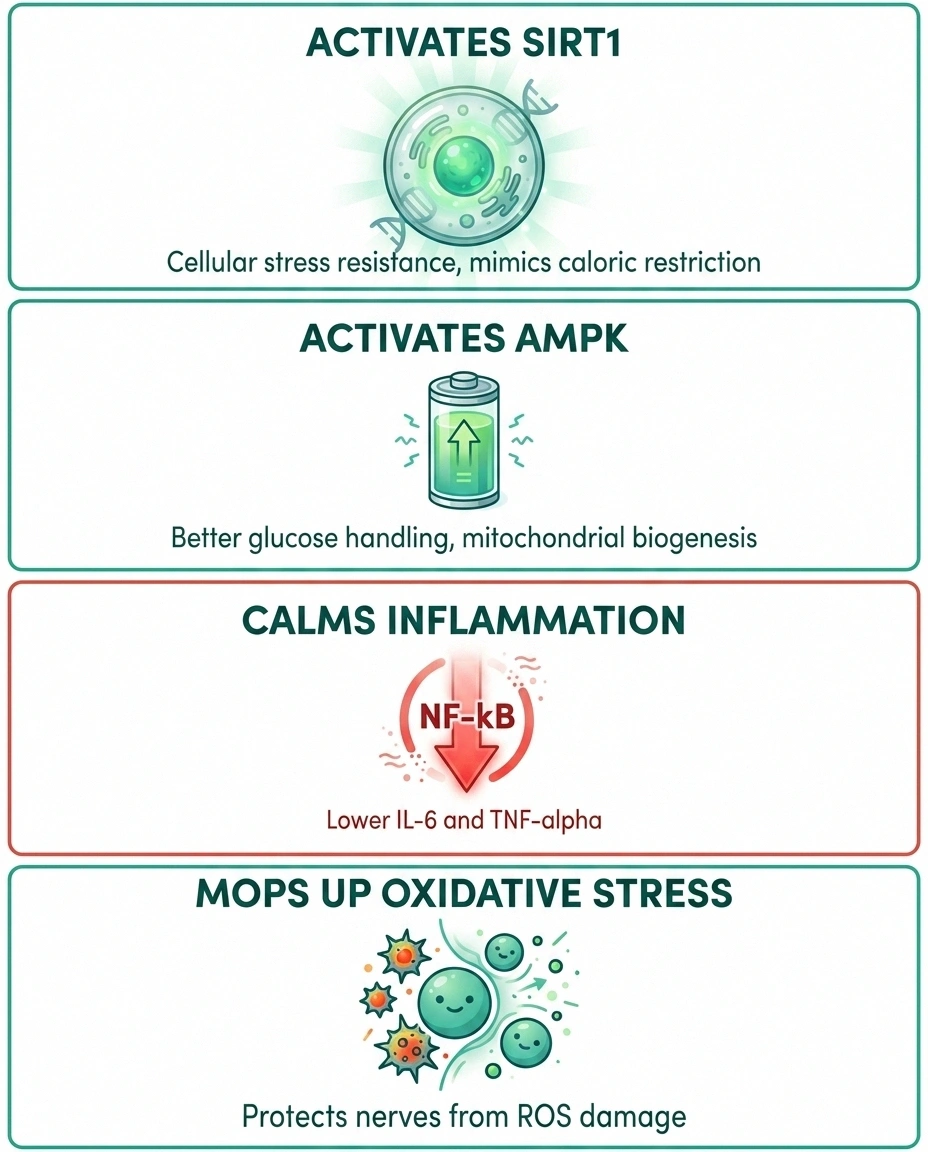
In the lab, resveratrol does several things that would, in theory, be very good for damaged nerves.
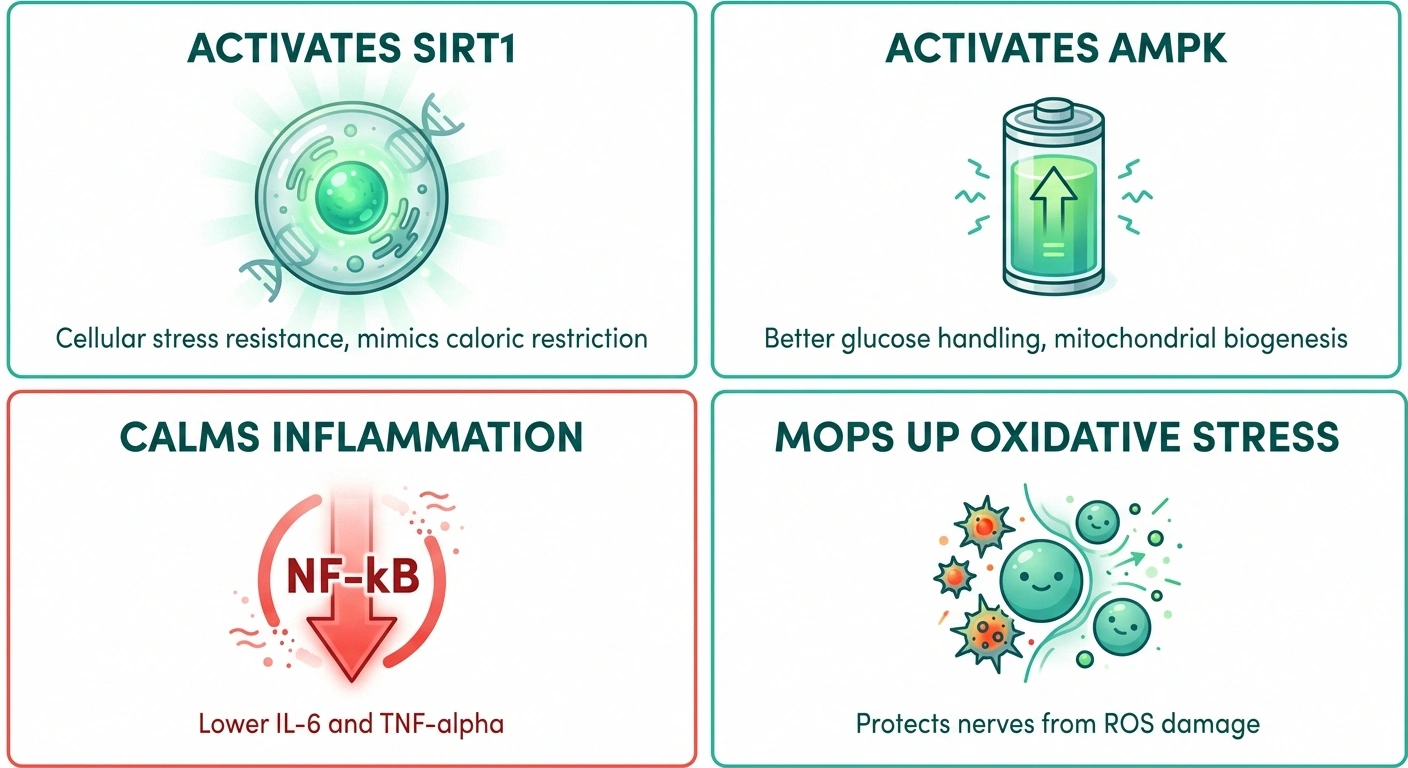
It activates a family of enzymes called sirtuins, particularly SIRT1. Sirtuins are involved in cellular stress resistance — they're some of the molecular machinery your cells use to weather hard times. Activating SIRT1 has been shown to push cells toward a more efficient, more resilient metabolic state. Some researchers describe this as a partial mimicry of caloric restriction, which is one of the few interventions in biology that reliably extends healthspan in lab animals.
It activates AMPK, an energy-sensing enzyme that helps cells use glucose better and build new mitochondria. In a diabetic context, this is exactly the kind of thing you want happening in your nerve cells.
It dampens inflammation. Resveratrol reduces the activation of NF-κB, which is a master switch for inflammatory gene expression, and lowers the production of inflammatory messengers like IL-6 and TNF-alpha. Chronic low-grade inflammation is a big part of the diabetic nerve-damage process, so quieting it should, in theory, help.
It mops up reactive oxygen species. Oxidative stress is the other big driver of diabetic nerve damage, and resveratrol is a respectable antioxidant in its own right while also boosting your cells' internal antioxidant systems.
In cell culture, resveratrol promotes the health of Schwann cells — the little support cells that wrap your nerve fibers — and supports new axon growth. In diabetic rats and mice, animals given resveratrol show better nerve conduction velocities, less mechanical pain, better intraepidermal nerve fiber density, and better Schwann cell function than untreated diabetic animals.
If the story stopped there, I'd be telling you to call your doctor and ask about resveratrol tomorrow. It doesn't.
What Actually Happens in Humans
There have been a handful of human randomized trials of resveratrol in diabetic peripheral neuropathy. They've been small — typically 40 to 100 patients per arm — and short, running between 8 and 24 weeks. Doses have varied, generally between 250 and 1,000 milligrams a day.
Research Says
Small RCTs in diabetic peripheral neuropathy (typically 40-100 patients per arm, 8-24 weeks, 250-1,000 mg/day) show modest improvements in pain scores (~20-30% reduction vs placebo), small nerve conduction improvements in some trials, and better quality-of-life scores. Effects are real but smaller than what alpha-lipoic acid or good glucose control deliver.
The picture across these studies, taken honestly:
- Pain scores generally improve modestly versus placebo. The effects are real and statistically significant in several trials, but they're not huge — typically a 20 to 30 percent reduction in self-reported pain, not a complete resolution.
- Nerve conduction studies show small improvements in some trials, no change in others.
- Self-reported quality-of-life scores tend to improve.
- Glucose markers improve in some studies, especially fasting glucose and insulin sensitivity, though these effects are also smaller than what good diet and exercise produce.
- Side effects are mild and uncommon — some GI upset at higher doses.
So the human data, modest as it is, leans in the right direction. The problem is that it leans much less convincingly than the animal data led people to expect. The honest summary you would write into a careful review paper is something like: “resveratrol shows promise in diabetic peripheral neuropathy, but the trials are small, short, and the effect sizes are modest. Larger and longer trials are needed.”
That gap between what the lab predicts and what humans actually get is the part nobody on the supplement aisle wants to talk about. And it has a clear explanation.
The Bioavailability Problem That Changes Everything
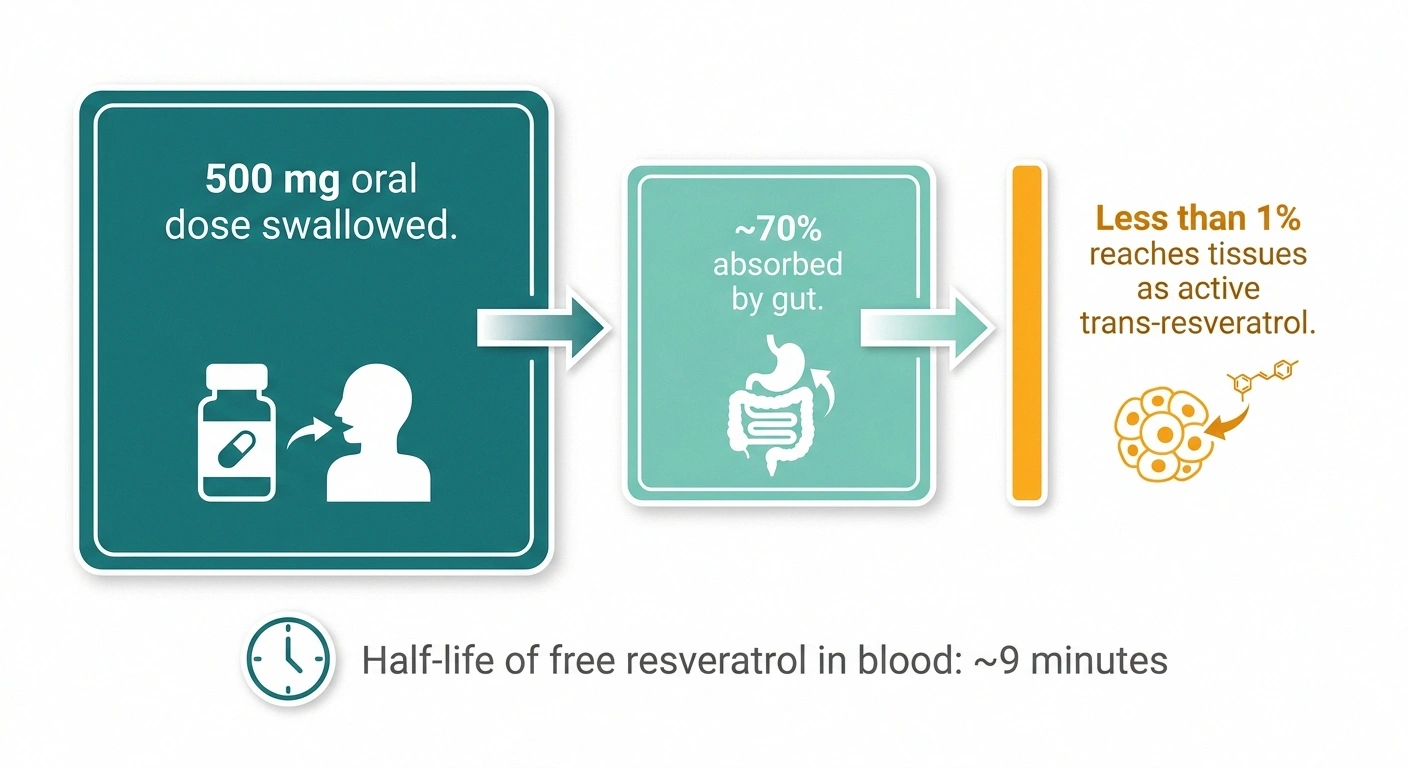
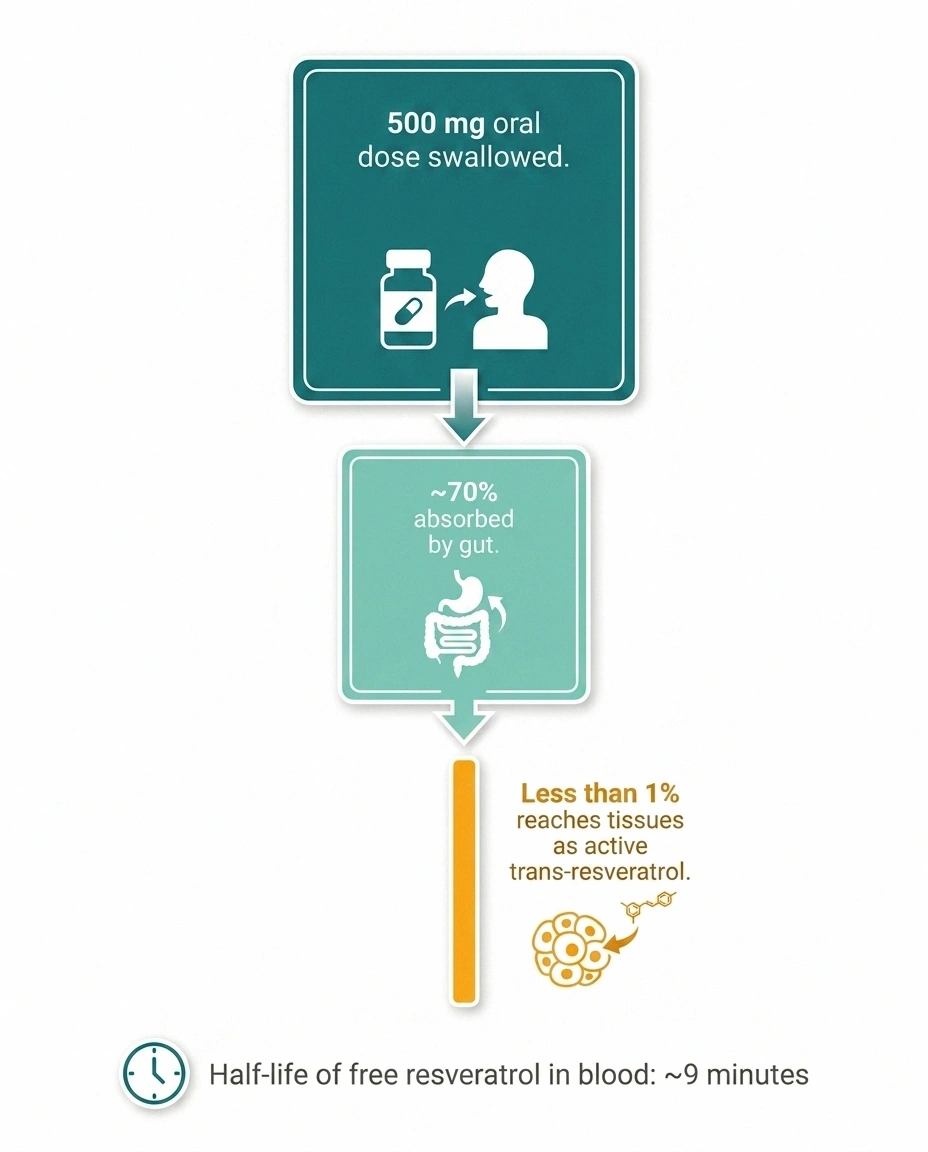
Here is the part of the story I most wanted Eleanor to understand before she handed over her sixty dollars.
The Bioavailability Reality
500mg
typical oral dose
<1%
reaches tissues as active compound
~9 min
blood half-life of free form
When you swallow a 500-milligram resveratrol capsule, your gut absorbs a decent fraction of it — about 70 percent. So far so good. But the moment that resveratrol hits your liver, the liver does what livers do: it metabolizes it. Specifically, your liver attaches a glucuronide or a sulfate group to most of the resveratrol molecules, which inactivates them and prepares them for excretion. This happens fast. The half-life of free, active trans-resveratrol in your blood is roughly nine minutes.
What this means in practice: less than 1 percent of a typical oral resveratrol dose actually reaches your tissues as the active compound. The rest is conjugated metabolites — molecules with some weak residual activity, but nothing like the parent compound. The 500 milligrams on the bottle becomes, effectively, maybe 1 to 5 milligrams of active resveratrol working in your body, for a very short window after each dose.
Now compare that to the doses used in those promising cell and rat studies. Many of them used direct exposure concentrations that would require oral doses of 5 to 10 grams a day in a human to even approach. The animal studies often use rodent doses that, scaled appropriately, correspond to several grams a day in a person.
This is why the human trials use 500 to 1,500 milligrams a day. They're trying to overwhelm the first-pass metabolism with sheer volume. And it works — partially. You can produce measurable, modest clinical effects with that approach. But you cannot reproduce the dramatic petri-dish results in a human body without using doses that haven't been studied for long-term safety.
This is also why the “drink red wine for the resveratrol” pathway is a fantasy. A typical glass of red wine contains somewhere between 0.3 and 1.0 milligrams of resveratrol. The trials that show a benefit use 500 to 1,500 milligrams. You would need to drink roughly 100 to 1,500 bottles of wine a day to match the supplement studies. The cardiovascular signal in moderate red wine drinkers, where it exists at all, is from other compounds and the moderate alcohol itself — not from resveratrol.
Forms That May Get Around the Liver, Partially
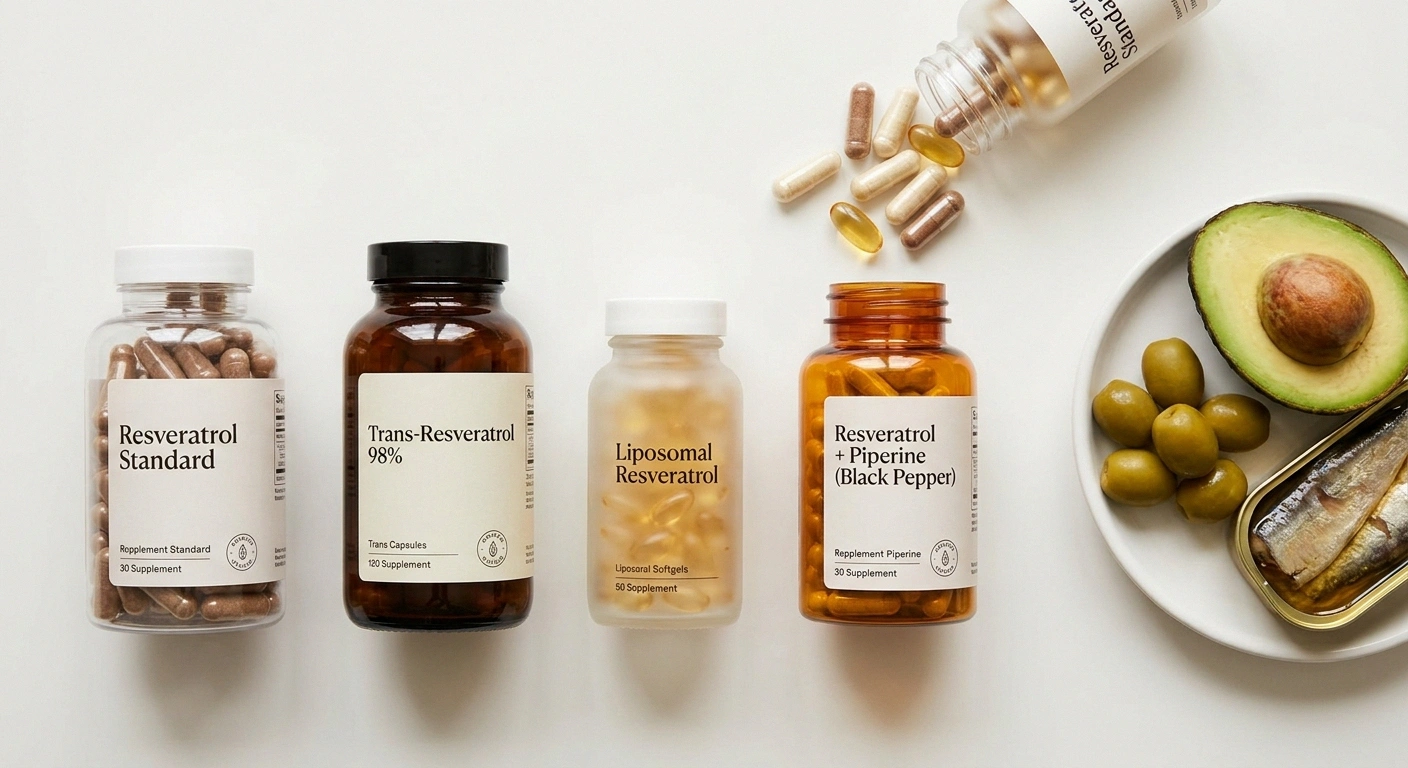
Researchers and supplement companies have known about the bioavailability problem for years and have tried several workarounds.
Four Workarounds for the Liver Problem
Buy “trans-resveratrol”
Look for 98% trans on the label. Cis-resveratrol is the inactive isomer and is filler.
Micronized or liposomal forms
Modest 2-3x absorption boost over standard powder — not a magic bullet but meaningful.
Pair with piperine (black pepper)
Slows liver conjugation enzymes; the same trick used in turmeric/curcumin products.
Take with a fat-containing meal
Resveratrol is fat-soluble. Olive oil, avocado, nuts, or fatty fish at the same meal improves absorption.
Trans-resveratrol vs. cis-resveratrol. Trans is the active form. Most products list this on the label. If yours doesn't, it may include a chunk of inactive cis-resveratrol and you're paying for filler.
Micronized and liposomal preparations. Making the resveratrol particles tiny, or wrapping them in lipid vesicles, can increase absorption and slow first-pass metabolism somewhat. The evidence is real but the magnitude of the effect is modest — maybe a doubling or tripling of effective exposure, not an order-of-magnitude shift.
Pairing with piperine. Piperine, from black pepper, slows the liver enzymes that conjugate resveratrol. This is the same trick used in turmeric and curcumin products. Some studies show meaningfully higher plasma levels when piperine is added.
Take it with a fat-containing meal. Resveratrol is fat-soluble. Taking the capsule with a meal that has olive oil, avocado, nuts, or fatty fish improves absorption versus an empty stomach.
None of these tricks turns a 500-milligram capsule into 500 milligrams of working resveratrol. They might turn it into 10 or 20 milligrams of working resveratrol instead of 5. That's still meaningful, and it's enough to produce the modest clinical signals we see in trials. But it's worth pricing your expectations against reality.
What a Reasonable Trial Looks Like

If you've read this far and still want to try resveratrol — and there are good reasons you might, especially if you have diabetic neuropathy and you're already on the foundational pieces — here's what I'd put together with your doctor's input.
A Reasonable 12-Week Trial
Dose
250-500 mg once daily with the fattiest meal of the day.
Form
Trans-resveratrol, ideally micronized or liposomal, ideally with piperine.
Duration
12-16 weeks before deciding. First hints around week 6-10.
Track
Weekly pain (0-10), sleep (1-5), numbness change. Without a baseline you can't decide later.
Dose: A reasonable starting trial is 250 to 500 milligrams once a day. Some practitioners go up to 1,000 milligrams divided into two doses. Going above 1,500 milligrams a day doesn't have a strong rationale and crosses into territory where GI side effects become common.
Form: Trans-resveratrol, ideally micronized or liposomal, ideally with piperine if you're not on medications that interact (more on that in a second). Take with the meal of the day that has the most healthy fat.
Duration: Give it 12 to 16 weeks before deciding. Nerve cells don't respond fast. If you're going to feel something, you'll probably feel the first hints around week 6 to 10 and a clearer signal by week 12.
Tracking: Keep a simple weekly note — average daily pain on a 0-10 scale, sleep quality on a 1-5 scale, any change in numbness or tingling. Without a baseline, you can't tell whether the supplement is doing anything. With one, you can tell within a few months whether to keep going.
Foundational pieces first. If you have diabetic neuropathy and your A1C is 9.5, fix the glucose first. If you might have a B12 deficiency, get it checked and corrected. Resveratrol is a fine third or fourth thing to layer on top of foundational care. It is not a substitute for foundational care.
Safety and Interactions Worth Knowing
Resveratrol at typical supplement doses is well-tolerated. Most published trials report no meaningful difference in side effects compared to placebo. At very high doses — above about 2.5 grams a day — GI upset (nausea, diarrhea, cramping) becomes common. There's no compelling reason for the average person to take that much.
Pharmacist Conversation Required
Resveratrol has mild antiplatelet activity and inhibits CYP3A4 and CYP2C9. Combined with warfarin, DOACs, daily aspirin, some statins, certain seizure meds, or many cardiac drugs, it can shift blood levels meaningfully. Run the full list past your pharmacist before starting. Avoid in pregnancy and breastfeeding.
Several interactions are worth flagging:
- Anticoagulants. Resveratrol has mild antiplatelet activity. Combined with warfarin, the newer DOACs (apixaban, rivaroxaban, etc.), or daily aspirin, it could theoretically increase bleeding risk. The effect in real-world use is probably small, but if you're on these medications, run it past your prescriber and your pharmacist.
- CYP450 substrates. Resveratrol inhibits several liver enzymes that metabolize other drugs (CYP3A4 and CYP2C9 most notably). This can elevate blood levels of many medications, including some statins, some blood pressure meds, some antidepressants, and certain seizure medications. Again — pharmacist conversation.
- Hormone-sensitive conditions. Resveratrol is a weak phytoestrogen. People with hormone-sensitive cancers should discuss with their oncologist before adding it.
- Pregnancy and breastfeeding. Not studied. Don't use.
Where Resveratrol Fits in the Supplement Stack
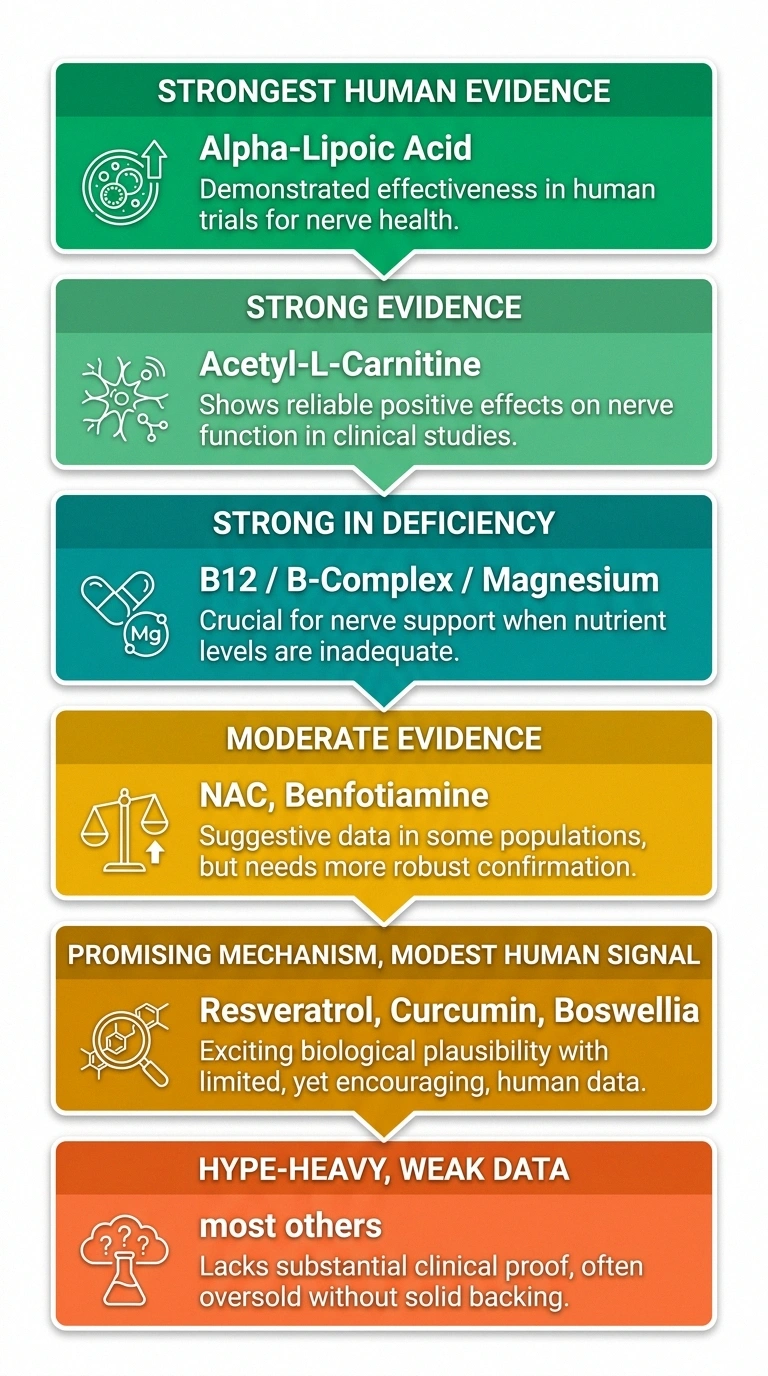
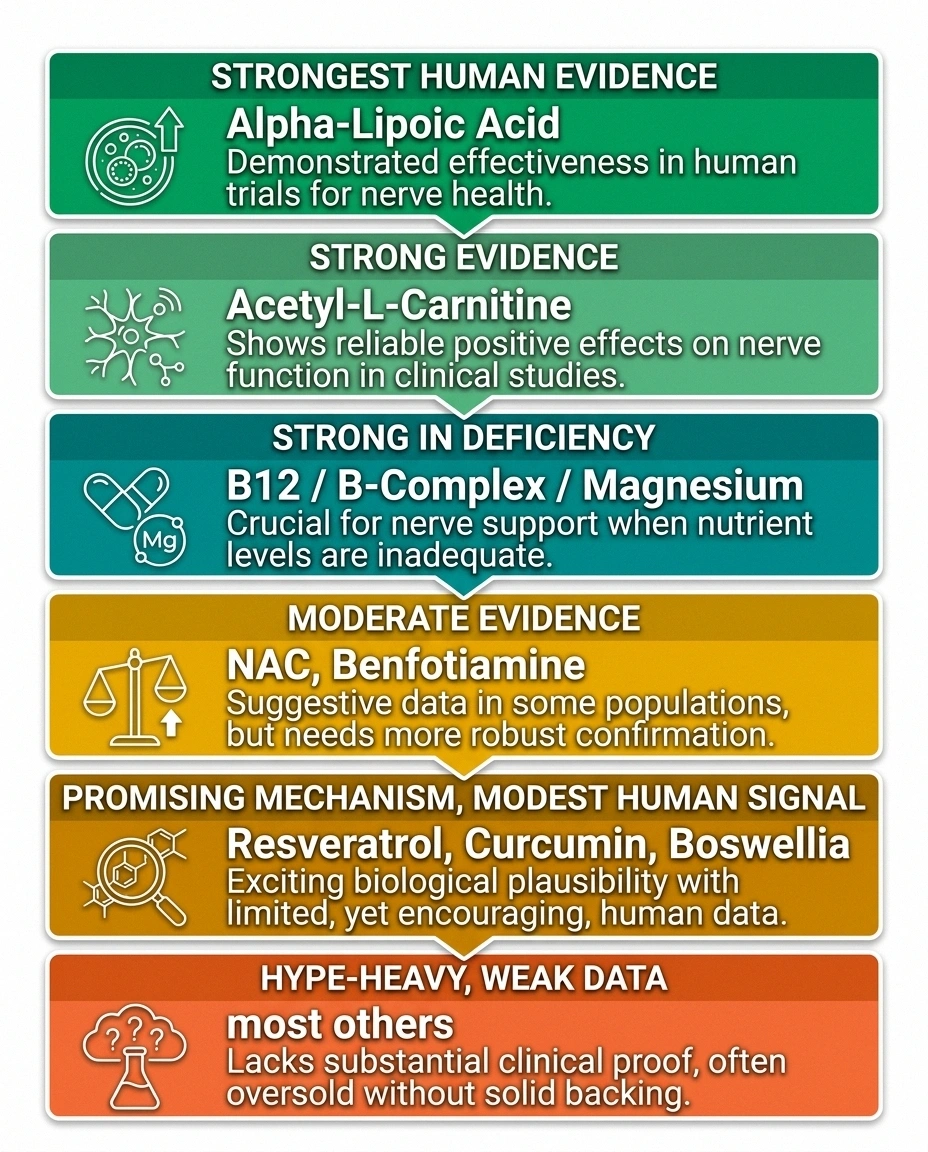
If you asked me to rank the supplements people in our group have actually tried for neuropathy by evidence strength in humans, the rough order would be: alpha-lipoic acid at the top with the strongest body of human trials, then acetyl-L-carnitine, then B vitamins where deficiency exists, then NAC, then magnesium where deficiency exists. Resveratrol sits below those — a tier I'd call “promising mechanism, modest human signal, under-studied.”
That doesn't mean it's worthless. It means that if budget and pill burden are limited, you'd put your money on alpha-lipoic acid before resveratrol. If you've already covered the basics and want to layer something additional with low downside, resveratrol is reasonable.
It also doesn't mean future trials won't push it up the ladder. The bioavailability problem is genuinely solvable — there are intravenous and improved-absorption preparations being studied in academic settings — and a larger, longer human trial showing clearer benefit would change the conversation. If that happens, I'll update this page.
What I Told Eleanor

Here is roughly what I said back to her over those heirloom tomatoes:
“Eleanor, you've already got your A1C under 7, you take your B-complex, you walk every morning, and you've been on alpha-lipoic acid for two years. If you want to add resveratrol on top of that and try it for three months, you're not wasting your money — you're running a small, reasonable experiment on yourself. Get the trans-resveratrol form, not the cheaper kind. Take it with your eggs and avocado breakfast. Keep a little pain diary. If you feel something, great. If you don't feel anything by Thanksgiving, stop and try something else.”
She nodded, bought the tomatoes and the capsules, and bought me a small jar of local honey because she said I just saved her from buying the marketing instead of the supplement. That, more than the chemistry, is what I want you to take away. Reversing neuropathy isn't on any one supplement's resume. But running smart, time-bound, evidence-shaped experiments on what helps you, one at a time, is the most honest version of what nerve health actually looks like. Resveratrol is one possible item on that experiment list. Now you know how to think about it.
Frequently Asked Questions
Can I just drink red wine instead of taking the capsules?
The amount of resveratrol in red wine is roughly a thousand times less than what's used in clinical trials. You would need to drink an impossible volume of wine to get a study-comparable dose, and the alcohol load would harm your nerves long before any resveratrol effect appeared. Wine and resveratrol supplementation are two separate conversations.
How long until I feel anything?
If you're going to respond, the first hints typically come around weeks 6 to 10 and a clearer pattern by weeks 12 to 16. Nerve cells regenerate slowly, and subjective symptoms lag behind any underlying biology. Don't judge it before three full months.
Is the cheap grocery store version the same as the premium brand?
Quality varies a lot. Look for the words “trans-resveratrol” on the label and a percent figure (98 percent trans-resveratrol is typical for a good product). Be wary of very cheap bottles that don't specify form, because some products contain mostly cis-resveratrol (the inactive isomer) or unstandardized plant extracts that may have very little active compound.
Does it matter what time of day I take it?
Probably not. The very short half-life of free resveratrol in the blood means timing within the day doesn't have a strong rationale either way. Taking it with the meal you're most likely to remember and the one with the most healthy fat is more important than timing.
Will resveratrol help if my neuropathy is from chemotherapy, not diabetes?
The direct human evidence is mostly in diabetic peripheral neuropathy. The mechanisms — reduced inflammation, oxidative stress protection, mitochondrial support — apply to other neuropathies in principle, but the trial evidence is thinner. Reasonable to try with the same timeline and tracking approach.
Can I take resveratrol with alpha-lipoic acid?
Generally yes. They work through partly different mechanisms and the combination is benign in most people. They're not formally proven to be more effective together, but the antioxidant overlap doesn't create a safety problem.
What about pterostilbene, the cousin compound I keep seeing advertised?
Pterostilbene is a methylated relative of resveratrol with better bioavailability — your liver doesn't metabolize it as fast. The mechanism overlap is real, but the human trial evidence is even thinner than for resveratrol itself. It's a reasonable thing to read about, not a reasonable thing to make a big purchase on yet.
Will my doctor know what this is if I ask?
Most primary care doctors and endocrinologists will recognize the word and know it as a polyphenol supplement with weak human evidence. Some will be enthusiastic, some will be neutral, most will have no objection if you bring it up alongside your other medications. The most important conversation isn't asking permission — it's making sure your prescriber knows you're taking it so interactions with your other medications can be considered.
About the Author