
There's a particular sinking feeling that comes when your doctor looks at you across the desk and says, “I think we should try something different.” If the medication you're on isn't working well enough, you might feel relief that someone finally agrees. But underneath that is almost always a quieter worry: what happens to my pain while we make the change? Will I be left with nothing? Will stopping this make me feel terrible? Did I do something wrong that it didn't work?
I've watched a lot of people in my support group go through medication switches, and I've been through more than one myself. The process is far less frightening when you understand how it's supposed to work. So let's walk through it together — not so you can do it yourself, because this is firmly a doctor-led process, but so you can be an informed partner in it instead of a passenger who doesn't know where the car is going.
I want to be clear up front about what this article is and isn't. It is a plain-language explanation of how medication switching works and what questions to ask. It is not a set of instructions or dose schedules for you to follow on your own. Specific tapering numbers belong to you and your prescriber, calibrated to your exact situation. What I can give you is the map, so the territory feels less strange.
First, the Thing Nobody Tells You: Switching Is Normal
Here is a fact that takes the shame out of this immediately. The main first-line medications for nerve pain — gabapentin, pregabalin, duloxetine, the tricyclics like amitriptyline and nortriptyline — each provide meaningful relief for only about one in three or one in four people who try them. That's not a knock on the drugs. That's the nature of neuropathic pain, which is stubborn and varies enormously from person to person.
Needing a second or third medication is the expected path
The main first-line nerve pain drugs each help only about 1 in 3 or 4 people who try them. Switching is the normal way this is worked through — not your failure, and not really the drug's. It just wasn't the right key for your lock.
What this means in practice is that needing to try a second or even third medication is the expected path, not a sign of failure — not your failure, and not really the drug's failure either. It just didn't happen to be the right key for your particular lock. Doctors expect this. The treatment guidelines explicitly anticipate it. When you reframe a switch as “we're working through the options the way this is supposed to be done,” it stops feeling like a defeat and starts feeling like progress.
“It Didn't Work” vs. “It Never Got a Fair Trial”
Before you and your doctor conclude a medication has failed, it's worth knowing what a real trial of a nerve pain drug looks like — because a surprising number of “failed” medications were never actually given a fair chance.
Most of these medications have to be started low and increased slowly over weeks. That slow climb isn't bureaucratic caution; it's how the body tolerates them without overwhelming side effects. The catch is that the dose that actually controls pain is often well above the starting dose, and it takes time to titrate up to it and then several more weeks at that effective dose to judge the result fairly. Many people stop at a low dose after a week or two, conclude “this doesn't work,” and move on — when in reality the drug never reached the level or duration where it could have helped.
This distinction matters enormously when you're deciding whether to switch. A genuinely useful conversation with your doctor includes the question: “Did this medication get an adequate trial — the right dose for long enough — or did we stop before it had a real chance?” Sometimes the better move isn't a different drug; it's a more patient run at the current one. Our guide on what to do when neuropathy medication stops working goes deeper into telling these situations apart.
Why You Cannot Just Stop the Old One

If there's a single safety message in this whole article, it's this: nerve pain medications should almost never be stopped abruptly.
“It wasn't working, so I just stopped” is one of the riskier moves
A drug not controlling pain doesn't mean your body hasn't adapted to it. Abrupt stops can cause withdrawal, a worse-than-before pain rebound, and with some medications more serious risks. Coming off is its own supervised step — never an afterthought.
Your body adapts to these drugs being present. That adaptation is normal and isn't addiction — it's the same reason many ordinary medications need to be tapered. But it means that stopping suddenly can cause a withdrawal reaction. Depending on the medication, abrupt discontinuation can bring anxiety, insomnia, sweating, nausea, dizziness, the unpleasant “brain zaps” some people get coming off certain antidepressants, and — importantly — a sharp rebound of your nerve pain that can be worse than where you started. With some medications, abrupt withdrawal carries more serious risks.
This is why “the medication isn't working, so I just stopped taking it” is one of the riskier things a person can do on their own, even when the logic feels sound. The drug not controlling pain well doesn't mean your body hasn't adapted to it. Coming off is its own carefully managed step, not an afterthought.
What Cross-Tapering Actually Is
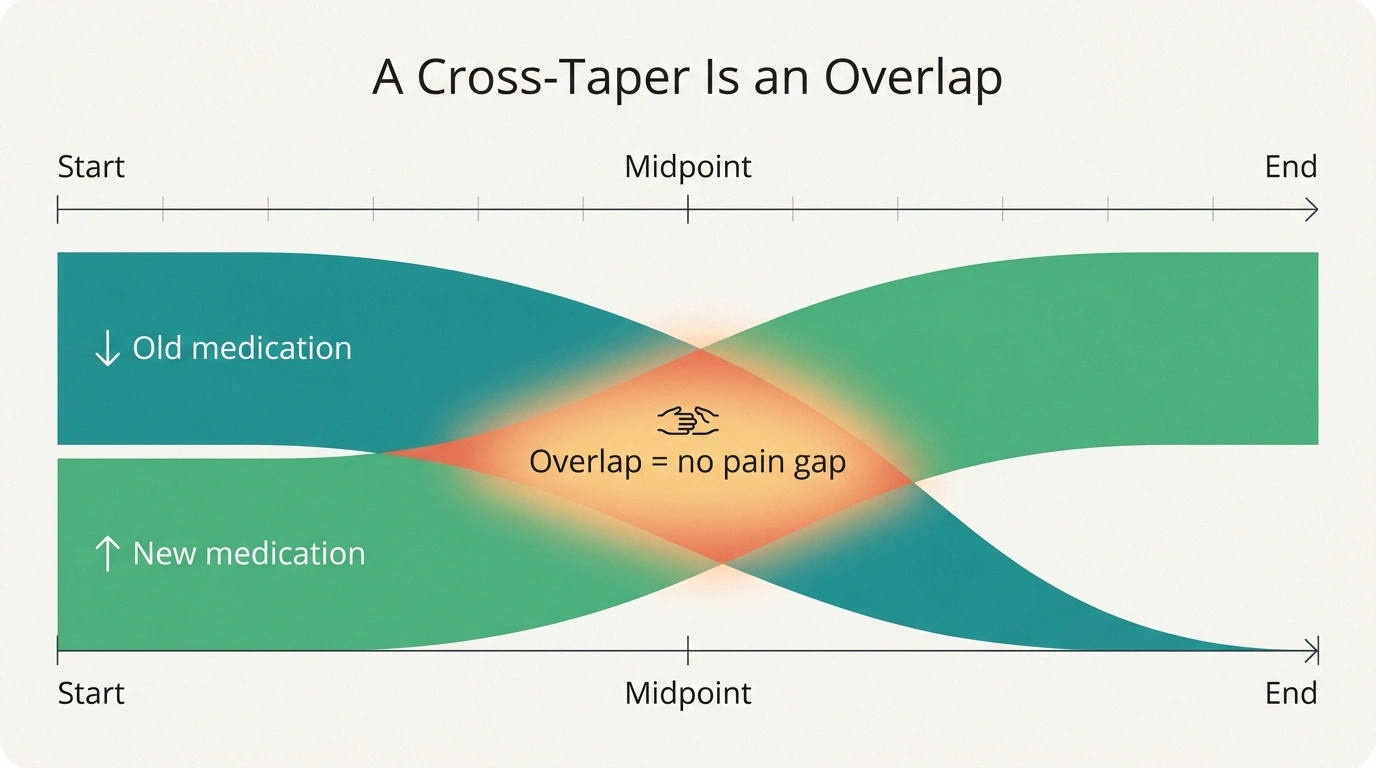
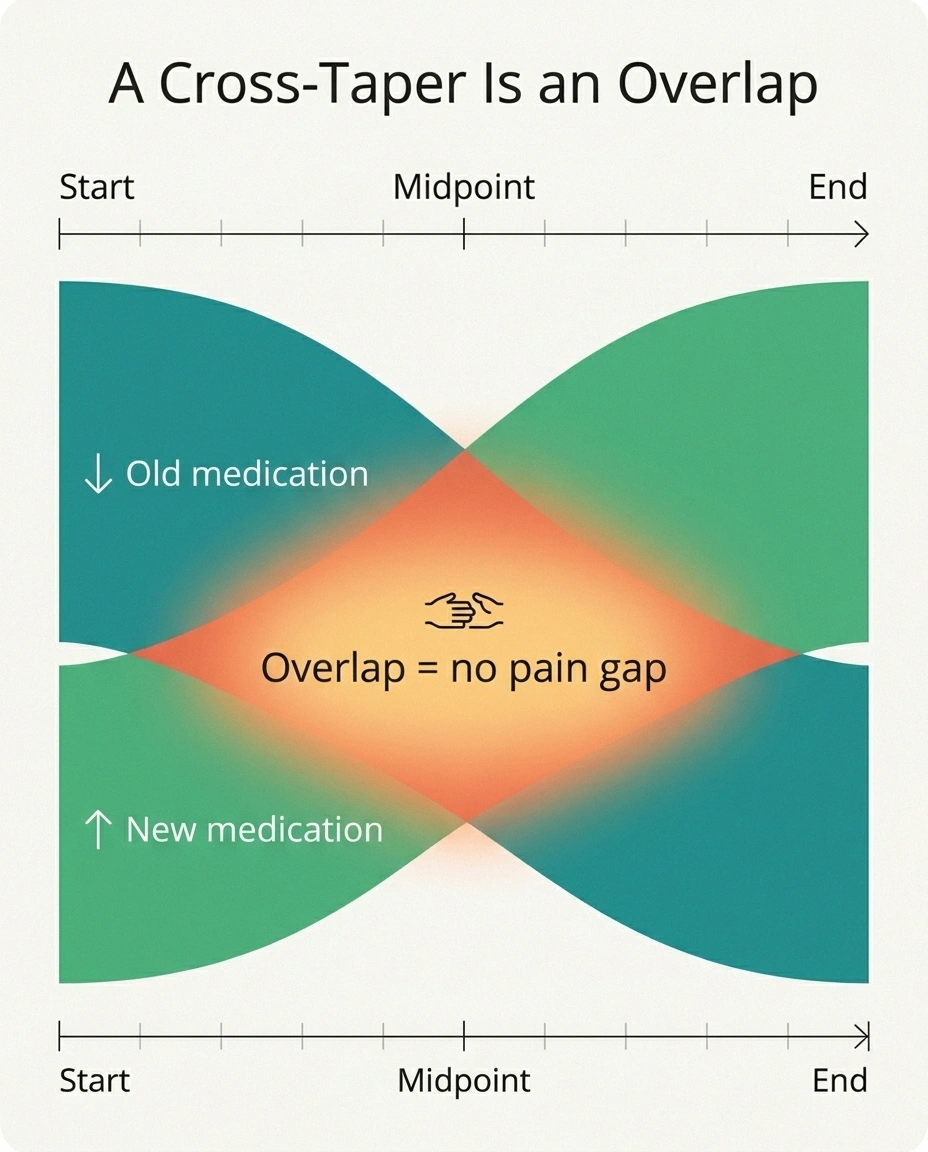
Here's the concept that makes the whole process click, and it's genuinely reassuring once you see it.
Cross-Taper: An Overlap, Not a Gap
The current medication is reduced step by step — but stays in place while the new one is being built.
The new medication is introduced and increased gradually alongside the old one.
You cross on the new bridge before the old one comes down. The overlap is the whole point — it keeps you out of the water.
When doctors switch you from one nerve pain medication to another, they usually don't stop the first and then start the second. Instead, they use what's called a cross-taper or cross-titration: the old medication is slowly reduced step by step while the new medication is gradually introduced and increased, with a deliberate period where the two overlap.
Think of it like crossing a river on two bridges. You don't demolish the first bridge and then start building the second while you're standing in the water. You build the new bridge alongside the old one, walk across as it's completed, and only then take the old one down. The overlap is the entire point — it's what keeps you from falling into a gap of unmanaged pain in the middle.
The exact pace of that overlap depends on which two medications are involved, your doses, how long you've been on the first one, your other conditions, and how you respond along the way. Some switches can move relatively quickly; others, especially off long-term or higher-dose treatment, are deliberately slow. This is exactly why the specific schedule is your prescriber's job and not something to copy from an article — including this one. What you should take away is the principle: a good switch is an overlap, not a gap.
What the Transition Actually Feels Like

People tolerate switches very differently, but knowing the general shape helps you not panic at normal bumps.
People abandon a switch during the uncomfortable middle window — before the new drug ever reached the dose where it could help. Knowing in advance that the middle is the rough part, and it's expected, makes it far easier to ride out with your doctor instead of bailing early.
In the early part of a cross-taper, you're often on a reduced dose of a drug that wasn't fully working anyway plus a low, still-building dose of the new one. It's common for this stretch to feel a little rough — your pain may be more noticeable and you may feel the new drug's start-up side effects (drowsiness, a foggy head, nausea, dizziness) before you feel its benefit. This is usually the hardest window, and it's also usually temporary.
As the new medication climbs toward an effective dose and your body settles into it, side effects often ease and pain control typically improves. The mistake I see most often is people abandoning a switch during that uncomfortable middle window, before the new drug ever reached the dose where it could help. Knowing in advance that the middle is the rough part — and that it's expected — makes it much easier to ride out with your doctor rather than bailing early.
Tell your prescriber what's realistic for your life, too. If you can't be foggy and nauseated during a critical work week or a family event, the timing and pace can often be adjusted. This is a collaboration, and your daily life is legitimate information for it.
Protecting Your Pain Control in the In-Between
The single biggest fear people bring to a switch is being left with nothing for the pain during the changeover. Naming that fear out loud to your doctor is one of the most useful things you can do, because there are real ways to address it.
The overlap of the cross-taper is the first line of defense. Beyond that, your prescriber may build in a plan for the rougher days — non-drug tools you can lean on harder during the transition, adjustments to timing so the worst side effects land when you can absorb them, and clear instructions on what to do and who to call if your pain spikes badly rather than just enduring it silently. There is almost always a contingency plan available; you just have to ask for it explicitly rather than assuming you'll be on your own.
Why Doctors Switch (the Reasons Behind the Decision)

Switching usually comes down to one of a handful of reasons, and knowing which one applies to you sharpens the conversation.
Know Which Problem You're Solving
Maxed out the tolerable dose, still not enough.
It worked but the cost was too high.
A new prescription or condition changed the fit.
A legitimate reason — and nothing to be embarrassed about.
The most common is inadequate relief at the maximum dose you can tolerate — you climbed as high as the side effects allowed and it still wasn't enough. The second is intolerable side effects — the drug might control pain, but the swelling, weight gain, sedation, or mental fog cost more than it's worth. Others include a drug interaction with something new you've been prescribed, a new medical reason the current drug is no longer a good fit, or simply cost and access, which is a perfectly legitimate reason and one many people are embarrassed to raise but shouldn't be.
Each of these points toward different alternatives. “It didn't work” leads somewhere different than “it worked but wrecked my balance.” When you can tell your doctor clearly which problem you're actually trying to solve, you both make a better choice. Our guides to the individual options — gabapentin, pregabalin, duloxetine, amitriptyline, and nortriptyline — can help you understand what each brings and costs before that appointment.
Sometimes the Answer Is “Add,” Not “Replace”
One option people often don't realize exists: the answer to a partially-working medication isn't always a full switch. Sometimes it's a combination.
If a drug is giving you, say, 40% relief with manageable side effects, completely abandoning it to chase a different single drug means gambling that 40% on an unknown. An alternative your doctor may consider is keeping it (sometimes at a lower dose) and adding a second medication from a different class that works by a complementary mechanism, so the two together do more than either alone — often at lower doses of each, which can mean fewer side effects than pushing one drug to its maximum. This isn't right for everyone or every combination, and some pairings have their own risks, which is why it's a prescriber's call. But it's worth knowing “switch” and “combine” are both on the table, so you can ask which makes more sense for you.
The Questions Worth Bringing to the Appointment

This is the part to actually use. When a switch is on the table, walking in with a few clear questions changes the entire quality of the conversation. Our broader guide to talking to your doctor about neuropathy pain and the companion piece on questions to ask before starting a neuropathy medication are worth reading alongside this, but here's the switch-specific shortlist.
Bring These to the Appointment
- Did the current drug get a fair trial — right dose, long enough?
- Are we switching or combining, and why that for me?
- What's the cross-taper schedule, and when will I know if it works?
- What should the rough middle feel like — and what's not normal?
- What's the plan if my pain spikes badly? Who do I call?
- Any interactions with my other medications or supplements?
- Is there a lower-cost option that's clinically reasonable?
Ask: Did the current medication actually get a fair trial — right dose, long enough — or should we try that first? Are we switching or combining, and why that choice for me? What does the cross-taper schedule look like, and roughly how long until I know if the new one works? What should I expect to feel during the rough middle stretch, and what's not normal? What's the plan if my pain spikes badly during the change — what do I do and who do I call? Are there interactions with my other medications or supplements I should know about? Is there a lower-cost option that's clinically reasonable?
You don't have to fire all of these at once. Even two or three of them transform the appointment from something that happens to you into something you're steering with your doctor.
A Last Word of Reassurance
Switching neuropathy medications is one of the most ordinary, well-trodden steps in living with this condition. It is not evidence that your case is hopeless or that you've run out of options — usually it means the opposite, that there are still options to work through. The fear that the changeover means abandonment is almost always solvable once you say it out loud and ask for the plan that addresses it.
The people I've watched come through switches best weren't the ones who suffered in silence or quietly stopped their pills out of frustration. They were the ones who treated it as a project they were doing with their doctor — informed, asking questions, reporting honestly how the middle felt, and trusting the bridge to be finished before the old one came down. You can be that kind of patient. Knowing how the process works, which is what you now do, is most of the way there.
Frequently Asked Questions
Can I just stop my nerve pain medication if it isn't working?
No. Even if a medication isn't controlling your pain well, your body has still adapted to it, and stopping abruptly can cause withdrawal symptoms and a sharp rebound of nerve pain that can be worse than where you started. With some medications, abrupt discontinuation carries more serious risks. Coming off a medication is a separate, carefully managed step that should always be done with your prescriber, not on your own.
What is cross-tapering?
Cross-tapering, or cross-titration, is the standard safe method for switching between two nerve pain medications. Instead of stopping the old drug and then starting the new one, the doctor gradually reduces the old medication while gradually introducing and increasing the new one, with a deliberate overlap period. That overlap is what prevents a gap of unmanaged pain during the change.
How long does it take to switch neuropathy medications?
It varies widely depending on which medications are involved, your doses, how long you have been on the first drug, and how you respond. Some switches move over a couple of weeks; others, especially coming off long-term or higher-dose treatment, are deliberately slower. Because the new medication also has to be titrated up to an effective dose, it can take several weeks to know whether the new drug truly works. Your prescriber sets the specific schedule.
Will my pain get worse while switching?
There is often a rough middle window where you are on a reduced dose of the old drug and a still-building dose of the new one, and pain can be more noticeable then while start-up side effects appear before the benefit. This stretch is usually temporary and improves as the new medication reaches an effective dose. Ask your doctor in advance for a plan to cover bad days during the transition so you are not left enduring a spike silently.
How do I know if a medication truly failed or just needs more time?
A fair trial usually means the medication was titrated up to an effective or maximum tolerated dose and stayed there for several weeks, not stopped after a low dose for a week or two. Many medications labeled failures never actually reached the dose or duration where they could work. Asking your doctor directly whether the current drug had an adequate trial is one of the most useful questions before deciding to switch.
Is switching medications a sign my neuropathy is getting worse or untreatable?
Usually not. The main first-line nerve pain medications each help only about one in three or four people, so trying a second or third option is the expected, normal path that treatment guidelines anticipate. Needing to switch generally means there are still options to work through, not that you have run out of them.
Can I take two neuropathy medications at once instead of switching?
Sometimes. If a medication gives partial relief with tolerable side effects, a doctor may consider keeping it and adding a second drug from a different class that works by a complementary mechanism, often at lower doses of each. This is not appropriate for everyone or every combination, and some pairings carry their own risks, so it is a prescriber's decision. It is worth asking whether combining rather than fully switching makes sense for your situation.
What withdrawal symptoms can happen when stopping gabapentin or duloxetine?
Abruptly stopping these medications can cause symptoms such as anxiety, insomnia, sweating, nausea, dizziness, the “brain zap” sensations some people get coming off certain antidepressants, and a rebound of nerve pain. This is why both are tapered gradually rather than stopped suddenly, and why any change should be planned and supervised by your prescriber rather than done on your own.
About the Author