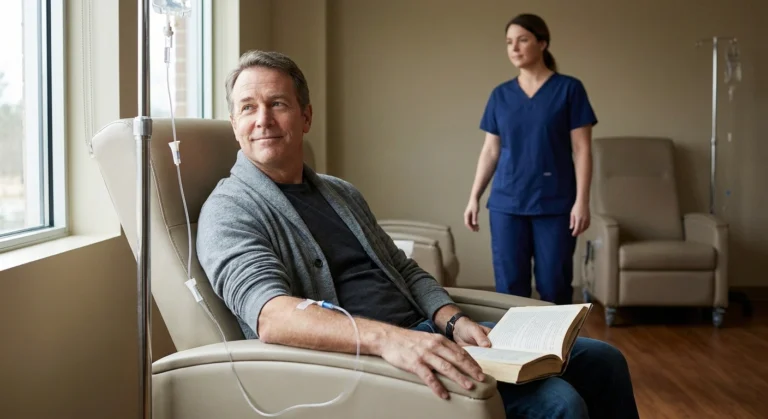
The phone call I dreaded came on a Tuesday morning. My friend Carol had been on gabapentin for two years for her diabetic neuropathy, and it had given her her evenings back — she could finally read in the recliner without her feet screaming at her. Then, slowly, the relief started fading. By the time she called me, she was right back where she had started, swallowing the same dose of the same pill and feeling nothing from it. “Janet,” she said, “I think I'm out of options.”
She wasn't. She was actually about three or four good options away from out of options, and the conversation we had that morning is the conversation I want to have with you now if you've reached the same wall.
“My medication stopped working” is one of the most common things I hear in our support group. It's also one of the most fixable — but only if you understand what's actually happening, and only if you don't make the two big mistakes most people make: stopping the pill on your own, or just begging the doctor for “something stronger.” Neither one solves the real problem.
This is the framework I wish someone had handed me years ago.
What “Stopped Working” Actually Means
Before you decide your medication failed, it's worth being precise about what's changed. There are at least five very different reasons a medication can feel like it stopped working, and each one has a different fix.
The dose was never high enough to begin with. This is the most common reason, by a wide margin. Most people are started on a “test dose” of gabapentin — say 300 mg three times a day — and stay there for years because the doctor never bumped them up and they never asked. The actual therapeutic range is much higher (usually 1,800 to 3,600 mg per day, divided across three doses). If the partial relief you got was as far as the dose ever climbed, the medication didn't fail you. The titration did.
You never gave it long enough at the right dose. Gabapentinoids need four to eight weeks at a therapeutic dose to show their full effect. SNRIs like duloxetine and tricyclics like nortriptyline need six to twelve weeks. If you abandoned the trial after three weeks because you didn't feel anything, you didn't actually finish the trial.
Your body has adjusted to the medication. This is a real phenomenon — it's called tachyphylaxis. With gabapentinoids especially, the body can become less responsive to the same dose over time. Sometimes a dose increase fixes it; sometimes a switch to a different drug class is needed.
Your underlying condition is progressing. If your diabetes isn't well-controlled, if your B12 has dropped, if your thyroid is out of range, the medicine isn't shrinking — the problem is growing. The medicine is doing the same job; the disease is just outpacing it.
Key Takeaway
“My medication stopped working” usually has a fixable cause. Most often: the dose was never high enough to begin with, or something new is interfering. Don't stop the medicine on your own, then walk through five steps with your doctor: verify how you're taking it, confirm a real therapeutic dose, address what's changed underneath, then consider switching or adding.
Something new is interfering. A new medication, a new supplement, a change in eating habits, alcohol, a new pain that's actually nerve-related but happening somewhere else — any of these can muddy the picture and make it look like your old reliable pill stopped working.
Step One: Don't Stop the Medicine
I'm putting this first because it's the single most important rule, and it's the one most people get wrong.
Stop — Don't Stop the Pill
Sudden discontinuation of gabapentin, pregabalin, duloxetine, or nortriptyline can cause withdrawal: anxiety, insomnia, sweating, brain zaps, and (rarely) seizures. The risk grows with longer use and higher doses.
The right way: a slow taper supervised by your doctor — usually about 25% per week, paced to your tolerance.
Do not stop gabapentin, pregabalin, duloxetine, nortriptyline, or any nerve pain medication abruptly. Even if you think it's doing nothing. Even if you're frustrated. Even if you're sure.
Gabapentinoids in particular have a withdrawal syndrome: anxiety, insomnia, sweating, tremor, racing heart, and in rare cases, seizures, especially in people who had no seizure history before. The risk goes up the longer you've been on it and the higher the dose. Sudden stops are how people end up in the emergency room.
SNRIs like duloxetine cause a different kind of withdrawal — “discontinuation syndrome” — with brain zaps, dizziness, nausea, mood swings, and sometimes weeks of misery. Tricyclics can cause cholinergic rebound (sweating, agitation, GI upset).
The right way to come off any of these, if it comes to that, is a slow taper supervised by your doctor. A typical schedule is reducing by about 25% per week, but the right pace depends on your dose, how long you've been on it, and how you tolerate each step down.
The decision to stop a medication is a doctor's-office conversation, not a kitchen-counter one.
Step Two: Make Sure You're Actually Taking It Right
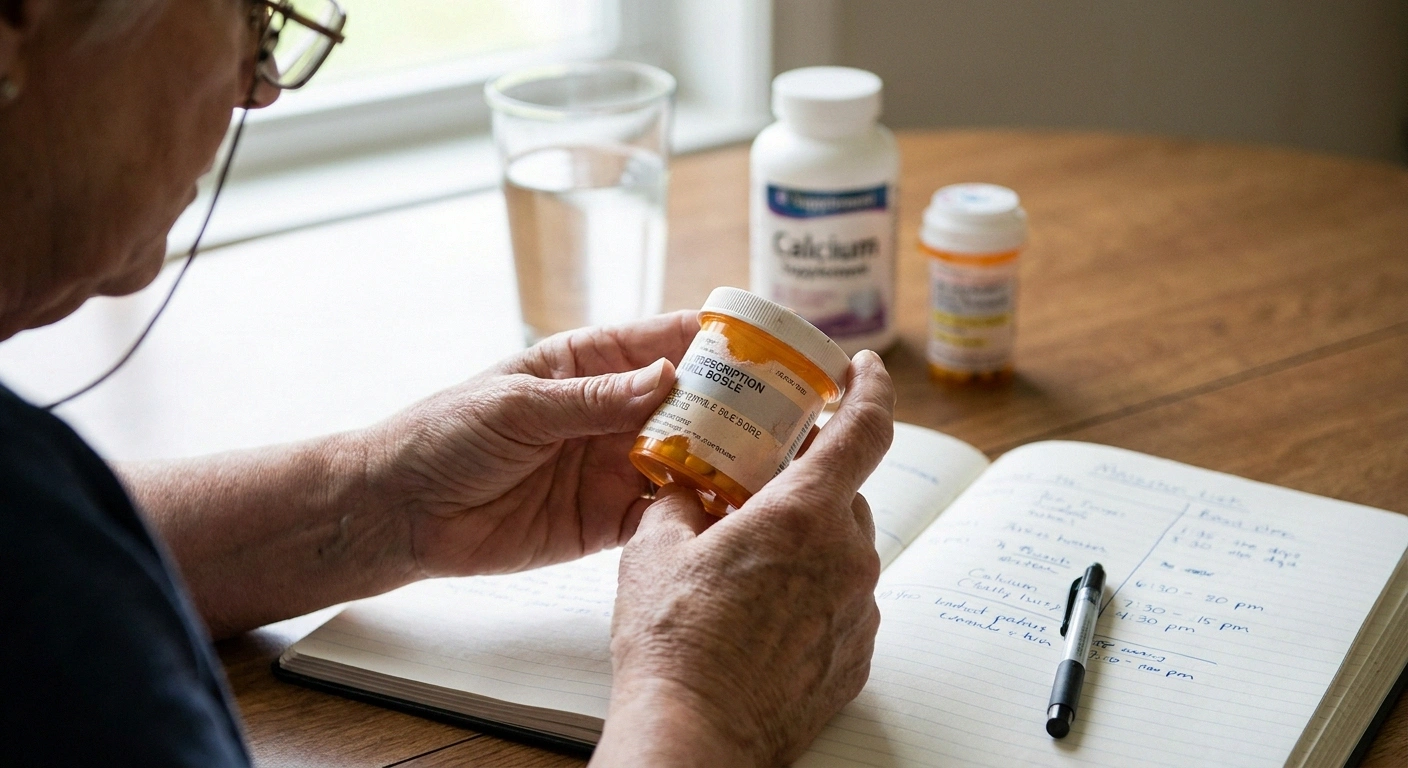
This sounds obvious. It is not obvious. I have watched dozens of people swear their medication stopped working when the real problem was that something about how they were taking it had changed.
Walk through these honestly:
- Are you taking every dose? Missing one of three daily doses, especially the middle-of-the-day one, is extremely common with three-times-daily regimens. Even a few missed doses per week can take the steady drug level down enough to feel different.
- Is the timing the same as before? Gabapentin has a short half-life. Spacing doses too far apart (say, 6 a.m., 4 p.m., midnight) gives you valleys of poor coverage in the afternoon and overnight that you wouldn't get on a tighter schedule (8 a.m., 2 p.m., 8 p.m.).
- Are you taking it with food the same way? Food slows gabapentin absorption but increases the total amount absorbed. Switching from “with breakfast” to “before bed on an empty stomach” can change how you feel.
- Did the manufacturer change? Generic gabapentin and pregabalin are bioequivalent on paper, but a small percentage of patients notice differences when their pharmacy switches manufacturers. Look at your bottle. Different shape or color than last time?
- Are you on any new medications? Antacids (especially calcium-based ones taken within two hours) reduce gabapentin absorption by about 20%. New blood pressure pills, statins, antidepressants, or even an antibiotic course can shift things.
I once had a friend convinced her pregabalin had quit on her. We sat down and walked through her day. Turns out she had started taking a calcium-and-magnesium supplement at bedtime, right when she took her pregabalin. Moving the supplement to morning fixed the problem in three days. The drug hadn't failed. The mineral had blocked it.
Step Three: Have You Actually Reached a Therapeutic Dose?
This is the conversation most people skip. Here's what therapeutic actually looks like for the most common nerve-pain medications:
Therapeutic Dose Ranges — Common Neuropathy Medications
Gabapentin (Neurontin)
1,800–3,600 mg/day divided into 3 doses. Many patients are stuck at 900 mg/day for years.
Pregabalin (Lyrica)
300–600 mg/day divided into 2-3 doses. Below 150 mg/day is usually subtherapeutic.
Duloxetine (Cymbalta)
60 mg/day typical neuropathy dose; 120 mg max for refractory cases.
Nortriptyline / Venlafaxine
Nortriptyline 25–100 mg at bedtime. Venlafaxine 150–225 mg/day for nerve pain effect.
If you're below the lower end of these ranges, the conversation isn't “switch drugs” — it's “should we titrate first?”
- Gabapentin (Neurontin): 1,800 to 3,600 mg per day, divided into three doses. Maximum effect typically requires reaching at least the lower end of this range. Many people are stuck at 900 mg per day for years.
- Pregabalin (Lyrica): 300 to 600 mg per day, divided into two or three doses. Below 150 mg total per day is usually subtherapeutic for nerve pain.
- Duloxetine (Cymbalta): 60 mg daily is the typical neuropathy dose; 120 mg is the maximum for refractory cases. Below 30 mg is unlikely to do much.
- Nortriptyline: 25 to 100 mg at bedtime; some patients need to push to 150 mg, which requires careful monitoring in older adults.
- Venlafaxine (Effexor): 150 to 225 mg daily for nerve pain effect; below 75 mg is mostly an antidepressant dose with little neuropathy benefit.
If you're below the lower end of these ranges and “the medication stopped working,” the most important conversation with your doctor isn't “let me try something stronger” — it's “should we try going up first?” A real titration to a therapeutic dose, paced carefully so you don't get knocked over by sedation, often brings the relief back.
Step Four: Look at What's Changed Underneath

Sometimes the medication is doing exactly what it always did, and the underlying neuropathy is what's getting worse.
Things to check or have your doctor check:
- Hemoglobin A1c. If you have diabetic neuropathy and your A1c has crept up from 6.8 to 8.2 over two years, the diabetes is doing more nerve damage than the gabapentin can mask.
- B12 level. If you're on metformin, an acid blocker (omeprazole, pantoprazole), or are 60+ and eat little meat, your B12 may have quietly fallen. Low B12 worsens any neuropathy. Treat it and the original medication often works better.
- Vitamin D, folate, and magnesium. Less dramatic than B12 but still relevant.
- Thyroid (TSH). Hypothyroidism worsens nerve symptoms and is easy to miss.
- Kidney function. Gabapentin and pregabalin are cleared by the kidneys. If kidney function has declined, blood levels may actually be higher than expected — but if function has improved (rare), levels can be lower.
- New diagnoses. Sleep apnea, autoimmune flare, vitamin deficiencies, even a slow-burning infection can all amplify nerve pain.
Bring a list of every supplement, OTC medication, and prescription you take to your next appointment. Not the abbreviated list — every single thing. Your doctor can spot interactions you can't.
Step Five: The Switching Conversation
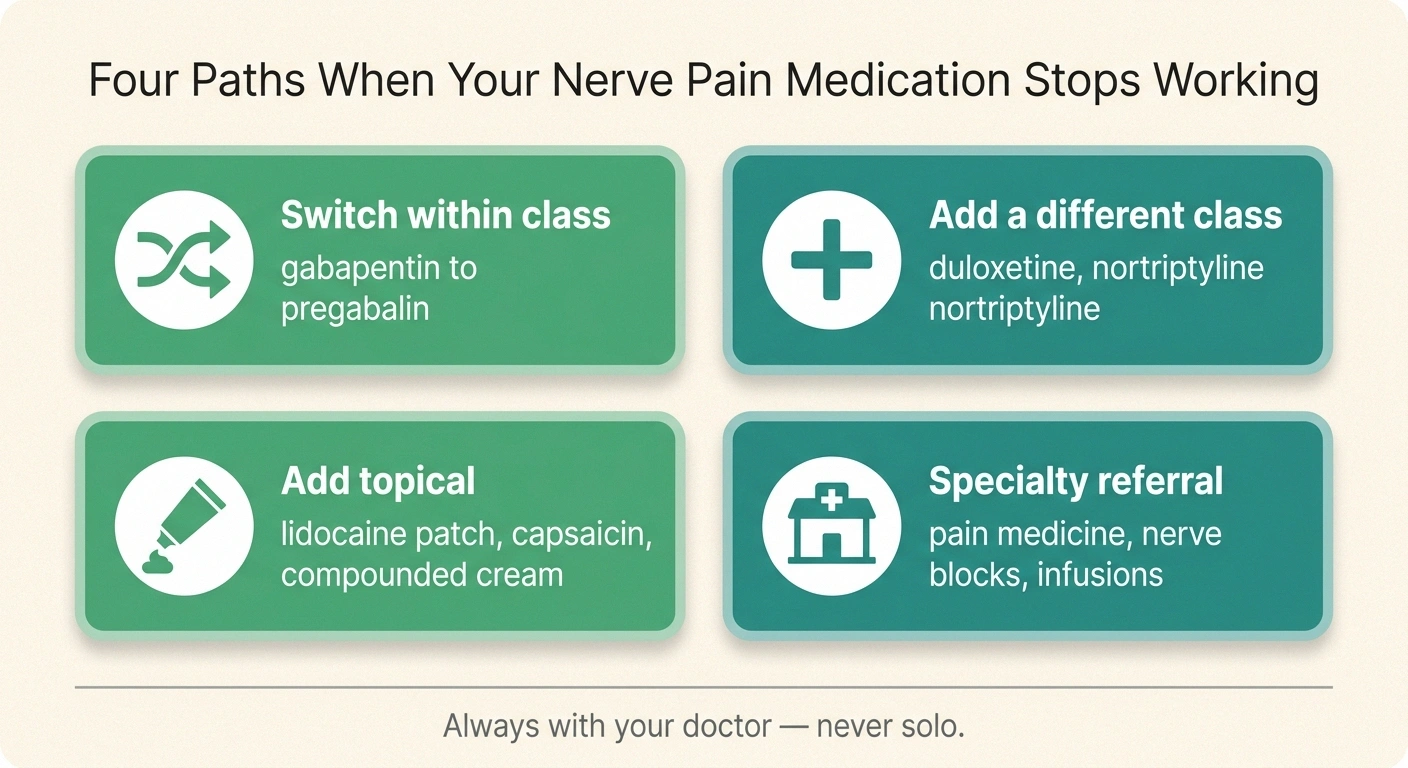
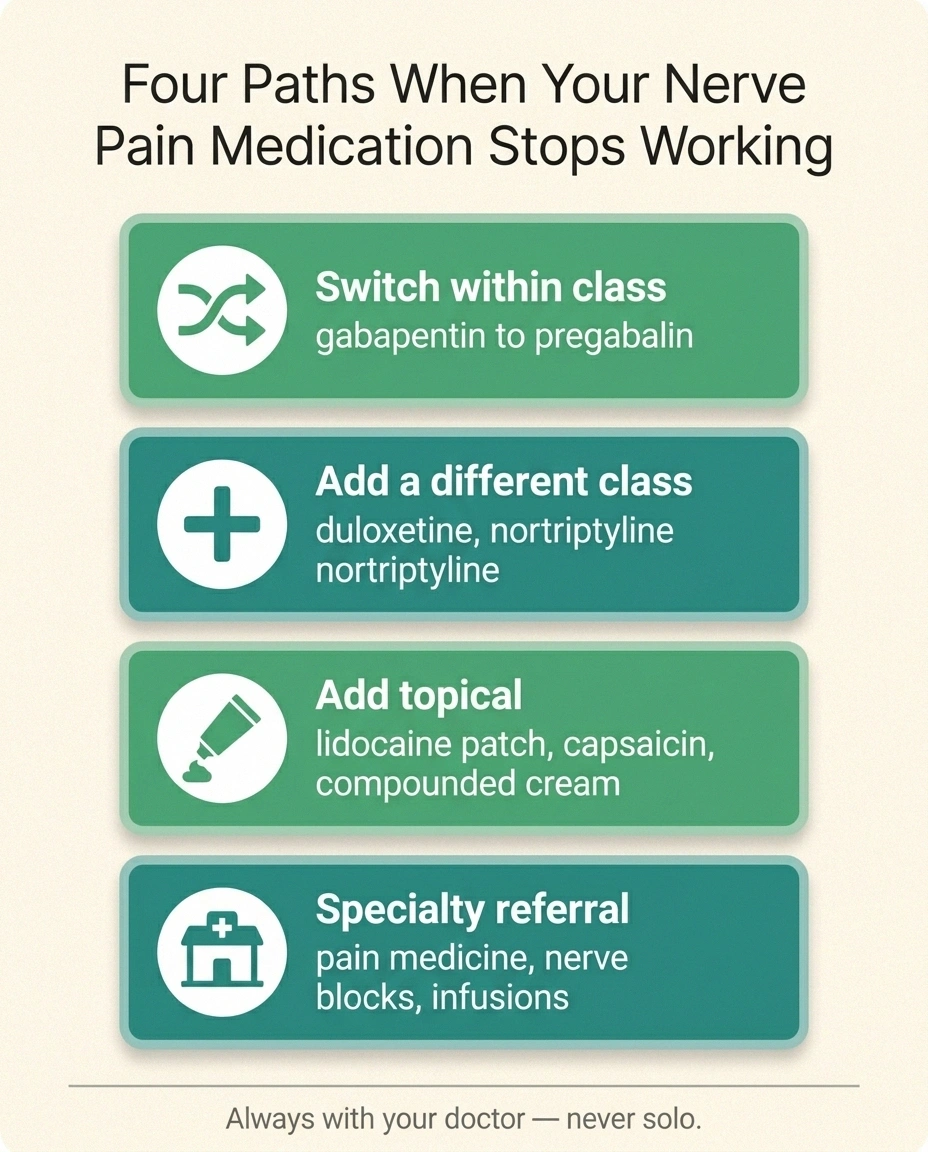
If you've optimized the dose, given it enough time, addressed the underlying drivers, and you're still not getting relief — now it's time to talk about switching or adding.
What the Evidence Says
Combination therapy beats single-drug therapy for many patients. Adding an antidepressant-class agent (duloxetine, nortriptyline, venlafaxine) to a gabapentinoid attacks the pain through two different mechanisms and is widely supported in clinical practice.
Topical lidocaine 5% patches and capsaicin can target focused painful areas without adding more systemic medication. This is one of the most under-used moves in neuropathy care.
Within the same class. Switching from gabapentin to pregabalin sometimes works because pregabalin has more predictable absorption (gabapentin absorption falls off at higher doses) and twice-daily dosing instead of three. Generic pregabalin is now affordable for most people. The switch isn't magic, but it's a real option.
Adding a different class. Combining a gabapentinoid with an antidepressant-class agent (duloxetine, nortriptyline, venlafaxine) attacks the pain through two different mechanisms. This is one of the most effective moves and is widely supported in clinical practice. The two classes are often complementary, not redundant.
Adding a topical agent. A 5% lidocaine patch (worn 12 hours on, 12 hours off) can take the edge off focused areas — the burning patch on the top of one foot, the strip down one calf. It's especially useful when oral medications give you global relief but leave one stubborn area uncontrolled. Capsaicin cream at 0.075% over-the-counter, or 8% capsaicin patch in a clinic, is another topical option. Compounded pain creams combine multiple active ingredients into one topical and are increasingly used for stubborn cases.
Tramadol or other low-dose opioids. A short trial of tramadol can sometimes break a flare. Low-dose, short-term, and only with eyes wide open about dependence risk.
Specialty referrals. Nerve blocks, ketamine infusions, and spinal cord stimulators all exist for refractory cases. A pain medicine specialist or interventional pain doctor is the right referral once oral options are exhausted.
The Add-Ons Most People Don't Try Hard Enough

Medications work better in a body that's set up to use them well. The non-pill levers are real, and they're usually under-pulled.
- Sleep. Six hours of broken sleep raises pain perception by a measurable amount. Address sleep first if you haven't.
- Blood sugar control if you have diabetes. Even modest improvements in A1c help nerve pain over months.
- Alcohol. More than two drinks a day amplifies neuropathy. Cutting back often makes existing meds work better.
- Movement. Walking, water exercise, gentle stretching — even chair exercises for those with mobility limits — improve nerve perfusion and pain modulation.
- Supplements with evidence. Alpha-lipoic acid, benfotiamine, B-complex, and magnesium all have decent supporting research. Run them by your pharmacist for interactions, but most are safe alongside prescription meds.
- Stress. Chronic stress amplifies nerve pain perception via the central nervous system. A daily ten-minute breathing or relaxation practice is small but real.
Two Mistakes to Avoid
I've watched both of these turn fixable situations into bigger problems. They're worth naming.
Two Mistakes to Avoid
1. Doctor-shopping for a stronger pill
Stacking opioids, benzos, or another sedative on top of your nerve meds usually means more side effects, more falls, and less function — not better pain control.
2. Stopping medication on your own
Withdrawal risk, rebound pain, and an unstable picture that makes it impossible for your doctor to figure out what's actually working.
The first is doctor-shopping for a stronger pill. Hopping from doctor to doctor looking for someone to prescribe you a higher dose, or an opioid, or a benzodiazepine on top of your nerve meds, is how people end up over-sedated, off-balance, and at much higher fall risk. The answer to “the pill stopped working” is rarely “stack more pills.” It's almost always “fix the dose, address the underlying issue, then consider a thoughtful switch or add-on.”
The second is going off the medication on your own. I've covered the withdrawal risks. Beyond the medical danger, going off cold-turkey then feeling worse and starting back up creates an unstable picture that makes it impossible for your doctor to tell what's actually working. Stay on what you're on, set up the appointment, walk in with a list, and make decisions together.
What to Bring to the Appointment
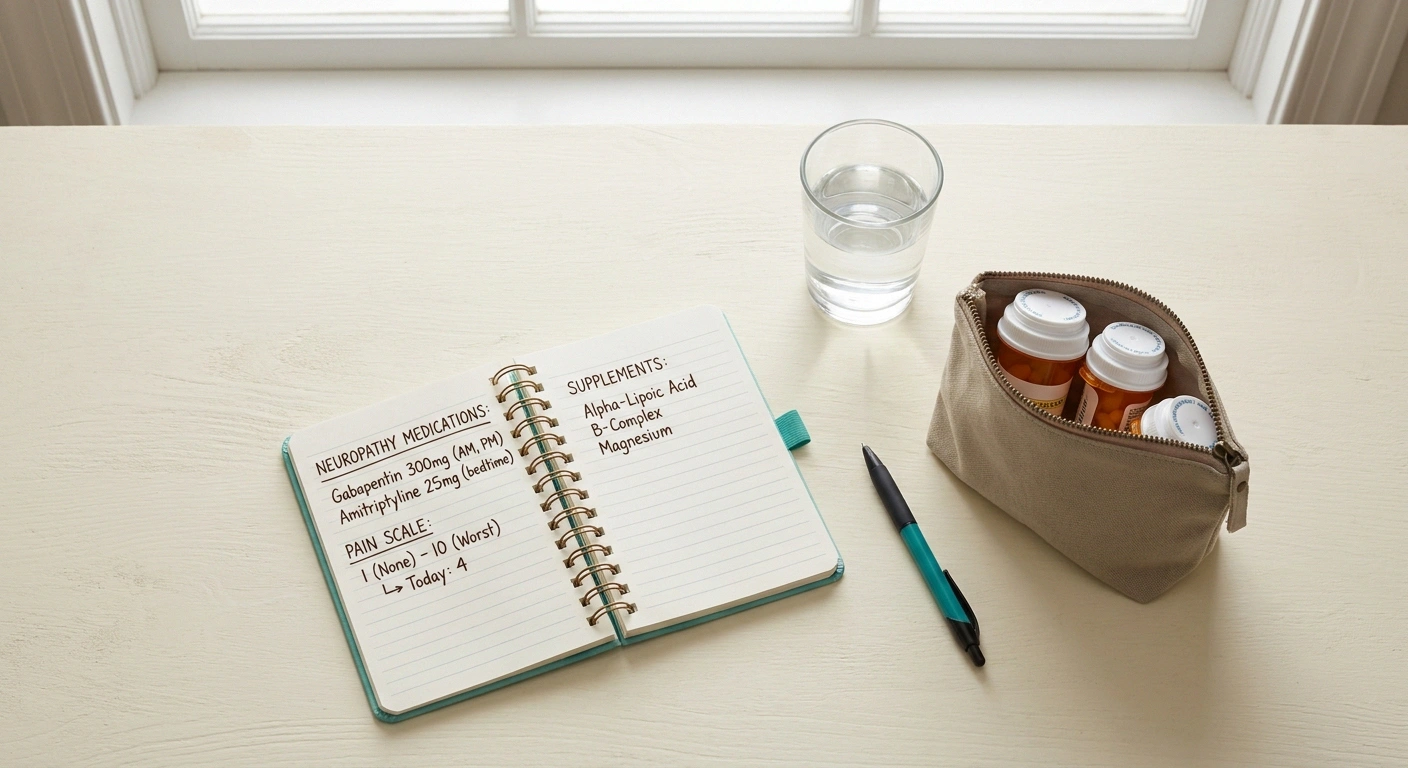
The conversation goes much better when you arrive prepared. A small notebook or a note on your phone with these items will save you from getting brushed off:
The Pre-Appointment Checklist — Bring This With You
- The exact name and dose of every medication, supplement, and OTC product you take, including timing
- When you noticed the change in effectiveness — gradual over months, or sudden over weeks
- Anything new in your life: medications, supplements, illnesses, alcohol changes, weight changes, sleep changes
- A 1-to-10 pain score for now, and your best estimate of what it was when the medication was working well
- What times of day are worst, and whether the medication's timing matches those times
- What you've already tried (heat, cold, lidocaine patches, supplements, exercise)
- One sentence about what you'd most want to be able to do again — “I want to walk to the mailbox without my feet burning”
That last one matters. Doctors prioritize differently when the goal is concrete. “Less pain” is harder to act on than “I want to be able to play with my grandson on the floor for ten minutes.”
The Honest Reality

I'll close with something that's true even though it's hard to say. Some people, even after trying every reasonable medication, every reasonable add-on, and every reasonable lifestyle change, never get back to the pain control they had at the start. The neuropathy is progressing faster than the toolkit can keep up with.
If that's where you are, it doesn't mean you've failed and it doesn't mean you're out of help. It means the goal shifts — from chasing perfect pain control to building a life that works around the pain that's left. Pacing, adaptive equipment, support groups, mental health care, and meaningful activity all become part of the toolkit alongside the medications.
But most people, when they tell me their medicine stopped working, are not at that wall. They're stuck at 900 mg of gabapentin from 2019. They never tried adding a topical. Their A1c hasn't been checked in two years. They haven't been told that combining classes works. There are still moves on the board.
Carol, the friend I started this article with? She got titrated up to 2,400 mg of gabapentin and added a low dose of duloxetine. Three months in, she's not back to where she was at her peak relief, but she's reading in the recliner again. That counts.
Frequently Asked Questions
Why did my gabapentin stop working after years?
The most common reason is that you never reached or never increased to a fully therapeutic dose, so you were always relying on partial coverage that finally became inadequate. Tachyphylaxis (the body becoming less responsive over time) is real but not the only cause. Other common reasons: your underlying neuropathy is progressing faster than the dose can keep up with, your B12 or thyroid has slipped, a new medication or supplement is interfering with absorption, or your kidney function has changed. Have your doctor recheck the dose, recheck the basics (A1c, B12, TSH, kidney function), and review every other thing you take before you assume the drug failed.
Can I just stop taking gabapentin or pregabalin if it's not working?
No, never stop these medications abruptly. Withdrawal from gabapentinoids can cause anxiety, insomnia, sweating, tremor, and in rare cases seizures, especially after long-term use or higher doses. The right way to come off is a slow taper supervised by your doctor, usually reducing by about 25% per week, with the pace adjusted to how your body tolerates each step down. Even if you're frustrated and convinced the pill is doing nothing, stay on the dose until you can talk to your prescriber.
What's the typical therapeutic dose of gabapentin for neuropathy?
Most patients need 1,800 to 3,600 mg per day, divided into three doses. Many people are kept at a starting dose like 300 mg three times daily (900 mg total) for years and never get titrated up. If you've been on a low dose with partial relief that has now faded, the first conversation is whether to increase the dose before declaring the medication a failure. Older adults and people with reduced kidney function need slower titration and lower maximum doses, but the principle still applies.
Is it safe to take gabapentin and pregabalin together?
Generally no. Both work on the same calcium channel system, so combining them rarely adds more pain relief, but it does stack the side effects: sedation, dizziness, ataxia, swelling, and confusion. The risk of falls and breathing depression goes up significantly, especially in older adults or anyone also taking opioids or sleep medications. If gabapentin is failing, the standard approach is to switch to pregabalin (one or the other), not to add them together. Always talk to your doctor before combining them.
What can I add to gabapentin if it's not working alone?
The most common add-on is an antidepressant-class nerve pain medication from a different mechanism. Duloxetine (an SNRI) or nortriptyline (a tricyclic) are common partners with gabapentin. A topical lidocaine 5% patch can target a focused painful area without adding more systemic medication. Capsaicin cream is another topical option. Compounded pain creams combine multiple active ingredients. For some patients, a short course of tramadol can break a flare. Combining classes that work through different mechanisms is more effective than just stacking similar drugs.
How long should I give a new neuropathy medication before deciding it's not working?
Gabapentinoids need 4 to 8 weeks at a real therapeutic dose. SNRIs like duloxetine and tricyclics like nortriptyline need 6 to 12 weeks at therapeutic dose. The catch is “at a real therapeutic dose” — if you're still titrating up, the clock hasn't really started. A common pattern is for someone to give up after three weeks at a starting dose and conclude the drug doesn't work, when in reality the trial never properly started. Patience is part of the protocol.
Should I see a pain specialist if my neuropathy medications stop working?
Yes, if your primary care doctor or neurologist has optimized your oral medications and you're still not getting adequate relief. A pain medicine specialist can offer interventional options like nerve blocks, radiofrequency ablation, ketamine infusions, and spinal cord stimulator referrals that primary care typically doesn't manage. They also have more experience juggling complex multi-drug regimens. Bring all your previous medication trials, doses, durations, and outcomes — a pain specialist's first appointment is often a deep history more than a procedure.
Will my neuropathy medication ever work as well again as it did at first?
Sometimes yes, often partially. If the loss of effect is from inadequate dosing or from a new interfering medication, fixing those usually restores most of the original benefit. If it's from genuine tachyphylaxis or from underlying neuropathy progression, you may not get all the way back to your peak relief — but combining a switched or added medication with the lifestyle levers (better blood sugar, better sleep, less alcohol, B-vitamin status, gentle movement, stress reduction) can often get you most of the way back. The goal becomes good enough function, not perfect pain control.
About the Author