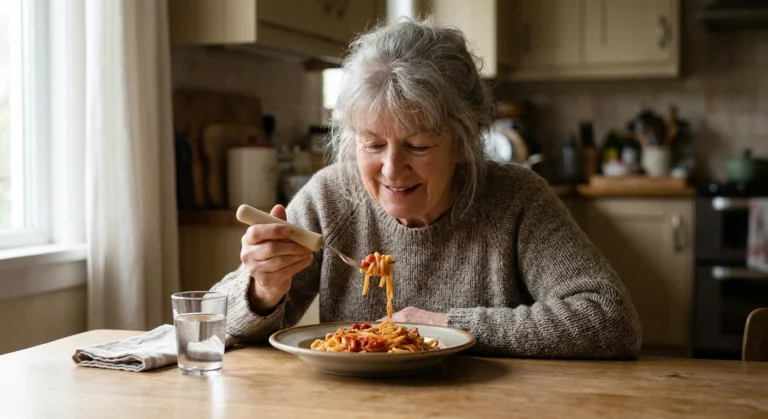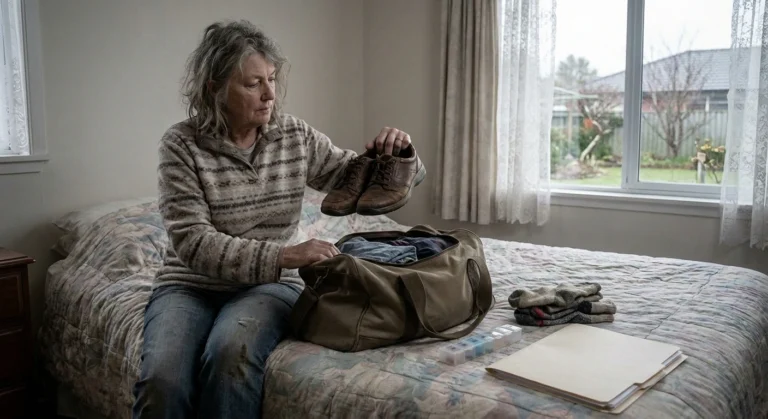
Carol came to our support group last spring not because she has neuropathy, but because her husband Frank has had it for nine years. She was the one driving him to appointments, helping him with his shoes every morning, watching the floor for the small obstacles he could no longer feel, and sleeping in the guest room because the restless legs and middle-of-the-night bathroom trips were keeping both of them exhausted. She said she had come because she needed to talk to someone, anyone, who understood. She also said, almost as an aside, that she had not been to her own doctor in two years.
This article is for Carol, and for everyone like her. If you are the spouse, the adult child, the sibling, the neighbor, or the paid professional caring for someone with peripheral neuropathy, this is the conversation about you. Not the patient. You. Because caregiver burnout is the unspoken cost of chronic illness, and in neuropathy specifically — a condition with no recovery point, no “after,” no obvious milestone of victory — the wear on the caregiver is chronic and quiet and dangerous if it goes unnamed.
I am a patient advocate, not a medical professional, and I write here both as someone who lives with neuropathy and as someone who has watched my own family rotate through the caregiver role over the years. The aim here is honest, practical, and direct: name what burnout actually looks like in this specific situation, identify the early warning signs that something has shifted, give you a real menu of respite and support options, and close with the lines that matter most — the warning signs that mean stop reading and pick up the phone for professional help. Asking for help is not weakness. Burning yourself out in service of someone you love is not a love story. It is a slow-motion crisis, and it is preventable.
What Neuropathy Caregiving Actually Looks Like — The Invisible Work
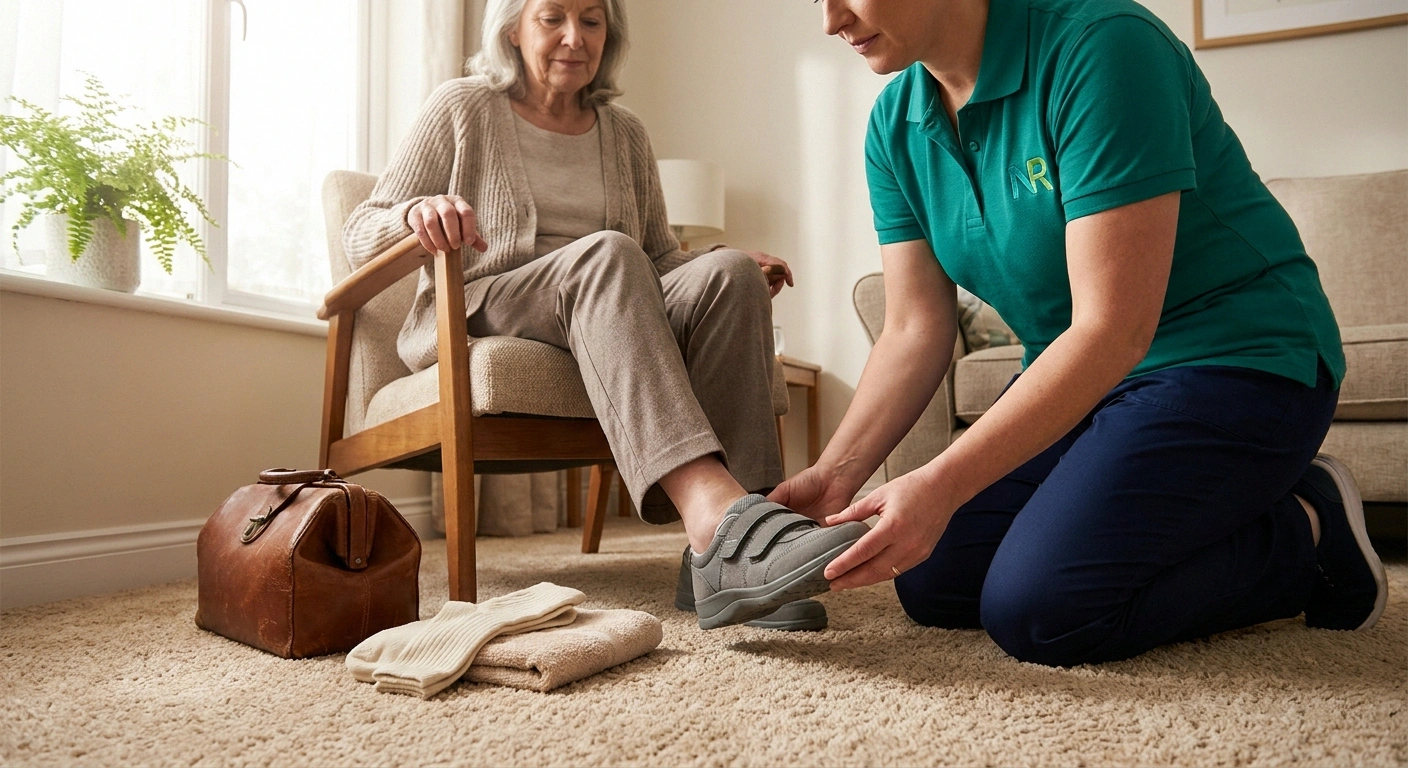
Most of the people in my support group will tell you that nobody outside their household understands what they actually do. Caregiving for someone with neuropathy is not the dramatic, heroic version of caregiving you see in commercials. It is a steady accumulation of small, repetitive tasks that — when you list them all out — represent a part-time job nobody trained you for and nobody is paying you to do.
Key Takeaway
You are doing a part-time job that nobody trained you for and nobody is paying you to do. The first step in preventing burnout is making the invisible work visible — to yourself, to your family, and eventually to the person you are caring for. Most caregivers underestimate their workload by half.
Here is what an honest day looks like. In the morning, you help your loved one out of bed because their feet feel unfamiliar first thing — they cannot quite trust the floor. You watch their balance as they shuffle to the bathroom. You help them put on socks, because reaching the feet has become harder and getting the seams smooth on numb skin matters more than it sounds. You help them choose shoes that protect their feet without rubbing — and you check the inside of those shoes for small objects they would not feel underfoot. Once a week, you do a careful inspection of the soles, the toes, and between the toes, looking for the cuts and blisters they cannot detect on their own. Daily foot care is the keystone, and in many households, the caregiver is the one performing it.
Throughout the day, you are watching the floor. You are mentally noting where the rugs bunch, where the threshold of the bathroom has a small lip, where the dog is sleeping. You are doing fall prevention work that does not feel like work until you stop doing it and your loved one falls. Fall prevention in neuropathy is largely a caregiver responsibility, even when nobody has named it that way.
You manage medications. Gabapentin, duloxetine, sometimes opioids, sometimes a half-dozen other prescriptions. You count the pills in the pillbox each Sunday night. You drive to refills. You sit through medication appointments and try to remember the things your loved one will forget to mention because the brain fog from chronic pain has eroded their working memory.
You handle the bigger things too. The driving, increasingly, falls to you because their reaction time on the pedals is not what it was. The household chores that involved standing for any length of time fall to you because their feet cannot tolerate it anymore. The financial worry — whether their reduced earnings or earlier retirement is going to stretch — settles on your shoulders. The advocacy in medical appointments, where you have to make sure their pain is taken seriously and their questions get answered, is exhausting work that nobody trains you to do.
And then, at the end of the day, you go to bed in the same room and listen to them shift and turn because their legs do not let them rest. Some nights you sleep in the guest room because at least one of you needs to function tomorrow. Other nights you lie awake listening to make sure they get to the bathroom safely.
This is not a description meant to make you feel sorry for yourself. It is a description meant to make the invisible work visible, because the first step in addressing burnout is naming, in specific detail, what you are actually doing all day. Most caregivers underestimate their own workload by half.
What Burnout Looks Like — The Three Dimensions
Researchers who study caregiver burnout — and there is a substantial body of research on this — generally describe it in three dimensions. They are not separate moods, they overlap and feed each other, but naming them gives you a way to assess where you are.
Research Says
The Maslach Burnout Inventory — originally built for studying nurse and physician burnout — has been adapted for family caregivers. It identifies three dimensions: emotional exhaustion, depersonalization (detachment or resentment toward the person being cared for), and reduced personal accomplishment. Surveys of long-term family caregivers consistently show that the majority report significant symptoms in at least one dimension, and roughly a third meet criteria in all three. You are not alone, and what you are feeling has a name.
Emotional Exhaustion
This is the one most people recognize. You have nothing left at the end of the day. You collapse onto the couch and the idea of getting up to make dinner feels like climbing a hill in flooded boots. You used to have hobbies, interests, conversations that lit you up — and now even the things you used to love feel heavy. You are not depressed in the classic medical sense necessarily, but you are flat. Drained. Operating on the empty fumes of obligation.
The diagnostic signal is asking yourself: “Do I have anything left for me at the end of any given day?” If the honest answer is “no, and it has been months like this,” that is emotional exhaustion talking.
Depersonalization
This is the one most caregivers feel deeply ashamed of, and it is also the one that does the most damage to the relationship. Depersonalization in caregiving looks like growing detachment, irritability, or even resentment toward the person you are caring for. You catch yourself thinking, “Why can't they just try harder?” You snap at small things — the slow shuffle, the third question they have asked about the same medication, the way they want the thermostat just so. You sometimes wish, in the privacy of your own head, that the day were over. You do not recognize yourself.
Almost every long-term caregiver I have ever met has felt some version of this, and almost every one of them has felt guilty about it. The shame keeps it secret. The secret keeps it growing. Naming it — even just to yourself, even just in a journal — takes some of the power away from it. This is not evidence that you are a bad person or a bad caregiver. It is evidence that you have been depleted for too long and your reserves are gone.
Reduced Personal Accomplishment
The third dimension is the one that flies under the radar but does serious harm. You start to feel like you are failing at this. You compare yourself to some imaginary perfect caregiver — usually a composite of social media impressions and someone's mother-in-law — and you fall short. You do not see your wins anymore. The good days get attributed to luck or to your loved one's resilience; the bad days get attributed to your own inadequacy.
This is the dimension that pulls caregivers into depression most quietly. You become invisible to yourself. The signal here is asking, “When was the last time I felt competent and effective at anything I did today?” If the answer is “I cannot remember,” that is reduced personal accomplishment talking.
Early Warning Signs in Your Body and Mood
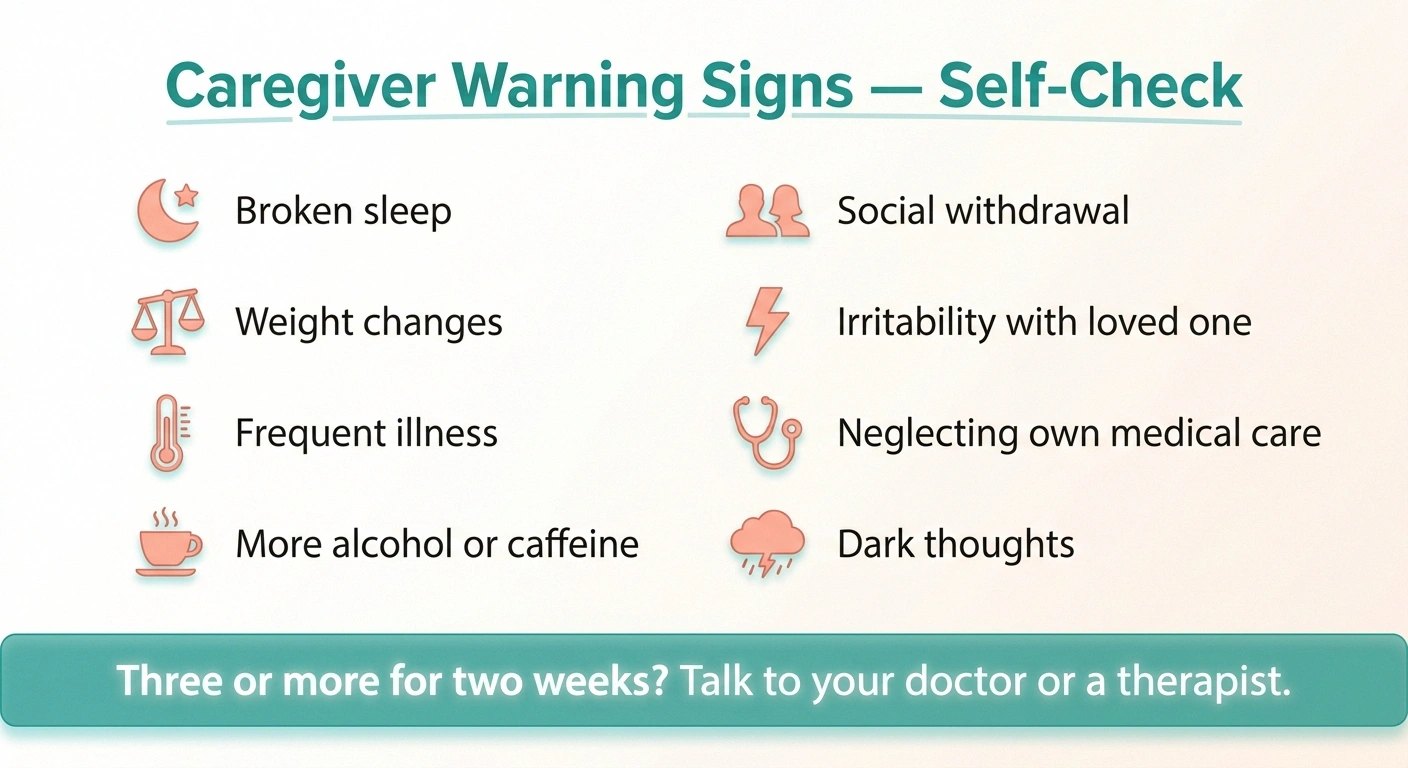
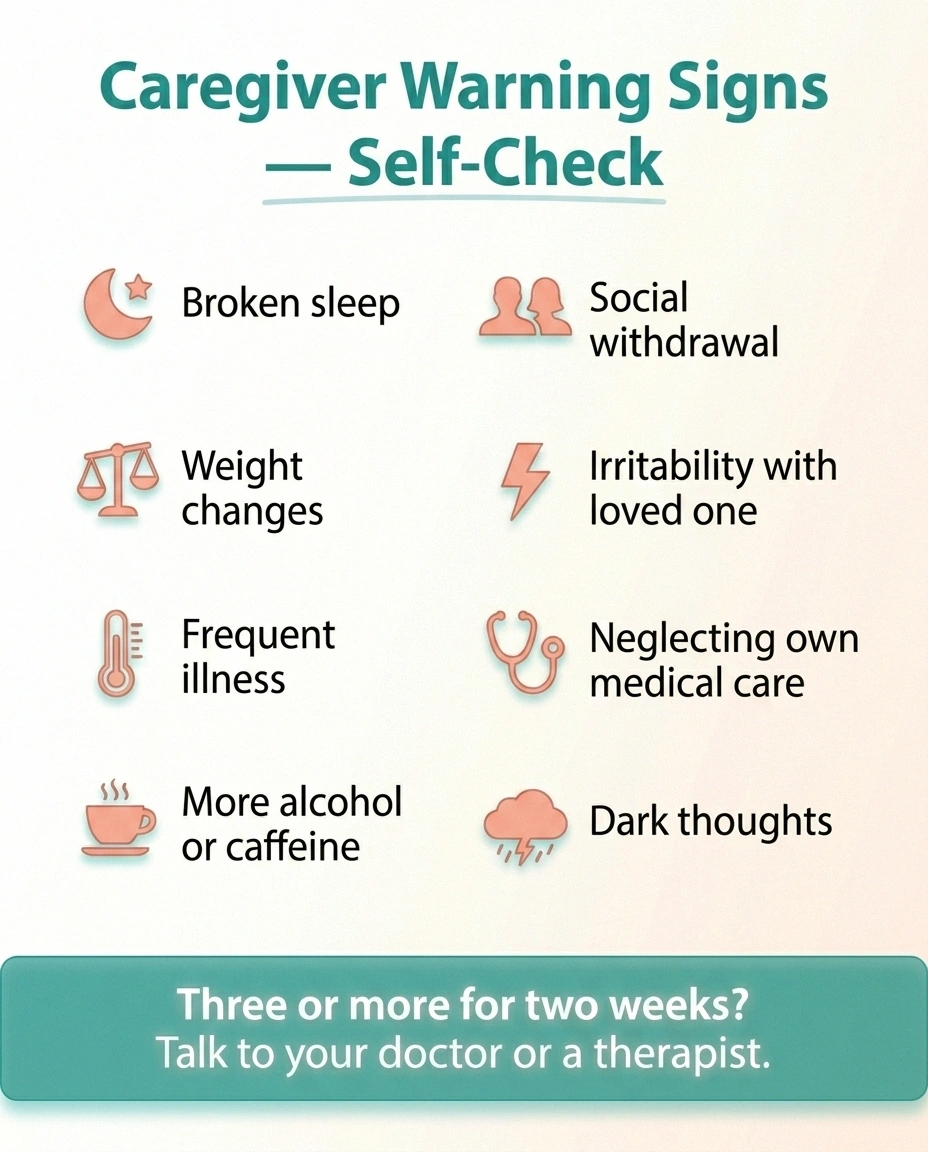
Burnout does not announce itself with a single dramatic event. It accumulates in small body and mood changes that are easy to dismiss in the moment and obvious in retrospect. Here is the watchlist that I share with everyone who walks into our caregiver discussion circle.
The “Dark Thought” Deserves a Direct Response
Thoughts like “they would be better off without me” or “I cannot do this anymore” are warning signs, not character flaws. They are more common in long-term caregivers than the world acknowledges, and they are exactly what 988 (Suicide and Crisis Lifeline) and 741741 (Crisis Text Line) are for.
You do not need to be in a planning stage to call. Earlier is better. The shame around these thoughts is what keeps them dangerous — please reach out.
Sleep that is broken independent of the patient. If you are sleeping in a separate room and STILL waking at 3 a.m. with your heart racing or your mind looping through tomorrow's tasks, that is a stress signal. Cortisol that does not turn off ruins sleep.
Weight changes without trying. Sudden loss because you are not eating, or sudden gain because food has become emotional regulation, are both stress signals. Either direction matters.
Lingering colds, frequent infections, dental flare-ups. Chronic stress suppresses immune function. If you are catching every bug going around and your body is not bouncing back like it used to, your caregiving stress is impacting your physical health.
Increased alcohol, increased caffeine, increased medication use. A nightly glass of wine that has crept up to two, the second pot of coffee just to function, the over-the-counter sleep aid that has become every night. These are coping mechanisms compensating for empty reserves.
Social withdrawal. When friends call, you do not pick up. When the family invites you to something, you make an excuse. The energy required to be “on” with people you love feels prohibitive. This is one of the most isolating signs and one of the most reversible.
Irritability with the person you care for. Small annoyances that used to roll off now provoke real anger. The slow walk, the forgotten conversation, the same question for the third time. If you find yourself biting back unkind words more often than you used to, that is your reserves talking, not your character.
Neglecting your own medical care. When was your last physical? Your last dental cleaning? Your last eye exam? Your last mammogram or colonoscopy or prostate screening? If you cannot answer because it has been more than two years, you are deprioritizing yourself in a way that compounds over time.
The dark thought. The flash of “they would be better off without me” or, more troublingly, “I cannot do this anymore.” These thoughts are signals, not character flaws, and they require professional help. They are also more common in long-term caregivers than anyone talks about publicly. We will come back to this.
Why Self-Care Is Not Selfish — The Empty-Cup Reframe
I want to push back hard on the framing many caregivers carry, often absorbed from family or from religious traditions, that self-care is selfish. That taking time for yourself is taking it away from your loved one. That a “good” wife or husband or daughter or son just keeps giving.
Here is the practical reality. A burnt-out caregiver becomes a hazard, not a help. Missed medications happen. Missed signs of foot infection or worsening symptoms get overlooked. Falls happen because the caregiver who normally watches the path was distracted by their own exhaustion. Tempers fray and the relationship becomes adversarial. Resentment poisons the home and both people end up worse off.
Caring for yourself is not in competition with caring for them. It is the foundation of caring for them sustainably. The version of you that has slept seven hours and gotten out for a walk is a kinder, more patient, more competent caregiver than the version of you that has been running on coffee and obligation for six months.
I tell people in my groups: this is not optional in the way you have been treating it. It is part of the medical plan. It belongs on the same priority shelf as your loved one's medications and appointments. If you would not skip filling their prescription, do not skip your own basic self-care.
The 4 R's of Real Respite

“Respite” is the word professionals use for the practice of stepping away from caregiving long enough to rebuild your reserves. Most caregivers I meet have a vague idea that they should be doing this and a long list of reasons why they cannot. So let me give you a framework that I have seen work.
The 4 R's of Real Respite
Name it without apology. Mark the date in a calendar. Not “when things calm down” — now.
“Could you sit with Mom Tuesday 2-4?” beats “let me know if you need help.”
Not laundry, not errands. Walk, sit in the sun, see a friend, sleep. Productive ≠ restorative.
Name what restores you. Double down on it. The block worked only if you came back lighter.
Recognize you need it. The first R is simply naming, without apology, that you need a break. Not “when things calm down,” not “after the next appointment,” not “in a few months when the new medication kicks in.” Now. You have read this far in this article — that is recognition. Mark the date in a calendar.
Request it specifically. Vague requests get vague responses. “Let me know if you need anything” from a family member is, in practice, nothing. You have to ask for specific things from specific people at specific times. “Could you come sit with Mom Tuesday from two to four so I can go to my own doctor?” “Could you take Dad to physical therapy next Thursday at ten?” “Could you cover dinner Wednesday so I can take a walk?” Specific asks work; vague asks do not.
Rest physically AND mentally. The first time most caregivers get a respite block, they use it to do laundry, run errands, return phone calls, or catch up on the work they have been behind on. That is not rest. That is rearranging exhaustion. Rest means doing nothing productive — walking without a destination, sitting in the sun, reading something escapist, calling a friend just to talk, going for a swim, sleeping in. The first few times this will feel weird and possibly guilty. Keep doing it anyway.
Return changed. A respite block has not worked if you come back exactly as drained as you left. Pay attention to what specifically restores you and double down on those things. For some people it is movement. For some it is solitude. For some it is being with friends who do not need anything from them. For some it is making something with their hands. Whatever yours is, name it and protect it.
Practical Respite Options — The Menu
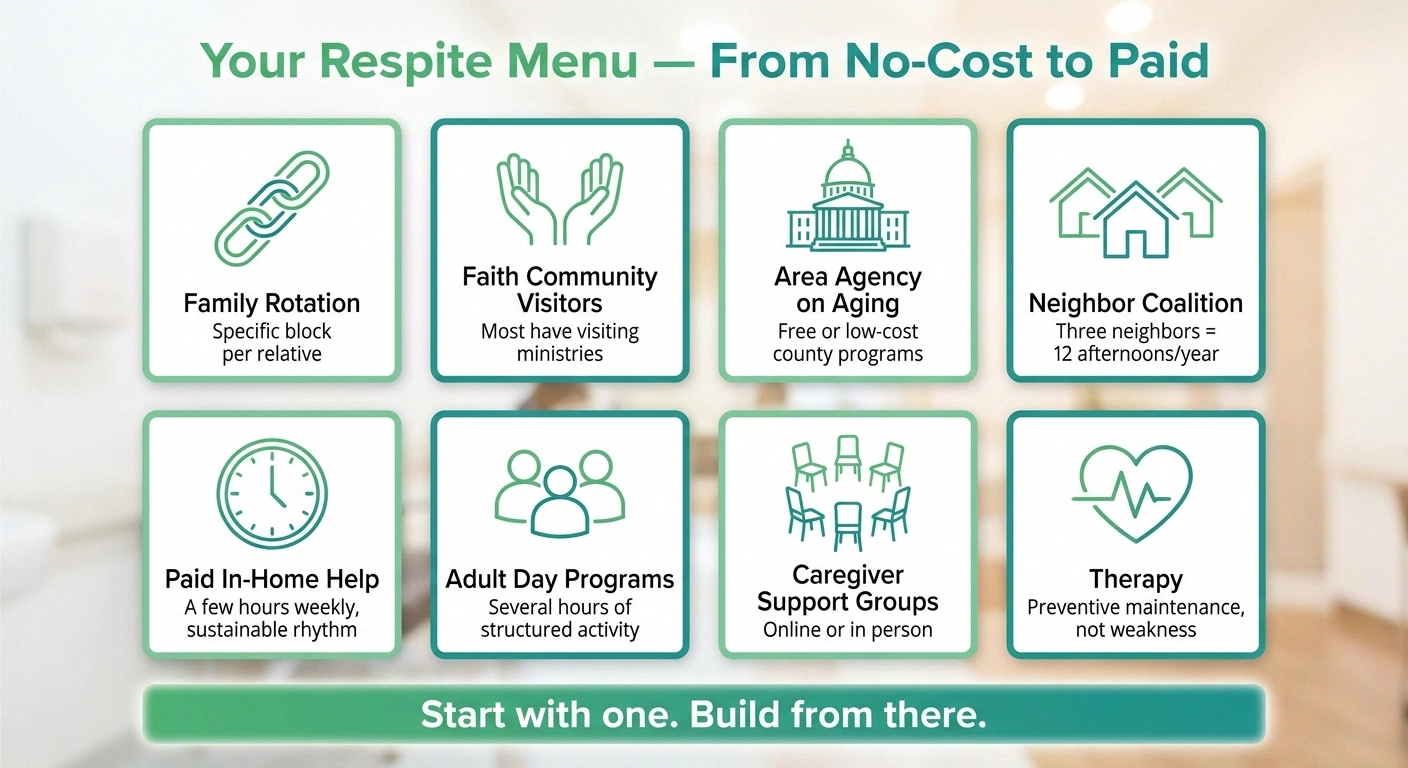
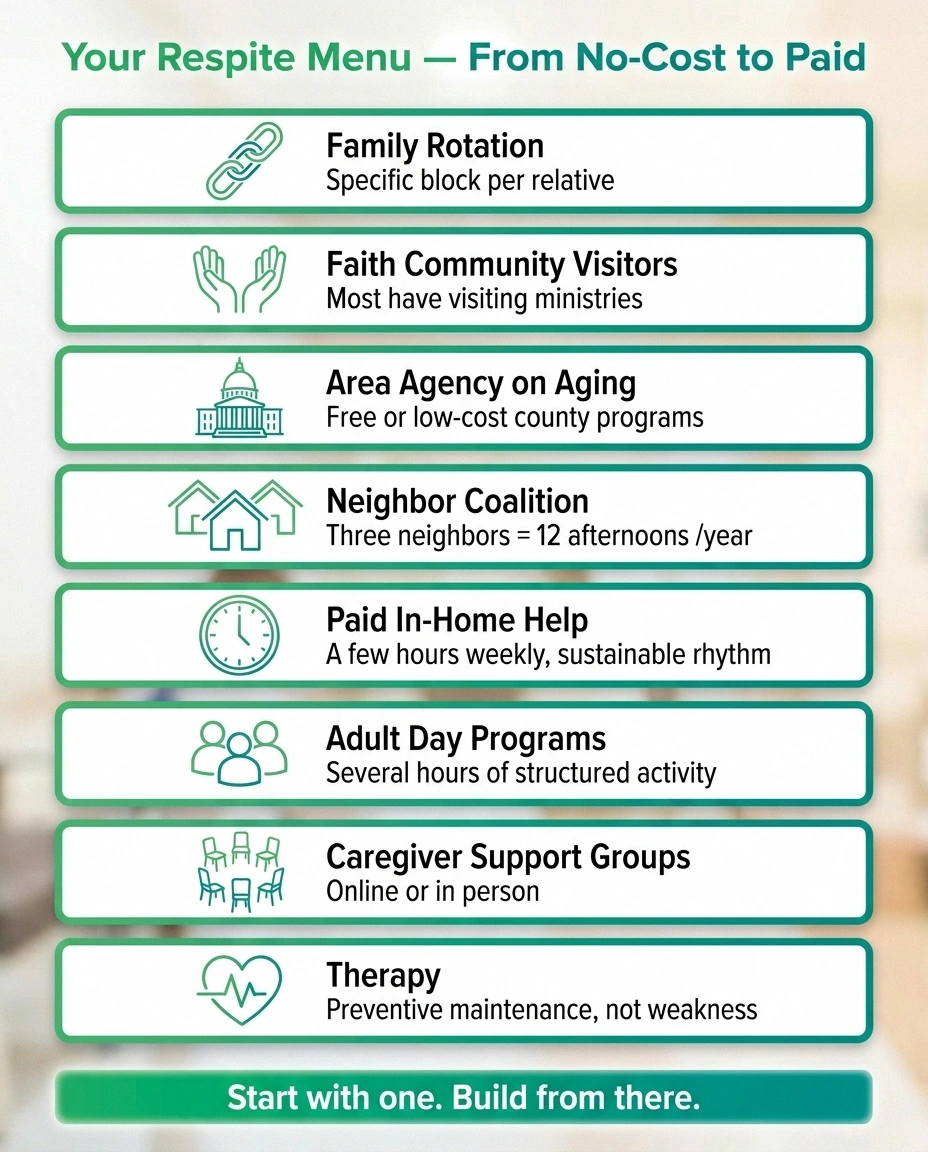
The most common reason caregivers tell me they cannot take respite is some version of “we cannot afford it.” That is sometimes true and often not — there are more low-cost and no-cost options than most people realize. Here is the menu I share with the caregivers who come to our group.
The hardest part is asking. The second-hardest part is accepting. Most neighbors are honored to be asked. Free options outnumber paid options for most families — your county's Area Agency on Aging is the single most underused resource.
Family rotation. The most underused option. If you have adult children or siblings, ask each of them to take one specific block each month — one Saturday afternoon, one weekday evening, one full day every other month. Even a sister who lives across the country can take a turn by coming for a long weekend twice a year. The asks have to be specific and the rotation has to be a real schedule, not a hopeful list.
Faith community volunteers. Most churches, synagogues, and mosques have visiting ministries or congregational care committees specifically organized for this. Many of them are happy to send someone to sit with your loved one for a few hours. You do not have to be active in the community to ask; most are generous to anyone in the neighborhood.
County Area Agency on Aging (AAA). Every state has a network of these, and they offer respite programs that are often free or low-cost. Search “area agency on aging” plus your county name. They can usually arrange a few hours of in-home help per week, weekly respite at adult day programs, or short-term overnight respite at a partner facility.
Neighbor coalitions. Three neighbors who each take one afternoon a month is twelve afternoons a year of real respite. The hardest part is asking, and the second-hardest part is accepting. Most neighbors are honored to be asked.
Paid in-home help. If finances allow, a few hours a week with a paid aide is often more sustainable than a long block once a quarter. The regular rhythm of “Tuesday afternoons are mine” rebuilds reserves better than a one-week vacation that requires three weeks of recovery work afterward.
Adult day programs. Often called “adult day health” or “senior day programs,” these provide several hours of structured activity, meals, and supervision in a group setting. Many are designed for people with chronic illness who do not need nursing-home-level care. Costs vary widely; some are sliding scale.
Support groups — including for you. Caregiver-specific support groups exist in most communities and many run online. The act of sitting in a circle with other people who actually understand the daily texture of what you are doing is itself a form of respite. You do not have to share if you do not want to; just being witnessed by people who get it is a kind of rest.
Therapy. A good therapist who works with chronic illness families is one of the highest-leverage investments a long-term caregiver can make. This is not “for crazy people.” This is preventive maintenance for the person doing one of the hardest unpaid jobs in your community. Many insurance plans cover it; sliding-scale options exist in most cities.
The Honest Grief Conversation
One thing I want to name plainly, because almost no one else does: caregivers of people with chronic illness grieve continuously. You are grieving the partner you used to have, the retirement you planned, the trips you talked about, the easy walks together, the dance at your granddaughter's wedding. Your loved one is alive and present, and you are also losing pieces of them slowly. This is real grief, and it does not get the cultural script that death does.
The grief is allowed. Naming it helps it move. Talking about it with someone — a therapist, a friend, a support group, a journal — keeps it from settling into bitterness. If you find yourself stuck in anger that has no clear cause, or sadness that does not lift, or a flat numbness that has been there for months, the grief may be doing damage in the background.
I will say something I learned later than I should have: grieving the changes does not mean you love them less. In fact, it usually means you love them more, and the grief is the size of the love.
When to Bring in Professional Help — The Real Threshold
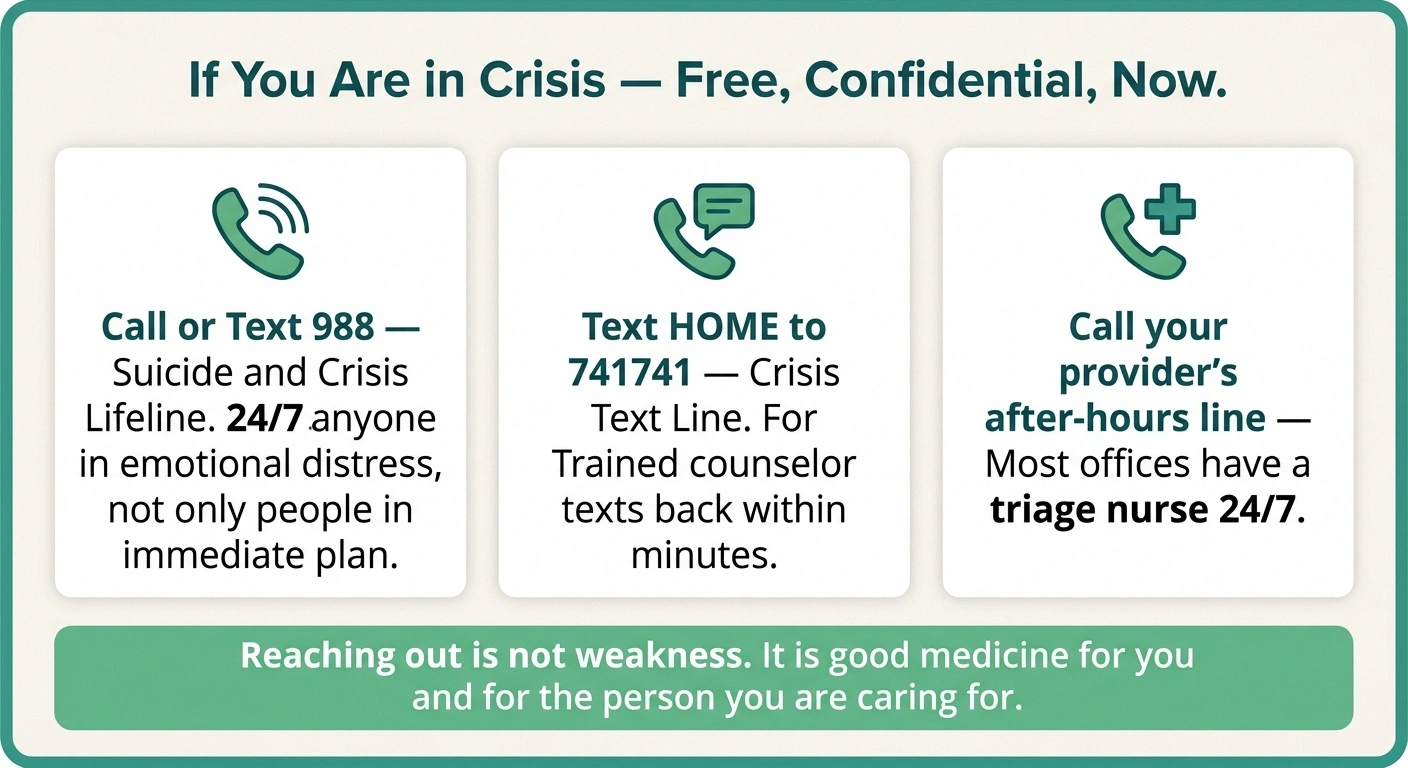
I want to be very direct about this section. There are levels of caregiver distress where talking to a friend or joining a support group is the right move. There are also levels where you need professional help, and the wait-and-see approach makes things worse.
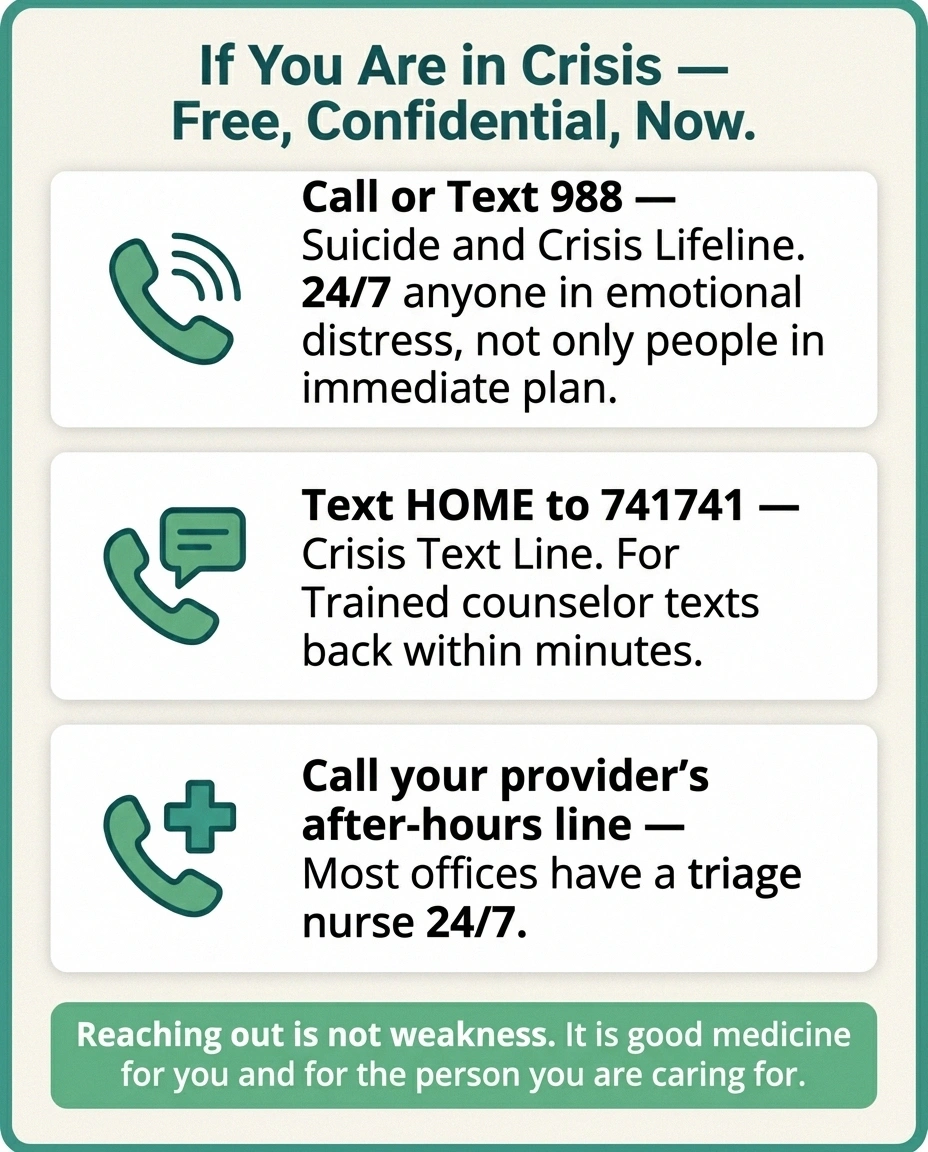
If You Are in Crisis — Free, Confidential, Now
Suicide and Crisis Lifeline. 24/7. For anyone in emotional distress — not only people with a plan.
Crisis Text Line. Trained counselor texts back within minutes. No phone conversation required.
Most primary care offices have a 24/7 triage nurse. Save the number in your phone now, while you are calm.
Reaching out is not weakness. It is good medicine for you and for the person you are caring for.
Talk to your own primary care doctor if you have been losing sleep for more than a few weeks, if your appetite has changed significantly, if you have been catching every illness going around, if your blood pressure or blood sugar (if you track them) have drifted, or if you have not had your own routine care in two or more years. Schedule yourself an appointment this week, treat it as non-negotiable, and bring a list of what has changed.
Schedule with a therapist if you have been feeling sad, flat, hopeless, or chronically irritable for more than two to three weeks. If you have been isolating from people you used to enjoy. If you find yourself ruminating on dark thoughts. If the relationship with your loved one has become consistently more conflict than partnership. A therapist who specializes in chronic illness or caregiving is ideal; a generalist who is open to the topic is also fine.
Call 988 (Suicide and Crisis Lifeline) or text HOME to 741741 (Crisis Text Line) if any of the following are happening: You are having thoughts about ending your own life, even passive thoughts (“I would not mind if I did not wake up”). You are having flashes of thoughts about harming your loved one, even thoughts that horrify you when they happen. You feel completely unable to keep going. You are using alcohol or other substances in a way that scares you. These are 988 calls. They are free. They are confidential. The person on the other end is trained for exactly this conversation. You do not have to be “actively suicidal in a plan” to call — these lines are for the early signs too, and earlier is better.
I want to particularly normalize this for the spouses I have known. The exhausted spouse who has, in a moment of utter depletion, had the thought “I cannot do this anymore and I do not know how I would even leave” — that thought is more common than the world acknowledges, and it is a 988 call. The exhausted adult child who has, in a moment of utter frustration with a parent who has changed beyond recognition, had a flash of harm-thought that horrified them — that flash is more common than the world acknowledges, and it is a 988 call. The shame keeps it secret. The secret keeps it dangerous. Please pick up the phone.
What Your Loved One Needs to Hear From You

One last piece. Many caregivers worry that talking about their own burnout will hurt the person they are caring for. They keep the suffering silent to protect them. Almost universally, this backfires. The person you are caring for is not stupid; they can feel your exhaustion, your resentment, your withdrawal. They often blame themselves silently for being a burden. The unspoken weight is harder on the relationship than the spoken truth would be.
The Conversation Script That Helps
“I love you. I am going to keep being here for you. AND I am running low and I need some help so I can keep doing this well. I am going to be asking [specific person] to take some specific tasks, and I am going to be taking some time for myself each week.”
“This is not because I love you less. It is because I want to be able to love you well for a long time.”
The conversation that helps, in my experience, goes something like this: “I love you. I am going to keep being here for you. AND I am running low and I need some help so I can keep doing this well. I am going to be asking [specific family member / friend / community resource] to take some specific tasks, and I am going to be taking some time for myself each week. This is not because I love you less. It is because I want to be able to love you well for a long time.”
Some loved ones initially resist — they do not want strangers helping, they do not want to feel like a burden, they have their own grief about needing care. Stay with the conversation. Often the resistance softens once they see you returning more rested. The same person who said “I do not want anyone but you helping” frequently becomes the person who looks forward to Wednesday afternoons with the home health aide who has become their friend.
If You Take Nothing Else From This Article
Take this. You are doing something hard. The hardness is real, it is not a sign of weakness, and it is not unique to your household — millions of people in this country are doing what you are doing, and most of them are also tired, also lonely, also worried, and also love the person they are caring for very much.
Caregiver burnout is preventable if you treat your own well-being as part of the medical plan, not as an optional luxury. The work is to recognize the warning signs early, to ask for specific help from specific people, to take real respite that actually rebuilds your reserves, to grieve what needs grieving, and to know when professional support is the right call. Mental health support applies to caregivers as squarely as it applies to patients — maybe more so, because no one else is checking on you.
The Carol who came to our group last spring is doing better now. She still has her hands full. Frank still has neuropathy and the appointments and the slow walks and the long nights. But Carol has a therapist, two Saturday afternoons a month with her sister-in-law covering at home, a Tuesday morning walk with two neighbors that she does not skip even on hard weeks, and she had her own annual physical for the first time in three years. She is not a different person. She is the same person, with reserves restored. Frank can see the difference. Their daughter can see the difference. Carol can see the difference. That is what we are aiming for.
Frequently Asked Questions
Is caregiver burnout a real diagnosis or just a feeling?
Caregiver burnout is a recognized syndrome in medical and psychological research, even if it is not always formally diagnosed the way major depression or anxiety disorders are. It is characterized by emotional exhaustion, depersonalization (detachment or resentment toward the person you are caring for), and reduced sense of personal accomplishment. The Maslach Burnout Inventory, originally developed for healthcare professionals, has been adapted for family caregivers and is used in research. Many caregivers eventually meet criteria for clinical depression or anxiety as well, which is part of why bringing it up with a healthcare provider matters. It is a real, well-studied condition that deserves real attention, not a vague feeling to push through.
How do I take a break when I have no family nearby and we cannot afford paid help?
This is one of the most common questions I hear, and there are real options that do not require either family or money. First, contact your county's Area Agency on Aging — every state has them, and they offer free or low-cost respite programs that most people never use because they do not know they exist. Second, ask your faith community (or any local one, even if you are not an active member). Most have visiting ministries that pair volunteers with families needing relief. Third, look for neighborhood mutual-aid groups, often organized on social media or through community centers, where neighbors take turns helping each other. Fourth, contact a national organization like the Family Caregiver Alliance or the National Council on Aging, which can connect you with local resources. And fifth, do not underestimate the value of even a half-hour break for a walk outside while your loved one watches television safely. Small consistent breaks add up.
I feel guilty for resenting my spouse — does that make me a bad person?
No. It makes you a long-term caregiver whose reserves have been running on empty. Resentment toward the person you are caring for is one of the three classic dimensions of caregiver burnout (researchers call it depersonalization), and almost every long-term caregiver I have known has felt some version of it. The shame around it keeps it secret, which is the most dangerous thing — because the secret keeps it growing and prevents the things that would actually help (respite, support groups, therapy, asking for help). Naming the resentment to yourself, or to a therapist, or to a support group of people who understand, takes some of the power away from it and creates space for the underlying love to come back to the surface.
How do I know if I need a therapist versus just more rest?
A reasonable rule of thumb: if you are tired but a weekend off restores you, you mostly need more rest and better respite scheduling. If you have been feeling flat, sad, irritable, hopeless, or detached for more than two or three weeks despite getting some breaks, you need to talk to a therapist or your primary care doctor. The threshold also lowers if you have a personal history of depression or anxiety, if you are having trouble sleeping for reasons that have nothing to do with your loved one, if appetite has changed significantly, or if dark thoughts have been visiting you. Therapy is not a sign of failure or weakness; it is preventive maintenance for one of the hardest unpaid jobs in your community.
What if my loved one refuses help from anyone but me?
This is incredibly common, and it usually softens with patience and slow introduction. A few moves that help: start with very short visits from the new helper (thirty minutes while you are still in the house) rather than a long block with you gone. Have the helper come with you to a familiar activity (an appointment, a meal) before they ever come alone. Frame it honestly with your loved one — “I need help so I can keep doing this for a long time” tends to land better than “you need help.” Give it three or four visits before evaluating; the first one is almost never representative. And if there is a specific helper your loved one connects with — a particular neighbor, a particular aide — invest in that relationship rather than rotating helpers every visit.
What is the difference between caregiver stress and caregiver burnout?
Stress is normal and somewhat manageable — you feel overwhelmed sometimes but you recover when you get breaks, you still feel mostly like yourself, and your sense of competence and warmth toward your loved one remain intact. Burnout is the chronic state that develops when stress has been unrelenting for too long: you feel depleted at a baseline level, the breaks no longer restore you the way they used to, you have begun to feel detached or resentful, and your sense of effectiveness has eroded. Burnout is what stress turns into when there is no functioning recovery cycle. The good news is that burnout is reversible, but it usually requires more deliberate intervention than just a weekend off.
I am the adult child living far from my parent with neuropathy — how do I help?
Distance caregiving is a real and growing role and there are specific moves that help. First, take ownership of the things that do not require physical presence: medication refills coordinated with the local pharmacy, appointment scheduling, insurance navigation, bill organization, research on resources in their area. Second, schedule regular visits with specific tasks (rather than “visiting”) — a trip every few months where you go to one appointment with them, do one bigger home modification project, and give the local caregiver a real break. Third, video-call regularly with both your parent AND the primary local caregiver, and ask the local caregiver direct questions about how they are doing, not just the patient. Fourth, contribute financially if you can — even partial coverage for in-home help one or two days a week buys huge relief. The local caregiver should not have to ask; offering proactively is the move.
How long does it take to recover from caregiver burnout once I start taking care of myself?
Honest answer: longer than you want and not as long as you fear. The physical exhaustion piece often eases within a few weeks of consistent sleep and real respite. The emotional flatness and resentment usually take two to three months of consistent self-care plus, often, some therapy work. The deeper resentment patterns and the relationship repair with your loved one can take six months or more. The most important thing to know is that the trajectory is reversible, but the work has to be steady — three weeks of self-care followed by sliding back into old patterns will not get you there. Think of it as a long, slow rebuild, not a sprint. And the rebuild gets easier as it goes; the first month is the hardest because everything feels foreign, and by the third month, the new patterns are starting to feel like yours.
About the Author