
When my doctor first mentioned the word “monoclonal” during a follow-up call, I remember gripping the kitchen counter and asking her to spell it. I was in my mid-fifties, already navigating the strange landscape of peripheral neuropathy, and now there was this new acronym on my chart: MGUS. She kept using calm words like “benign” and “monitor,” but my brain latched onto the part that sounded like “precancerous.” If you've just heard the same three letters from your neurologist or hematologist, please take a breath. I've been sitting with this diagnosis for years now, and I want to walk through what I've learned with you the way I wish someone had walked through it with me. This isn't medical advice — I'm a patient, not a physician — but it is a friend's-eye view of what MGUS-related neuropathy actually is, why it happens, and what a reasonable path forward looks like in 2026.
What Is MGUS? Breaking Down the Alphabet Soup
MGUS stands for Monoclonal Gammopathy of Undetermined Significance. It's a mouthful, and every word in it matters, so let's take them apart the way my hematologist did for me over a paper napkin.
Key Takeaway
MGUS is a condition, not a cancer. It sits in about 3% of adults over 50 and 5% of adults over 70, and it progresses to a related blood cancer at roughly 1% per year. That number is the reason your care team monitors it — and also the reason not to panic.
The guiding phrase from every specialist worth listening to: monitor, don't panic.
Monoclonal means “from a single clone.” Your immune system normally makes a huge variety of antibodies from many different plasma cells. In MGUS, one line of plasma cells has decided to work overtime and produce identical copies of a single antibody — called a monoclonal protein or “M protein.” Gammopathy just means a disorder involving those gamma globulins (antibodies). And undetermined significance is the phrase doctors use to say, honestly, “we see this thing, but on its own it isn't behaving like a disease.”
Here's the part that surprised me: MGUS is not rare. Somewhere around 3% of adults over 50 and closer to 5% of adults over 70 have it, and most never know. It's usually caught by accident when routine bloodwork shows an unexpected protein pattern. For the majority of people, MGUS sits quietly for years, sometimes decades, causing no symptoms at all.
The catch — and the reason your care team pays attention — is that MGUS carries about a 1% per year risk of progressing to a related blood cancer such as multiple myeloma, Waldenström macroglobulinemia, or certain lymphomas. That's a number I had to sit with for a while. Read it the other way: about 99 out of 100 years with MGUS pass without progression. That's why the guiding phrase from every specialist I've talked with is “monitor, don't panic.”
For a subset of people, though, the M protein does something else. Instead of causing bone or blood problems, it goes after the nerves. That's the branch of the family tree we're really here to talk about.
Why Do Some People with MGUS Develop Neuropathy?
When I asked my neurologist “why me? why nerves?”, he pulled up a diagram of a peripheral nerve and pointed to the fatty insulation wrapped around it. That insulation is myelin — the sheath that lets electrical signals zip along nerves at high speed. In MGUS-related neuropathy, the rogue M protein often behaves like a mislabeled key: it's shaped in a way that lets it bind to structures on myelin or on the nerve itself, and the immune system inflammation that follows damages the sheath.
Not every person with MGUS gets neuropathy, and not every case of neuropathy in someone with MGUS is actually caused by the M protein. That distinction matters. Doctors have to work carefully to decide whether the two conditions are truly linked in your case, or whether the neuropathy has another explanation — such as diabetes, a vitamin deficiency, an autoimmune process, or something the workup calls idiopathic neuropathy when no cause is found.
The clues that point toward MGUS being the actual driver usually include:
- A slowly progressive pattern that has crept in over months to years — not weeks
- Symptoms that started in the feet and are strikingly symmetric (both sides at once)
- More sensory symptoms than motor symptoms at first — tingling, numbness, balance trouble
- A tremor in the hands as you use them, especially with fine tasks
- Nerve conduction studies showing a demyelinating pattern rather than a purely small-fiber or purely axonal one
If that pattern sounds like a mix of things you've been feeling, don't diagnose yourself from a paragraph on the internet. It's an invitation to a specific conversation with your neurologist about which subtype of MGUS you have and whether an anti-MAG test is on the table. Which brings us to the class of M protein that matters most for nerves.
The IgM Subtype: Why It Matters Most for Nerves

M proteins come in classes, and the three you'll hear about are IgG, IgA, and IgM. When my hematologist first named them, she said “the class tells us about the personality of your MGUS.” Here's the short version of what that means in plain English.
M Protein Class at a Glance
| Class | Frequency | Neuropathy Risk | What to Watch For |
|---|---|---|---|
| IgG | Most common overall | Uncommon; when present, may look CIDP-like | Progression to myeloma pathway |
| IgA | Rarest of the three | Low; patterns vary when present | Progression to myeloma pathway |
| IgM | Second most common | ~50% develop neuropathy; DADS pattern | Anti-MAG antibodies; Waldenström pathway |
IgG MGUS is by far the most common overall. Most people with IgG MGUS never develop neuropathy at all. When they do, it can sometimes look like chronic inflammatory demyelinating polyneuropathy (CIDP) — a treatable autoimmune neuropathy that neurologists know how to approach.
IgA MGUS is the rarest of the three and, of the three, the least commonly linked to neuropathy. When it is linked, patterns vary.
IgM MGUS is the class that punches far above its weight when it comes to nerve involvement. Roughly half of people with IgM MGUS will develop peripheral neuropathy at some point. And IgM MGUS neuropathy tends to have a distinctive shape — a slowly progressive, sensory-dominant, demyelinating picture with balance and tremor as prominent features. Neurologists have a name for this pattern: DADS, which stands for Distal Acquired Demyelinating Symmetric neuropathy.
The reason DADS matters is that its symptoms often get mistaken for “just getting older.” Weren't we all going to lose a step, become clumsier on the stairs, feel a little wobble when we stand up in the dark? Sometimes yes — and sometimes it's a specific, identifiable nerve process that could be diagnosed and monitored. If your MGUS is the IgM class, that alone is a reason your neurologist should be paying close attention to your feet, your gait, and any tremor.
Anti-MAG Antibodies: The Signature of IgM MGUS Neuropathy

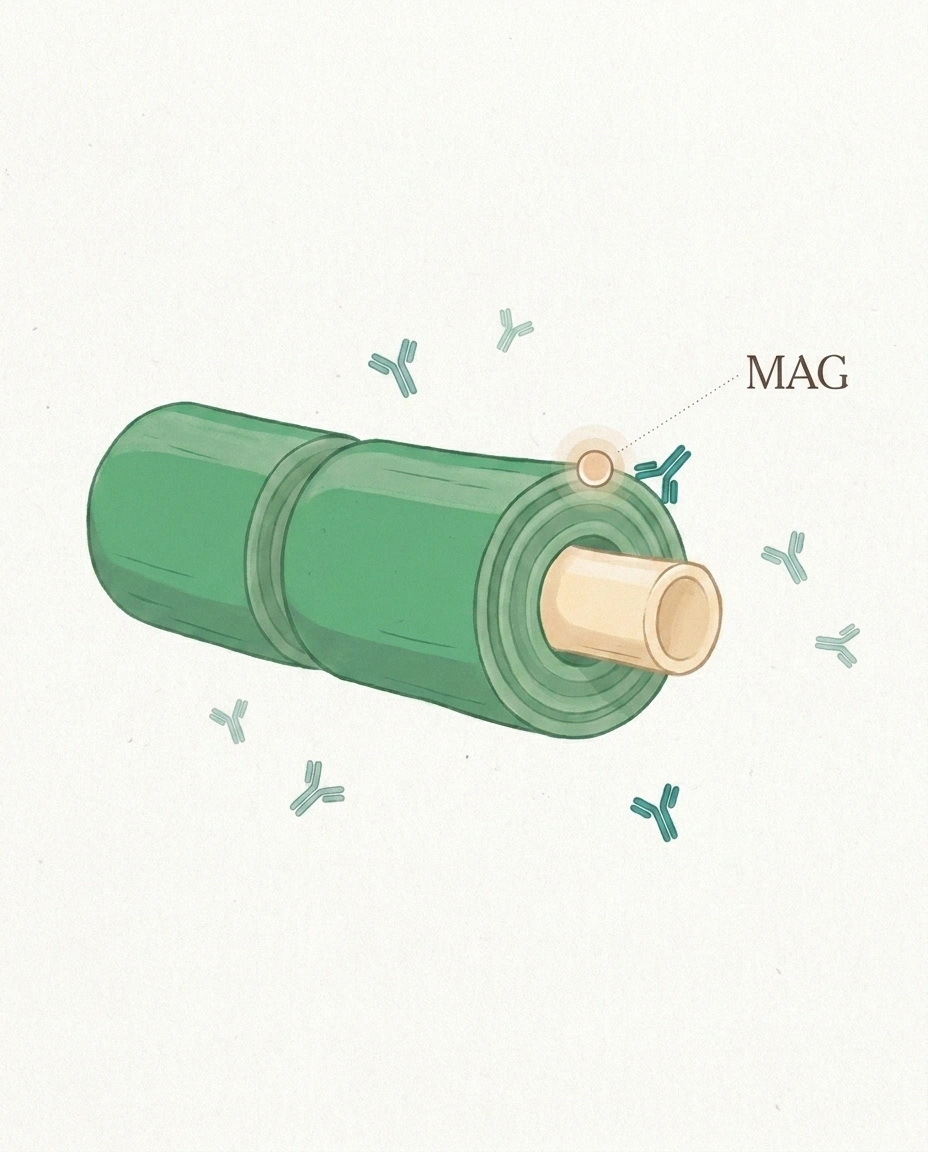
Here is where the science gets genuinely interesting. About half of people with IgM MGUS neuropathy have M proteins that specifically target something called myelin-associated glycoprotein, or MAG for short. MAG is a molecule that lives on the outside of the myelin sheath — think of it like a tiny address label on the insulation of your nerves. An anti-MAG antibody is an M protein that recognizes that address and, over time, disrupts the sheath.
Research Says
Roughly half of IgM MGUS neuropathy cases test positive for anti-MAG antibodies — M proteins that specifically target myelin-associated glycoprotein on the surface of the myelin sheath.
When an IgM M protein, a positive anti-MAG titer, and a demyelinating nerve conduction pattern line up, the diagnostic picture pulls into focus — but a negative result does not rule out IgM-related nerve disease.
Anti-MAG antibodies are considered the signature finding of IgM MGUS neuropathy. When your bloodwork shows a positive anti-MAG titer alongside IgM MGUS and a DADS-pattern nerve conduction study, the diagnostic picture pulls into focus. It's a moment where three separate clues line up into one coherent explanation, and I remember mine feeling almost like relief — I finally had a name for what I was feeling.
Two important caveats. First, a positive anti-MAG test does not, by itself, tell you how aggressive the neuropathy will be. Some people with high titers progress slowly for years; others progress faster. Second, a negative anti-MAG test does not rule out IgM MGUS neuropathy — the other half of cases involve different antibody targets or mechanisms that testing is still catching up on. This is exactly why your neurologist and hematologist look at the whole picture, not any one number.
What Diagnosis Actually Looks Like: The Tests That Matter
If MGUS-associated neuropathy is on the table, the workup is fairly standardized. You won't get all of these at once — usually blood tests come first, then imaging or nerve testing as the picture develops. Here's the map I wish I'd had at my first appointment. (For a broader look at how doctors approach nerve testing generally, see Neuropathy Diagnosis: Tests Your Doctor May Order.)
The MGUS Neuropathy Diagnostic Pathway
Blood and Urine Tests
- Serum Protein Electrophoresis (SPEP) — separates the proteins in your blood so an abnormal M protein “spike” can be identified.
- Immunofixation (IFE) — confirms the class of the M protein (IgG, IgA, or IgM) and identifies its light chain (kappa or lambda).
- Serum Free Light Chain assay — measures the ratio of kappa to lambda light chains, which helps risk-stratify MGUS.
- 24-hour urine electrophoresis — looks for M protein spilling into the urine, which can be another sign of plasma cell activity.
- Anti-MAG antibody titer — ordered when the M protein is IgM class, especially if the neuropathy pattern fits DADS.
Nerve Testing
- Nerve conduction studies (NCS) and electromyography (EMG) — these are the tests that show whether your nerves are conducting electricity normally. In IgM MGUS neuropathy the pattern is typically demyelinating, with prolonged distal latencies especially in the sensory fibers of the feet.
- Small fiber testing in select cases, since some MGUS patients have overlapping small fiber neuropathy that standard NCS may miss.
Specialists You'll Meet
This is one place I'd gently push back on the instinct to stick with a single doctor. MGUS-associated neuropathy really does benefit from a multidisciplinary team, and every guideline I've seen agrees on that. You'll usually work with:
- A hematologist who monitors the MGUS itself — the M protein level, kidney function, calcium, blood counts, and progression risk
- A neurologist — ideally one with experience in peripheral nerve disorders — who follows the neuropathy: strength, sensation, balance, and whether treatment is warranted
If your MGUS is IgM class with a paraprotein-driven neuropathy, ask whether your neurologist has experience with these specific presentations. It's a fair, respectful question, and the good ones welcome it.
Treatment in 2026: What Options Exist Today

I want to be careful here. Treatment for MGUS-associated neuropathy is a genuinely active area of research, decisions belong to your specialists, and what's right for one person may be wrong for another. What I can share is the landscape of options that people are talking about right now, roughly organized from most-established to newest.
2026 Treatment Landscape
Treatment decisions belong to your hematologist and neurologist together.
Watchful Waiting
For many people whose neuropathy is mild and slowly progressive, the honest first-line “treatment” is careful observation. That doesn't mean doing nothing — it means periodic exams, sensible symptom management, fall prevention, and rechecking bloodwork on your hematologist's schedule. If life quality is intact, aggressive treatment isn't automatically better.
Rituximab
Rituximab is a monoclonal antibody that targets B cells (the cells that make the rogue M protein). It's been the traditional go-to for IgM MGUS neuropathy that's progressive enough to warrant treatment. Response rates in the studies I've seen run in the 30–50% range, which is meaningful but also means many people don't respond. One thing to know: rituximab can cause a temporary IgM flare in some patients — a paradoxical rise in IgM levels that can briefly worsen symptoms. Your hematologist will watch for this.
BTK Inhibitors: Ibrutinib, Zanubrutinib, Acalabrutinib
This is the newer story. BTK inhibitors are oral medications originally developed for Waldenström macroglobulinemia and certain lymphomas that also affect the pathway that keeps the rogue B cells alive. In IgM MGUS neuropathy, small case series and studies have shown improvements in disability scores over roughly 9 months on ibrutinib. Zanubrutinib has generated a handful of encouraging 2025 case reports, and acalabrutinib is being studied in a phase 2 trial that has been reading out through 2025 and into 2026. This class isn't standard of care yet and isn't appropriate for everyone, but it's part of the conversation your hematologist may raise if rituximab hasn't been enough.
IVIG and Other Immunomodulators
Intravenous immunoglobulin (IVIG) has a variable track record in IgM MGUS neuropathy — it can help some patients, especially those whose picture looks more like CIDP. Plasma exchange, corticosteroids, and combination regimens all have their place in specific circumstances.
Symptom Management You Can Do Alongside Treatment
Whatever your MGUS-directed plan looks like, symptom care matters. Sleep, movement, and mental health are not “extras” — they're part of how you live well with a chronic condition. A few resources that have helped me:
- Natural approaches to peripheral neuropathy pain for at-home strategies
- A grounded look at supplements for nerve health so you can bring an informed list to your doctor
- Neuropathy and mental health — the emotional side is real and deserves attention
Living With the “Monitor, Don't Panic” Reality

I want to talk about the emotional shape of this diagnosis, because no one prepared me for it. When your chart carries a word like “precancerous” — even in the mild, ~1%-per-year sense that MGUS carries — every ache becomes ominous for a while. Every routine appointment feels like a verdict. That reaction is normal, and it eases.
Some of what has helped me:
- Anchor to the numbers, not the label. A ~1% annual risk of progression means that on any given year, the odds are overwhelmingly on your side. This is a monitoring condition, not an emergency.
- Keep your monitoring schedule. Whatever cadence your hematologist sets — every 6 months, once a year — put it on the calendar and treat it as non-negotiable. Consistency is what turns “unknown” into “watched.”
- Keep a simple symptom log. A single line a week is enough: how are your feet, your balance, your hands? Trends over months are what your neurologist actually needs.
- Protect your feet. Even mild sensation loss changes how you should think about shoes, foot inspections, and heat exposure. If you also have any burning-feet symptoms, that's worth flagging.
- Watch for autonomic clues. A subset of neuropathies involve the automatic nervous system. If you notice new dizziness on standing, sweating changes, or digestion issues, ask your neurologist about autonomic involvement.
- Do the mental health work. A chronic condition with an uncertain arc is a real emotional load. A therapist familiar with chronic illness can matter as much as any pill.
None of this makes MGUS-associated neuropathy trivial. But framing it as a condition you actively partner with your specialists to manage — rather than a countdown — has changed how I live with it.
Red Flags: When to Call Your Doctor Today

Most of what MGUS-related neuropathy does happens slowly, over months. But there are specific changes that should prompt a call to your care team the same day or a trip to urgent care, not “at your next visit”:
Call Your Doctor Today If…
Most MGUS-related nerve changes happen slowly. These do not — treat them as same-day calls, not “at your next visit”:
- New or rapidly worsening weakness (trouble lifting your foot, standing from a chair, climbing stairs)
- New bowel or bladder changes alongside nerve symptoms
- Unexplained bone pain — especially back, ribs, or hips
- Weight loss, night sweats, or persistent fevers
- New swollen lymph nodes or masses
- A sudden step-change — days-to-weeks worsening after months of slow change
- Signs of hyperviscosity: visual changes, unusual headaches, nosebleeds
Your hematologist would rather hear from you and reassure you than miss something.
- New or rapidly worsening weakness — trouble lifting your foot, climbing stairs, or standing from a chair
- New bowel or bladder changes (incontinence or retention) alongside neurologic symptoms
- Bone pain that is new, focal, and unexplained — especially back, ribs, or hips
- Unexplained weight loss, drenching night sweats, or persistent fevers
- New swollen lymph nodes or masses
- A sudden step-change in your neuropathy — going from slowly progressive to noticeably worse in days to weeks
- New severe fatigue, easy bruising, or unusual bleeding
- Signs of hyperviscosity — visual changes, unusual headaches, nosebleeds (more relevant to high IgM levels)
Individually, most of these have benign explanations. Together with an MGUS diagnosis, they earn a phone call. Your hematologist would rather hear from you and reassure you than miss something.
Frequently Asked Questions
Is MGUS the same thing as cancer?
No. MGUS is a condition, not a cancer. It is sometimes described as a “premalignant” state because the same abnormal plasma cells can, in a small percentage of people, eventually evolve into a blood cancer like multiple myeloma or Waldenström macroglobulinemia. But the yearly rate of that progression is on the order of about 1%, and most people with MGUS live their whole lives without it ever becoming cancer. That's why the standard approach is periodic monitoring rather than treatment, and why your hematologist will set a follow-up schedule tailored to your risk factors.
What's the difference between IgG, IgA, and IgM MGUS?
IgG, IgA, and IgM refer to different classes of antibody, and the class of your M protein shapes what your care team watches for. IgG MGUS is the most common overall and less often causes neuropathy. IgA MGUS is the rarest and, like IgG, is not usually neuropathy-driving. IgM MGUS is the class most associated with peripheral neuropathy — roughly half of people with IgM MGUS develop nerve symptoms — and is also the class linked to Waldenström macroglobulinemia. Your workup will identify the class through a test called immunofixation, and that result guides monitoring intensity.
How do doctors test for anti-MAG antibodies?
Anti-MAG testing is a blood test that measures whether your M protein binds to myelin-associated glycoprotein, a molecule on the outside of the myelin sheath around your nerves. The lab reports a titer — a number that reflects how strongly the antibody binds. Anti-MAG testing is generally ordered when the M protein is IgM class and the neuropathy pattern fits the sensory-dominant, demyelinating picture called DADS. A positive result supports the diagnosis of anti-MAG neuropathy; a negative result does not rule out IgM MGUS-related neuropathy, because other antibody targets exist.
Can MGUS neuropathy be cured?
Cure isn't usually the right word yet — control is closer to the truth. For some people, MGUS-associated neuropathy is mild enough that watchful waiting plus symptom management is the plan for years. For others, treatments like rituximab or newer BTK inhibitors (ibrutinib, zanubrutinib, acalabrutinib) can slow or partially reverse symptoms. Response rates vary and no single treatment works for everyone. The realistic goal your team will usually discuss is protecting function — strength, balance, walking — while monitoring both the neuropathy and the MGUS itself over time.
What should I ask at my next hematology appointment?
Bring a short, focused list. Reasonable questions include: What class is my M protein (IgG, IgA, or IgM)? What is my kappa/lambda light chain ratio? Based on my risk factors, how often should I be monitored? Given my neuropathy symptoms, is anti-MAG testing appropriate? Should I be co-managed with a neurologist who specializes in peripheral nerve disorders? Are there red-flag symptoms specific to my case I should watch for? Writing these down in advance makes the appointment shorter and more useful, and it signals to your specialist that you're an engaged partner in your own care.
Does diet or lifestyle change MGUS progression?
Honestly, the evidence that any specific diet reverses MGUS is thin. What's better established is that general nerve-supportive habits — steady blood sugar, adequate B vitamins, regular movement, sleep, not smoking, moderate or no alcohol — help protect the nerves you have from additional insults. If you're layering MGUS-related neuropathy on top of, say, a B12 deficiency or prediabetes, addressing those things absolutely helps your nerves even if it doesn't touch the underlying MGUS. Talk with your doctor about a basic nutritional workup, because “fix what's fixable” is genuinely part of good care.
Should I get a second opinion?
Yes, if it will give you peace of mind or if your current care team hasn't specifically addressed the neuropathy question. IgM MGUS with an anti-MAG-positive DADS neuropathy is uncommon enough that not every general neurologist sees many cases, and academic medical centers often have neuromuscular clinics with dedicated experience. Asking for a one-time consultation at such a center isn't a criticism of your current doctor — it's a reasonable step for a condition that benefits from specialist input. Your existing team can typically send records ahead so the consulting specialist walks in fully informed.
About the Author