
When my friend Robert first told me his neurologist wanted to test him for “anti-MAG antibodies,” he called me in a bit of a panic. He'd been living with what everyone had assumed was idiopathic peripheral neuropathy for nearly six years. Slowly worsening numbness in his feet, then his fingertips. A new tremor in his hands that made his morning coffee a two-hand operation. He'd been through the workup — diabetes ruled out, B12 fine, thyroid fine, autoimmune panels unremarkable. Then a new neurologist ordered one more test, and everything changed.
Anti-MAG neuropathy is one of those diagnoses that sits in a strange middle ground. It's rare enough that most people, and honestly most doctors outside of neuromuscular specialty clinics, have never heard of it. But it's specific enough that once identified, it points toward a treatment path very different from the usual “manage the symptoms and hope” approach. If you or someone you love just got this diagnosis — or you're wondering whether it might explain a slow-motion neuropathy that's not responding to the usual playbook — this guide is for you.
I've spent a lot of time in the last year sitting with Robert as he navigated the testing, the second opinions, the rituximab infusions, and the strange grief of finally having a name for something that had been quietly reshaping his life. What follows is what I wish we'd had going in — plain language, honest about the uncertainties, and rooted in the current research.
What Anti-MAG Neuropathy Actually Is
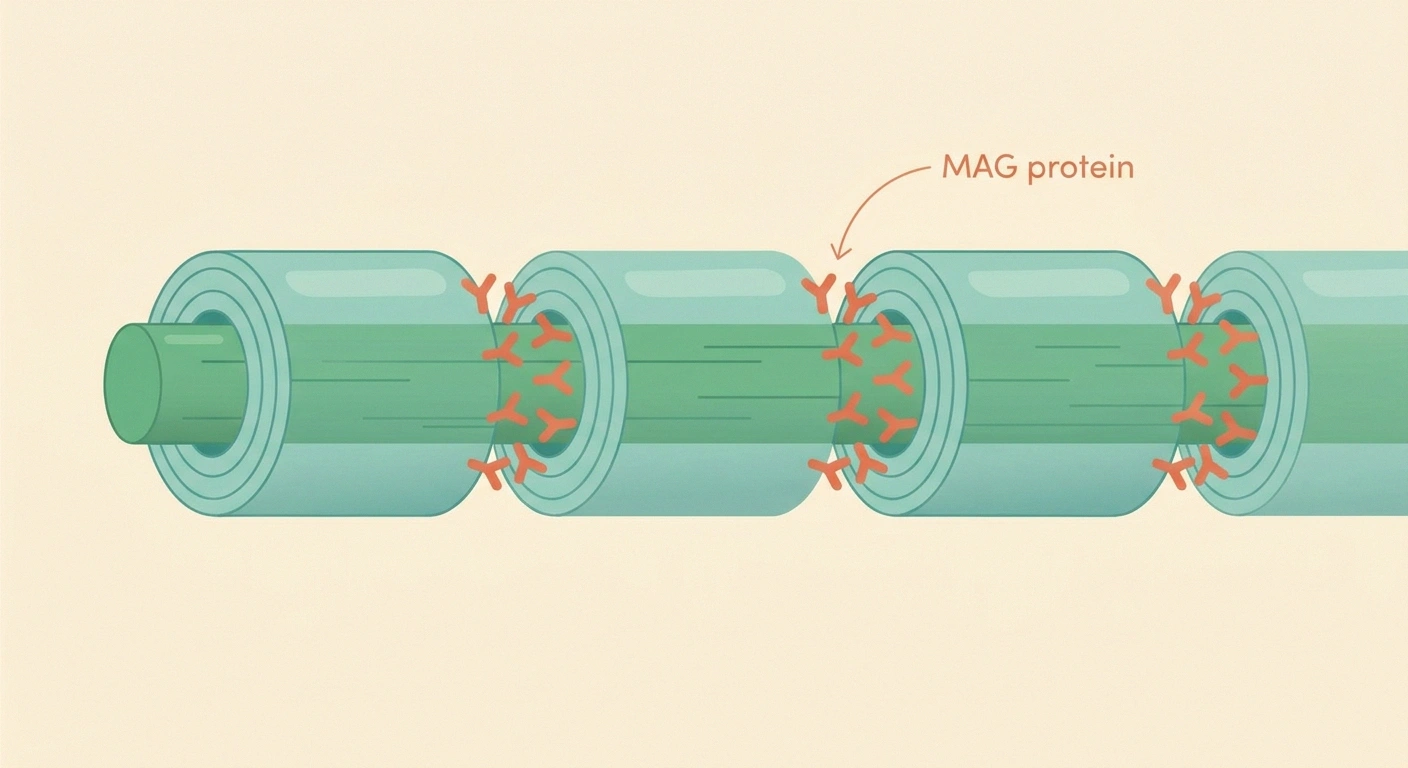
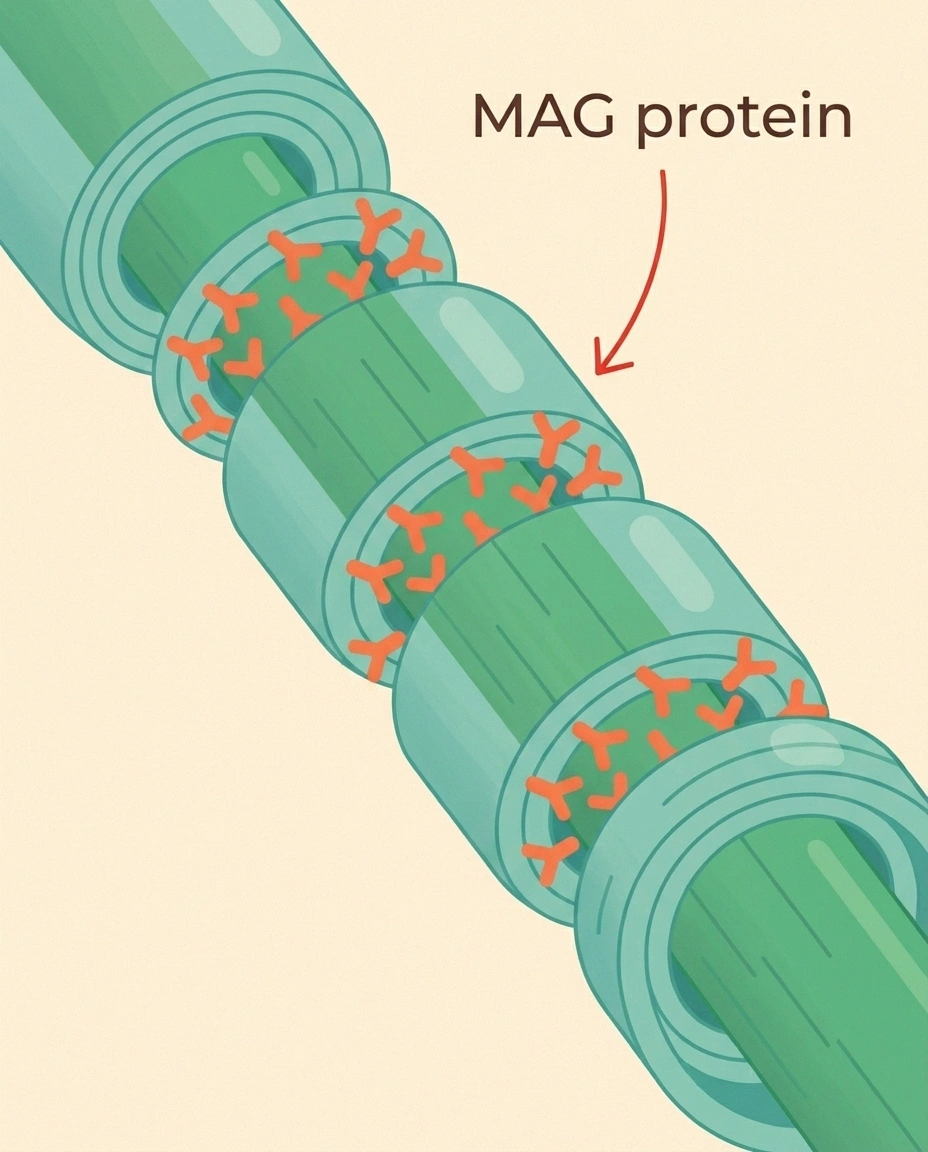
Let's start with what those letters mean, because the name itself tells you almost everything about the mechanism.
Key Takeaway
Anti-MAG neuropathy is an autoimmune condition in which your own IgM antibodies target a specific protein (MAG) in peripheral nerve myelin. The result is slowly progressive numbness, balance loss, and often a hand tremor — usually starting after age 50. Diagnosis requires a specific blood test, and treatment differs meaningfully from other neuropathies.
MAG stands for myelin-associated glycoprotein. Myelin is the fatty insulation wrapped around your nerve fibers — think of it as the coating on an electrical wire. MAG is a specific protein embedded in that insulation, concentrated at the tiny gaps between myelin segments (the paranodes, if you want the technical term). It helps keep the myelin structure organized and helps nerve signals travel cleanly.
Anti-MAG means your immune system has, for reasons that are still not fully understood, produced antibodies that target this specific protein. When those antibodies bind to MAG on your peripheral nerves, they set off an inflammatory cascade that gradually strips away the myelin, especially at the far ends of the nerves — your toes, your fingertips, the parts of you farthest from your spinal cord.
The result is a slow, methodical loss of the fast, clear nerve signaling that lets you feel the ground under your feet, feel the pen in your hand, feel where your body is in space without looking.
Who Gets Anti-MAG Neuropathy?
This is one of the rarer neuropathy diagnoses. Best estimates put the prevalence somewhere around 1 in 100,000 people, though it's almost certainly underdiagnosed — many folks live for years with a label of “idiopathic” or even a mistaken CIDP diagnosis before someone thinks to order the antibody test.
Roughly 50% of patients with an IgM monoclonal gammopathy and peripheral neuropathy will test positive for anti-MAG antibodies. That's why the antibody test is a critical next step whenever a monoclonal IgM protein and neuropathy show up on the same workup.
Source: Multiple case series in Journal of the Peripheral Nervous System and Neurology, 2015-2024.
The typical profile looks like this:
- Age: Onset usually happens after age 50, most commonly in the 60s and 70s.
- Sex: Men are affected roughly two to three times more often than women.
- Progression: Slow. We're talking about symptoms that inch forward over years, not weeks. Many people can trace vague symptoms back a decade before diagnosis.
There's also an important connection that shapes the whole story: anti-MAG neuropathy is almost always linked to something called a monoclonal IgM protein circulating in the blood. That sounds scary, but for the great majority of people it's a benign finding called MGUS — monoclonal gammopathy of undetermined significance. A small subset of patients have it in the context of a slow-growing blood disorder called Waldenström macroglobulinemia. Your hematologist will sort out which category you fall into, and that changes some of the treatment decisions.
The Symptoms: What It Actually Feels Like

The pattern of anti-MAG neuropathy is distinctive enough that experienced neuromuscular doctors can often suspect it just from a careful history. Here's what people typically describe.
Numbness That Starts Far and Moves In
Almost everyone starts with numbness or tingling in the toes and soles of the feet. The classic description is “walking on cotton” or “walking on wooden feet.” Over months and years, the numb zone climbs slowly up the legs. Around the time it reaches the knees or ankles, the fingertips usually start too.
Balance Trouble, Especially in the Dark
This is one of the signature features. Your feet still work — you can move your legs, wiggle your toes, walk across a well-lit room. But you can't feel where the ground is. The nerves that carry position sense (proprioception) are hit hard early, and they're the ones your brain uses to know where your feet are in space without looking down.
In daylight, in familiar rooms, your eyes compensate. But turn the lights off, or ask you to close your eyes and stand still, and you sway or fall. This is called sensory ataxia, and it's why falls prevention becomes such an important part of living with this condition.
The Hand Tremor
Roughly half of people with anti-MAG neuropathy develop a distinctive tremor of the hands — most noticeable when you're holding a cup, trying to write, or bringing a fork to your mouth. It's not the same as a Parkinson's tremor (which is worst at rest). This one shows up with action and posture. Robert first noticed it when his morning coffee started sloshing.
Weakness — Later, and Milder
Unlike some other neuropathies, actual muscle weakness tends to be a later, milder feature. When it comes, it's usually in the small muscles of the feet (making toes hard to spread or lift) and later in the hands. Many people with anti-MAG neuropathy still walk unassisted or with a cane a decade after diagnosis.
What's Usually Not Part of the Picture
Anti-MAG neuropathy is a sensory-predominant condition. If your main problem is severe burning pain, severe weakness, or symptoms that came on over weeks rather than years, something else may be going on. Talk to your neurologist about whether you might be dealing with small fiber neuropathy or another condition instead.
How Anti-MAG Neuropathy Gets Diagnosed


The diagnosis rests on three pillars: the clinical picture, the electrical testing, and the blood work. Every neurologist who does this work regularly follows some version of this path.
Important: Testing Order Matters
A positive anti-MAG antibody test alone doesn't make the diagnosis — clinical presentation and nerve conduction findings must fit the pattern. Conversely, if your history and EMG look like anti-MAG neuropathy, don't accept a “CIDP that's not responding” label without asking specifically for the antibody test. This is one of the most common misdiagnoses in the peripheral nerve world.
Pillar 1: The Neurological Exam and Story
A neuromuscular specialist will spend a lot of time on the history and exam — how long symptoms have been present, how they've progressed, whether there's any family history, what the balance and sensory exam look like. The full neuropathy workup is the starting point.
Pillar 2: EMG and Nerve Conduction Studies
This is the electrical test where they measure how fast and cleanly your nerves are conducting signals. Anti-MAG neuropathy has a very specific fingerprint here: something called disproportionate distal motor latency prolongation. In plainer terms, the signal takes a long time to travel across the very end of the nerve, near the fingers and toes, compared to how it moves along the main length. Neurologists calculate something called the Terminal Latency Index, and a very low number in that calculation strongly points to anti-MAG.
This pattern is different from what you see in CIDP (chronic inflammatory demyelinating polyneuropathy), where slowing is spread more evenly along the nerve. Getting this pattern right is one of the reasons a neuromuscular specialist matters so much.
Pillar 3: The Anti-MAG Antibody Blood Test
This is the confirmatory test — a specific ELISA blood test that measures the amount of anti-MAG IgM antibody in your blood. It's usually reported in “Buhlmann Titer Units” (BTU). Values above 10,000 BTU strongly support the diagnosis. Very high titers (100,000 or more) are common.
Alongside this, your doctor will run something called serum protein electrophoresis and immunofixation to look for that monoclonal IgM protein I mentioned earlier. Almost everyone with anti-MAG neuropathy has one.
The Referrals That Follow
Once the diagnosis is confirmed, you'll usually meet a hematologist too, because the IgM protein needs its own workup. This might include a bone marrow biopsy to check whether the plasma cells producing that antibody are behaving benignly (MGUS) or in a way that suggests a slow blood cancer like Waldenström macroglobulinemia. Most patients are in the MGUS group and don't need cancer treatment — just monitoring.
Why Anti-MAG Gets Mistaken for CIDP (and Why That Matters)
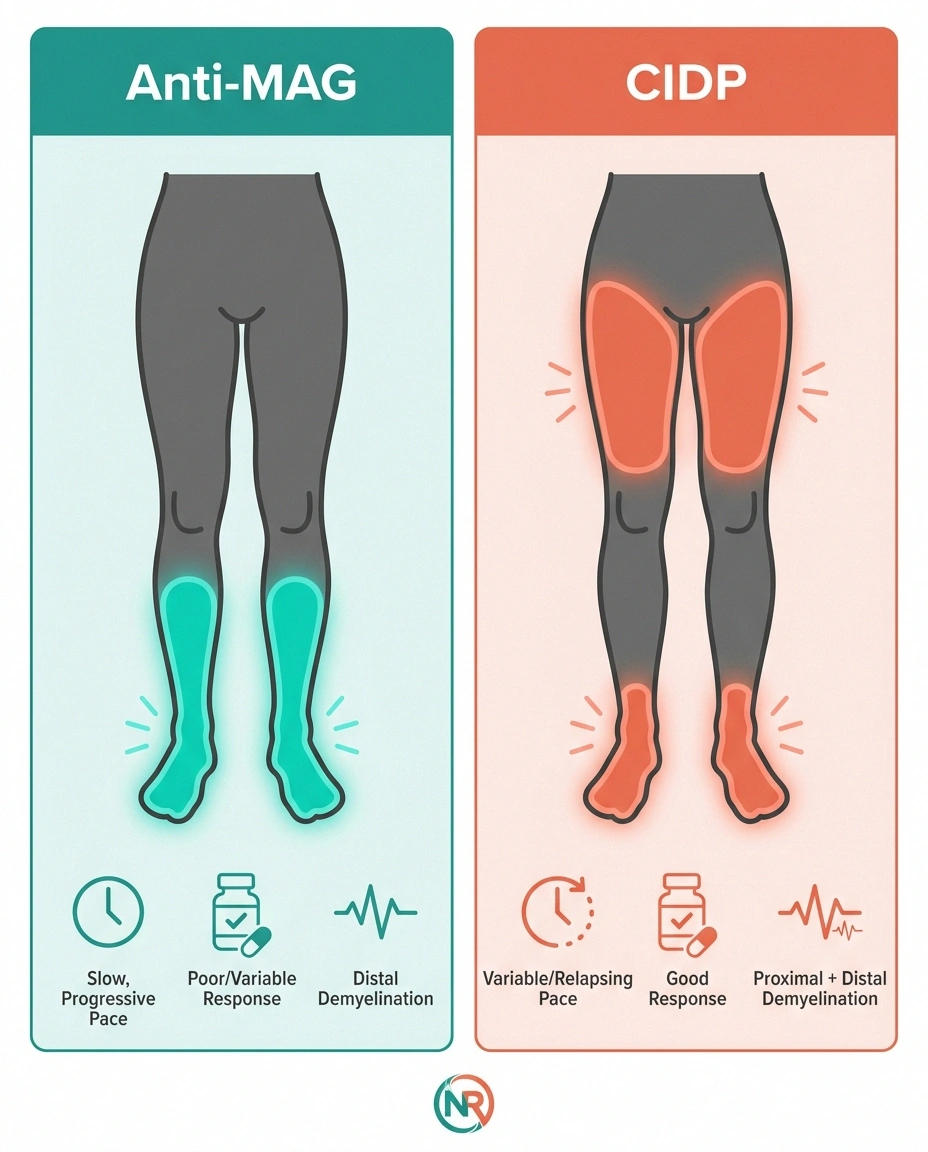
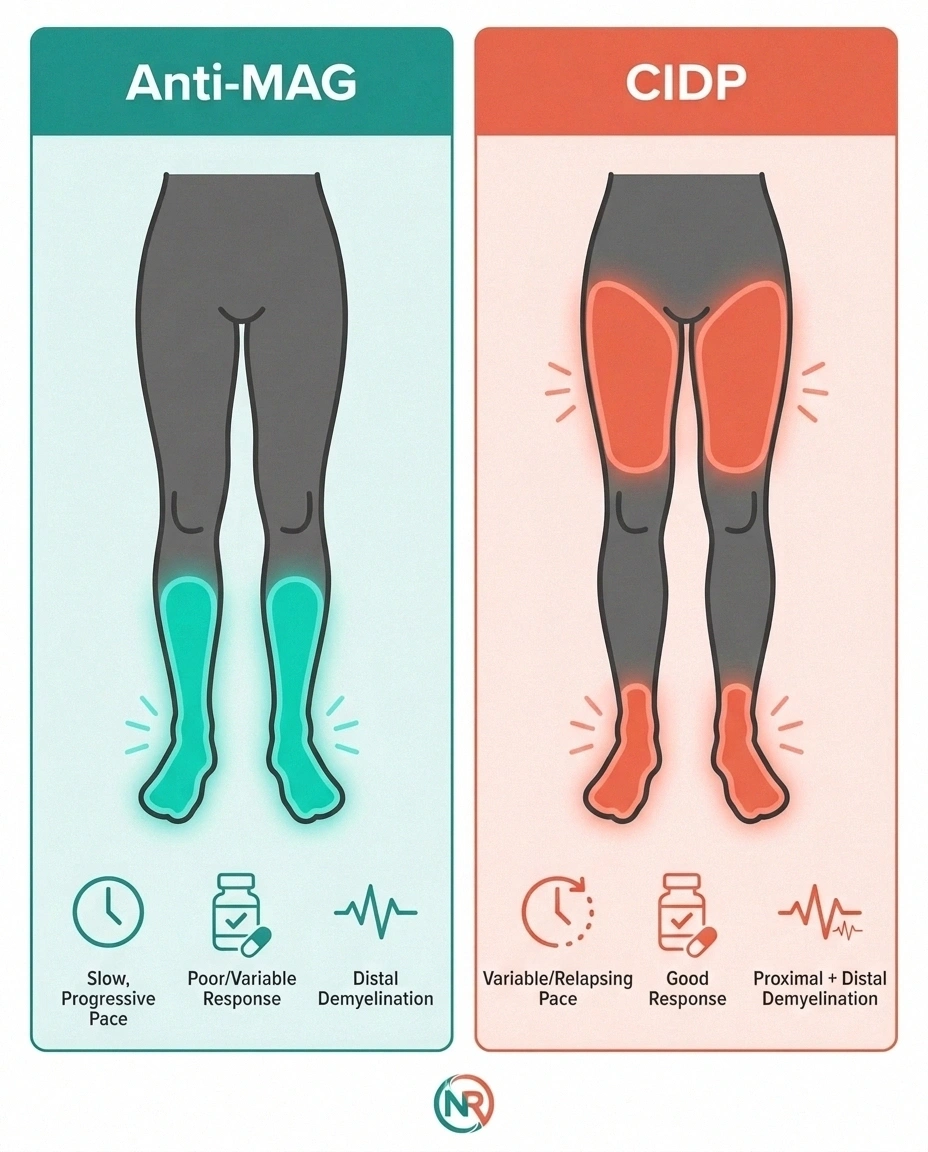
This is the misdiagnosis Robert lived with for six years. Both anti-MAG neuropathy and CIDP involve immune attack on peripheral nerve myelin. Both cause slowly progressive symptoms. Both show demyelination on nerve conduction studies. On the surface, they look similar.
Anti-MAG vs CIDP: Side-by-Side
| Feature | Anti-MAG | CIDP |
|---|---|---|
| Progression pace | Years (very slow) | Months (moderate) |
| Symptom pattern | Distal sensory-predominant | Proximal + distal, motor |
| Hand tremor | Common (~50%) | Uncommon |
| EMG pattern | Distal-predominant demyelination | Multifocal demyelination |
| IVIG response | Usually poor | Usually good |
But the treatment response is very different, and that's why sorting them out matters. CIDP typically responds well to intravenous immunoglobulin (IVIG), corticosteroids, or plasma exchange. Anti-MAG neuropathy, in contrast, tends to respond poorly to these first-line CIDP treatments. Patients often go through months or years of IVIG infusions with little to no benefit before someone thinks to check for anti-MAG antibodies.
If you've been given a CIDP diagnosis but you're not responding well to standard treatment — especially if your symptoms are mostly sensory, mostly distal, and slowly progressive — it's absolutely reasonable to ask your neurologist about anti-MAG antibody testing. The extra blood test costs relatively little and can completely reshape the treatment plan.
Treatment: What Actually Helps

This is where the honest conversation gets more nuanced. There's no cure for anti-MAG neuropathy, and no treatment that reliably reverses the damage already done. But there are approaches that can slow the progression, and increasingly, options for stabilizing symptoms.
Typical Rituximab Treatment Journey
Rituximab: The Current Front-Line Treatment
Rituximab is a monoclonal antibody that depletes B cells — the immune cells that make antibodies, including the anti-MAG antibodies causing the trouble. Multiple studies have found that about 30 to 50 percent of anti-MAG patients see meaningful stabilization or modest improvement after rituximab infusions.
What “response” typically looks like: stabilization of symptoms rather than dramatic reversal. Some folks notice slightly better balance, less progression of numbness. Others don't respond at all. Predicting who will respond is still an active area of research.
Treatment usually involves a series of infusions (four weekly, or two doses two weeks apart, depending on the protocol), sometimes repeated at 6-month or yearly intervals. Side effects are usually manageable — infusion reactions and increased infection risk are the main concerns.
What About IVIG and Steroids?
Both have been tried extensively. The consensus of specialist opinion and controlled studies is that they help only a minority of anti-MAG patients, and when they do, the benefit is usually modest and short-lived. Many neurologists will still trial IVIG for a few months to see if you're one of the lucky responders, but if you're not, staying on it long-term rarely pays off.
Emerging Options
For patients whose anti-MAG neuropathy is linked to Waldenström macroglobulinemia, targeted drugs like ibrutinib (a BTK inhibitor) are showing promise, treating both the underlying blood disorder and the neuropathy in one shot. Newer B-cell-targeting agents (obinutuzumab, others) are being studied. Trials of drugs that clear the antibodies more directly are ongoing.
Symptomatic Management
Alongside the disease-directed treatment, most people benefit from symptom management: medications like gabapentin for burning or shooting pain, physical therapy for balance and gait training, cane or walking-pole use to prevent falls, and attention to the same daily habits that support any neuropathy: gentle movement, blood sugar control, alcohol moderation, foot inspection routines. Many folks find that adding evidence-based natural remedies alongside prescribed medications helps them feel more in control of the day-to-day symptom load.
Living With It: What Robert Taught Me

Robert and I have talked a lot in the last year about how life changes with this diagnosis. A few things stand out.
The Living-With-It Playbook
- Prioritize balance work over pain control — falls are the biggest indirect risk
- Light every hallway and stairway — sensory ataxia worsens in dim light
- Use assistive devices earlier than pride wants you to — canes and walkers extend independence
- Adapt handled tools before giving up hobbies — the tremor is workable
- Find community — this diagnosis is rare enough that online groups fill a real gap
The tremor takes some grieving. For a woodworker who had spent forty years fine-tuning cabinet drawers, the loss of steady hands hit harder than the numb feet did. He's adapted — bigger-handled tools, jigs to hold pieces steady, more measure-twice-cut-once patience. But that grief is real. Naming it helped.
Balance work matters more than pain relief. The biggest life-quality issue isn't pain; it's the fear of falling. Robert's neurologist connected him with a physical therapist who does vestibular and proprioceptive training. Those sessions — plus a nightlight in the hallway, grab bars in the bathroom, and finally accepting a cane — have made more difference than any medication.
The dark is different now. Nighttime bathroom trips, walking to the mailbox at dusk, moving through a dim restaurant — anywhere the visual cues fade, the sensory ataxia comes forward. Motion-sensor lights around the house have been a small, real help.
Community helps. Anti-MAG is rare enough that most people don't have anyone in their local orbit who understands it. Online groups — the Foundation for Peripheral Neuropathy, GBS/CIDP Foundation International, disease-specific Facebook groups — have been where Robert has found people who get it. The mental health toll of chronic neuropathy is real, and sharing it with people who understand the specific texture of this diagnosis eases some of the isolation.
When to Push for a Specialist

If you're reading this because you're wondering whether anti-MAG neuropathy might explain what's going on with you, here are the flags that would push me toward asking your doctor for a neuromuscular specialty referral:
Ask for a Neuromuscular Referral If…
Any two of these together warrant a specialist look:
- Slowly progressive numbness moving from feet up the legs over years
- Balance noticeably worse in low light or with eyes closed
- New action or postural tremor in the hands after age 50
- An “idiopathic neuropathy” label that hasn't been reassessed recently
- A CIDP diagnosis not responding to standard treatment
- Monoclonal protein already noted on other blood work
- Slowly progressive numbness that has moved from feet toward knees over years, not months.
- Balance trouble that's noticeably worse in low light or with eyes closed.
- A postural or action tremor in the hands that's new since middle age.
- An “idiopathic neuropathy” label that hasn't been reassessed in years.
- A CIDP diagnosis that's not responding well to IVIG or steroids.
- A monoclonal protein already flagged on other blood work.
None of these prove anti-MAG neuropathy on their own. But they add up to a picture worth investigating with someone who does this work full-time. A neuromuscular specialist — the neurologist within neurology — has the tools and the pattern-recognition to sort it out.
What the Research Is Working On
The last decade has been quietly promising for anti-MAG research. Better antibody-clearing therapies are moving through trials. Understanding of the IgM-plasma-cell biology is deepening, borrowing insights from the multiple myeloma and Waldenström treatment worlds. There's genuine reason to expect that patients diagnosed today will have more options within five to ten years than those diagnosed a decade ago had.
That's not the same as a cure. But it's not nothing, either. In a slowly progressive condition, buying time and stability is meaningful. Robert put it this way: “I don't need it fixed. I need it to stop getting worse. That, I can live with.”
Frequently Asked Questions
Is anti-MAG neuropathy the same as CIDP?
No, though they can look similar on the surface. Both involve immune attack on peripheral nerve myelin, and both cause slowly progressive weakness or sensory loss. But anti-MAG neuropathy is driven by a specific antibody targeting the myelin-associated glycoprotein, is more sensory and distal, and responds much less well to the standard CIDP treatments like IVIG and steroids. Getting the diagnosis right matters because the treatment strategies diverge.
What causes anti-MAG neuropathy?
The underlying cause is the production of IgM antibodies that target MAG, a protein in peripheral nerve myelin. In almost all cases, those antibodies come from a monoclonal population of plasma cells — most often in the context of MGUS (a benign clonal expansion) and occasionally Waldenström macroglobulinemia. Why the antibody targets MAG specifically, and why this happens in some people but not others, is still an area of active research.
How rare is anti-MAG neuropathy?
It's rare. Estimates put prevalence around 1 in 100,000 people, though it's almost certainly underdiagnosed. Among people who have an IgM monoclonal gammopathy plus peripheral neuropathy, roughly half will test positive for anti-MAG antibodies.
Can anti-MAG neuropathy be cured?
There's no cure available today. Rituximab and other B-cell-directed therapies can stabilize the disease or produce modest improvement in a subset of patients, but the antibody-producing cells and the underlying immune process are not eliminated permanently. The realistic treatment goal is slowing or halting progression, not reversal.
Does rituximab work for everyone with anti-MAG?
No. Response rates in the published studies range from about 30 to 50 percent, depending on how “response” is defined. Some patients see clear stabilization or slight improvement. Others show no meaningful change. Predicting individual response is still difficult, and most specialists consider a trial of rituximab reasonable for patients whose neuropathy is progressive and functionally impacting.
Is anti-MAG neuropathy life-threatening?
The neuropathy itself is not life-threatening. Life expectancy for people with anti-MAG neuropathy is generally similar to unaffected peers of the same age. Falls and their complications are the biggest indirect risk, which is why balance and safety strategies matter. When the associated blood disorder is Waldenström macroglobulinemia rather than MGUS, that condition has its own prognosis and treatment path, managed by hematology.
Should I get genetic testing for anti-MAG neuropathy?
No — anti-MAG neuropathy is not a genetic condition. It's an acquired autoimmune disorder. There's no known family risk that requires screening children or siblings.
What's the difference between anti-MAG and idiopathic neuropathy?
“Idiopathic” simply means the cause hasn't been identified. Some people carrying an idiopathic label actually have anti-MAG neuropathy, and their diagnosis would change if the right test were run. If you have an idiopathic diagnosis, especially with slowly progressive sensory symptoms and any monoclonal protein on your blood work, asking about anti-MAG antibody testing is reasonable.
How long can I expect to keep walking with anti-MAG neuropathy?
The condition progresses slowly, and most people continue walking, often with a cane or walker, for a decade or more after diagnosis. Wheelchair use eventually happens for some patients, especially without treatment, but it typically comes years down the road. Physical therapy, balance training, and appropriate use of assistive devices make a large difference in maintaining walking ability.
About the Author