Pour yourself something warm before we get into this one. Actually, that’s fitting, because “something warm” is about to become one of the most important phrases in your life if you or someone you love is starting oxaliplatin. I’ve sat around the folding tables at my Tuesday night support group more times than I can count, listening to people describe the exact same moment: they took a sip of water straight from the refrigerator, and it felt like touching a live wire to their tongue. Nobody warned them it was coming. That’s the strange thing about oxaliplatin. It’s one of the most effective drugs we have for colorectal and other GI cancers, and it comes with one of the oddest, most specific nerve reactions in all of oncology. In this article, I want to walk you through what’s actually happening in your nerves when cold turns into pain, why there are really two different neuropathies hiding under one drug name, how long each one tends to last, and the practical things — some proven, some still being studied — that can make the months ahead easier to live through.
What Oxaliplatin Is and Why It Targets Your Nerves
Oxaliplatin is a platinum-based chemotherapy drug, a close cousin of cisplatin and carboplatin. It’s best known as the “ox” in FOLFOX, the combination regimen (folinic acid, fluorouracil, and oxaliplatin) that’s a backbone treatment for colorectal cancer, and it also shows up in protocols for other gastrointestinal cancers. Platinum drugs work by binding to the DNA inside cancer cells and jamming up their ability to divide. That’s the whole point of the drug, and for a lot of patients, it’s genuinely life-extending medicine.
Oxaliplatin, the backbone of FOLFOX chemotherapy for colorectal and other GI cancers, causes two distinct nerve reactions: a short-lived acute reaction triggered specifically by cold, and a separate chronic neuropathy that builds with cumulative dose over months of treatment. They have different triggers, different timelines, and different management approaches — understanding which one you’re dealing with changes what you should expect.
The problem is that platinum compounds don’t just find cancer cells. They travel through the bloodstream and settle into other tissues too, including the dorsal root ganglia, which are small clusters of nerve cell bodies sitting just outside your spinal cord. Damage there shows up as chemotherapy-induced peripheral neuropathy, or CIPN for short. Nearly every platinum-based chemo drug can cause some version of this, but oxaliplatin’s version has a signature twist that none of the others have quite as dramatically: cold.
Two Different Neuropathies, Not One
Here’s something I wish someone had drawn out on a napkin for me the first time I tried to understand this: oxaliplatin doesn’t cause one kind of nerve problem. It causes two, and they behave almost like separate conditions sharing the same cause.
- Onset: hours to 1-2 days after infusion
- Trigger: cold air, cold drinks, cold objects
- Feels like: electric, shock-like, buzzing
- Location: hands, feet, mouth, throat
- Duration: usually resolves within about a week
- Onset: after roughly 4-6 treatment cycles
- Trigger: cumulative dose, not cold
- Feels like: numbness, tingling, aching
- Location: stocking-glove — feet then hands
- Duration: can persist months to years after chemo ends
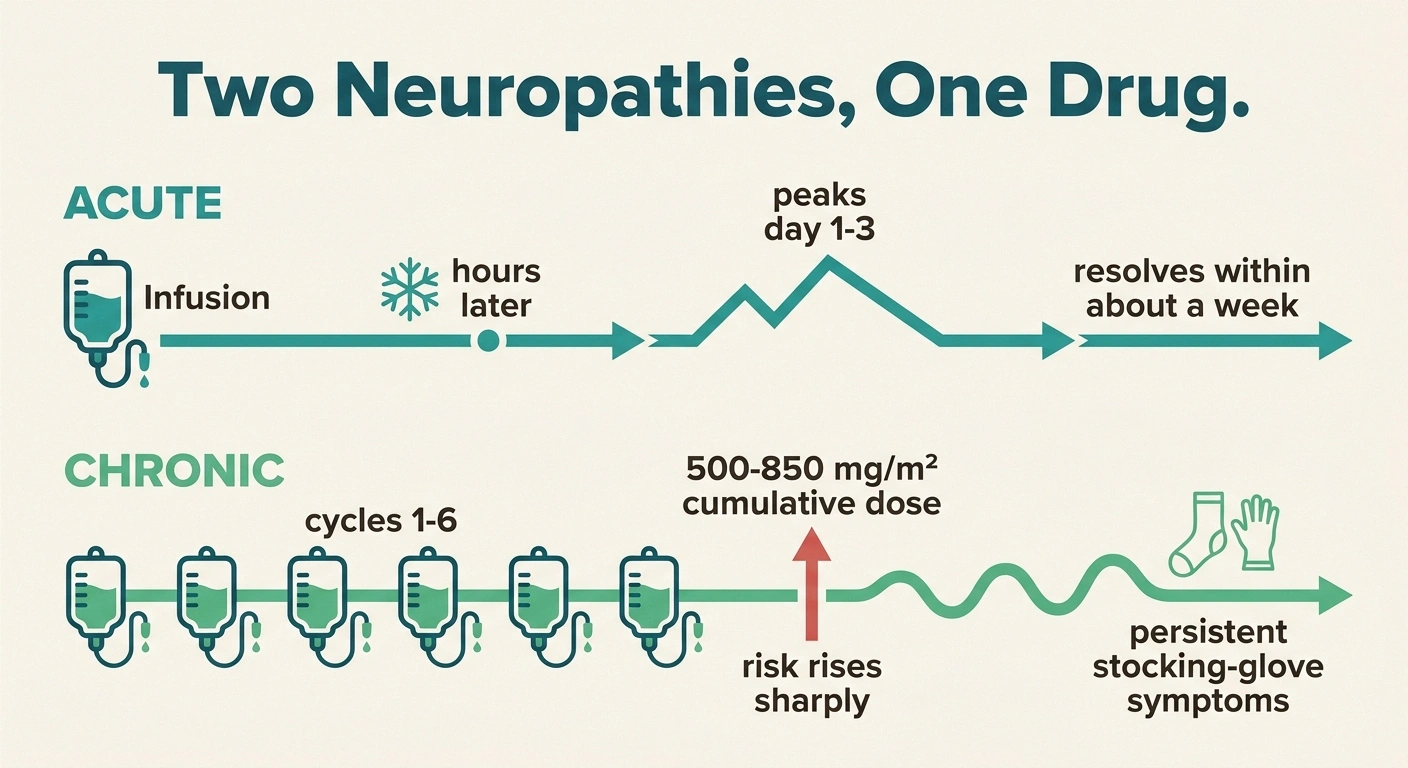
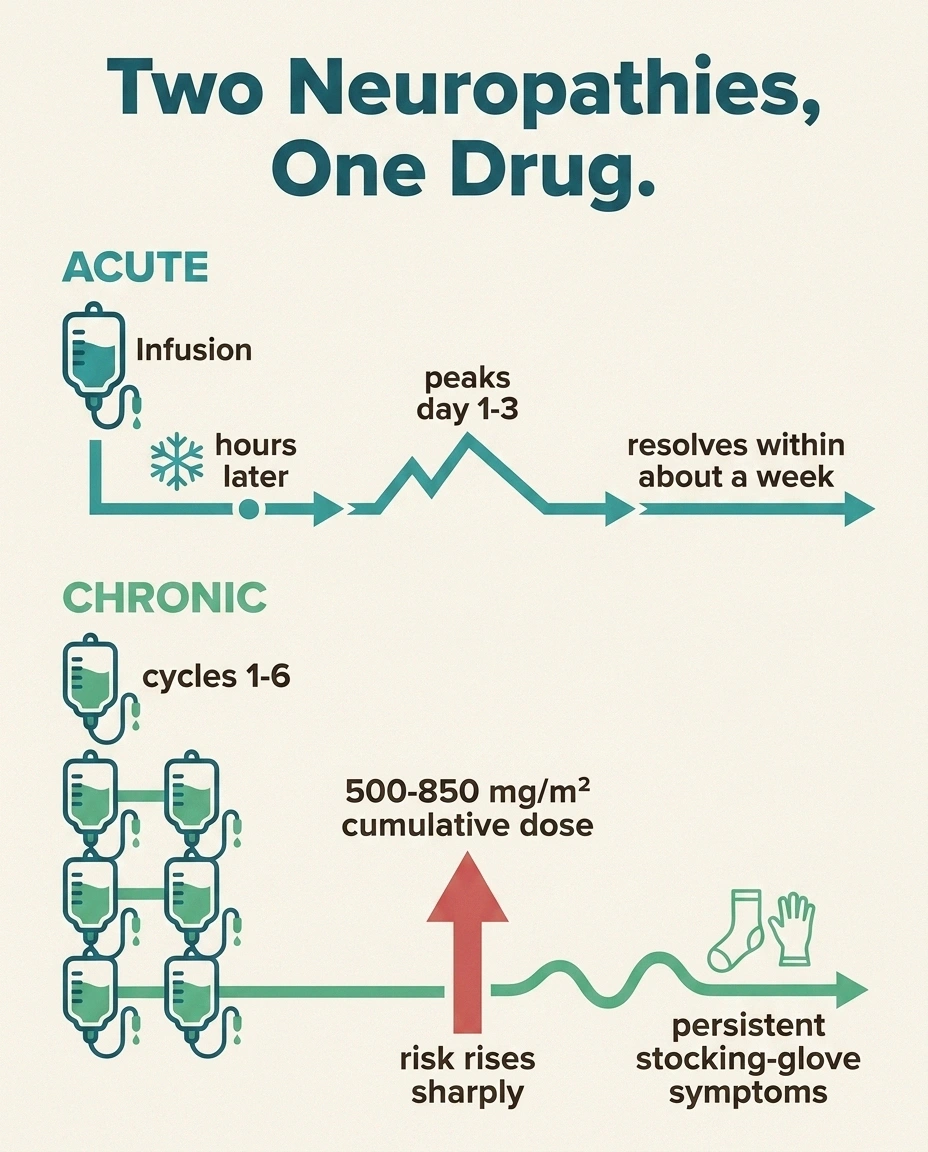
The first is acute neuropathy — it shows up within hours to a couple of days of an infusion, gets triggered specifically by cold, and usually settles down within a week. The second is chronic neuropathy — it builds slowly over multiple treatment cycles, has nothing to do with cold once it’s established, and can stick around long after chemo ends. Understanding which one you’re dealing with at any given point changes what you should expect and what you should do about it.
The Acute Reaction — What Cold Feels Like on Oxaliplatin

This is usually the first thing people notice, sometimes as early as the drive home from their first infusion. Cold air hits your face and your jaw tightens. You reach into the freezer and your fingers cramp into claws. You take a sip of anything below room temperature and your throat or tongue feels like it’s being zapped.
Patients describe it in strikingly consistent language: electric, shock-like, buzzing, a jolt rather than an ache. It shows up almost exclusively in the hands, feet, mouth, and throat, and almost always within the first one to three days after infusion, then fades. Most people find the reaction is worst after the first couple of cycles and either stays roughly the same or intensifies slightly with each round, but it typically resolves fully between infusions in the early cycles. This acute pattern is really an extreme version of general temperature sensitivity that shows up in a lot of nerve conditions, just compressed into a dramatic, drug-triggered window.
The Channel Science, Kept Plain
I’m not a scientist, and I promise not to turn this into a biochemistry lecture, but the mechanism here is worth understanding because it explains why cold specifically is the trigger, and that knowledge is genuinely useful.
Researchers believe oxaliplatin’s breakdown product, oxalate, interferes with calcium regulation of a sodium channel called Nav1.6 in cold-sensing nerve fibers. That makes the channel hyperexcitable — it fires too easily, turning an ordinarily mild cold sensation into a pain signal.
It’s the same reason a sip of ice water can register as an electric shock in the throat: the fiber isn’t being newly injured in that moment, it’s a channel that’s been chemically primed to misfire.
Your peripheral nerves fire signals using tiny gates in their membranes called sodium channels. One type in particular, called Nav1.6, plays an outsized role in nerve fibers that sense cold. Researchers believe that oxaliplatin, or more precisely a byproduct it breaks down into called oxalate, interferes with how calcium regulates these sodium channels. The result is that the channels become hyperexcitable — they fire too easily, too often, and in response to stimuli that shouldn’t hurt at all.
Normally, cold produces a mild, unremarkable sensation. On oxaliplatin, a hyperexcitable Nav1.6 channel turns that same mild cold signal into a pain signal. That’s the whole story behind why drinking ice water can feel like an electric shock in your throat: it’s not damage happening in that instant, it’s a nerve fiber that’s been chemically primed to misfire.
Chronic CIPN — Cumulative Dose and the Danger Zone
Chronic oxaliplatin neuropathy is a different animal entirely. It isn’t triggered by cold, and it doesn’t come and go between infusions. It builds cumulatively, meaning the risk climbs with every cycle you receive, and it tends to appear after roughly four to six cycles for most patients.
The number that matters most here is cumulative dose. Research has consistently pointed to a cumulative dose somewhere in the range of 500 to 850 mg/m² as the zone where chronic CIPN risk jumps sharply. Below that range, persistent symptoms are less common. Above it, the odds climb fast. Because a standard FOLFOX cycle typically delivers around 85 mg/m² of oxaliplatin every two weeks, many patients cross into that higher-risk territory somewhere between their eighth and twelfth infusion, which usually lands around the four-to-six-month mark of treatment.
Unlike the acute reaction, chronic CIPN presents as ongoing numbness, tingling, and sometimes burning or aching pain in a stocking-and-glove pattern — feet first, then hands, symmetric on both sides. Some patients also develop reduced fine motor control (trouble with buttons, zippers, picking up small objects) and, less commonly, balance problems. When it’s significant enough to interfere with daily life, doctors sometimes reach for medications like gabapentin to help manage the discomfort, separate from whatever is happening with the chemo regimen itself.
The Timeline — Onset, Coasting, and Recovery
Putting the whole arc together: acute symptoms show up within the first cycle or two and largely resolve between infusions early on. Chronic symptoms build gradually and become the dominant issue somewhere in the middle of a treatment course. Then comes a phenomenon that catches a lot of patients off guard, one my support group calls “the cruel surprise”: coasting.
Coasting refers to nerve symptoms that continue to worsen for weeks or even a few months after oxaliplatin treatment has already ended. It happens because the drug’s effects on nerve tissue don’t switch off the moment the infusions stop; there’s a lag, and for a subset of patients, that lag includes a period of things getting worse before they get better. It’s disorienting to be told treatment is finished and then feel your hands getting number, not less numb, a month later. If that happens to you, it doesn’t necessarily mean anything has gone wrong. It’s a recognized part of the pattern.
After coasting resolves, recovery is typically slow and partial. Improvement tends to happen gradually over the following months to a couple of years. The honest numbers: a meaningful share of patients see substantial improvement, but research following patients long-term has found that roughly 30 to 40 percent still have persistent CIPN symptoms two or more years after finishing treatment. That’s not meant to be discouraging, it’s meant to help you plan realistically rather than assume the clock resets to zero the day chemo ends.
Cold-Avoidance Strategies That Actually Help
This is the part of the article I actually get the most questions about at support group, because it’s the part people can act on today. None of this is exotic. It’s mostly about removing cold from your daily routine as thoroughly as you reasonably can, especially in the days right after an infusion.
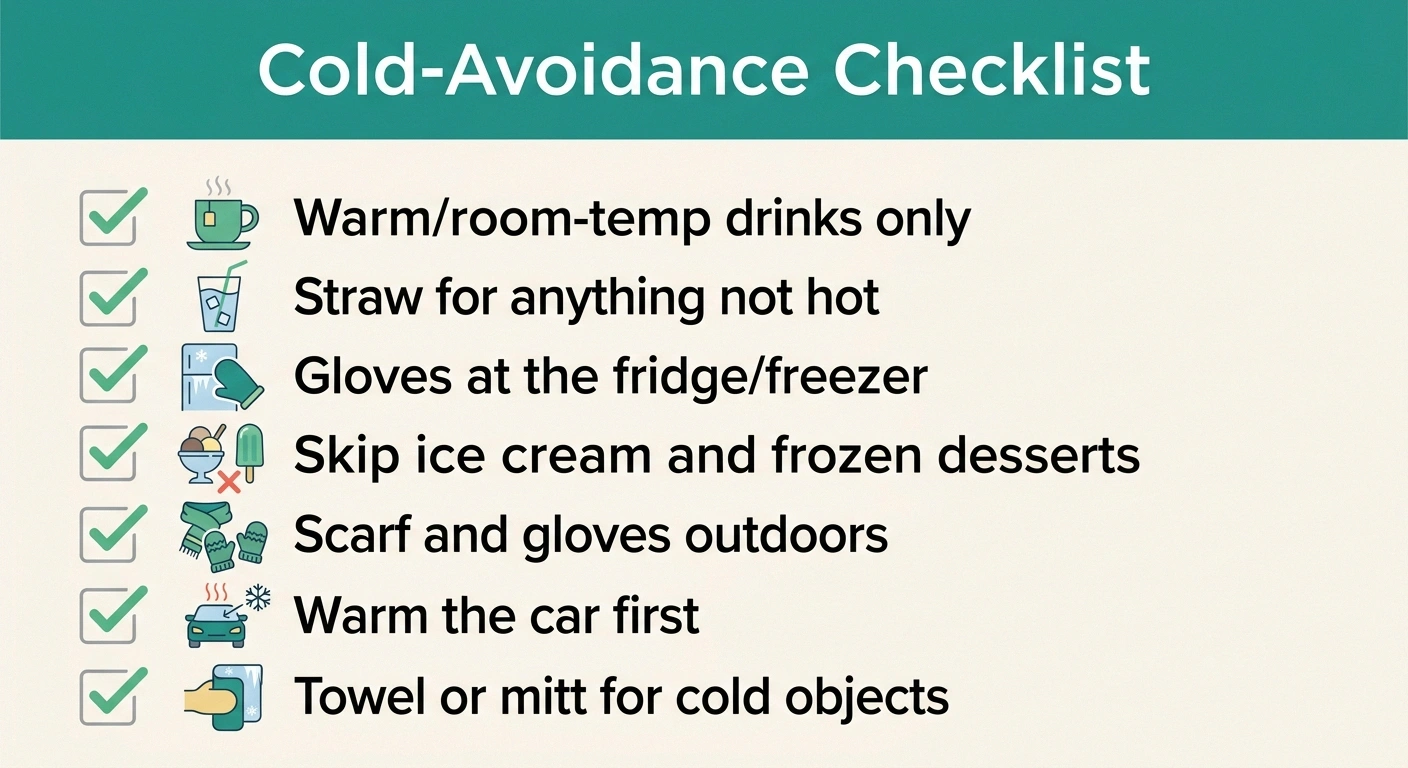
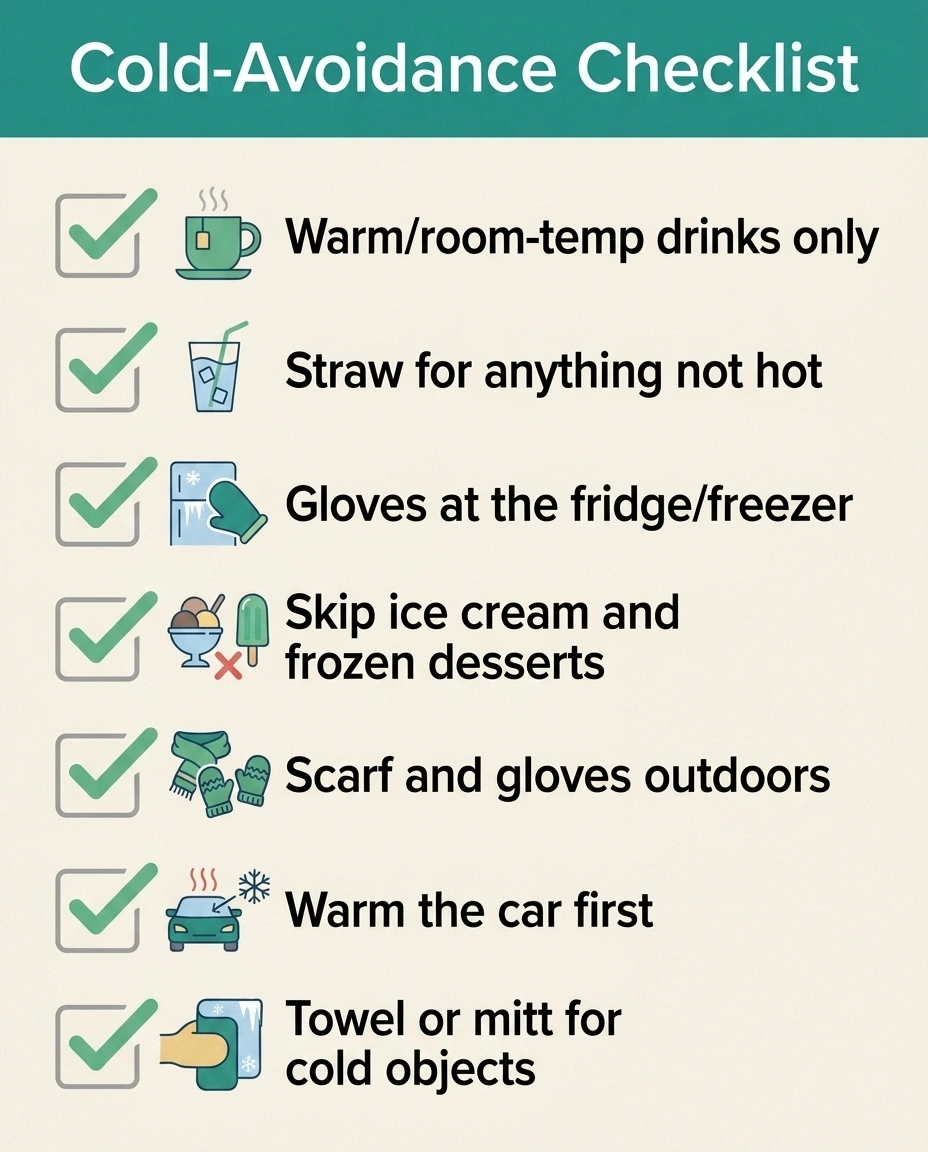
- Drink only room-temperature or warm beverages. Skip the ice entirely. Coffee, tea, soup, and warm water become your defaults for at least the first several days after each treatment.
- Use a straw for anything that isn’t piping hot. A straw routes liquid past the back of the mouth and throat faster, reducing the contact time that triggers the throat-tightening sensation.
- Wear gloves to open the refrigerator or freezer. Cold metal handles and cold air from an open freezer door are a classic trigger. Keep a pair of thin gloves near the fridge.
- Skip ice cream and frozen desserts during the sensitive window after infusion, no matter how tempting they are.
- Bundle up before you go outside, especially the first three to five days post-infusion — scarf over your nose and mouth, gloves, warm socks, and avoid prolonged exposure to cold air or wind if you can help it. This matters even more if you live somewhere with real winters; a lot of the general guidance for managing neuropathy in cold weather applies here too, just amplified.
- Warm your car before you get in, and keep a blanket in it for the ride home from infusions.
- Handle cold objects with a towel or oven mitt rather than bare hands — that includes cans from the pantry, frozen food packaging, and cold glassware.
None of these strategies stop the underlying nerve chemistry. What they do is reduce how often you’re setting it off, which for most patients means meaningfully fewer painful episodes during an already hard stretch of life.
What the Field Is Trying to Prevent It
Researchers and oncology teams have spent two decades trying to find something that reliably prevents or blunts oxaliplatin neuropathy, and it’s been a genuinely frustrating search. Here’s where things actually stand, without overselling any of it.
Cold-avoidance habits and reporting your symptoms early and accurately to your oncology team matter far more for your long-term nerve outcome than any supplement on this page. None of the protocols above — stop-and-go dosing, calcium/magnesium, cryotherapy, scrambler therapy — are things to request or self-direct.
Never stop or reduce oxaliplatin on your own. Dose and schedule decisions belong to your oncologist, who is weighing your nerve symptoms against your cancer treatment as a whole. Your role is to report clearly and promptly.
Stop-and-go dosing (OPTIMOX). Some oncology teams use a modified schedule where oxaliplatin is paused after a set number of cycles while the other FOLFOX components continue, then reintroduced later if needed. The idea is to cap cumulative dose exposure without abandoning the regimen entirely. Whether and how this is used is entirely a treatment-planning decision your oncologist makes based on your cancer, not something to request casually.
Calcium and magnesium infusions. This one has a complicated history. Early small trials suggested calcium/magnesium infusions around treatment might reduce neuropathy, and for a while it became fairly common practice. Larger, better-designed trials since then — including the CONcePT trial and CALGB N08CB — did not confirm a meaningful protective benefit. Some centers still use it selectively, but it’s no longer considered a reliably effective prevention strategy the way it once looked.
Duloxetine. This is the one genuine bright spot, though it’s worth being precise about what it actually does. Duloxetine hasn’t been shown to prevent CIPN from developing. What it has shown, in the CALGB 170601 trial — the only positive phase 3 trial for any CIPN treatment to date — is real benefit for pain relief once established chemotherapy-induced neuropathy is already present. That’s an important distinction: it’s a treatment for the pain that’s already there, not a shield against the nerve damage happening in the first place. There’s also investigational work on newer prevention compounds being studied for reducing CIPN risk, though these remain in the research pipeline rather than standard practice.
Venlafaxine. A related antidepressant that’s been studied for both prevention and treatment of CIPN, with mixed results across trials. Some oncology teams use it off-label, particularly for the acute cold-triggered symptoms, but the evidence base is weaker and less consistent than duloxetine’s.
Cryotherapy — cooling gloves and socks during infusion. This sounds counterintuitive given everything you just read about cold being the trigger, but the theory is different: cooling the hands and feet during the infusion itself constricts blood vessels and may reduce how much drug reaches those peripheral nerve endings in the first place. The evidence here is mixed but growing, and a number of infusion centers now offer it as an option. It’s being studied, not universally proven, but it’s one of the more promising non-drug approaches in active use.
Scrambler therapy. A non-invasive electrical stimulation technique that’s being studied for CIPN pain management. It’s investigational for this specific use, available at a limited number of centers, and worth asking about if standard approaches aren’t cutting it, understanding that the evidence is still developing.
What Isn’t Proven Yet

I get asked constantly about supplements, and I want to be straight with you rather than hand you a shopping list. Alpha-lipoic acid, acetyl-L-carnitine, vitamin E, glutathione, and glutamine have all been studied for preventing or reducing chemotherapy-induced neuropathy, oxaliplatin’s included. The data across these is mixed and, in a few cases, actually concerning rather than reassuring — one notable trial found acetyl-L-carnitine performed worse than placebo in patients on taxane chemotherapy, which is a reminder that “natural” doesn’t automatically mean “safe” during active cancer treatment. None of these have the kind of consistent, well-designed trial evidence that would let me tell you confidently that they work. If you’re considering any of them, that’s a conversation for your oncologist and pharmacist first, not a solo decision, because some supplements can interact with chemotherapy or affect how well it works.
Talking to Your Oncology Team

This might be the single most important section in this whole article, so let me say it plainly: report your symptoms early, and report them in detail. Not “my hands feel a little weird,” but specifics — when it started, what it feels like, whether it’s triggered by cold, whether it’s getting worse, whether it’s affecting your grip, your balance, your ability to button a shirt or pick up a coin.
Here’s why that detail matters so much. Oncology teams use standardized grading scales to track neuropathy severity, and that grading directly informs decisions about whether to continue the current dose, reduce it, switch to a modified schedule, or stop oxaliplatin altogether while continuing the rest of the regimen. Catching worsening neuropathy early gives your oncologist more options and more room to preserve your long-term nerve function while still treating the cancer effectively. Waiting until symptoms are severe narrows those options considerably.
I want to be very clear about something, because I’ve heard well-meaning people suggest otherwise: this is not a decision to make on your own. Oxaliplatin dose reductions and discontinuation decisions belong entirely to your oncology team, weighed against your specific cancer, your treatment goals, and how you’re responding. Your job is to report accurately and honestly. Their job is to use that information to make the call. If you want to understand the broader landscape of what’s being explored to reduce chemotherapy nerve damage generally, our chemotherapy neuropathy prevention overview is a good next stop, but bring any questions it raises straight back to your care team.
When to Call the Doctor Right Away
Most of what I’ve described in this article, while uncomfortable, is expected and manageable at home with the strategies above. But there are a handful of symptoms that need a same-day call, not a “mention it at my next appointment” approach.
- Difficulty breathing or a sensation of throat tightness or spasm that feels like it’s affecting your airway. This is called pharyngolaryngeal dysesthesia, and while it’s rare, it can be genuinely frightening — patients sometimes describe feeling like they can’t get a full breath during or shortly after an infusion. It’s almost always brief and resolves on its own, but it needs to be reported immediately and evaluated, especially the first time it happens.
- New muscle weakness — trouble lifting your foot, gripping objects, or a noticeable change in strength that wasn’t there before.
- Falls, or a new sense of unsteadiness on your feet. Balance changes deserve prompt attention, both for safety and because they can signal that neuropathy is progressing.
- Symptoms spreading rapidly or a sudden significant worsening rather than the gradual pattern typically expected.
None of this is meant to frighten you into silence or over-worry about every twinge. It’s meant to help you tell the difference between “uncomfortable and expected” and “call now,” so you can respond calmly and appropriately either way.
Frequently Asked Questions
How soon after my oxaliplatin infusion will I feel the cold sensitivity?
Most people notice it within hours of finishing the infusion, and it typically peaks over the following one to three days. It’s often the very first side effect people notice, sometimes even before nausea or fatigue set in. Early cycles tend to be the most surprising simply because you don’t yet know what to expect; by the second or third infusion, most patients have already adjusted their habits around drinks and cold exposure.
Does the acute cold reaction mean I’ll definitely get permanent nerve damage?
No. The acute cold-triggered reaction and the chronic cumulative neuropathy are related but distinct processes. Having a strong acute reaction doesn’t automatically predict how severe your chronic symptoms will be, though some research suggests patients with more pronounced acute symptoms may be somewhat more likely to develop chronic neuropathy. It’s a pattern worth mentioning to your oncologist, not a guaranteed outcome.
Why does drinking something cold make my throat feel like it’s closing up?
This is one of the more alarming acute symptoms, and it comes from the same hyperexcitable nerve fibers responsible for the electric-shock sensations in your hands and feet, just located in the throat and jaw area. For most patients it’s a brief, uncomfortable tightness rather than an actual airway problem, and it passes quickly. If it ever feels like true difficulty breathing rather than tightness, that needs prompt medical attention.
What is the “coasting phenomenon” everyone talks about?
Coasting is when neuropathy symptoms continue to worsen for weeks or months after oxaliplatin treatment has ended, before eventually beginning to improve. It happens because the nerve effects of the drug don’t stop the instant infusions stop. It’s disorienting and can feel like something has gone wrong, but it’s a recognized part of the recovery arc for a subset of patients, not a sign of a new problem.
Should I take alpha-lipoic acid or other supplements to prevent this?
The evidence for alpha-lipoic acid, acetyl-L-carnitine, vitamin E, glutathione, and similar supplements preventing oxaliplatin neuropathy is mixed and inconsistent, and at least one trial found a related supplement performed worse than placebo in a similar chemotherapy setting. Don’t start any supplement during active chemotherapy without running it by your oncologist and pharmacist first, since some can interact with treatment.
Can I ask my oncologist to change my chemo schedule because of the nerve symptoms?
Yes, and you should. Reporting your symptoms clearly and early is exactly how those conversations start. Your oncologist may consider dose reduction, a modified schedule, or discontinuing oxaliplatin while continuing other components of your regimen, depending on your specific situation. This decision is always made by your oncology team weighing your cancer treatment goals against your nerve symptoms, never something to adjust or stop on your own.
About the Author