
If you or someone you love just started bortezomib for multiple myeloma, you’ve probably already heard the word “neuropathy” more than once — from the pharmacist counseling you before the first dose, from other patients in the infusion chair, maybe from your oncologist almost as an afterthought while walking through the treatment calendar. It’s one of those side effects that gets a passing mention early on and then becomes very real, very fast, once it actually shows up.
I hear from a lot of readers going through myeloma treatment, and bortezomib neuropathy has a particular flavor that’s different from what I hear about with other chemotherapy drugs. It tends to hurt more than it numbs, at least at first, and it shows up on a fairly predictable schedule. This is also the part that tends to surprise people: it’s one of the more manageable chemo-related neuropathies out there, because the drug itself has a well-worn playbook for adjusting dose and route once nerve symptoms appear.
This piece walks through what bortezomib does to your nerves, what the pain pattern typically feels like, why the route your team chooses — IV or under-the-skin — matters more than almost anything else here, and what the realistic options are once symptoms show up, including what’s proven to help and what isn’t. None of this replaces your hematology-oncology team, but knowing the shape of what’s ahead makes it a lot easier to speak up early, which is exactly what protects both your nerves and your treatment.
What Bortezomib Is and Why It’s Used
Bortezomib is sold under the brand name Velcade, and it belongs to a drug class called proteasome inhibitors — bortezomib was actually the first one ever approved, back in 2003. It’s used most often for multiple myeloma, a cancer of the plasma cells in bone marrow, but it also shows up in treatment plans for mantle cell lymphoma and for AL amyloidosis, a rarer condition where misfolded proteins build up in organs and, notably, in nerves themselves.
Bortezomib (Velcade), the first proteasome inhibitor approved for multiple myeloma, causes a distinct kind of chemo neuropathy — pain-dominant and small-fiber/autonomic in flavor rather than numbness-first. The good news: BIPN is one of the more dose-modifiable chemotherapy neuropathies that exists, with a well-documented protocol for adjusting route, schedule, and dose that protects both your nerves and your myeloma treatment.
For years bortezomib was given only by IV infusion. That changed in 2012, when the FDA approved a subcutaneous — under-the-skin — injection option, based on trial data showing it worked just as well against the cancer while causing meaningfully less nerve damage. Most patients now start on the subcutaneous version unless there’s a specific clinical reason to use IV, though both are still in active use.
Bortezomib is typically combined with other drugs in modern myeloma regimens, often paired with dexamethasone and either lenalidomide or another agent, cycled over weeks. That combination approach is part of why bortezomib has remained such a durable part of myeloma treatment even as newer drugs have entered the field — effective, well studied, and with a neuropathy risk that’s genuinely one of the more manageable side effects in the myeloma world once you understand how it behaves.
How Bortezomib Affects Your Nerves
To understand why bortezomib causes the particular kind of nerve pain it does, it helps to know what a proteasome actually does. Every cell in your body constantly builds proteins and breaks old or damaged ones back down — the proteasome is the cellular recycling machine that handles the breakdown half of that cycle. Bortezomib blocks a piece of that machine called the 26S proteasome. When a cell can no longer clear out misfolded and damaged proteins efficiently, those proteins accumulate, and the resulting stress can eventually damage or kill the cell.
Myeloma cells are unusually dependent on their proteasomes, because they produce huge quantities of protein — antibodies, in myeloma’s case — and generate correspondingly huge cellular waste. That’s the therapeutic point of the drug: myeloma cells are more vulnerable to proteasome blockade than most healthy cells are.
The complication is that one group of healthy cells is also unusually vulnerable — the sensory neurons living in your dorsal root ganglia, small clusters of nerve cell bodies just outside your spinal cord. These cells sit outside the blood-nerve barrier that shields most of the nervous system, so they’re exposed to more circulating drug than most tissue is. Within those neurons, the smallest, thinnest fibers — the ones carrying pain and temperature signals, and the ones running your autonomic nervous system — tend to take the earliest hit. Bortezomib also appears to disrupt mitochondrial function along the nerve fiber itself, essentially causing an energy shortfall in cells that already run on a tight metabolic budget. That combination is the leading explanation for why bortezomib neuropathy tends to be so painful, so early to affect the smallest fibers, and so closely tied to cumulative dose.
What Bortezomib-Induced Peripheral Neuropathy Actually Feels Like

In the myeloma world, this side effect has its own shorthand — BIPN, for bortezomib-induced peripheral neuropathy. If you’ve read anything about chemotherapy-induced peripheral neuropathy caused by other drugs, BIPN has a personality of its own worth understanding, because it doesn’t always match the pattern people expect.
Most people describe BIPN as predominantly painful rather than predominantly numb. Burning, tingling, and sharp, sometimes electric-feeling pains in the feet and hands, typically in the classic small-fiber “glove and stocking” distribution — worse at the farthest points, the toes and fingertips, and creeping inward as it progresses. Some patients describe burning feet intense enough that socks or bedsheets become genuinely hard to tolerate at night.
Because the small autonomic fibers are hit early too, some people also notice symptoms that don’t feel like typical “neuropathy” at first — lightheadedness on standing up quickly (your blood pressure normally gets a small automatic boost from nerve signals when you stand, and that reflex can get blunted), changes in sweating, or digestion and bladder function that isn’t working quite the way it used to. These are autonomic nervous system symptoms, worth mentioning specifically since they don’t always come up in a general “any numbness or tingling?” checklist question.
This is a genuinely different symptom profile than what’s common with platinum-based chemotherapy, like oxaliplatin, or taxane drugs, like paclitaxel, where numbness and loss of sensation tend to dominate the early picture and pain develops later, if at all. With bortezomib, pain often arrives first and can be the more disruptive symptom, even before numbness becomes noticeable.
When BIPN Typically Shows Up, and What Makes It Distinct
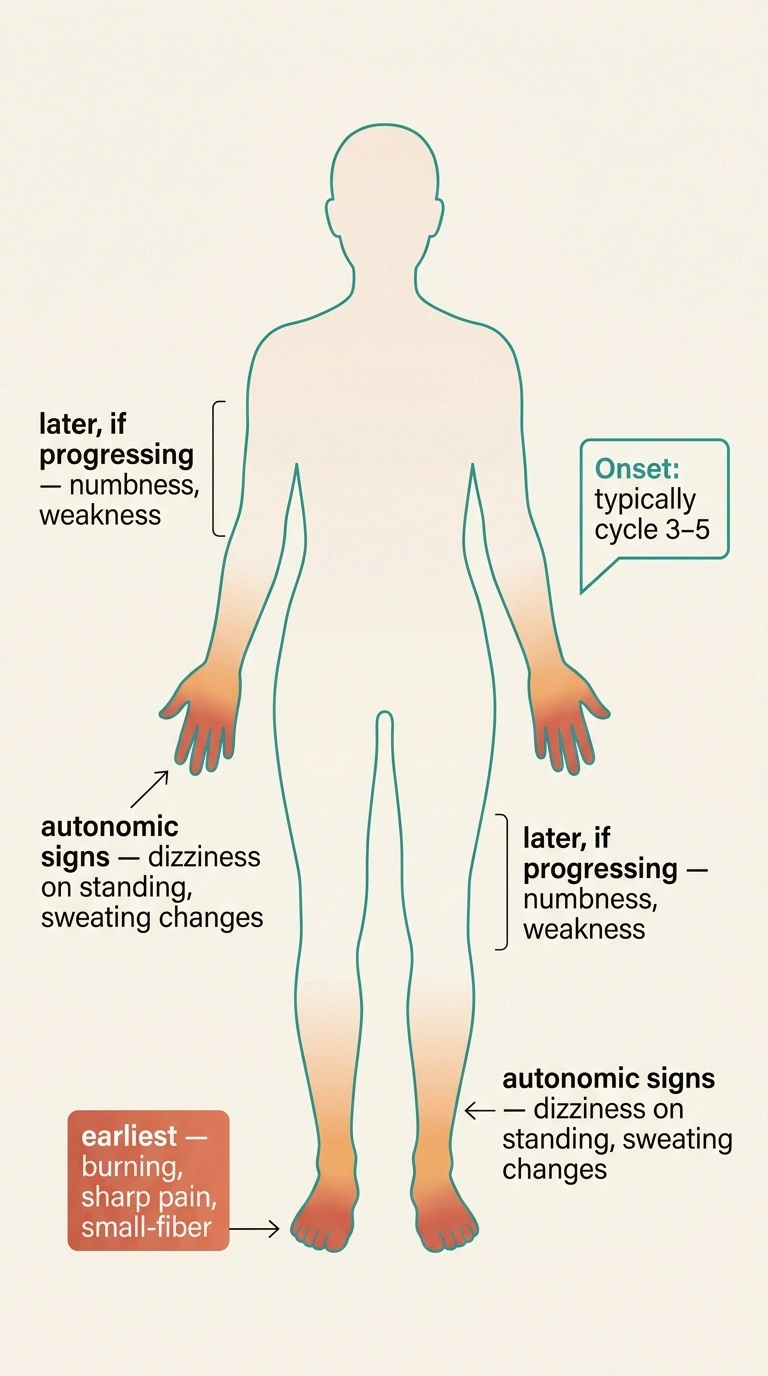
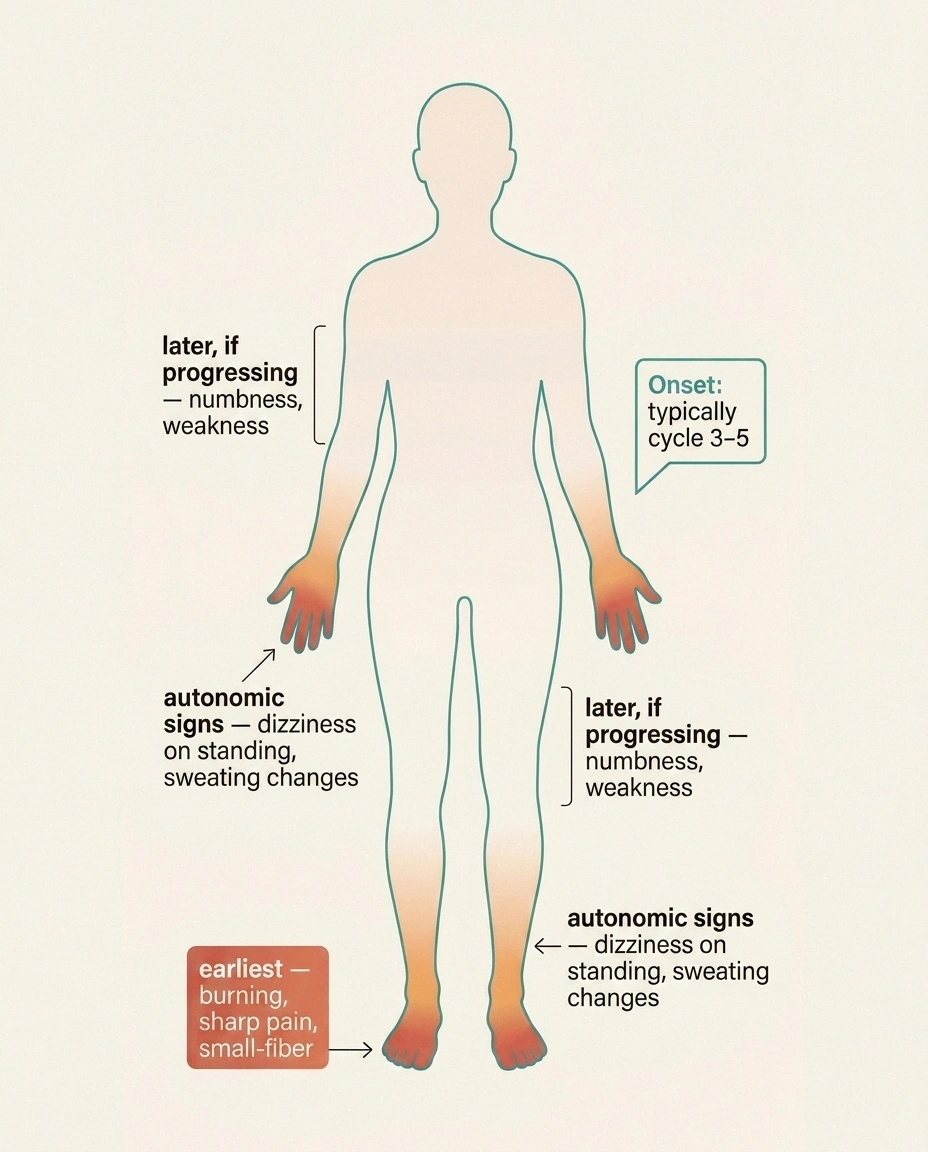
BIPN doesn’t usually appear with the first dose. Most patients notice symptoms somewhere around the third to fifth treatment cycle, as cumulative dose builds. That timing matters, because the early cycles are a genuine opportunity — this is when your team is watching closely for the first hints of nerve involvement, and when action tends to be most effective.
A few features define the “hallmark” pattern of BIPN compared to other chemotherapy-related nerve damage:
- Onset after cycles 3 through 5, rather than immediately, worsening with cumulative dose rather than appearing all at once
- Pain-dominant presentation, rather than numbness-dominant, especially in the early going
- Small-fiber and autonomic involvement early, sometimes before larger-fiber symptoms like numbness or weakness show up at all
- Strong dependence on route and schedule — how the drug is given changes the risk substantially, which is unusual among chemotherapy neuropathies and genuinely useful information for you and your care team
That last point is significant enough to deserve its own section, because it’s the single most actionable piece of this entire topic.
The Single Biggest Modifiable Factor: Route and Schedule
Most chemotherapy neuropathies don’t come with a clean, well-studied lever that reduces risk without giving up cancer control. Bortezomib does, worth understanding even though the decision belongs entirely to your oncology team.
Based on MMY-3021 trial data. Route and schedule decisions belong to your oncology team — this is context for the conversation, not a self-directed choice.
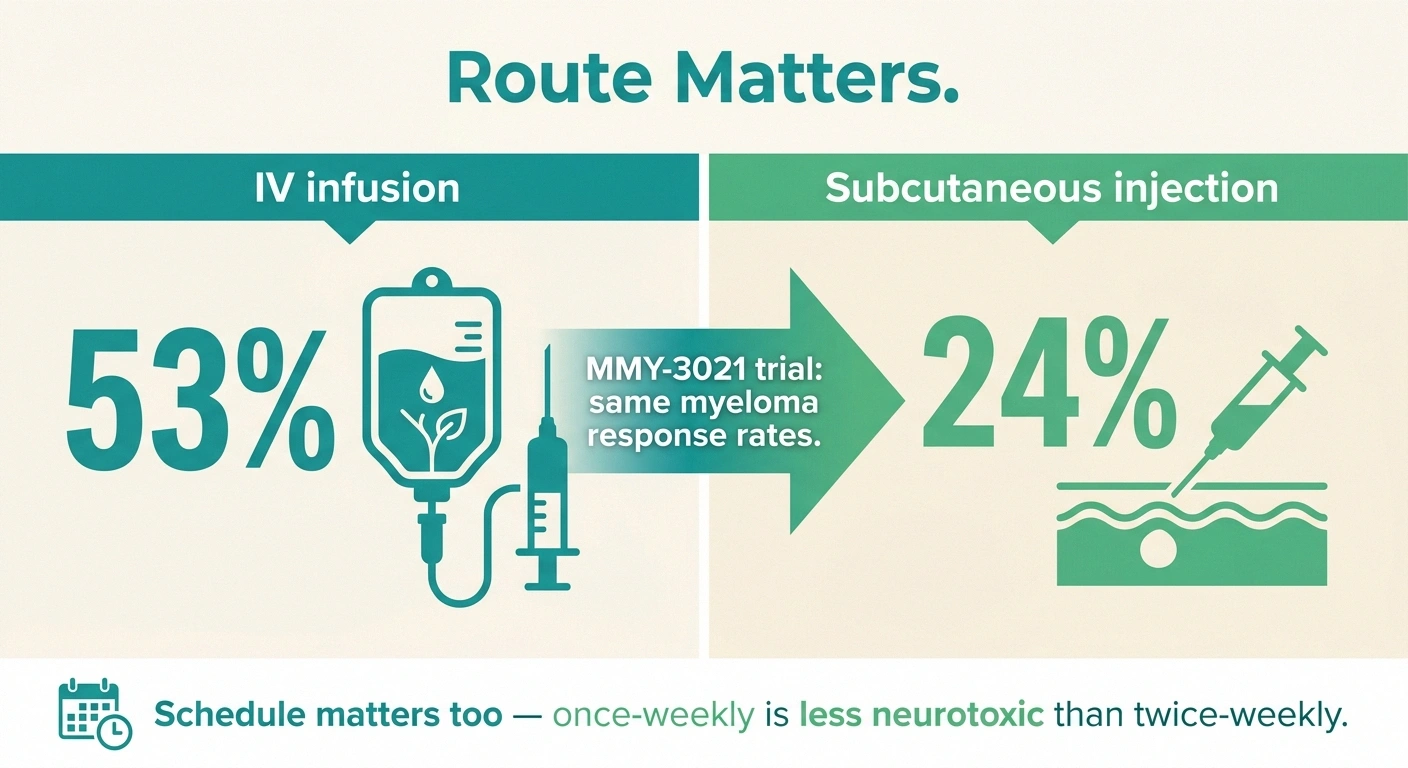
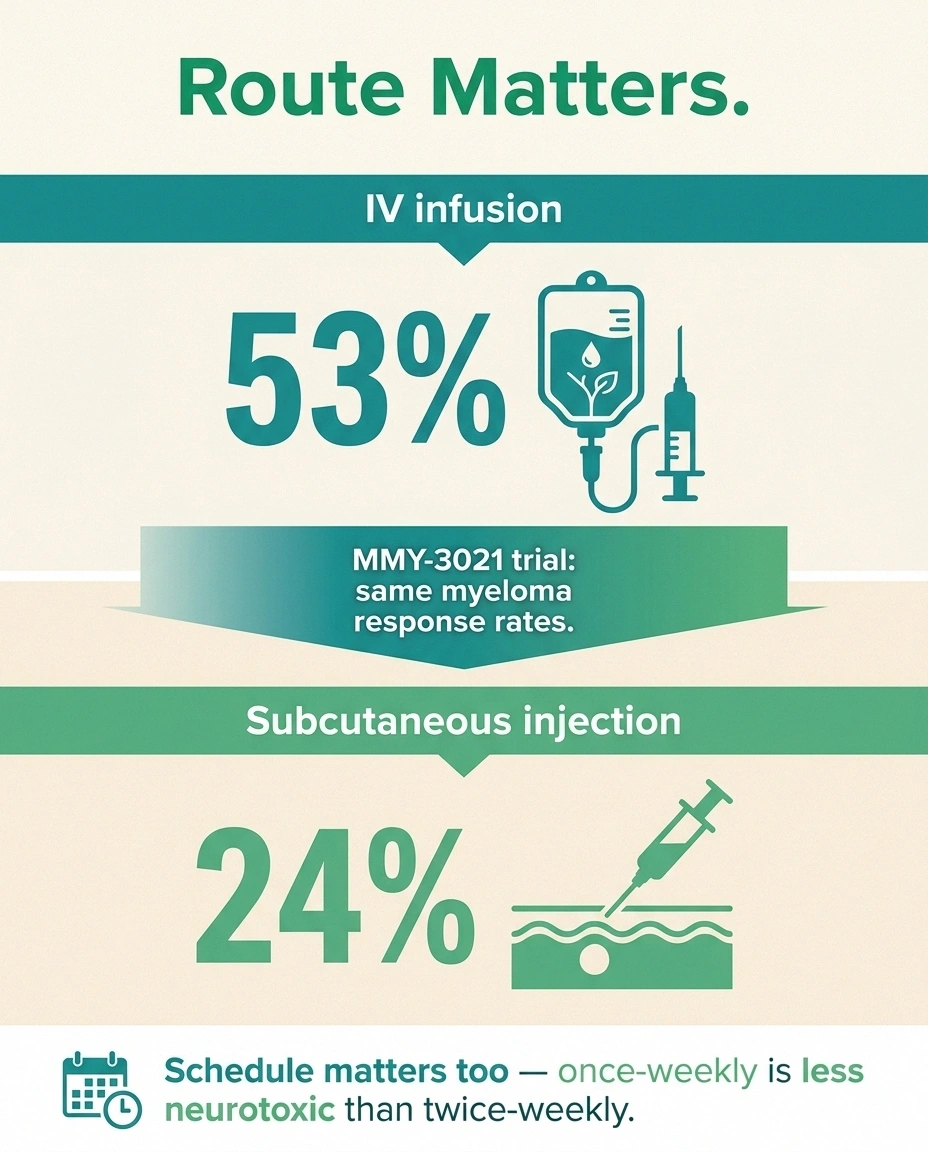
The pivotal trial comparing the two delivery methods (MMY-3021, building on earlier APEX trial data) found that switching bortezomib from IV to subcutaneous injection cut the incidence of peripheral neuropathy roughly in half — from about 53% of patients on IV dosing down to about 24% on subcutaneous dosing — while myeloma response rates stayed comparable between the two groups. That’s a substantial difference for a change that doesn’t appear to cost anything in terms of cancer control, which is exactly why subcutaneous bortezomib became the standard starting approach for most patients after 2012.
Schedule matters too. Once-weekly bortezomib dosing tends to be less neurotoxic than the twice-weekly schedules used in some earlier regimens, even at similar cumulative doses. Many current myeloma protocols already default to once-weekly subcutaneous dosing for exactly this reason.
None of this means you can request a switch on your own, or that every patient belongs on the lowest-intensity option — the right schedule depends on how aggressive the myeloma is and how the response is tracking. But if you’re newly starting bortezomib, or symptoms are showing up on a twice-weekly IV schedule, this is precisely the question worth raising directly: is subcutaneous, once-weekly dosing an option here?
How Your Care Team Adjusts Treatment When BIPN Develops

One of the more reassuring things about bortezomib, compared to other neurotoxic chemotherapy drugs, is that oncology teams have a well-established, structured playbook for responding to nerve symptoms. National Comprehensive Cancer Network (NCCN) guidelines lay out a dose-modification framework tied to symptom severity:
Do not stop or reduce bortezomib on your own. Call your oncology team promptly when new pain, numbness, or dizziness arises — dose adjustments preserve myeloma control while protecting nerves. Stopping abruptly without a plan for what replaces it in your regimen carries its own risks.
- Mild symptoms, or moderate symptoms without pain: often managed with dose reduction or a switch to a less intensive schedule, while treatment continues
- Moderate symptoms with pain, or symptoms that interfere with daily activities: bortezomib is typically held, or paused, until symptoms improve, then restarted at a reduced dose
- Severe, disabling symptoms: bortezomib is generally discontinued, and treatment shifts to a different drug or combination
The specific grading and thresholds are a clinical judgment call made by your care team, using standardized severity scales alongside your own description of how symptoms affect daily function. That’s why your own reporting matters so much — the scale isn’t measured only by nerve conduction tests, it includes what you tell them about pain, sleep, walking, and grip strength.
This is exactly the kind of side effect where speaking up early changes the outcome. Please don’t stop or reduce your bortezomib dose on your own — always call your oncology team promptly when new pain, numbness, or dizziness shows up. Dose and schedule adjustments are how your team protects your nerves while keeping your myeloma treatment working. Bortezomib also carries real risks if stopped abruptly without a plan for what replaces it, so this always has to be a team decision, never a self-adjustment.
Because the modification pathway is so well documented for bortezomib specifically, early, honest reporting genuinely changes what happens next. This isn’t a drug where nerve symptoms just get logged and endured until the end of treatment — they actively drive protocol decisions in real time.
Will the Neuropathy Get Better?
This is usually the question people care about most, and the honest answer for bortezomib is better than for a lot of other chemotherapy-related neuropathies. Compared to platinum-based drugs like oxaliplatin, which can leave more permanent nerve damage behind, BIPN tends to be meaningfully more reversible.
Once dose modification or discontinuation happens, roughly 60 to 70% of patients see partial or complete improvement in their neuropathy symptoms within about three to six months. That’s a real majority. It’s not universal, though — around 30% of patients are left with some degree of persistent symptoms even after the drug is adjusted or stopped, particularly if the neuropathy was allowed to progress to a more severe stage before changes were made.
That last point is worth sitting with. The timing of when symptoms get reported and addressed genuinely affects the odds of a fuller recovery. Nerve damage caught and acted on early, while it’s still mild, has a better shot at resolving than nerve damage that’s been allowed to progress to the point of significant pain or weakness before anything changes.
Newer Proteasome Inhibitors: Where Carfilzomib and Ixazomib Fit

Bortezomib was the first proteasome inhibitor, but it’s no longer the only one, and the differences in neuropathy risk between the three approved options are significant enough to matter if your treatment plan ever needs to change.
Carfilzomib (Kyprolis) is a second-generation proteasome inhibitor, given by IV, that binds the proteasome differently and causes substantially less peripheral neuropathy than bortezomib. It carries its own distinct side-effect profile — cardiovascular and kidney effects need monitoring — but for a patient whose myeloma is responding well and whose main obstacle is nerve symptoms, carfilzomib is sometimes the switch that allows treatment to continue without the neuropathy burden.
Ixazomib (Ninlaro) is the oral proteasome inhibitor in the family, taken as a weekly pill rather than an infusion or injection. Its neuropathy risk sits somewhere in between bortezomib and carfilzomib — lower than bortezomib, but not as clean as carfilzomib on this specific side effect.
None of these switches happen casually — each drug has a different efficacy profile for different myeloma subtypes, and changing proteasome inhibitors is a full clinical conversation, not a simple side-effect trade. But it’s useful context: if bortezomib’s nerve effects become the limiting factor, you’re not necessarily choosing between “this drug” and “no drug in this class.”
What Actually Helps With the Pain and Symptoms

While the route, schedule, and dose conversation happens with your oncology team, day-to-day symptom management usually runs in parallel, often coordinated with a palliative care team, a pain specialist, or your oncologist directly.
- MMY-3021 (route trial): subcutaneous bortezomib cut neuropathy incidence from ~53% (IV) to ~24% (SC) with comparable myeloma response rates
- CALGB 170601 (duloxetine trial): showed meaningful pain reduction for chemotherapy-induced neuropathic pain, though the study population was mostly platinum- and taxane-treated patients rather than bortezomib specifically
- Applied together: route/schedule optimization to prevent BIPN, plus duloxetine or gabapentin-class drugs to manage pain once it appears, is the current evidence-informed approach most oncology teams use
Duloxetine’s evidence base in bortezomib patients specifically is thinner than in platinum/taxane CIPN — it’s used by extension, not because of a bortezomib-specific trial.
Duloxetine is one of the more commonly used medications for chemotherapy-related nerve pain. The strongest trial evidence for duloxetine in CIPN, the CALGB 170601 trial, was conducted mostly in patients on platinum and taxane chemotherapy rather than bortezomib specifically, but it’s widely used off that evidence base across CIPN types, including BIPN, because the underlying pain mechanisms overlap enough to make it a reasonable first-line option.
Gabapentin, pregabalin, and nortriptyline are the other standard options, and any of them may come up depending on your other medications, side-effect tolerance, and what’s worked, or hasn’t, before. Topical treatments — menthol creams or lidocaine patches applied directly to the feet or hands — can take the edge off without adding another systemic medication.
Physical therapy focused on balance and gait is worth asking about early rather than waiting until falls become a concern; losing position sense in the feet changes how you walk before it becomes obvious. TENS units and a newer device called scrambler therapy, which uses surface electrodes to interrupt pain signal patterns, are sometimes used as adjuncts alongside medication, particularly when pain doesn’t fully respond to the standard drug options.
Supplements: What the Evidence Does and Doesn’t Support
Patients dealing with BIPN often ask me about supplements, and I want to be straight about where the evidence actually stands, because myeloma treatment already involves enough medications without adding something that doesn’t help.
Vitamin B6 has been studied in a small trial with some suggestion of benefit, but the evidence isn’t robust enough to call it established. It’s generally low-risk at appropriate doses, which is part of why some oncology teams don’t object to it, but it shouldn’t be mistaken for a proven treatment.
Acetyl-L-carnitine has equivocal data in chemotherapy-induced neuropathy generally — some studies show modest benefit, others show none, and one larger trial in a different chemotherapy population actually showed worse outcomes in the treatment group. That’s a reminder that “natural” doesn’t automatically mean “safe” during active cancer treatment. Glutamine has mixed data too, with some smaller studies suggesting a possible protective effect and others showing no meaningful benefit.
The most important rule with any supplement during active myeloma treatment isn’t whether it might help your nerves — it’s whether it’s safe to combine with your specific regimen. Some supplements can interact with chemotherapy or change how your body processes other drugs. Always run anything you’re considering, even something that seems harmless, past your oncology team before starting it.
Talking to Your Hematology Team, and When to Call Right Away
I want to come back to something I mentioned earlier, because it’s really the central message of this whole piece: BIPN is one of the more genuinely dose-modifiable chemotherapy neuropathies that exists. For bortezomib specifically, the structured response pathway means your reporting has real, immediate leverage over what happens to your treatment plan.
That’s a very different situation from simply “living with side effects.” Early, specific reporting — not “I have some tingling,” but “the tingling started in my toes about two weeks ago, it’s now a 5 out of 10 most evenings, and it’s starting to affect my sleep” — gives your team what they need to adjust the dose, switch the route or schedule, or bring in additional pain management, all while keeping your myeloma treatment on track.
Managing active cancer treatment alongside a new, painful side effect is genuinely hard, physically and emotionally, and it’s worth acknowledging directly rather than glossing over. If the weight of it is wearing on you, that’s common, and worth talking about — with your team, a counselor, or resources built around the emotional side of living with nerve pain.
There are a few symptoms that shouldn’t wait for your next scheduled visit. Call your oncology team promptly, rather than waiting, if you notice:
- Fainting or near-fainting when you stand up, which can signal significant autonomic nerve involvement affecting blood pressure regulation
- New muscle weakness, such as a foot that starts to drop or drag, or a hand that’s losing grip strength
- Rapidly progressive symptoms — nerve pain or numbness that’s clearly worsening over days rather than weeks
- Symptoms escalating noticeably between visits, rather than staying stable or improving slowly
None of these mean something has gone catastrophically wrong. They mean your team needs updated information sooner than your next scheduled appointment, so the plan can be adjusted with current data rather than a two-week-old snapshot from memory.
Frequently Asked Questions
What does bortezomib neuropathy feel like compared to other chemo neuropathy?
Bortezomib-induced peripheral neuropathy, or BIPN, tends to be pain-dominant rather than numbness-dominant, at least in its early stages. Most people describe burning, tingling, or sharp, electric-feeling pain in the toes, feet, fingers, and hands. This is different from platinum-based drugs like oxaliplatin or taxanes like paclitaxel, where numbness and loss of sensation typically show up first and pain develops later, if at all. Because small autonomic nerve fibers are affected early too, some people also notice dizziness when standing up quickly, changes in sweating, or digestive changes alongside the more typical nerve pain symptoms.
How soon after starting bortezomib does neuropathy usually start?
Most patients who develop bortezomib neuropathy notice it starting somewhere around the third to fifth treatment cycle, though this varies by individual, dose, schedule, and whether other risk factors like diabetes or prior chemotherapy exposure are present. It generally builds gradually as cumulative dose increases rather than appearing suddenly with the first dose. This is part of why the first several cycles are watched closely by your care team.
Does switching from IV to subcutaneous bortezomib actually reduce neuropathy risk?
Yes, and the data on this is unusually strong for a chemotherapy side effect. The pivotal trial comparing the two delivery methods found that subcutaneous injection cut the incidence of neuropathy roughly in half compared to IV infusion, from about 53 percent down to about 24 percent, while myeloma response rates stayed comparable between the two approaches. This is why subcutaneous bortezomib has become the standard starting method for most patients since 2012. Whether a switch makes sense for you specifically is a conversation for your oncology team.
Will my myeloma treatment still work if my dose gets reduced for neuropathy?
Dose and schedule modifications for bortezomib follow a structured framework developed specifically to balance nerve protection against cancer control, and this framework is well established in national treatment guidelines. Your care team’s goal in adjusting the dose is to keep your myeloma treatment effective while reducing further nerve damage, not to choose one over the other. That said, every case is different, and your hematologist-oncologist is the only person who can tell you what a specific modification means for your individual treatment plan and myeloma subtype.
Is bortezomib neuropathy permanent?
Not usually, though it isn’t always fully reversible either. Research suggests roughly 60 to 70 percent of patients see partial or complete improvement in their neuropathy symptoms within three to six months after dose modification or discontinuation. About 30 percent are left with some degree of persistent symptoms, particularly if the neuropathy progressed to a more severe stage before changes were made. Catching and reporting symptoms early generally improves the odds of fuller recovery.
What can I do at home while my care team sorts out the treatment plan?
Keep a simple daily log of your symptoms, including where they occur, how severe they are, and how they’re affecting sleep, walking, or daily tasks. That gives your team far more useful information than trying to recall two weeks of symptoms from memory during a short appointment. Beyond that, the general neuropathy symptom-relief toolkit, including topical treatments, gentle movement, supportive footwear, and balance-focused physical therapy, can help day to day while the bigger decisions are being made. Never start a new supplement or over-the-counter product without checking it’s safe alongside your specific chemotherapy regimen.
About the Author