When my doctor first told me I had prediabetes back in my late 40s, she said something I only half-heard at the time: “Even at this level, your nerves are already at risk.” I remember nodding, taking the paper handout, and mostly worrying about the number itself, not what it meant. A few years later, when the tingling in my toes started, that conversation came rushing back.
Here’s what I wish someone had drawn on a piece of paper for me that day: a simple reference chart showing which blood sugar numbers actually protect your nerves, which numbers begin to put them at risk, and which numbers signal that damage is already accumulating. That’s what this article is.
Whether you’re newly diagnosed, deep into managing diabetes, or living with prediabetes and hoping to keep it from progressing, understanding these targets can help you have a much better conversation with your doctor about what “good control” actually means for your feet, your hands, and every nerve in between.
Why A1C Matters So Much for Your Nerves
Your A1C — sometimes written as HbA1c — is a blood test that shows your average blood sugar over the previous two to three months. Unlike a fingerstick reading that captures a single moment, A1C reflects a longer stretch of daily life: the birthday cake and the salad, the missed dose and the perfect morning walk. It’s a measure of your body’s average exposure to sugar.
Your nerves respond to averages, not single readings.
A1C measures your body’s exposure to sugar over 2 to 3 months. That sustained exposure — not any one high reading — is what damages nerves. The longer you spend above your target range, the more nerve fibers quietly take damage before symptoms appear.
That average matters more to your nerves than almost any single high reading. Peripheral nerves — especially the long ones running down to your feet — are unusually sensitive to the metabolic environment they live in. Sustained high blood sugar damages nerves through several overlapping pathways: oxidative stress, buildup of advanced glycation end products (AGEs), reduced blood flow through the tiny vessels that feed the nerves (the vasa nervorum), and disruption of the myelin sheath that helps signals travel cleanly.
None of these mechanisms flip on the day your A1C crosses a certain number. They accumulate. The longer you spend above your target range, the more small-fiber and large-fiber nerves quietly take damage — sometimes years before symptoms appear.
The good news: the reverse is also true. Bringing your A1C down and holding it in a protective range can slow or halt the progression of nerve damage. In some cases, especially early on, it can even allow partial recovery.
The Reference Chart: A1C and Nerve Risk
Here’s the plain-language chart I wish I’d had in my hand years ago. These ranges reflect general guidance from the American Diabetes Association and consistent findings across large trials like the DCCT and UKPDS. They are general reference points, not personalized targets — your doctor may recommend something different based on your age, other health conditions, and how long you’ve had diabetes.
General reference guidance — your personal target may differ based on age, other conditions, and hypoglycemia risk. Discuss with your doctor.
A1C 5.6% or lower — Normal. Nerve damage from blood sugar alone is very unlikely in this range. If you have neuropathy symptoms and your A1C is here, another cause is much more likely (vitamin deficiency, medication, autoimmune, and so on).
A1C 5.7% to 6.4% — Prediabetes. Nerve damage is possible and, according to a growing body of research, already happening in some people. Small-fiber neuropathy has been documented in prediabetic patients at rates several times higher than the general population. This is the range where prevention pays the biggest dividends.
A1C 6.5% to 6.9% — Diabetes, well-controlled. This range is considered protective for most adults with diabetes. Large trials show that keeping A1C consistently below 7% substantially reduces the risk of developing neuropathy and slows progression if it’s already begun.
A1C 7.0% to 7.9% — Diabetes, moderately controlled. Nerve risk begins to rise here. One prospective study found that people with type 2 diabetes and an A1C above 7% for three or more years had significantly higher rates of clinically detectable neuropathy. This isn’t a cliff — it’s a gradient.
A1C 8.0% to 8.9% — Diabetes, poorly controlled. Nerve damage risk climbs substantially. Autonomic neuropathy (affecting heart rate, digestion, blood pressure regulation) also becomes more common in this range.
A1C 9.0% and above — Diabetes, uncontrolled. Rapid nerve fiber loss is common if sustained. The risk of foot ulcers, Charcot foot, and severe autonomic complications rises steeply.
Fasting and Post-Meal Blood Sugar Targets
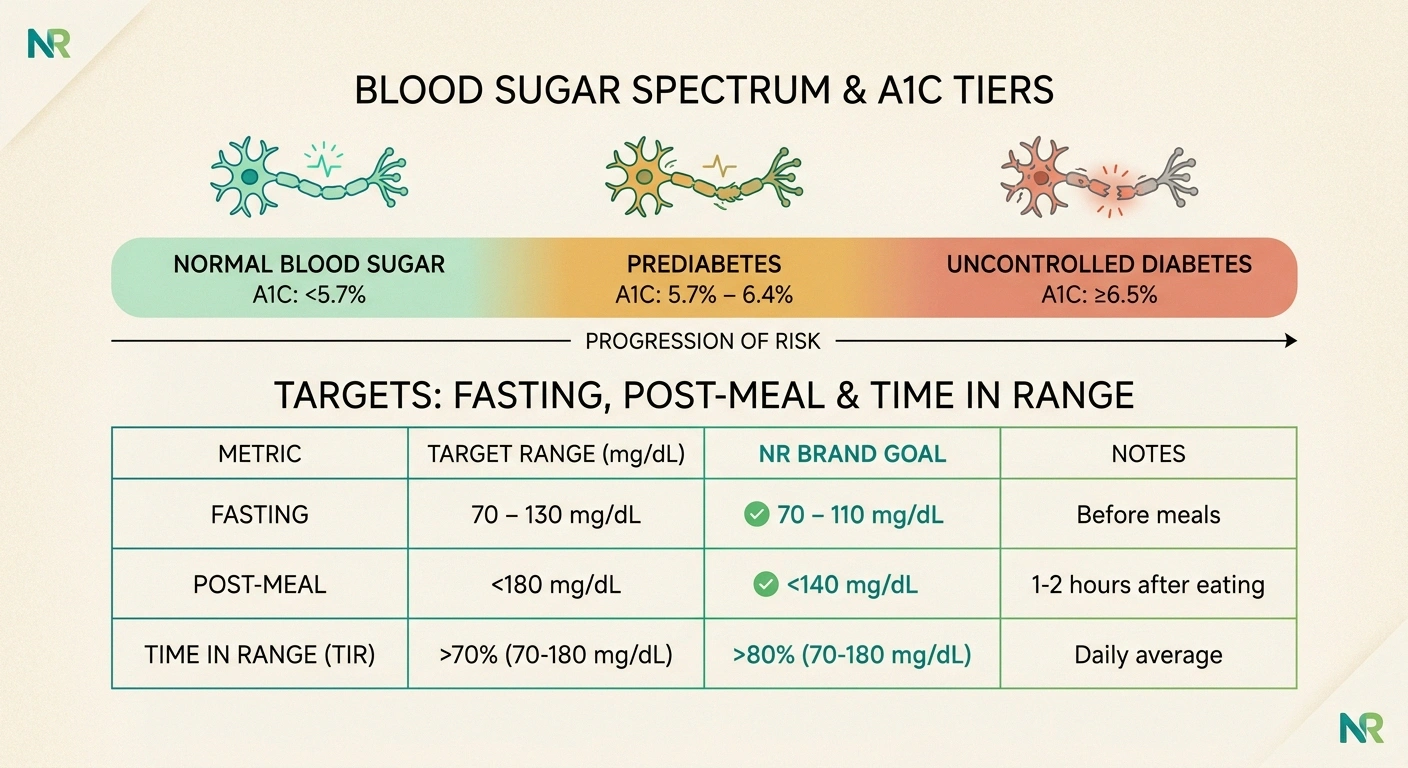
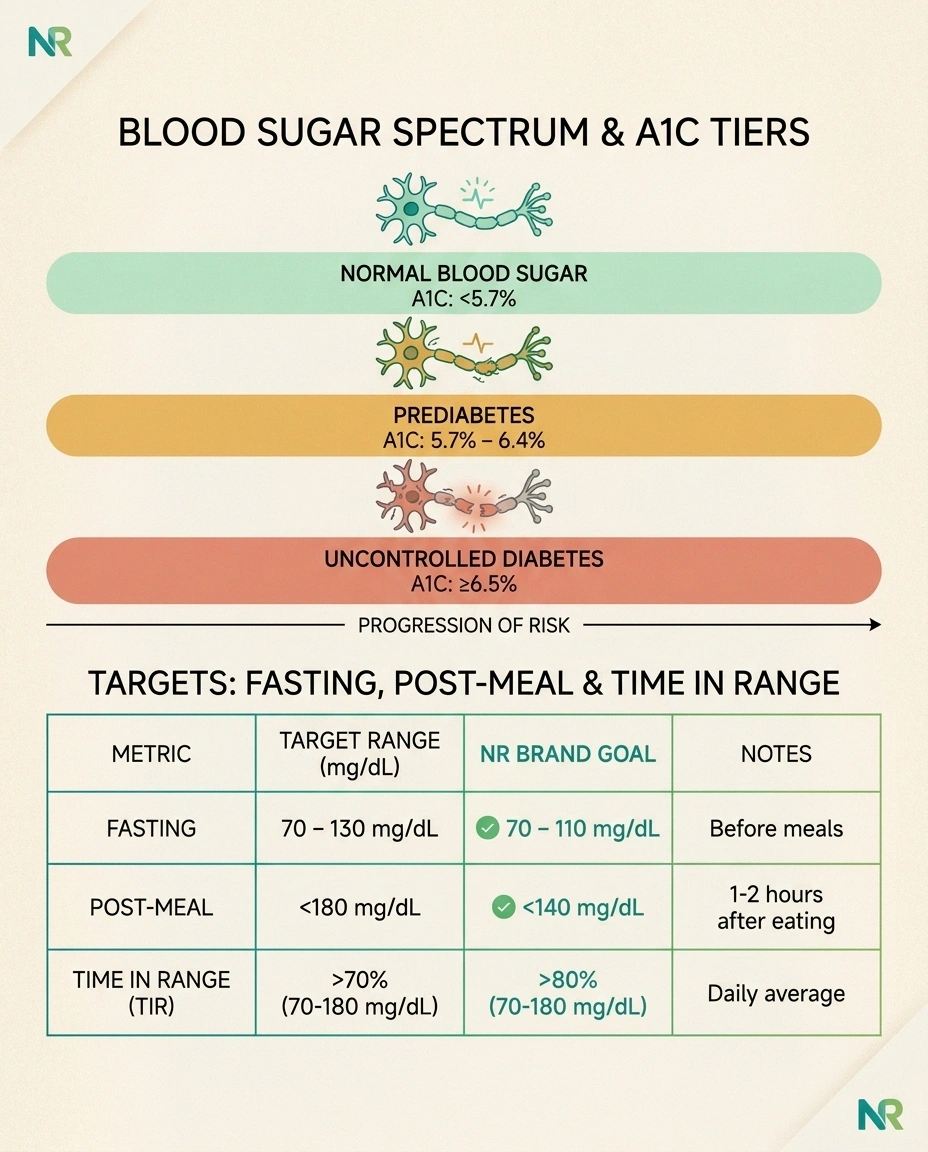
A1C is the long-view number, but day-to-day, you’ll be watching two other readings: fasting blood glucose (typically checked first thing in the morning) and post-meal glucose (usually two hours after starting a meal). These matter for nerve protection because they show how big your swings are — and nerves, it turns out, are damaged by swings almost as much as by sustained highs.
For most adults with diabetes, the ADA recommends a fasting blood glucose of 80 to 130 mg/dL. Some doctors aim for the lower end of that range in younger, otherwise healthy patients and toward the higher end in older adults or those with hypoglycemia risk.
The two-hour post-meal target is under 180 mg/dL for most adults, though tighter targets (under 140 mg/dL) are sometimes recommended for pregnancy, prediabetes, or patients aiming for aggressive reversal.
Prediabetes uses slightly different cutoffs. A fasting glucose of 100 to 125 mg/dL falls into the prediabetes range. An oral glucose tolerance test result of 140 to 199 mg/dL at two hours also flags prediabetes. If your fingerstick or continuous monitor consistently shows fasting readings above 100 or post-meal readings above 140, that’s information to bring to your doctor, even if your A1C looks fine.
Why Glycemic Variability Matters as Much as A1C
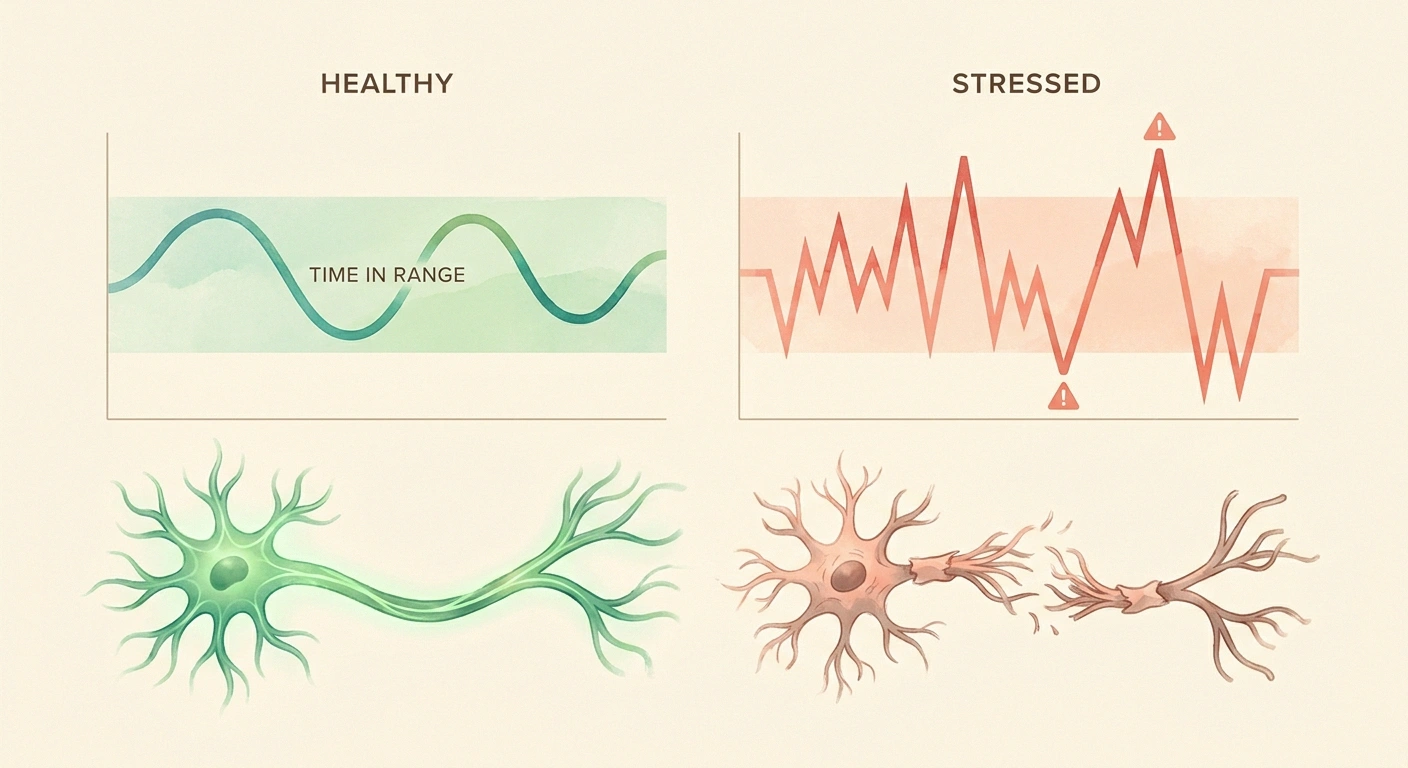
Here’s something that took researchers years to figure out and that most patients still don’t hear about: two people can have identical A1Cs — say, 7.2% — and have very different nerve outcomes. The one whose blood sugar bounces between 60 and 300 all day is doing far more damage than the one whose sugar hums along between 90 and 180.
Two people with identical A1C values can have very different neuropathy outcomes. Wide daily swings in blood glucose generate more oxidative stress and inflammation than steady elevation alone. Time in Range (TIR) — the percentage of the day between 70–180 mg/dL — is now considered a more sensitive predictor of complication risk than A1C by itself.
Sources: American Diabetes Association Standards of Care 2024; Battelino et al., Diabetes Care 2019 (International Consensus on Time in Range).
This is called glycemic variability, and it’s now considered a separate risk factor for neuropathy. The theory is that big swings generate more oxidative stress and inflammation than steady elevation does. Nerves, which live on delicate microvasculature, feel every wild ride.
If you use a continuous glucose monitor (CGM), the metric to watch is Time in Range (TIR) — the percentage of the day your glucose sits between 70 and 180 mg/dL. A TIR of 70% or higher is now considered the goal for most adults with diabetes, and it’s a much more sensitive predictor of complication risk than A1C alone.
For people who don’t have a CGM, the workaround is simpler than it sounds: check your fingerstick at consistent times each day for a week (fasting, before lunch, before dinner, at bedtime, and occasionally two hours after a meal). If your readings are clustered tightly, your variability is likely low. If they range wildly, variability is high — and that’s a conversation to have with your doctor even if your A1C looks acceptable.
How Age and Health Change Your Personal Target
The 7% number gets thrown around like a rule, but it isn’t one. The American Diabetes Association explicitly recommends individualizing A1C targets based on the whole picture.
For a healthy 45-year-old newly diagnosed with type 2 diabetes and no other conditions, a doctor might aim for an A1C under 6.5%. Tighter control here has the most potential upside — decades of nerve protection to gain — and the person’s body can generally tolerate aggressive treatment without dangerous lows.
For a 78-year-old with heart disease, kidney impairment, and a history of falls, the same target could be dangerous. Aggressive glucose lowering in this profile increases the risk of hypoglycemia, which can cause falls, arrhythmias, and cognitive changes. The doctor may recommend an A1C target of 7.5% or even 8.0%, accepting slightly more nerve risk in exchange for a much lower risk of a life-threatening low.
Other factors that loosen A1C targets:
- Long-standing diabetes (15+ years) where nerve damage has largely stabilized
- Frequent unrecognized hypoglycemia
- Limited life expectancy
- Cognitive impairment that affects self-management
- Living alone without support for treating a low
Factors that tighten targets:
- Newly diagnosed, especially young
- Pregnancy (targets shift toward 6.0-6.5%)
- Actively trying to reverse early neuropathy symptoms
- Otherwise healthy with long life expectancy
What “Tight Control” Actually Achieves for Neuropathy

Two large trials shaped everything we know here. The Diabetes Control and Complications Trial (DCCT), in people with type 1 diabetes, showed that tight glucose control (average A1C around 7%) reduced the risk of developing neuropathy by roughly 60% compared to standard care. The follow-up, called the Edic study, showed that early tight control kept protecting nerves for decades — a phenomenon called “metabolic memory.”
The story for type 2 diabetes is less dramatic but still meaningful. The UKPDS trial showed clear reduction in microvascular complications overall, though neuropathy-specific effects were more modest. Trials like ACCORD have shown that aggressive lowering doesn’t always help and can occasionally hurt (from hypoglycemia and cardiovascular risk) — reinforcing that personalized targets matter.
What the data suggests, taken together: tight control in the first years after diabetes diagnosis is when you get the most nerve-protective payoff. If you’ve had diabetes for 20 years and significant nerve damage, tightening from 8% to 7% probably won’t reverse what’s happened, though it may slow further progression. If you’re newly diagnosed with an A1C of 8.5% and no symptoms yet, that same drop could protect you for decades.
None of this is a promise of reversibility. Established, moderate-to-severe neuropathy rarely reverses fully. But early damage sometimes recovers with sustained good control, and even advanced neuropathy usually stops progressing when metabolic control improves. That’s meaningful.
What to Do If Your A1C Is Above Target

If you’re reading this and thinking, “my last A1C was 8.6% and I’ve been putting off dealing with it” — you’re not alone, and today is a fine day to start. A few practical anchors:
Don’t crash-lower your A1C.
Dropping blood sugar too fast can trigger a temporary worsening of neuropathy called treatment-induced neuropathy of diabetes (insulin neuritis). Aim for gradual improvement — roughly 0.5 to 1.0 percentage points every 3 months — unless your doctor specifically directs otherwise.
Don’t crash-lower. Dropping blood sugar too fast can actually trigger a temporary worsening of neuropathy called treatment-induced neuropathy of diabetes, or insulin neuritis. Aim for gradual improvement — roughly 0.5-1.0 percentage points every three months — unless your doctor specifies otherwise.
Talk to your doctor about the “why.” Is it food choices? Medication timing? A medication that isn’t working? A missed diagnosis (like undiagnosed pancreatic issues or steroid use for another condition)? The path forward depends on the cause.
Consider the diet lever first. For many people, a lower-carbohydrate approach, more fiber, less refined sugar, and adequate protein at each meal is the fastest way to bring A1C down. The neuropathy diet section on this site covers what to eat in more detail.
Move regularly. Even 20-30 minutes of walking after meals significantly reduces post-meal spikes. Muscle contraction pulls glucose out of the bloodstream without needing extra insulin. Walking is one of the most effective nerve-protective habits, and it doesn’t cost anything.
Ask about a CGM. Insurance coverage has expanded significantly. Seeing your numbers in real time changes behavior faster than any lecture ever will.
Add complementary support. Some people benefit from alpha-lipoic acid as an antioxidant adjunct, from B-vitamins if there’s a vitamin deficiency contributing to symptoms, or from magnesium for cramping. None of these replace glucose control, but they can support it.
What to Do If Your A1C Is In Range But Symptoms Are Progressing
This one confuses people. Your A1C is 6.8%, your fasting glucose looks good, and yet your feet feel worse. What’s happening?
A few possibilities:
Glycemic variability. As covered above, big swings damage nerves even when the average looks fine. Ask your doctor about a two-week CGM trial if you don’t have one.
Another cause layered on top of diabetes. B12 deficiency (common with metformin use), thyroid dysfunction, alcohol use, medication side effects, and autoimmune conditions can all cause or worsen neuropathy independently of blood sugar. A workup for these is part of a good neuropathy evaluation.
Damage catching up. Nerve damage from prior poorly-controlled years doesn’t reverse the moment your A1C improves. If you spent five years at 9% and just brought it down to 6.8% last year, you may still see gradual symptom evolution before things stabilize.
Progression isn’t inevitable. If you’re doing everything right on the glucose side and symptoms are still worsening, that’s the moment to push for a specialist referral — a neurologist or neuromuscular specialist — to look for treatable contributing factors.
The Prediabetes Wake-Up Call

I want to say something plainly to anyone in the 5.7% to 6.4% range: prediabetes is not a “not-yet” diagnosis. It is an “already-happening” diagnosis for your nerves. Multiple studies have documented small-fiber neuropathy in people whose A1C never crossed 6.5%.
Nerve damage happens in the 5.7 – 6.4% range too.
Small-fiber neuropathy has been documented in prediabetic patients at rates several times higher than the general population. If you’re in this range with any tingling, burning, or numbness — do not wait for the A1C to cross 6.5%. Prevention still works dramatically well in this window.
The tingling I felt in my toes started when I was still officially “prediabetic.” I mistakenly took the label to mean I had time. What it actually meant was that my nerves were sending an early distress signal, and the metabolic conditions damaging them were already in place.
If you’re in this range and you have any nerve symptoms — tingling, burning, numbness, unusual foot sensations — do not wait for the A1C to hit 6.5%. Bring the symptoms up now. Ask about a full neuropathy evaluation. And put the same energy into reversing prediabetes that you would into managing full diabetes: dietary changes, activity, weight loss if appropriate, and regular monitoring. This is the window where prevention still works dramatically well.
Your Target-Number Conversation With Your Doctor
The single most useful thing this chart can do is help you have a specific conversation at your next appointment. Instead of “how am I doing?” try:
- “What A1C target should I be aiming for, given my age and overall health?”
- “What’s my time in range if we have that data?”
- “Are my fasting numbers where they should be, or are we tolerating something suboptimal?”
- “How big are my post-meal spikes? Should I be watching those more closely?”
- “Given my current control, what’s my personal risk of nerve damage progressing?”
- “If I’m already having symptoms, what’s a realistic timeline for expecting improvement with tighter control?”
Bring your last three A1C values, a week of fingerstick logs, and any symptom notes. A well-prepared 10 minutes with your doctor beats an hour of generic advice. And remember: the doctor gives the recommendation, but you live the numbers. Your choices, day in and day out, are what actually protect your nerves.
A Note on What This Chart Isn’t

This reference chart is a starting point for understanding, not a prescription. It doesn’t tell you what your personal target should be. It doesn’t factor in medications you’re on, other conditions, or your own risk tolerance. It doesn’t replace the individualized guidance of a doctor who knows your whole health picture.
- What A1C target should I be aiming for, given my age and health?
- What’s my Time in Range if we have CGM data?
- Are my fasting numbers where they should be?
- How big are my post-meal spikes?
- What’s my personal risk of nerve damage progressing at my current control?
- If I’m already having symptoms, what’s a realistic improvement timeline?
What it can do — what I hope it does — is give you a shared vocabulary and a set of anchor numbers so that the next conversation about your control feels less mysterious. When your doctor says “we want to keep you under 7,” you’ll know what that range means for your nerves specifically. When they suggest loosening the target, you’ll know the tradeoff. When they get concerned about a rising number, you’ll understand why.
The nerves in your feet, your hands, and every part of your body work quietly on your behalf every second of every day. Giving them a metabolic environment they can thrive in — steady blood sugar, in a protective range, most of the time — is one of the most powerful things you can do for your long-term nerve health. It’s rarely dramatic, rarely quick, and rarely easy. But it works.
Frequently Asked Questions
What A1C level causes neuropathy?
There’s no single number where nerve damage begins. Damage is a gradient. Small-fiber nerve damage has been documented in people with A1Cs as low as the prediabetic range (5.7-6.4%). Risk rises substantially above 7% and steeply above 8%, especially when elevated levels are sustained over years. Individual susceptibility varies — some people accumulate damage faster than others at the same A1C.
Can neuropathy get worse if my A1C is under 7%?
Yes, occasionally. Reasons include high glycemic variability (big blood sugar swings despite a good average), another underlying cause (B12 deficiency, thyroid issues, medications), or damage from years of prior poor control still evolving. If your control is good and symptoms are progressing, that’s a signal to look beyond glucose — talk to your doctor about a broader neuropathy workup.
What’s the ideal A1C to reverse neuropathy?
“Reversal” is the wrong frame for most cases. Established moderate-to-severe neuropathy rarely reverses fully. However, early nerve damage can sometimes recover with sustained tight control (A1C at or below 6.5% for most adults). Even when symptoms don’t reverse, tight control usually stops progression. The earlier you achieve good control, the more nerves you protect.
Is A1C 6.5% too high?
An A1C of 6.5% is the threshold that defines diabetes, but it’s considered a reasonable and protective target for many adults. It’s usually not “too high” as a goal — in fact, aiming much lower can increase hypoglycemia risk without adding nerve protection benefit for most people. Younger adults, pregnant women, and those aggressively pursuing reversal may target lower (5.7-6.4%).
How fast does high blood sugar damage nerves?
There’s no universal timeline. Some people show measurable small-fiber nerve loss within a year or two of sustained hyperglycemia; others tolerate elevated sugars for many years before symptoms appear. Genetics, other risk factors (blood pressure, cholesterol, alcohol, smoking), and glycemic variability all influence the pace. What’s clear is that damage accumulates — and every year at target range is nerve tissue protected.
What is Time in Range and why does it matter for nerves?
Time in Range (TIR) is the percentage of a 24-hour period your glucose sits between 70 and 180 mg/dL, measured by continuous glucose monitor. A TIR of 70% or higher is the current goal for most adults with diabetes. TIR captures glycemic variability that A1C misses — and variability is now recognized as an independent risk factor for nerve damage. Two people with identical A1Cs can have very different TIRs and very different nerve outcomes.
Should I aim for a lower A1C if I already have neuropathy?
Not necessarily. If you have established neuropathy, the goal is to stop progression, not chase a lower number at the cost of other risks. For most adults with existing neuropathy, an A1C in the 6.5-7.0% range strikes a good balance. Going lower rarely reverses existing damage and increases hypoglycemia risk — which is dangerous when you already have neuropathy affecting balance and sensation. Discuss your specific target with your doctor.
Why does my A1C look fine but I still have symptoms?
Common reasons: (1) glycemic variability — big swings despite a good average; (2) another cause layered on top of diabetes (vitamin deficiency, thyroid, autoimmune, medications, alcohol); (3) damage from prior poorly-controlled years still evolving. This is a scenario worth a specialist referral to a neurologist for a broader workup.
About the Author