Every January, a particular kind of phone call goes around the support group.
Someone has gone to pick up a prescription they’ve collected without incident for eleven straight months, and the number at the register is unrecognisable. Nothing about their coverage changed. Nothing about the drug changed. The year changed — and their deductible reset.
Meanwhile there’s a genuinely good piece of news that most people have heard about and almost nobody has been told how to use: Medicare Part D now has a hard ceiling on what you can be charged for covered drugs in a year. In 2026 that ceiling is $2,100.
Here’s what I want to do with the next few thousand words. Sort out who that ceiling actually helps, because for most people with neuropathy the honest answer is that it changes nothing. Flag the one exception that catches people badly. And explain the tool that fixes the January problem, which is separate from the cap and which you have to ask for.
What the $2,100 Cap Is
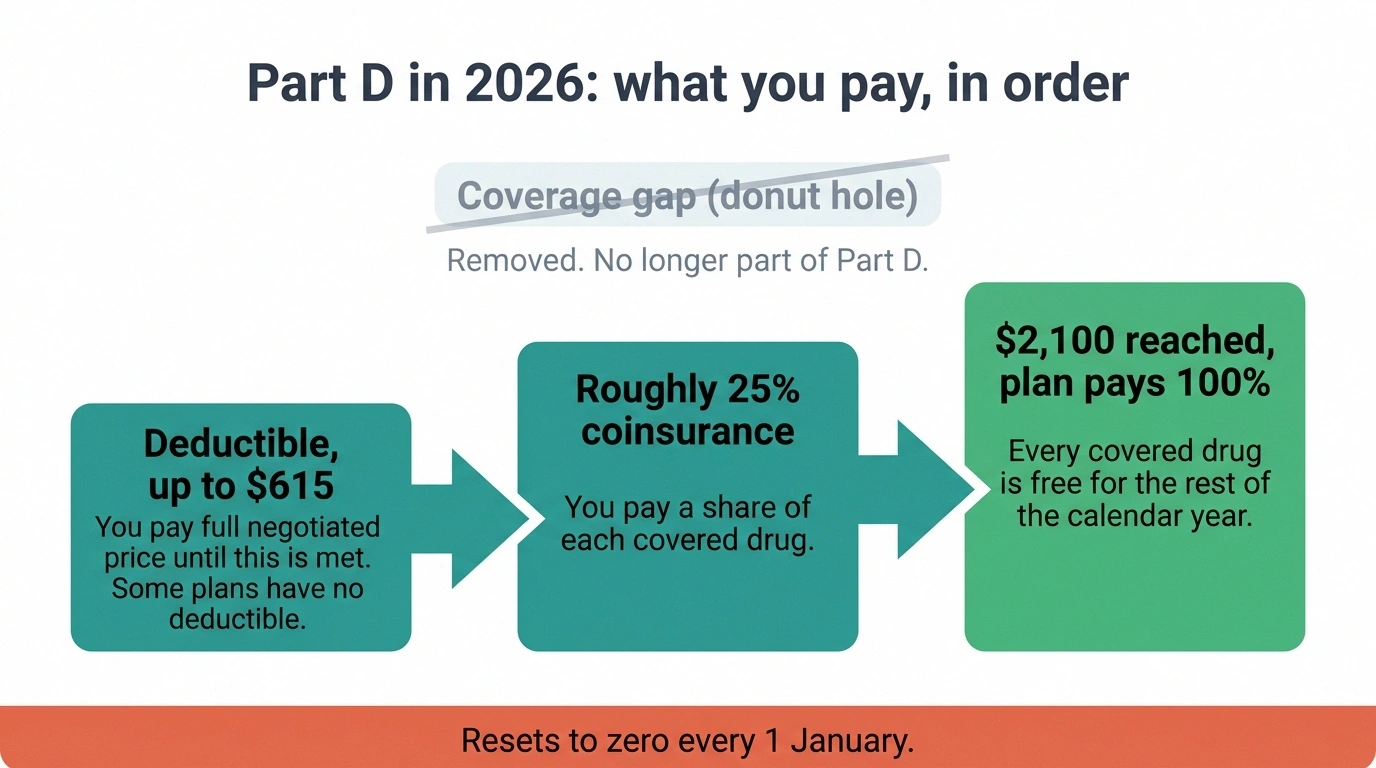
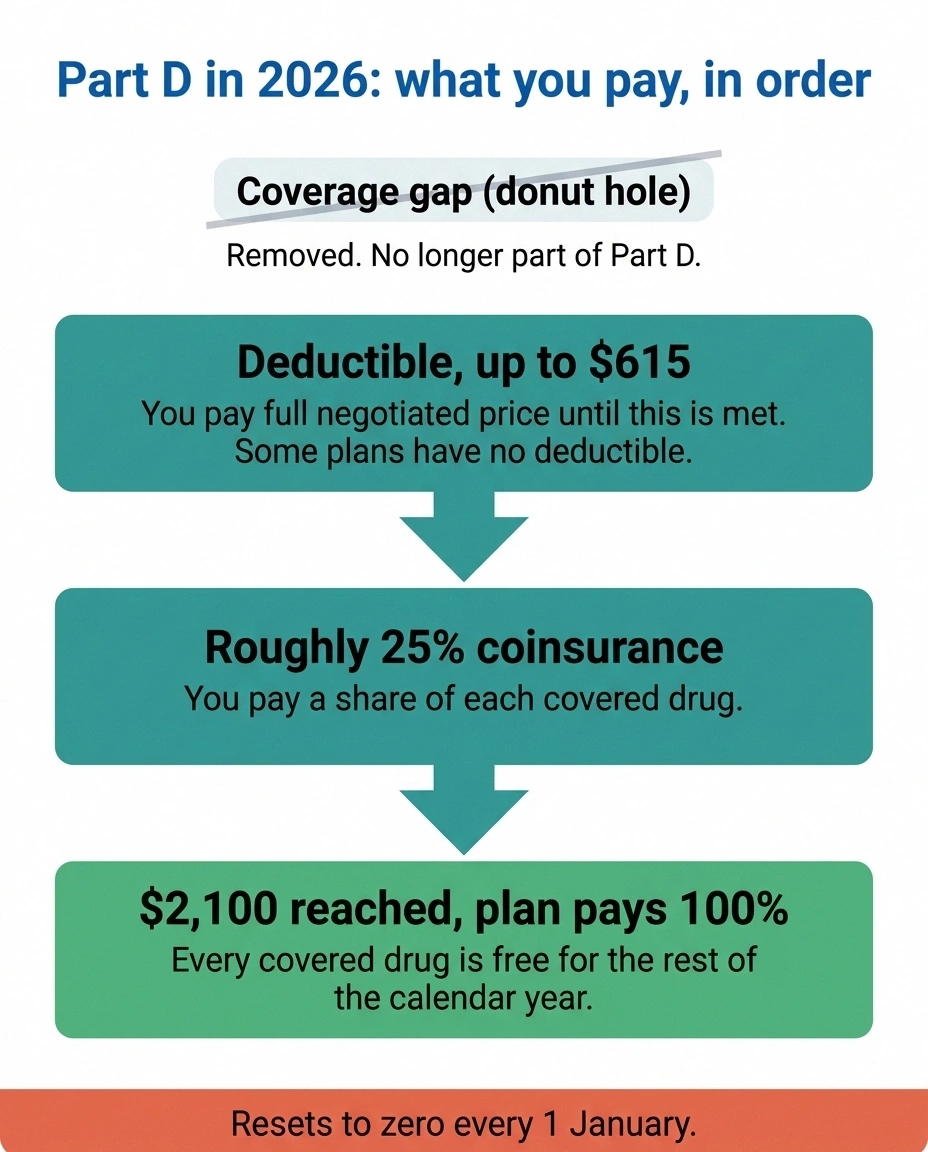
Part D used to have four spending stages, including the coverage gap that everyone called the donut hole. That structure is gone.
Someone on three generics. A plan with a $200 deductible, then modest copays. Annual out-of-pocket lands somewhere near $350. The $2,100 ceiling is never approached, never relevant, and never worth a phone call.
Someone on a specialty drug. The full $615 deductible is consumed by the first fill. Coinsurance on the balance takes them past $2,100 within that same fill or the next one. Every covered prescription afterwards, all year, costs nothing.
Two people, one policy change, completely different experiences of it. The deciding factor is not how sick you are. It is whether your particular drug still has a patent on it.
What’s left is straightforward. You may have a deductible, capped at $615 in 2026, depending on your plan. After that you pay roughly 25% coinsurance on covered drugs. Once your own out-of-pocket spending on covered drugs reaches $2,100, you’re finished for the year. Your plan pays 100% of covered drugs through 31 December.
What counts toward the $2,100: your deductible, your copays, your coinsurance on drugs your plan covers.
What does not count: your monthly premium, drugs that aren’t on your plan’s formulary, and anything billed under Part B rather than Part D. Hold onto that last one.
The counter resets to zero on 1 January. Every year — and that reset is the mechanism behind the phone calls.
For Most of Us, This Changes Nothing
I’d rather tell you this plainly than let you spend an afternoon working it out yourself.
Look at what people with neuropathy actually take. Gabapentin. Pregabalin, now generic. Duloxetine. Nortriptyline or amitriptyline. Topical lidocaine. Alpha-lipoic acid, which isn’t covered anyway because supplements never are.
These are generics, and cheap ones. Someone taking three of them will typically spend a few hundred dollars a year out of pocket. Not $2,100. The ceiling exists and they will never touch it.
That isn’t a disappointment — it’s the system working. Your drugs are cheap because they’re old and off-patent. If your pharmacy costs are modest, the cap is a safety net you’re glad exists and never need. Skip to the section on the payment plan, which may still help you, or to the guide on bringing down neuropathy medication costs, which is aimed squarely at people in exactly this position.
Who the Cap Genuinely Rescues
Now the group for whom this is one of the most consequential policy changes in decades.
If your neuropathy comes from hereditary transthyretin amyloidosis, you are in a different pharmacy economy from everyone else reading this. The treatments there have list prices that look like typographical errors — and they are not errors.
Tafamidis, sold as Vyndamax, carries a list price around $225,000 a year, roughly $23,000 for a bottle of thirty capsules. Eplontersen, sold as Wainua, runs in the region of $572,000 a year. Vutrisiran, sold as Amvuttra, sits near $463,500.
Under the old rules, coinsurance on numbers like those was ruinous. Five percent of an unbounded amount is still an unbounded amount, and people made genuinely awful decisions because of it.
Under the current structure, one prescription puts you past $2,100 and you are done for the calendar year. The manufacturer’s own patient materials for Vyndamax say exactly that: fill it once in 2026 and you hit the cap, and every Part D drug after that costs you nothing.
For a household weighing whether they can afford treatment for a progressive nerve disease, that is not a modest improvement. That is the difference between treatment and no treatment.
A smaller group also benefits: anyone on a specialty drug dispensed through a pharmacy rather than administered in a clinic. Which brings me to the part that trips people up.
The Part B Trap

This is the most important section here, and it’s the reason I wanted to write this page at all.
| Treatment | Usually billed under | Protected by the $2,100 cap? |
|---|---|---|
| Gabapentin, duloxetine, nortriptyline | Part D | Yes, though the cost rarely gets near it |
| Tafamidis, eplontersen, vutrisiran | Part D | Yes, and decisively |
| IVIG in an infusion centre | Part B | No |
| Capsaicin 8% patch applied in clinic | Part B | No |
| Alpha-lipoic acid and other supplements | Neither | No. Supplements are not a covered benefit at all |
Billing can vary by setting and by plan, so treat this as the shape of the answer rather than the answer. The definitive version comes from the billing office that sends you the statement.
The $2,100 cap applies to Part D only. Part D is the pharmacy benefit: drugs you pick up or have delivered, that you administer yourself.
Drugs a professional gives you in a clinic or infusion centre are billed under Part B, the medical benefit. And Part B has no annual out-of-pocket maximum at all. None. You pay 20% coinsurance with no ceiling — unless you carry a Medigap policy or a Medicare Advantage plan with its own out-of-pocket limit.
For neuropathy that lands hardest on:
Immunoglobulin infusions. IVIG given in an infusion centre for CIDP and related autoimmune neuropathies is generally a Part B expense. The most expensive recurring treatment in this whole field — and the $2,100 cap does not touch it.
Clinic-applied treatments. The Qutenza capsaicin 8% patch is applied by a clinician in an office, so it’s billed as a procedure rather than a prescription.
Infused and injected therapies generally, when a professional administers them.
There’s a wrinkle worth knowing here, because it cuts the other way for once. Immunoglobulin given at home under the skin, rather than intravenously in a centre, can sometimes fall under Part D instead, since you administer it yourself. Whether that helps or hurts depends entirely on your particular coverage, and it is exactly the sort of thing worth raising if your neurologist has mentioned subcutaneous immunoglobulin as an option. The clinical conversation and the billing conversation are usually held in different rooms by different people, and nobody is looking at both at once.
I have watched people budget an entire year around $2,100 and then get a bill that had nothing to do with Part D. If any part of your treatment happens in a chair with a nurse attached to it, ask a direct question of whoever bills you: is this billed under Part B or Part D? Ask before January, not after.
Medigap is the usual answer for Part B exposure, and I’ve covered how the pieces fit together in the guide to Medicare coverage for neuropathy, including where the supplemental policies actually pick up the slack.
Why January Hurts
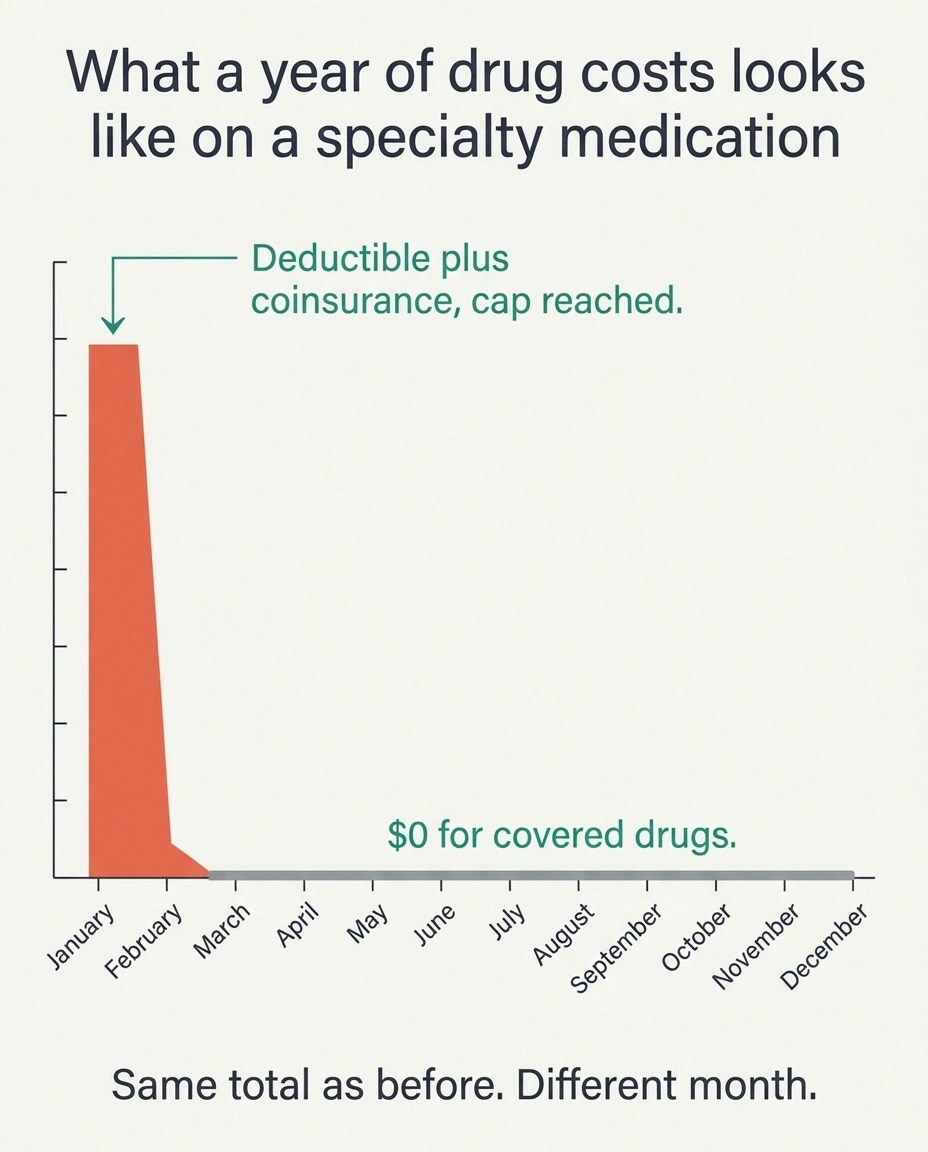
Here’s the awkward consequence of a hard annual cap that nobody designed on purpose.
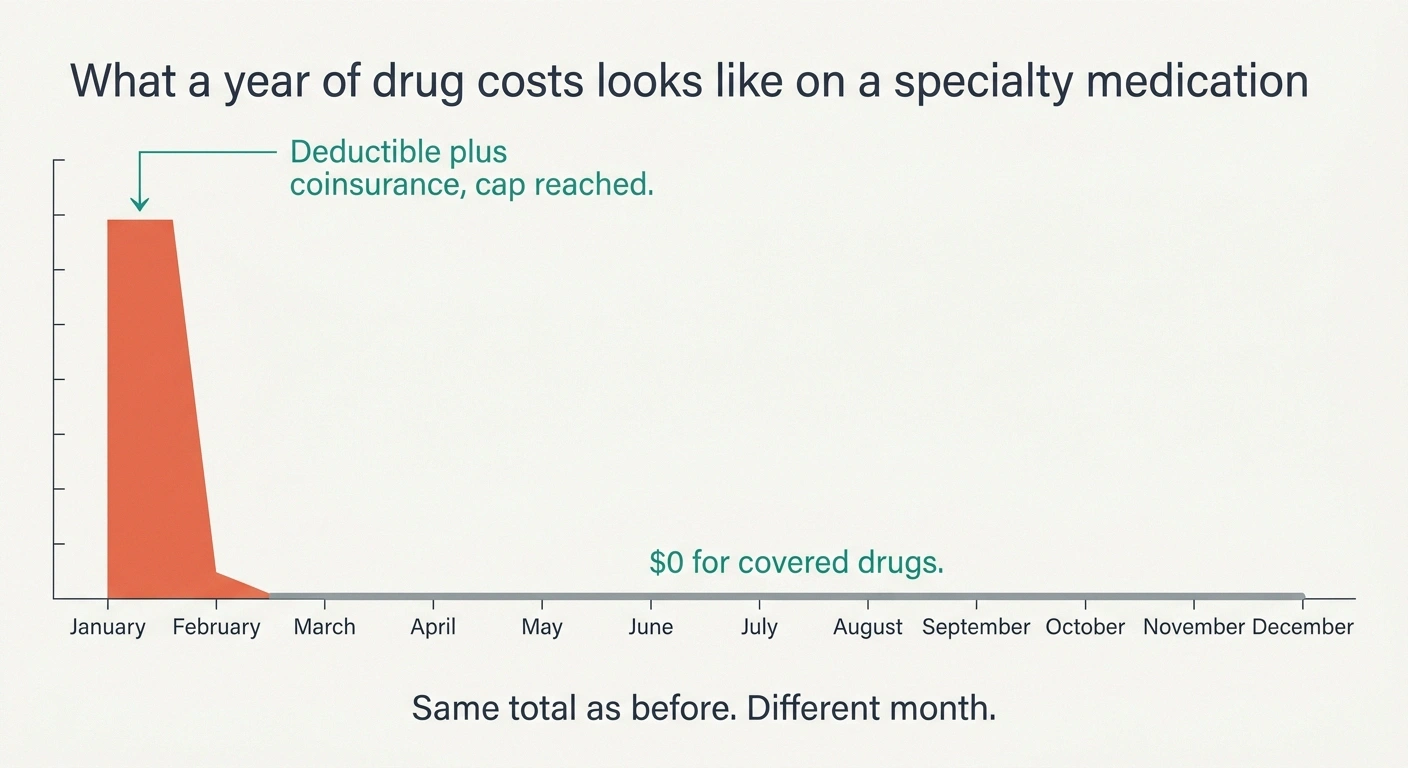
If you take an expensive drug, your entire year’s drug spending now happens in the first few weeks of the year. Deductible, then coinsurance, then $2,100 reached, then nothing until 31 December.
Your total cost for the year is far lower than it used to be. Your January is far worse — and January is the month you have to survive first. A retiree on a fixed monthly income can be genuinely unable to produce $2,100 in the first week of the year while still paying rent, and the fact that March through December will be free doesn’t help them at the register in January.
This is a cash-flow problem wearing the costume of a cost problem. It has a specific fix, and the fix is the least-publicised piece of the whole reform.
The Payment Plan Nobody Told You About
It’s called the Medicare Prescription Payment Plan. You’ll also see it written as MPPP or M3P.
- Switching plans quietly cancels it
- Enrolment carries over automatically within the same plan from 2026, but not across a change. Choose a new plan during open enrolment and you have to opt in again with the new one.
- The bill arrives from somewhere unfamiliar
- You pay nothing at the counter, so the statement comes later from the plan. More than one person has set it aside as junk mail and fallen behind without meaning to.
- A late-year fill lands hard
- Costs are divided by the months left in the calendar year. Something expensive filled in November is spread over two payments, not twelve, and December can be worse than paying at the register would have been.
- It is the wrong tool for real hardship
- The plan reschedules a bill. It does not shrink one. If the total is unaffordable rather than badly timed, Extra Help and charitable foundation funds are the programs that change the number itself.
What it does: instead of paying at the pharmacy counter, you pay nothing there, and your Part D plan bills you monthly for what you owe, spread across the remaining months of the calendar year.
The terms are better than you’d expect. No interest. No fees. It isn’t a loan, it isn’t a credit product, and it doesn’t touch your credit file. It’s a billing schedule — nothing more alarming than that.
The mechanics worth knowing:
You have to opt in. It is never automatic. Contact your Part D plan directly by phone, on their website, or by mail. Nobody will offer it to you at the pharmacy.
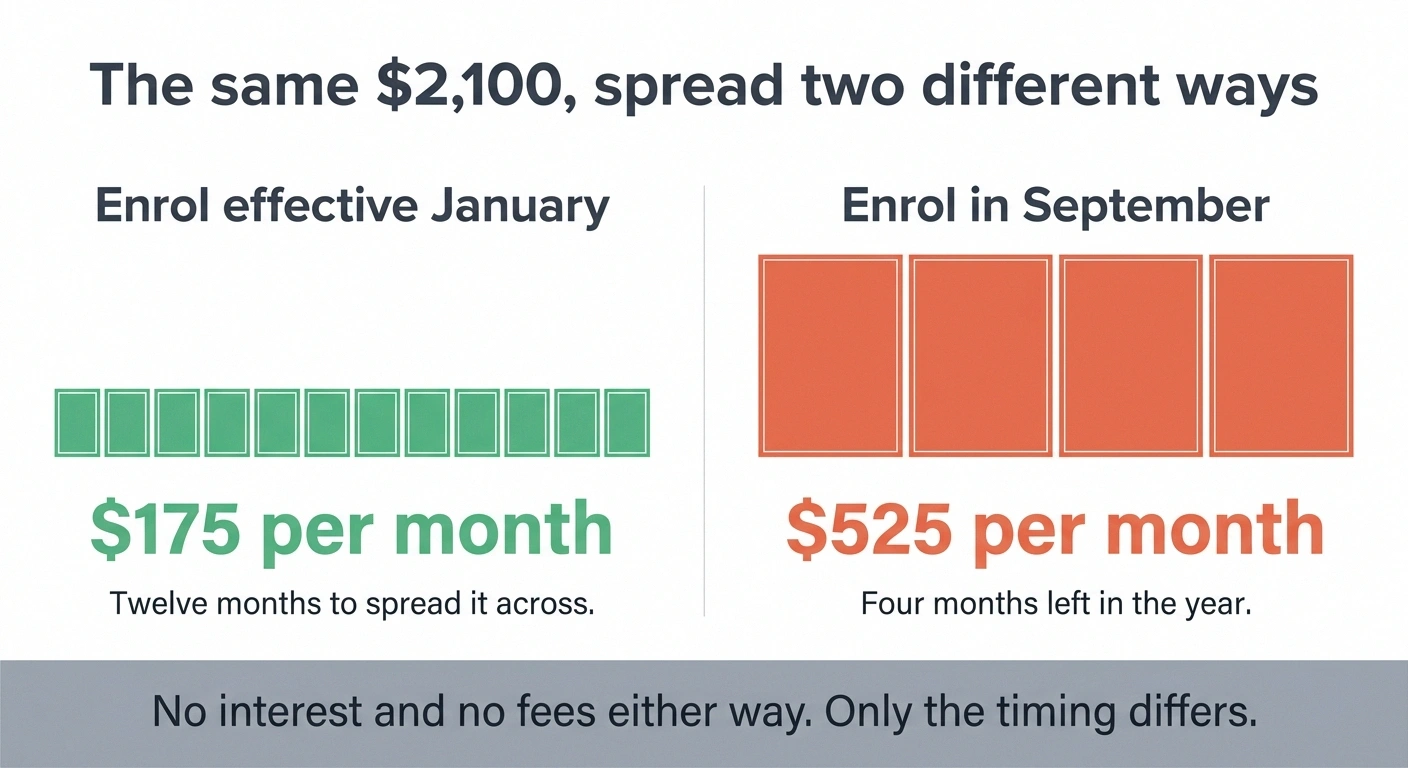
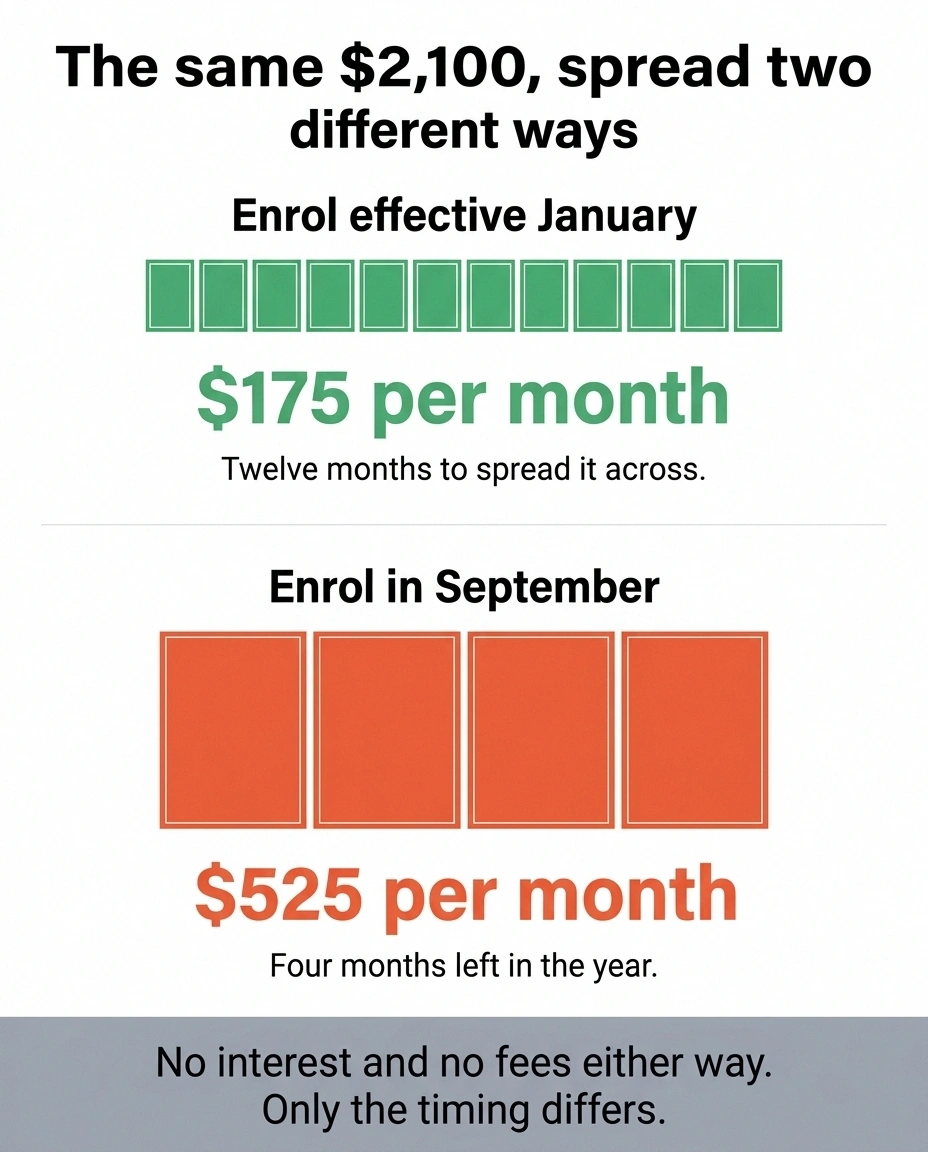
When you join decides your monthly amount. Costs are divided by the months remaining in the year. Join in January and $2,100 spreads across twelve months. Join in September and the same amount spreads across four. Same total — very different monthly bill.
From 2026 it renews automatically if you were enrolled in 2025. But if you switch plans, you have to opt in again with the new one, and this is where people fall through the gap.
Your bill comes from the plan, not the pharmacy. This surprises people. You’ll walk out with your medication having paid nothing, and the statement arrives later.
It does not save you a cent. Worth being blunt about. The total is identical. Only the timing changes.
Missing payments can remove you from the program, which puts you back to paying at the counter. If money is genuinely tight rather than just badly timed, the program to look at is Extra Help, the low-income subsidy, which reduces what you actually owe.
The Negotiated Prices, and Why They Matter Here
Something else took effect in January 2026 that gets discussed separately from the cap, though for this audience the two belong together.
Medicare negotiated prices directly with manufacturers for the first time, and the first ten drugs are now priced at those negotiated rates. Discounts off list ranged from 38% to 79%.
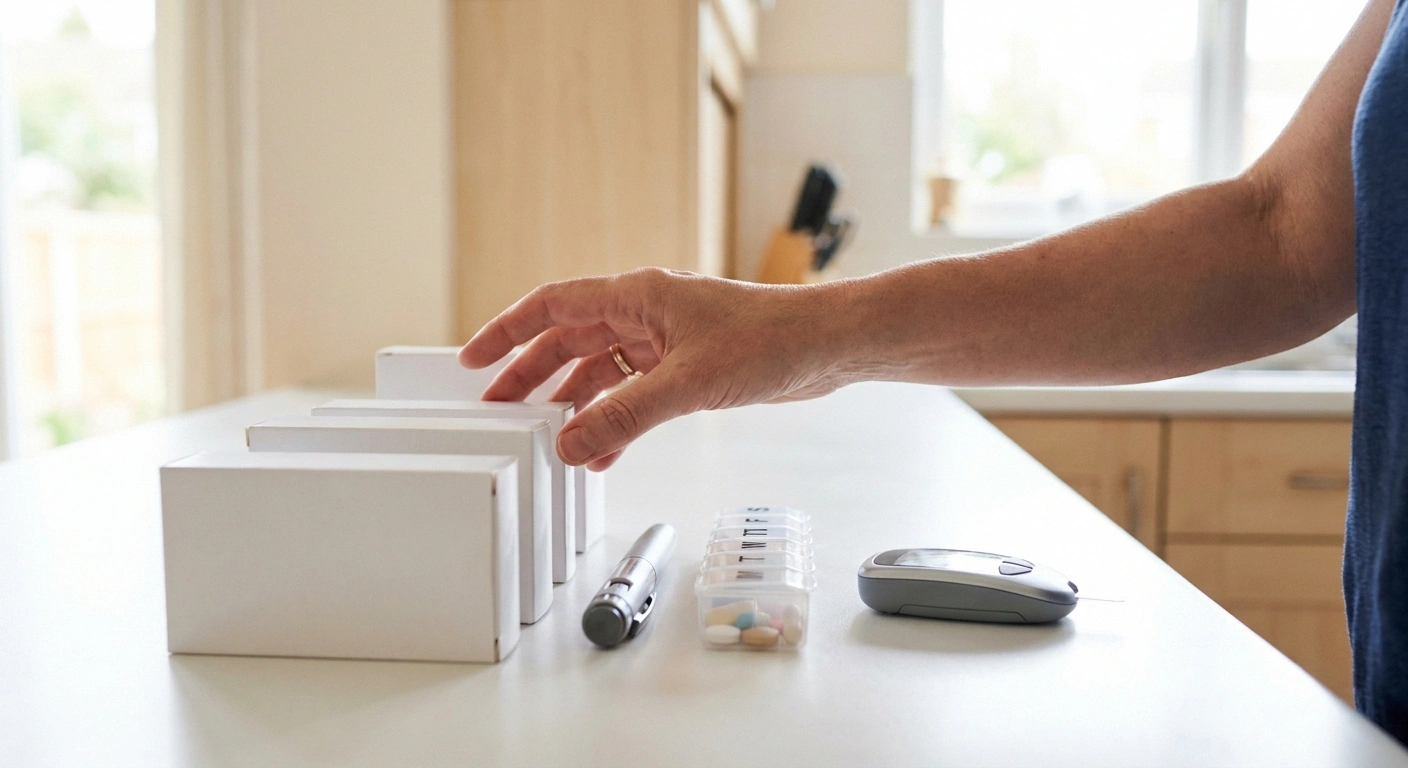
None of the ten is a neuropathy drug. Four of them are diabetes drugs — which is the connection worth making.
Jardiance, Januvia, Farxiga, and the insulins NovoLog and Fiasp are all on the list, alongside Eliquis, Xarelto, Entresto, Enbrel, Imbruvica and Stelara.
If you have diabetic neuropathy, there’s a decent chance at least one of those is on your list, and the savings arrive without you doing anything. For a household running a tight budget where blood sugar control competes with everything else for money, a meaningful drop in the cost of the diabetes drugs is not a side note. Glucose control is the single most evidence-backed thing available for slowing nerve damage, and cost is one of the main reasons people ration it.
Five Things Worth Doing Before January
Concrete steps, in the order I’d take them.
“I’d like to enroll in the Medicare Prescription Payment Plan for next year, effective January.”
“Can you confirm that all of my current medications are on the formulary for next year, and tell me which tier each one is on?”
“Do any of them require prior authorisation or step therapy in the coming plan year?”
“What is my deductible for next year, and roughly when would you expect me to reach the out-of-pocket maximum?”
Write down the date, the time, and the name of whoever answers. Formulary and prior-authorisation answers given over the phone are frequently disputed later, and a name plus a date settles the argument quickly.
Find out which benefit pays for each of your treatments. Part B or Part D, for every drug and every infusion. Anything administered by a professional is the one to check. This single question prevents more nasty surprises than everything else on this list.
Estimate whether you’ll actually reach $2,100. Add up last year’s out-of-pocket pharmacy spending. If it was $400, the cap is irrelevant to you and you can stop thinking about it. If it was over $2,000, plan around January specifically.
If you’ll reach the cap, call your plan about the payment plan in December. Joining in January gives you twelve months to spread the cost. Every month you delay makes the monthly figure larger.
Check your formulary during open enrollment. The cap only applies to covered drugs. A medication your plan doesn’t cover contributes nothing toward the $2,100, and formularies change annually.
Find out whether Extra Help applies to you. This is a separate program from everything above and it is the one that actually lowers what you owe rather than rescheduling it. Eligibility is based on income and assets, the thresholds are higher than most people assume, and a surprising number of people who qualify have never applied because they assumed they earned too much. If money is genuinely tight rather than badly timed, start here rather than with the payment plan.
Look at foundation assistance if you’re on a specialty drug. Independent charitable funds exist for specific conditions and are separate from manufacturer programs, which generally cannot be used with Medicare. HealthWell, for instance, runs a fund specific to Vyndamax with support of up to $15,000 a year in 2026. These funds open and close as money runs out, so applying early in the year matters.
What I Actually Think About All This

I’ve been sceptical of policy announcements for a long time, and this one deserves better than my scepticism.
The cap is real, it works, and for the small group of people facing six-figure drug prices it has removed a genuine cause of ruin. I don’t want to undersell that.
What frustrates me is the gap between the headline and the practical reality. “Medicare now caps your drug costs at $2,100” is true and, taken alone, misleading. It will not help most people with neuropathy, because our drugs were already inexpensive. It does not help anyone whose main treatment goes in through a needle in a clinic. And the tool that solves the timing problem it creates requires you to know it exists and phone your plan to ask for it.
None of which is a reason to ignore any of it. It’s a reason to spend twenty minutes finding out which of the three categories you’re in, and then to act only on the one that applies to you.
Frequently Asked Questions
What is the Medicare Part D out-of-pocket cap in 2026?
$2,100. Once your out-of-pocket spending on covered Part D drugs reaches that figure, your plan pays 100% of covered drugs for the rest of the calendar year. The cap was $2,000 in 2025 and is adjusted annually. It resets to zero every 1 January.
Do my premiums count toward the $2,100?
No. Only your deductible, copays and coinsurance on covered drugs count. Monthly premiums are excluded, as are drugs not on your plan’s formulary.
Does the cap cover IVIG for CIDP?
Generally not. Immunoglobulin infused in a clinic or infusion centre is usually billed under Part B, the medical benefit, not Part D. Part B has no annual out-of-pocket maximum, so the $2,100 cap does not apply. Confirm with your provider’s billing office which benefit is used for your specific treatment.
Which neuropathy drugs are expensive enough to reach the cap?
Mainly treatments for hereditary transthyretin amyloidosis. Tafamidis carries a list price around $225,000 a year, eplontersen around $572,000 and vutrisiran around $463,500. Standard nerve pain medications such as gabapentin, pregabalin, duloxetine, nortriptyline and amitriptyline are inexpensive generics and rarely bring anyone near $2,100.
What is the Medicare Prescription Payment Plan?
An opt-in program that lets you spread out-of-pocket Part D costs into monthly payments across the calendar year instead of paying at the pharmacy counter. There is no interest and no fee. It does not reduce what you owe, only when you pay it. You must contact your plan to enroll.
Why is my pharmacy bill so high in January?
The cap and any deductible reset on 1 January. If you take an expensive drug, most of your annual out-of-pocket spending is now concentrated in the first weeks of the year, after which you pay nothing. The Medicare Prescription Payment Plan exists specifically to smooth that out.
Does the cap apply to Medicare Advantage plans?
Yes, where the plan includes Part D drug coverage. The $2,100 limit applies to the drug portion. Medicare Advantage plans also carry their own separate out-of-pocket maximum for medical services, which is a different limit with a different amount.
Should I join the payment plan if my drug costs are low?
Usually not. If you spend a few hundred dollars a year at the pharmacy, spreading that into monthly billing adds paperwork without meaningful benefit, and missed payments can remove you from the program. It is designed for people facing large, front-loaded costs.
Which drugs got negotiated prices in 2026?
The first ten are Eliquis, Jardiance, Xarelto, Januvia, Farxiga, Entresto, Enbrel, Imbruvica, Stelara and NovoLog/Fiasp, with discounts off list price ranging from 38% to 79%. None treats neuropathy directly, but four are diabetes medications relevant to anyone managing diabetic nerve damage.
About the Author