
There is a sentence that gets said in scleroderma appointments so routinely that nobody hears it as a decision anymore. A patient mentions that their fingers feel numb, and someone answers that the skin is tightening.
That answer is often correct. Scleroderma does tighten skin, and tight skin over a fingertip genuinely dulls sensation. It is also the single most efficient way in medicine to close a conversation before it starts, because it explains the symptom without requiring anyone to check whether something else is producing it.
Underneath that closed conversation sits a substantial body of research showing that peripheral nerve damage in systemic sclerosis is considerably more common than the field once assumed. Not universal. Not inevitable. But common enough that in a large review of neurological involvement, sensorimotor polyneuropathy appeared in roughly one in seven patients, and one particular cranial nerve problem appeared in more than one in six.
The reason this gets missed is not carelessness. It is that scleroderma produces several symptoms that feel exactly like nerve damage and are not, while simultaneously producing nerve damage that does not look the way nerve damage is supposed to look. Both errors run in the same direction, and both end with the same shrug.
What follows is the framework for telling them apart: the actual prevalence numbers, the numb face that shows up more often than most people are ever told, why the usual feet-first rule fails here, and what the distinction changes about treatment.
Why Nerve Symptoms Get Blamed on the Skin
Scleroderma is a disease of fibrosis and small blood vessels. Collagen accumulates where it should not, tissue thickens and stiffens, and the smallest arteries narrow and behave abnormally. From those two processes come most of the recognisable features: the taut shiny skin, the fingers that will not fully bend, the Raynaud's attacks where circulation shuts down in the cold.
Four questions that sort one numb hand from another
Points toward vessels or skin
- Comes and goes, tied to cold or stress
- Colour change in the fingers alongside it
- Eases within minutes of rewarming
- Sits exactly where the skin is tightest
Points toward nerve
- Still there in a warm room, hours later
- Wakes you at night and improves when you shake the hand
- Follows a nerve's map, with a border you can trace
- Includes skin that is not especially tight
Both columns can be true at once, and frequently are. The point is not to pick a side but to arrive with evidence that at least one item on the right is happening, which is what turns a dismissed symptom into an ordered test.
Every one of those can imitate neuropathy convincingly.
Tight skin dulls light touch, because sensation depends partly on how skin deforms when something presses on it. Raynaud's produces numbness, tingling and burning during and after an attack, which is exactly the vocabulary of nerve pain. Contractures make hands clumsy, and clumsiness reads as weakness. A person can describe numb, tingling, weak, painful hands, and have every one of those symptoms explained by processes that never touch a nerve.
The trap is that the same disease is also damaging nerves in a meaningful fraction of patients, and when it does, the symptoms overlap almost perfectly with the ones that have a non-nerve explanation ready to hand. Attribution becomes a habit, and the habit is right often enough to survive.
Two features break the tie, and they are worth carrying into an appointment. Raynaud's numbness is episodic and tied to cold or stress, arriving with a colour change and easing as the hand rewarms; nerve numbness persists in a warm room. Skin-tightness numbness sits where the skin is tightest, meaning fingertips and the backs of the fingers; nerve numbness follows nerve territory instead, which frequently means a patch that includes skin nowhere near the worst fibrosis. Learning to separate nerve pain from vascular pain is the most useful skill a scleroderma patient can bring to this problem.
The Numbers Nobody Quotes at Diagnosis
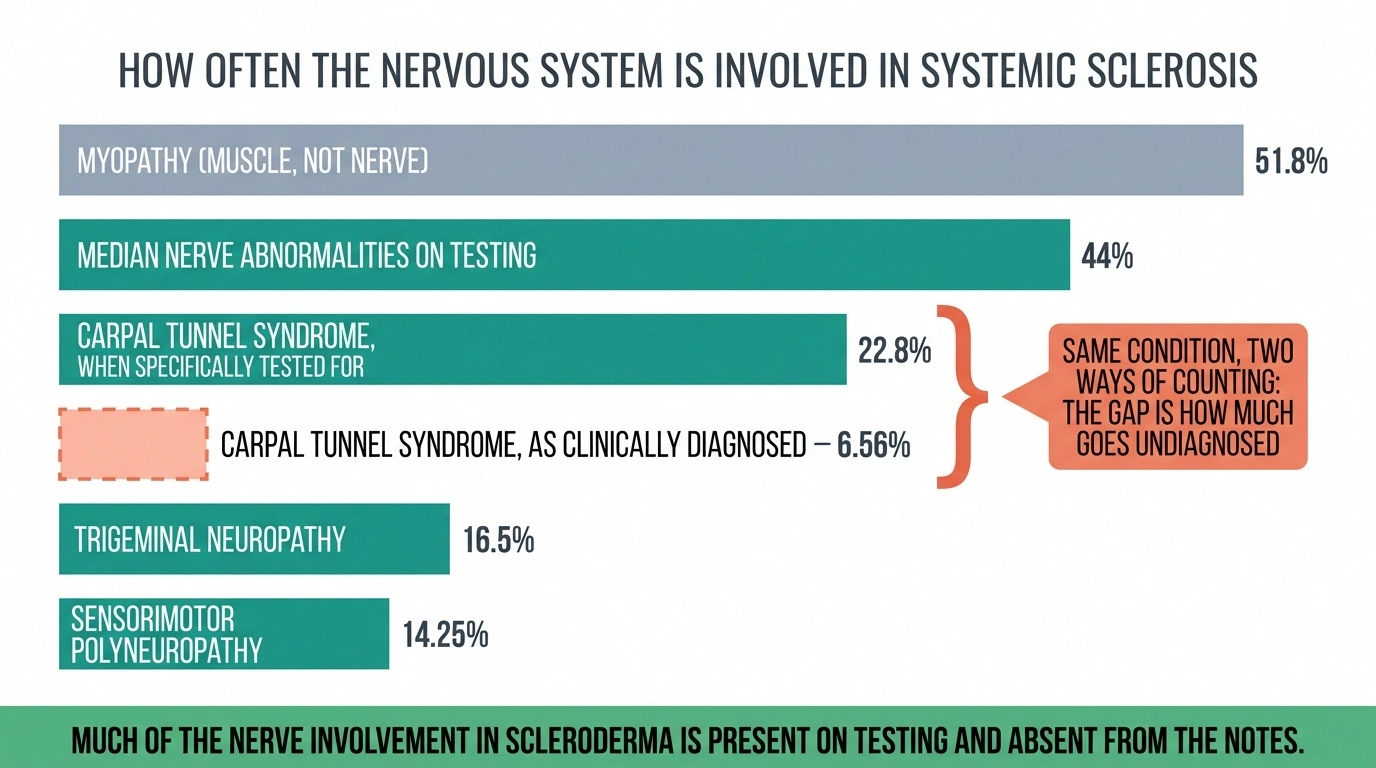
Because nerve involvement is treated as a footnote, most people never see the figures. They are not small.
A systematic review of neurological involvement in systemic sclerosis found myopathy, meaning muscle disease rather than nerve disease, in about half of patients at 51.8 percent. Trigeminal neuropathy, affecting the nerve that carries sensation from the face, appeared in 16.5 percent. Peripheral sensorimotor polyneuropathy, the pattern most people mean by neuropathy, appeared in 14.25 percent. Carpal tunnel syndrome was recorded in 6.56 percent.
That last number is where the literature stops agreeing with itself, and the disagreement is informative rather than embarrassing. Studies that specifically looked for compression neuropathies with nerve testing rather than waiting for a clinical diagnosis found carpal tunnel syndrome in 22.8 percent of patients, and abnormalities of the median nerve on electrophysiology in 44 percent.
The gap between 6.56 percent and 44 percent is not a contradiction. It is the difference between how many people get diagnosed and how many people actually have measurable nerve dysfunction. A large share of scleroderma nerve involvement is subclinical, present on testing and unremarked in the notes, either because symptoms are mild or because they have already been attributed to the skin.
Timing adds another layer. Nerve damage in scleroderma is common within the first decade of disease rather than emerging only after decades of accumulated fibrosis. It is not a late complication you can stop worrying about for twenty years.
Trigeminal Neuropathy: The Numb Face Nobody Warned You About

Of everything in this article, this is the finding most likely to be new information, and it is strange enough that people often do not report it.
If your mouth or tongue is part of it
A numb mouth removes the warning system that normally stops you burning or biting yourself. These are the four adjustments people report making, and none of them require anyone's permission.
- Let hot drinks sit for three minutes. Coffee is commonly served near 70 C and scalds at that temperature. Judging by feel stops being reliable.
- Chew on the side that reports back. Repeated cheek and tongue biting on a numb side leaves ulcers that then heal slowly.
- Tell your dentist before, not during. Reduced sensation changes how anaesthesia is judged and how a sore spot presents afterwards.
- Report a new numb chin promptly, even if it seems minor. It is a symptom that gets taken seriously in anyone, so raising it is never a wasted appointment.
The trigeminal nerve carries sensation from the face: forehead, cheek, jaw, the front of the tongue, the inside of the mouth. When scleroderma affects it, the result is numbness, tingling, burning or crawling sensations in the face, sometimes on one side, sometimes both, sometimes confined to the chin or an area around the mouth.
Among nerve problems in scleroderma that are not caused by compression, trigeminal neuropathy is the most common. Depending on which series you read it appears in somewhere between roughly one in ten and one in six patients. The association is strong enough that it is considered a recognised feature of the disease rather than a coincidence, and it is more frequent in scleroderma than in most other connective tissue diseases.
People underreport it for understandable reasons. A numb chin sounds trivial next to lungs and kidneys. It sounds like something dental. It sounds odd enough that patients worry about how it will land. So they mention the hands, which feel more legitimate, and the face goes unspoken for years.
It is worth mentioning for three reasons. It is a recognised part of the disease, which makes it a real observation rather than a strange one. It has practical consequences, because a numb mouth and tongue mean burns from hot drinks and biting the inside of the cheek without noticing. And a new numb chin in anyone, including people without scleroderma, is one of those symptoms medicine takes seriously enough to investigate properly, so bringing it up is never wasted.
Carpal Tunnel and the Other Squeezed Nerves
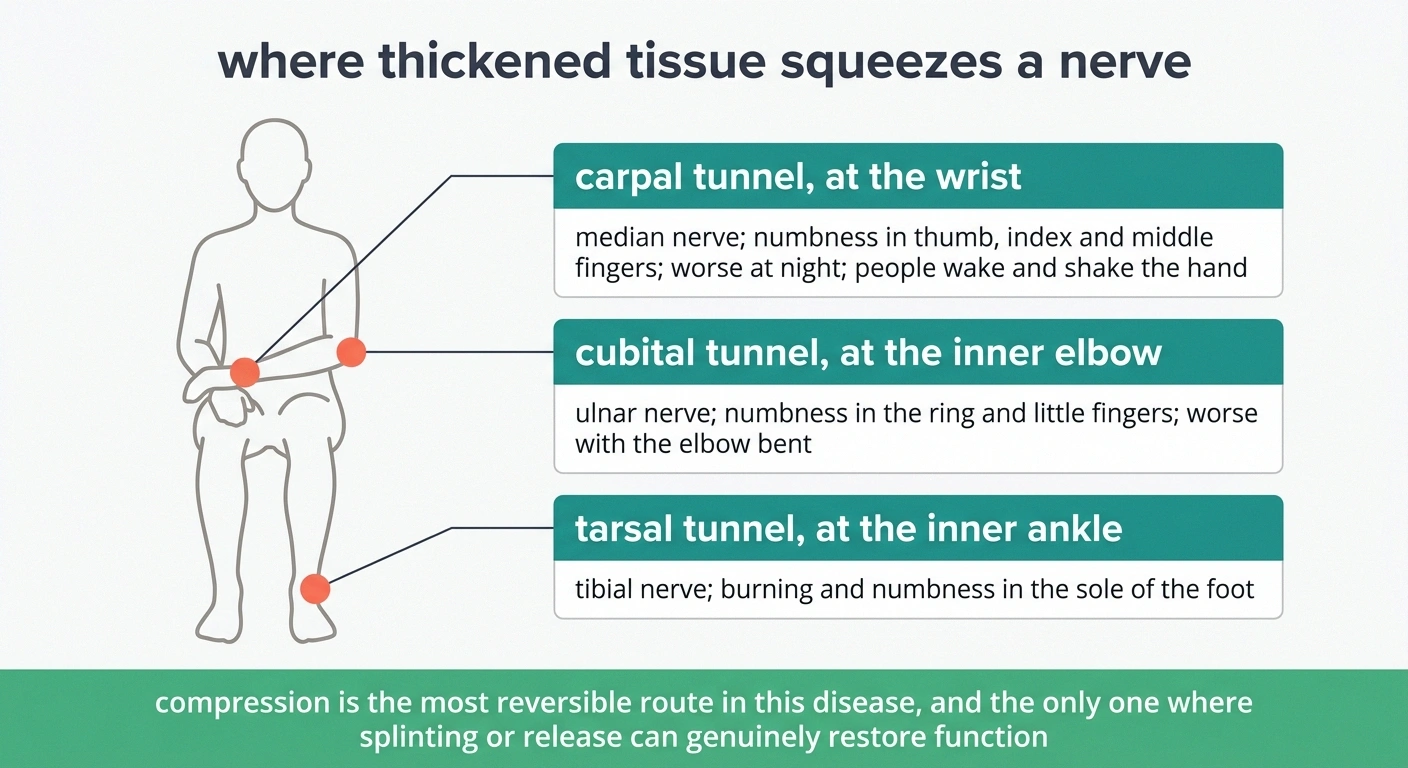
Compression is the second major route, and mechanically it makes obvious sense. Nerves pass through tunnels bounded by connective tissue. Scleroderma thickens connective tissue. Tunnels narrow, and the nerve inside gets squeezed.
The carpal tunnel at the wrist is the classic site, and the median nerve running through it produces the familiar pattern: numbness and tingling in the thumb, index and middle fingers, worse at night, sometimes waking people who then shake the hand to relieve it. The ulnar nerve at the elbow and the tarsal tunnel at the inner ankle can be affected the same way.
Two things make compression neuropathy in scleroderma different from ordinary carpal tunnel syndrome, and both change what you do about it.
First, it can come first. Carpal tunnel syndrome has been documented as the initial manifestation of scleroderma, preceding the skin changes that eventually make the diagnosis obvious. Someone whose carpal tunnel arrives alongside Raynaud's, puffy fingers or unexplained reflux deserves a broader look than a wrist splint.
Second, the usual treatments are complicated by the surrounding disease. Night splinting is a reasonable first step and is the same advice anyone would get. Surgical release works, but wound healing in fibrotic, poorly perfused skin is a genuine consideration, and the decision belongs with a surgeon who knows the disease rather than one meeting it for the first time. The tingling of nerve symptoms in the hands also has more possible sources here than in most people, which is exactly why testing rather than assuming matters.
The Damage That Skips the Rulebook

Almost all peripheral neuropathy follows one rule: longest nerves fail first. Feet before hands, toes before ankles, a slow symmetrical creep upward. That pattern is called length dependent, and it is so reliable that a neuropathy which does not follow it is treated as a clue rather than an exception.
Scleroderma neuropathy frequently does not follow it.
The research finding that matters most here is that peripheral nerve involvement in scleroderma affects both large and small fibres in a non-length-dependent fashion, and that these findings cannot be attributed to compression. In plain terms, the damage is patchy. It can appear on the trunk, the thighs, the face, one arm and not the other, without ever producing the classic stocking-and-glove distribution.
Small fibre involvement produces its own vocabulary: burning, prickling, a sensation of ice or of insects on the skin, pain out of proportion to anything visible, and sometimes disturbances of sweating. These fibres are invisible to standard nerve conduction testing, which measures large fibres only, so a normal nerve conduction study does not rule this out. Small fibre neuropathy requires different testing entirely, usually a skin biopsy that counts nerve endings.
Why this matters practically: if you report burning feet and a numb patch on your thigh and your nerve conduction study comes back normal, the correct conclusion is not that nothing is wrong. In scleroderma specifically, that combination is a recognised pattern, and burning feet with normal large-fibre testing is one of the more common ways small fibre disease announces itself.
Three Mechanisms Wearing One Name
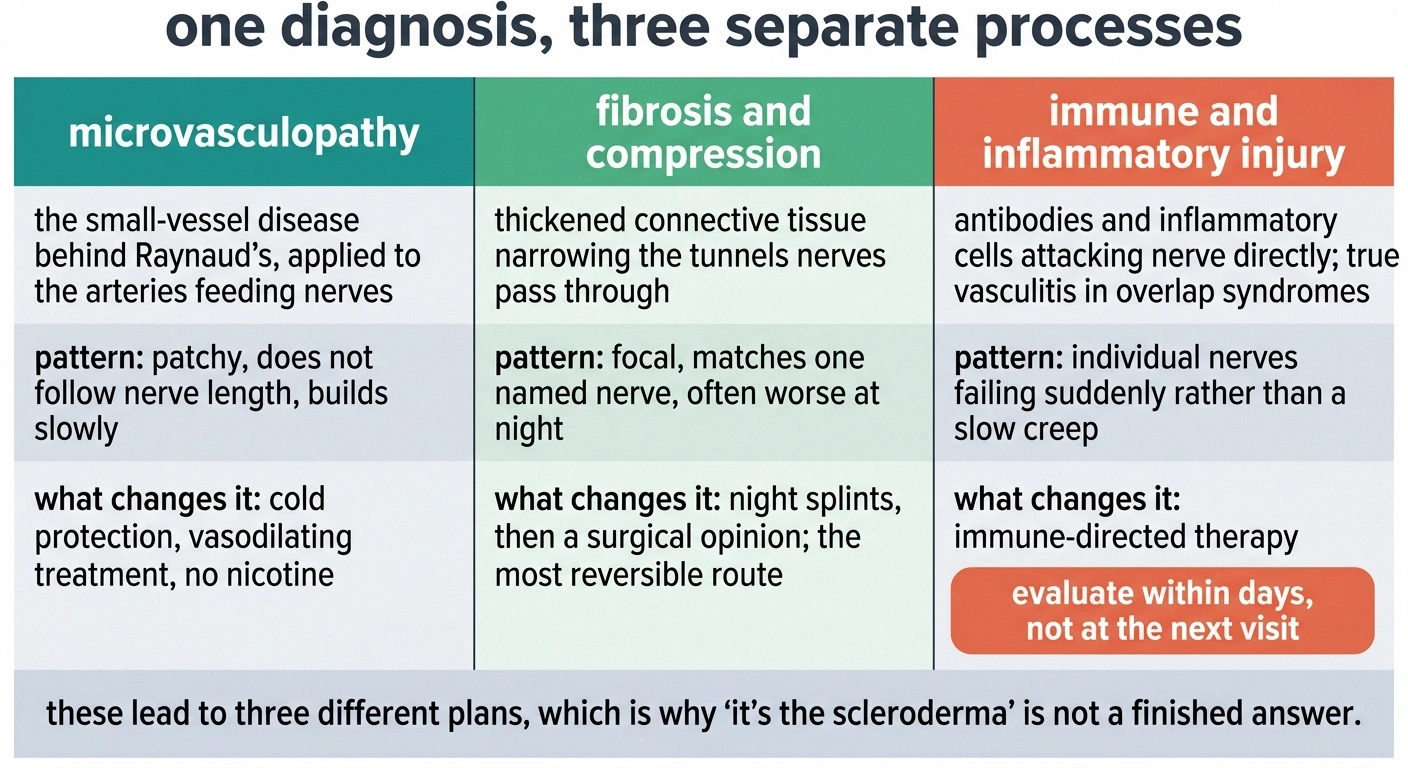
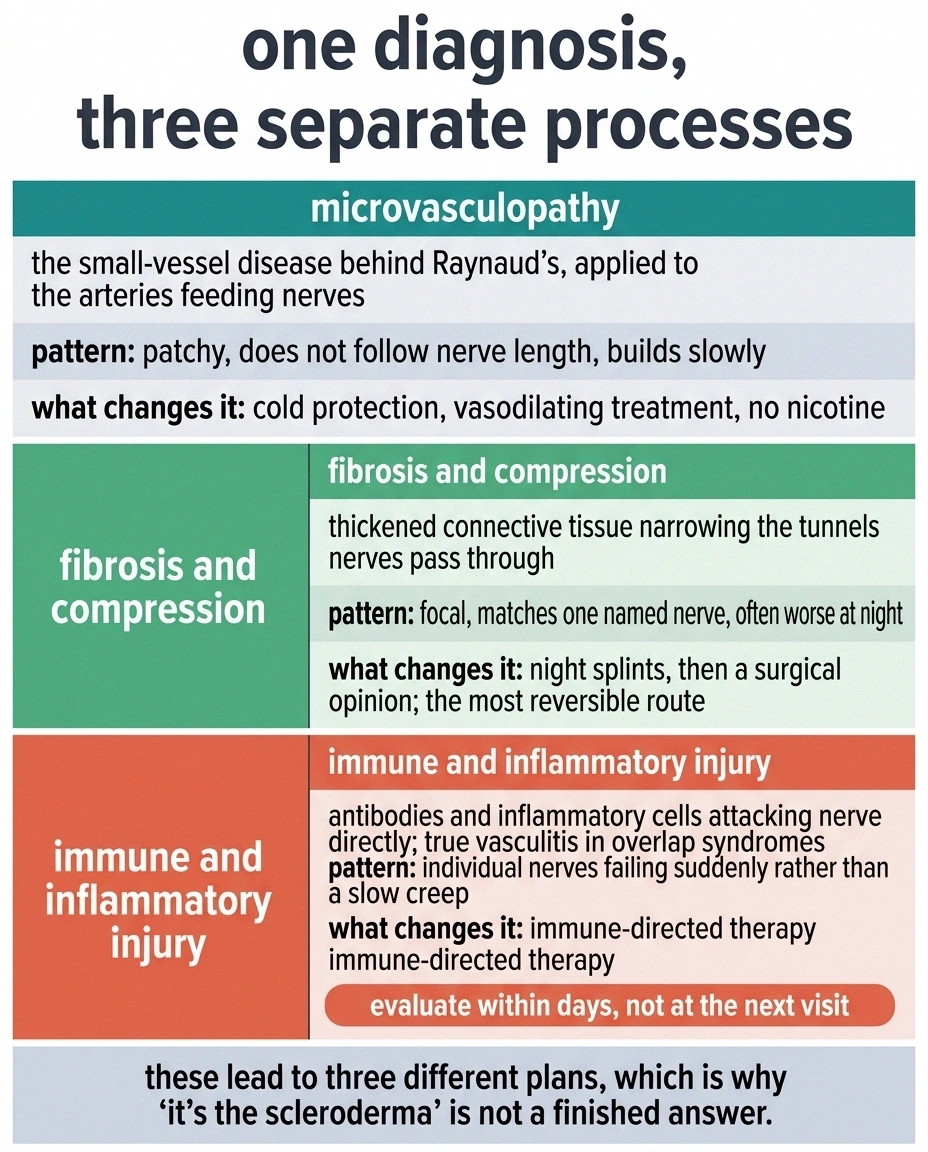
Scleroderma reaches nerve tissue by at least three separate routes, and they behave differently enough that lumping them together produces bad decisions.
The first is microvasculopathy. The small-vessel disease that produces Raynaud's is not confined to fingers. The tiny arteries feeding peripheral nerves, the vasa nervorum, are the same calibre and subject to the same narrowing. Chronically under-perfused nerve tissue degenerates slowly, and the patchy non-length-dependent pattern described above fits vascular supply far better than it fits length.
The second is fibrosis and compression, discussed above. Mechanical, focal, and the most treatable of the three.
The third is immune and inflammatory injury. Antibodies and inflammatory cells can attack nerve tissue directly, and in overlap syndromes where scleroderma coexists with another autoimmune disease, a true vasculitic neuropathy can occur. That version is more aggressive, tends to produce individual nerves failing suddenly rather than a slow creep, and is the one situation in this article that calls for evaluation within days rather than at the next visit.
Autonomic nerve involvement deserves a mention alongside these, because in scleroderma it usually shows up somewhere people do not think of as neurological. Difficulty swallowing, reflux, early fullness, bloating and alternating constipation and diarrhoea are frequently driven by the nerves controlling the gut rather than by the gut itself. Autonomic neuropathy is often the most disruptive nerve problem in scleroderma and the least likely to be filed under nerves.
Getting Tested When Everything Looks Like Scleroderma

The practical obstacle to diagnosis is that scleroderma explains everything, so nothing gets investigated.
Skin, vessel, muscle or nerve: what answers each one
| Nerve, large fibres | Nerve conduction study and EMG. Also identifies compression at a specific site and separates nerve weakness from muscle weakness. |
| Nerve, small fibres | Skin biopsy counting nerve fibre density. This is the test to ask for when the conduction study came back normal and the burning did not. |
| Muscle | EMG plus creatine kinase. Worth doing early, since myopathy is more common here than any nerve finding. |
| Autonomic nerves | Autonomic function testing, when swallowing, bloating, blood pressure or sweating symptoms lead. |
| A cause unrelated to scleroderma | B12, folate, thyroid function, HbA1c. Gut dysmotility and bacterial overgrowth make B12 deficiency genuinely likely here. |
Nerve conduction studies and electromyography are the starting point. They map large-fibre function, identify compression at specific sites, and distinguish nerve disease from the muscle disease that is more common still in this population. Given that half of patients have some myopathy, separating a weak muscle from a weak nerve signal is not a technicality.
A normal study does not close the question. If the complaint is burning, temperature sensitivity, or patchy pain, skin biopsy to measure nerve fibre density is the test that looks at the fibres involved. Autonomic testing has a place when gut, blood pressure or sweating symptoms dominate.
Blood work matters here more than in most neuropathy work-ups, because scleroderma patients can develop nerve damage from causes that have nothing to do with scleroderma. Vitamin B12 deficiency is common in anyone with gut dysmotility and bacterial overgrowth, and it is treatable in a way that fibrosis is not. Thyroid disease, diabetes and other autoimmune conditions cluster with scleroderma. Finding a second cause is a good outcome, not a distraction, and it is worth asking directly whether the standard neuropathy work-up has been done rather than assuming the diagnosis covers it.
The question to actually ask is narrow: are these symptoms coming from skin, from vessels, from muscle, or from nerve. Those four answers lead to four different plans, and the appointment gets more useful the moment it is framed that way.
What Helps, Realistically
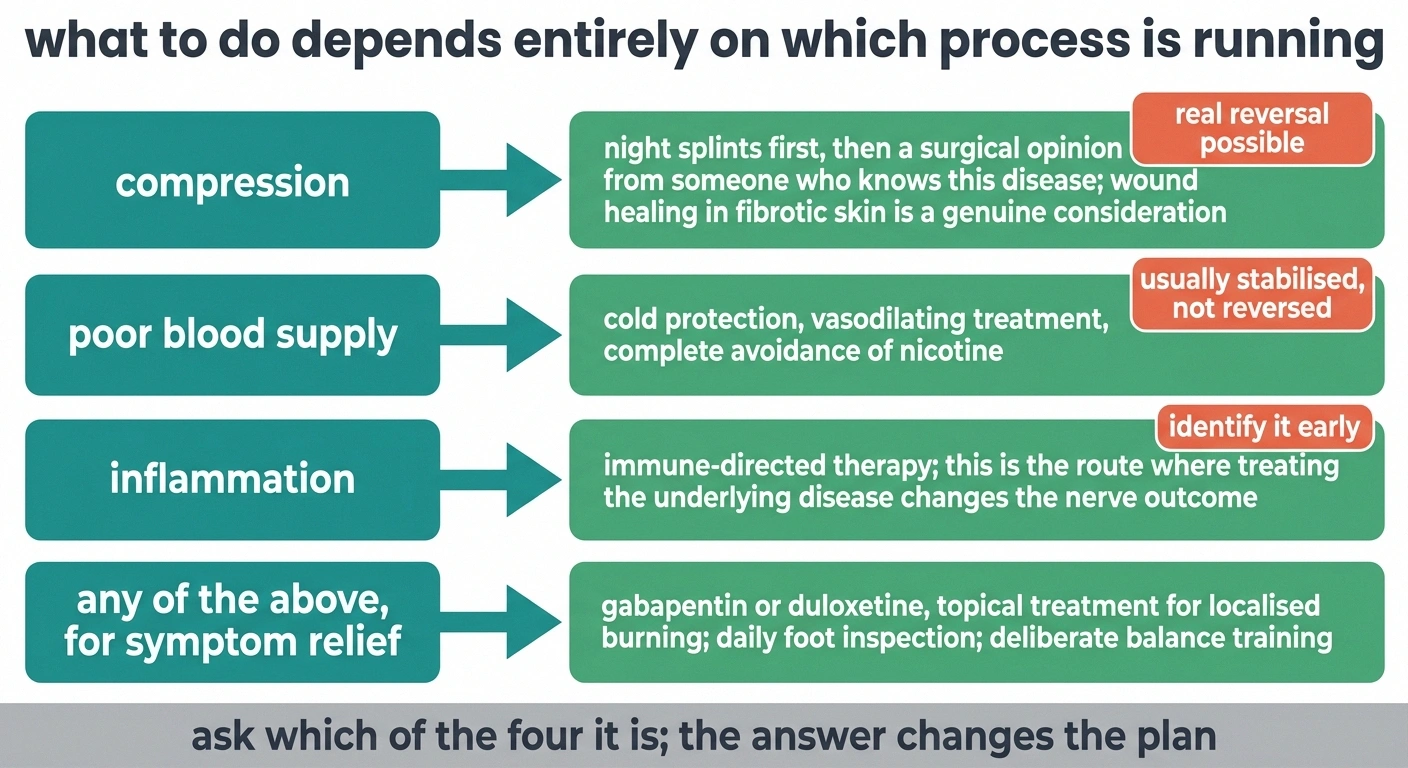
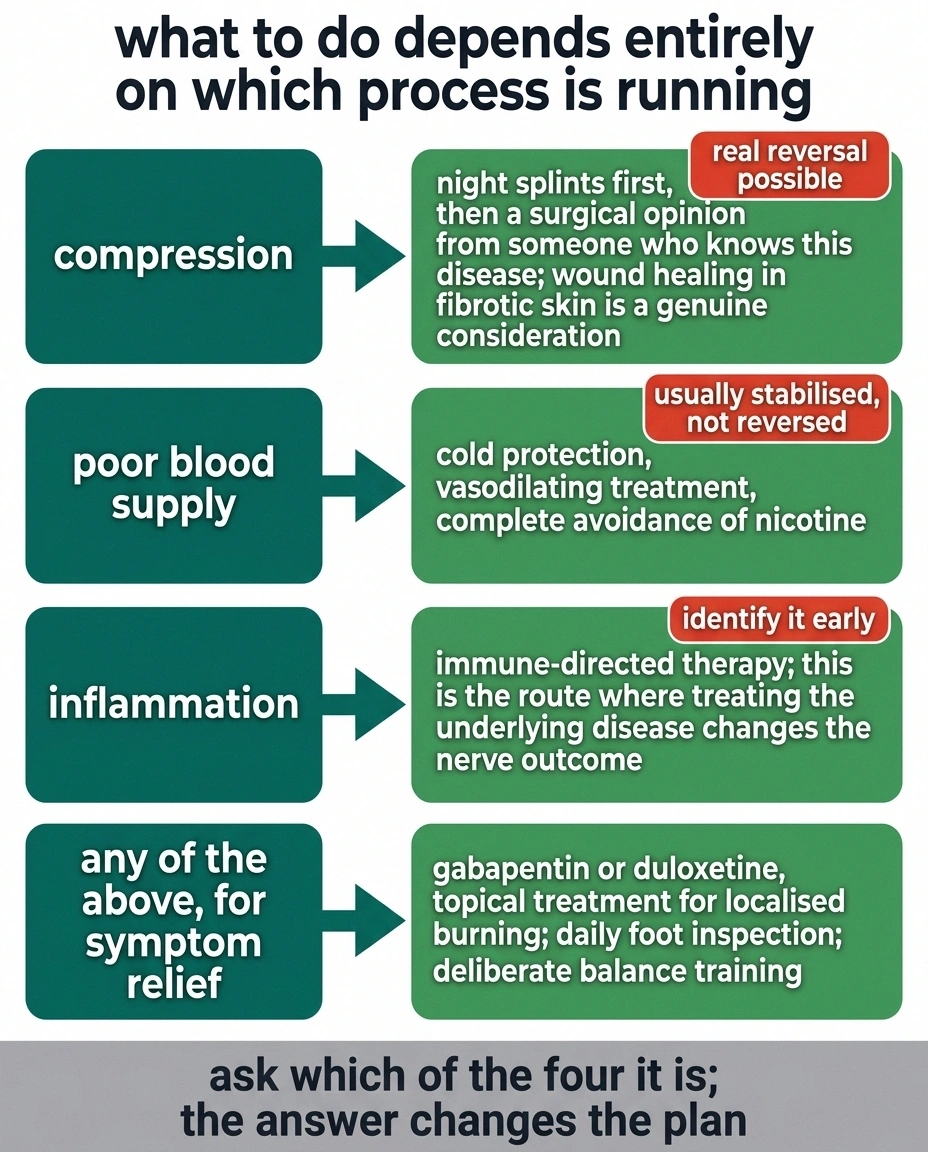
Treatment splits by mechanism, which is the practical payoff of the distinctions above.
The cheapest possible win, and the one most often skipped
Scleroderma slows the gut. A slow gut breeds bacterial overgrowth. Overgrown bacteria consume B12 before you absorb it. That chain ends in a nerve problem that has nothing to do with fibrosis and everything to do with a vitamin, and it responds to replacement rather than to immunosuppression.
ASK FOR
Serum B12 with methylmalonic acid, since a borderline B12 alone can look falsely reassuring
ALSO WORTH IT
Thyroid function and HbA1c, both of which cluster with autoimmune disease and both of which damage nerves
WHY IT MATTERS
Fibrosis cannot be reversed. A deficiency can. Finding a second cause is the best result this work-up can produce
Compression responds to decompression. Night splints first, then a surgical opinion from someone experienced with scleroderma's wound-healing considerations. This is the route where meaningful reversal genuinely happens.
Vascular contribution responds to the measures already central in scleroderma care: aggressive cold protection, calcium channel blockers and other vasodilating treatment, and complete avoidance of nicotine, which constricts exactly the vessels in question. Anything that improves perfusion to fingers plausibly improves perfusion to the nerves running alongside them.
Inflammatory nerve disease is treated with immune-directed therapy, and this is why identifying it matters. It is the version where the underlying disease treatment changes rather than just the symptom management.
Symptom control follows the same playbook as neuropathy from any cause. Gabapentin and duloxetine are the usual starting medications, with duloxetine sometimes preferred where fatigue and low mood coexist. Topical treatments are useful for localised burning.
Protection deserves emphasis because scleroderma stacks risks that ordinarily arrive alone. A fingertip that cannot feel, on a hand with impaired circulation and fragile skin, is a setup for wounds that heal badly. The same logic applies below: daily foot inspection is not optional advice here, and well-chosen footwear is doing more work than it does for most people. Balance is worth training deliberately, since patchy sensory loss undermines it in ways that are hard to compensate for, and fall prevention is easier to build before a fall than after.
The last point is the one worth leaving with. Getting a straight answer about which of these is happening to you takes persistence, because the default explanation is always available and always plausible. Asking whether a symptom is skin, vessel, muscle or nerve is a reasonable question, and it is the one that opens the door.
Frequently Asked Questions
Does scleroderma cause peripheral neuropathy?
Yes, more often than the field once recognised. A systematic review found sensorimotor polyneuropathy in about 14 percent of patients and trigeminal neuropathy in about 16 percent, and studies that test specifically for compression find carpal tunnel syndrome in up to 23 percent. Much of it is subclinical, meaning detectable on testing but not diagnosed.
Why is my face or chin numb with scleroderma?
Trigeminal neuropathy is a recognised feature of systemic sclerosis and the most common non-compression nerve problem in the disease. It causes numbness, tingling or burning in the face, sometimes limited to the chin or around the mouth. It is worth reporting both because it is a genuine disease feature and because a numb chin is a symptom doctors evaluate carefully in anyone.
How do I tell nerve numbness from Raynaud's or tight skin?
Raynaud's numbness is episodic, triggered by cold or stress, comes with colour changes and eases as the hand rewarms. Skin-tightness numbness sits where the skin is tightest, usually the fingertips. Nerve numbness persists in a warm room and follows nerve territory, which often includes areas where the skin is not particularly involved.
Can carpal tunnel syndrome be the first sign of scleroderma?
It has been documented as the initial manifestation, appearing before the skin changes that make the diagnosis obvious. Carpal tunnel syndrome arriving together with Raynaud's, puffy fingers or new reflux is worth a broader evaluation rather than a splint alone.
My nerve conduction study was normal but I still have burning feet. What now?
Nerve conduction studies measure large fibres only. Burning, temperature sensitivity and patchy pain come from small fibres, which those studies cannot see. Skin biopsy measuring nerve fibre density is the test for that, and small fibre involvement is a documented pattern in scleroderma.
Why does my neuropathy not start in my feet?
Because scleroderma nerve damage is frequently non-length-dependent, unlike most neuropathy. Research shows it affects large and small fibres in a patchy distribution that does not follow nerve length, which is consistent with a blood supply problem rather than a length problem. A numb patch on the thigh or face is not evidence against nerve involvement here.
Is scleroderma nerve damage reversible?
It depends on the mechanism. Compression can improve substantially with splinting or surgical release. Inflammatory nerve injury can respond to immune-directed treatment. Damage from chronic poor blood supply is usually stabilised rather than reversed, which is why identifying which process is running changes what you can expect.
Could my numbness be something other than scleroderma?
Quite possibly, and it is worth checking. Vitamin B12 deficiency is common when gut dysmotility and bacterial overgrowth are present, and thyroid disease and diabetes cluster with autoimmune conditions. These causes are treatable, and finding one is a better outcome than attributing everything to fibrosis.
About the Author