
Two facts about hepatitis B and nerve damage sit uncomfortably next to each other, and most of the confusion around this topic comes from people being handed one without the other.
The first fact is reassuring. The overwhelming majority of people living with chronic hepatitis B never develop peripheral neuropathy. Millions of people carry this virus for decades with normal sensation in their hands and feet, and if you have just been diagnosed and gone looking for what might happen to you, nerve damage does not belong near the top of that list.
The second fact is not reassuring at all. In a small subset of people, hepatitis B causes a blood vessel disease that attacks nerves specifically and aggressively, and it can do it early, sometimes before anyone knows the infection exists. There are documented cases where numbness and a foot that suddenly stopped working were the reason a person got tested for hepatitis B in the first place.
So the useful question is never “does hepatitis B cause neuropathy.” The useful question is which group you are in, and that question has a real answer with recognisable features. This is not a coin flip you wait out.
What follows separates the two situations: how the virus reaches nerve tissue when it does, the specific pattern that should send you to a doctor within days rather than at your next scheduled visit, why the treatment approach here runs backward from how doctors normally treat this kind of inflammation, and whether the antiviral pills you may already be taking have anything to do with your symptoms.
Why Most People With Hepatitis B Never Get Nerve Symptoms
Hepatitis B is a liver virus. It infects liver cells, replicates there, and the damage it causes comes mostly from your own immune system attacking infected liver tissue. Peripheral nerves are not a target. The virus does not live in them, does not travel down them, and has no particular interest in them.
That is why nerve involvement stays rare. When it happens, it is not the virus reaching out and touching a nerve. It is a side effect of how the immune system fights the virus, and specifically what happens when the fight produces debris.
During chronic infection, viral proteins circulate in the blood. Your immune system makes antibodies against them. Antibody binds antigen and forms a clump called an immune complex, which normally gets cleared quietly by the liver and spleen. In most people that clearance works. In some people it does not keep up, and complexes accumulate and start to lodge in the walls of small and medium blood vessels.
A blood vessel with immune complexes stuck in its wall becomes inflamed. Inflammation in a vessel wall is called vasculitis, and vasculitis is the entire bridge between a liver infection and a numb foot. Nothing about hepatitis B damages nerves directly. The vessels feeding those nerves are what get damaged, and the nerves starve.
Understanding that chain matters practically, because it tells you what changes your risk. Anything that raises circulating viral protein and immune complex load raises the risk. Effective viral suppression lowers it. This is one of the few causes of neuropathy where controlling the underlying disease genuinely changes the nerve outlook rather than merely slowing it.
Polyarteritis Nodosa: The Route That Does the Real Damage
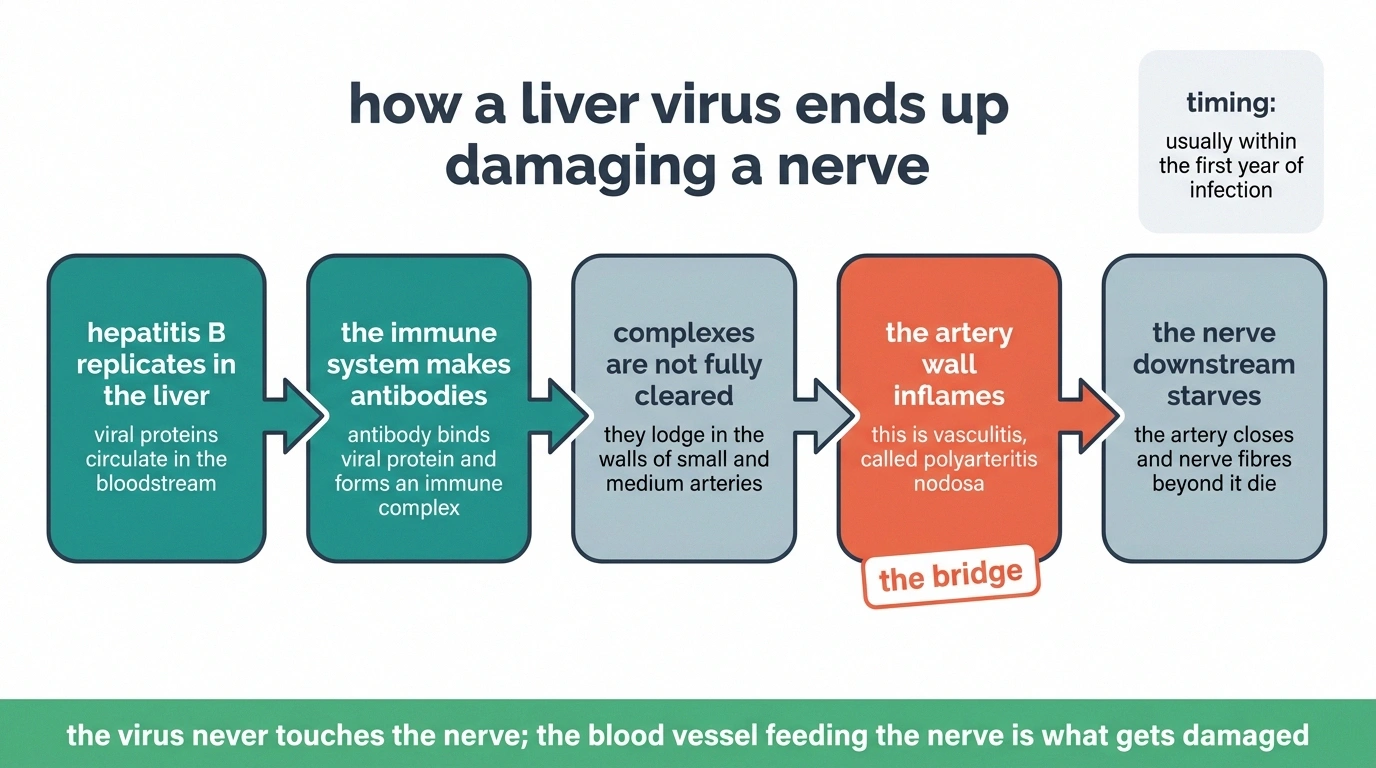
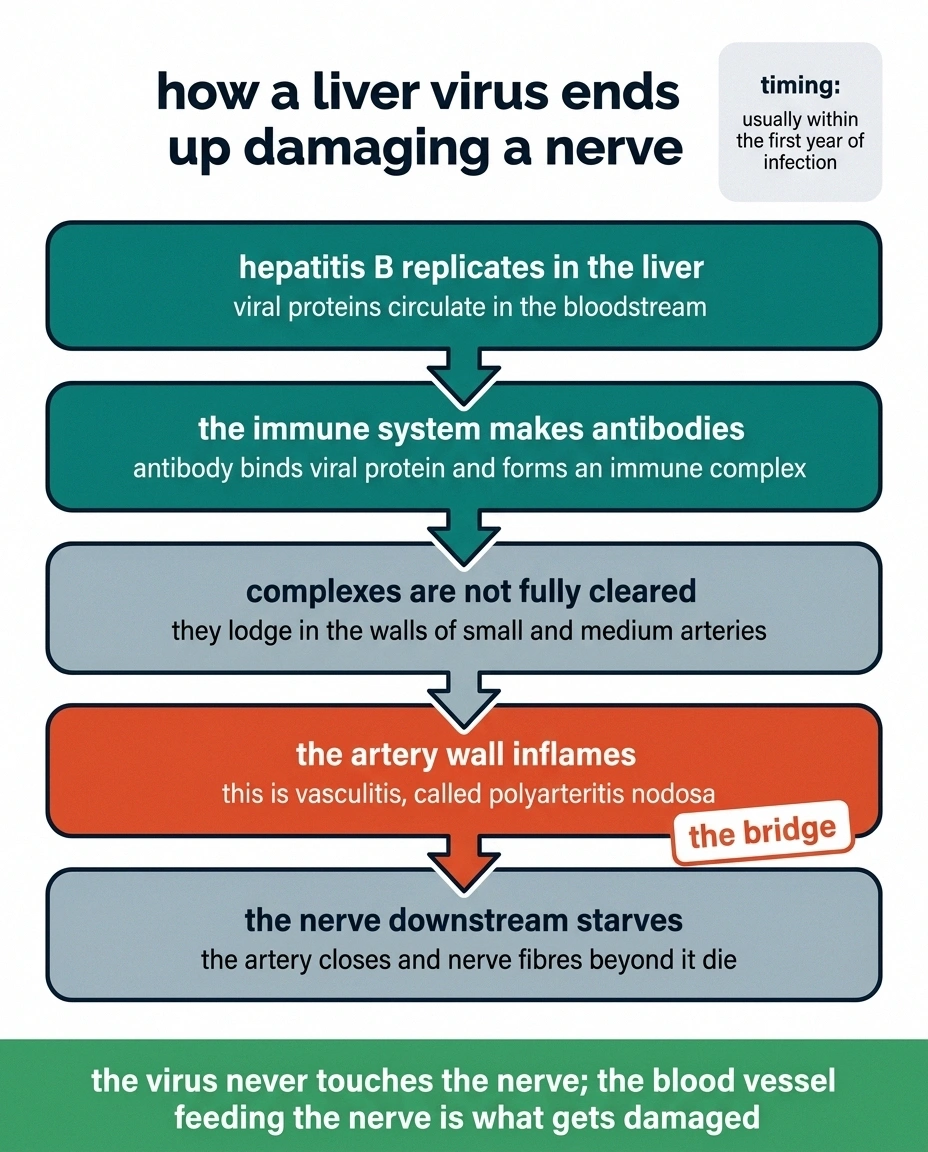
The vasculitis that hepatitis B causes has a name: polyarteritis nodosa, usually shortened to PAN. It attacks medium and small arteries throughout the body, and the arteries feeding peripheral nerves are exactly the calibre it prefers.
The relationship between the two conditions is not a coincidence or a statistical association. It is causal. In case series from the 1970s and 1980s, roughly a third of all polyarteritis nodosa cases were linked to hepatitis B infection. That share has fallen steeply since, driven almost entirely by two public health measures: universal hepatitis B vaccination and routine screening of the blood supply. In recent European cohorts, hepatitis B accounts for a small minority of PAN cases. The disease did not become less dangerous. There are simply far fewer new hepatitis B infections to cause it.
Peripheral neuropathy is one of the defining features of this vasculitis rather than an occasional complication. It shows up alongside a cluster of other findings that tend to travel together: unexplained weight loss, fever, muscle and joint pain, kidney involvement, abdominal pain after eating, and skin changes including tender nodules, a mottled purple net pattern on the legs, and in some cases ulcers. Somewhere between half and three quarters of people with polyarteritis nodosa develop nerve involvement, and among those whose PAN is driven by hepatitis B, the rates of neuropathy and of the specific pattern described in the next section run higher still.
Timing is one of the more useful things to know. Hepatitis B associated polyarteritis nodosa tends to appear early, often within the first year of infection, sometimes within months. It is a disease of new infection rather than a slow complication of decades of carriage. If you have carried hepatitis B for twenty years with no vasculitis, the odds of it starting now are low.
Low is not zero, and there is a documented case worth knowing about: vasculitic neuropathy occurring in a person classified as an inactive carrier, with a viral load low enough that the infection was considered dormant. Inactive carrier status makes this unlikely. It does not make it impossible, and a neurologist evaluating an unexplained vasculitic neuropathy should still know your hepatitis history.
Mononeuritis Multiplex: The Pattern That Gives It Away

Most neuropathy is symmetric and gradual. It starts in both feet at once, creeps upward over months or years, and by the time it reaches the ankles the hands are usually beginning too. That pattern is called length dependent, and it describes nearly everything people mean when they say neuropathy.
Two patterns, told apart at the bedside
| Usual neuropathy | Vasculitic neuropathy | |
|---|---|---|
| How fast | Months to years | Hours to days per event |
| Where it starts | Both feet together, creeping upward | One nerve, one limb, no pattern to the order |
| Edge of the numbness | Fades out gradually, stocking shaped | Sharp border following one nerve's map |
| Nerves most often hit | Longest fibres first, by length alone | Peroneal (foot drop), ulnar, radial (wrist drop) |
| What to do about it | Raise it at your next scheduled visit | Seek evaluation within days, not weeks |
If enough separate nerves are hit, the two columns start to look alike. Nerve conduction testing can usually still separate them, which is why the test is worth doing even when the picture looks ordinary.
Vasculitic neuropathy looks nothing like that, and the difference is the single most useful diagnostic clue in this entire topic.
When a small artery feeding a nerve trunk becomes inflamed and closes off, that one nerve is injured, in one place, all at once. The result is loss of function in the specific territory of that one nerve, arriving suddenly and often painfully. A foot that drops. A hand that cannot lift at the wrist. A patch of numbness with a hard edge that follows a nerve map rather than fading out gradually the way a stocking-shaped numbness does.
Then, days or weeks later, it happens somewhere else. A different nerve, a different limb, no obvious relationship to the first. That stepwise accumulation of individual nerve injuries is called mononeuritis multiplex, and in someone with hepatitis B it is a medical urgency rather than something to raise at a routine appointment.
The reason for the urgency is mechanical. Each event is a small artery closing. Nerve tissue downstream of a closed artery has a limited window before the damage stops being recoverable, and every week that the vasculitis runs unchecked adds new territory. Treatment started early preserves function that treatment started late cannot recover. This is one of the few situations in the entire field of nerve disease where speed genuinely changes the outcome.
Confusingly, the pattern does not always stay tidy. If enough individual nerves are hit, the deficits blur together and start to resemble the symmetric neuropathy described above. A neurologist can often still pick apart the underlying pattern on nerve conduction testing, which is one reason the testing matters even when the clinical picture looks generic.
The Other Routes: Cryoglobulins and Immune Attack
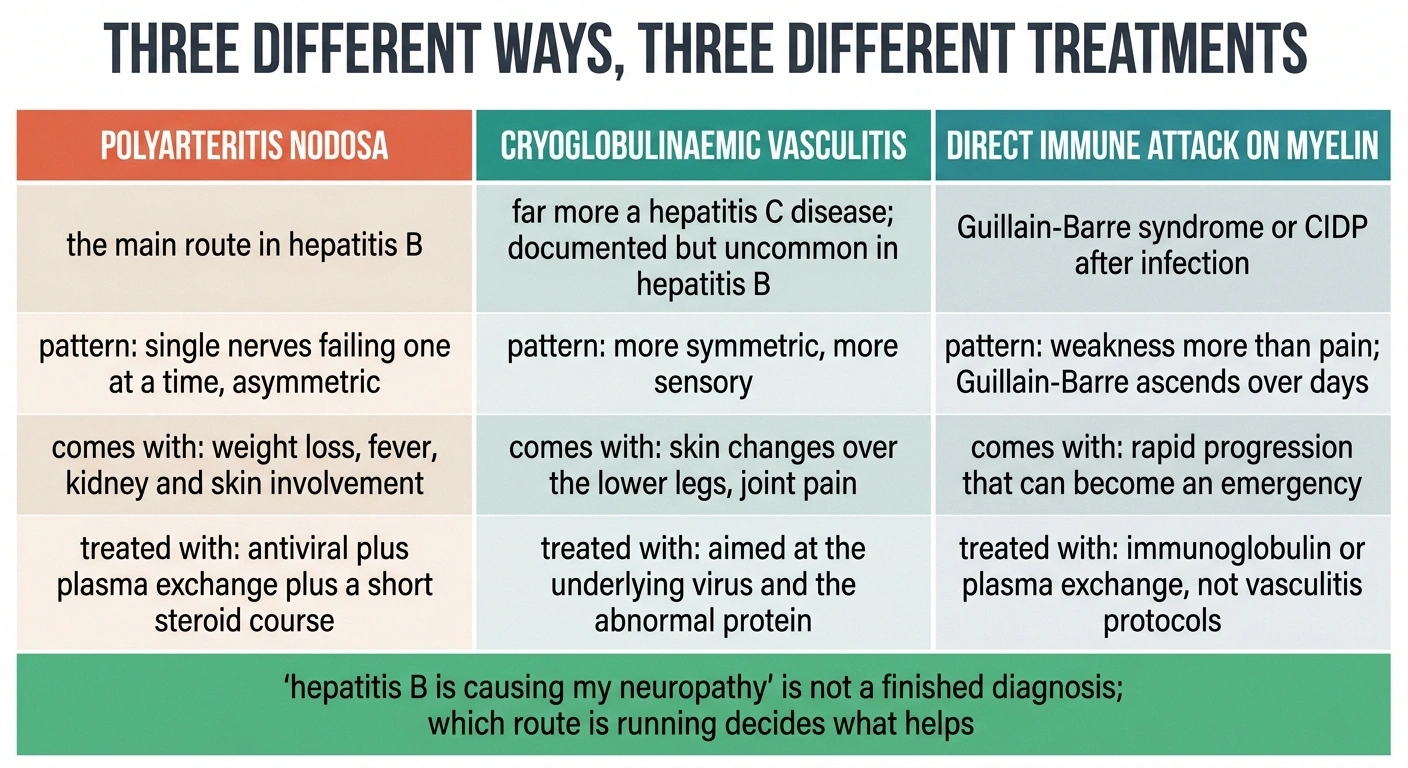
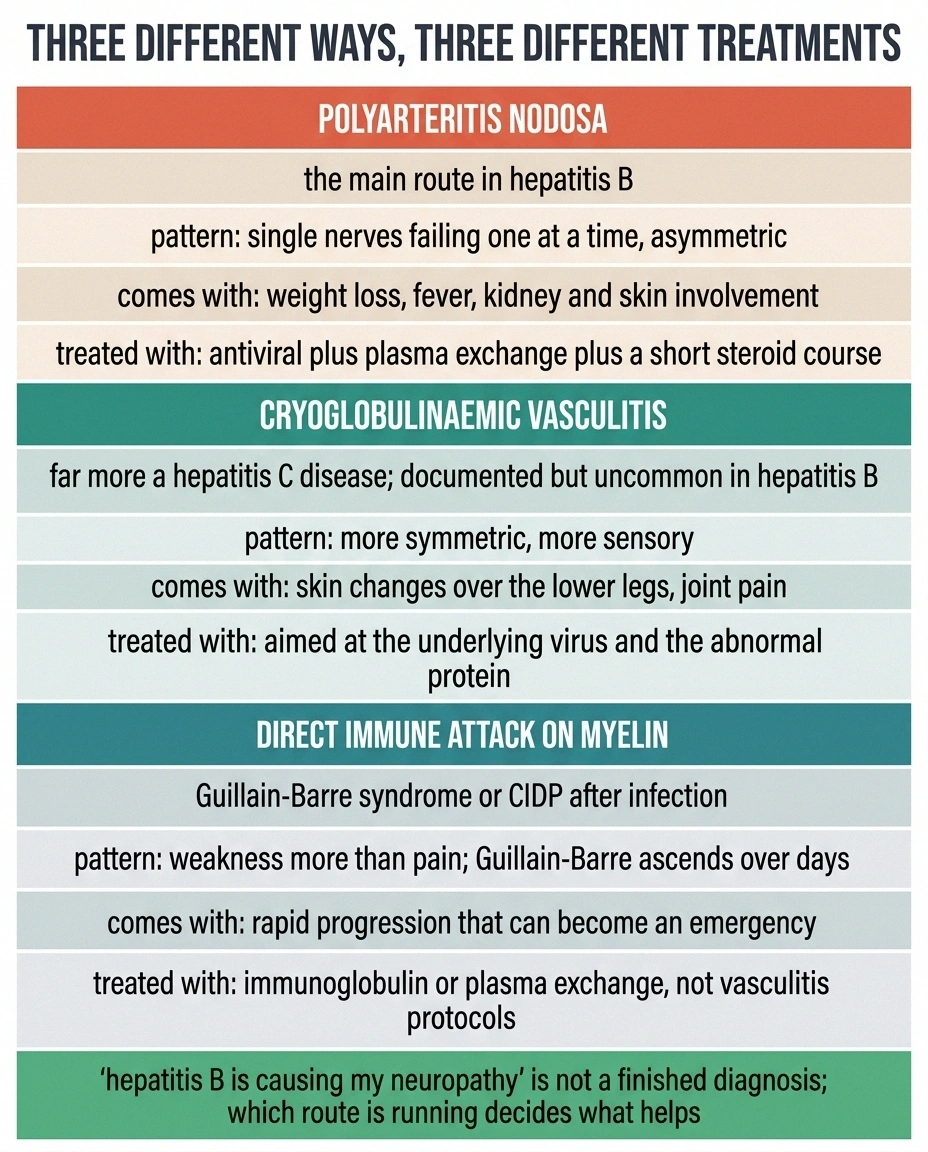
Polyarteritis nodosa is the main event, but it is not the only way hepatitis B reaches nerve tissue, and the alternatives get confused with it constantly.
Cryoglobulins are abnormal proteins that clump together in cold temperatures and dissolve again when warmed. When they clump inside small vessels they cause their own vasculitis, and that vasculitis causes its own neuropathy, usually more symmetric and more sensory than the PAN pattern, often with skin changes over the lower legs.
Here is the part that matters for anyone reading about their own case: cryoglobulinaemia is overwhelmingly a hepatitis C disease, not a hepatitis B disease. If you have hepatitis B and you have read about cryoglobulinaemic vasculitis and become alarmed, the association you were reading about probably belongs to the other virus. Hepatitis B can cause it, and documented cases exist, including in people carrying both viruses at once. It is simply far less common. The two conditions also overlap clinically enough that they get mistaken for each other, sharing joint pain, skin lesions, abdominal symptoms and kidney involvement.
A third route is a direct immune-mediated attack on nerve tissue without vessel inflammation as the middle step. Guillain-Barré syndrome and chronic inflammatory demyelinating polyneuropathy have both been reported following hepatitis B infection. These are antibody and immune-cell attacks on the myelin sheath itself, they produce weakness more than pain, and they are treated completely differently from vasculitis. Guillain-Barré in particular is a rapidly ascending weakness that becomes an emergency within days.
The practical consequence of having several possible routes is that “hepatitis B is causing my neuropathy” is not a finished diagnosis. Which mechanism is running determines what treatment helps, and nerve biopsy is sometimes the only way to settle it definitively.
What Testing Looks Like When Hepatitis B Is in the Picture

Evaluation runs on two tracks at once, and both need to happen. One track establishes what your virus is doing. The other establishes what your nerves are doing and why.
What each result changes, and what it does not
- HBV DNA viral load and e antigen
- Active replication is the setting vasculitis arises in. A high load raises concern; a suppressed load lowers it but does not eliminate it, since vasculitic neuropathy has been documented in an inactive carrier.
- Sedimentation rate and C-reactive protein
- Usually markedly elevated in active vasculitis. Normal values alongside a new stepwise neuropathy are a genuine argument against this diagnosis and should prompt a search for another cause.
- ANCA antibodies
- Classical polyarteritis nodosa is characteristically ANCA negative. A negative result does not clear you. It separates this disease from a different vasculitis family that presents similarly.
- Nerve conduction and EMG
- Shows axon loss in a patchy, asymmetric distribution, frequently more extensive than symptoms suggest. Maps which nerves are involved and rules out a demyelinating pattern.
- Sural nerve biopsy
- The one test that proves rather than infers. It leaves a permanent numb patch on the outer foot, which is why it is reserved for when the treatment being weighed carries real risk of its own.
On the viral side, the work-up covers surface antigen and e antigen status, HBV DNA viral load, and liver enzymes. These numbers do more than confirm infection. Active replication with high viral load and a positive e antigen is the setting in which vasculitis arises, so the viral profile is genuinely part of the neurological assessment rather than a separate concern belonging to a different doctor.
On the inflammatory side, sedimentation rate and C-reactive protein are usually markedly elevated in active vasculitis, and normal values in someone with a new stepwise neuropathy are a real argument against this diagnosis. Complement levels, cryoglobulins, and the ANCA antibodies are usually checked as well. That last one trips people up: classical polyarteritis nodosa is characteristically ANCA negative, so a negative ANCA does not clear you. It helps sort PAN from a different family of vasculitis with a similar presentation.
Nerve conduction studies and electromyography map which nerves are affected and whether the injury is to the axon or the insulation. Vasculitic neuropathy is an axon-loss pattern, asymmetric, patchy, and often more severe than the person's symptoms suggest.
Imaging of the abdominal blood vessels can show the small aneurysms that give polyarteritis nodosa its name, and finding them is strong evidence.
The definitive test is a nerve biopsy, usually of the sural nerve at the ankle, sometimes with a small piece of adjacent muscle. It is not a trivial procedure and it leaves a permanent numb patch on the outer foot. It is done because seeing inflammatory cells in the wall of a nerve's blood vessel, with a closed vessel and dying nerve fibres downstream, is proof rather than inference. When the treatment being considered carries real risk, proof is worth the cost.
Treating the Virus and the Vasculitis Together
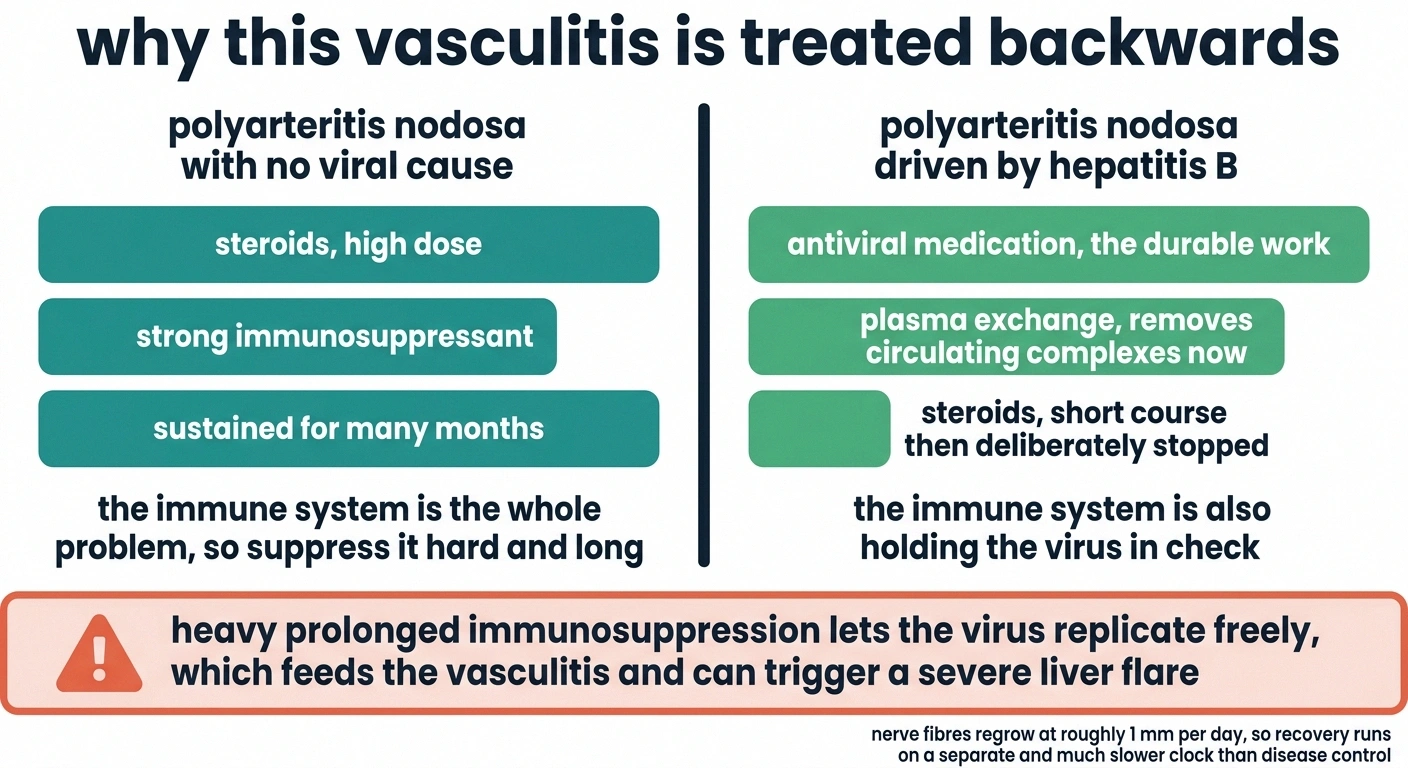
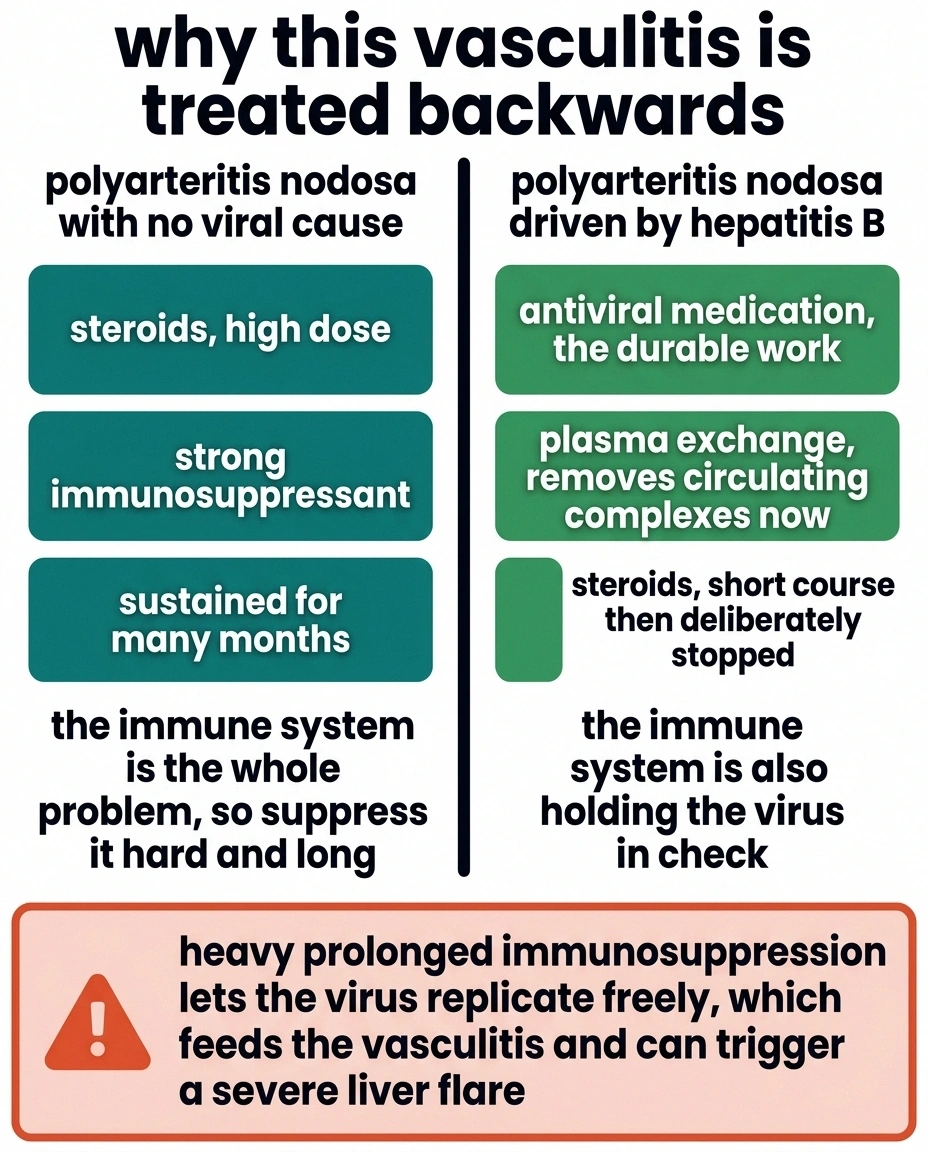
This is where hepatitis B associated vasculitis diverges from almost everything else in rheumatology, and the logic is worth following because it explains treatment decisions that otherwise look strange.
Ordinary polyarteritis nodosa without a viral cause is treated by suppressing the immune system hard and for a long time: steroids plus a strong immunosuppressant, sustained over months. That approach works because the immune system is the problem.
When hepatitis B is driving the vasculitis, the immune system is doing something useful as well as something harmful. It is holding the virus in check. Suppress it heavily and for a long time and the virus replicates freely, viral protein floods the circulation, more immune complexes form, and the vasculitis you were trying to treat gets more fuel. Long-course immunosuppression can also reactivate hepatitis B into a severe flare, which is a well-recognised danger with these medications generally.
So the strategy inverts. Antiviral medication does the durable work, cutting the production of viral antigen at the source. Plasma exchange physically removes the immune complexes already circulating, giving fast relief while the antiviral takes hold. Steroids are used briefly at the start to control the acute inflammation, then withdrawn deliberately rather than tapered slowly over many months. Short and sharp, not long and heavy.
Response to this combination can be very good, including in the neuropathy. Intravenous immunoglobulin has also been used successfully in cases of hepatitis B related vasculitic neuropathy where the standard approach was unsuitable.
Nerve recovery, when it comes, is slow. Damaged axons regrow at roughly a millimetre a day under good conditions, which is a useful number to hold onto: a nerve injured at the knee has a very long way to travel to reach the foot. Improvement over a year or more is normal. Some deficits do not come back, particularly from the nerves hit earliest and hardest. Stopping the disease is a separate achievement from reversing what it already did, and the first one is what treatment can reliably deliver.
Do Hepatitis B Medications Cause Neuropathy?

This question deserves a direct answer, because a lot of people arrive here having decided their pills are the problem and are considering stopping them.
Nerve risk by medication, ranked honestly
The larger risk runs the other way. Stopping antiviral therapy abruptly can set off a severe hepatitis flare, and an untreated replicating infection is a bigger nerve threat than any drug on this list. Raise the suspicion before changing the dose, not after.
For the oral antivirals used in chronic hepatitis B today, the answer is essentially no. Entecavir's common adverse effects are headache, fatigue, dizziness and nausea. Peripheral neuropathy is not an established effect. A single case report of severe polyneuropathy after entecavir exists in the literature, and the authors who published it framed it as a caution to keep in mind at high dose over long duration or in someone who already has risk factors for nerve damage. One case report is a reason for awareness, not a reason to stop a medication that is protecting your liver.
Tenofovir's recognised problems are elsewhere: kidney function and bone density, with low phosphate and reduced bone mineral density the effects to watch. These are more prominent in HIV treatment than in hepatitis B, and the newer formulation was developed specifically to reduce them. Neither is a nerve issue.
Interferon is the genuine exception. Peripheral neuropathy is a recognised risk with interferon-based regimens, and the risk rises meaningfully in combination therapy. If your nerve symptoms started during an interferon course, that connection is real and worth raising promptly. Most people on modern hepatitis B treatment are not on interferon.
Worth naming separately: an untreated, actively replicating hepatitis B infection is a far larger nerve risk than any of these medications. Stopping antiviral therapy on your own is also dangerous for a different reason entirely, because abrupt withdrawal can trigger a severe hepatitis flare. If you suspect your medication is contributing to your symptoms, that is a conversation to have before changing anything, not after.
Living With the Nerve Damage That Remains

Once the vasculitis is controlled, what is left is ordinary nerve damage, and it responds to the ordinary approaches.
Why recovery takes as long as it does
A regrowing nerve fibre advances at roughly one millimetre a day under favourable conditions. That single number explains most of what people are told about waiting, so it is worth doing the arithmetic once rather than asking repeatedly whether progress has stalled.
~2 months
wrist to fingertips, about 60 mm
~12 months
knee to toes, roughly 350 mm
Not all
fibres cut off longest may never reconnect
Judge progress in three-month blocks rather than week to week. Ask for a repeat strength and sensation exam at fixed intervals so the comparison rests on a record instead of memory.
Pain from injured nerves does not respond well to standard painkillers, and the medications that do work are ones borrowed from other conditions. Gabapentin and pregabalin calm overactive nerve signalling; duloxetine works through a different pathway in the spinal cord. None of them repair anything, and expecting them to is a common source of disappointment.
Foot protection carries more weight here than in slowly progressive neuropathy, because the deficits can be dense. A foot with genuinely absent sensation cannot report a blister, a stone in a shoe, or a burn from a hot bath, and daily visual checks become the substitute for feeling. Practical routines are covered in foot care for neuropathy, and shoe selection matters more when one foot is weaker than the other.
Balance deserves specific attention. Asymmetric weakness combined with lost position sense is a fall risk profile that differs from the usual symmetric picture, because your body cannot compensate the way it does when both sides are equally affected. Targeted work on balance and fall prevention is worth starting before a fall rather than after one. If a foot drops, an ankle-foot brace changes gait immediately and prevents the trips that come from catching a toe.
The emotional load of this particular diagnosis runs high, and it is worth saying so plainly. Being told you have a rare vasculitis, a chronic viral infection, and permanent nerve damage in a compressed span of weeks is a lot, and the nerve pain itself is independently associated with low mood. Nerve pain and mental health are linked closely enough that treating one and ignoring the other rarely works.
One last piece of context that belongs in a hopeful place rather than buried: this disease is becoming rarer, and the reason is the hepatitis B vaccine. Preventing the infection prevents the vasculitis, prevents the neuropathy, and prevents the permanent deficits entirely. That is the cleanest form of nerve protection medicine has produced for any of these conditions.
Frequently Asked Questions
Can hepatitis B cause peripheral neuropathy?
Yes, but uncommonly, and almost always indirectly. The virus does not attack nerves. It can trigger a blood vessel inflammation called polyarteritis nodosa, and inflamed arteries feeding nerve trunks close off and starve the nerve tissue downstream. Most people with chronic hepatitis B never develop this complication.
How soon after infection does hepatitis B neuropathy appear?
Usually early. Hepatitis B associated polyarteritis nodosa typically develops within the first year of infection, sometimes within a few months, and it is far less likely to begin after many years of stable carriage. In some cases the nerve symptoms come first and are the reason the infection is discovered at all.
What is mononeuritis multiplex?
It is a pattern in which individual named nerves fail one at a time, in different limbs, over days to weeks, rather than both feet going numb together and gradually. Each event reflects a separate small artery closing off. It is the signature pattern of vasculitic neuropathy and warrants urgent evaluation rather than a routine appointment.
Do entecavir or tenofovir cause nerve damage?
Peripheral neuropathy is not an established side effect of either. Entecavir has one published case report, which its own authors framed as a caution rather than an expected effect. Tenofovir's recognised risks involve kidney function and bone density instead. Interferon-based treatment is the hepatitis B therapy with genuine nerve risk.
Does treating the hepatitis B fix the neuropathy?
Treating the virus stops the process that is causing ongoing damage, which is the main goal. Recovery of function is a slower and separate matter. Damaged nerve fibres regrow at roughly a millimetre per day, so meaningful improvement takes many months, and deficits from the earliest and most severe injuries may be permanent.
Why are steroids used only briefly here?
Because prolonged immune suppression lets hepatitis B replicate more freely, which increases the circulating viral protein driving the vasculitis and can trigger a severe liver flare. The standard approach pairs antiviral medication and plasma exchange with a deliberately short steroid course, rather than the long immunosuppression used for vasculitis without a viral cause.
Is cryoglobulinaemia a hepatitis B problem?
Rarely. Cryoglobulinaemic vasculitis is strongly associated with hepatitis C. Hepatitis B can cause it and documented cases exist, including in people infected with both viruses, but if you encountered this association while reading, it most likely referred to the other virus.
Can the hepatitis B vaccine prevent this kind of neuropathy?
Preventing the infection removes the cause, and the sharp decline in hepatitis B associated polyarteritis nodosa since universal vaccination and blood-supply screening began is the clearest evidence of that. It is prevention rather than treatment, and it does nothing for an infection already established.
About the Author