
A question comes up often enough in amyloidosis groups that it deserves a straight answer. Someone reads about a newer, stronger stabilizer called Attruby, asks their neurologist about it for their nerve symptoms, and gets a confusing response. Sometimes it is a flat no. Sometimes it is a longer explanation involving cardiologists and insurance. Almost never is it a simple yes.
The reason is not that the doctor is behind on the research. It is that acoramidis, sold as Attruby, was approved for the heart, and its dedicated nerve study never finished.
That single fact reorganizes the whole comparison people are trying to make. If you have transthyretin amyloidosis and your worst problems are in your feet and hands, this drug is not the one being weighed against your nerve treatment. Something else is. Here is the full picture, including the one trial where acoramidis and nerve outcomes actually do meet.
Attruby Is a Heart Drug, and the Label Says So
The US Food and Drug Administration approved acoramidis on 22 November 2024. The approved use is transthyretin amyloid cardiomyopathy, abbreviated ATTR-CM, in adults with either the hereditary or the wild-type form. The stated purpose on the label is to reduce cardiovascular death and cardiovascular hospitalization.
Acoramidis, by the label
- Approved
- 22 November 2024, FDA, for ATTR cardiomyopathy in adults with hereditary or wild-type disease
- Stated purpose on label
- Reduce cardiovascular death and cardiovascular hospitalization
- Dose
- 712 mg twice daily, oral, with or without food
- Polyneuropathy indication
- None, in any country
Insurance authorization is written against the indication line, which is why documented cardiac involvement, not symptom severity, usually decides whether this prescription goes through.
Nowhere in that indication is polyneuropathy mentioned. Not as a secondary use, not as an exploratory finding.
This matters practically, not just technically. Insurance approval is written against the indication. A prescription for acoramidis in someone whose amyloidosis is expressed mainly as neuropathy, with no cardiac involvement documented, is a prescription without a covered indication behind it. That is usually where the conversation with the neurologist stalls, and it is not a judgment about whether the drug might help.
What Acoramidis Actually Does Inside the Body
Transthyretin, usually shortened to TTR, is a protein made mostly by the liver. Its normal job is carrying thyroid hormone and vitamin A through the bloodstream. It travels as a stable group of four linked units, called a tetramer.
Amyloid disease begins when that group of four comes apart. The loose pieces misfold and clump into deposits that settle in tissue. When they settle in heart muscle, the heart stiffens. When they settle around nerves, the nerves are damaged, which is what produces amyloid neuropathy.
Stabilizers are drugs that hold the group of four together so it cannot fall apart in the first place. Acoramidis was designed to imitate a naturally occurring genetic variant, T119M, which some people carry and which appears to protect them from amyloid disease entirely. Nature had already run the experiment. The drug copies the result.
Acoramidis achieves what its developer calls near-complete stabilization, meaning 90 percent or greater. The dose is 712 milligrams taken twice daily, as tablets, with or without food.
That number, 90 percent, is the drug’s main marketing claim and the source of most of the confusion that follows. It is a measurement of protein chemistry in a test tube and in the blood. It is not a measurement of anything happening in a nerve.
The Nerve Study That Was Cancelled
Acoramidis was not ignored as a nerve treatment. It was tested, briefly.
ATTRibute-PN, registered as NCT04882735, was designed as an open-label, single-arm Phase 2 study in people with transthyretin amyloid polyneuropathy. Open-label means everyone knew what they were getting. Single-arm means there was no comparison group. It was a first look, not a definitive test.
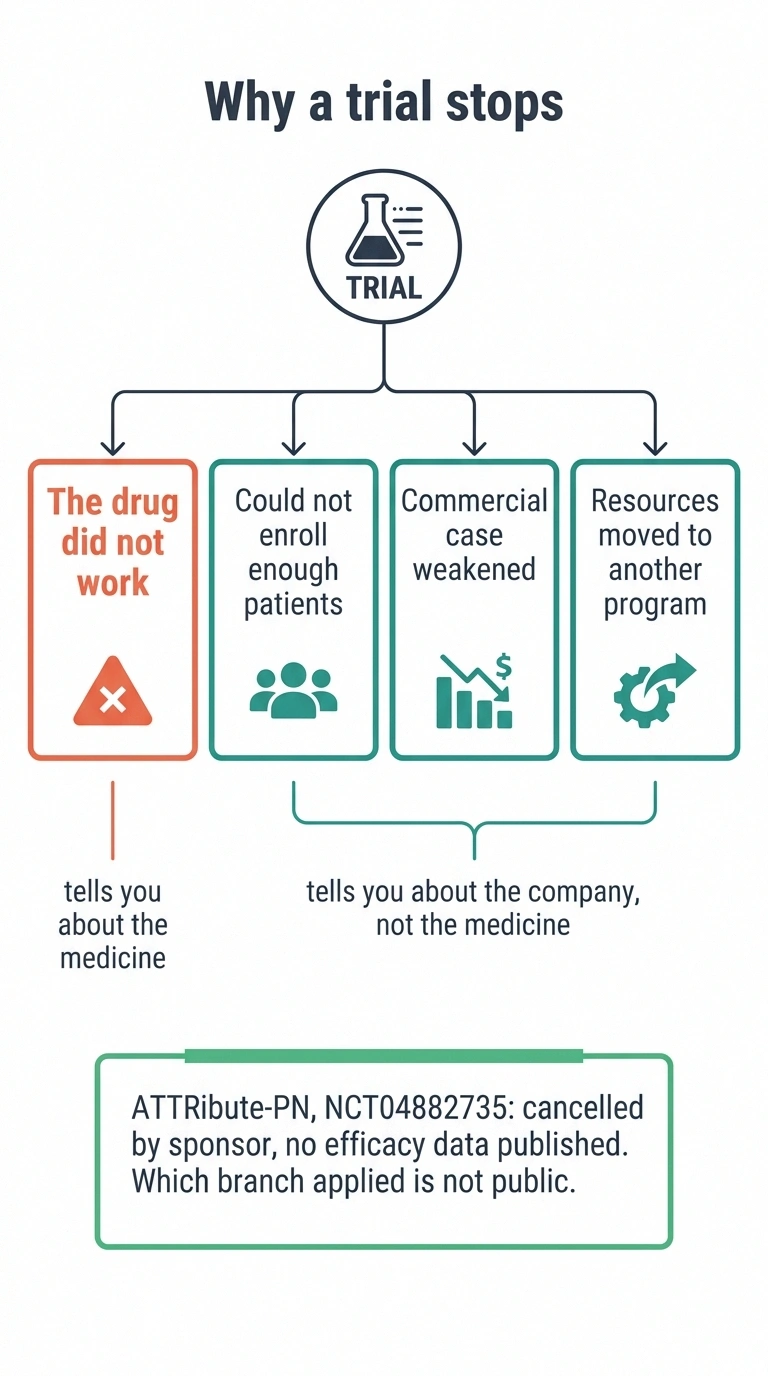
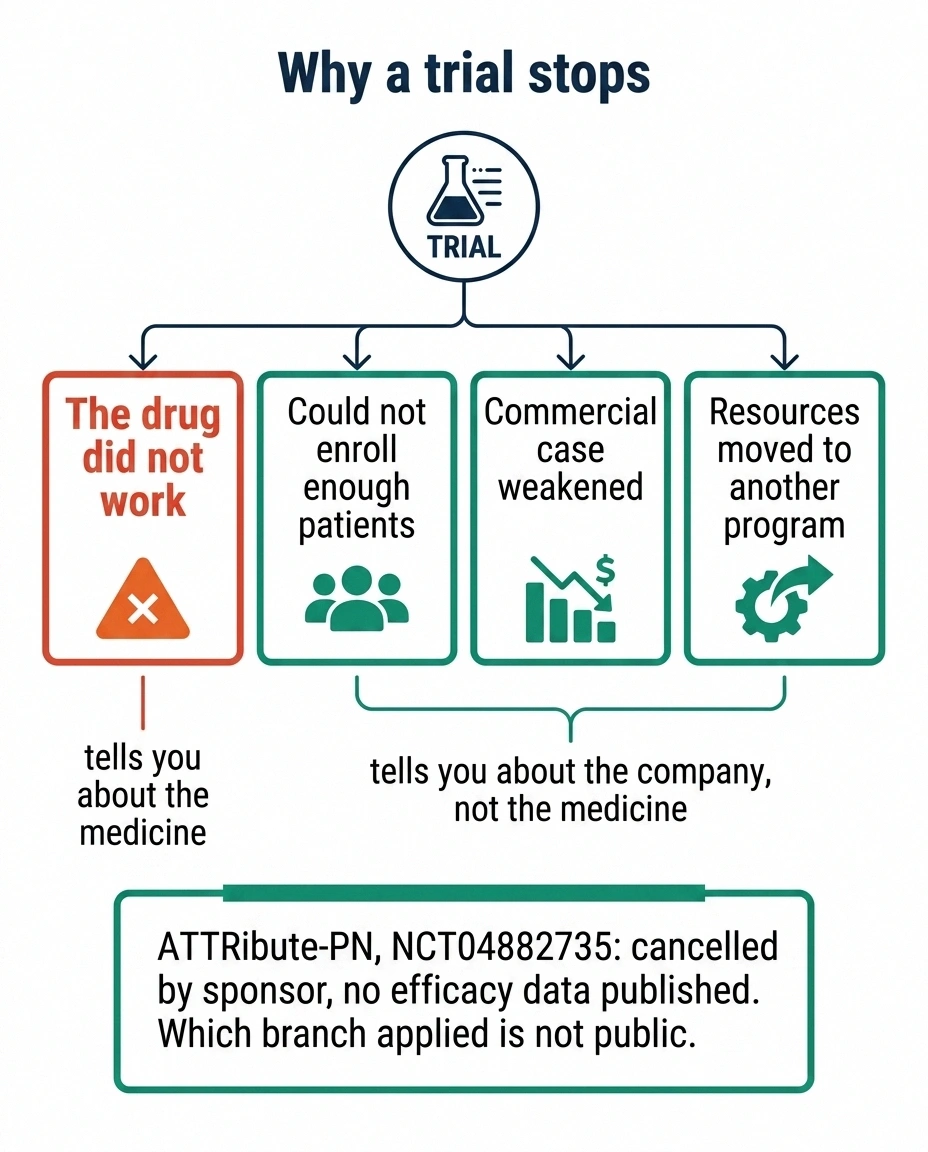
The sponsor cancelled it. The study generated no efficacy data. There is no acoramidis nerve result to cite, positive or negative, because the experiment that would have produced one was stopped before it produced anything.
People sometimes read a cancelled trial as evidence that a drug failed. That is not what happened here, and the distinction is worth holding onto because it comes up constantly in this field. A trial can end because the drug did not work, because the sponsor could not enroll enough patients, because a competitor made the commercial case weak, or because resources moved to a program with a clearer path to approval. Only the first of those tells you anything about the medicine. Nothing published indicates which of these applied to ATTRibute-PN.
The Tafamidis Situation Is Stranger Than the Comparison Suggests
Now the other half. If you have been told that tafamidis is the established stabilizer and acoramidis is the newer challenger, that is accurate for the heart and misleading for the nerves.
Same molecule, two different answers depending on your address
| Drug and dose | Nerve indication | Heart indication |
|---|---|---|
| Tafamidis 20 mg (Vyndaqel) | EU since 2011, Japan since 2013, 40+ countries. Not US. | No, this is the nerve dose |
| Tafamidis 61 / 80 mg (Vyndaqel, Vyndamax) | No | US since 2019 |
| Acoramidis 712 mg (Attruby) | No, anywhere. Phase 2 nerve study cancelled. | US since November 2024 |
A reader in Portugal and a reader in Ohio with identical stage 1 ATTR polyneuropathy have different options from the same molecule. That gap is regulatory filing history, not medicine.
Tafamidis exists in two dose forms with two separate regulatory histories.
Vyndaqel at 20 milligrams was approved in the European Union in 2011 specifically for transthyretin amyloid polyneuropathy, in adults with stage 1 symptomatic disease, to delay peripheral neurologic impairment. Japan followed in September 2013. That indication now exists in more than 40 countries.
The United States is not one of them. The FDA approved tafamidis in 2019, but only for cardiomyopathy, at the higher doses sold as Vyndaqel 61 mg and Vyndamax 80 mg.
So a person with stage 1 ATTR polyneuropathy in Lisbon has had an approved oral stabilizer for their nerves since 2011. A person with the identical disease in Ohio does not, and never has. The drug is the same molecule. The regulatory geography is different because the sponsors filed different applications in different markets at different times.
This is the piece that makes the acoramidis-versus-tafamidis question incoherent for a nerve-focused reader. In the country where most of this site’s readers live, only one of those two drugs has ever been approved for nerves, and it is not available at the nerve dose.
What the Head-to-Head Comparison Actually Measures
There has never been a randomized trial comparing acoramidis directly against tafamidis. Every comparison you will read is indirect: separate trials placed side by side, or real-world databases matched statistically.
Here is what those comparisons contain.
The acoramidis Phase 3 trial, ATTRibute-CM, enrolled 632 people and ran 30 months. It showed roughly a 42 percent relative reduction in a combined measure of all-cause death and cardiovascular hospitalization, about a 50 percent reduction in how often people were hospitalized for cardiovascular reasons, and about a 39.6 meter advantage on the six-minute walk test compared with placebo. An open-label extension later reported a significant reduction in cardiovascular mortality through month 42.
Tafamidis has its own Phase 3 record from the ATTR-ACT trial, with reductions in all-cause mortality and cardiovascular hospitalization of a broadly similar magnitude.
Analyses published through 2026, including propensity-matched real-world comparisons and network meta-analyses, have suggested acoramidis may hold a modest edge on some cardiovascular endpoints. One matched analysis reported a 37 percent reduction in combined cardiovascular events at six months and a 43 percent reduction in the need to intensify diuretics.
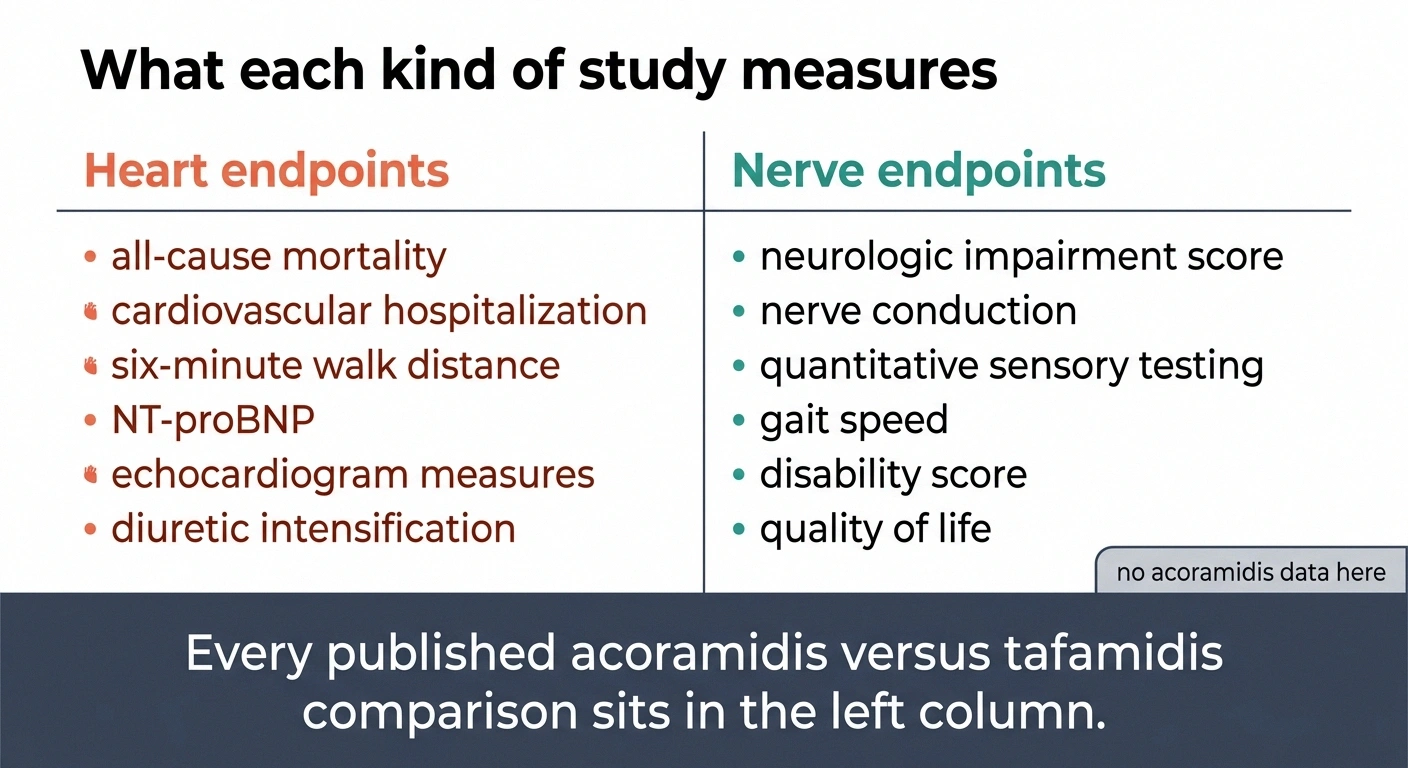
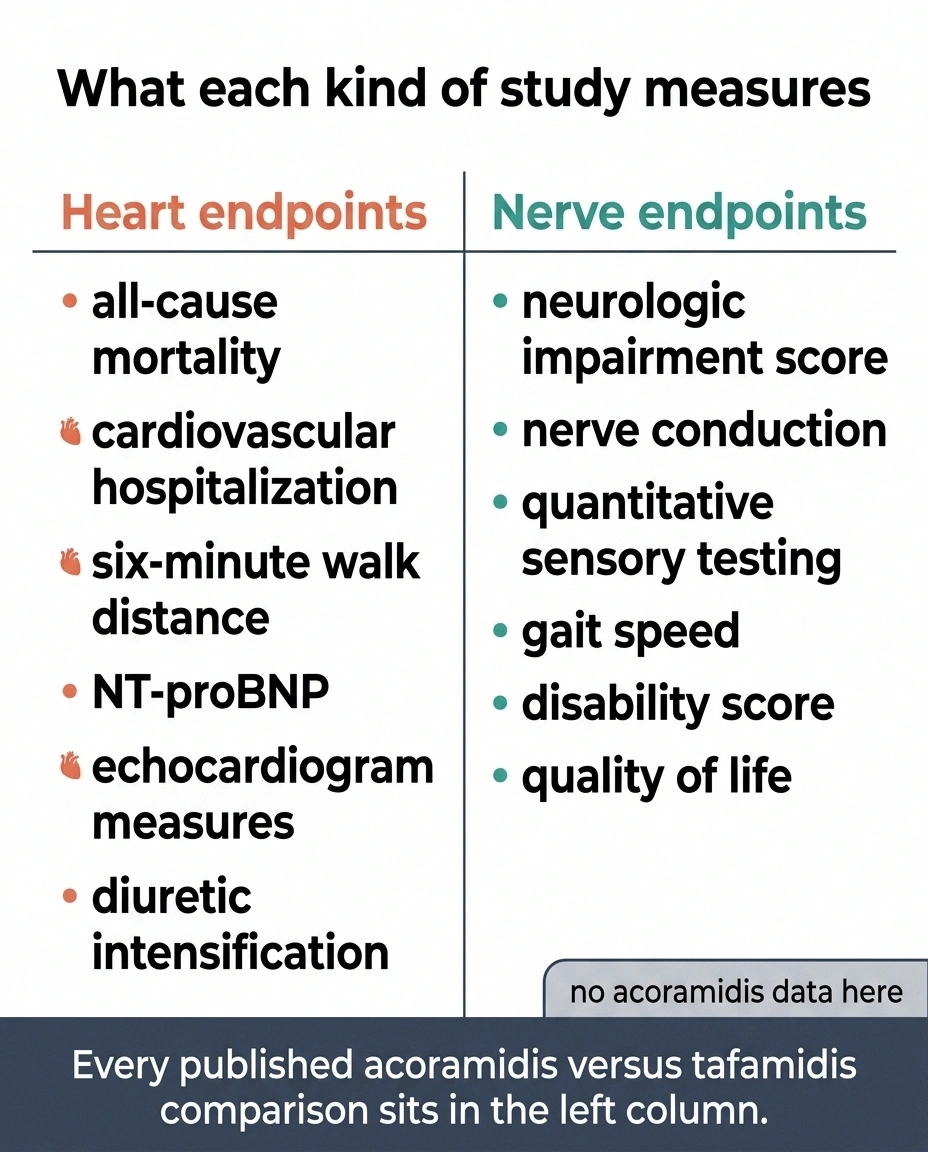
Every number in the preceding four paragraphs is cardiac. Hospitalization, mortality, walk distance, diuretics. Not one of them measures sensation, strength, balance, or autonomic function.
Real-world comparisons also carry a specific distortion here. Acoramidis arrived years after tafamidis, into a treatment environment where ATTR is diagnosed earlier and managed more aggressively. People starting acoramidis in 2025 are, on average, at a different disease stage than people who started tafamidis in 2020. Statistical matching narrows that gap. It does not close it.
What Does Treat the Nerve Side of ATTR

The drugs that carry US approval for ATTR polyneuropathy are not stabilizers at all. They belong to a different class, built on a different idea.
Two ways to lower the amount of misfolding protein
Both mechanisms are legitimate. In the US they simply were not tested in the same organ.
Stabilizers
Hold the four-unit protein together so it cannot come apart and misfold. Oral, daily.
Acoramidis, tafamidis
US lane: the heart
Silencers
Reduce how much protein the liver makes at all. Injection or infusion, weeks to months apart.
Patisiran, vutrisiran, eplontersen
US lane: the nerves
Stabilizers hold the existing protein together. Silencers reduce how much of it the liver makes in the first place. Less TTR in circulation means less raw material available to misfold, regardless of how stable the remaining protein is.
The silencer class includes patisiran, vutrisiran, and eplontersen. These are the agents that have carried polyneuropathy indications in the United States, and the ones a neurologist is actually weighing when nerve symptoms dominate. A newer approach, gene editing, is represented by nexiguran ziclumeran, which aims to switch off TTR production permanently rather than suppress it on a schedule.
So the landscape divides along an unexpected line. In the US, stabilizers took the heart and silencers took the nerves. That split is a product of which trials each company chose to run and where they chose to file, not a law of biology. Both mechanisms lower the amount of misfolding protein available. They simply were not tested in the same organs.
ACT-EARLY: Where Acoramidis and Nerves Finally Meet
There is one active program in which acoramidis is being evaluated against a polyneuropathy outcome, and it is the most interesting trial in this whole story.
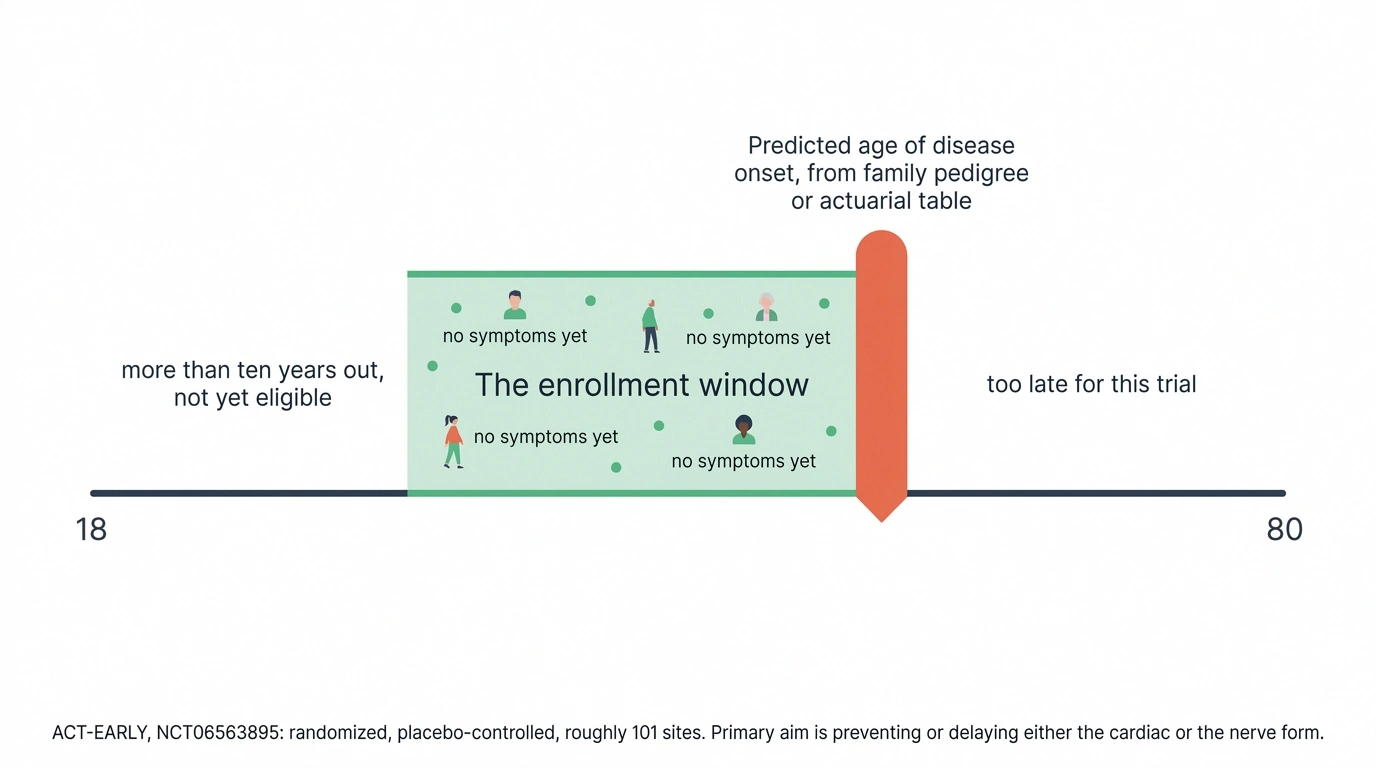
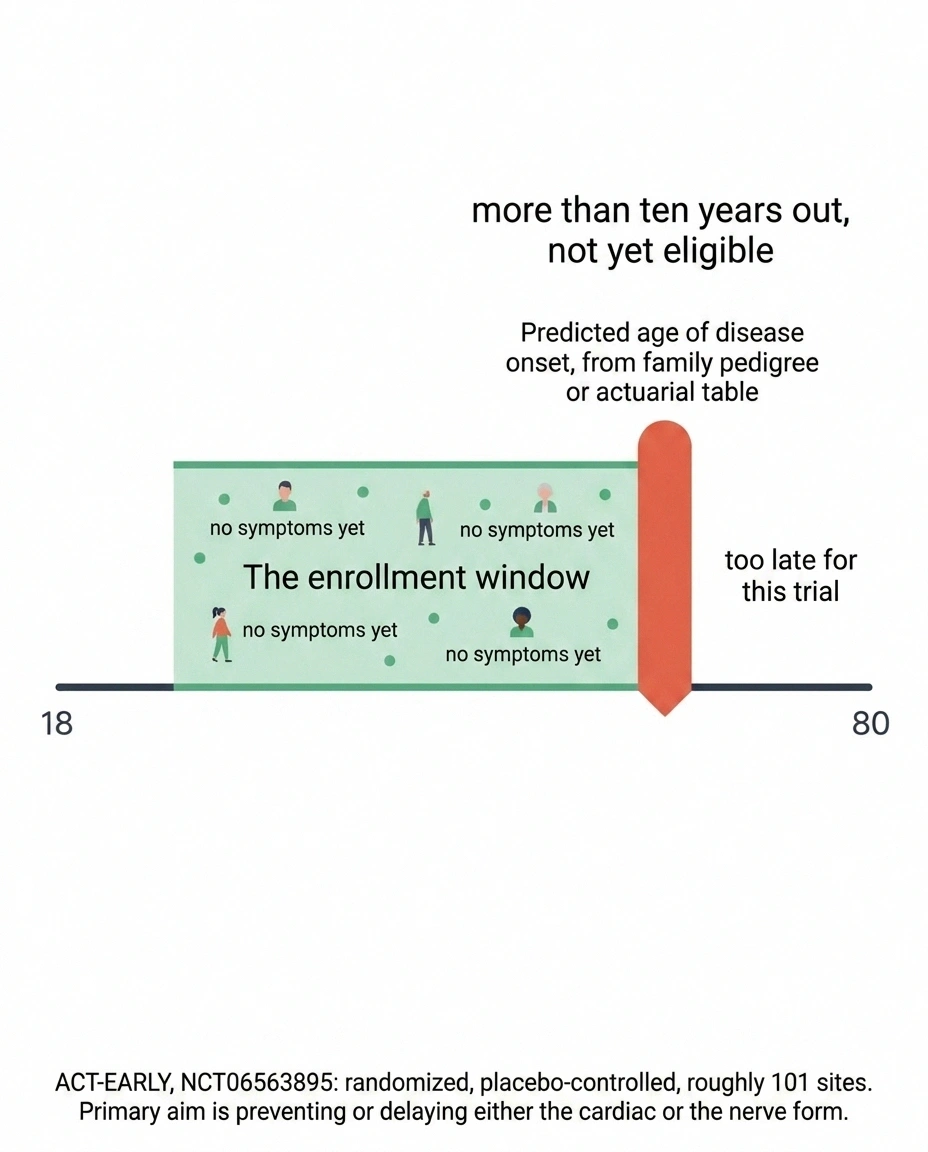
ACT-EARLY, registered as NCT06563895, is a randomized, double-blind, placebo-controlled study of acoramidis in people who carry a disease-causing TTR gene variant and have no symptoms yet. Not early disease. No disease.
The enrollment logic is unusual and worth understanding. Participants are between 18 and 75, and they must be within 10 years of their predicted age of disease onset. That prediction comes from family history, mapped through a pedigree, or from published actuarial tables when the family history is not informative enough. Researchers are deliberately enrolling people who are approaching, but have not reached, the age at which their relatives got sick.
The stated goal is to prevent or delay the development of either ATTR cardiomyopathy or ATTR polyneuropathy. Both. The trial is running at roughly 101 sites and was actively recruiting through 2026.
If it succeeds, the framing of this entire article changes. Acoramidis would move from being a heart drug to being a prevention drug for a disease that attacks two organ systems, and the nerve question would be answered before symptoms ever appear. That is a genuinely different proposition, and it is a long trial by design, because you have to wait for disease that has not happened yet.
For families with a known TTR variant, this is worth raising with a genetic counselor or amyloidosis center. It is the rare situation where being asymptomatic is the qualification rather than the disqualification. Our overview of neuropathy clinical trials covers how enrollment conversations typically work.
If You Have Both Heart and Nerve Symptoms

Mixed phenotype, meaning meaningful involvement of both the heart and the peripheral nerves, is common in hereditary ATTR and it complicates every treatment decision.
In practice, care usually gets split between a cardiologist and a neurologist, and the drug choice tends to follow whichever specialist is driving. Someone with a stiff heart and mild numbness often ends up on a stabilizer through cardiology. Someone with progressive weakness and mild cardiac findings often ends up on a silencer through neurology. The same person could plausibly land in either lane depending on who saw them first.
Combination therapy, a stabilizer plus a silencer, is used at some amyloidosis centers and debated at others. The reasoning for it is that the two mechanisms act at different points, so they should be additive. The reasoning against is cost, unproven benefit, and the absence of randomized evidence. There is no trial establishing that the combination outperforms either drug alone.
The practical move is to be treated at a center that sees amyloidosis regularly, where the cardiologist and neurologist coordinate rather than prescribe past each other. Guidance on which specialists treat neuropathy is a useful starting point if you are assembling that team.
Side Effects and the Practical Details
In ATTRibute-CM, diarrhea occurred in 11.6 percent of people on acoramidis compared with 7.6 percent on placebo. Gout occurred in 10.9 percent versus 8.1 percent. Most gastrointestinal effects were mild and resolved without stopping the drug.
Sudden foot pain on this drug is not automatically your neuropathy
Gout occurred in 10.9 percent of people on acoramidis versus 8.1 percent on placebo. In a foot that already has reduced sensation and possible circulation problems, an abrupt severe pain has at least four plausible causes, and they are treated very differently.
Worth naming out loud at the visit: gout, cellulitis, a Charcot joint, an injury you did not feel happen.
Tell whoever examines the foot that you take acoramidis. That one sentence moves gout up the list, and a serum uric acid test is inexpensive.
The gout signal deserves a note because it is easy to dismiss. A gout flare in the foot of someone who already has neuropathy is a diagnostic problem. Sudden severe foot pain in a person with a stiff heart, reduced sensation, and possible circulation issues has a differential that includes gout, cellulitis, a Charcot joint, and an unnoticed injury. Knowing that your medication carries a modestly increased gout risk changes what you tell the doctor evaluating that foot. Regular foot care and inspection matters more, not less, on this drug.
Twice-daily dosing is a real adherence consideration for a lifelong medication. Missing an evening dose is easier than missing a morning one, and stabilization depends on continuous presence of the drug.
Cost is substantial. Acoramidis is a specialty product distributed through limited pharmacy networks, and access typically runs through a manufacturer support program alongside insurance. Approval hinges on documented cardiomyopathy, which loops back to the first section of this article.
How to Read the Next Stabilizer Headline

ATTR is one of the most active drug development areas in neurology and cardiology right now, and press coverage will keep blurring the organs together. Three questions cut through most of it.
The three questions, run against a real result
Headline: “Acoramidis cut deaths and hospitalizations by 42 percent.”
- Which organ?
- The endpoint was a composite of all-cause death plus cardiovascular hospitalization over 30 months in ATTRibute-CM. Cardiac. No nerve measure was in it.
- Which population?
- 632 people with diagnosed ATTR cardiomyopathy, hereditary and wild-type mixed together. Not people whose disease is confined to nerves.
- Endpoint or stand-in?
- A real endpoint, and a good one. Death and hospitalization are things that happen to people, not laboratory readings. The 90 percent stabilization figure quoted alongside it is the stand-in.
- What the reader learns
- A genuinely strong cardiac result that says nothing about feet.
First, which organ was measured? If the endpoints are hospitalization, mortality, walk distance, or an echocardiogram measurement, it is a heart study. Nerve studies measure impairment scores, nerve conduction, quality of life, and gait speed.
Second, what population was studied? Hereditary and wild-type ATTR behave differently. Wild-type is largely cardiac and shows up in older adults. Hereditary can hit nerves hard and starts earlier. A result in one does not automatically transfer.
Third, is the measured outcome the thing you care about, or a stand-in for it? Percentage of protein stabilized, or percentage of protein reduced, is a laboratory number. It is a reasonable proxy, and it is not the same as walking better. Our guide to the 2026 neuropathy drug pipeline applies these questions across the field.
What to Ask at Your Next Appointment
Bring specific questions rather than a drug name. Specific questions get specific answers.
Ask whether your amyloidosis has documented cardiac involvement, and what test established it. That single answer determines which drugs are realistically available to you.
Ask whether your form is hereditary or wild-type, and whether genetic testing has been done. If it is hereditary, ask what the variant is, because variants differ in how much nerve disease they produce.
Ask what is being tracked to know whether your nerve involvement is progressing, and how often. If nothing is being tracked, that is the conversation to have first. Our guide to preparing for a neurology appointment covers how to structure this.
If you have a known family variant and no symptoms, ask about ACT-EARLY specifically, by name.
Frequently Asked Questions
Is Attruby approved for neuropathy?
No. Acoramidis, sold as Attruby, is approved in the United States only for transthyretin amyloid cardiomyopathy, meaning heart involvement. Its dedicated polyneuropathy study, ATTRibute-PN, was cancelled by the sponsor and produced no efficacy results. There is no nerve indication anywhere.
Which is better, acoramidis or tafamidis?
For the heart, the honest answer is that no randomized head-to-head trial exists. Indirect comparisons and real-world matched analyses published through 2026 have suggested acoramidis may have a modest edge on some cardiovascular endpoints, but those studies are observational and confounded by the fact that the two drugs entered practice years apart. For nerves, the question does not apply, because acoramidis has no nerve data at all.
Why is tafamidis approved for polyneuropathy in Europe but not the United States?
Vyndaqel 20 mg was approved in the EU in 2011 for stage 1 ATTR polyneuropathy and in Japan in 2013, and it now carries that indication in more than 40 countries. The FDA approved tafamidis in 2019, but only for cardiomyopathy at higher doses. The molecule is the same. The difference is which applications were filed and approved in which markets.
What actually treats ATTR polyneuropathy in the United States?
The silencer class: patisiran, vutrisiran, and eplontersen. These reduce how much transthyretin the liver produces, rather than stabilizing the protein already circulating. Gene editing approaches, including nexiguran ziclumeran, are in trials.
Can I take a stabilizer and a silencer at the same time?
Some amyloidosis centers do combine them, on the reasoning that the two mechanisms act at different points and should add up. No randomized trial has established that the combination beats either drug alone, and the cost of two specialty medications is significant. It is a center-by-center judgment call rather than a standard of care.
What are the most common side effects of acoramidis?
In the Phase 3 trial, diarrhea occurred in 11.6 percent of people taking acoramidis versus 7.6 percent on placebo, and gout occurred in 10.9 percent versus 8.1 percent. Most gastrointestinal effects were mild and did not lead to stopping the drug. The gout risk is worth flagging to whoever evaluates any sudden foot pain you develop.
What is ACT-EARLY and who qualifies?
ACT-EARLY is a randomized, placebo-controlled trial testing whether acoramidis can prevent or delay ATTR disease in people who carry a disease-causing TTR gene variant but have no symptoms yet. Participants are 18 to 75 and must be within 10 years of their predicted age of disease onset, calculated from family history or published actuarial tables. It aims at both the cardiac and the polyneuropathy forms.
Does 90 percent stabilization mean 90 percent fewer symptoms?
No. Stabilization percentage describes how much of the transthyretin protein stays in its intact four-unit form in a laboratory measurement. It is a mechanistic marker, not a clinical result. A drug can stabilize protein very effectively and still produce a modest change in how someone walks or feels, particularly if nerve damage has already accumulated.
About the Author