
The week before my first neurology appointment, I couldn't sleep. Not just because of the burning in my feet — though that was part of it — but because I had no idea what to expect. Was the doctor going to poke me with needles? Order scary tests? Tell me something I wasn't ready to hear? I showed up with a crumpled list of symptoms on a sticky note and spent most of the appointment trying to remember things I'd forgotten to write down.
If you're heading to your first neurology appointment for neuropathy, I want to save you that experience. The neurologist visit is one of the most valuable appointments you'll have in your neuropathy journey — but only if you're prepared. With the right documents, the right questions, and the right mindset, you can walk in confident and walk out with real answers.
Why the First Neurology Appointment Matters So Much
Your primary care doctor may have suspected neuropathy, but the neurologist is the specialist who will confirm it — and figure out why it's happening. That “why” matters enormously. Neuropathy from diabetes responds to different treatment than neuropathy from B12 deficiency or an autoimmune condition. Getting the cause right is the first step to treating it effectively.
The first appointment typically runs 45 to 60 minutes — significantly longer than a typical doctor visit. Your neurologist will spend much of that time building a complete picture of your nervous system, which means they'll ask detailed questions, review your history, and likely perform a physical neurological exam. The more organized you arrive, the more productive that time will be.
What to Bring to Your First Neurology Appointment
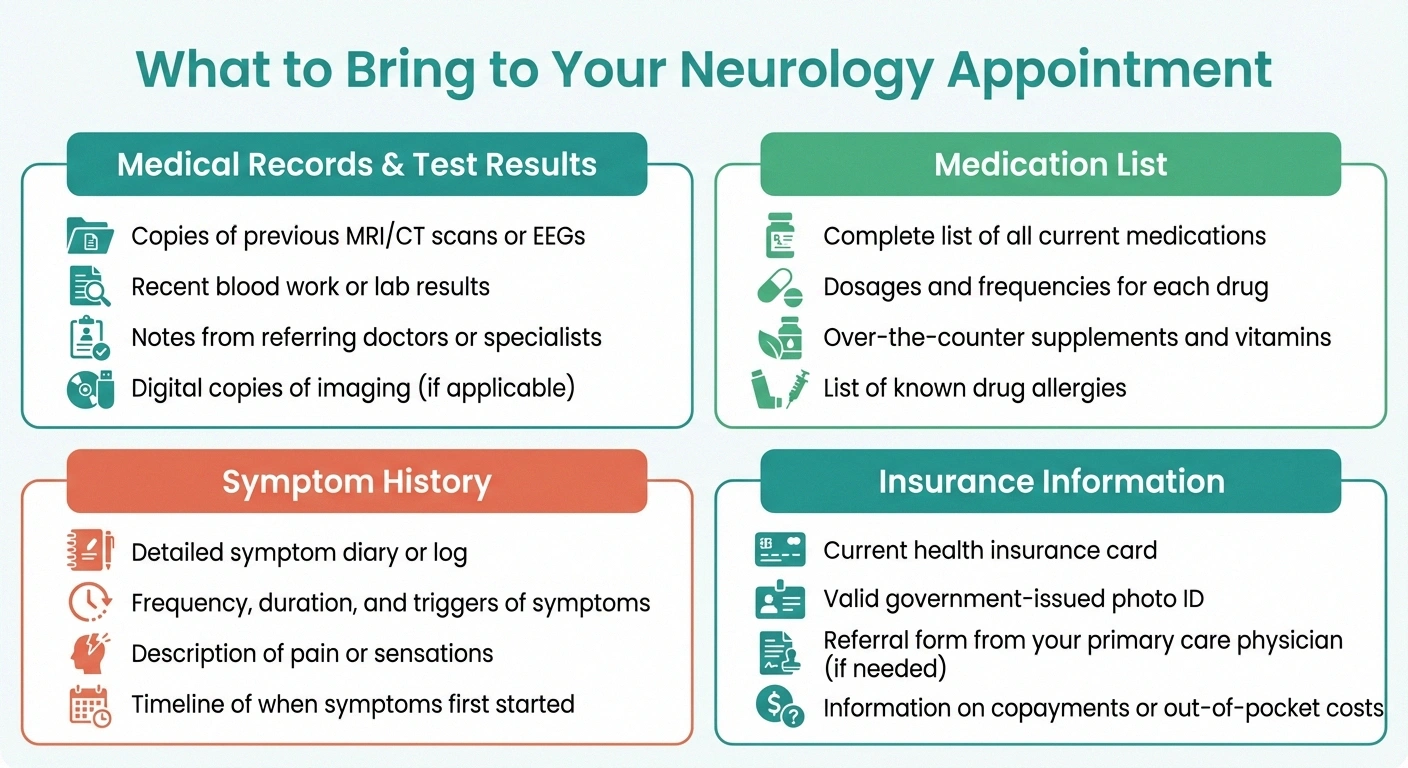
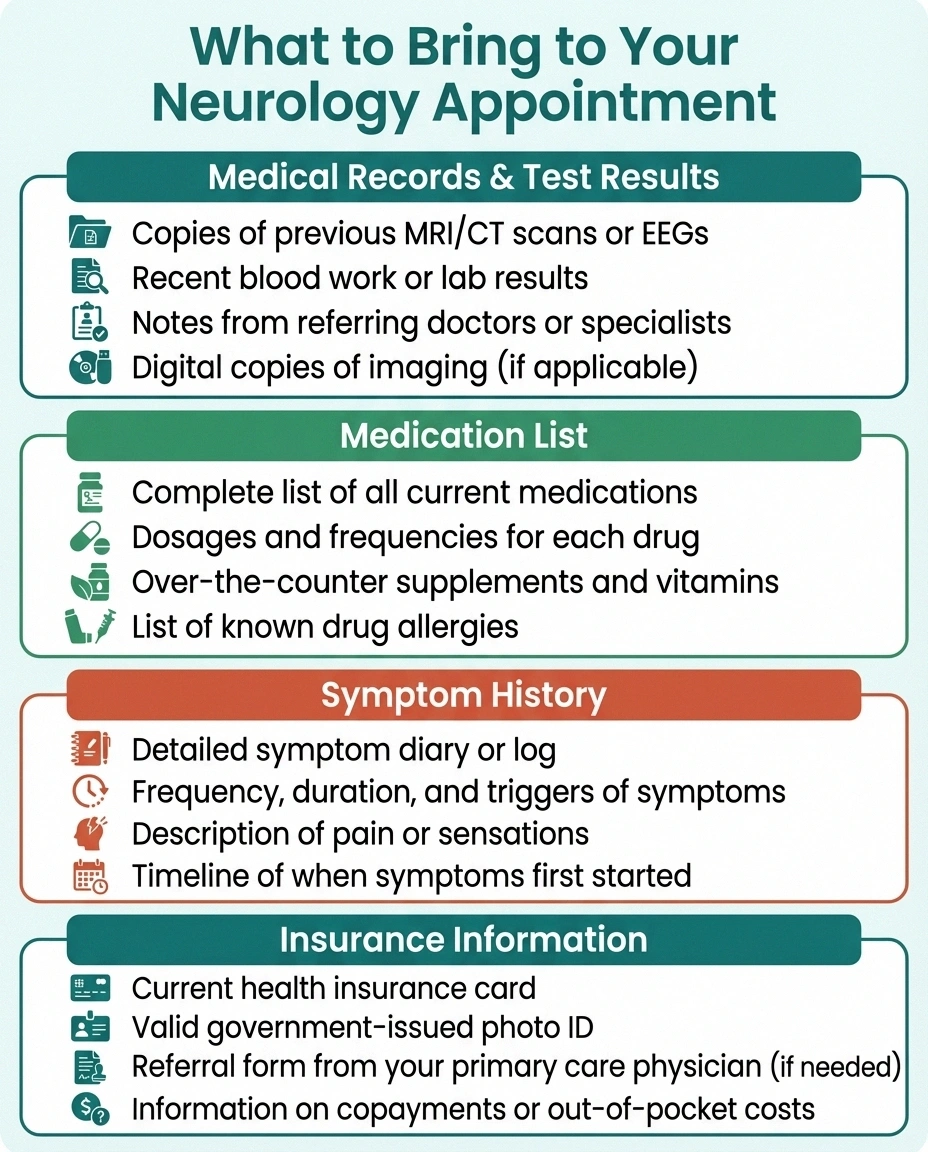
Think of your records as your nervous system's biography. Your neurologist needs to understand what's happened before they can understand what's happening now. Here's what to gather:
Medical Records and Test Results
Bring copies of any relevant test results from the past one to two years. This includes:
- Blood work — especially B12, glucose/HbA1c, thyroid function (TSH), and any autoimmune panels
- Nerve conduction studies or EMG results — if you've had them done previously
- MRI or imaging reports — spine or brain imaging if ordered by your primary care physician
- Previous specialist notes — rheumatology, endocrinology, or any specialists who've evaluated related symptoms
If you can't get actual reports in time, bring a list of the tests, where they were done, and approximate dates. Neurologists can request records, but having them in hand means your first appointment focuses on you rather than administrative catch-up.
Your Complete Medication List
Write out every medication, supplement, and vitamin you take — including dosages and how long you've been taking them. This matters more than you might think: certain medications can actually cause neuropathy, and your neurologist needs to know what you're taking before prescribing anything new. Include over-the-counter pain relievers, sleep aids, and herbal supplements.
Your Symptom History — Written Down
This is the most important thing you can bring, and most people skip it. Your neurologist will ask you to describe your symptoms in detail, but under pressure it's easy to forget half of what you've been experiencing. Before the appointment, write out:
- When symptoms started — as specifically as you can remember
- Where you feel them — feet, hands, legs, other areas
- What they feel like — burning, tingling, numbness, electric shocks, weakness, sensitivity to touch
- How they've changed — getting worse? Spreading to new areas? Fluctuating?
- What makes them better or worse — time of day, activity, temperature, elevation
- How they affect your daily life — sleep disruption, difficulty walking, reduced grip strength
If you've been using a neuropathy symptom journal, bring those notes. Even a few weeks of tracking gives the neurologist patterns that a single-day description can't capture.
Preparing Your Questions in Advance
Appointments move fast, and it's easy to forget what you wanted to ask once you're in the room. Write your top 3 to 5 questions before you go and bring them on paper. You won't always get answers to everything in the first visit, but having them written ensures you don't leave with regrets.

Prepare a clear one-minute description of your chief complaint before you walk in. The neurologist will ask “what brings you in today?” — and patients who give vague answers like “my feet hurt a bit” get less focused appointments than patients who say “I've had burning pain in both feet for eight months that's gradually spreading to my ankles, worse at night, not responding to over-the-counter NSAIDs.” Practice your version out loud before the appointment.
Questions worth asking at a first neurology appointment for neuropathy:
- What type of neuropathy do I have, and what's causing it?
- What tests do you recommend, and what will they tell us?
- Is my neuropathy likely to get worse, stay the same, or improve?
- Are any of my current medications potentially contributing to my symptoms?
- What are the treatment options at this stage?
- Are there lifestyle changes — diet, exercise, supplements — that might help?
- When should I come back, and what would prompt an earlier visit?
Don't be shy about asking follow-up questions if something isn't clear. Neurological explanations can be dense. A good neurologist will expect you to ask for clarification.
What Happens During the Neurological Exam
Many first-time patients are surprised by the neurological examination — it's not like a standard physical. It's designed to systematically assess how your nervous system is functioning. Here's what to expect:
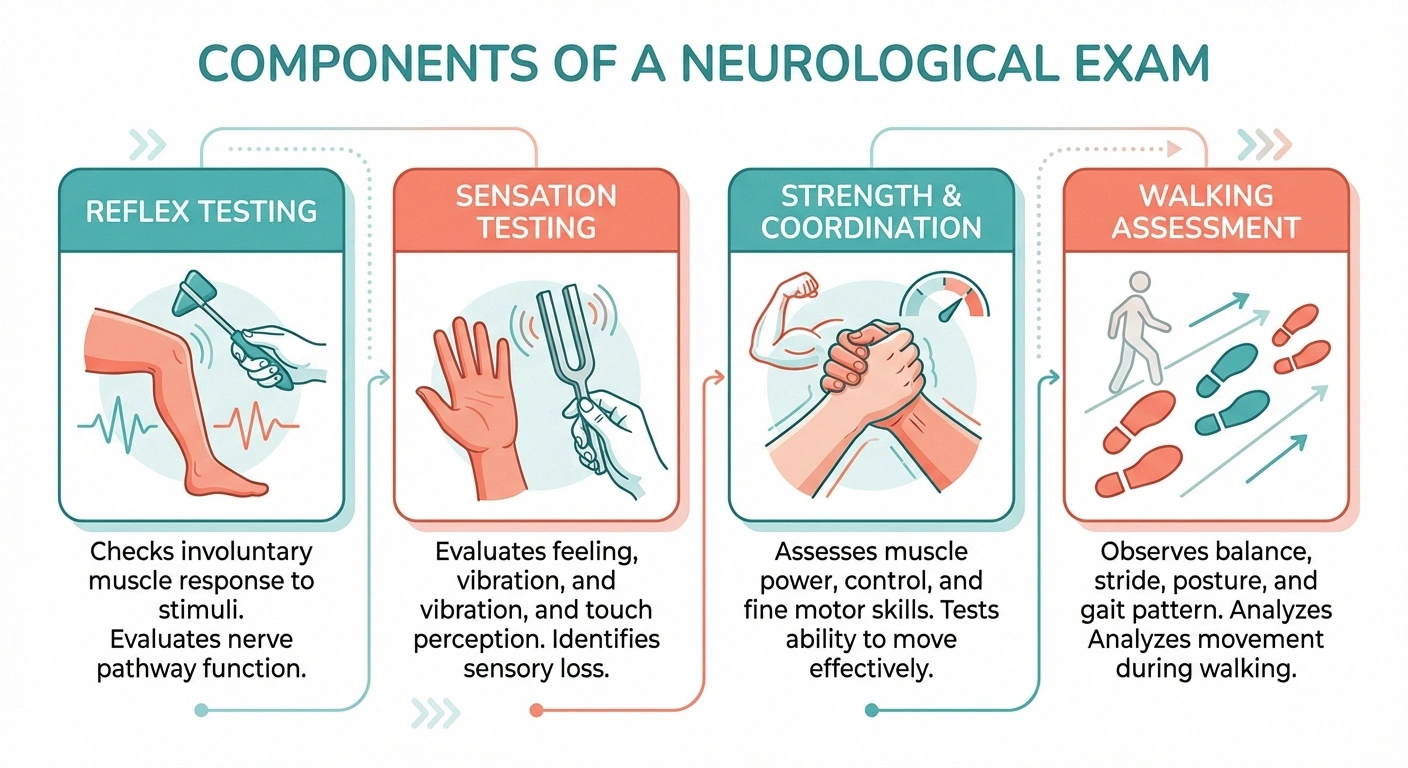
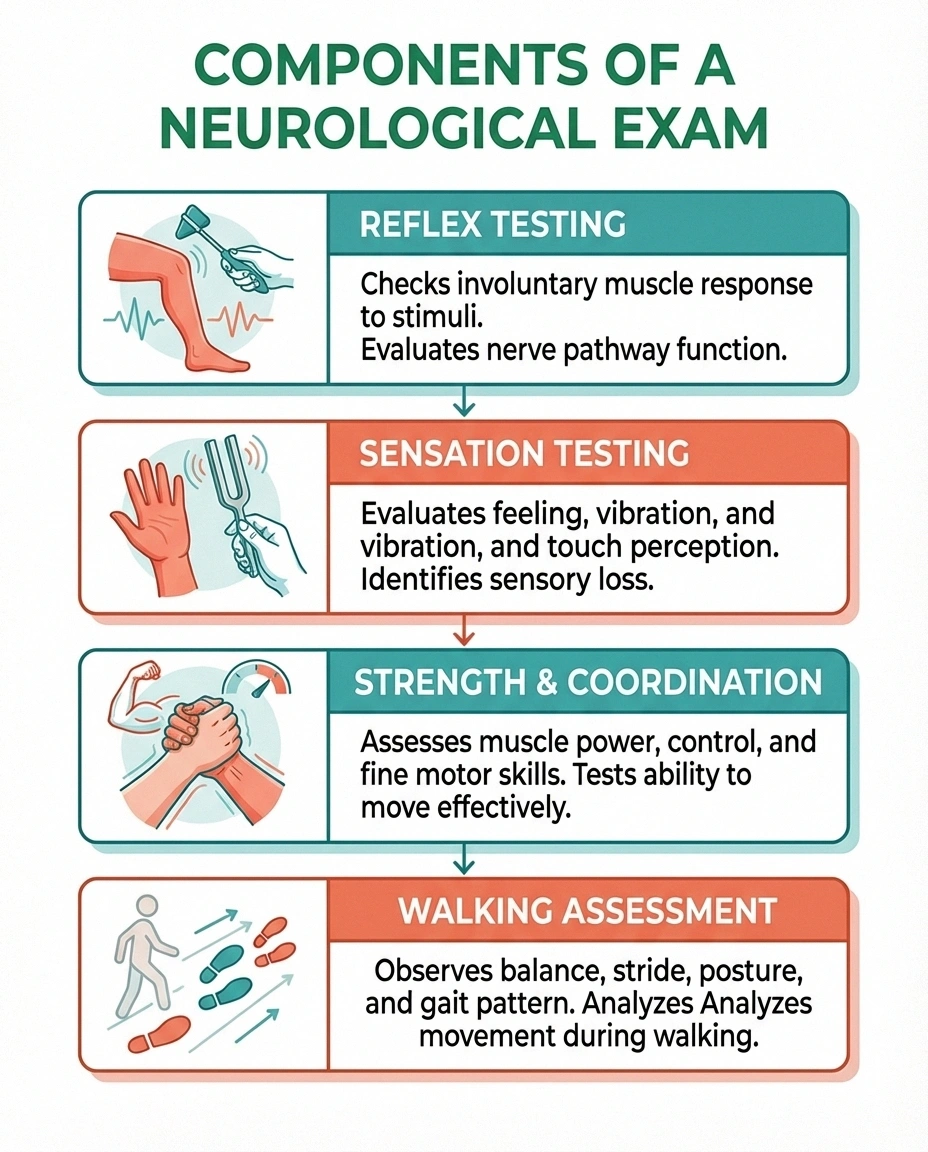
Rubber hammer taps knees and ankles. Absent or reduced ankle reflexes are a key diagnostic finding in peripheral neuropathy. Not painful.
Tuning fork, soft brush, and pin assess vibration, light touch, and pain. Maps which nerve fiber types are affected.
Pushing against resistance, grip testing, coordination movements. Assesses whether motor nerves are involved.
Walking normal, on heels, on toes, and heel-to-toe. Assesses gait, balance, and fall risk from nerve involvement.
Reflex Testing
The doctor will tap your knees, ankles, and sometimes other joints with a small rubber hammer to test deep tendon reflexes. In peripheral neuropathy, reflexes are often reduced or absent at the ankles — this is one of the key physical findings that supports a diagnosis.
Sensation Testing
Using a tuning fork, soft brush, pin, or cold object, the doctor will test whether you can feel vibration, light touch, pain, and temperature in different areas. These tests map which nerve types are affected — sensory, motor, or autonomic — and can suggest whether you have small fiber neuropathy or a more generalized peripheral neuropathy.
Strength and Coordination
The neurologist will ask you to push against resistance, grip objects, and perform coordination movements (like touching your nose with your finger). This assesses motor nerve involvement — whether neuropathy is affecting the nerves that control muscle movement, not just sensation.
Walking Assessment
You'll likely be asked to walk across the room — possibly on your heels, on your toes, and in a heel-to-toe line. Balance and gait abnormalities can indicate which parts of the nervous system are involved and help assess fall risk, which is a significant concern for people with neuropathy and balance problems.
Tests the Neurologist May Order
Based on your history and exam, the neurologist will likely order additional testing. Don't be alarmed — this is how they confirm what type of neuropathy you have and what's driving it. Common tests include:

Nerve Conduction Study (NCS) and EMG
This is the gold-standard test for peripheral neuropathy. During an NCS, small electrical pulses are applied to the skin to measure how quickly nerve signals travel. An EMG measures the electrical activity in muscles. Together, they can identify whether nerve damage is present, how severe it is, and whether it's primarily sensory or motor. Some patients find the test uncomfortable, but it's not typically painful.
Blood Work
Even if you've had bloodwork through your primary care doctor, the neurologist may order a more comprehensive panel. This often includes a complete metabolic panel, thyroid function, B vitamin levels, blood glucose and HbA1c, inflammatory markers, and sometimes genetic testing or autoimmune panels. Understanding the lab tests for neuropathy before your appointment helps you understand why each is ordered.
Skin Punch Biopsy
For suspected small fiber neuropathy — which standard NCS often misses — the neurologist may order a skin punch biopsy. A tiny sample of skin (typically from the calf and thigh) is examined under a microscope to count nerve fiber density. Reduced density confirms small fiber neuropathy.
Autonomic Testing
If you have symptoms suggesting autonomic neuropathy — dizziness upon standing, irregular heart rate, sweating abnormalities, or digestive issues — specialized autonomic function tests may be ordered. These assess the nerves controlling involuntary body functions.
Practical Tips for the Day of Your Appointment
A few logistical things that make a real difference:

- Arrive early — neurology offices often have longer intake paperwork than general practices. Give yourself 15 to 20 minutes before your scheduled time.
- Wear accessible clothing — loose pants or shorts and short sleeves make the neurological exam easier. You'll likely need your legs and arms accessible.
- Bring someone with you if possible — a family member or trusted friend can take notes, remember details you might miss, and help you process information. Many patients find they retain less than half of what was discussed when they're anxious and in the room alone.
- Don't take pain medications that morning if possible — some neurologists prefer to assess your baseline symptoms without medication masking. Ask your doctor's office when scheduling if there are any pre-appointment instructions.
- Write down what you want to say first — neurologists ask “what brings you in?” and patients often undersell their symptoms or say “it's fine, I just wanted to get it checked.” Prepare a one-minute summary of your chief complaint so you start the appointment focused.
Managing Anxiety About the Appointment
It's completely normal to feel anxious about a neurology appointment. You may be worried about what the tests will find, about hearing a difficult prognosis, or about the appointment process itself. A few things worth remembering:
Seek urgent (same-day or ER) evaluation — not a scheduled appointment weeks away — if you experience:
- Rapidly spreading weakness over hours or days
- Difficulty breathing or swallowing
- Neuropathy symptoms alongside unexplained weight loss
- Symptoms that started in both legs simultaneously and are moving upward
The neurologist is not there to deliver bad news — they're there to give you accurate news, which is a different thing. Many patients with neuropathy symptoms discover that the cause is treatable or manageable. And for those with more complex conditions, knowing what you're dealing with is always better than not knowing. Uncertainty is its own kind of suffering.
You're also allowed to ask the doctor to slow down, repeat something, or explain terminology. Medical appointments are collaborative, not one-directional. Advocate for yourself — your neurologist wants you to understand what's happening.
After the Appointment: What to Expect Next
Very few people leave their first neurology appointment with a complete diagnosis and treatment plan. It often takes 2 to 3 visits — and the results of ordered tests — before the full picture becomes clear. Here's what typically happens:

- Tests are scheduled — NCS/EMG, bloodwork, and any other ordered tests will be completed and results reviewed at a follow-up
- A working diagnosis may be provided — your neurologist might say “this is consistent with peripheral neuropathy” before confirming with tests
- Initial management may begin — depending on your symptoms, the doctor might start you on medication or refer you to physical therapy while tests are pending
- A follow-up is scheduled — usually 4 to 8 weeks out to review test results and finalize the diagnosis and treatment plan
If you're wondering whether the neurologist found something concerning or you're weighing a second opinion for neuropathy, give the process a full cycle before drawing conclusions. The first appointment is information-gathering — the treatment plan emerges from it.
When You Should See a Neurologist Sooner Rather Than Later
If you've been on the fence about making a neurology appointment, let me be direct: there are situations where waiting is a mistake. You should seek a neurologist's evaluation promptly if you're experiencing:
- Rapidly spreading numbness or weakness over days or weeks
- Neuropathy symptoms alongside unexplained weight loss
- Difficulty swallowing or breathing in combination with limb symptoms
- Symptoms starting in both legs simultaneously and moving upward
These patterns may suggest more urgent underlying causes that need prompt evaluation. If you're unsure when to see a neurologist for neuropathy, the answer in most cases is: sooner rather than later. Early diagnosis typically means more treatment options and better outcomes.
Frequently Asked Questions
How long does a first neurology appointment take?
Plan for 45 to 60 minutes, sometimes longer. Neurology appointments involve detailed history-taking, a physical examination, and discussion of next steps. Arriving prepared with your records and symptom history helps use that time efficiently.

Should I bring a list of all my medications?
Yes — this is one of the most important things you can bring. Include prescription medications, over-the-counter drugs, vitamins, and supplements with dosages. Some medications can cause or worsen neuropathy, and the neurologist needs a complete picture before prescribing anything new.
Will I get a diagnosis at my first appointment?
Possibly a preliminary one, but usually not a confirmed diagnosis. Neuropathy diagnosis often requires nerve conduction studies, bloodwork, and sometimes a skin biopsy — tests that are ordered at the first appointment and reviewed at a follow-up. Your neurologist may share an initial impression while waiting for results.
Is the neurological exam painful?
The physical exam during your neurology appointment is generally not painful. Reflex testing, sensation tests with a soft brush or tuning fork, and strength assessments are non-invasive. If an EMG or nerve conduction study is scheduled later, some patients find those mildly uncomfortable, but they are not typically described as painful.
Can I bring someone with me to my neurology appointment?
Absolutely — and it's a good idea. A companion can take notes, help you remember what was discussed, and catch details you might miss when anxious. Let the front desk know they'll be joining you, and inform the doctor at the start of the appointment.
What if I can't afford to see a neurologist?
If cost is a barrier, explore options including community health centers, teaching hospitals with neurology clinics, Medicare and Medicaid coverage for medically necessary specialist visits, and patient assistance programs. Some neurologists offer sliding scale fees. Ask your primary care doctor for referrals to lower-cost options in your area.
You're More Prepared Than You Think
Walking into that first neurology appointment feeling prepared is a form of self-advocacy — and it matters. When patients arrive organized, they get more done in less time, they leave with better information, and they build a more productive relationship with their specialist from the start.
You don't need to be an expert in neurology. You just need to show up ready to tell your story clearly and ask good questions. The rest is the doctor's job. And the sooner you have that first conversation, the sooner you'll have a clear path forward for managing your neuropathy.
For a broader look at your options, explore our guide to natural remedies for peripheral neuropathy or review what the research says about neuropathy supplements to bring up with your neurologist.
This article is for educational purposes only and does not constitute medical advice. Always consult your healthcare provider about your specific symptoms and treatment options.
About the Author