Search for how to stop taking gabapentin and look at who wrote the results. Recovery centers. Rehabilitation clinics. Addiction treatment programs. Page after page of them.
If you are taking gabapentin because your feet burn, none of that was written for you. You are not stopping a substance you misused. You are stopping a treatment that did not deliver, or that cost more in side effects than it returned in relief, or that your prescriber now wants to unwind for reasons involving your kidneys or your age or a guideline that changed. That is a completely different problem, and it has a completely different hard part.
The hard part is this: coming off these medications produces symptoms that look almost exactly like the condition they were prescribed for. Which means the most important skill in a taper is not willpower and it is not a dosing chart. It is being able to tell what you are feeling apart from what you are afraid you are feeling.
This is a taper you do with your prescriber rather than instead of one. What follows is meant to make you a better participant in that conversation, not to replace it.
Why People Actually Stop
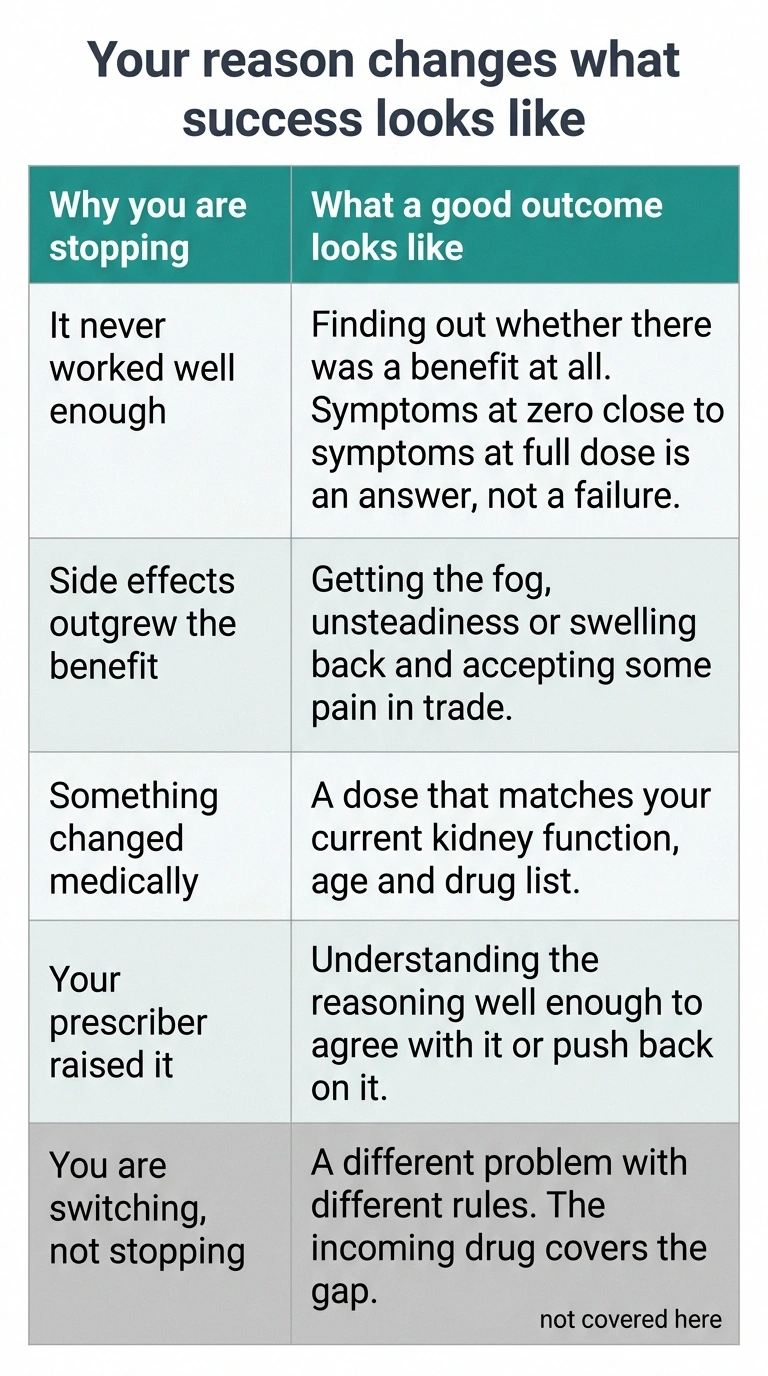
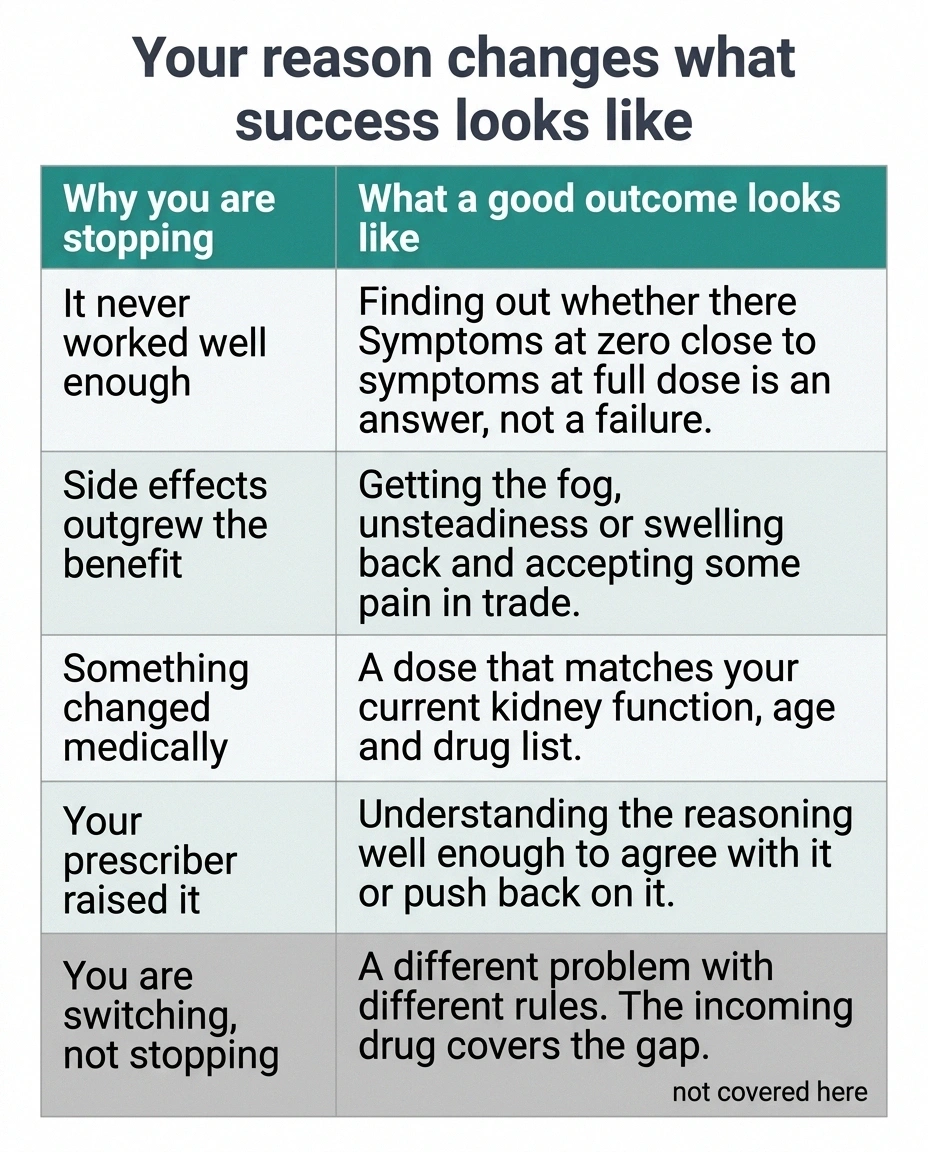
Understanding your own reason matters, because it changes what a successful taper even looks like.
It never worked well enough. The most common reason by a distance. A good many people take a nerve pain medication for years at a dose that is doing very little, because stopping felt riskier than continuing and nobody revisited it. If this is you, the goal is not to preserve a benefit. The goal is to find out whether there was one.
The side effects outgrew the benefit. Fogginess, unsteadiness, weight gain, swelling in the ankles, daytime sleepiness. These accumulate quietly, and it can take years to notice how much of your day the medication is shaping.
Something changed medically. Kidney function declines with age, and both gabapentin and pregabalin are cleared by the kidneys, so a dose that was fine at seventy can be too much at seventy-eight. A fall, a new drug that interacts, a surgery coming up.
Your prescriber raised it, not you. Deprescribing has become a much more active practice, particularly for older adults, because systematic reviews of randomized trials have not supported much off-label gabapentinoid use for pain, with harms often outweighing benefits. Being offered a taper you did not ask for is unsettling. It is also usually reasonable.
You are switching, not stopping. A different problem with different rules, because the incoming drug can cover the gap left by the outgoing one. Our guide to switching between neuropathy medications handles that case. Everything below assumes you are coming off without a direct replacement.
The Problem at the Center of Every Taper
Look at the recognized discontinuation symptoms for duloxetine: dizziness, headache, nausea, diarrhea, paresthesia, irritability, vomiting, insomnia, anxiety, sweating, fatigue.
One question, asked out loud, most days
“Does this feel like my neuropathy, or does it feel like coming down with something?”
People are far better at that comparison than at rating pain out of ten, because both experiences are already familiar. Withdrawal from these drugs has a distinctly viral quality: queasy, sweaty, wired and unwell in a general way. Your own neuropathy, whatever else it does, does not usually make you feel like you are catching something.
Paresthesia. Pins and needles. Tingling. The exact sensation many people are taking the drug to control appears on the list of symptoms produced by stopping it.
Gabapentin does something similar. Its withdrawal produces anxiety, insomnia and a rebound in pain, and poor sleep on its own measurably lowers pain tolerance the following day. So a person reducing their dose feels worse, reasonably concludes the medication was doing more than they realized, and goes back up.
Sometimes that conclusion is right. Often it is not. And the difference determines whether you spend the next five years on a drug that was never helping much.
Three features separate withdrawal from your neuropathy returning.
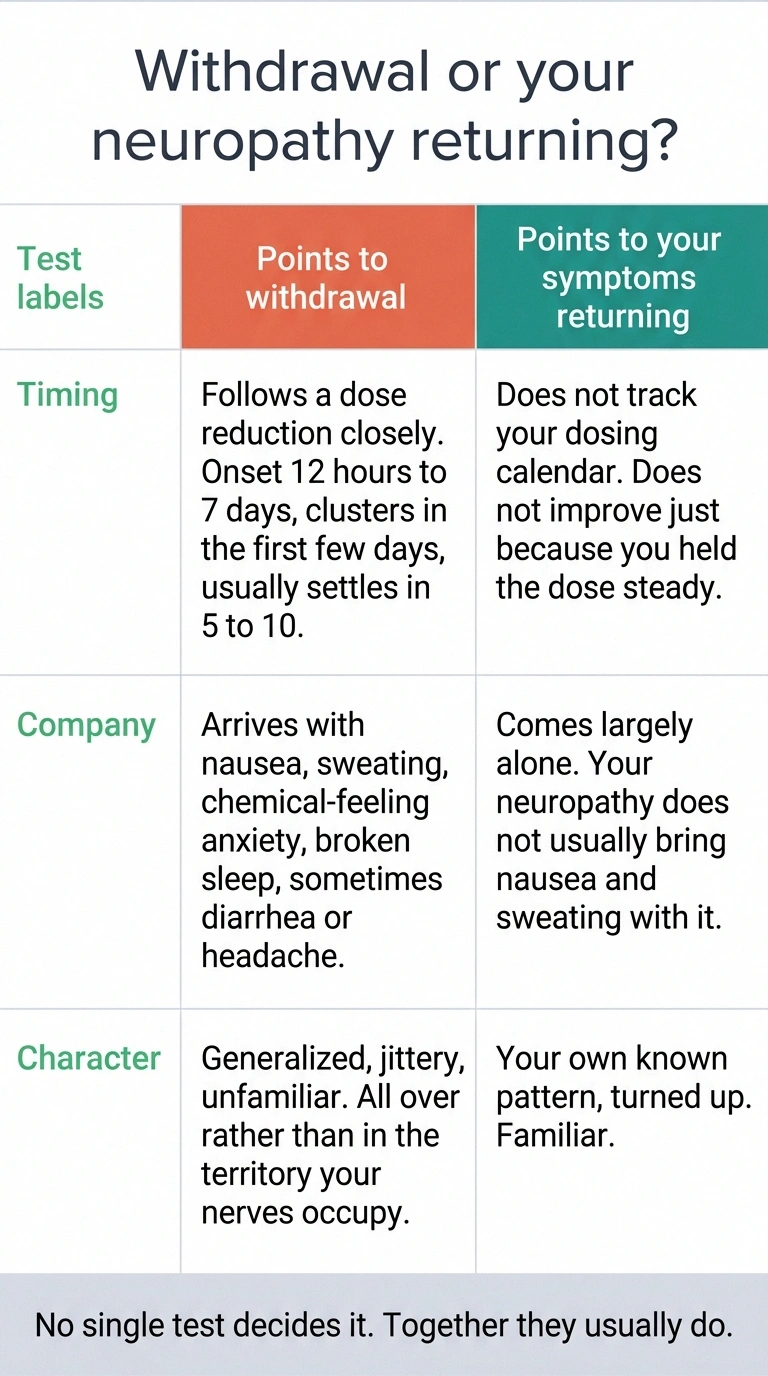
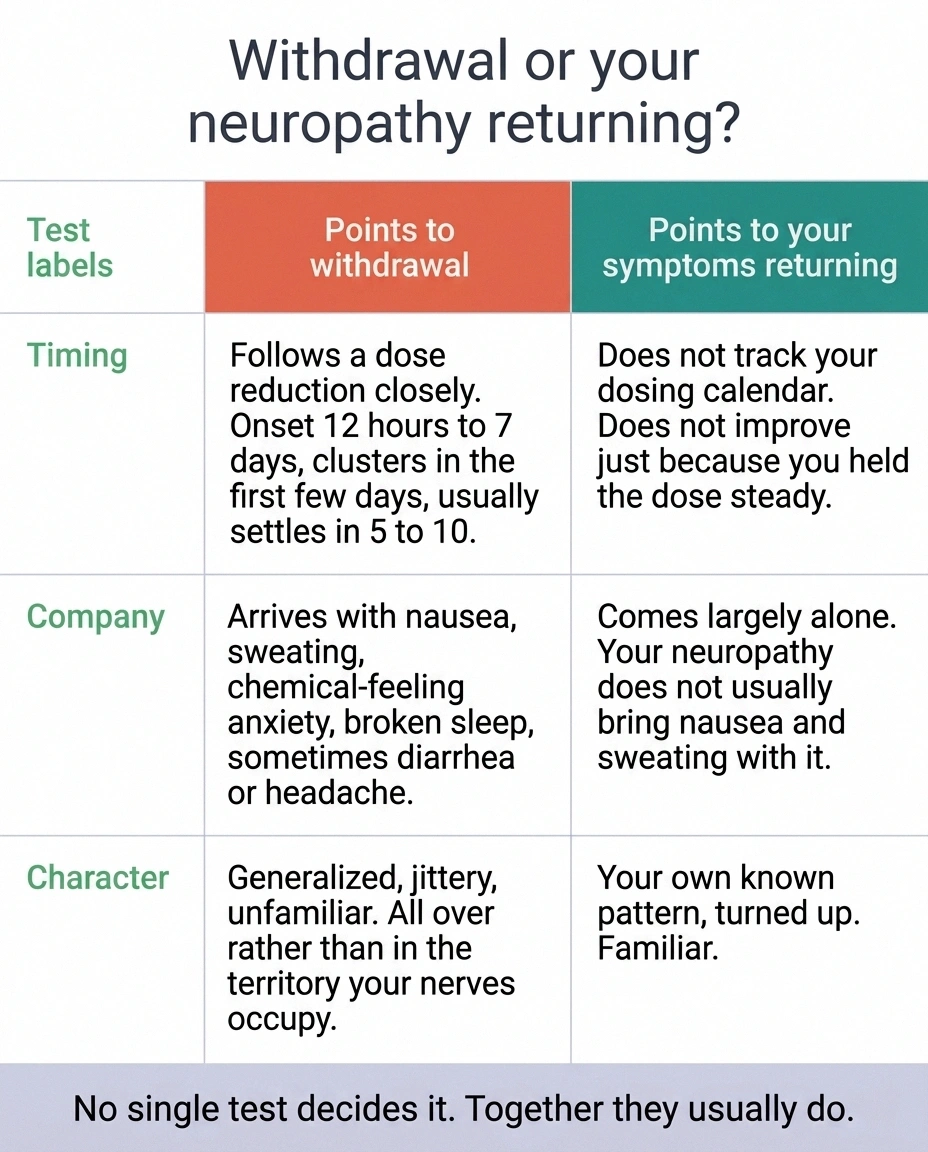
Timing. Withdrawal follows the dose reduction closely. Gabapentin withdrawal appears anywhere from 12 hours to 7 days after a reduction, clusters in the first few days, and typically settles within 5 to 10 days. Neuropathy that is genuinely returning does not care what day you changed the dose. If your worst days line up with the two or three days after each step down and then improve before the next step, you are watching withdrawal.
Company. Withdrawal arrives with a retinue. Nausea, sweating, anxiety that feels chemical rather than situational, sleep that breaks apart, sometimes diarrhea or a headache. Your neuropathy on its own does not usually bring nausea and sweating with it.
Character. This is the subtle one and the most useful. Ask whether what you feel is your symptom, the familiar one you know intimately, or something adjacent to it. Returning neuropathy usually feels like your own known pattern turned up. Withdrawal often feels generalized and unfamiliar, jittery, all over rather than in the specific territory your nerves occupy.
None of these three is decisive alone. Together they are usually enough.
Gabapentin: Two Very Different Sets of Instructions
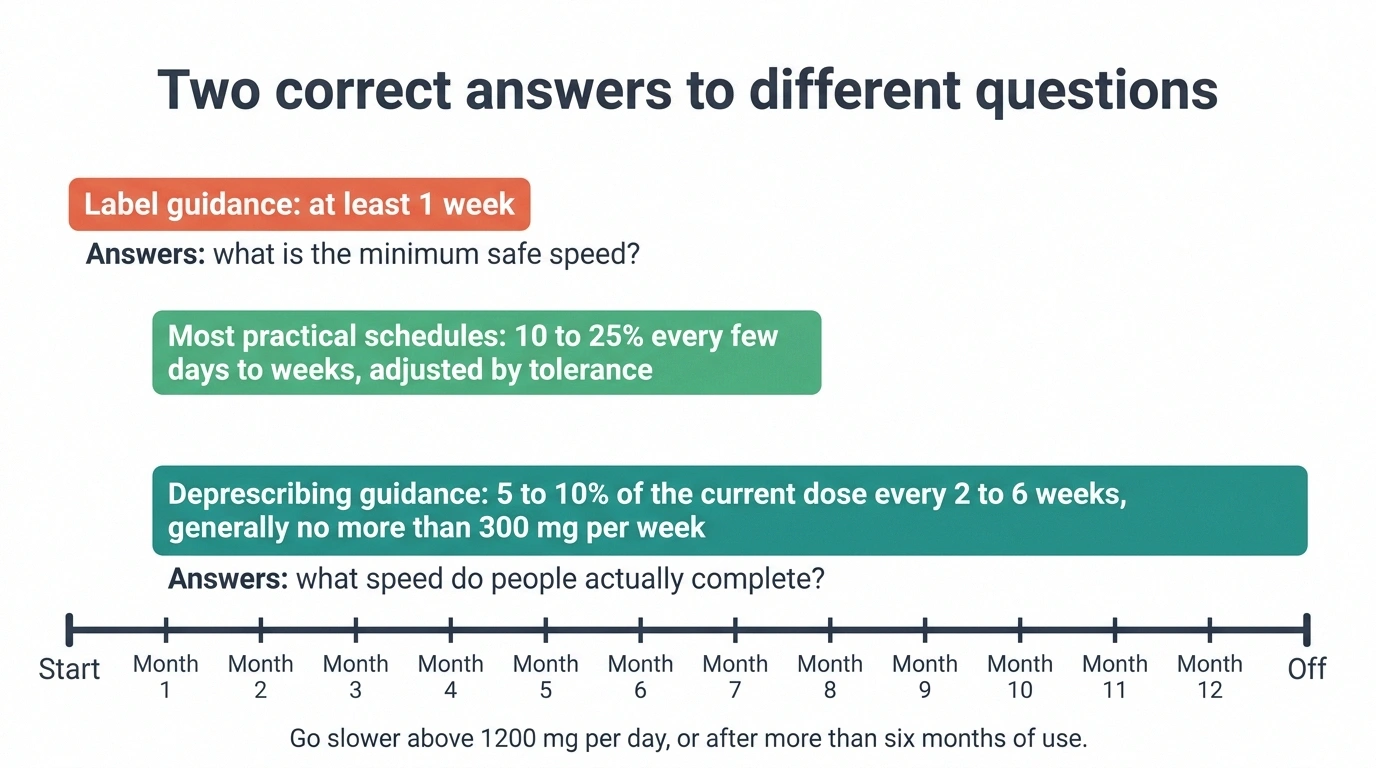
Ask what the taper schedule should be and you will find two answers that are far apart, both legitimate.
The label says at least a week. FDA labelling and the manufacturer recommend reducing or discontinuing gradually over a minimum of one week. This is the floor, and it exists mainly to avoid the acute risks of abrupt cessation.
Deprescribing guidance says far slower. Reduce by 5 to 10% of the current total dose every 2 to 6 weeks, generally avoiding reductions greater than 300 mg per week unless the prescriber decides otherwise. At that pace, coming off 1800 mg per day is a project measured in months.
Both are correct because they are answering different questions. The label answers “what is the minimum safe speed.” The deprescribing guidance answers “what speed do people actually complete without abandoning the attempt.”
A middle course sits between them and it is what most practical schedules use: reduce by 10 to 25% every few days to weeks, adjusted by how you handle each step.
Two circumstances call for the slower end. Doses above 1200 mg per day, and use lasting longer than six months. The extreme end of the literature includes a case report of a person who required an eighteen-month taper, which is far outside the ordinary and is worth knowing about only so that a slow taper does not feel like failure. Our overview of gabapentin for neuropathy covers what the drug does at the other end of that journey.
One structural note that makes a real difference: gabapentin is usually taken in three divided doses, which gives you finer control than the numbers suggest. Dropping one of the three by 100 mg is a much smaller step than dropping 300 mg from the daily total in a single move, and it spreads the change across the day rather than opening a gap in it.
Every Drug in This Category Behaves Differently

Tapers are not interchangeable. If you have taken more than one of these over the years, do not assume the last one predicts the next.
The four drugs side by side
| Drug | Published minimum | What tends to happen in practice |
|---|---|---|
| Gabapentin | At least 1 week | Deprescribing guidance runs to months. Three daily doses gives you finer steps than the daily total suggests. |
| Pregabalin | At least 1 week | More predictable absorption makes the taper more consistent person to person. Symptoms usually mild to moderate, clearing in about a week. |
| Duloxetine | 2 to 4 weeks | The bumpiest of the four. Capsules do not split, so the last stretch relies on every-other-day dosing rather than smaller doses. |
| Amitriptyline, nortriptyline | No abrupt stop | Small tablet sizes make gradual reduction genuinely easy. A low nightly dose taken for years is not a low exposure. |
Tablet and capsule sizes are the hidden variable in every one of these rows. Ask the pharmacist which strengths exist before you design the steps.
Pregabalin
Minimum of one week, same as gabapentin, with protocol examples stepping 300 mg per day down to 150 mg per day for seven days. Reported discontinuation symptoms are insomnia, nausea, headache and diarrhea, generally mild to moderate and resolving in about a week. Pregabalin is absorbed more predictably than gabapentin, which tends to make its taper more consistent from person to person. Our page on pregabalin for neuropathy covers the drug itself.
Duloxetine
The one that most often catches people out, because its discontinuation syndrome is more pronounced than the gabapentinoids and it is a different mechanism entirely. Taper over two to four weeks. A typical schedule steps 60 mg daily down to 30 mg daily for one to two weeks, then 30 mg every other day for one to two weeks, then stops.
Two duloxetine specifics worth knowing in advance. The dizziness can be sharp and sudden, sometimes described as brief electrical sensations in the head, and it is unpleasant but self-limiting. And because the capsules are not designed to be split, the every-other-day step exists as a workaround rather than as an ideal, which is why the last stretch can feel bumpier than the first. Some prescribers avoid alternate-day dosing altogether for exactly that reason, because the trough between doses can make discontinuation symptoms worse rather than smoother, and use a compounded liquid or a bridging alternative instead. Which route suits you is a question worth raising before you reach the bottom of the taper rather than during it. Our page on duloxetine for neuropathy has the fuller picture.
Amitriptyline and nortriptyline
Never stopped abruptly, because rebound symptoms follow. The tricyclics are frequently prescribed at low doses for nerve pain, which creates a false impression that the taper is trivial. A low dose taken every night for four years is not a low exposure. These also come in small tablet sizes, which makes a gradual reduction genuinely easy to execute. Our comparison of nortriptyline against amitriptyline covers how the two differ, and those differences carry into how each comes off.
The rule that applies to all of them
One drug at a time, unless your prescriber has deliberately planned otherwise for a reason they can explain. If you are on gabapentin and amitriptyline and want to be free of both, taper one, hold, evaluate, then start the second. Reducing both at once produces a fog of symptoms with no way to attribute anything to anything. The full picture of what these medications are and how they differ is worth reviewing before you decide which goes first.
Building a Schedule You Can Hold
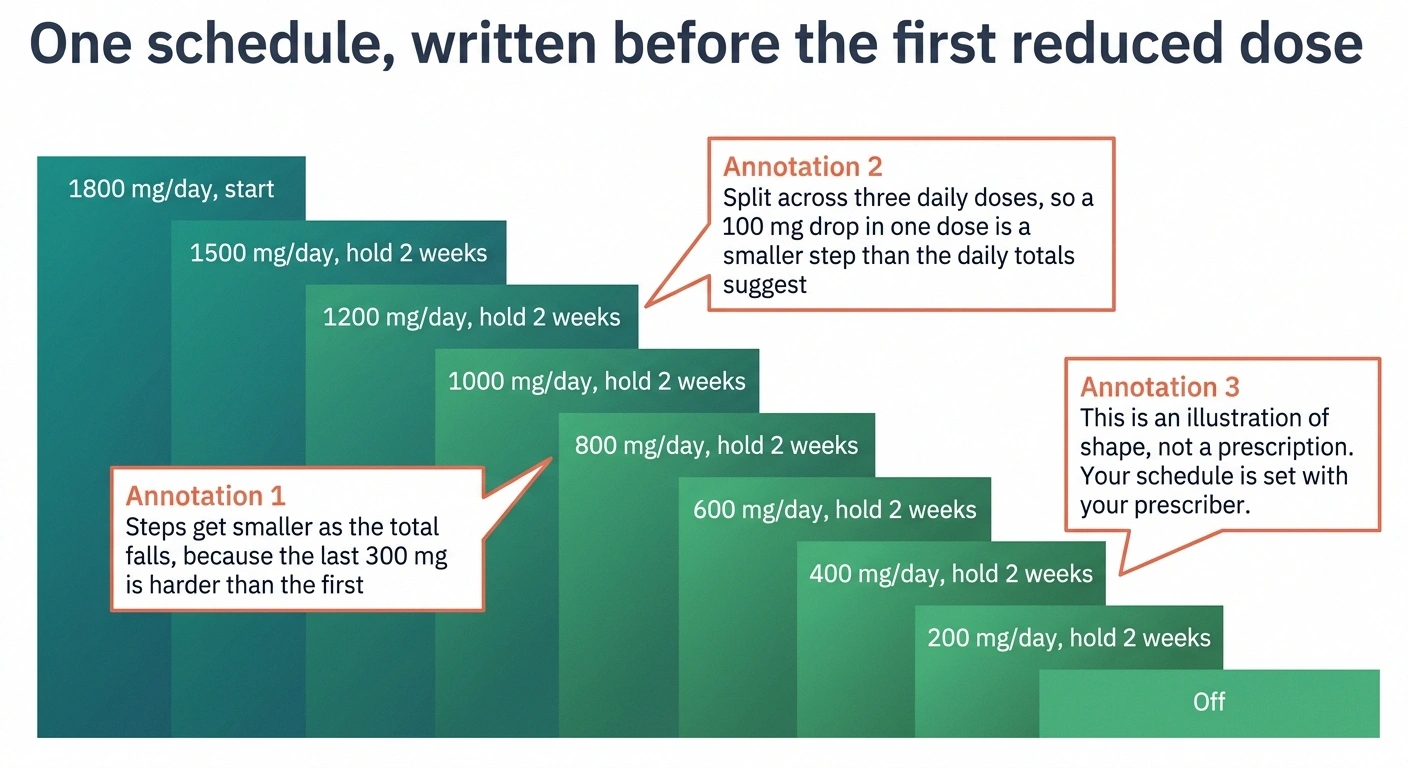
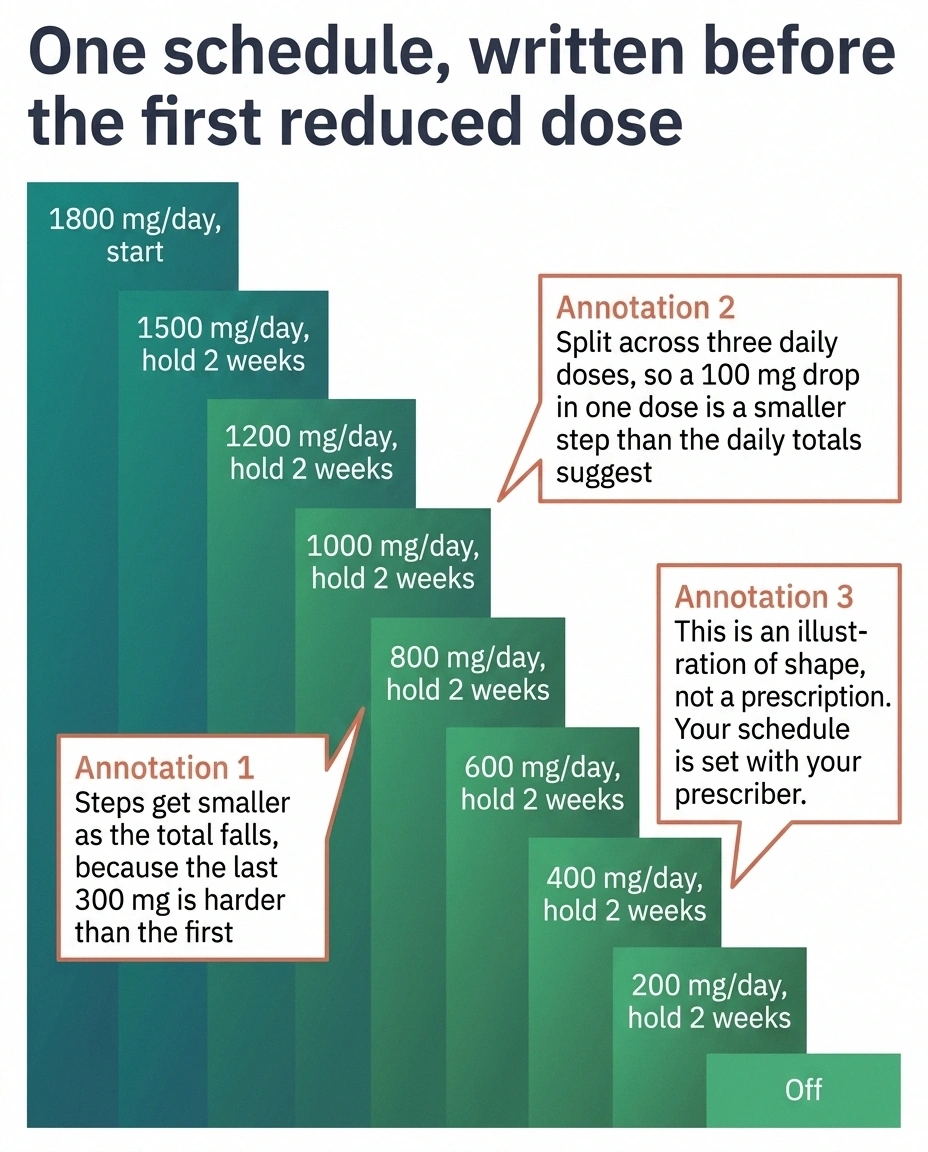
The best taper is not the fastest one you can survive. It is the one you finish.
Start from where you are, not from the package. Percentage reductions of the current dose mean the steps get smaller as the total falls, which matches how the difficulty actually distributes. The last 300 mg is harder than the first 300 mg, reliably, and a schedule with even-sized steps has its hardest work at the end when your reserves are lowest.
Give each step a real hold. The point of the hold is to let withdrawal pass so that what remains is information. If you step down again while the last reduction is still echoing, you accumulate symptoms and lose the ability to interpret any of them. Two weeks per step is a reasonable default. One week is workable at higher doses.
Pick the calendar deliberately. Do not begin a taper the week before a wedding, a house move, or a trip. Withdrawal will make an already demanding week worse, and a demanding week will make you misread the withdrawal.
Ask about the pharmacy problem before you need to. Getting from 300 mg capsules down to 100 mg increments means having 100 mg capsules on hand. Sort the prescription logistics at the start, because discovering mid-taper that you cannot make the next step is how people end up cutting capsules open on a kitchen counter.
Write the whole schedule down before you take the first reduced dose. Dates, doses, planned hold lengths. A taper improvised week to week drifts, and drift is how a three-month plan quietly becomes a permanent dose reduction nobody decided on.
The Two-Week Rule
Here is the single practice that prevents the most common wrong conclusion.
The same step, judged on two different days
A single reduction produces two entirely different verdicts depending on when you ask. This is why the hold length is not padding.
- Day 3. Withdrawal is at its loudest. Sleep is broken, everything hurts, and the honest answer to “how is it going” is badly. Any decision made here is a decision about withdrawal.
- Day 14. Withdrawal has cleared for most people. What remains is close to what this dose actually feels like. This is the only day worth asking on.
The same logic applies at the end. Give yourself a month at zero before deciding what the drug was doing, because the last step has the longest tail.
Do not judge a dose reduction until you have held it for two weeks. And do not judge the whole taper until you have been off entirely for a month.
The reasoning follows directly from the timing. Withdrawal clusters in the first several days after a change and usually settles within five to ten. Judge on day three and you are judging withdrawal. Judge on day fourteen and most of the noise has cleared, leaving something closer to a signal.
To make this work you need a record, because memory will not hold the detail and will bend toward whatever you expected. A simple symptom diary is enough: date, current dose, a morning and evening pain number, sleep quality, and one line about anything else you noticed. Two minutes a day.
What you are looking for at the end is a comparison nobody usually gets to make: your symptoms at full dose against your symptoms at zero, measured the same way, weeks apart. A surprising number of people discover the two are close. That is not a failed taper. That is the answer to a question that had gone unasked for years, and it frees you to spend your attention on approaches that might do more. Our guide on what to do when a neuropathy medication stops working picks up from there.
When to Slow Down, and When to Stop Tapering Altogether

A taper is not a test of character and there is no prize for finishing on schedule.
Four facts to have ready before you dial
Tapering calls go badly when the person answering has to extract the timeline question by question. Say these four things first and the conversation takes two minutes instead of ten.
- The drug, and the dose you were on before the taper started
- The dose you are on today, and the date you stepped down to it
- What you are feeling, and whether it started within days of that step
- Whether anything on the same-day list is present
Point two is the one people leave out and the one that determines the answer. A symptom that began four days after a reduction is a different problem from the same symptom in someone who has been stable for a month.
Slow down if each step is taking longer than about ten days to settle, if sleep has not recovered by the end of a hold, or if you find yourself dreading the next reduction. Halving the step size costs you weeks and buys back the ability to continue. That is a good trade every time.
Pause and hold if life delivers something else. Illness, bereavement, a hospital admission. Staying at your current dose for a month is not a setback, and going back up one step to get through a genuinely bad stretch is a legitimate move rather than a failure.
Stop the taper and speak to your prescriber the same day for any of these:
- A seizure, or any episode of losing awareness
- Confusion, agitation, or a marked change in your thinking
- New or worsening thoughts of harming yourself
- A racing heart, chest pain, or a fever with sweating
- Pain that is not merely worse but different in kind, particularly rapidly increasing weakness, or numbness climbing upward
That last one is not withdrawal at all. Advancing weakness or a sensory change moving up the limbs is a reason to be seen, taper or no taper, and our page on neuropathy symptoms that warrant urgent care covers what separates those from an ordinary bad week.
Getting Through the Rough Days

Some stretches will be uncomfortable regardless of how well the schedule is built. What actually helps is unglamorous.
Heat or cold, ten to fifteen minutes. Whichever your nerves prefer. Both work by giving the nervous system a competing signal, and neither needs to last long. If sensation in your feet is impaired, check the temperature with your hand or elbow first, every time.
Movement, gently and often. Walking, swimming, or slow stretching. Not because exercise cures withdrawal but because a body that has moved sleeps better, and sleep is the variable with the largest effect on how the following day feels.
Protect sleep deliberately during step-down weeks. Same bedtime, cool dark room, no screens in the last hour. Insomnia is on the withdrawal list for every drug in this category, and it is the symptom that amplifies all the others.
Tell someone what you are doing. Irritability and anxiety are recognized withdrawal symptoms, which means the people around you will notice something before you attribute it correctly. Saying “I am reducing a medication over the next few weeks and I may be short-tempered” costs one sentence and prevents a great deal.
Keep the reason visible. Write down, on the day you start, why you are doing this. On the hard days you will genuinely forget, and a note in your own handwriting saying “I have been foggy for three years and I want to know if this is why” is worth more than any amount of resolve.
Frequently Asked Questions
How long does gabapentin withdrawal last?
Symptoms usually begin somewhere between 12 hours and 7 days after a reduction or the last dose, and commonly persist for 5 to 10 days. A minority of people take considerably longer, with resolution reported over a period of weeks and, in rare documented cases, months. Higher doses and longer use both push toward the longer end.
Is the pain coming back, or is this withdrawal?
Look at three things. Timing: withdrawal follows dose reductions closely and eases within about a week, while returning neuropathy does not track your dosing calendar. Company: withdrawal usually arrives alongside nausea, sweating, anxiety and disrupted sleep, which neuropathy on its own does not bring. Character: returning neuropathy tends to feel like your own familiar symptom intensified, whereas withdrawal often feels generalized and unfamiliar. Holding each step for two weeks before judging it is the practical way to separate them.
Can I just stop gabapentin if I have only been on it a few weeks?
Even short courses are generally tapered rather than stopped outright, and the labelling recommends gradual reduction over at least a week regardless of duration. Short use at a low dose is the situation where a fast taper is most likely to be appropriate, but that is a judgment for the person who prescribed it, since it depends on your dose, your kidney function and what else you take.
What is a typical gabapentin taper schedule?
There is no single standard. The labelling sets a floor of at least one week. Deprescribing guidance suggests reducing by 5 to 10% of the current total dose every 2 to 6 weeks and generally avoiding reductions greater than 300 mg per week. Many practical schedules sit in between, reducing 10 to 25% every few days to weeks depending on tolerance. Because gabapentin is usually split across three daily doses, reducing one of the three at a time gives you smaller steps than the daily totals imply.
Why is duloxetine harder to come off than gabapentin?
Different mechanism and a more pronounced discontinuation syndrome. Duloxetine stopping symptoms include dizziness, headache, nausea, diarrhea, paresthesia, irritability, insomnia, anxiety, sweating and fatigue, and the dizziness in particular can be abrupt. It is usually tapered over two to four weeks, often by halving the dose, then moving to every other day before stopping.
Can I taper two neuropathy medications at the same time?
It is not a good idea. Overlapping withdrawal makes every symptom unattributable, so you cannot tell which drug is producing what, and you lose the information the taper was supposed to give you. Take one down fully, hold at zero long enough to see where you land, then start the second.
What if I feel much worse and want to go back on it?
Going back up one step is a normal part of tapering rather than a failure, particularly if a difficult stretch of life has landed at the same time. What is worth avoiding is returning to the full original dose on the strength of a bad three days, because the first few days after a reduction are when withdrawal is loudest and least informative. Hold, wait out the two weeks, and then decide with better information.
That applies to ordinary post-reduction misery, which is unpleasant but self-limiting. It does not apply if anything on the same-day list above has appeared, or if what you are feeling is severe or frightening rather than simply worse. In that case contact your prescriber straight away instead of waiting the fortnight out.
Will my neuropathy get permanently worse if I stop?
Stopping a symptomatic medication does not damage nerves. These drugs modify how pain signals are perceived; they do not repair or protect the nerve itself, so removing one changes your experience of the condition rather than its course. Whatever is driving the underlying nerve damage continues on its own trajectory regardless of what you take for the pain, which is also why treating the underlying cause matters more than the choice of pain medication.
About the Author