
When my neighbor Carol's husband Frank, who's seventy-four and has had diabetic neuropathy for fifteen years, sat me down at their kitchen table and said his new neurologist wanted to switch him from amitriptyline to nortriptyline, he asked the question almost everyone asks: “Janet, what's the actual difference? They sound like the same word.”
They sort of are. They're the same family. They were discovered within a few years of each other. They work the same way for nerve pain. They share most of the same side effects. And yet picking between them, especially after sixty-five, is one of the more important small decisions in neuropathy care — because one of them is on a list of medications most doctors try to avoid in older adults, and the other isn't.
Let me walk you through what's actually different, when one is preferred over the other, and what to know going in if you're about to have this conversation with your prescriber.
Same Family, Different Profiles
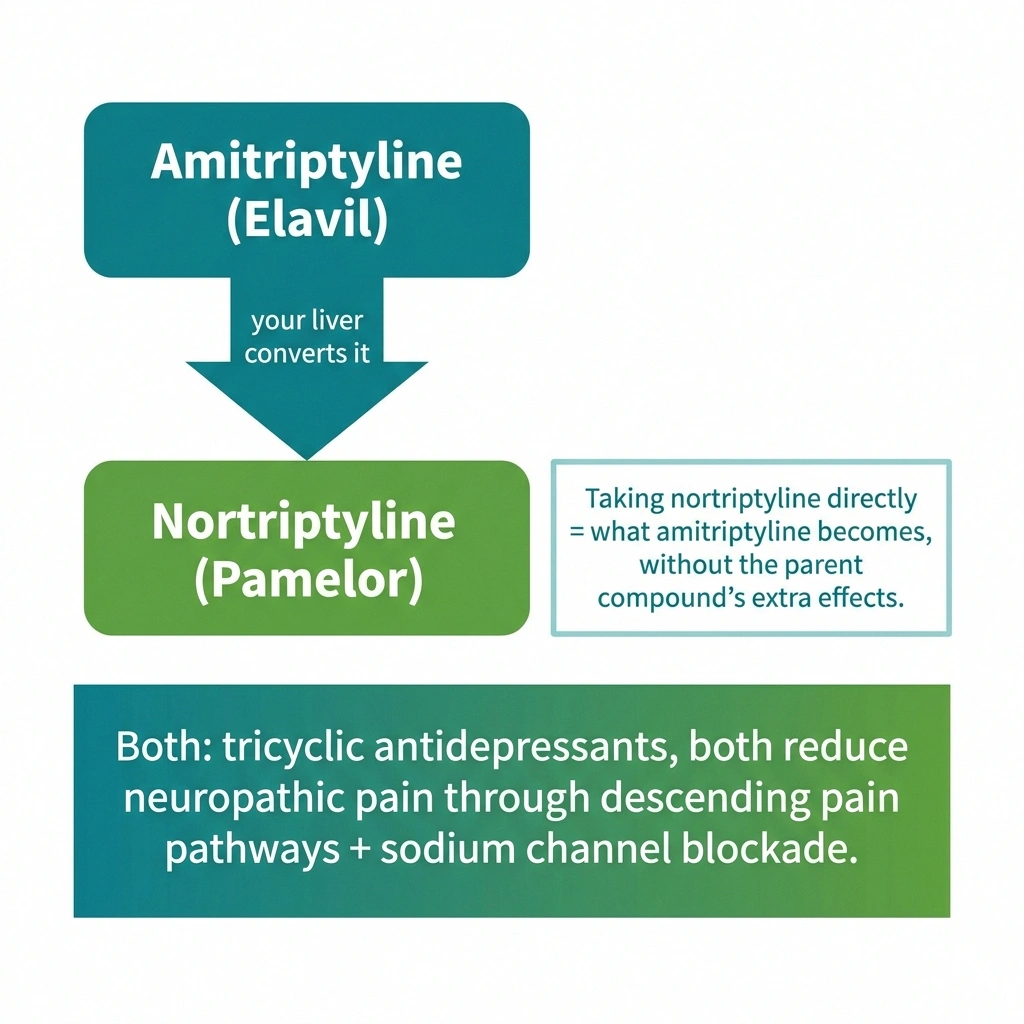
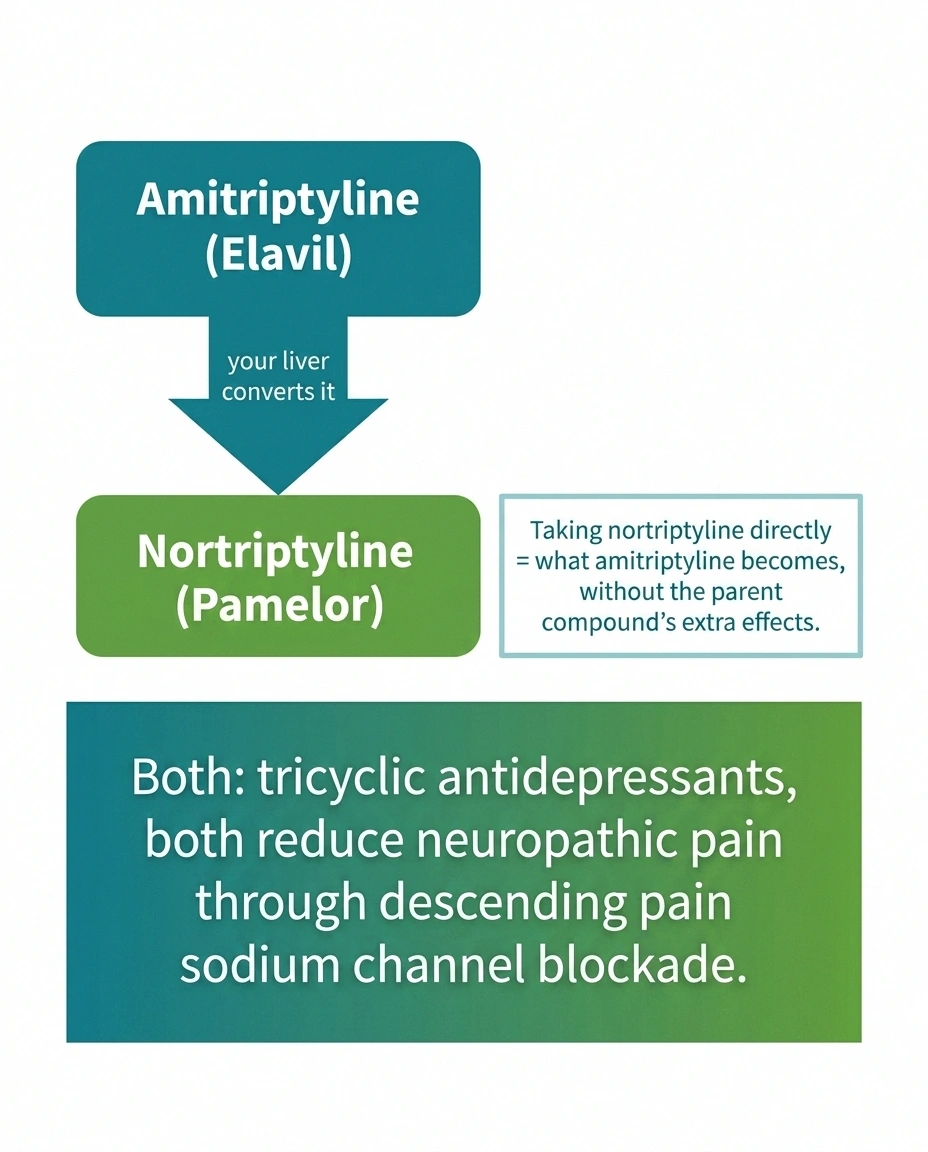
Amitriptyline and nortriptyline are both tricyclic antidepressants. They were originally developed in the 1950s and 1960s to treat depression. Over the decades, doctors noticed that patients with chronic nerve pain who happened to take these drugs often reported less pain — and at much lower doses than were needed for depression. By the 1980s, tricyclics had become first-line treatments for many types of neuropathic pain, and they're still in nearly every guideline for diabetic neuropathy, post-shingles nerve pain, and chemo-induced peripheral neuropathy today.
Key Takeaway
Nortriptyline is a metabolite of amitriptyline — your liver makes it from the parent drug. Taking it directly means you get the nerve-pain benefit with milder side effects across the board. The two are similar in pain relief; the decision is almost always about side-effect tolerance, age, and what else is on your medication list.
Here's a useful piece of trivia for understanding how related they are: when you swallow amitriptyline, your liver converts a significant chunk of it into nortriptyline. So if you've taken amitriptyline, you've already taken nortriptyline in your bloodstream. Nortriptyline is the metabolite. Taking nortriptyline directly is, in effect, taking what amitriptyline becomes — without the parent compound's extra effects on top.
That single fact explains most of the practical differences. Nortriptyline has fewer of the side effects that come from the parent compound's broader chemical activity. The pain relief mechanism — which doesn't involve the antidepressant effects of either drug, by the way, but rather a separate effect on descending pain-modulating pathways in your spinal cord plus some sodium channel blockade in damaged nerves — is preserved.
How They Work for Nerve Pain
Both drugs reduce nerve pain through two main mechanisms, and the doses required are much lower than antidepressant doses.
Research Says
Tricyclics reduce nerve pain through two mechanisms unrelated to their antidepressant effect: increased norepinephrine and serotonin in descending spinal pain pathways, and sodium-channel blockade in damaged peripheral nerves. Pain relief shows up at weeks 1-3 — well before any antidepressant action would appear. They work in non-depressed patients with the same effect size.
First, they increase the levels of norepinephrine and serotonin in the spinal cord pathways that normally tamp down incoming pain signals. Your body has its own built-in pain-modulating system — sometimes called the descending inhibitory system — and tricyclics turn it up. This is the main way they help with the burning, electric, shooting kinds of pain that diabetic neuropathy and other peripheral nerve damage produce.
Second, at the kind of blood levels you reach on therapeutic doses, both drugs block certain sodium channels in damaged peripheral nerves. The same misfiring fibers that cause spontaneous nerve pain become harder to fire when sodium channels are partially blocked. This is the same broad mechanism behind lidocaine patches and some newer experimental drugs in the pipeline.
Crucially, the antidepressant effects of these drugs do not seem to drive the nerve pain benefit. Studies have shown the pain relief works in people who aren't depressed, and the time course is wrong for it to be an antidepressant effect. People with depression usually feel mood benefit at 4 to 6 weeks. People with nerve pain often start to feel the analgesic effect by 1 to 3 weeks.
Typical Dosing — for Nerve Pain, Not Depression
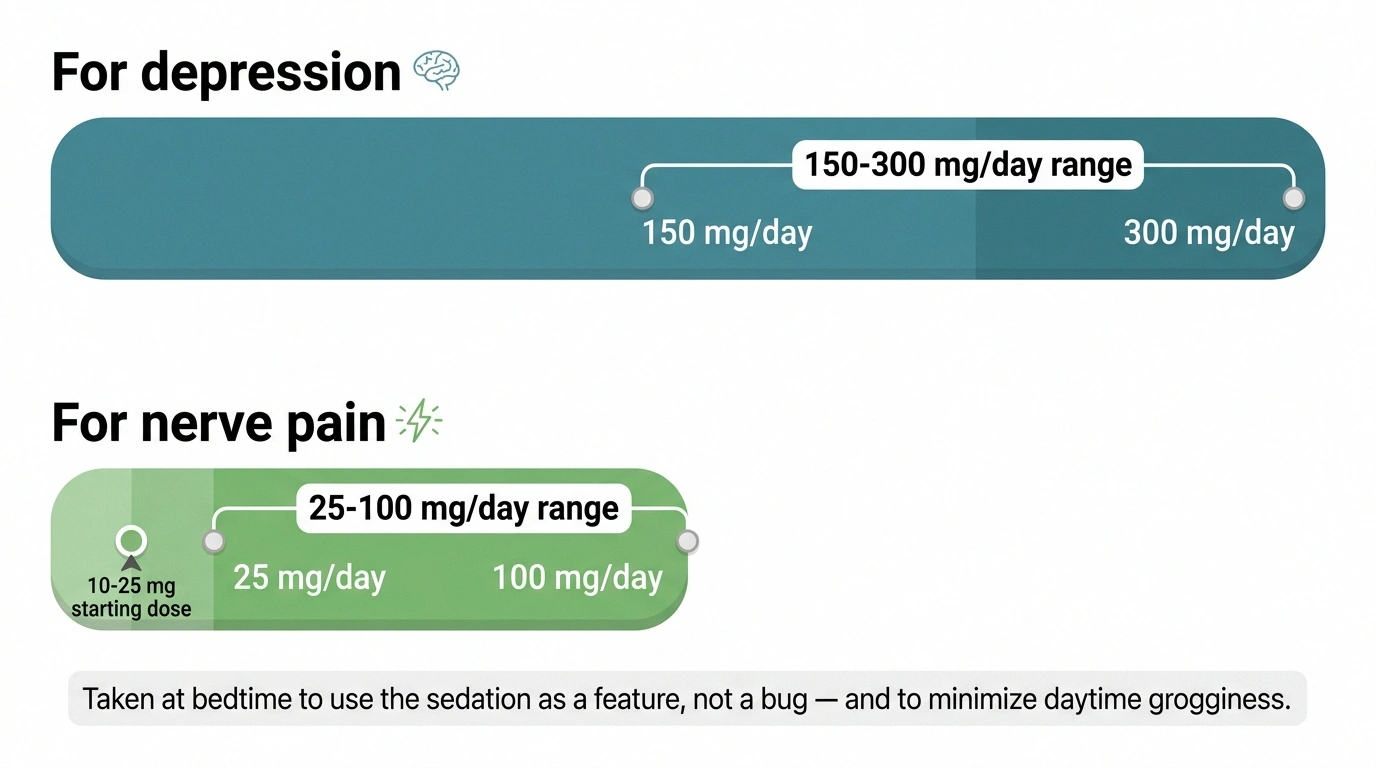
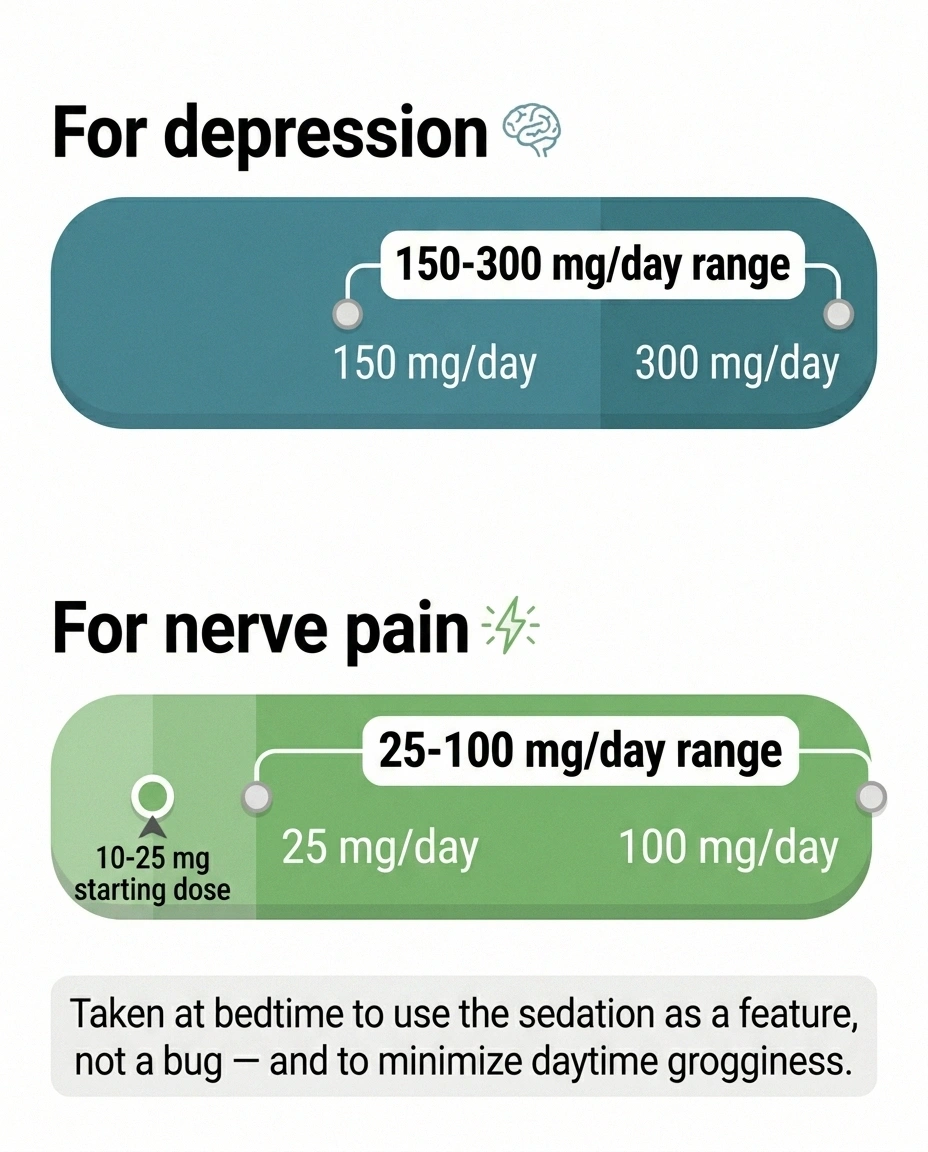
This is one of the most useful pieces of vocabulary I can give you before your prescriber visit: the doses used for nerve pain are far lower than the doses used for depression.
For nerve pain, both drugs typically start at 10 to 25 milligrams at bedtime. Your prescriber usually increases by 10 to 25 milligrams every 1 to 2 weeks based on whether you're getting relief and whether you're tolerating side effects. The usual effective range for nerve pain is 25 to 100 milligrams a day. Compare that to depression doses, which are typically 150 to 300 milligrams a day.
Both are taken at bedtime for two reasons. First, they're sedating — so the drowsiness becomes a feature, not a bug, helping with the well-known pattern of neuropathy worsening at night. Second, taking them at bedtime puts most of the drug's blood-level peak during sleep, which minimizes the daytime grogginess that would otherwise be a problem.
Important to know going in: these are not as-needed pain medications. Both build up over weeks and need to be taken every day at roughly the same time. Skipping doses or trying to “save them up” for bad nights breaks the mechanism. If you stop them suddenly after weeks or months of use, you can have flu-like withdrawal symptoms. Tapering over 2 to 4 weeks is standard when discontinuation is needed.
The Effectiveness Comparison Is Closer Than the Side Effect Comparison
When researchers pool the trial data on both drugs for various neuropathic pain conditions, amitriptyline has a small edge in head-to-head numbers — its number needed to treat for any pain relief is about 3 to 4, versus 4 to 5 for nortriptyline. But this is a slightly unfair comparison because amitriptyline has been the subject of many more high-quality trials over the decades and is the default tricyclic in most studies. Nortriptyline has fewer trials of its own and is often inferred to be roughly as effective by extrapolation from amitriptyline data.
Most clinical guidelines treat the two as roughly equivalent in pain efficacy. The reason your prescriber might pick one over the other almost always comes down to side effects, not anticipated pain relief.
Where the Side Effects Diverge
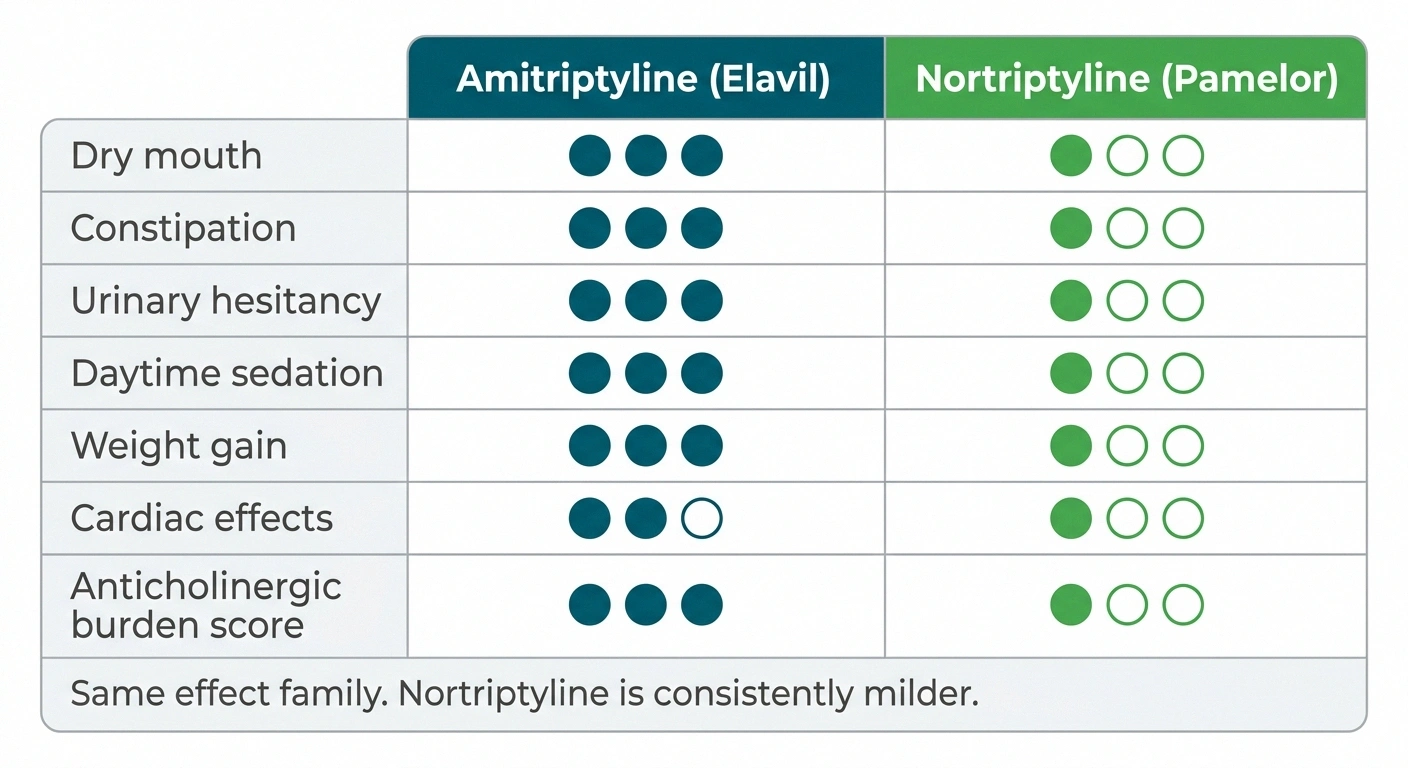
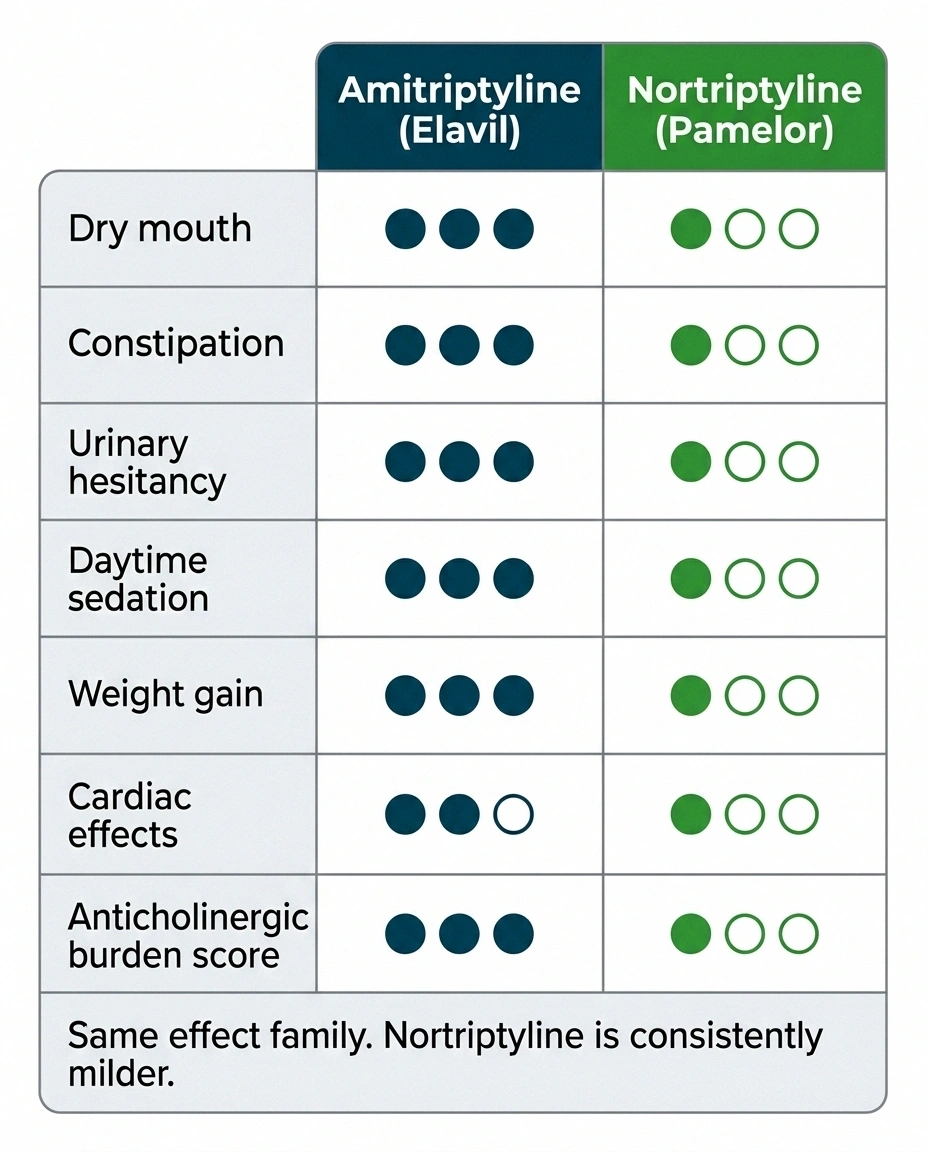
This is the heart of the comparison. Both drugs share a side effect family — they're called anticholinergic effects, and they include dry mouth, constipation, blurred vision, urinary hesitancy, drowsiness, sometimes confusion. They both also have some cardiovascular effects, primarily a small increase in heart rate, occasional drops in blood pressure when standing up (orthostatic hypotension), and the potential to prolong the QT interval on an EKG.
Anticholinergic Burden Score
Amitriptyline
3
HIGH burden
Nortriptyline
1
MILD burden
Long-term high anticholinergic burden in older adults has been associated with increased cognitive decline risk.
Across all of those:
- Dry mouth. Amitriptyline is one of the worst offenders in common use; nortriptyline is markedly milder.
- Constipation. Same pattern. Amitriptyline can produce real constipation that requires daily management. Nortriptyline often produces only mild firming of stools.
- Urinary hesitancy. Amitriptyline is more likely to make it hard to start a urine stream, especially in older men with any prostate enlargement. Nortriptyline less so.
- Daytime sedation. Amitriptyline produces more morning grogginess. Nortriptyline is less likely to leave you feeling foggy the next day.
- Weight gain. Amitriptyline produces more appetite increase and weight gain over months of use than nortriptyline does.
- Cardiac effects. Both can affect heart conduction, but amitriptyline's effects are typically a bit larger. People with any history of arrhythmia, recent heart attack, or unexplained fainting deserve a baseline EKG and a careful prescriber conversation before starting either drug.
- Cognitive effects in older adults. Amitriptyline scores 3 on the standard anticholinergic burden scale, which puts it in the “high” category. Nortriptyline scores 1, in the “mild” category. Long-term high anticholinergic burden in older adults has been associated in observational studies with increased risk of cognitive decline.
The pattern across the whole list is consistent. Nortriptyline produces the same family of effects as amitriptyline, but milder. That is the practical reason most prescribers reach for nortriptyline first in older patients.
The Beers Criteria and the Over-65 Question
The American Geriatrics Society publishes a list called the Beers Criteria — medications that should usually be avoided in adults over 65 because the risks tend to outweigh the benefits in that age group. Amitriptyline has been on this list for years. The reason is exactly the side effect cluster above: anticholinergic burden, fall risk from sedation and orthostatic effects, and cognitive concerns over time.
Beers Criteria Flag
Amitriptyline is on the American Geriatrics Society Beers Criteria list of medications to usually avoid in adults over 65, because of anticholinergic burden plus fall risk plus cognitive concerns. Nortriptyline is not on the strong-avoid list. If you are over 65 on amitriptyline, ask your prescriber whether nortriptyline at an equivalent dose makes sense.
Nortriptyline is not on the strong-avoid list. It's still used cautiously in older patients, with attention to dosing, but it doesn't carry the same Beers flag.
This is why Frank's new neurologist suggested the switch. Frank's prior doctor had started him on amitriptyline ten years ago when he was sixty-four, with good pain control. The new neurologist looked at his medication list, saw he was now seventy-four and also taking a bladder medication (which is also anticholinergic) and an over-the-counter sleep aid (diphenhydramine — also anticholinergic), and decided the cumulative anticholinergic burden was probably contributing to his recent complaints of brain fog and constipation. Switching the amitriptyline to nortriptyline at a comparable dose was the lowest-cost, lowest-disruption way to take a meaningful step down on his total anticholinergic load.
The lesson Frank's case offered, and that I'd want anyone in his position to take: the question isn't just “is amitriptyline working?” It's “is amitriptyline still the right tool given everything else I'm now taking and how old I am now?” Medications that were the right choice ten years ago can become the wrong choice without anything changing about the drug itself.
When Amitriptyline Is Still the Better Pick
I don't want to leave the impression that nortriptyline is simply the better drug. It isn't, for everyone.
Amitriptyline tends to be the right starting choice when:
- The patient is under 65 with no significant cardiac history.
- Sleep disruption is a major part of the problem and the patient would benefit from a more sedating medication.
- Nortriptyline has been tried and didn't provide adequate pain control at a reasonable dose.
- The pain pattern is severe and the prescriber wants the slightly stronger statistical edge in efficacy that amitriptyline shows.
- Cost or formulary availability is an issue — both are very cheap generics in the US, but availability can vary in some countries or insurance plans.
Many people do extremely well on amitriptyline for years. The point isn't that it's a bad drug — it's that it's a drug with a higher side effect ceiling, and that ceiling matters more as you age, more if you take other medications with similar effects, and more if you have specific risk factors like heart disease or cognitive concerns.
When Nortriptyline Is the Better Pick
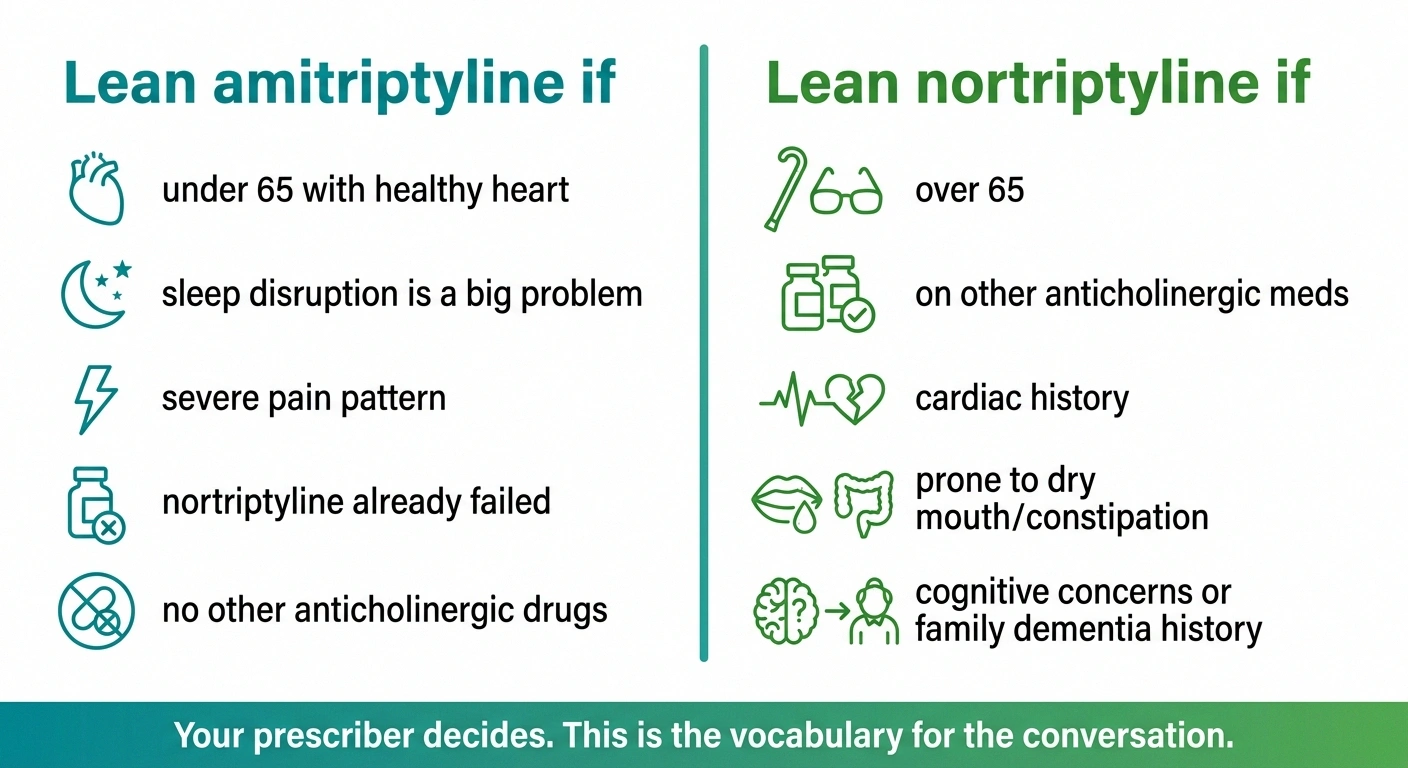
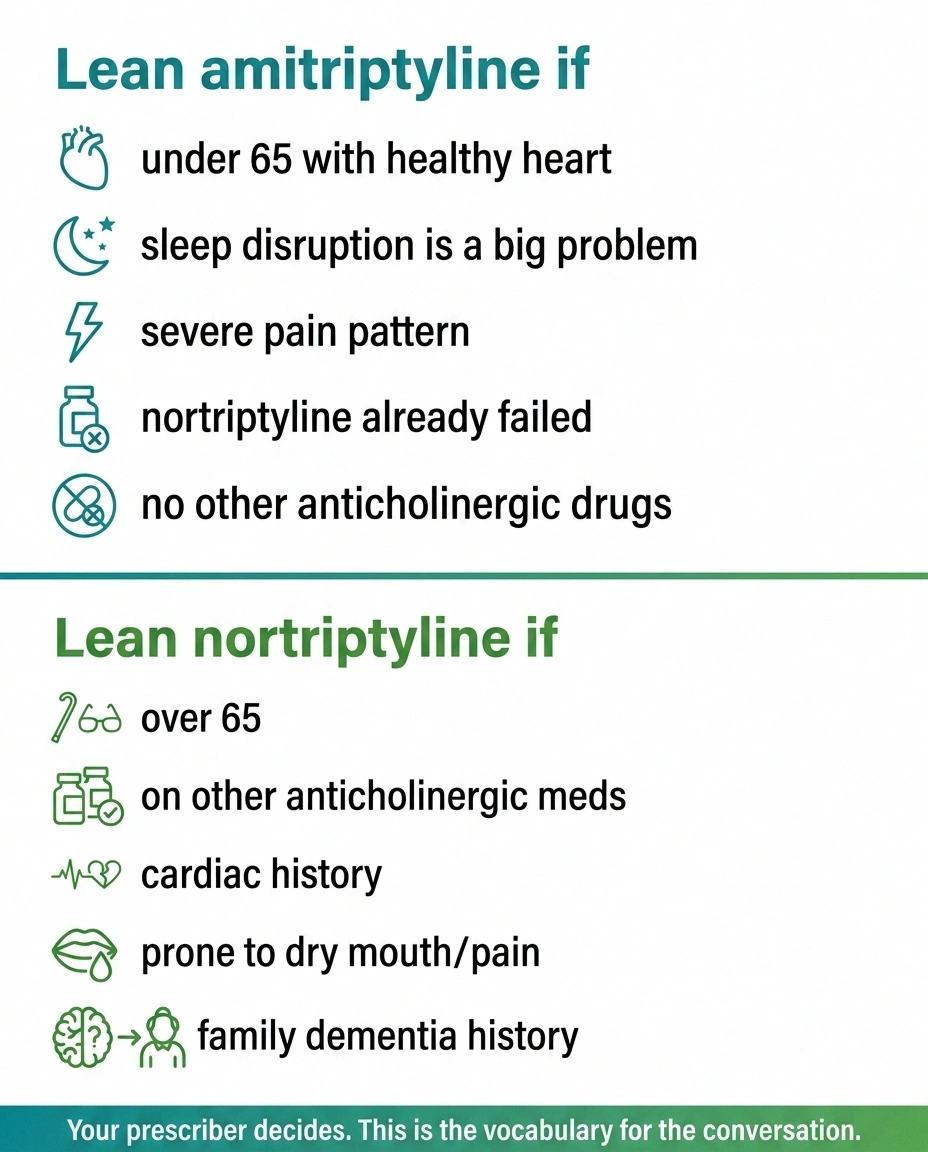
Nortriptyline tends to be the better starting choice when:
Quick Decision Rubric
Lean amitriptyline
Under 65, healthy heart, sleep disruption is a big part of the problem, severe pain pattern, no other anticholinergic drugs.
Lean nortriptyline
Over 65, on other anticholinergic meds, cardiac history, prone to dry mouth or constipation, cognitive concerns, or amitriptyline worked but side effects were too much.
- The patient is over 65.
- The patient already takes other anticholinergic medications — common examples include oxybutynin or tolterodine for bladder, scopolamine for nausea, OTC sleep aids containing diphenhydramine (Benadryl, ZzzQuil, Tylenol PM), some inhalers for COPD, and various antihistamines.
- The patient has any history of cognitive complaints, brain fog, or family history of dementia.
- The patient has a tendency toward constipation or already takes daily fiber or laxatives.
- The patient has prostate enlargement or any history of urinary retention.
- The patient needs to be alert during the day and can't tolerate morning grogginess.
- The patient has documented orthostatic hypotension or recurrent dizziness on standing.
- Amitriptyline helped with pain but caused intolerable side effects — nortriptyline at an equivalent dose is the natural next step.
What Both Drugs Share, Safety-Wise
A few cautions apply equally to both:
Both Drugs — Interactions to Flag
Serotonin syndrome risk: tramadol, SSRIs, SNRIs, MAOIs (contraindicated).
QT prolongation stacking: some antibiotics (ciprofloxacin), some antifungals, ondansetron.
Blood levels pushed by: fluoxetine and paroxetine (CYP2D6 inhibition) can drive TCA levels into toxic range.
Hidden anticholinergic load: OTC sleep aids (Benadryl, Tylenol PM, ZzzQuil), bladder meds, some COPD inhalers.
Drug interactions. Both interact meaningfully with several other drug classes. The most clinically important interactions include tramadol (serotonin syndrome risk), SSRIs and SNRIs (also serotonin syndrome risk), MAOIs (contraindicated), other QT-prolonging drugs (some antibiotics like ciprofloxacin, some antifungals, some antiemetics like ondansetron), and other sedating drugs which compound the drowsiness. Some SSRIs — fluoxetine and paroxetine in particular — inhibit the CYP2D6 enzyme that metabolizes nortriptyline and amitriptyline, sometimes pushing blood levels into the toxic range. Your pharmacist is the best person to do a complete interaction check.
EKG considerations. A baseline EKG is reasonable for older patients, anyone with a cardiac history, and anyone on other QT-prolonging medications. Most healthy adults under 60 starting a low nerve-pain dose don't need one.
Suicide warning labels. Both carry a class warning about suicidal thinking, especially in patients under 25. The risk at low nerve-pain doses is very low but the warning exists.
Don't stop suddenly. Both can cause withdrawal symptoms — flu-like feeling, GI upset, anxiety, vivid dreams — if stopped abruptly after weeks of daily use. If you're stopping either drug, taper over 2 to 4 weeks with your prescriber's guidance.
Pregnancy. Neither is a clear yes or no in pregnancy. Nortriptyline is often slightly preferred among the TCAs in pregnancy if a tricyclic is needed, but the decision is always individual with your obstetrician.
If You're Switching From One to the Other
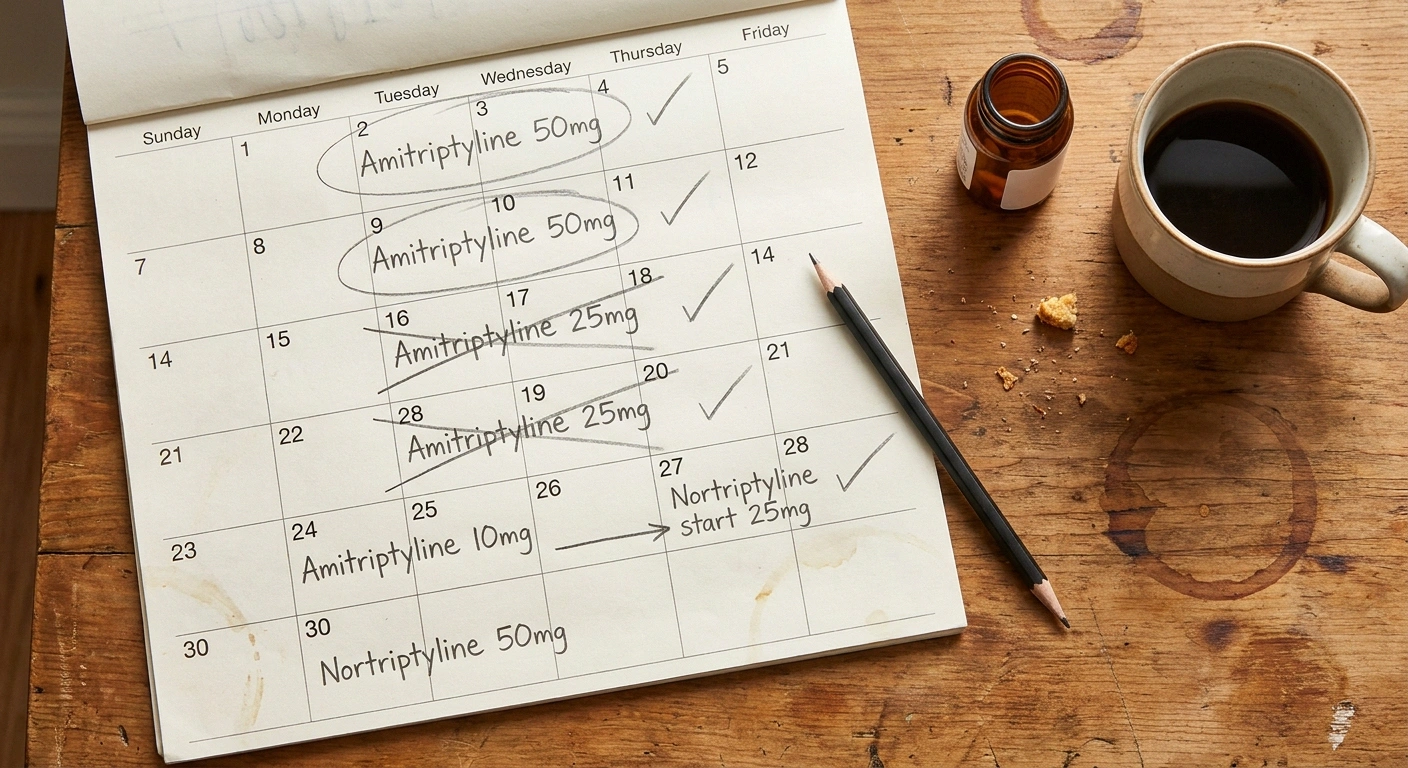
A practical sketch of how Frank's switch worked, which is roughly the standard approach:
His amitriptyline dose was 50 milligrams at bedtime. The neurologist tapered him down to 25 milligrams for two weeks, then to 10 milligrams for one week, while simultaneously starting nortriptyline at 25 milligrams at bedtime. After Frank was off amitriptyline entirely, the neurologist titrated nortriptyline up to 50 milligrams over another two weeks. The whole switch took about six weeks. Frank's pain was a little worse for about ten days during the transition; then it settled back to where it had been, and within another month his dry mouth, constipation, and morning grogginess had all eased meaningfully.
Switches like this are usually uneventful. The two drugs are similar enough that the brain doesn't get any major surprise. Some prescribers do a faster crossover; others do a slower one. Your prescriber's call.
When Both Have Failed
If you've tried either tricyclic at an adequate dose for 6 to 8 weeks and you're not getting acceptable pain control, your prescriber will usually move to a different drug class rather than push the dose higher. The next-line options for neuropathic pain typically include the gabapentinoids — gabapentin or pregabalin (Lyrica) — and the SNRI antidepressant duloxetine (Cymbalta). Each of these has its own profile, and many neuropathy patients end up on combinations rather than a single drug at higher doses.
Tricyclics also don't address everything. They don't fix the underlying cause of your nerve damage, so glucose control, B12 status, and the broader plan still matter. They don't reverse nerve damage. They make the symptoms more livable, often substantially so, and they help with the sleep piece that worsens everything else, but they're a piece of a bigger plan.
The Conversation to Have With Your Prescriber

If you're going in to talk about starting one of these, or switching from one to the other, the questions worth asking:
- Given my age, my other medications, and my health history, which of these would you start with and why?
- What dose are we starting at, and what's the target dose? How long until we know if it's working?
- Do I need a baseline EKG?
- What side effects should I expect in the first two weeks versus later?
- Which of my other medications interact with this — including OTC sleep aids, antihistamines, and any supplements?
- If this side effect (dry mouth, constipation, daytime grogginess) shows up, what's the plan?
- If I want to come off this in six months, what does the taper look like?
Carol and Frank brought a written list very much like this to Frank's neurologist visit. The neurologist's response was so positive — the kind of “thank you for thinking about this” you sometimes hear — that they've taken to bringing a similar list to every appointment since. Doctors will reliably tell you they prefer patients who arrive prepared and they have nicer answers for those patients. It's worth doing.
Frequently Asked Questions
Are these the same as antidepressants you'd take for depression?
Yes, structurally the same drugs, but the doses for nerve pain are much lower (typically 25 to 100 milligrams a day versus 150 to 300 milligrams for depression). At nerve-pain doses, most people don't experience meaningful mood effects.
How long until I know if it's working?
Most people who respond start to feel a difference somewhere between weeks 1 and 4, and a clearer signal by week 6 to 8. Prescribers usually titrate the dose upward during that window. If you've reached a reasonable target dose and you're at week 8 with no benefit, your prescriber will usually try a different approach rather than keep pushing the dose.
Will I feel high or different on these?
The most common early-week experience is drowsiness — that's why they're taken at bedtime. After the first one to two weeks most people don't notice they're on the drug at all, except that the nerve pain is quieter. They are not euphoria-producing and they don't have abuse potential.
Can I drink alcohol on these?
Moderate occasional alcohol is generally tolerated, but both drugs amplify alcohol's sedating effects and add to the next-morning drag. Heavy or daily drinking is a real interaction problem and worsens neuropathy anyway. Run your patterns past your prescriber.
Will my doctor screen me for cardiac safety before starting?
If you have a cardiac history, are over 65, or take other QT-prolonging medications, a baseline EKG is reasonable and many prescribers will order one. Healthy adults under 60 starting at a low nerve-pain dose often don't need an EKG, though prescriber practice varies.
What if I'm already on an SSRI for depression — can I add a TCA for nerve pain?
This combination is sometimes used but requires care. The risk is serotonin syndrome, especially with SSRIs that strongly inhibit the CYP2D6 enzyme (fluoxetine and paroxetine particularly), which can raise the tricyclic to toxic levels. Your prescriber and pharmacist will think carefully about this combination and may suggest duloxetine as an alternative that handles both moods and nerve pain with a single medication.
What if I'm on tramadol for breakthrough pain?
Tramadol plus a tricyclic raises serotonin syndrome risk. Many prescribers will avoid the combination or watch closely. If you're on tramadol, definitely bring it up before starting either of these drugs.
Can I take these as needed when nerve pain flares?
No. These drugs only work when taken daily and require weeks to build to effect. They're not as-needed medications. If you have unpredictable flares on top of a baseline that's controlled, talk with your prescriber about a separate as-needed plan.
Will the side effects get better over time?
Many of the early-week side effects do ease as your body adjusts — particularly the morning grogginess. Dry mouth and constipation often persist as long as you're on the drug, though they may become milder. Anticipating them and managing them (water, fiber, sugar-free gum, stool softener) is the standard playbook.
About the Author