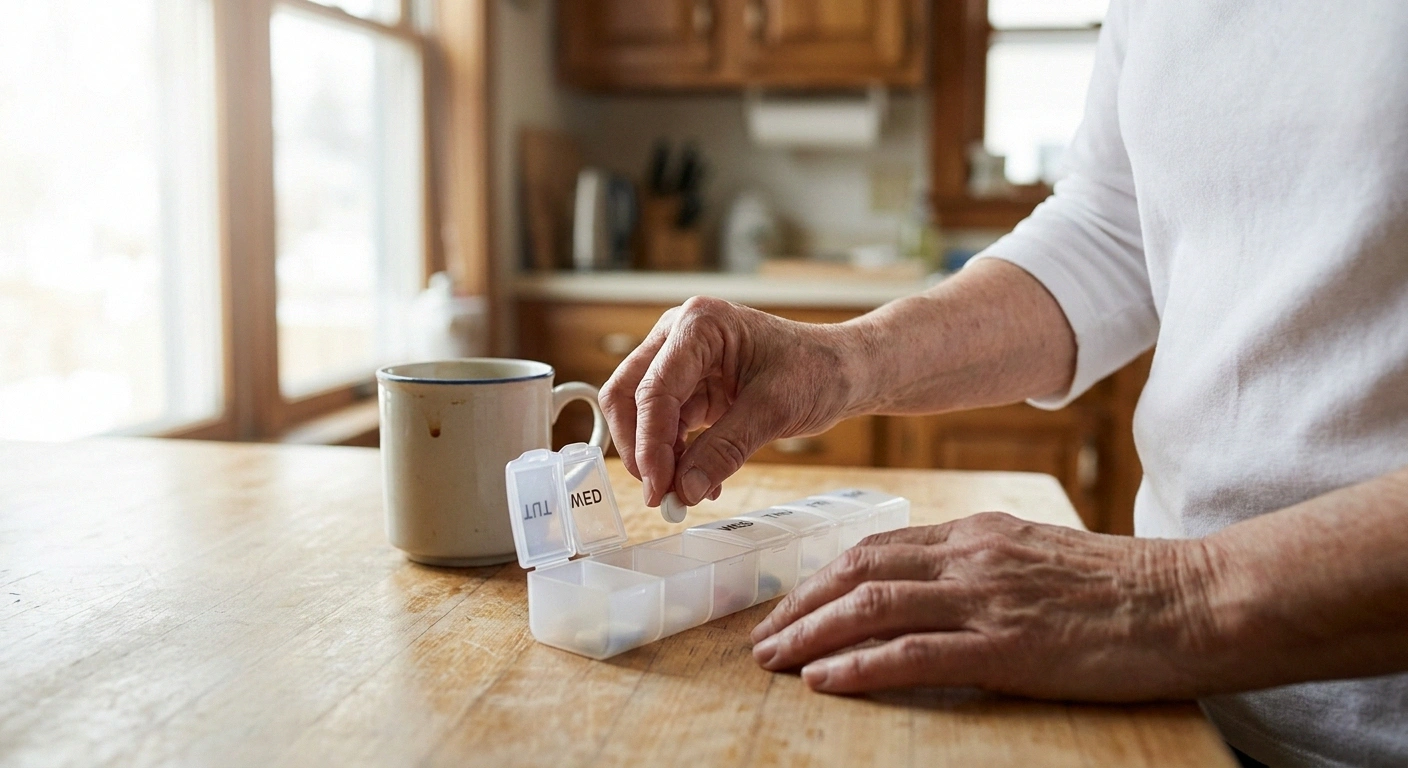
My friend Ruth takes omeprazole every morning. She has taken it since 2009, when a bout of reflux made her miserable enough to ask for something, anything. It worked. The burning stopped. Nobody ever revisited the prescription, and seventeen years later it is simply part of her morning, sitting in the pill organizer between her blood pressure tablet and her calcium.
Last spring she told our support group that her fingertips had gone strange. Not painful. Buzzy. Like they had fallen asleep and forgotten to wake up.
Her first assumption was that the neuropathy she already had in her feet was climbing. That is a reasonable assumption and it happens to be the wrong one, and the reason it was wrong is sitting in her pill organizer.
Two Separate Roads to the Same Empty Tank
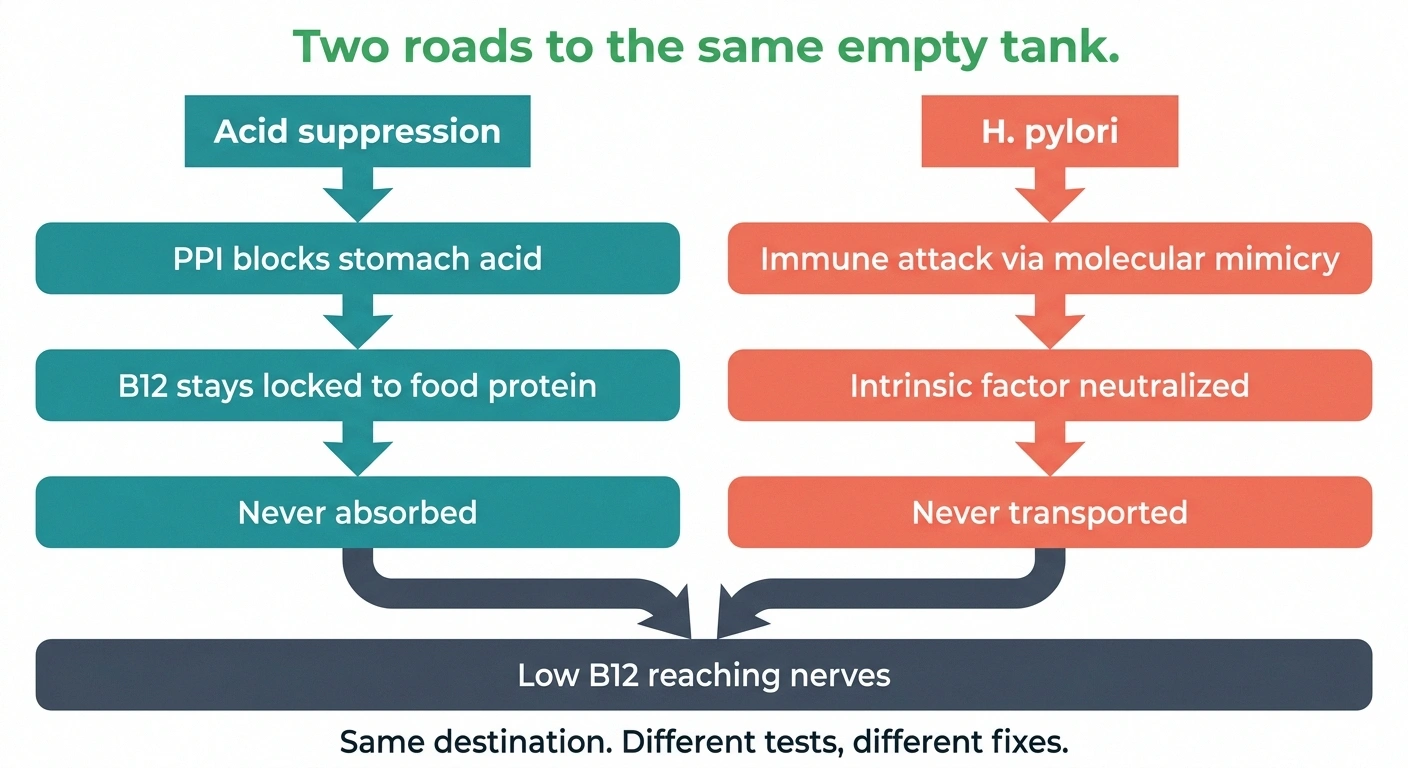
Almost every article on this subject collapses into a single sentence: acid reflux drugs lower your B12. That sentence is true and it is also close to useless, because it hides the fact that there are two genuinely different things that can go wrong in your stomach, and they call for different responses and carry different odds of recovery.
The two roads, side by side
Both end at low B12. They need different tests and carry different odds of reversal, which is why collapsing them into one sentence costs readers real information.
| Road one: acid suppression | Road two: H. pylori | |
|---|---|---|
| What breaks | Acid and pepsin cannot free B12 from food protein | Immune attack on parietal cells and intrinsic factor |
| Speed | Years, buffered by 2-5 years of liver stores | Years, but progressive and structural |
| Test that finds it | Methylmalonic acid (serum B12 can read normal) | Urea breath or stool antigen test |
| Fix | Oral B12 works; crystalline B12 needs no acid | Eradication therapy, plus B12 repletion |
| Reversible? | Usually, since the intestine was never the problem | B12 improved in ~40% after eradication; atrophy may persist |
Road one is chemical. A proton pump inhibitor does exactly what its name says. It shuts down the pumps in your stomach lining that produce acid.
Road two is immunological, and it starts with a bacterium.
Both roads end at a nerve that is not getting the B12 it needs. But knowing which road you are on changes the test you ask for, the fix that works, and how much of your sensation you are likely to get back.
Road One: Why Blocking Acid Blocks a Vitamin
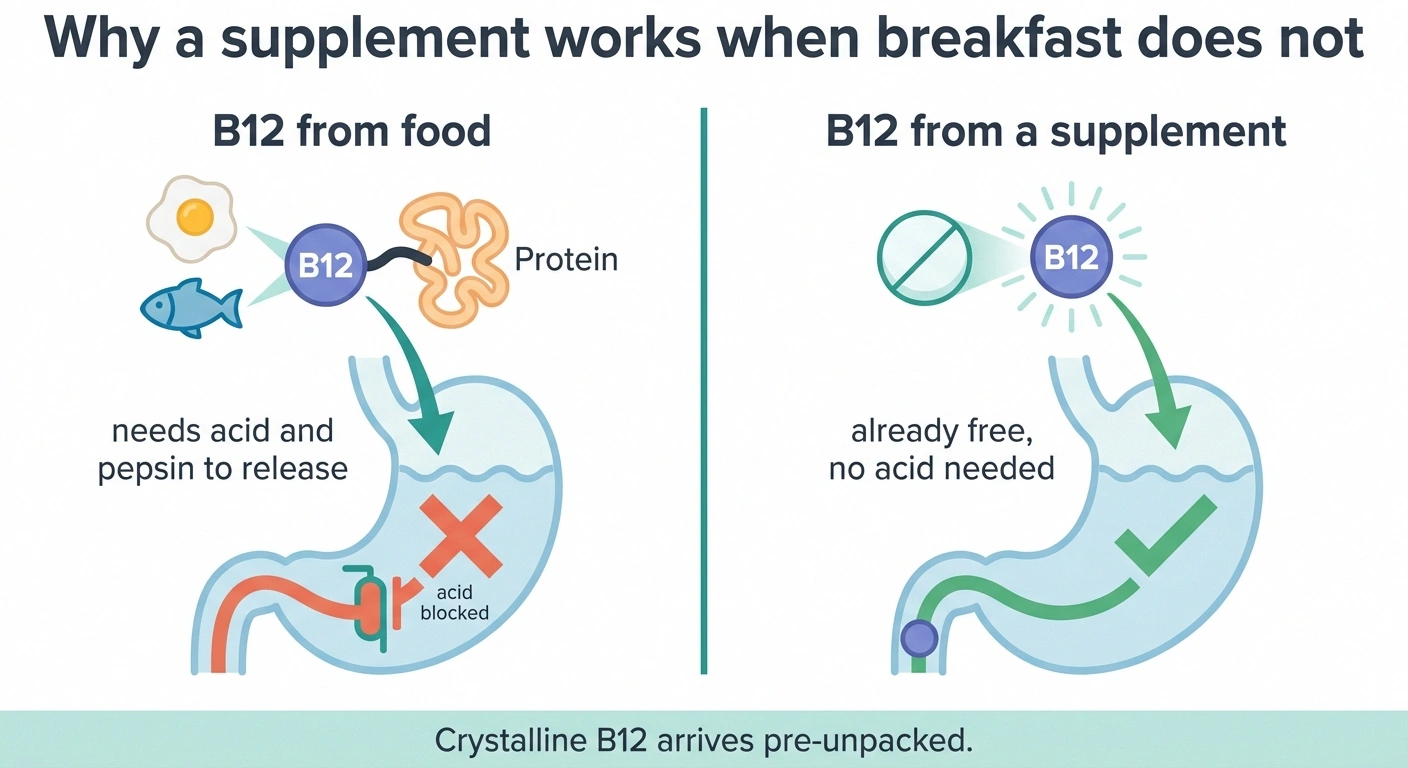
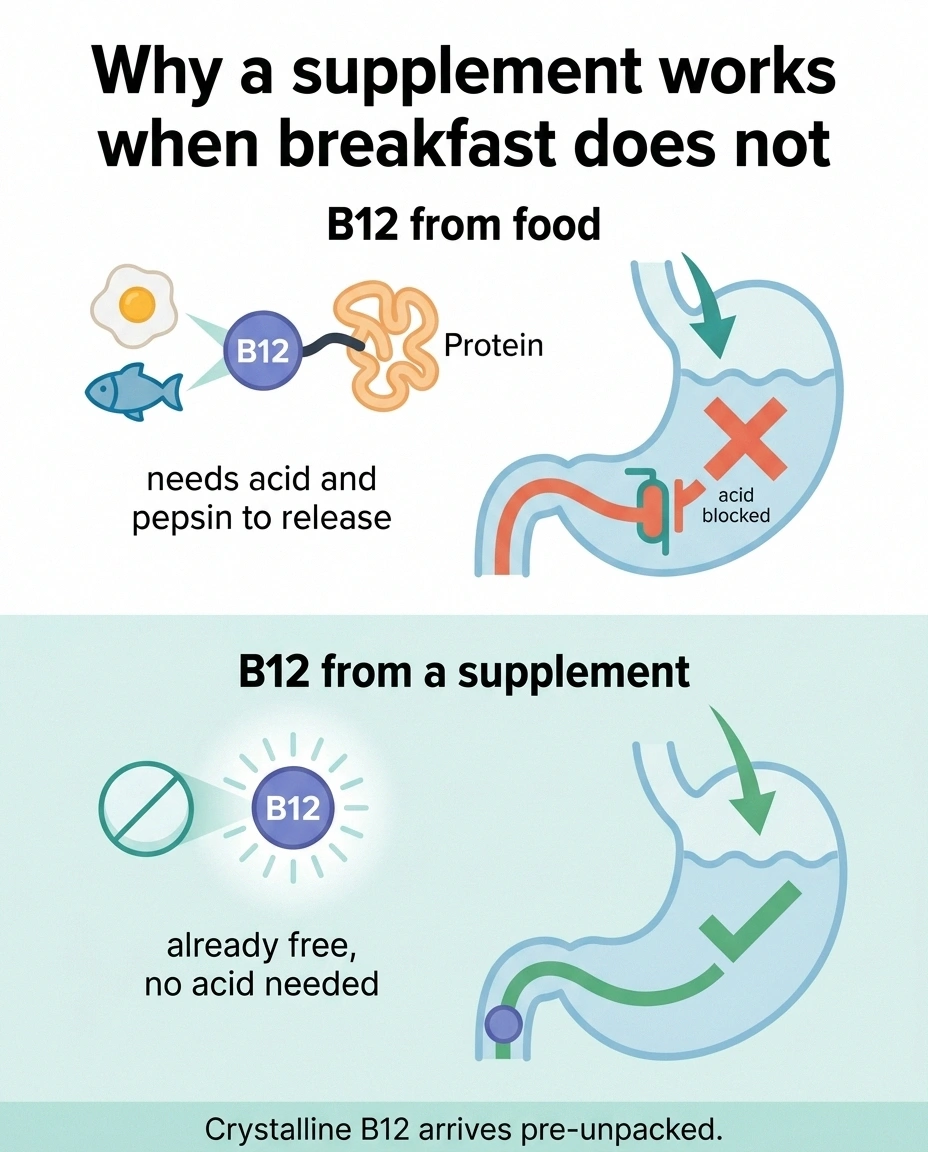
The B12 in a piece of salmon or a boiled egg is not free-floating. It arrives bound tightly to the proteins in that food, and it has to be pried loose before your body can do anything with it.
Stomach acid and an enzyme called pepsin do the prying. Acid creates the environment; pepsin does the cutting. Only after B12 has been separated from food protein can it be handed off to intrinsic factor, the escort protein that carries it down to the far end of the small intestine where absorption actually happens.
Suppress the acid and you break the very first step. The B12 is right there in the meal. It simply never gets unpacked.
Researchers have measured this directly: as gastric pH rises, serum B12 falls. Long-term acid suppression reduces B12 concentrations by interfering with the absorption of food-bound B12 specifically.
That last word carries more weight than it looks like it does. Food-bound. A B12 tablet contains crystalline B12, which is not attached to any protein and therefore needs no acid to release it. This is the quiet, useful consequence of the mechanism: the same stomach that can no longer extract B12 from your breakfast can usually still absorb it from a supplement. The road is blocked, but there is a way around the roadblock, and it costs about four dollars a month.
Road Two: When the Bacterium Turns the Immune System Against You
Helicobacter pylori is a spiral-shaped bacterium that colonizes the stomach lining. Enormous numbers of people carry it. In many of them it causes nothing they would ever notice.
In some people it does something considerably more interesting, and considerably worse.
Certain surface antigens on H. pylori closely resemble structures on your own gastric cells, including subunits of the very proton pump that makes stomach acid. Your immune system, hunting the bacterium, starts hitting the resemblance instead. Immunologists call this molecular mimicry, and it is the same trick behind several autoimmune conditions.
The immune attack lands on parietal cells and on intrinsic factor itself. Antibodies against intrinsic factor mean the escort protein is neutralized before it can carry anything anywhere. Over years, the stomach lining thins into atrophic gastritis, and at the far end of that road sits pernicious anemia.
The numbers here are more striking than most people expect. In one series of 138 patients with B12 deficiency, H. pylori was found in 77 of them. Fifty-six percent. That is not a footnote; that is a substantial fraction of unexplained deficiency having an identifiable, treatable cause sitting underneath it.
What This Does to Nerves, and Why Feet First

B12 does two jobs your nerves cannot function without.
It maintains myelin, the fatty sheath insulating your nerve fibers. Degraded insulation means signals that arrive slowed, scrambled, or as sensations that were never sent. Buzzing. Pins and needles. Numbness in a glove or stocking pattern.
It also drives a metabolic step that clears methylmalonic acid from your tissues. When B12 is short, that compound accumulates, and the accumulation is itself toxic to nerve tissue.
The longest nerves suffer first because they have the most insulation to maintain and the longest supply line to maintain it along. Toes before ankles, ankles before calves. Fingertips join later, which is roughly the pattern Ruth described and roughly how neuropathy progresses through its stages from almost any cause.
One detail deserves emphasis because it derails so many diagnoses: the neurological damage from B12 deficiency can arrive before any anemia does. A normal complete blood count does not clear you. Plenty of people are told their blood work looks fine while their nerves are actively being demyelinated, because the test that would have shown the problem was never the one that got ordered.
The Test That Fails Quietly
Here is the trap that catches Ruth and thousands like her.
What each test is actually asking
Roughly three quarters of circulating B12 is bound to haptocorrin and unavailable to cells. That single fact explains every normal-looking result below.
- Total serum B12
- How much B12 is in the blood in total, usable or not. The test most likely to reassure you incorrectly.
- Methylmalonic acid
- Whether your tissues are actually short. Rises specifically in B12 deficiency. The one to ask for by name.
- Homocysteine
- Corroborating evidence. Also rises with folate and B6 deficiency, so it supports a case rather than settling one.
- Active B12 (holotranscobalamin)
- The delivery fraction directly. Answers the right question where a lab offers it, which many still do not.
Standard serum B12 measures the total pool circulating in your blood. Most of that pool is bound to a carrier protein called haptocorrin, and haptocorrin-bound B12 is essentially warehoused. Your nerve cells cannot draw on it. Only the fraction bound to transcobalamin is available for delivery.
So a total that reads 340, comfortably mid-range, can be sitting on top of a delivery fraction that is genuinely inadequate. The test is not lying. It is answering a question you did not mean to ask.
Three tests answer better questions, and it is worth knowing their names before you walk into the appointment.
Methylmalonic acid rises specifically when B12 is functionally short at the cellular level. It is the closest thing available to asking your tissues directly whether they have enough.
Homocysteine also rises in B12 deficiency, though it rises in folate and B6 deficiency too, so it is corroborating evidence rather than proof.
Active B12, sometimes labeled holotranscobalamin, measures the delivery fraction directly. Availability varies considerably by laboratory and region. Our deeper piece on which vitamin deficiencies cause neuropathy covers how these markers behave across the whole B-vitamin family.
If you are on long-term acid suppression and your feet or hands have changed, a mid-range total B12 is not an all-clear. It is a reason to ask for methylmalonic acid.
Testing for the Bacterium Is a Separate Errand
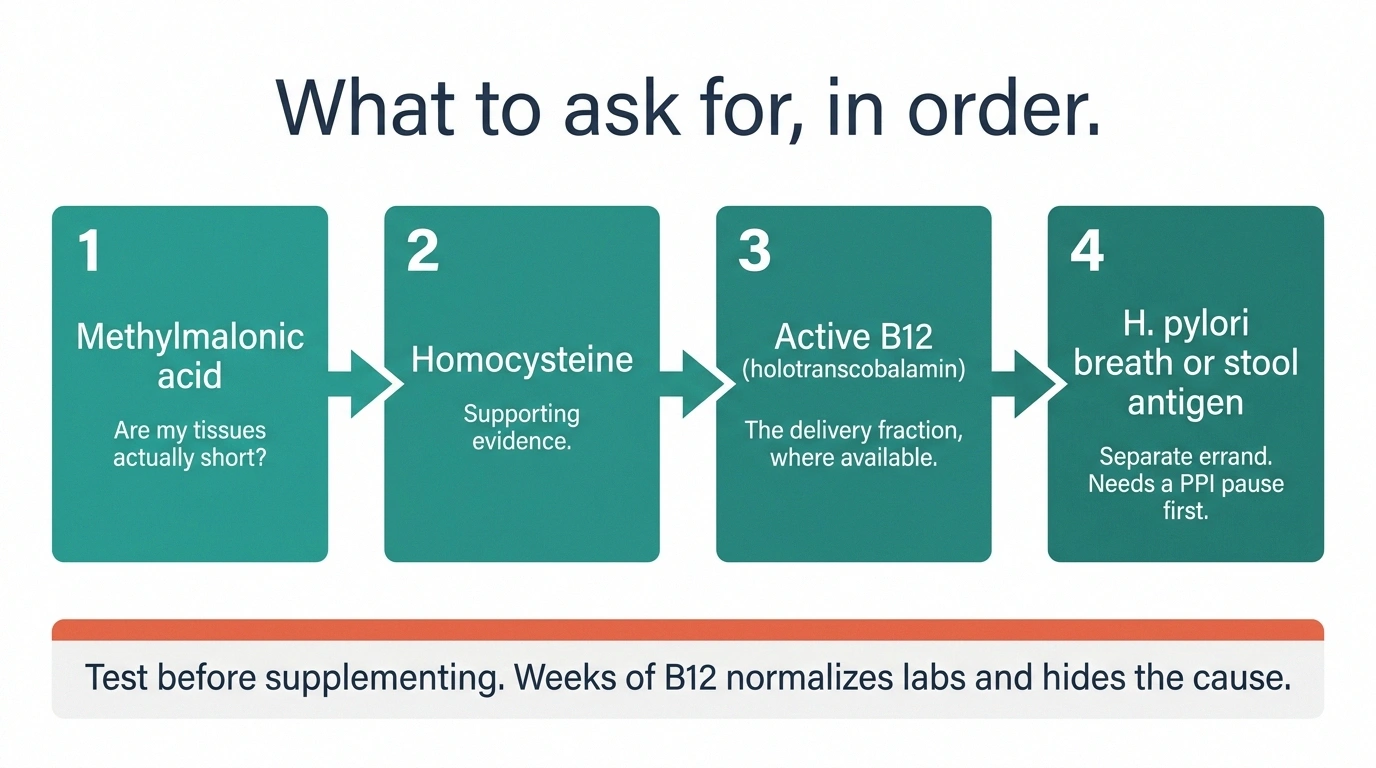
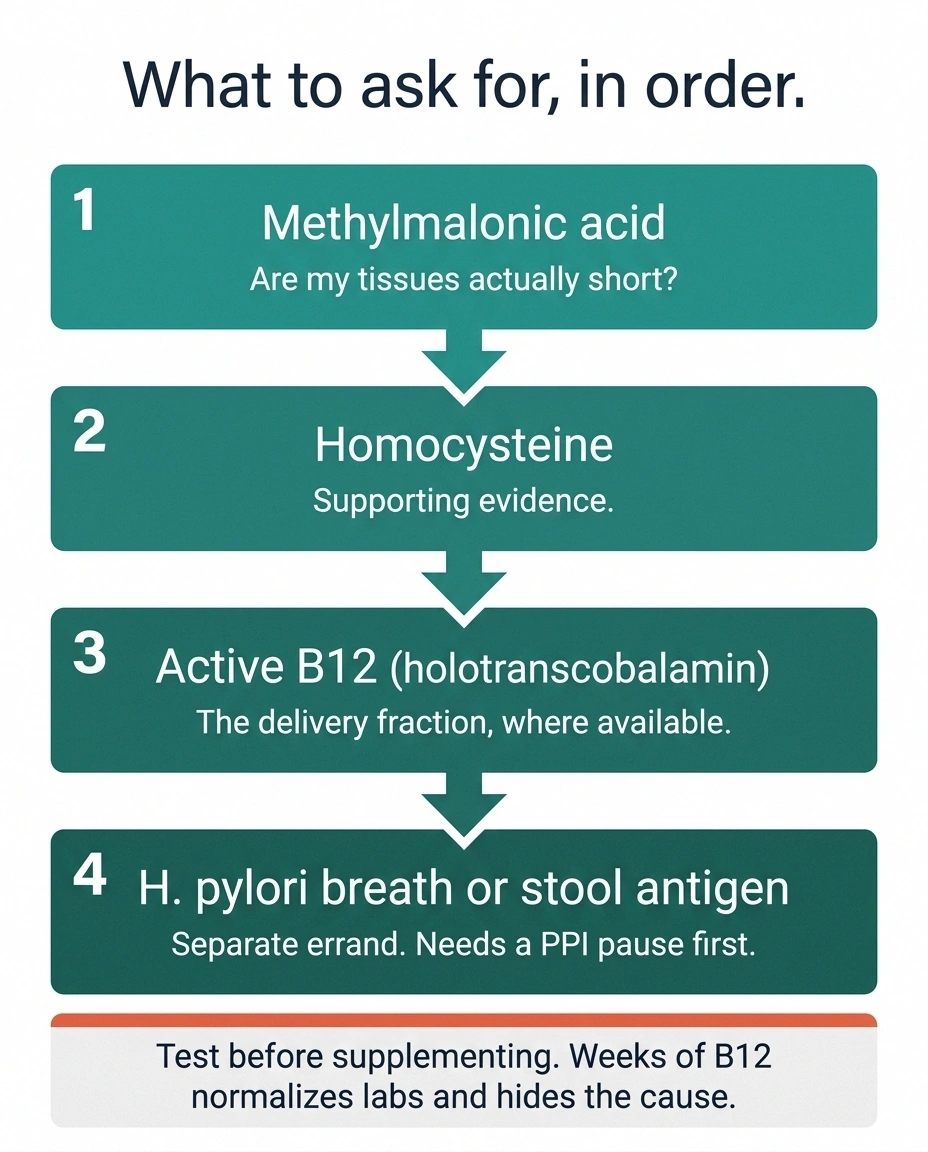
Nothing in a B12 panel detects H. pylori. It is its own test, and it is easy to obtain: a urea breath test or a stool antigen test, both non-invasive, both accurate.
A negative H. pylori test taken on a PPI proves very little
Acid suppression lowers bacterial activity enough to push breath and stool antigen tests toward false negatives. Guidance generally calls for roughly a two-week pause before testing, arranged with the prescriber rather than improvised.
The exception worth knowing: blood antibody testing is unaffected by PPIs, but antibodies persist for years after successful treatment, so it cannot distinguish a current infection from one cleared in 2014.
One practical warning that trips up an enormous number of people. Both tests produce false negatives if you are taking a proton pump inhibitor at the time. Suppressed bacteria are less detectable. Guidance generally calls for stopping the PPI for around two weeks before testing, and that pause is something to arrange with your prescriber rather than improvise on your own, for reasons the next section makes plain.
If you have unexplained B12 deficiency and nobody has ever checked you for H. pylori, that is a genuine gap and a fair question to raise.
Do Not Cold-Stop Your Acid Medication

People read an article like this one and stop their omeprazole that night. It is an understandable impulse and it produces a predictable, miserable outcome.
Before you stop tonight: what rebound actually does
Months of suppression cause acid-producing machinery to upregulate. Remove the drug abruptly and that machinery runs unopposed, frequently producing reflux worse than the original problem. Most people read that as proof the drug was essential and restart at a higher dose.
The point that gets lost: in many cases stopping is not the goal at all. Oral B12 corrects the deficiency while the medication keeps doing its job, and for Barrett’s esophagus or erosive esophagitis the drug prevents outcomes far worse than a correctable vitamin gap.
Months of acid suppression cause the acid-producing machinery to upregulate in compensation. Remove the drug abruptly and that machinery runs unopposed. The rebound is frequently worse than the reflux that started the whole thing, which convinces people the drug was essential all along and sends them straight back onto it, often at a higher dose.
Tapering avoids this. Reducing gradually, sometimes stepping down to an H2 blocker on the way, lets production normalize without the overshoot. It takes weeks, not one night.
There is a further point worth stating plainly, because articles like this one can drift toward implying that acid suppression is simply a mistake. It is not. For Barrett’s esophagus, severe erosive esophagitis, or an active ulcer, these drugs prevent outcomes far worse than a manageable vitamin gap. The realistic goal for most people is not elimination. It is the lowest effective dose, revisited periodically instead of renewed on autopilot for seventeen years, with B12 monitored alongside it.
What Actually Reverses, and How Much
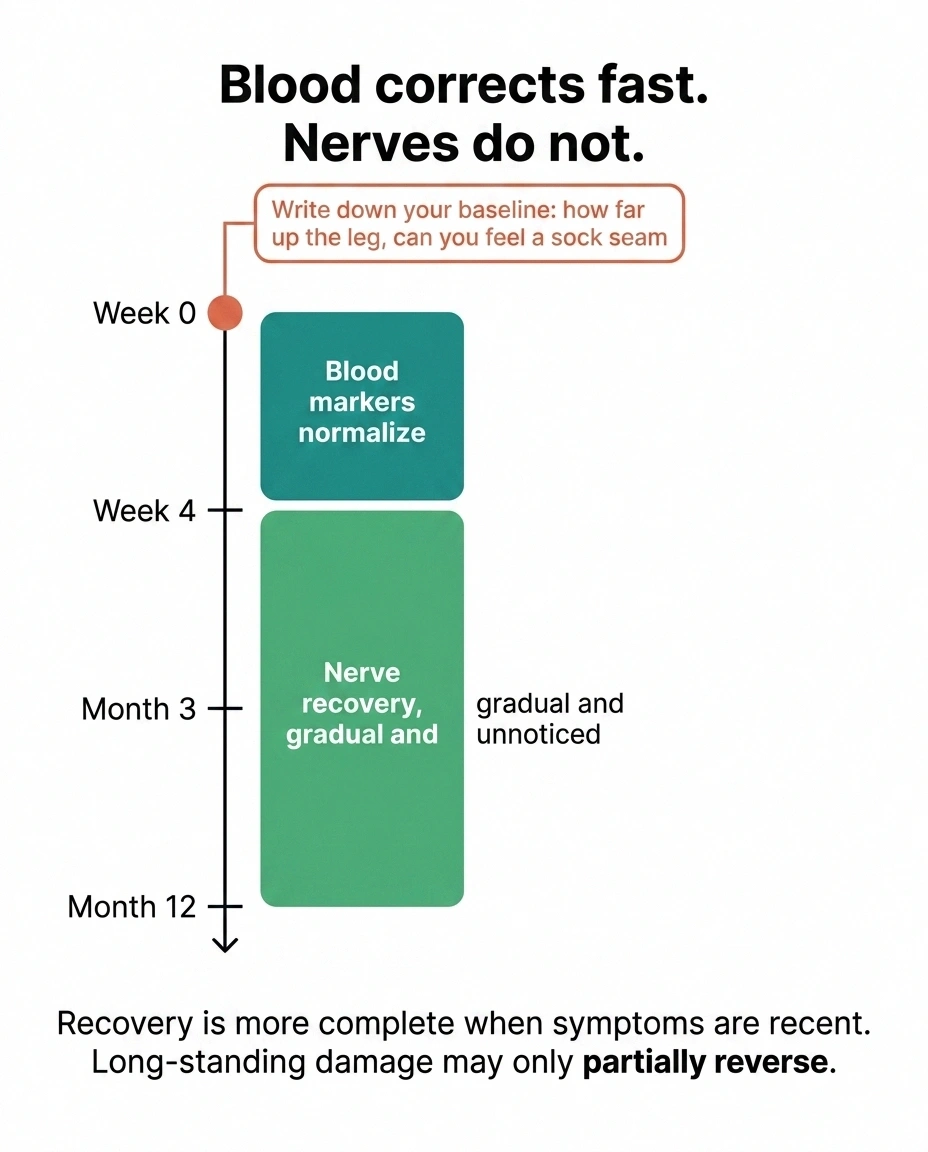
This is the question underneath every other question, so here is the honest version.
Eradicating H. pylori is not merely symptom management. In one series, eradication improved anemia and serum B12 in 31 of 77 infected patients, roughly forty percent. Beyond the blood work, eradication has been associated with falling antibody titers and reversion of atrophic changes in the stomach lining. The underlying process partially unwinds, which is rare and genuinely good news.
Forty percent is also not one hundred percent. Where atrophy has progressed far enough, the damage holds, and lifelong B12 replacement becomes the answer regardless of whether the bacterium is gone.
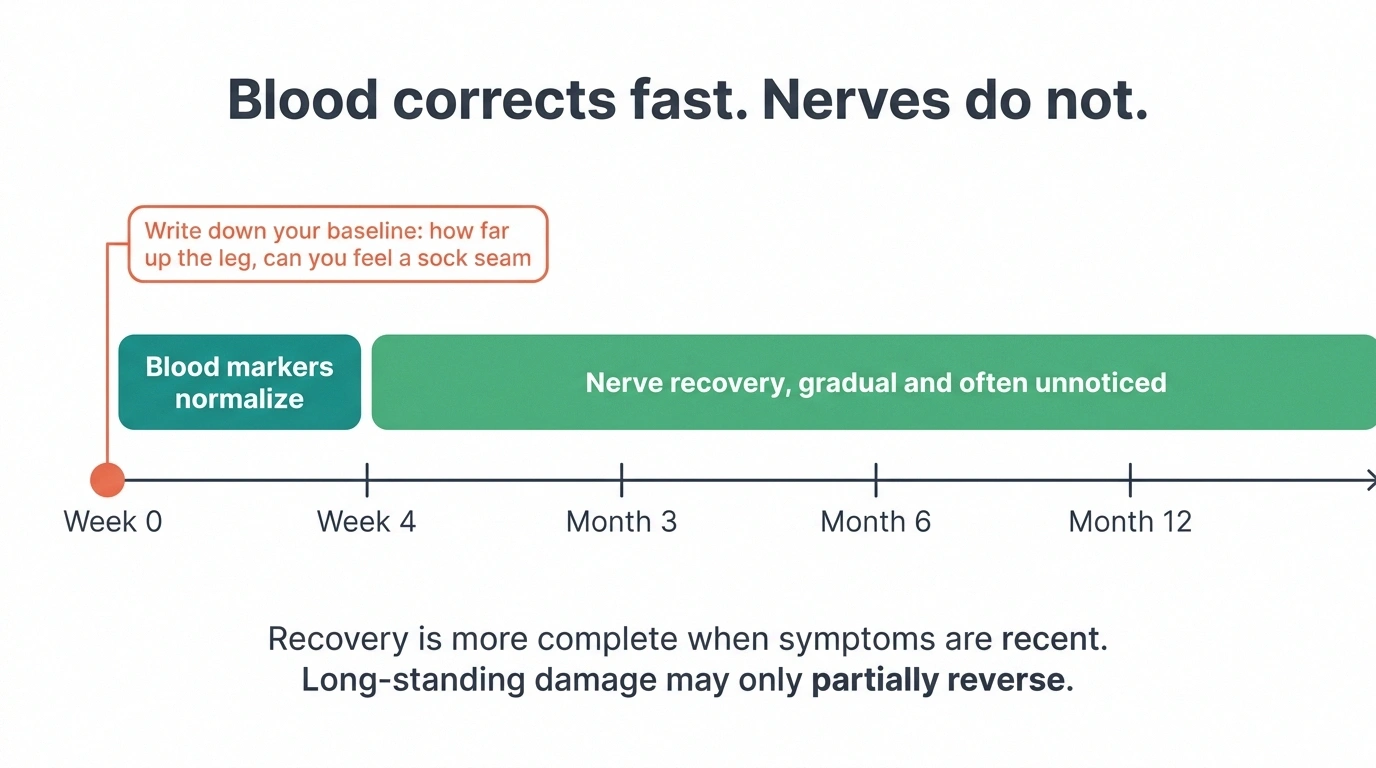
For nerves specifically, timing governs almost everything. B12 neuropathy caught within months tends to recover substantially. Caught after years, recovery is partial, and some loss is permanent because axons that have degenerated fully do not regrow the way a bruised nerve heals. Our article on whether neuropathy can be reversed works through what determines that ceiling.
Expect a lag, too. Blood markers correct in weeks. Nerves improve over many months, and the improvement is slow enough that people frequently miss it. Writing down a specific baseline now, how far up your leg the numbness reaches, whether you can feel the seam of a sock, gives you something to measure against in April. Memory is a poor instrument for gradual change.
Repletion, and Why the Route Matters Less Than People Think
Injections have a reputation as the serious option, and for absolute intrinsic factor failure they are the reliable choice. But high-dose oral B12 works better than most people assume, including in many absorption disorders, because a small fraction crosses the intestinal wall by passive diffusion independent of intrinsic factor entirely. Push the dose high enough and that inefficient side channel carries a meaningful amount.
Risk stacks, and most people carry more than one
Each item below independently lowers B12 through a different route. Two or three together is common in anyone over 65 on a standard medication list, and the effects add.
- A proton pump inhibitor taken longer than two years
- Metformin, which impairs B12 uptake in the ileum through a separate calcium-dependent step
- H2 blockers, a milder version of the same acid problem
- Untreated or undetected H. pylori
- A plant-forward diet, which lowers intake rather than absorption
- Age itself, since acid production declines independently of any drug
Test before supplementing. Even a few weeks of B12 normalizes the labs while leaving the cause unidentified.
For the PPI situation specifically, oral repletion is usually straightforward, since the problem was never the intestine. It was the unpacking step in the stomach, and crystalline B12 arrives pre-unpacked. Our guide to B12 injections for neuropathy compares the routes in more detail, and the wider B vitamins guide covers where B6 and folate fit alongside it.
A caution that matters more than it sounds: do not start supplementing before you get tested. Even a few weeks of B12 can normalize your labs while the underlying cause sits undisturbed, and you lose the chance to find out which road you were on. Test first. Treat second.
Ruth’s Ending

Her total B12 came back at 310. Unremarkable. Her methylmalonic acid was clearly elevated, which settled the question the first test could not answer.
Her breath test was negative, so this was road one, not road two. Her gastroenterologist tapered her to the lowest dose that held her reflux and added a daily oral B12. The buzzing in her fingertips faded over about five months, slowly enough that she only noticed it was gone when she realized she had stopped mentioning it.
The part she keeps repeating to the group is not about the vitamin. It is that a prescription written in 2009 was still running in 2026 and nobody, including her, had asked whether it still fit. Long-term medications deserve a look every so often, and the ones that quietly interfere with nutrient absorption deserve it most. Metformin has the same problem, through a different mechanism, and anyone taking both is stacking two independent hits on the same vitamin.
Frequently Asked Questions
Can omeprazole cause nerve damage?
Not directly. The drug does not attack nerve tissue. It reduces stomach acid, which impairs absorption of B12 from food, and prolonged B12 deficiency damages nerves. Analyses of adverse event reports have found more neuropathy reports among people taking proton pump inhibitors than among those taking H2 blockers, with B12 as the suspected mechanism. The damage is a downstream consequence rather than a direct drug effect, which is why supplementing B12 usually solves it without stopping the medication.
How long does it take for a PPI to cause B12 deficiency?
Generally years rather than months. The body stores a substantial reserve of B12 in the liver, often enough for two to five years of ordinary demand, so absorption can be impaired for a long stretch before the tank runs low enough to produce symptoms. This delay is exactly why the connection gets missed. By the time symptoms appear, the medication has been part of the routine for so long that nobody thinks to question it. Most guidance suggests checking B12 periodically after roughly two years of continuous use.
Does H. pylori cause vitamin B12 deficiency?
It can, through two mechanisms. The infection raises stomach pH, which interferes with releasing B12 from food. It can also provoke an autoimmune response against intrinsic factor and the stomach’s parietal cells through molecular mimicry, which is the more serious pathway because it can progress to atrophic gastritis. In one study of 138 people with B12 deficiency, 56 percent carried the bacterium.
Will nerve damage from B12 deficiency go away?
It depends almost entirely on how long the deficiency ran. Damage caught within months usually improves substantially with repletion, because the myelin sheath can be rebuilt. Damage that has persisted for years often improves only partially, since axons lost to prolonged deficiency do not regenerate reliably. Recovery is also slower than people expect. Blood work normalizes within weeks while nerve improvement unfolds over six to twelve months or longer.
What form of B12 should I take if I am on a PPI?
Any standard oral supplement will generally work, because supplemental B12 is crystalline and not bound to food protein, so it does not require stomach acid to be released. This is the useful quirk of the mechanism. Higher doses are commonly used to take advantage of passive diffusion, which absorbs a small percentage independent of intrinsic factor. The specific form, cyanocobalamin or methylcobalamin, matters far less than most marketing suggests. Dose and consistency matter more.
Should I stop my PPI if my B12 is low?
That is a decision for the person who prescribed it, and stopping abruptly is a poor idea regardless. Rebound acid hypersecretion after sudden discontinuation frequently produces worse symptoms than the original reflux. In many cases the practical answer is not stopping at all, since supplementing B12 addresses the deficiency directly while the medication continues to do its job. Where the original indication no longer applies, a gradual taper is the appropriate route.
Can I be tested for H. pylori while taking a proton pump inhibitor?
The results become unreliable. Acid suppression reduces bacterial activity enough to produce false negatives on both breath and stool antigen testing, so a negative result obtained while on a PPI does not truly rule out infection. Guidance typically calls for a pause of about two weeks beforehand, which needs to be arranged with the prescriber rather than done independently. Blood antibody testing is unaffected but has its own limitation, since antibodies persist long after successful treatment and cannot distinguish current from past infection.
My B12 was normal but my feet still burn. What now?
Ask for methylmalonic acid. Standard serum B12 measures the total circulating pool, roughly three quarters of which is bound to haptocorrin and unavailable to your cells, so the number can look reassuring while the usable fraction is genuinely low. Methylmalonic acid rises when B12 is functionally short inside tissues and is the more informative test in exactly this situation. Active B12 answers a similar question where a laboratory offers it.
About the Author