
The word gets said in an exam room and then it lives in your house.
Someone mentions amputation, maybe as a warning, maybe as motivation, and you drive home with it. By evening you have found a statistic online saying thirty-one percent, and thirty-one percent of anything involving your feet is a number that follows you to bed.
I want to take that number apart, because it is real and it is also being read by almost everyone in the worst possible way. Not to soften it. To make it accurate, and then to hand you the part nobody puts in the scary articles: the intervention that cuts these outcomes roughly in half, which exists, which is measured, and which most people are not receiving.
The Denominator Everyone Drops
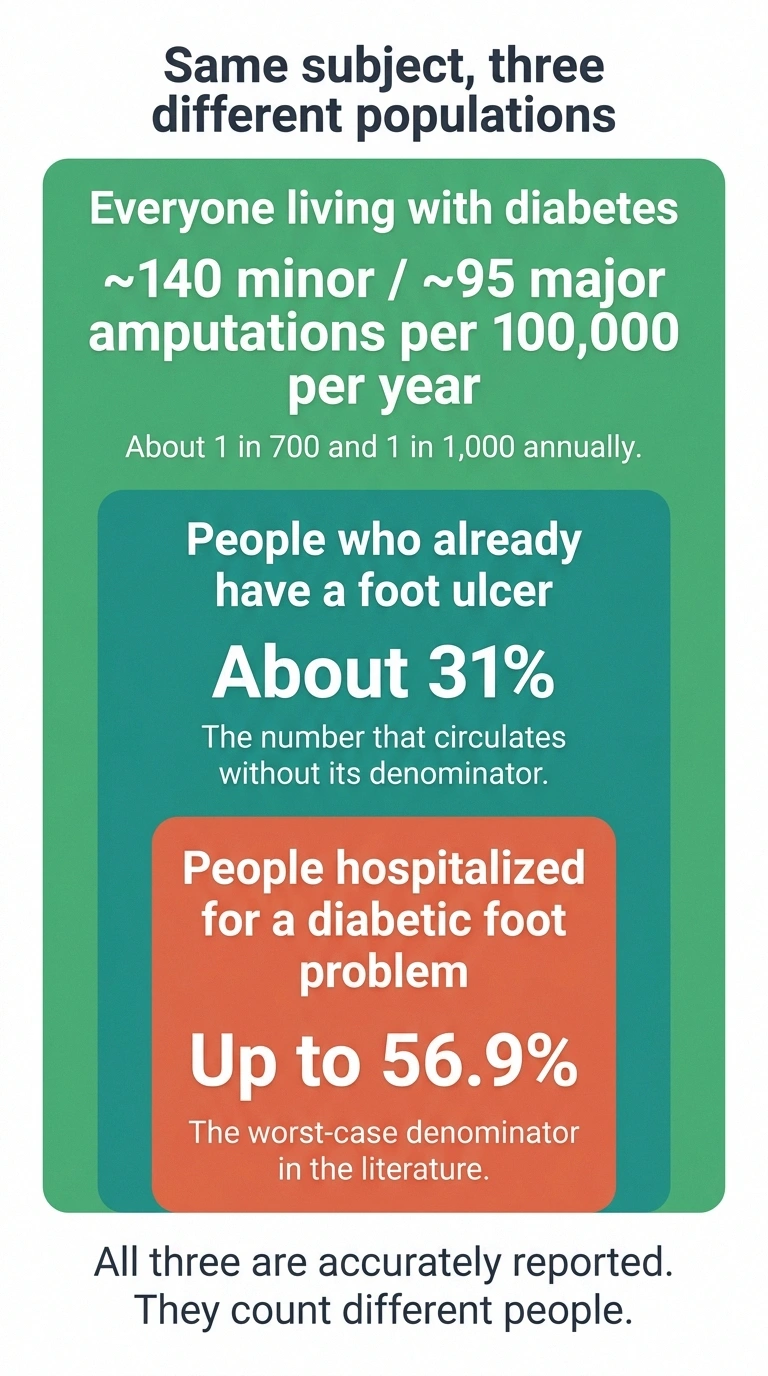
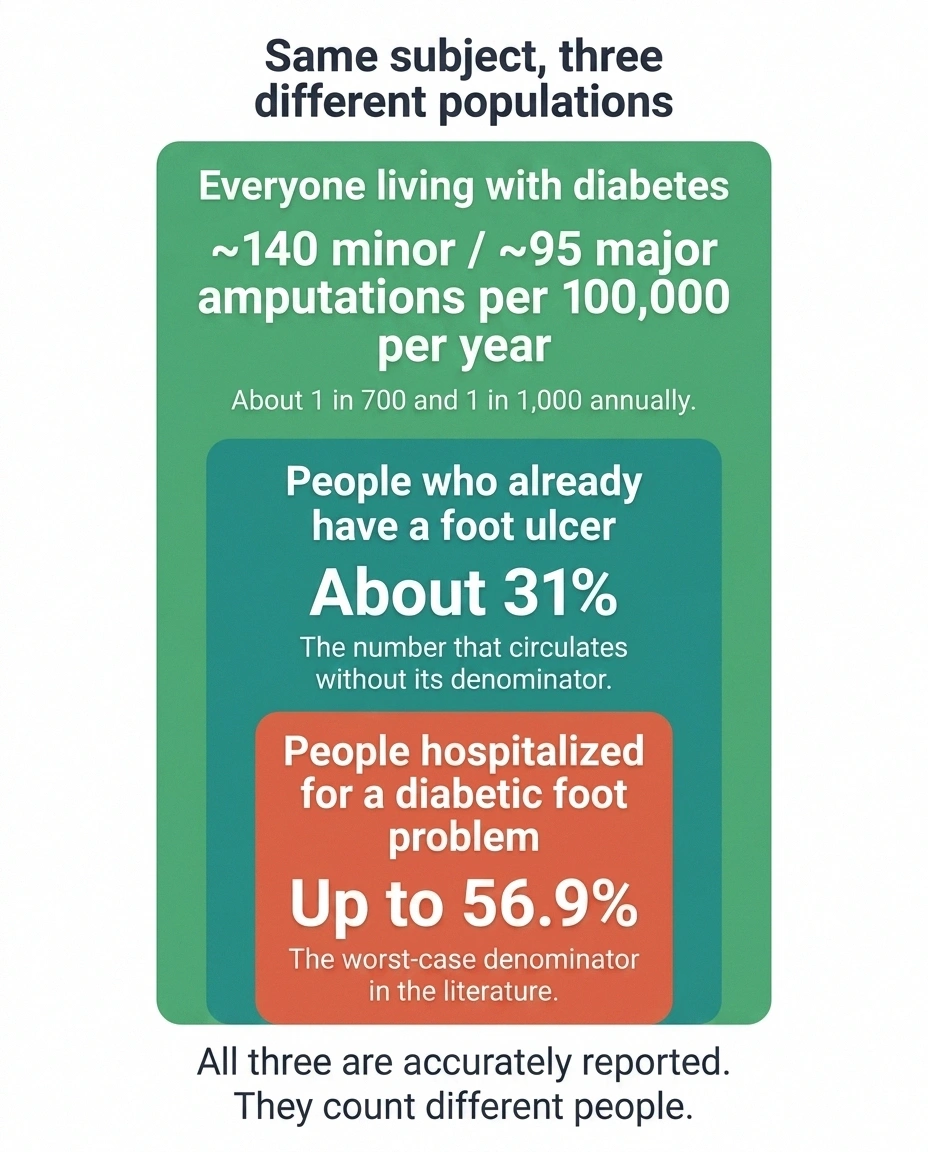
That thirty-one percent figure comes from a meta-analysis of amputation rates. It is correctly reported. What gets left out is who was counted.
Same subject, three different populations
Every figure below is accurately reported in the literature. They are not in conflict. They count different people, and the number you were shown probably did not say which.
Everyone living with diabetes
About 140 minor and 95 major amputations per 100,000 per year. Roughly 1 in 700 and 1 in 1,000 annually.
People who already have a foot ulcer
About 31 percent. This is the figure that circulates online without its denominator attached.
People hospitalized for a diabetic foot problem
Up to 56.9 percent in one inpatient series. The worst-case denominator in the entire literature.
It is thirty-one percent of people who already had a diabetic foot ulcer.
Not thirty-one percent of people with diabetes. Not thirty-one percent of people with neuropathy. Thirty-one percent of people who had already crossed into an open wound on the foot. The higher numbers circulating, including one hospital series where 487 of 856 patients went to amputation, come from inpatient populations, meaning people sick enough with a foot problem to be admitted. Those are the worst-case denominators in the entire literature.
Here is what the picture looks like when you widen the frame to everyone living with diabetes. Global figures for 2010 through 2020 put annual amputations at roughly 140 minor and 95 major per 100,000 people with diabetes.
Per hundred thousand. In plainer terms, in any given year, somewhere around one person in seven hundred has a minor amputation and about one in a thousand has a major one.
Both things are true at once. Population-wide risk is low. Risk once an ulcer opens is high. The distance between those two facts is where all of your leverage lives.
Neuropathy Is the Permission Slip, Not the Event
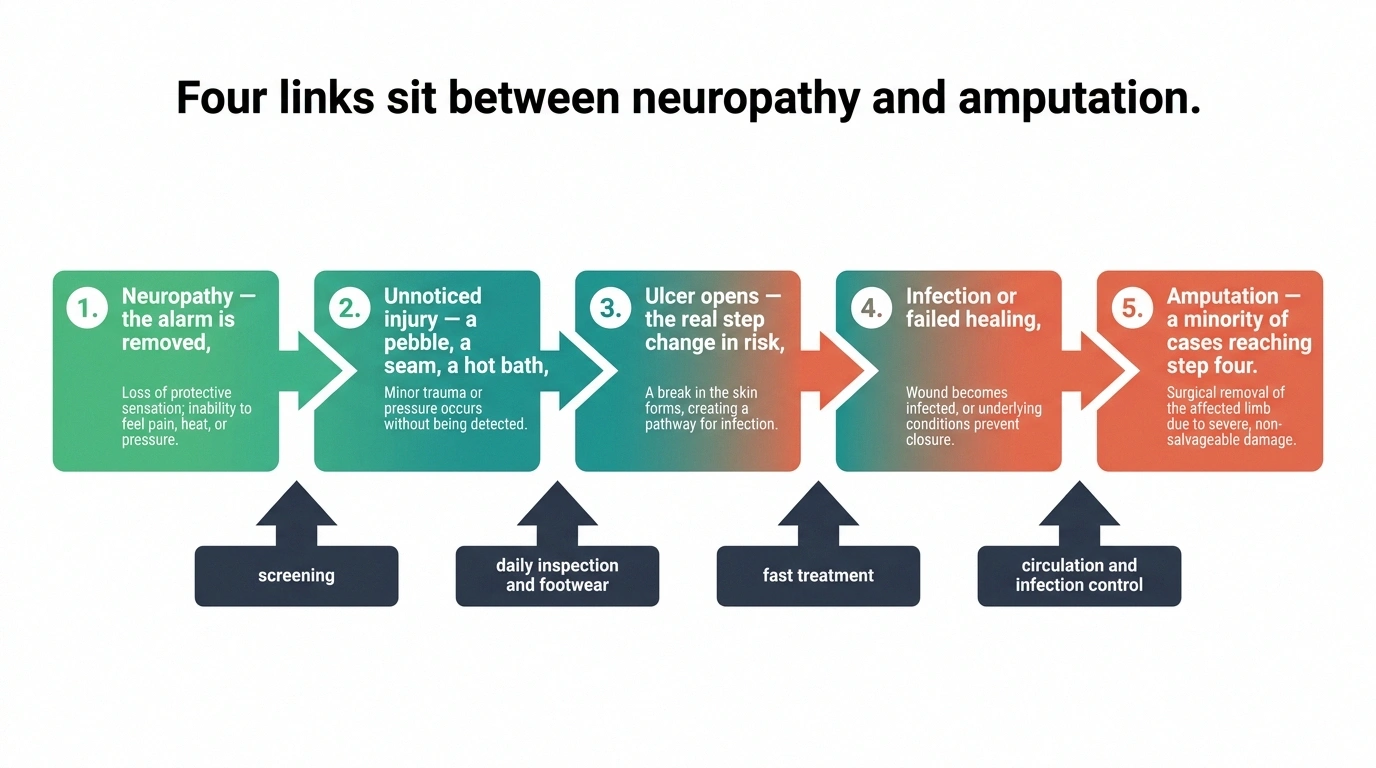
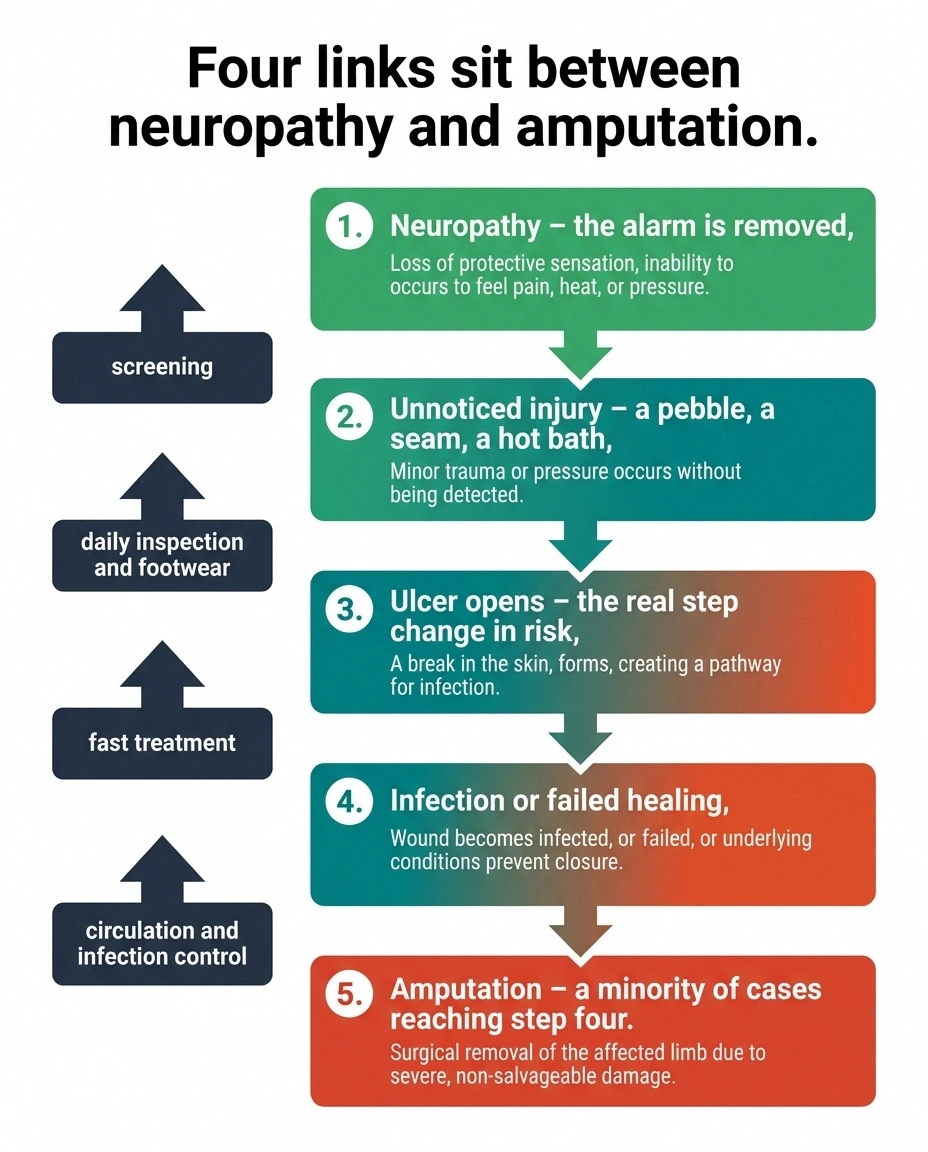
This is the reframe that changes how the whole subject sits.
Four links sit between neuropathy and the outcome
Each arrow is a place the chain can be broken, and the earliest breaks are the cheapest ones.
- Neuropathy removes the alarm. Sensory loss silences injury, motor loss concentrates pressure, autonomic loss dries and cracks skin.
- An unnoticed injury. A pebble, a seam, a new shoe, a hot bath. Walked on for days because nothing hurt.
- An ulcer opens. This is the step change in risk, not the neuropathy diagnosis.
- Infection or failed healing. Where circulation and time to treatment decide the outcome.
- Amputation, in a minority of cases that reach step four.
Neuropathy almost never causes an amputation. What it does is remove the alarm system that would otherwise protect your foot, and it does that in three ways at once.
Sensory loss means an injury does not announce itself. A pebble, a seam, a blister from a new shoe, a hot bath, a tack in the carpet. In a foot with sensation, any of these produces a yelp and immediate correction. In a numb foot, it produces nothing, and you keep walking on it for a week.
Motor involvement quietly reshapes the foot. Small muscles weaken, toes claw, the arch changes, and the load that used to spread across the whole sole concentrates onto a few points. Those points are where pressure accumulates and where tissue eventually gives way.
Autonomic involvement shuts down sweating in the feet. Skin turns dry and cracks, and a crack is a doorway for bacteria in a region with reduced blood flow.
So the sequence is not neuropathy to amputation. It is neuropathy, then an unnoticed injury, then an ulcer, then infection or poor healing, and only then, in a minority of cases, amputation. That chain has four links before the outcome you fear, and every one of them is a place to intervene. Our article on diabetic foot ulcers covers the middle of that chain in depth.
The Two-Year Number, Read Correctly
A 2025 retrospective cohort study of adults newly diagnosed with diabetic polyneuropathy produced a finding that sounds alarming out of context. Researchers calculated that a clinician would need to evaluate fewer than two such patients to find one who would experience a lower extremity event within two years.
Better than one in two. That is a genuinely high rate, and it deserves to be taken seriously.
It also is not what most readers assume it is, because lower extremity event is a composite outcome. It bundles together ulcers, foot infections, related hospitalizations, and amputations into a single category. The overwhelming majority of those events are ulcers and infections. Amputation is the smallest component of that bundle by a wide margin.
Read properly, the study is saying something both sobering and useful: a new neuropathy diagnosis means your feet are now statistically likely to have a problem within two years. It is not saying you are likely to lose part of your foot. It is saying your feet just moved into a category that requires active monitoring, starting now rather than after something happens.
What Raises the Risk, Split by What You Can Move
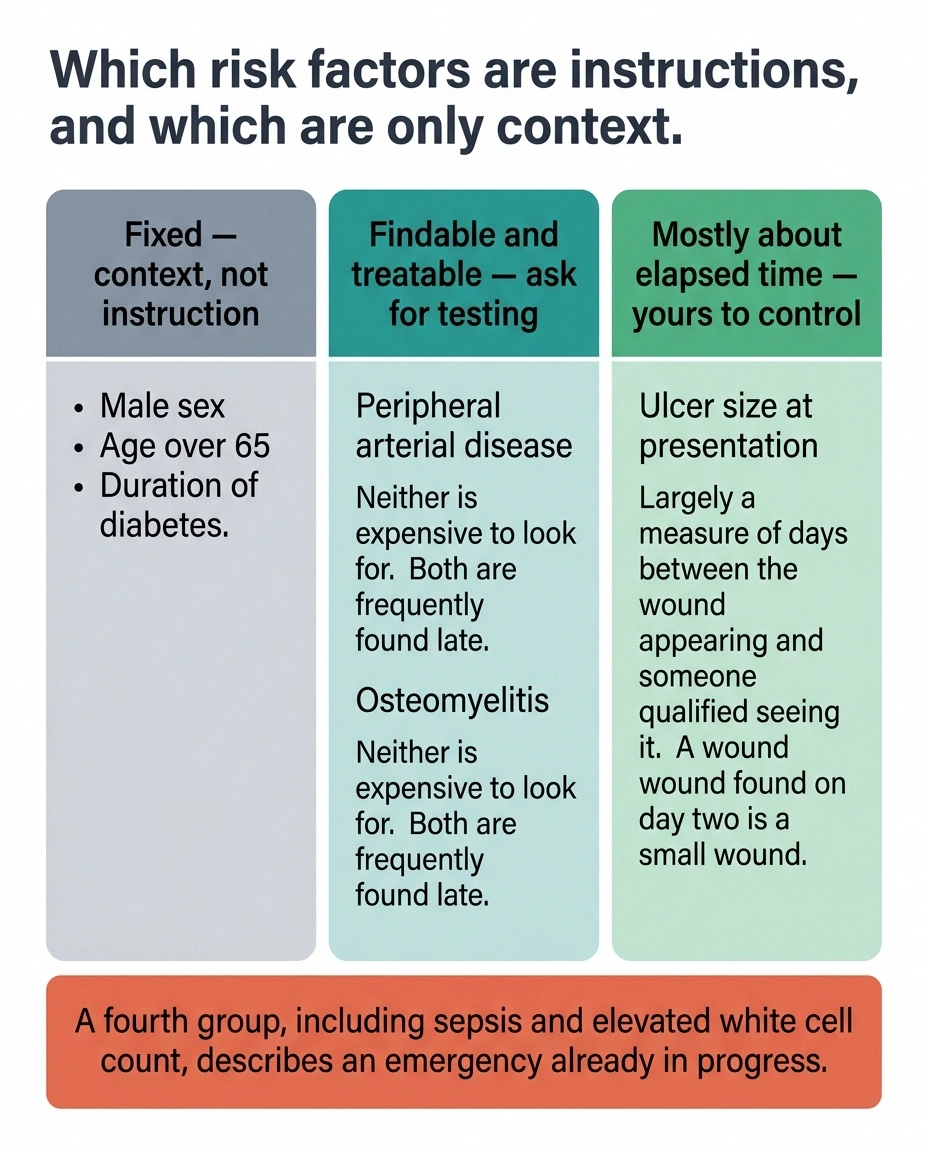
Studies of people who reached amputation consistently identify the same risk factors. Sorting them by whether you can do anything about them is more useful than listing them.
Some are fixed. Being male, being over sixty-five, and the simple duration of your diabetes are not adjustable, and no amount of effort changes them. They are context, not instruction.
Some are medical conditions requiring detection and treatment. Peripheral arterial disease is the one that matters most, because an ulcer in a foot with poor circulation is a fundamentally different problem than one in a well-perfused foot. Osteomyelitis, infection that has reached bone, is another. Both are findable with testing that is neither expensive nor difficult, and both are frequently found late.
Some reflect how sick a person already was on arrival. Elevated white cell count, sepsis at presentation, high fibrinogen, advanced Wagner grade. These describe the state of an emergency in progress.
And one is almost purely about timing. Ulcer size at presentation is a strong independent predictor of amputation, and ulcer size at presentation is largely a measure of how many days passed between the wound appearing and someone qualified looking at it. A wound found on day two is a small wound. The same wound found on day twenty is a large one with a much worse prognosis.
That single factor, more than any other in the list, is under your control tonight.
The Number the Frightening Articles Omit
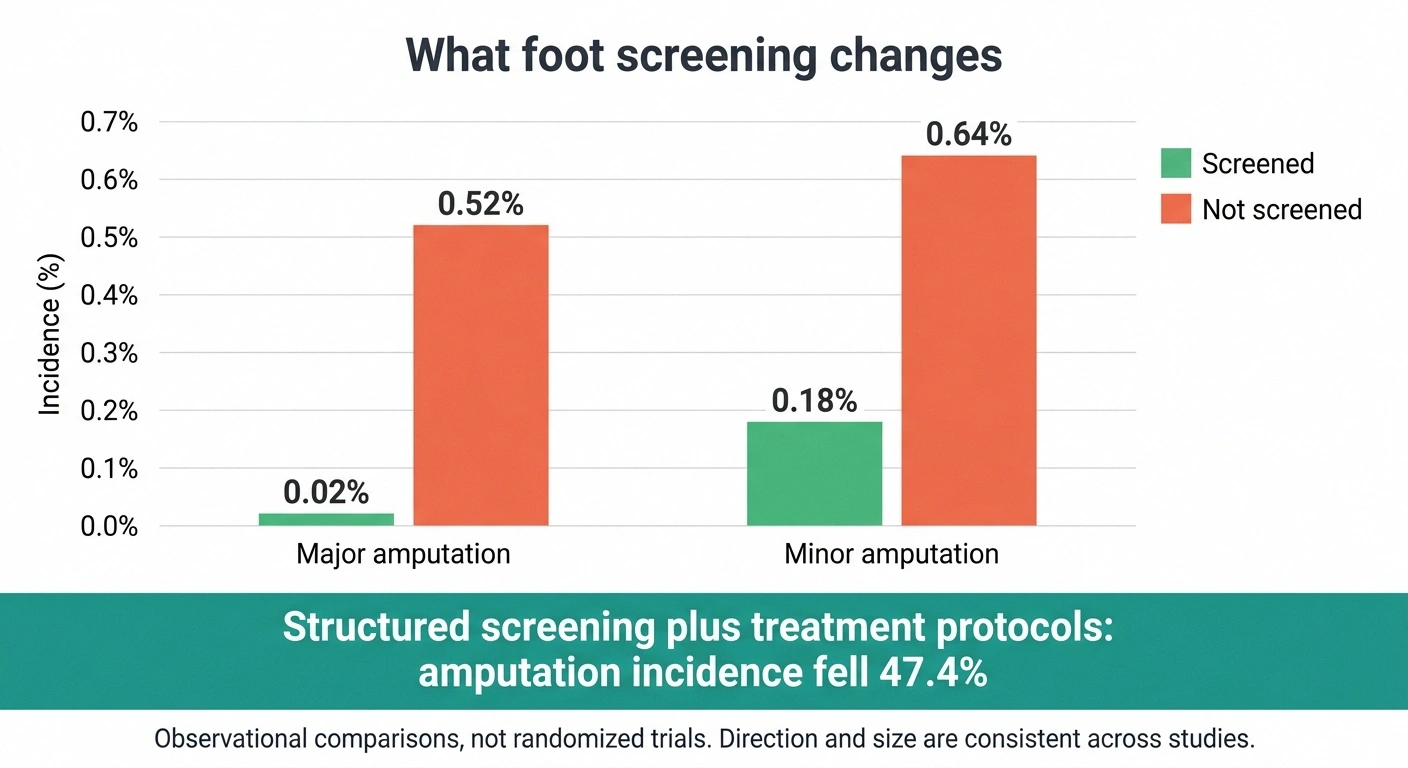
If you remember one figure from this article, make it this one.
What foot screening changes
These are observational comparisons rather than a randomized trial, so some of the gap reflects who gets screened. The direction and size of the effect are consistent across studies regardless.
| Outcome | Screened | Not screened |
|---|---|---|
| Major amputation | 0.02% | 0.52% |
| Minor amputation | 0.18% | 0.64% |
| Structured program effect | Amputation incidence fell 47.4% with screening plus treatment protocols | |
A structured disease management program built around foot screening and treatment protocols reduced amputation incidence by 47.4 percent.
Not a modest improvement. Nearly half.
The comparison of screened against unscreened populations is even more striking. Among people who received foot screening, major amputations occurred in 0.02 percent and minor amputations in 0.18 percent. Among those who did not, the figures were 0.52 percent and 0.64 percent. Across three separate studies of screening programs, reductions in major amputation ranged from 17 to 96 percent.
The broad conclusion in this literature is that early risk identification and prevention can prevent roughly half of people with diabetes from ever developing a foot ulcer or requiring an amputation.
Half. From screening. From someone competent looking at your feet on a schedule and acting on what they find.
This is the most actionable finding in the entire subject and it is nearly absent from consumer content about amputation risk, which prefers the frightening percentages because they hold attention better.
What Screening Actually Involves
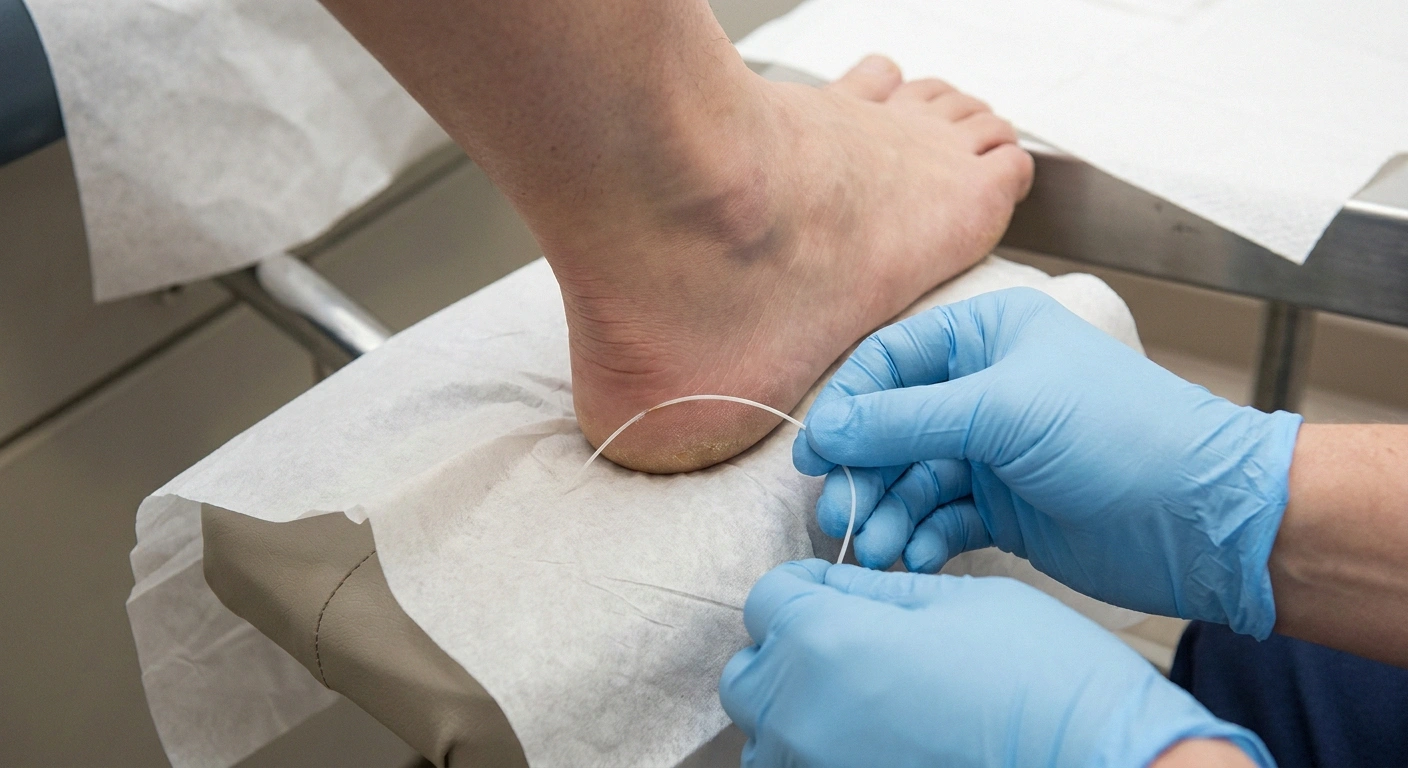
Foot screening is not a glance while you sit on the exam table with your socks half off. A genuine assessment covers five specific things.
Five things a real foot exam covers
If your last foot check involved a glance while your socks stayed on, you did not receive this. Use the list to ask for what is missing.
- Sensation tested with a 10-gram monofilament at defined points, often with a tuning fork for vibration
- Circulation checked by pulses, frequently with an ankle-brachial index measurement
- Structure examined for clawed toes, bunions, collapsed arches, and callus pattern
- Pressure points identified, since callus marks exactly where load is concentrating
- History taken, because a previous ulcer is the single strongest predictor of the next one
ADA guidance: a visual check at every visit, a comprehensive assessment at least annually, more often with added risk factors.
Sensation gets tested, usually with a 10-gram monofilament pressed against defined points on the sole, sometimes with a tuning fork for vibration sense. Circulation gets checked by feeling pulses in the foot and often by measuring the ankle-brachial index. Structure gets examined for clawed toes, bunions, collapsed arches, and callus patterns, since callus marks exactly where pressure is concentrating. Pressure points get identified. And your history gets taken, because a previous ulcer is the single strongest predictor of a future one.
The American Diabetes Association’s position is straightforward: feet should be checked at every visit, and a comprehensive foot assessment should happen at least annually.
At every visit. If you have diabetic neuropathy and have taken your shoes off at fewer than half your appointments this year, that is the gap, and closing it is a matter of saying so out loud. Ask directly whether a full foot exam is on the schedule and whether a referral to podiatry is appropriate given your risk level. Treating the underlying neuropathy matters too, but the foot exam is the part that specifically prevents the outcome discussed here.
Your Own Half of the Job

Professional screening happens a few times a year. You are with your feet every day, which makes you the higher-frequency monitor even though you have less training.
Look at both feet daily, including between every toe and across the entire sole. Use a mirror on the floor or a long-handled mirror if bending is difficult, and ask someone else if your vision makes it unreliable. This takes under a minute and we walk through the specifics in our guide to daily foot inspection.
Check inside your shoes with your hand before putting them on, every single time. Objects find their way in and a numb foot will not tell you about them.
Treat any new callus, any red area that does not fade within a few hours, any warm spot, and any blister as a scheduling event rather than a wait-and-see. Warmth is worth particular attention, because a localized temperature difference between the same spot on your two feet often precedes visible breakdown. That is the principle behind temperature-monitoring smart socks, and it works with a cheap infrared thermometer too.
Keep skin moisturized everywhere except between the toes, where trapped moisture invites fungal breakdown.
And wear shoes that fit the foot you have now, not the foot you had at forty. Neuropathic feet change shape, and pressure from ill-fitting footwear is a leading cause of the ulcers this entire article is about. Our footwear guide covers what to look for.
The Two Conditions That Escalate Fast
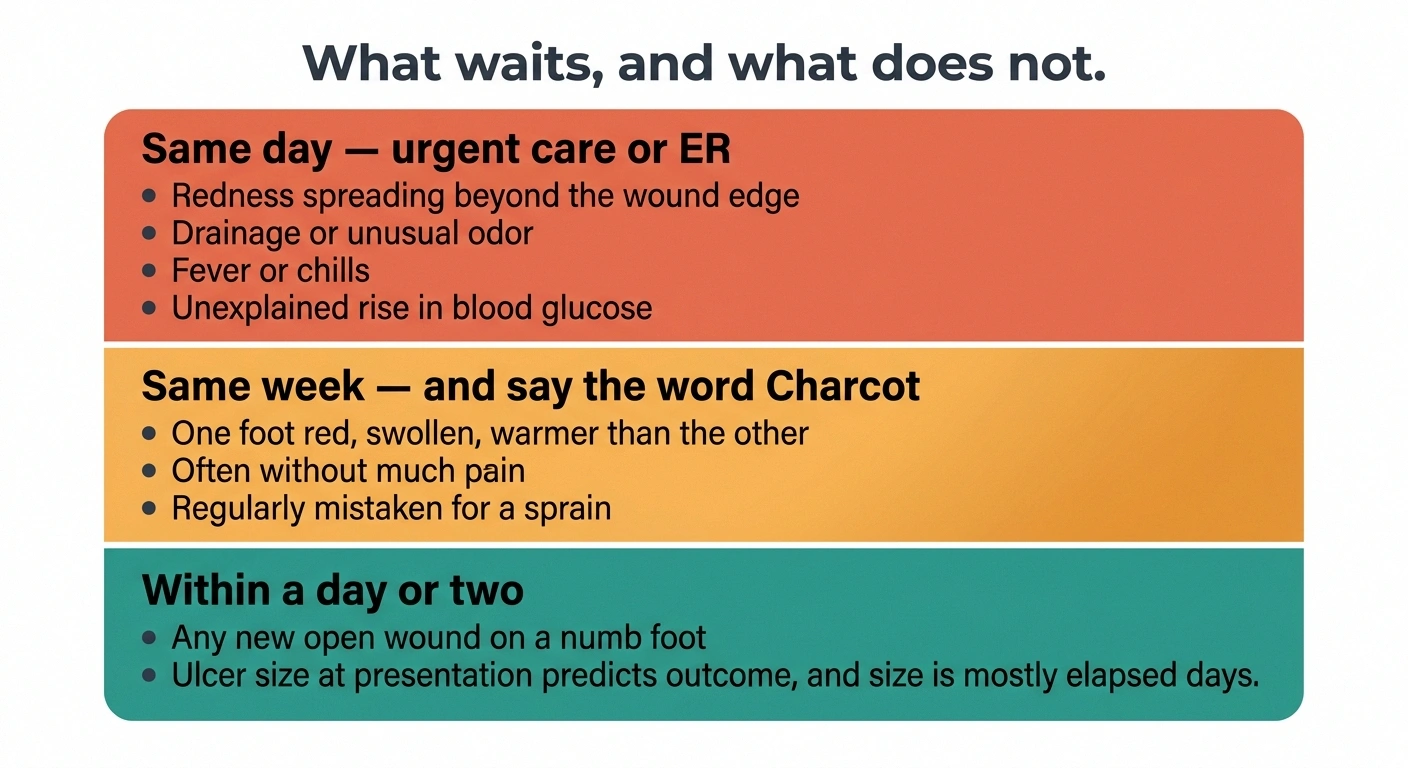
Most foot problems allow time to schedule an appointment. Two do not, and both are frequently missed.
The signs that do not wait until Monday
Same day, urgent care or emergency: redness spreading beyond a wound’s edge, drainage or unusual odor, fever or chills, or an unexplained jump in blood glucose. These point to infection that is winning.
Same week, and say the word Charcot: one foot red, swollen, and noticeably warmer than the other, often without much pain. It is regularly mistaken for a sprain, and late detection produces permanent deformity.
Within a day or two: any new open wound on a numb foot. Ulcer size at presentation is a strong independent predictor of amputation, and size is mostly a measure of elapsed days.
Charcot foot is a destructive process where bones in a numb foot fracture and collapse, often without significant pain. It presents as a foot that is red, swollen, and noticeably warmer than the other one, and it is regularly mistaken for infection or a sprain. Caught early it can be managed. Caught late it produces a permanently deformed foot that is extremely difficult to fit and highly prone to ulceration. If one foot is warm and swollen and you cannot account for why, that is a same-week problem. Our article on Charcot foot covers the presentation in detail.
Spreading infection is the other. Redness expanding beyond a wound’s edge, drainage, an unusual odor, fever, chills, or a sudden unexplained rise in blood glucose all suggest infection that is winning. That is an urgent care or emergency department visit, not a Monday morning phone call.
The Upstream Lever
Everything above deals with protecting feet that already have neuropathy. Glycemic control operates one level up, on whether the neuropathy progresses at all.
Better glucose control slows nerve damage, and it also improves wound healing and infection resistance, which means it acts on both ends of the chain simultaneously. It will not restore lost sensation. What it does is reduce how much further you travel down the road. Our piece on blood sugar and nerve damage works through the mechanism.
Where That Leaves You
The thirty-one percent that frightened you describes people who already had an open ulcer. You may not be in that group, and a substantial share of the effort required to stay out of it is inspection and footwear rather than anything heroic.
Neuropathy is the condition that makes injury silent. The ulcer is the event that carries the real risk. Screening cuts that event roughly in half and most people are not getting it on schedule.
So the practical version is short. Look at your feet tonight. Ask at your next appointment whether you are on a foot screening schedule, and if you are not, ask for a podiatry referral. That is the whole intervention, and it is the one with a 47.4 percent figure attached to it.
Frequently Asked Questions
What percentage of people with diabetic neuropathy end up losing a limb?
Far lower than the widely quoted figures suggest, because those figures use the wrong denominator. The commonly cited 31 percent applies to people who already have a diabetic foot ulcer, not to everyone with neuropathy. Across the whole population living with diabetes, annual amputation incidence runs at roughly 140 minor and 95 major per 100,000, which works out to about one in 700 and one in 1,000 per year respectively. Neuropathy raises risk meaningfully, but the large percentages describe a much sicker subgroup than most readers encountering them.
How quickly can a foot ulcer lead to amputation?
There is no fixed timeline, and the variation is enormous. An ulcer in a foot with good circulation, caught early and properly offloaded, frequently heals without any threat to the limb. An ulcer in a foot with peripheral arterial disease that becomes infected and reaches bone can threaten the limb within weeks. The strongest predictor is not how long you have had diabetes but how much time passes between the wound appearing and receiving proper care, which is why ulcer size at presentation is such a powerful independent risk factor.
Does neuropathy by itself cause amputation?
No. Neuropathy removes protective sensation, alters foot mechanics through muscle weakness, and dries the skin through lost sweating. Those changes allow injuries to go unnoticed and to progress into ulcers. The amputation risk attaches to what follows: the ulcer, the infection, and any circulatory problem present alongside them. This distinction matters practically, because it means the interventions that work are the ones aimed at preventing and rapidly treating wounds rather than at the neuropathy itself.
How often should my feet be examined?
American Diabetes Association guidance calls for a visual foot check at every diabetes-related visit and a comprehensive assessment at least once a year. People with additional risk factors, including previous ulceration, foot deformity, or peripheral arterial disease, generally warrant more frequent specialist review, often quarterly. A previous ulcer is the strongest single predictor of a future one, so anyone with that history belongs in a higher-frequency schedule.
Can I prevent amputation once I already have neuropathy?
The evidence on this is genuinely encouraging. Structured screening and prevention programs have reduced amputation incidence by 47.4 percent, and the broader literature suggests early risk identification can prevent about half of ulcers and amputations. Screened populations show major amputation rates of 0.02 percent versus 0.52 percent in unscreened populations. Neuropathy raises risk substantially but does not fix your trajectory, and the interventions that change it are ordinary: regular professional foot exams, daily self-inspection, appropriate footwear, and fast action on any new wound.
What are the warning signs I should act on immediately?
Redness spreading outward from a wound, drainage or an unusual smell, fever or chills, and an unexplained rise in blood glucose all point toward infection that needs same-day attention. Separately, a foot that is red, swollen, and warmer than the other one may indicate Charcot foot, a bone collapse process that often occurs without much pain and is frequently mistaken for a sprain or an infection. Any new open wound on a numb foot warrants professional evaluation within a day or two rather than watchful waiting.
Does controlling blood sugar reduce amputation risk?
It helps on two fronts. Better glycemic control slows the progression of nerve damage, which limits how much protective sensation is eventually lost, and it improves wound healing and infection resistance, which matters enormously once a wound exists. It cannot restore sensation already gone, so it works alongside foot protection rather than replacing it. Someone with excellent control and no foot inspection routine is still at meaningful risk.
Is a minor amputation the same as losing a leg?
No, and the distinction is significant both medically and statistically. Minor amputations involve a toe or part of the forefoot, preserve the ankle, and usually allow walking with appropriate footwear afterward. Major amputations occur above the ankle and involve far greater functional loss. Minor amputations are more common than major ones in the incidence data, so the composite statistics people encounter are weighted toward the less severe outcome, which is another reason the raw numbers read as more frightening than the reality they describe.
About the Author